Sprinkles reviews Old Possum’s Book of Practical Cats by T.S. Eliot

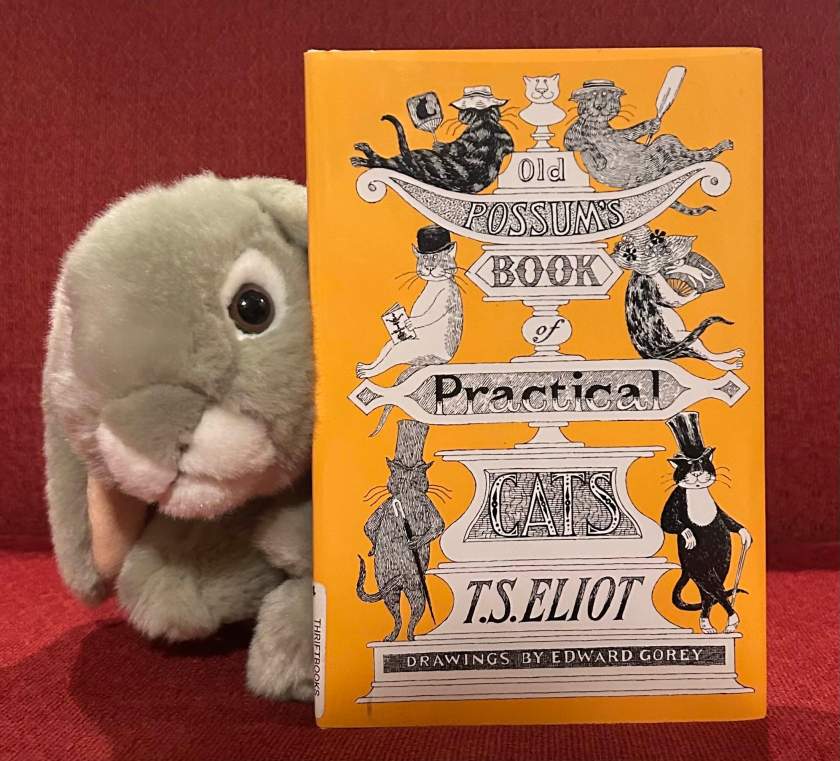
Today Sprinkles reviews a classic book of poems about cats, Old Possum’s Book of Practical Cats by T.S. Eliot, originally published in 1939. The edition reviewed here was illustrated by Edward Gorey and published in 1982.
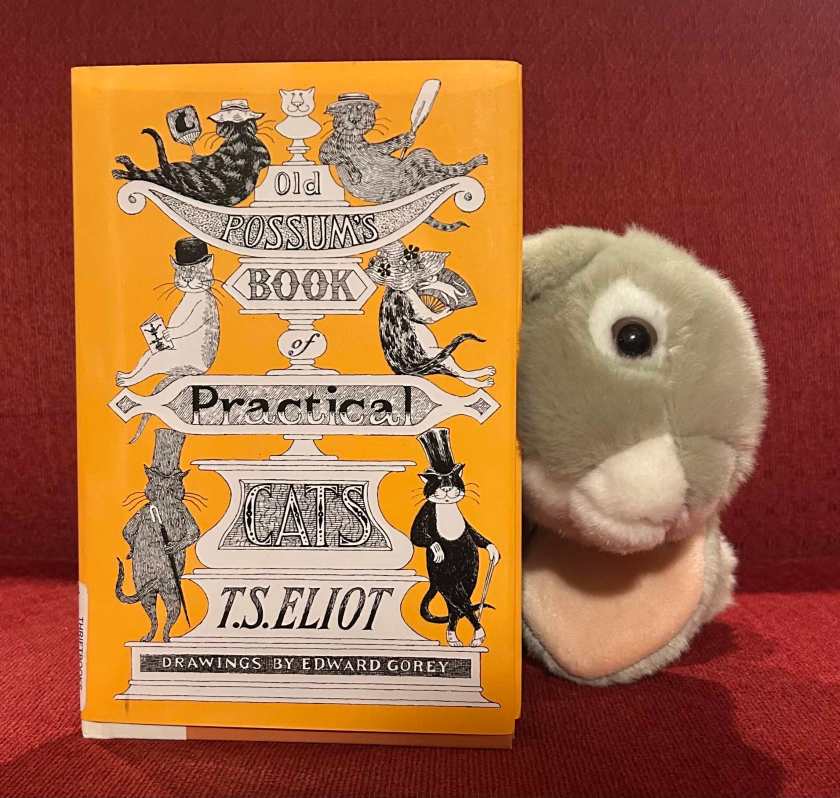
Sprinkles reviews Old Possum's Book of Practical Cats by T.S. Eliot.
Sprinkles reviews Old Possum’s Book of Practical Cats by T.S. Eliot.

After chatting with Marshmallow about s most interesting book written by a cat, I decided to see if I could read more books about or by cats. This is how I first laid my paws on Old Possum’s Book of Practical Cats. This book was not claiming to be written by a cat but rather an old possum, but of course the possum was none other than the famed poet T.S. Eliot. Having reviewed a poetry book about dogs, I thought it would be fun to review a poetry book about cats as a way to balance the issue.

Old Possum’s Book of Practical Cats is a small book, with a total of fifteen poems spread over less than sixty pages. Every poem is accompanied by at least one full-page illustration, drawn expertly by Edward Gorey. Most of the poems have relatively simple and standard rhyme structures, so that they can be read out loud to a little one with much pleasure for all involved.

I should warn the reader that the book does include a poem, “Growltiger’s Last Stand“, that has a serious racist slur. This particular poem is about a dangerous cat named Growltiger, a bad bully of a cat, who hates Siamese cats because he was beaten by one and lost an ear to it. So it is within reason that he could be hateful towards all Siamese cats, but the poet himself did not need to use a racial slur to describe the latter. [It is honestly jarring to see this word in an otherwise perfectly enjoyable poetry collection. I’d recommend parents reading poems out loud to their little ones to consider skipping this poem, or perhaps rephrasing the line with the problematic word.]
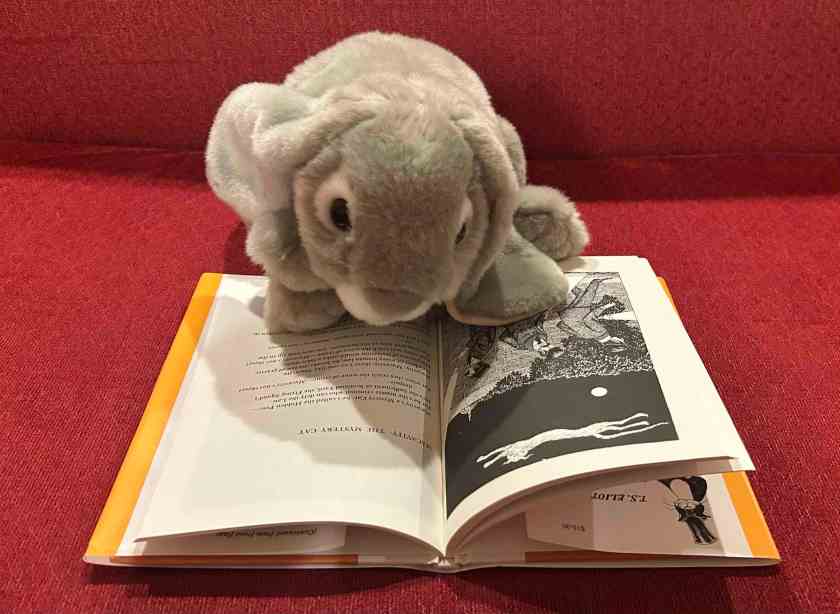
Sprinkles is reading "Macavity: The Mystery Cat" in Old Possum's Book of Practical Cats by T.S. Eliot.
Sprinkles is reading “Macavity: The Mystery Cat” in Old Possum’s Book of Practical Cats by T.S. Eliot.

When I started reading Old Possum’s Book of Practical Cats, I had no idea that it was the main inspiration for the outrageously successful Andrew Lloyd Webber musical Cats, which premiered in 1981. I had seen the musical itself way back in the last millennium, when I was about Marshmallow’s age. At the time, I had been overwhelmed by the sounds and the lights and knew that I was probably missing more than half of the plot. (I was seeing it performed in German, a language that I admire but am not terribly fluent in, so maybe you will give me some grace.) Now reading about it in more contemporary outlets, I can see that I did miss a lot. In particular the musical can apparently be viewed at a lot more adult, sensual level, and this totally evaded me back then. However, I am not at all upset about having missed all that. The cats were so fascinating, and they were so alien, and yet so irresistibly alive, I vividly remember leaving the performance hall excited and full of curiosity. Reading T.S. Eliot’s little book that started it all completes the circle for me, bringing me back to the joy and humor, to the simple appreciation of the many feline characters introduced so playfully by the poet in his letters to his godchildren.

While writing this review I also learned of a relatively recent movie production of the same content. Apparently it was a big flop, but looking at the trailer, I have to wonder how much of the failure was due to the uncanny valley effect, the discomfort humans tend to feel when a character in a book or a movie is almost too humanlike but not quite. As a bunny of course, this would not affect me as much, so I might end up trying to watch the movie some day.

Coming back to Old Possum’s Book of Practical Cats, I would like to suggest that readers should take a look at it for sure, especially if they are cat parents, of course, but even if one is not especially fond of cats, the book can offer some pleasure and fun.
Sprinkles loved reading Old Possum's Book of Practical Cats by T.S. Eliot and recommends it to all bunnies, young and old, who love cats, musicals, and whimsical poetry.
Sprinkles loved reading Old Possum’s Book of Practical Cats by T.S. Eliot and recommends it to all bunnies, young and old, who love cats, musicals, and whimsical poetry.

Marshmallow reviews Soseki Natsume’s I Am A Cat: The Manga Edition

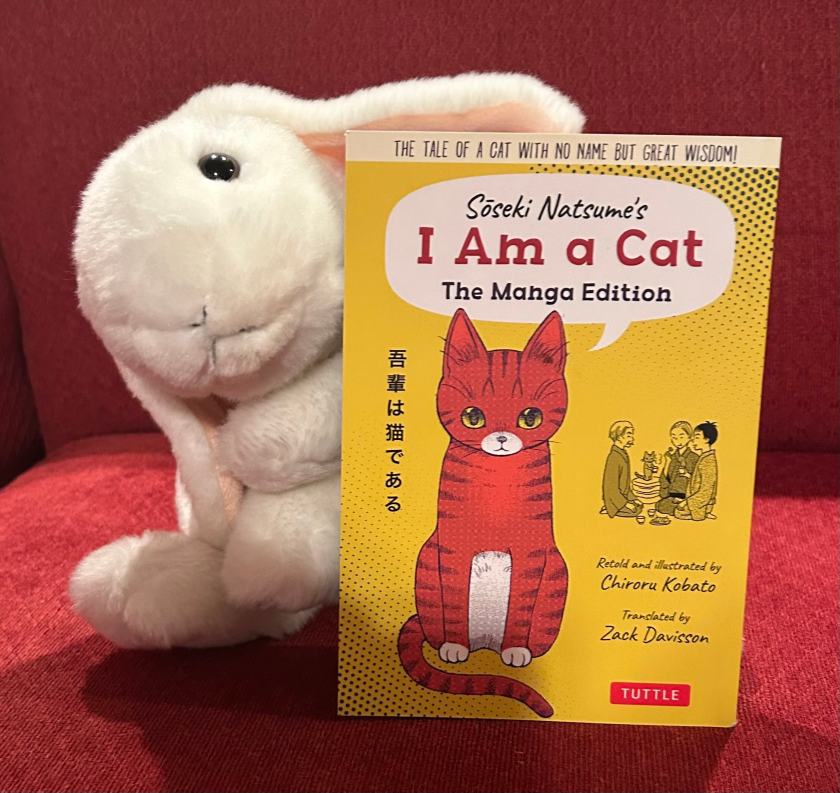
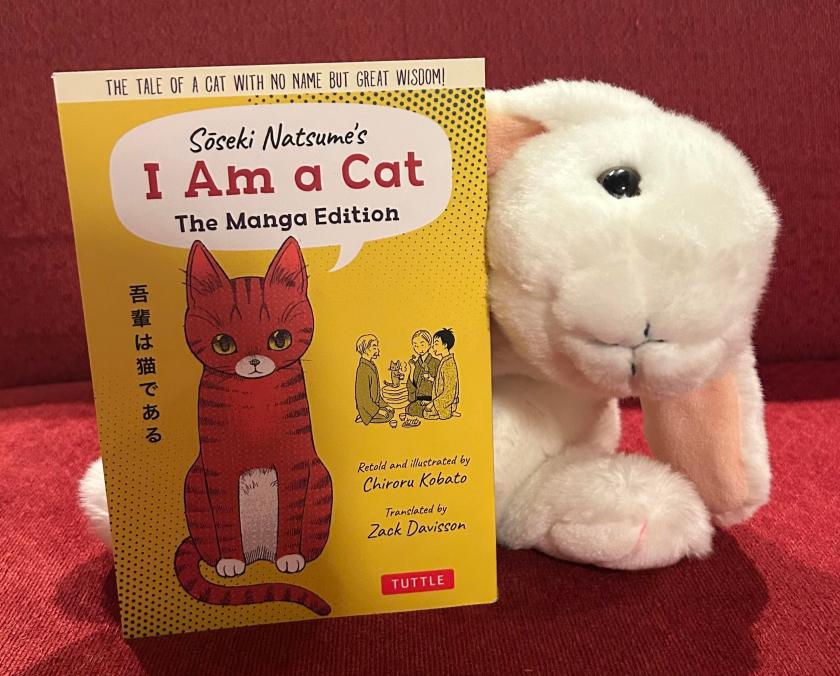
Today Marshmallow reviews Soseki Natsume’s I Am A Cat: The Manga Edition, the graphic novelization of the Japanese classic I Am A Cat, originally written by Soeki Natsume in 1905-1906. This “manga edition” was retold and illustrated by Chiroru Kobato, translated into English by Zack Davisson, and published in 2021. Sprinkles is taking notes and asking questions.

[In this post, we mention suicide as it relates to the content of the book, so if this is a sensitive topic for you, please consider not reading further.]

Marshmallow reviews Soseki Natsume's I Am A Cat: The Manga Edition, retold and illustrated by Chiroru Kobato, and translated into English by Zack Davisson.
Marshmallow reviews Soseki Natsume’s I Am A Cat: The Manga Edition, retold and illustrated by Chiroru Kobato, and translated into English by Zack Davisson.

Sprinkles: I am so excited we are finally talking about this book! I am very curious about it. So let us start with your standard overview. 

Marshmallow: Sure! If you like thought-provoking and eye-opening books from other cultures and other time periods, then this is the book for you!

S: That is a great start. Okay, now please do tell us a bit about what this book is about.. Since the title is “I am a cat”, I am guessing it is probably about a cat.

M: Yes, actually the main character is a cat who narrates the whole story (which takes place in early twentieth century Japan). He was separated from his family at a young age and was taken in—reluctantly—by the family of an English teacher named Sensei Kushami. He describes his life with them and the silly human occurrences / things they experience. 

S: So what kinds of things does he talk about? 

M: Early on, he describes his near-death experience with mochi. He also watches the humans gossip a lot about a rich woman named Ms. Kaneda and her nose (which I thought was very insensitive). The woman, whom the cat calls Lady Nose, has a very ungrateful yet beautiful daughter who may marry one of Sensei Kushami’s friends. There is a lot of confusion that surrounds this affair though and a lot of false rumors and accusations get thrown around. 

S: So the cat witnesses and talks about a whole lot of silly, trivial, petty things humans worry about. 

M: Yes. In the original version of the book, according to this neat recap we found online, this makes him feel pretty superior. In this manga version, he also seems a little amused by their behavior; however, he seems a little less judgemental.

S: In that recap and also on the Wikipedia article for the book, we also learn that the Japanese version of the title “I Am A Cat” also has sort of this formal feel to it because it uses a particular version of the first person pronoun “I” that is “a very high-register phrasing more appropriate to a nobleman, conveying grandiloquence and self-importance”. I am guessing that also makes the book funny to begin with, the cat is kind of pretty full of himself. 

M: I presume it does in Japanese, but of course, I didn’t quite catch that joke myself in English. 

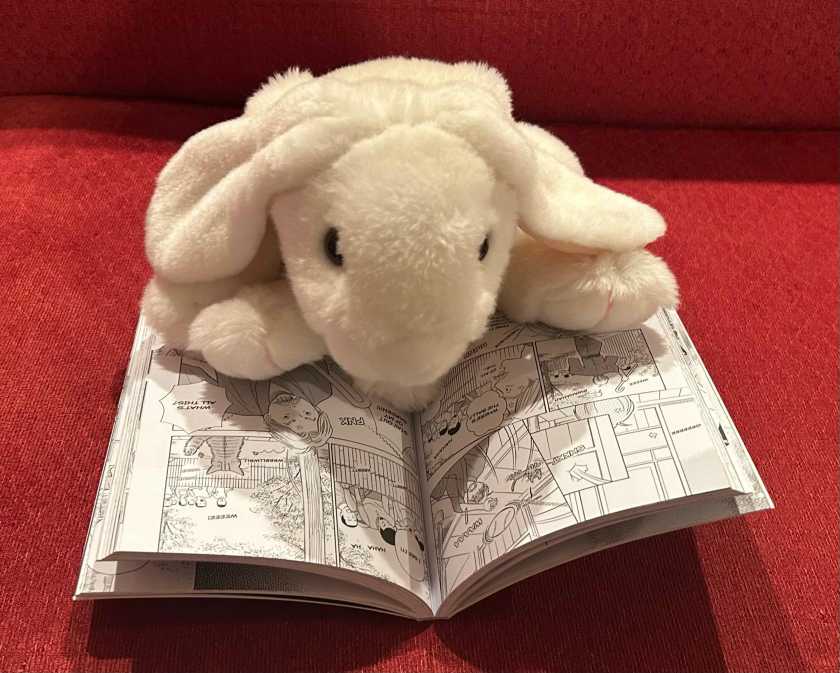
Marshmallow is reading Soseki Natsume's I Am A Cat: The Manga Edition, retold and illustrated by Chiroru Kobato, and translated into English by Zack Davisson.
Marshmallow is reading Soseki Natsume’s I Am A Cat: The Manga Edition, retold and illustrated by Chiroru Kobato, and translated into English by Zack Davisson.

S: English has a single first-person pronoun which makes it a lot easier to learn or speak it, but you also lose a lot of nuance in this way, I suppose. Anyways, so this cat is observing his humans, kind of like Garfield. Garfield is kind of self-important in a way, but maybe a bit less interested in the humans.

M: Yes. I felt like the main character here did seem to care about his human family, but they did not really seem to always care about him too much (Sensei Kushani originally did not want him in the house at all). 

S: Hmm, that is interesting. So I know that when you first read this book, you were a bit disturbed by it. Can you tell us a bit about that? 

M: I felt that the book made too many references to suicide too lightly. Several characters consider hanging themselves on a pine called the Hanging Tree. None of the main characters ends up killing themselves, but it felt like it was mentioned too many times in the course of such a short book. 

S: I can see how that made the feel of the book kind of dark and uncomfortable for you. I am sorry about that. I had thought that this book is supposed to be satirical and philosophical, so I suggested that you read it. 

M: It’s okay! It was a little dark and unexpected, but the rest of the book was amusing to read. I can see why people find it both satirical and philosophical. It is pretty amusing to read a cat pontificating about the silly ways of humans. Like we bunnies do sometimes. People-watching is one of my favorite hobbies. 

S: I know, right? People-watching is fun! Okay, so tell us a bit about the satire or the philosophy then. 

M: Okay, the philosophy part was also pretty dark and depressing though. Sensei Kushani and his friends in academia and one in business discuss the integration of Western ideals into traditional Japanese culture. They also say some very sexist things about women to their friend who just got engaged. Meanwhile, the cat narrating the book ponders about life and whether it is worth it. At some point, he reaches the conclusion (which I disagree with) that life is only suffering and that death is the only peace. 

S: Okay, I can see that maybe these ideas are a bit too heavy for a “manga edition”. Maybe the original book deals with them with more nuance. So maybe let us now talk about the manga nature of the book. I know both you and Caramel have read a lot of graphic novels. But is this your very first manga?

M: I think so. I have never read a book that was meant to be read backwards which was a little difficult to adjust to.

S: Backwards for us of course, not for many other people around the world who read from right to left. 

M: Yes, but  I am still not sure whether I was supposed to start from the top of the page or somewhere else. 

S: I can imagine that can be disorienting. I have read only one manga-style book and that was disorienting for me, too. But I am honestly disoriented by all graphic novels, so maybe it was also that. Anyways, so let us wrap up this review then. All in all, did you enjoy reading this book? Did you find it interesting?

M: This book was definitely interesting. It helped me understand a little bit more about Japan’s culture and its understated, natural aesthetics and style. I also liked how this version simplified a classic book into a format that was somewhat easy to understand and definitely a lot easier to read for people who can’t read Japanese. I liked how this made one of the great Japanese novels accessible to others! I would rate this book around 95%. 

S: That is wonderful, Marshmallow. Then I am also glad you read it. What would you like to tell our readers as we end the post?

M: Stay tuned for more amazing book reviews from the book bunnies!

Marshmallow rates Soseki Natsume's I Am A Cat: The Manga Edition, retold and illustrated by Chiroru Kobato, and translated into English by Zack Davisson, 95%.
Marshmallow rates Soseki Natsume’s I Am A Cat: The Manga Edition, retold and illustrated by Chiroru Kobato, and translated into English by Zack Davisson, 95%.