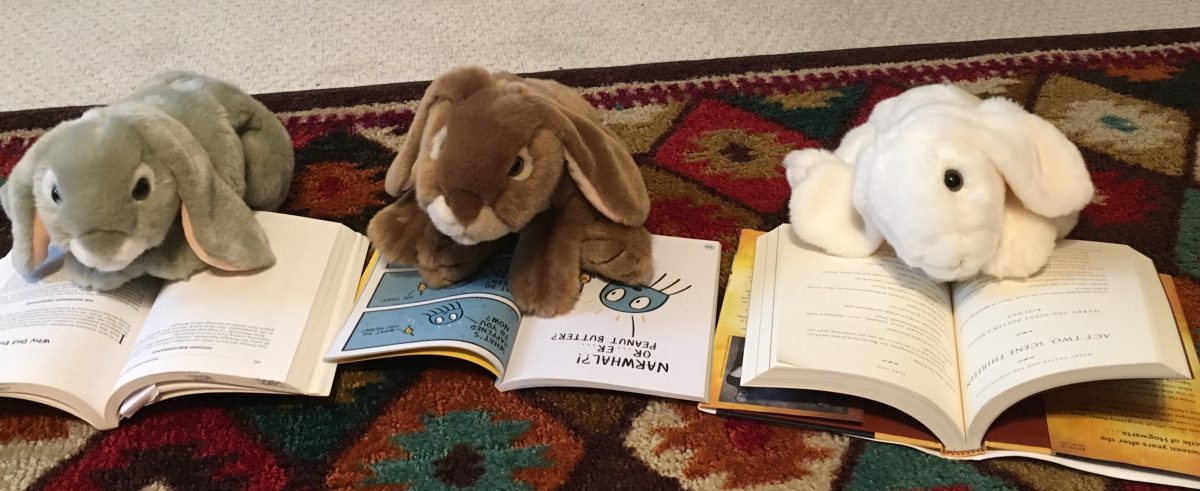
Caramel reviews Mysterious Tales of Japan by Rafe Martin

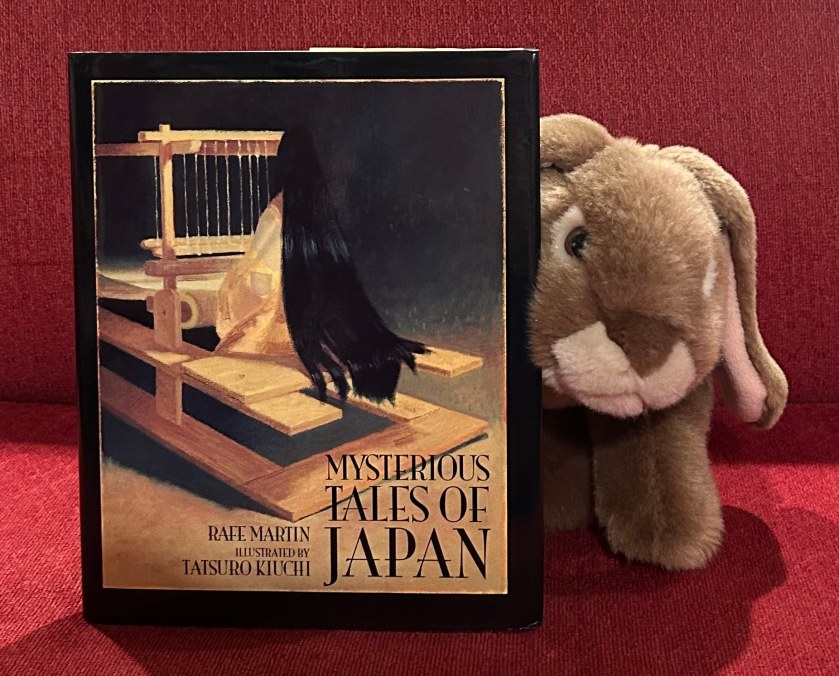
Today Caramel is talking to Sprinkles about Mysterious Tales of Japan, written by Rafe Martin and illustrated by Tatsuro Kiuchi, originally published in 1996.

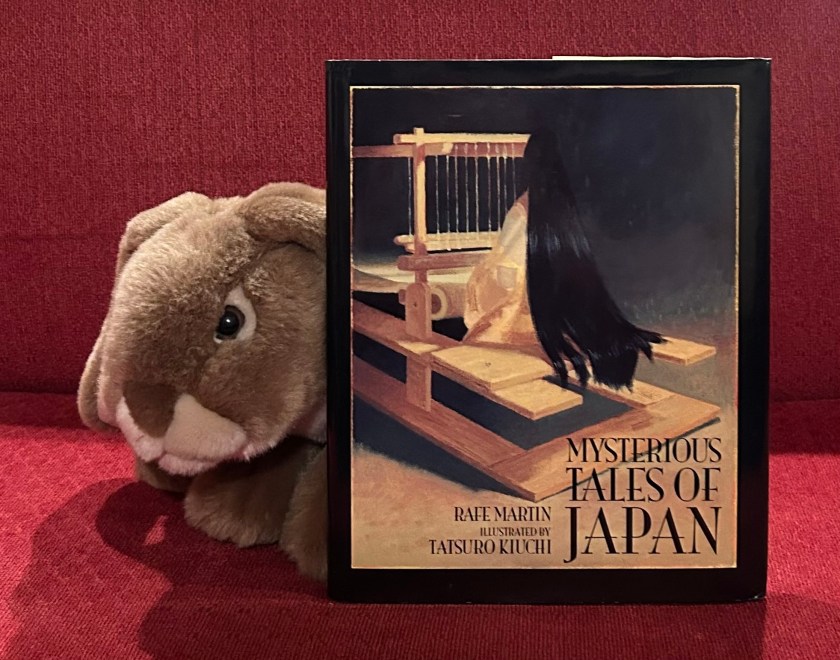
Caramel reviews Mysterious Tales of Japan, written by Rafe Martin and illustrated by Tatsuro Kiuchi.

Sprinkles: So Caramel, today we are talking about Mysterious Tales of Japan, another one of those books you read for that Asian Myths and Legends summer course you took a while back. 

Caramel: Yeah, it is, I think, the last one? I already reviewed the other ones: Japanese Myths, Legends, and Folktales, Tamamo the Fox Maiden and Other Asian Stories, Chinese Myths and Legends: The Monkey King and Other Adventures, Vietnamese Children’s Favorite Stories, and Favorite Children’s Stories from China and Tibet

S: Yes, I think you are completing the set today. But this one is a bit different from the others, right? The stories are a bit spooky, I am guessing. 

C: Spooky? No, they’re not that spooky. But yes, there are ghosts and spirits and such. 

S: I see. Then please tell me a bit more about the book. 

C: It has some stories shared with some of the others, like “Ho-Ichi the Earless” and “Urashimmo Taro”, which I had already read in Tamamo the Fox Maiden and Other Asian Stories. Besides these, there are eight other stories, and I had not read those before; they were all new to me.

S: That’s cool Caramel. So ten stories and eight of them were totally new for you. Tell me a bit about the new stories. 

C: The other eight stories are “Green Willow”, “The Snow Woman”, “Kogi”, “The Crane Maiden”, “The Pine of Akoya”, “A Frog’s Gift”,  “The Boy Who Drew Cats”, and “Black Hair”. They are all about five pages or so.

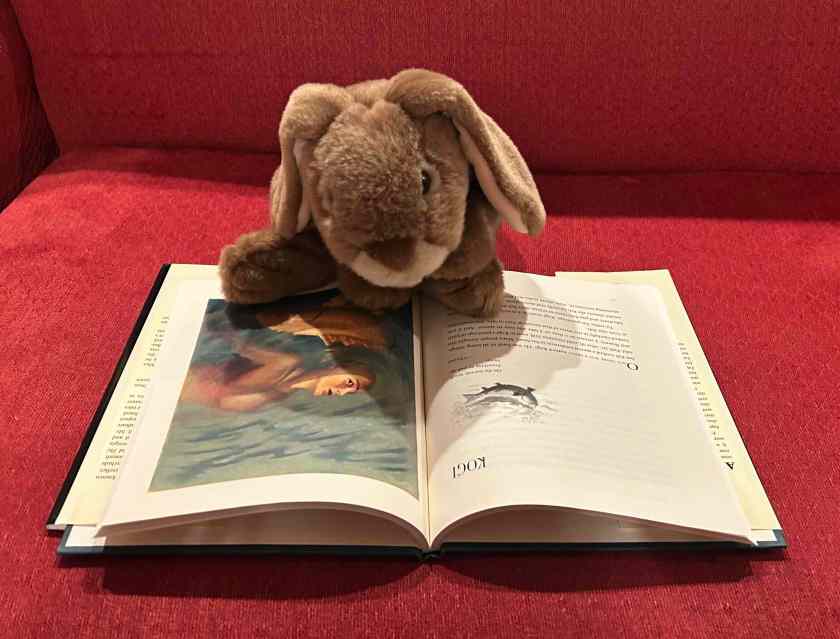
Caramel is reading Mysterious Tales of Japan, written by Rafe Martin and illustrated by Tatsuro Kiuchi.

S: Okay, so tell me a bit about these stories. Any one that surprised you? 

C: No, not really; most of the stories are sort of similar to others that I read before.

S: Okay, so I guess you are getting used to Japanese folk tales and their general feel. Then, maybe tell me which was the most interesting? Or the spookiest? 

C: I think that “Ho-ichi the Earless” is the spookiest. 

S: I remember that story from the other book. It was quite weird and spooky, I agree. But that book was basically a graphic novel adaptation, so it was very visual. Left not much to your imagination. 

C: This book has pictures, too, but only one or two for each story. So you have a lot more to imagine. 

S: That can sometimes be scarier. 

C: True. Sometimes the imagining is the part where I like real books over picture books. Let me think about what I want the main character to look like. Let me think about how the house the author is describing actually looks like. And so on. And the pictures in this book are not all very detailed. They give you a feel for the story, but you still have a lot more to imagine on your own. 

S: Yes, the pictures are beautiful and evocative, but you are right, they are not very detailed. They leave much room to create in your own imagination. So for example, the two stories you had already read before in that other book: when you were reading them here, did you have some new imagery in your mind to go along with the story line? 

C: Yeah, sometimes the space not drawn is the spookiest. It definitely was like that for me for “Ho-ichi the Earless”. 

S: Cool, thanks for all this Caramel. I think we have enough for a post, so maybe this is a good time to wrap things up. 

C: Sure, why not?

S: Great! What would you like to say to our readers as your closing words? 

C: Stay tuned for more book bunny reviews!

Caramel appreciated reading Mysterious Tales of Japan, written by Rafe Martin and illustrated by Tatsuro Kiuchi, and recommends it to all other young bunnies, but maybe they should think about reading it with a grownup bunny so they don't get too scared.
Caramel appreciated reading Mysterious Tales of Japan, written by Rafe Martin and illustrated by Tatsuro Kiuchi, and recommends it to all other young bunnies, but maybe they should think about reading it with a grownup bunny so they don’t get too scared.

Caramel reviews Favorite Children’s Stories from China and Tibet by Lotta Carswell Hume

In these past few months Caramel has reviewed several books that collect together stories from various Asian traditions: Japanese Myths, Legends, and Folktales, Tamamo the Fox Maiden and Other Asian Stories, Chinese Myths and Legends: The Monkey King and Other Adventures, and Vietnamese Children’s Favorite Stories. Today he adds to this list another book: Favorite Children’s Stories from China and Tibet, written by Lotta Carswell Hume (1876-1976), illustrated by Lo Koon-Chiu (1918–2012), and originally published in 1962. The edition Caramel read was the 2004 edition. As usual, Sprinkles is taking notes and asking questions.

Caramel reviews Favorite Children’s Stories from China and Tibet, written by Lotta Carswell Hume and illustrated by Lo Koon-Chiu.

Sprinkles: So Caramel, here we are, talking about another neat collection of stories! 

Caramel: Yes, this one has stories from China and Tibet. 

S: Tell me more.

C: Well, let me see. There are eighteen stories. Each of them is about three to seven pages long. And there are a lot of pictures. I really liked them! 

S: Yeah, I saw that there are a lot of colorful illustrations. Apparently they were made by a Chinese artist named Lo Koon-Chiu. 

C: That makes sense. Because a lot of the stories are Chinese. But the person who wrote them does not sound like a Chinese person. And I don’t know too many Tibetan names, but the author’s name does not sound Tibetan either. 

S: You are right. The author was apparently from Baltimore, USA, and then got married and moved to Asia with her husband. She lived in China and India for decades, and her children got to hear a lot of traditional Chinese stories. So this is a collection she put together to share those stories with children who would read or be read to in English. 

C: I see. Then she did not write the stories herself. That makes a lot more sense now. 

S: Yeah, I was curious too, and then looked it all up. Anyways talk a bit about the stories. Can you tell which stories are from Tibet and which are from China?

C: Yes. There is a little note under the story title for each one. So there are five stories from Tibet. The rest are from China. But they separated those, too. Some are from West China, some from Southeast China, some from Central China, and so on. 

S: Hmm, I guess that makes sense. China is a big country. Maybe they did not want to go into detail about the exact geography of China and give the province names and such. 

C: I guess. But there are a lot more stories from China, so maybe they just split the Chinese stories so they would not look too uneven. 

S: Interesting! That could be a good reason, too, Caramel.

Caramel is reading Favorite Children’s Stories from China and Tibet, written by Lotta Carswell Hume and illustrated by Lo Koon-Chiu.

S: Anyways, so why don’t you tell me more about the stories themselves? 

C: Well, there is a story like Cinderella, and it is called A Chinese Cinderella, And there is this story about a woman who is called Mrs. Number Three who is an innkeeper.

S: That is a very strange name!

C: It is not her real name, but nobody knows her real name so they call her that. But the story is really interesting. Its name is “The Magic Pancakes at the Footbridge Tavern”. So as you can imagine, there are magic pancakes! 

S: Oh, I know you love pancakes! 

C: Yeah, but these are magic and you really don’t want to eat them. 

S: Oh, that is interesting! I guess I just have to read the story to figure out what you mean. 

C: Yep. 

S: Okay, so that is two of the eighteen stories. What about the others?

C: A lot of the others are about animals. Like there is a Tibetan story about a tortoise and a monkey and another about some jackals and a tiger. And then there is another about a hungry wolf, and one about some mice. 

S: Oh, that is interesting. Kind of like fables, I am guessing. 

C: Yeah, kind of. But wait, it looks like the animal stories are almost all stories from Tibet. Some of the Chinese stories also have animals, but they also have people. 

S: Very interesting observation, Caramel.

C: And then there are two stories like the ones we talked about before about how some things came to be the way they are. There is a story about how the rooster got its red crown and another about how the deer lost its tail. They are both from China. 

S: I see. True, we did talk about such stories when you were reviewing Vietnamese Children’s Favorite Stories by Tran Thi Minh Phuoc. Apparently such stories were called “pourquoi” stories

C: Oh, yes, I remember you said that last time. 

S: Okay, so all in all it seems like you have enjoyed reading this book, right? 

C: Yep! 

S: Can you tell us if you have a favorite story? 

C: No, I liked them all. 

S: That is wonderful, Caramel. Okay, maybe this is a good time to wrap up this review. What would you like to tell our readers? 

C: Stay tuned for more book bunny reviews!

Caramel enjoyed reading Favorite Children’s Stories from China and Tibet, written by Lotta Carswell Hume and illustrated by Lo Koon-Chiu, and recommends it to all the other little bunnies who enjoy reading or hearing short stories.

Caramel reviews Ultimate Spy by H. Keith Melton

Today Caramel reviews Ultimate Spy by H. Keith Melton, published in 2002. As usual, Sprinkles is taking notes and asking questions.

Caramel reviews Ultimate Spy by H. Keith Melton.

Sprinkles: So what is this book about Caramel?

Caramel: This is about the equipment and weapons that spies use.

S: I see. After reading so many Spy School books, you needed to get to some of the facts! 

C: Yep. You know me and facts. I like them. 

S: Okay, so what kind of equipment and weapons are we talking about here? 

C: Some of them are really cool gadgets, like the match box pistol.

S: Sounds like something out of a James Bond movie. What is the match box pistol?

C: Yes, it sounds like it’s from a movie and it does look like it, too. It basically looks like a metal match box, but a barrel can be attached, and it can shoot one bullet. So you can carry it around without anyone being suspicious that you are carrying a weapon. Or you could simply let it sit on a coffee table and they would not suspect anything. 

S: I see. That is cunning. 

C: Yes, it is, it’s crazy. There are so many little and big things that they have made that spies can use as secret weapons. 

S: And these are real, not for movie sets and such?

C: Yep, they are all things that were used at some point.

S: Oh wait, you used the past tense. So these are real but maybe no longer classified, like the government no longer needs to keep them secret. 

C: Yeah, at least I think so. The author is a historian and the foreword of the book is written by some real people from the intelligence world. Some guy named Richard Helms who was apparently a former director of the CIA and Markus Wolf who was the former head of the East German Foreign Intelligence Service, the HVA. This is the real CIA, the Central Intelligence Agency! And I didn’t know about the HVA, but now I do. 

S: Wow! That is pretty cool. This all probably means that they have a lot of other cool stuff they are using these days, and we don’t know about them. 

C: Yeah, most likely a lot. And this book was published all the way back in 2002, so definitely they must have a lot of new tools and gadgets that they are not telling us about. 

S: I did notice that our copy is from 2002. There is apparently a newer edition, from 2015. 

C: Oh, that is cool. Maybe that edition has a few new things. But this book was more than good enough; it definitely has enough neat things to keep me busy! 

S: I can see that!

Caramel is reading Ultimate Spy by H. Keith Melton.

S: Okay, so tell me a bit more about the book. 

C: Sure.  The content is organized around some themes like Famous Spying Operations, World War II, Cold War, Post-Cold War Spying, and Equipment and Techniques.  Under that last one, there are pages on Cameras, Secret Operations, Counterintelligence, Clandestine Communications, and Weapons. Finally there is a section on How To Be a Spy. 

S: Hmm, it is interesting that there is some historical context to this all. And there are lots of big words in there. Did you know what “clandestine” means for example? 

C: Of course. It means secret. 

S: Of course, I should have guessed that. You are a little bunny with a huge vocabulary. Anyways, what else can you tell us about the book?

C: There are 206 pages. And there are many, many, many pictures on each page. 

S: That makes sense. You’d want to see these gadgets of course! 

C: Yeah, I definitely liked looking at them.

S: So what was your favorite gadget? 

C: Probably the match box pistol, it’s small, even a bunny spy could carry it around! 

S: Wait, are you interested in becoming a spy? 

C: Not really. I was teasing you. It is too dangerous. But it is neat to read about them. And you know I love my Spy School books, so this book helps me put what is going on in those books into some context. 

S: Alright, so maybe this is a good place to wrap up this review. You seem to have really enjoyed this book. 

C: Yes. And yes. 

S: So what would you like to tell our readers as we end this post?

C: Stay tuned for more book bunny reviews!

Caramel enjoyed reading Ultimate Spy by H. Keith Melton and learning about cool gadgets and some history, too.

Caramel reviews Artificial Condition: The Murderbot Diaries by Martha Wells

A few months ago, Caramel reviewed All Systems Red: The Murderbot Diaries by Martha Wells. Today he reviews Artificial Condition, the second book in the Murderbot Diaries saga, written originally in 2018. As usual, Sprinkles is taking notes and asking questions.

Caramel reviews Artificial Condition: The Murderbot Diaries by Martha Wells.

Sprinkles: So here we are ready to talk about a new Murderbot Diaries book. 

Caramel: Yeah, I like these books! This is the continuation of the first one, and I like it.

S: Okay, so maybe you can remind us a bit about what this is all about. Murderbot sounds kind of violent, like a technologically sophisticated and out-of-control killer robot. 

C: It is sort of true. The main character calls himself Murderbot, and he is definitely able to kill, he just sort of doesn’t.

S: Yes, I remember. He actually calls himself Murderbot kind of tongue in cheek, like a personal inside joke. He could kill everyone, but he just does not want to. Kind of. 

C: Yes, but he also is smart. He knows he is capable of killing humans, but also humans are very powerful and eventually they would capture him and melt him down. So even though humans sometimes really annoy him, he is kind of not going wild on a murderous rampage also because he does not want to die. 

S: We keep saying “he” and “die” and “wants” and so on, almost humanizing him. This is a cyborg, a part-organic, part-robot creature, who has hacked his own governing module, so he has about as much free will as the humans around him. 

C: Exactly. He has full control over his body and mind, and he enjoys watching soap operas instead of dealing with humans and killing things and so on. But he is a SecUnit, that means he is a security unit, his job is to defend the people who hire him, and so occasionally he has to fight. 

S: In the first book, he joined a group of scientists who were surveying a planet searching for anything useful or interesting. We even ended up watching the TV series they made out of that book. I think you enjoyed that a lot. 

C: Yes! I think it is more correct to say that we both enjoyed it. 

S: True. 

C: And this book takes over when that first book ended, and more or less where the first season of the TV show ends. Murderbot is now traveling on his own and he faces new enemies and makes new friends. 

S: That sounds cool! 

C: It is cool. There is a new character, a very powerful artificial intelligence, for example, and he is pretty cool. But he is annoying too, so Murderbot calls him ART in his mind. R and T stand for Research Transport, and A stands for a word I cannot say because I am a good little bunny who does not say bad words. (But don’t worry. There are not that many other bad words in the book.)

Caramel is reading Artificial Condition: The Murderbot Diaries by Martha Wells.

S: So it sounds like this book is quite fun too. Is it as fun as the first book? 

C: Yes, maybe more fun, he is now a security advisor. And he still loves to watch his soap operas, but he is also a lot more interested in doing things, helping people, solving problems, and so on. And he is still very funny. And he makes a lot of funny sideways comments.

S: That is wonderful, Caramel. You know I still have not read the first book. I did enjoy the TV series though. And talking to you about this book makes me want to go back to that first book and read it after all. So then I can also read this one. 

C: Can we maybe add the trailer?

S: We have included the trailer for the first season in your review of the first book. They do not seem to yet have the trailer for the second season, even though they apparently will have one. 

C: Oh, okay. At least maybe our readers can go and check out that first trailer. The show is funny, and a lot funnier than the trailer. 

S: Yes, the title “Murderbot” kind of turns off some people, but it is actually pretty funny and interesting. 

C: I can see why people might not like the name, but it is not really that violent most of the time. Though there are some violent scenes. After all it is a SecUnit and has to fight sometimes. 

S: Yes. Okay, maybe this is a good time to wrap up this review. 

C: Sure, I can always go back to reading!

S: Sounds like a good idea. But before that, what would you like to tell our readers?

C: Stay tuned for more book bunny reviews!

Caramel loved reading Artificial Condition: The Murderbot Diaries by Martha Wells and is looking to read many more books in this series in the coming weeks and months.