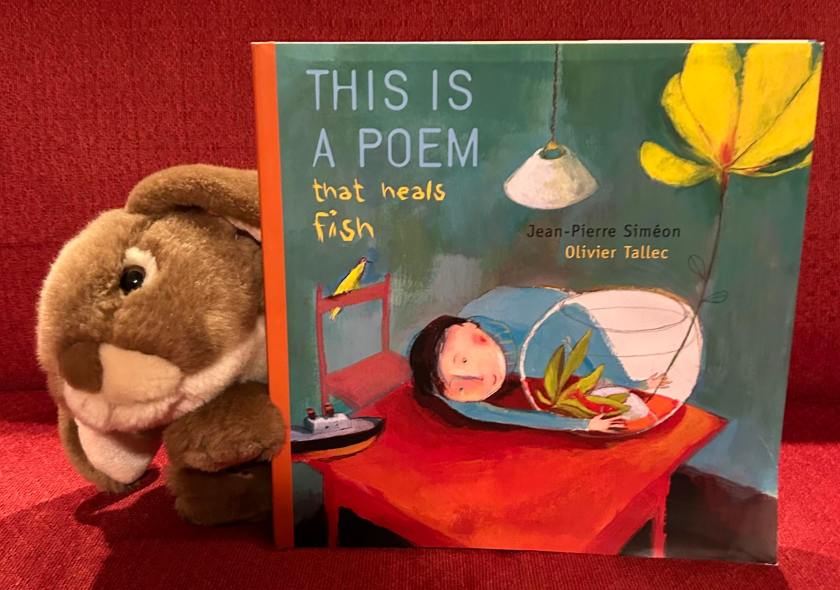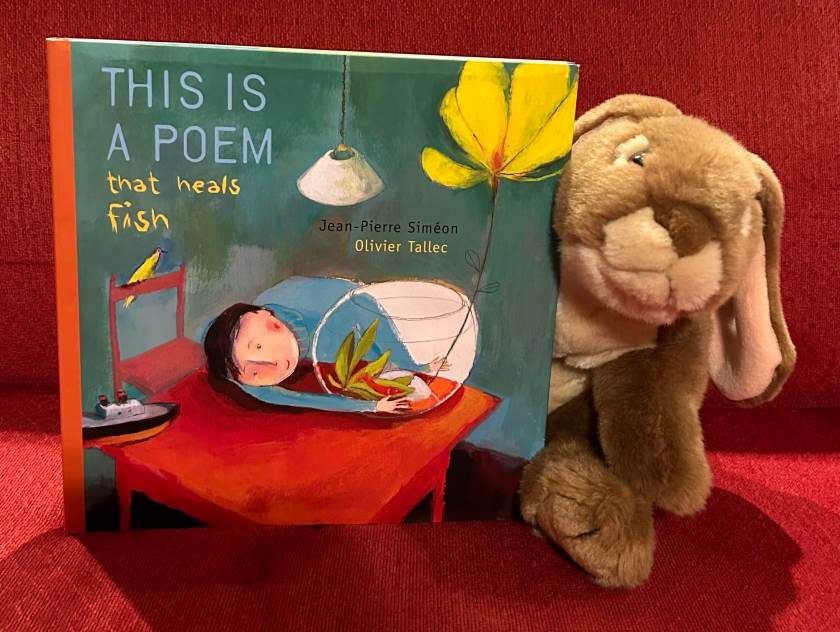
Caramel reviews This is a Poem That Heals Fish by Jean-Pierre Siméon and Olivier Tallec

Today Caramel talks to Sprinkles about a neat picture book about poems: This is a Poem that Heals Fish, originally written in French by Jean-Pierre Siméon and illustrated by Olivier Tallec. The version Caramel read was translated into English by Claudia Zoe Bedrick and originally published in 2007.

Caramel reviews This is a Poem That Heals Fish written by Jean-Pierre Siméon, illustrated by Olivier Tallec and translated by Claudia Zoe Bedrick.
Caramel reviews This is a Poem That Heals Fish, written by Jean-Pierre Siméon, illustrated by Olivier Tallec and translated by Claudia Zoe Bedrick.

Sprinkles: So, Caramel, you know that I will be reviewing a poetry book this weekend. Is that why you picked this book to review today?

Caramel: No, actually, I just thought it might be cool to review it.

S: That makes sense. I do think this is a really cool book. Also very pretty. 

C: Yep, that is what caught my attention.

S: So why don’t we begin at the beginning? Can you tell us what this book is about?

C: This book is about a kid named Arthur whose fish Leon is sick. Or maybe bored actually. Anyways Arthur asks his mom what to do and she tells him to give him a poem. 

S: And then off she goes to play tuba, right?

C: Yep, how did you know?

S:You know I read this book too Caramel! I actually first read about this book in a blog post about it and had to get one for us. The pictures and the words, they were all so beautiful. I am so glad you liked the pictures too. 

C: Oh, I had no idea, but yes, I do like the pictures a lot! 

S: So happy to hear that! Okay maybe we can get back to the story of Arthur and Leon. So does Arthur know what to do when his mom tells him to give the fish a poem?

C: Not really. So he asks everyone he knows what a poem is. And everyone tells him something different. 

S: Can you give an example or two of the kinds of answers he gets?

C: One of them says that it is when you are in love and have the sky in your mouth. And another says that a poem is words turned upside down and suddenly the world is new. And another person says it is the heartbeat of a stone. And so on.

S: Which one of them is your favorite? 

C: I have no idea. It is hard to pick one. They are all slightly different and all together make up a really good definition.  

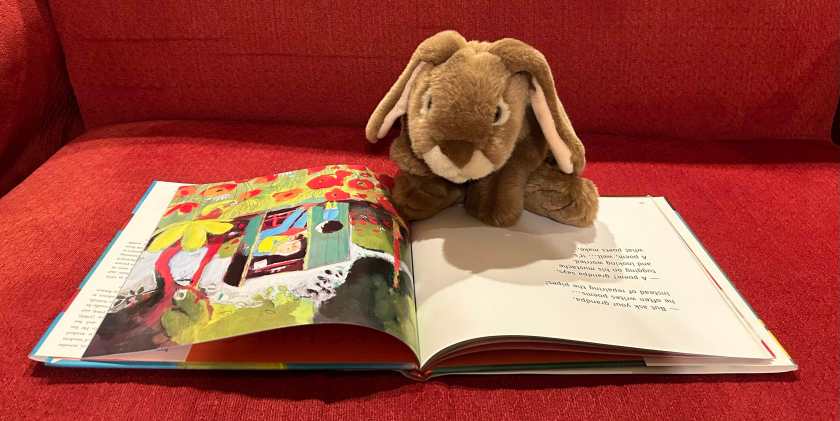
Caramel is reading This is a Poem That Heals Fish, written by Jean-Pierre Siméon, illustrated by Olivier Tallec and translated by Claudia Zoe Bedrick.

S: So how would you define a poem Caramel?

C: Hmm, I think it is a song of the heart. 

S: That is beautiful, Caramel! I love it! 

C: Why, thank you, I would like to think that that was very good of me.

S: Yes, I thought so. Anyways, I think this is the first poetry book you have reviewed for our blog. 

C: Not really. I know Marshmallow reviewed more books about poetry than me, but i also reviewed a poetry book. Remember Change Sings: A Children’s Anthem by Amanda Gorman and Loren Long? That was a good book to read and review, too.

S: Oh yes. That is true. And this weekend I hope to review a few more poetry books. But I am glad you chose to talk about this book today. And I love that you posed with one of my favorite pages in the book with the grandpa and the red poppies!

C: I am always gracious like that! 

S: Yes, you are! Okay, so before we wrap things up, tell us if Leon the fish gets to feel better at the end.

C: Yes! He does!  Arthur tells his fish Leon all that he learned about poetry. And Leon is no longer bored. He says his silence is his poetry. 

S: That is kind of cryptic but also beautiful. 

C: Yup, creepy, too, a bit though. 

S: I guess one could think that. In his silence there is a lot going on, lots of meanings in words unsaid. I choose to think of it as beautiful. 

C: Yeah, I suppose that is a better way of seeing it. And more poetic!

S: Yep! So okay, maybe it is time to wrap up this review. What would you like to tell our readers?

C: Stay tuned for more book bunny reviews!
Caramel loved reading This is a Poem That Heals Fish, written by Jean-Pierre Siméon, illustrated by Olivier Tallec and translated by Claudia Zoe Bedrick, and sharing it with the readers of the book bunnies blog!

Caramel reviews Pathfinder Roleplaying Game: Core Rulebook

Last week Caramel reviewed Warhammer 40,000: Core Book, the core rule book for a tabletop game he is really keen on these days. Then he realized that he also could talk about his other favorite tabletop game, Dungeons & Dragons, and brought his rule book out. So today he is talking to Sprinkles about Pathfinder Roleplaying Game: Core Rulebook.

Caramel reviews Pathfinder Roleplaying Game: Core Rulebook.

Sprinkles: So, you found another rule book for another tabletop game. This one is about Pathfinder. And I am not sure everyone knows what that is. So why don’t you start by telling us something about the game?

Caramel: Sure, I suppose everyone knows about Dungeons & Dragons (D&D) but Pathfinder is a bit different from D&D. It is actually very similar to D&D version 3.5. However there are some slight differences in the character types, and I think there are some changes in the rules.

S: Okay, wait. So let us go back a bit. First there is the famous tabletop game Dungeons & Dragons. For any bunnies who might not know what that is, can we start by talking briefly about what that is?

C: Sure, good idea. D&D is also a role playing game, like Warhammer 40,000, which I talked about last week. However, instead of controlling an army, in D&D you control one person. And it is the same in Pathfinder.

S: Okay, so I looked them all up on Wikipedia, and it seems that both Warhammer and D&D are relatively old actually. D&D was first published in 1974, and Warhammer, the original game, was published in 1983. Pathfinder was first published in 2009 as a kind of a spinoff of the original D&D, or rather, the third edition of it. 

C: I had an idea that the Warhammer game was that old! I knew for example that the first Warhammer 40K miniatures were made out of metal because, according to Google, at the time “plastic molding technology was not advanced enough to produce the intricate details and durability needed for tabletop miniatures.”

S: That makes sense! So anyways, last time you talked about the general setting for the game when you were telling us about Warhammer 40K. Now is there a general setting for D&D or Pathfinder?

C: Kind of. It is kind of in a fairy tale time period, where they have firearms, but getting them is very hard. Most people have simpler weapons, like swords, slings, bows and arrows, and … war hammers! 

S: I see what you did there! Anyways, so this sounds like maybe the late middle ages, but there is more, right? I do hope there is indoor plumbing, because that I think is one of the most important benefits of modernity. 

C: I don’t think there is indoor plumbing; they use outhouses and chamber pots mostly.  

S: Hmm, not sure I’d like to live that way… But there is more, right? There is sorcery, and there are different kinds of beasts and types of humanoid characters?

C: Yes! There are elves, and sorcerers, and wizards, and bards, and so on. And there are all sorts of beasts. And as you can tell from the original name, there are dragons!

S: So it is a fantastical world, kind of like our own medieval times, but with some interesting extras! 

C: Yes. But actually there is a lot of freedom in the game. You can set up your own game to be in a world with more magic or less. You can have elves in your particular story or not. 

S: No wonder people do not get bored, and generations of bunnies have been playing it without running out of ideas. It sounds very versatile.

Caramel is reading Pathfinder Roleplaying Game: Core Rulebook.

S: Okay so now let us get back to the book. This is the standard book with rules of the game then?

C: Yes, it is.

S: So tell me what kinds of things there are in the book. 

C: There are parts on creating a character. Then there is a part on choosing a class, then skills, then feats, then equipment. Next is extra rules, combat, magic, spells, special classes. Then there is a section on how to be a GM, making NPCs, magic items, and a ton of appendices.

S: That is a lot! 

C: Well there are over five hundred pages!

S: And what is a GM?

C: A Game Master. It is the person who develops the main story and the setting, and acts out all the NPCs. And before you ask, those are the characters that are not played by any of the main players. NPC stands for Non-Player Character. So the PCs are the characters the players play. 

S: I see. So the GM is the main story teller in some sense.

C: Yes, but the players can and do make choices that change the GM’s original goals, I know from experience.

S: Well, that sounds more fun actually. And kind of like real life, where big and important people might have all these grand schemes, but then a little bunny comes along and does something differently, and the whole world is changed. 

C: Yeah, I suppose. When I play as a GM, sometimes my players can be frustrating when they choose to do totally off-the-wall things. But I have also been a frustrating character to my own GMs so I guess it can go both ways!

S: Yes, kind of like free will. You get to choose; within all the constraints, you still have a choice. I like that. And I bet that is one of the reasons why the game works so well. There might be standard storylines and GMs might have some creative ideas, but each game turns out to be totally different because the players decide to do some things differently and the world changes. Like the butterfly effect, like in chaos theory.

C: What is chaos theory?

S: Okay, we are veering off topic a bit but chaos theory is a field of mathematics where people study systems which are extremely sensitive to small changes and seem to behave chaotically but can still be described and explained mathematically. And the butterfly effect captures that idea: “the flap of a butterfly’s wings in Brazil can set off a tornado in Texas.” A while ago, I reviewed a couple books about famous mathematicians who worked in chaos theory for our blog. Maybe you can check those books out… 

C: Cool, maybe I will.

S: Okay, so the book seems chock-full of ideas and basic rules of playing this game. I think you have read it from beginning to end several times. I also saw you often opening a random page to read. And I have a feeling that you will keep using it for the foreseeable future. 

C: Yup. I like reading this book. I also really like looking at the pictures. They are pretty well drawn. 

S: Yes, I can see that. Maybe this is a good time to end the review. What would you like to tell our readers?

C: Stay tuned for more book bunny reviews!
Caramel expects he will continue reading Pathfinder Roleplaying Game: Core Rulebook for many years to come!

Caramel reviews Warhammer 40000: Core Book

Today Caramel is talking to Sprinkles about his new Warhammer 40,000: Core Book.

Caramel reviews Warhammer 40000: Core Book as his Aeldari friend watches.

Sprinkles: So Caramel, today we are talking about your new Warhammer 40000: Core Book. So maybe start by telling us a bit about it?

Caramel: Sure, this book is a rule book for the Warhammer 40,000 game. It includes a description for every army in the game and tells you about some of the units in the army.

S: Wait, let us start a bit slower. I know you like this game but honestly I do not know much about it. On the book website I read “In the grim darkness of the far future, there is only war.” That sounds utterly terrifying. 

C: Yeah, I suppose.

In the grim darkness of the far future, there is only war.

In the 41st Millennium, warring factions from ancient civilisations and upstart empires fight endless battles across innumerable worlds. Humanity stands alone, beset on all sides by the heretic, the mutant, and the alien. There is no mercy. There is no respite. Prepare yourself for battle.

https://warhammer40000.com

S: So this is supposed to be the future of our universe, right?

C: Yes, we are in the 41st century 

S: And there are no humans or bunnies, I presume?

C: No, there are humans, but they mainly worship the God Emperor of Mankind. 

S: Hmm, not loving that at the moment, but okay. And are they based on Planet Earth or is the main scene elsewhere in the universe? And are they the main heroes or villains or just one among many other races? 

C: They are somewhere in between, not too evil, but not great people, either. And they do inhabit thousands of planets but their civilization has stagnated. Not terribly optimistic.

S: I see. So the game you play takes place about forty thousand years in the future when there is constant war in the universe. So what is the game like? Do you role play individual heroes? Do you lead armies or nations or planets? 

C: You lead a single army, and the size of the army is determined by a point system. You usually have 1000 points, but in some game rounds, you can have more or less.

S: And do you cooperate with friends when you are playing with them? Or are you usually battling one another? 

C: Both. Occasionally you have allies. At other times, it is just you and your army against all the other players’ armies. 

S: I see. So are the battles random battles for power over a resource or a planet? Or is there an overarching goal, like beating the main baddies of the galaxy or pushing back invaders and reestablishing the dominion of an empire? 

C: I think usually it is a battle over resources or knowledge that causes battles.

S: So why do you like this game? Because it is a neat strategy game? 

C: Yes, I like the strategy needed to win.. 

S: And you like having an excuse to hang out with friends for an extended period of time?

C: Yes.

Caramel and Aeldari friend are reading and enjoying Warhammer 40000: Core Book.

S: Alright, let us get back to the book. So the book is the rule book for the game then, right? But you were playing the game without it, so it is not only a rule book, is it?

C: Oh, it is a rule book. The way I was playing was by asking my friends about the rules. 

S: So this is more like the Dungeons and Dragons type of thing, where the rules are quite complex and there is a wide range of things you can do or types of beings you can be. 

C: Yes, kind of, but in Warhammer you control an army, In D&D, you control one person.

S: I understand that, I think. Okay, so tell me more about the book. It is a large-format and full-color book, printed on rather nice paper and with solid binding. I am assuming you look a lot at the pictures.

C: Yes, that is what I do a lot, but I also read the rules and the descriptions.

S: So do you think you will keep it as a reference book as you continue to play the game with your friends? 

C: Yes, I think I will. 

S: But you have already read this whole book from cover to cover? How long is it? How many pages does it have? It does look pretty thick.

C: It has 220 pages.

S: Hmm, so not too thick, you have read much thicker books before. So maybe it is the high quality paper that makes it so thick. Okay. But you have not yet answered all my questions. Maybe I should have asked them one at a time. So I will ask again. Have you read the whole book from cover to cover yet? 

C: Yes, many, many times.

S: Well, that sounds very much like a strong endorsement! So I am guessing you like the book then. 

C: Yes, greatly.

S: Here is the hard question though: would you have enjoyed this book at all if you did not know about Warhammer or did not like to play it already?

C: Well, I probably wouldn’t have gotten the book if I didn’t like the game, but I think maybe, the pictures and stories might have drawn me in if i just got to look at the book a bit. 

S: Yeah, I can see that. You already like space-related things, you like Star Wars, you enjoy reading and learning about wars more generally, and you like fiction with aliens and spaceships. You also like role-playing games. I am guessing this has a lot of the things that you would like.

C: Yes, that is true. This Warhammer book has almost everything that I like: spaceships, robots, elves, and to top it all off, PICTURES!!!

S: There are elves?! That is awesome!

C: Well, technically they are called the Aeldari, but they are basically space elves with guns and cool armor, but I might be biased.

S: That does sound cool! But I think I know why you said almost everything though. There are no dragons!

C: Well, they have these things called heldrakes, which are robot dragons, but they are kind of sadistic.

S: I see. You probably prefer the dragons in Wings of Fire or How to Train Your Dragon. The ones who have different kinds of personalities, but can be kind and friendly and generous as well, right?

C: Yes, I do. 

S: Okay, Caramel, I think this is already a very long post. So let us wrap things up. What would you like to tell our readers?

C: Stay tuned for more book bunny reviews!
Caramel and Aeldari friend will continue to read and enjoy Warhammer 40000: Core Book for many months and years to come.

Caramel reviews My Friend John by Arleen McCarthy

Today Caramel is talking to Sprinkles about a brand new book, My Friend John by Arleen McCarthy, which just came out on Friday November 8.

The book bunnies received this book from the publisher as a review copy.

Caramel reviews My Friend John by Arleen McCarthy.

Sprinkles: So Caramel, here we are again, this time to talk about this book about a boy named John. So maybe start by telling us a bit about it?

Caramel: Sure. In this book the main character is a girl. 

S: Wait, the girl is named John?

C: No. Wait, I am getting there. The girl is in class one day when the teacher announces that there is going to be a new kid, named John. At lunch the main character invites John over to sit with her, and he says thank you. Later the kid John makes a noise and shakes, then goes back to normal.

S: What kind of noise? 

C: i think that he says something like “tak”.

S: So maybe something that does not mean anything to the other people? Maybe something in a different language? 

C: No, it is not quite that. Later John doesn’t come to school because in class this same kind of thing happens, too, and the rest of the class makes fun of him.

S: Oh, I see. He is not really in control when he is making the sounds and shaking, right? 

C: Yes, in fact I was going to get to that. Later the teacher tells her that John has Tourette Syndrome, and that is why he made those noises and started to shake.

S: I see. Of course the other kids did not know about Tourette Syndrome so they just ended up making fun of him and making him feel bad. 

C: Yes, but eventually the girl who is the main character understands this and later tells the class that the reason John did not come to school is because they made fun of him.

S: I see. I guess it is normal for most children not to know about this syndrome, but they did not need to make fun of someone just because they are behaving differently or unexpectedly. 

C: Yeah, I agree.

Caramel is reading My Friend John by Arleen McCarthy.

S: Did you know about Tourette Syndrome before reading this book?

C: Yes, a little.

S: Same here. I knew of the syndrome but I do not think I have met someone with a severe case of it. I can imagine it can be surprising to children if they have never seen someone with it, but that is no reason to make fun of the person. 

C: Yes, I suppose that is true; sometimes little bunnies can be cruel. But not me, right?

S: Right, not you. I know you are always trying to be kind, and you always want to help and include other bunnies. But I think it is in all of us to want to push away different people because we might be afraid. Many bunnies want to be with bunnies like themselves. It probably feels more comfortable. But we must choose to be kind whenever we can. And to know that many bunnies are different from one another, and differences do not have to separate us. I am happy that you consciously choose to be kind whenever you can. You only tease Marshmallow and me. 

C: Yes, I do.

S: We usually can handle it! Anyways, so what did you think about this book overall? I feel like there is always room for a new book about being kind. 

C: Yeah, agreed. This is a good book. And I learned about Tourette syndrome and you know I always like to learn new things. 

S: I know! So maybe this is a good time to wrap things up. Can you give me a description of the book in three to five words?

C: Positive and full of color. That is exactly five words, right?

S: Yes, that is perfect, thank you! And now what would you like to tell our readers?

C: Stay tuned for more book bunny reviews!
Caramel appreciated reading My Friend John by Arleen McCarthy and learning about ways we can support friends with differences.