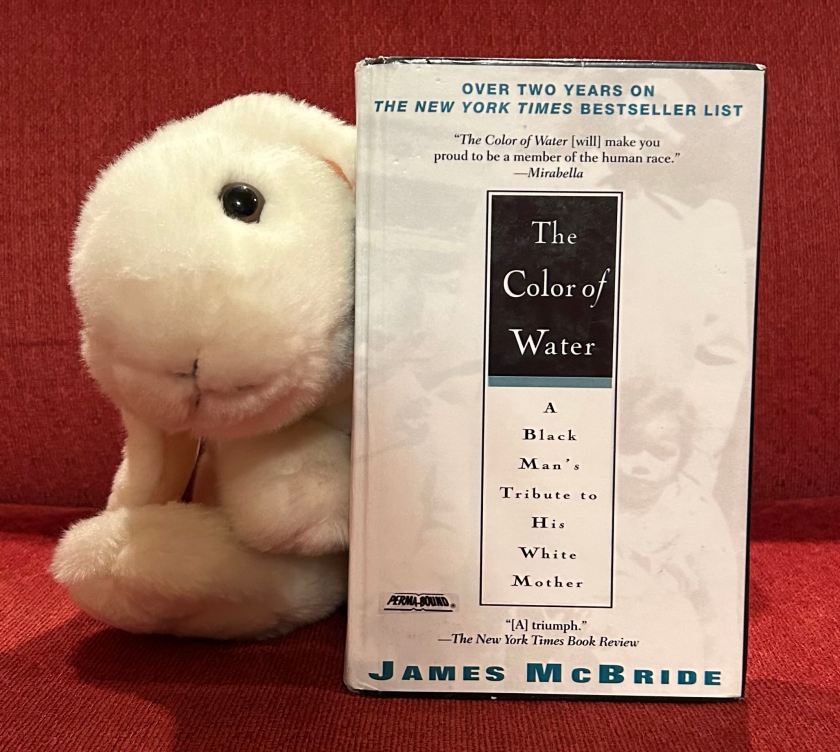
Today Marshmallow is writing about The Color of Water: A Black Man’s Tribute to His White Mother, written by James McBride and first published in 1995.
Marshmallow reviews The Color of Water: A Black Man’s Tribute to His White Mother by James McBride.
Marshmallow’s Quick Take: If you like biographies that reveal nuanced stories about race, family, identity, and love, then this is the book for you!
Marshmallow’s Summary (with Spoilers): James McBride is a Black man with a White mother. Today, this would likely not be considered much of a big deal. After all, mixed race marriages are something relatively commonplace in the United States today and are the simple result of the fact that love generally does not see color. However, back in the 1960s, such relationships were demonized and the pair separated by all means possible; Loving v. Virginia, the landmark decision of the U.S. Supreme Court on interracial marriage was only passed in 1967.
For James’ mother Ruth, this was yet another struggle in a long, seemingly endless line of strife. She was born in America to two Polish Jews and, due to the fact that her father was a “lousy rabbi,” her family had to keep moving to find new places of work for him. Eventually, they settled down in Suffolk, Virginia. There, Ruth felt discrimination firsthand constantly, with classmates calling her “Jew baby” or worse. But she also witnessed the overt racism directed towards Black people around her. Her first boyfriend, Peter, was a Black man and the young couple kept their relationship a secret out of fear of the KKK. Ruth also faced consistent abuse at home from a father that emotionally, physically, and sexually tormented her; yet, despite all of this, she persevered quietly and eventually built a family. She then kept rebuilding every time she was torn down.
In The Color of Water, the author James McBride tells the story of Ruth’s life intertwined with segments of his own autobiography in between. McBride describes his chaotic environment growing up as the eighth child out of twelve total. While he knew he was loved, there was unending pressure from Ruth to be academically successful, and within such a large family, there was not enough attention to go around. As James grew older, he started recognizing that his mother’s race was different from his own and that race was a construct that society unfortunately valued in countless ways. In seeking to uncover the details of his mother’s life, James simultaneously searches for his own identity and the role that race has in America. This likely won’t come as a surprise to anyone, but the answer is nuanced and riddled with mystery—much like Ruth herself.
Marshmallow is reading The Color of Water: A Black Man’s Tribute to His White Mother by James McBride.
Marshmallow’s Review: I found The Color of Water: A Black Man’s Tribute to His White Mother to be a very interesting book. As a mixed race bunny growing up in a quite mixed neighborhood and school district, I have never really felt any need to ‘discover myself’ because I already knew what I was. However, James’ identity quest is understandable, especially because race was even more central to society in those times. Today, of course, race is still an issue, but seeing the way our nation was back then gives you a better sense of the role of race over time.
The Color of Water: A Black Man’s Tribute to His White Mother examines race on a national scale by specifically analyzing its role within a family setting. James’ story is rather unique, but the themes throughout the book (abuse, race, search for security, selflessness, grief, etc) are representative of the general human experience in certain ways. I think the fact that his life is sort of a more extreme version of general experiences helps highlight how remarkable the people in his life—and most people in general—are.
The book is relatively easy to read and I think the author wrote it for a broad audience. There are mentions of sexual abuse, drug use, and violence, so some parts might make this better for older readers (maybe twelve and older?) But overall, The Color of Water is a very important book that reveals simple truths about love, humanity, and America—such as the obvious fact that race should never dictate anything, especially love.
Marshmallow’s Rating: 100%.
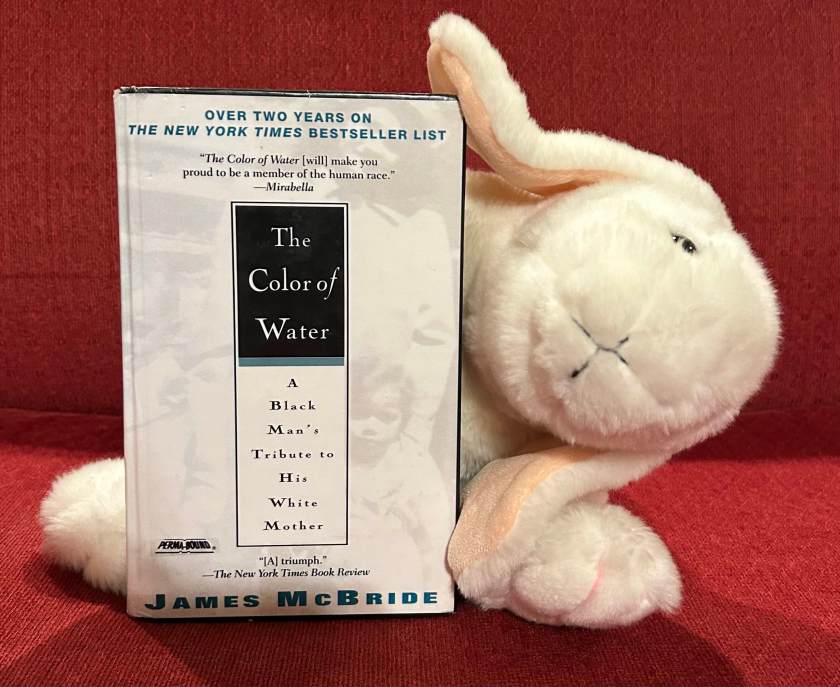
Marshmallow rates The Color of Water: A Black Man’s Tribute to His White Mother by James McBride 100%.
Sprinkles has recently seen the one-woman play Diving Into Math with Emmy Noether, performed expertly by Anita Zieher. When she saw the play, she was in the middle of writing a joint review of two recent biographies on Emmy Noether for the newsletter of the Association for Women in Mathematics: Proving it Her Way: Emmy Noether, A Life in Mathematics, by David E. Rowe and Mechthild Koreuber, and Emmy Noether – Mathematician Extraordinaire by David E. Rowe, published in 2020 and 2021, respectively. The play impacted her deeply, and so she began to wonder if there were any good books about Emmy Noether written for children. This post is the outcome of her resulting explorations.
Today I am writing to share with you some of my thoughts on reading two children’s books about Emmy Noether (1882-1935), who just happens to be one of the greatest mathematicians of the twentieth century. After having reviewed a whole bunch of children’s books about Ada Lovelace, I expected that Noether’s life must also have been depicted in several children’s books, given the importance of her work to modern mathematics and physics.
Emmy Noether’s life is also intrinsically interesting: though filled with sorrows and frustrations, and all sorts of challenges due to her gender (being a woman) and ethnicity (being a German Jew during the rise of Nazism before World War II), Noether’s life was also jam-packed with good friendships, great creative accomplishments, and according to the one-woman play Diving into Math with Emmy Noether performed by Anita Zieher, plenty of delicious pudding. [In case you are interested, here is a trailer for the play:
Trailer for Diving into Math with Emmy Noether, via YouTube.]
Especially after seeing Diving Into Math, I was convinced that Noether’s story would be appealing not only to an adult general audience of curious readers but also to a great many young readers. So I began to look around for books intended for a young audience.
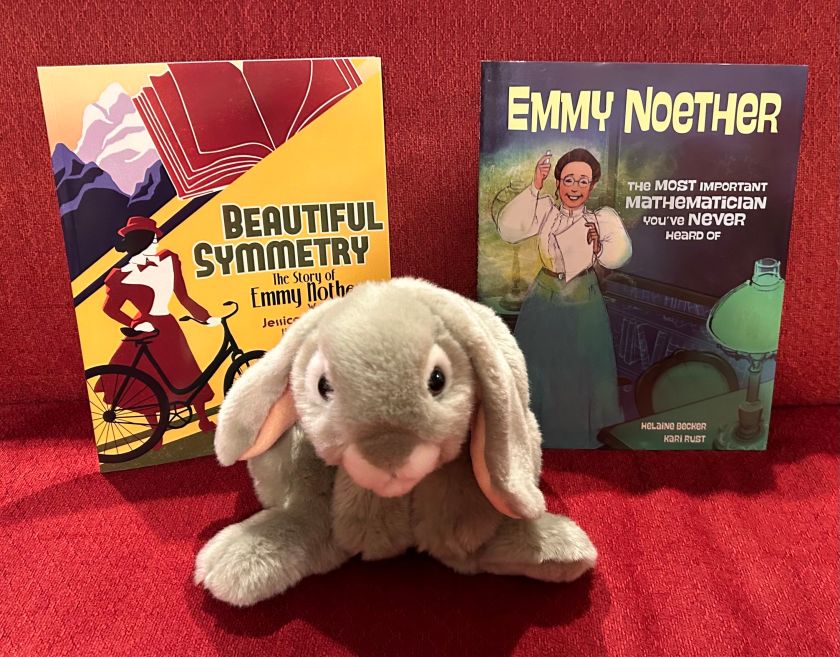
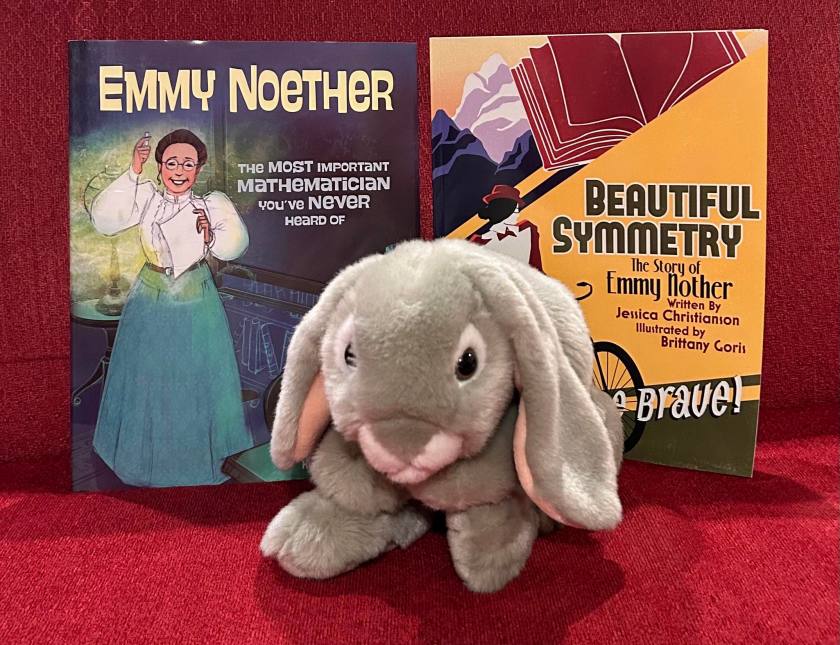
Surprisingly I could find only two books: Beautiful Symmetry: The Story of Emmy Noether, written by Jessica Christianson and illustrated by Brittany Goris, and Emmy Noether: The Most Important Mathematician You’ve Never Heard Of, written by Helaine Becker and illustrated by Kari Rust. Both books are interesting and could be appealing to young readers, though I believe they have somewhat different strengths.
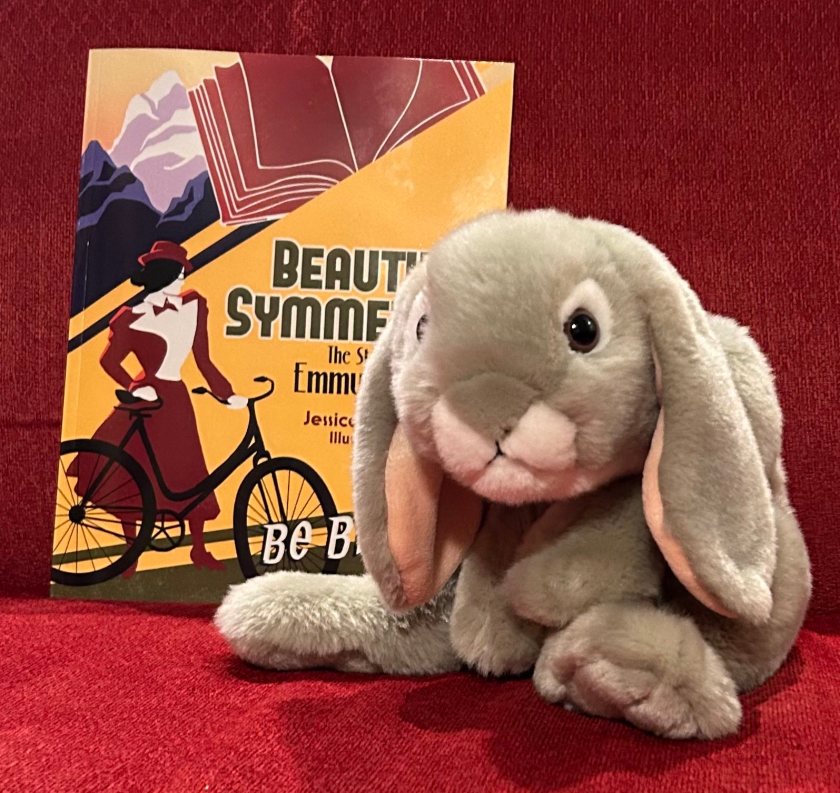
Sprinkles is posing with Beautiful Symmetry: The Story of Emmy Noether, written by Jessica Christianson and illustrated by Brittany Goris.
The first of the pair, Beautiful Symmetry: The Story of Emmy Noether, written by Jessica Christianson and illustrated by Brittany Goris, was published in 2017. In softcover paperback, the book is large format. The bold, striking page design which alternately reminded me of political posters and The Powerpuff Girls, and the large font used throughout might make the book more appealing to younger bunnies. The story of Emmy Noether’s life is told in the book in broad strokes, and that might also help with the younger crowd.
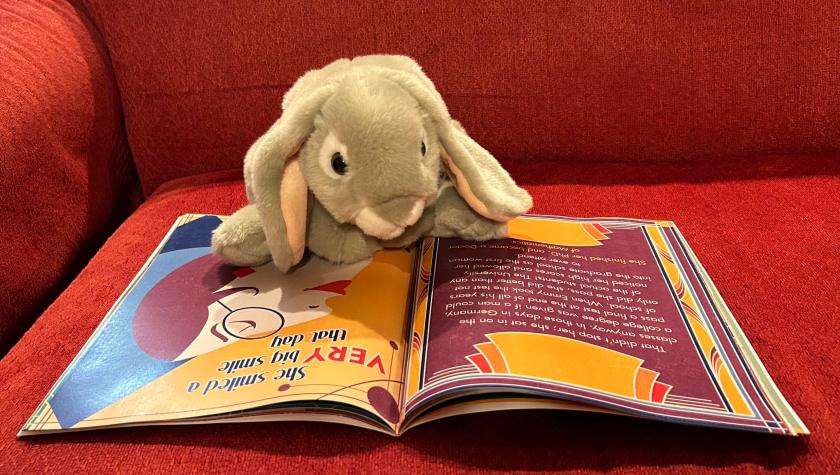
Beautiful Symmetry is visually very appealing and symmetry abounds throughout the book, adding to the theme and encouraging the reader to associate Noether’s life and accomplishments with the visual experience of symmetry. The end of the book has a short section on Emmy Noether’s mathematical work as well as a few simple math puzzles for the young readers who might want to explore math on their own a bit now that they have presumably gotten all inspired by the story they just read. I liked and appreciated each of these features.
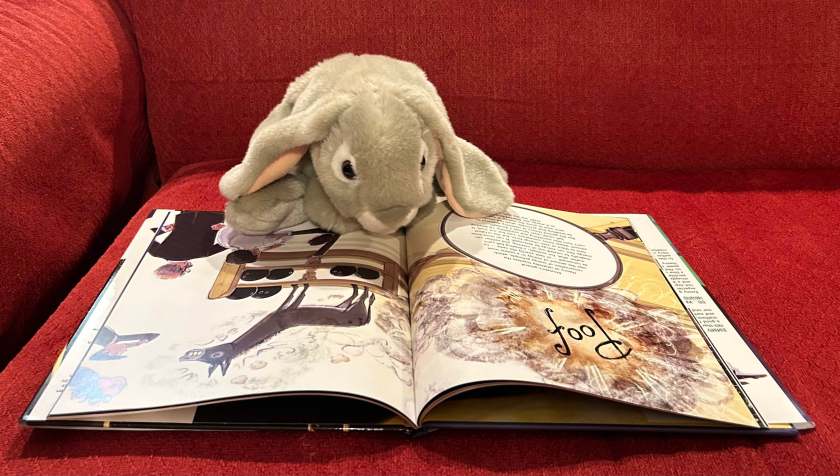
Sprinkles is reading Beautiful Symmetry: The Story of Emmy Noether, written by Jessica Christianson and illustrated by Brittany Goris.
Unfortunately, one occasionally finds a few factual errors here and there. For example, it was not a simple university official but the great mathematician David Hilbert who defended Emmy Noether in Göttingen, and he did not mention a locker room; rather he said “After all, we are a university, not a bathhouse.” (Well, he said it in German, so his exact words were “Meine Herren, der Senat ist doch keine Badeanstalt.”) Here is another example: Emmy Noether eventually did find a position at Bryn Mawr College, but despite what we read in Beautiful Symmetry, she never became the math department head there. (For more on Noether’s time at Bryn Mawr, see, for example, “A Refugee Scholar from Nazi Germany: Emmy Noether and Bryn Mawr College” by Qinna Shen.) These and a couple other small errors (including an embarrassing typo on the front cover) make me a bit wary to encourage readers to use this book as a reference for a book report.
For a book report, a much better reference would be Emmy Noether: The Most Important Mathematician You’ve Never Heard Of, written by Helaine Becker and illustrated by Kari Rust, and published in 2020. This book is well researched and according to the acknowledgments, had some fact-checking assistance from the Perimeter Institute. So in terms of facts, including the math and physics connections of Noether’s work, this book is a lot more reliable.
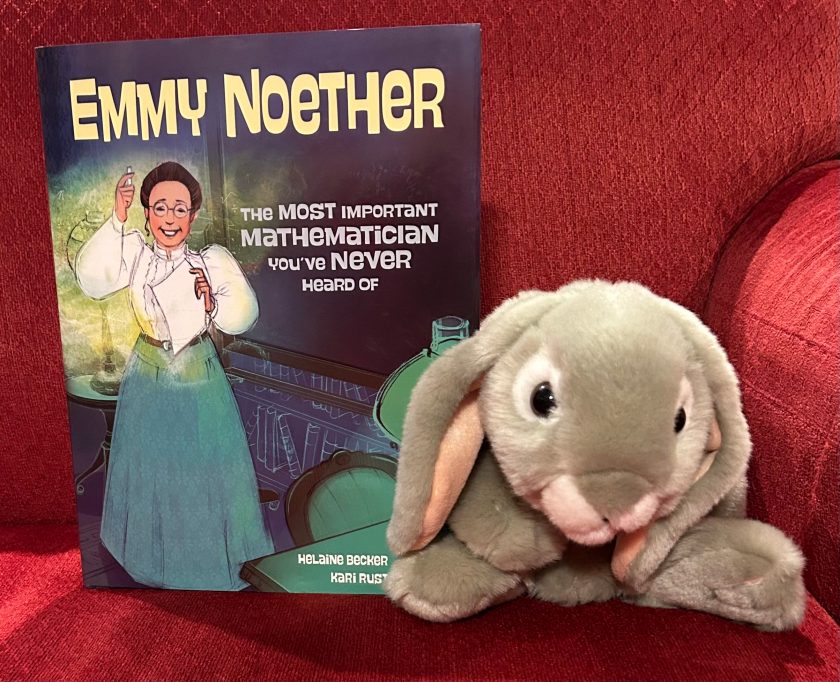
Sprinkles is posing with Emmy Noether: The Most Important Mathematician You’ve Never Heard Of, written by Helaine Becker and illustrated by Kari Rust.
Emmy Noether: The Most Important Mathematician You’ve Never Heard Of was published in 2020, and the title is reminiscent of a 2012 New York Times article on Noether, “The Mighty Mathematician You’ve Never Heard Of” by Natalie Angier. But that essay, though very well written, made an unfounded claim that Noether published articles using men’s names. (Beautiful Symmetry also makes this unfounded claim, so perhaps Angier’s article led to some misunderstandings that were propagated. See this discussion for more details on the claim.) Becker’s book does not fall into such oversimplifications. And the story of Emmy Noether does not need such tropes. It is fascinating on its own with no need for embellishments.
Rust’s illustrations are cute and sharp at the same time, and the cartoonish detractors of Noether are shown humorously while the severity of Noether’s challenges is not minimized. The math and physics connections of her work are explained with precise terms in what is still a totally comprehensible language, and the illustrations support these descriptions. The book manages to distill into simple language some relatively abstract and advanced mathematical ideas, and somehow still retains a entertaining quality. The reader cannot help but root for Emmy, and laugh triumphantly each time she embarrasses her detractors.
Sprinkles is reading Emmy Noether: The Most Important Mathematician You’ve Never Heard Of, written by Helaine Becker and illustrated by Kari Rust.
All in all, I enjoyed reading Emmy Noether: The Most Important Mathematician You’ve Never Heard Of, and would definitely recommend it to any young person interested in learning about what a mathematician does. Similarly the book would work well to introduce young bunnies to a most creative and impactful woman scientist, whose name is unfortunately not as well known as some others. There is a significant amount of math in the book, too, for those who want it, though the reader who does not want to dive too deep into those pools can easily avoid the more technical bits (left to a separate section at the very end) and enjoy and appreciate the rest of Emmy Noether’s story completely.
To be honest, I did enjoy reading both books, and despite the factual errors of Beautiful Symmetry, I would recommend either book to young readers. If one is looking for complete factual accuracy of course, I’d suggest sticking with The Most Important Mathematician You’ve Never Heard Of, or perhaps even jumping over to the other side and looking into some of the more standard biographies, written for adult consumption. Proving It Her Way by David E. Rowe was published in 2020 to accompany the play Diving into Math with Emmy Noether I started this review with. Rowe is a historian of mathematics, but this book was intended for a general audience. As such, I think it could be a great next step for anyone interested in learning more about this creative mind who found so much joy in mathematics, abstract ideas, and good intellectual companions.
Sprinkles encourages all young bunnies to learn more about Emmy Noether by exploring one of the two children’s books about Emmy Noether she reviewed here: Beautiful Symmetry: The Story of Emmy Noether, written by Jessica Christianson and illustrated by Brittany Goris, and Emmy Noether: The Most Important Mathematician You’ve Never Heard Of, written by Helaine Becker and illustrated by Kari Rust.
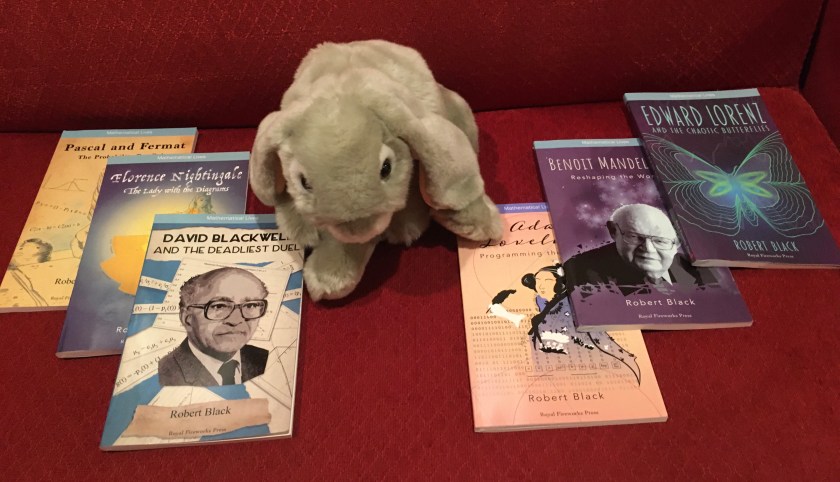
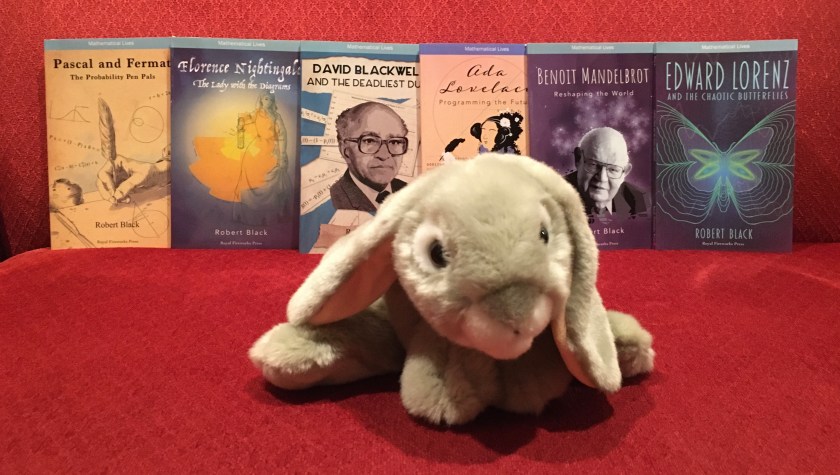
Sprinkles reviews the Mathematical Lives series by Robert Black. From left to right: Pascal and Fermat: The Probability Pen Pals (2019), Florence Nightingale: The Lady with the Diagrams (2019), David Blackwell and the Deadliest Duel (2019), Ada Lovelace: Programming the Future (2020), Benoit Mandelbrot: Reshaping the World (2021), and Edward Lorenz and the Chaotic Butterflies (2022).
Last summer Sprinkles got a hold of a few mathematical biographies, written by Robert Black and published by a small publisher focusing on the homeschooling and educational enrichment market named Royal Fireworks Press. She was planning to at least skim through the books herself before sharing them with the younger bunnies of the household, but once she began reading, she could not put them down. She ended up reading all the books pretty fast, and earlier this year, when she learned that the series had a sixth book, she decided to read that too. In this review, she writes about the whole series, sharing her thoughts on what young bunnies might get out of them (quick hint: a lot!). She also explains why curious adult bunnies might want to read these books, too, whether they like math or not. The quick summary is that the books show us very clearly that people who come up with some of the most fanciful and powerful mathematical theories are all human, with human challenges, human dilemmas, human desires and concerns. And their mathematics is much more interesting in the context of their lives.
Read on for the long version.
Sprinkles reviews the Mathematical Lives series by Robert Black. From left to right: Pascal and Fermat: The Probability Pen Pals (2019), Florence Nightingale: The Lady with the Diagrams (2019), David Blackwell and the Deadliest Duel (2019), Ada Lovelace: Programming the Future (2020), Benoit Mandelbrot: Reshaping the World (2021), and Edward Lorenz and the Chaotic Butterflies (2022).
Mathematics is a common topic of discussion in the book bunnies household, and the book bunnies have reviewed many mathematical books written for children for the book bunnies blog. I have personally reviewed Women Who Count: Honoring African American Women Mathematicians by Shelly M. Jones as well as several books written about Ada Lovelace. More generally, you can check out all posts we published that are tagged “math“. So when I got a hold of a neat collection of mathematical biographies, written by Robert Black, that are aimed for a young but curious audience, I thought I could write a review of them all for the blog, too. After all, the young bunnies have been complaining nonstop about how I have not reviewed anything for a long time now.
So in this review, I’m talking about Robert Black’s Mathematical Lives series, currently composed of six books: Pascal and Fermat: The Probability Pen Pals (2019), Florence Nightingale: The Lady with the Diagrams (2019), David Blackwell and the Deadliest Duel (2019), Ada Lovelace: Programming the Future (2020), Benoit Mandelbrot: Reshaping the World (2021), and Edward Lorenz and the Chaotic Butterflies (2022). Most of these names are not household names. One might wonder why the author chose these particular people to write about. (I will get to that at the end of this review.) Even though I had heard of all six of them, and reviewed several books written about one of them, in most of the cases, I did not know the specifics of the lives and achievements of these people. And reading these books, I learned a lot. A lot of mathematics as well as a lot of interesting facts about the lives of six fascinating people.
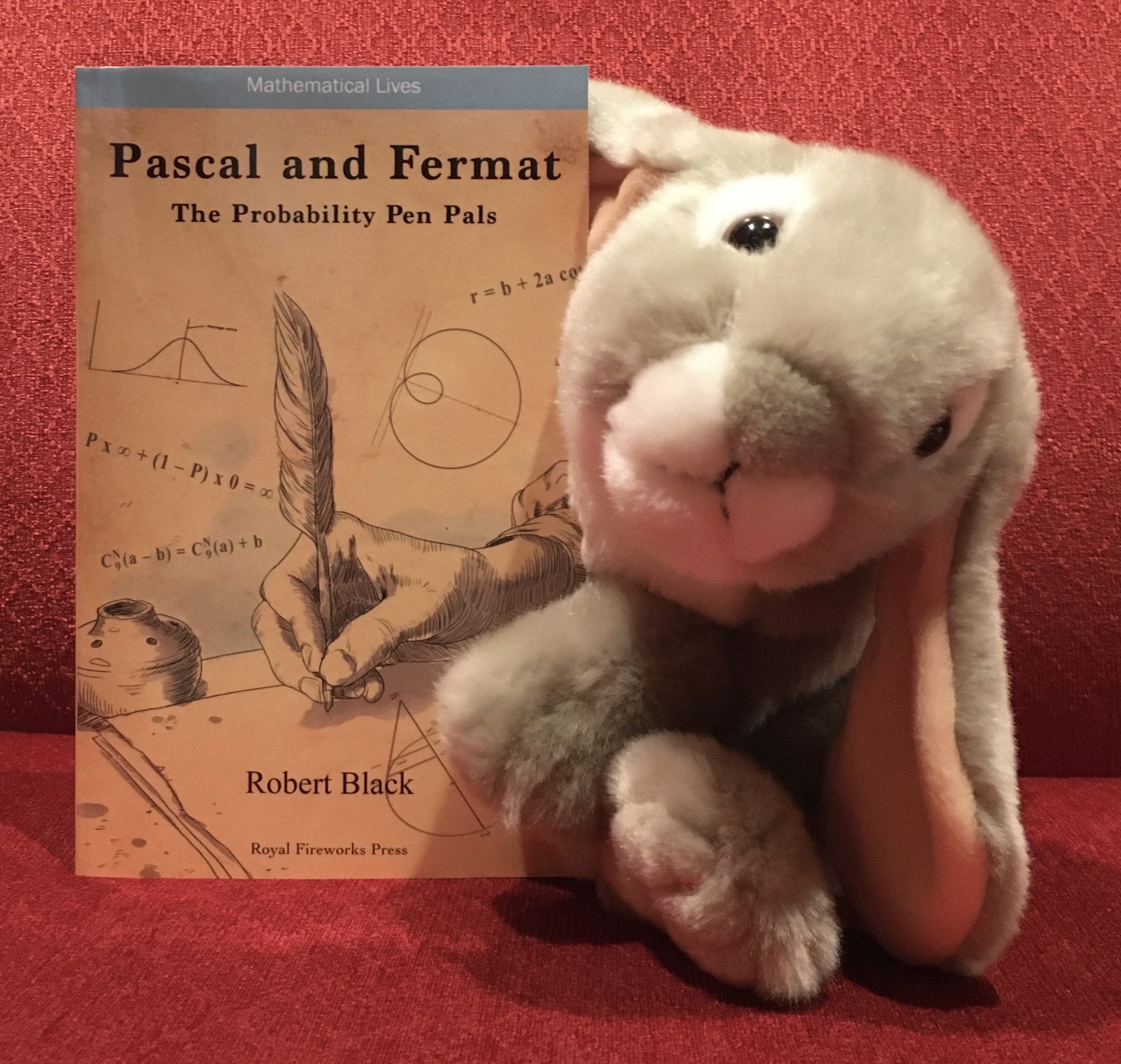
Sprinkles is posing with and then reading Pascal and Fermat: The Probability Pen Pals (2019) by Robert Black.
Let me begin with the first book I read from the series: Pascal and Fermat: The Probability Pen Pals (2019). This is the story of Blaise Pascal (1623-1662) and Pierre de Fermat (1607-1665), and how through letters, they developed the foundational concepts of modern probability theory.
The book, like all the others in the series, is divided into ten short chapters. We start with Blaise Pascal, more specifically his family. The author portrays the general setting in which Blaise finds himself, both historically and culturally. Along the way, we learn of the specifics of a question a friend asks Blaise about gambling that gets the ball rolling and leads eventually to the correspondence between Blaise and Pierre de Fermat that in turn leads the two, Blaise and Pierre, to the modern constructs of probability.
The math is sprinkled here and there, always written in an accessible manner, in digestible chunks. The author is writing for a young but curious audience and it seems to me that he knows well how to keep them interested, how to zero in on the crux of the issue at hand, and how to impart significant amount of math accurately all the while keeping things still manageable.
The ten chapters of the book also include a solid narrative on Fermat’s own life story, and the stories of several other mathematicians whose ideas and earlier attempts formed the background to the mathematics the main characters of the book ended up extending, enhancing, and building upon. The author is especially skilled at making connections and finding contexts for the math he is talking about that would be comprehensible to a young bunny, or a curious adult bunny.
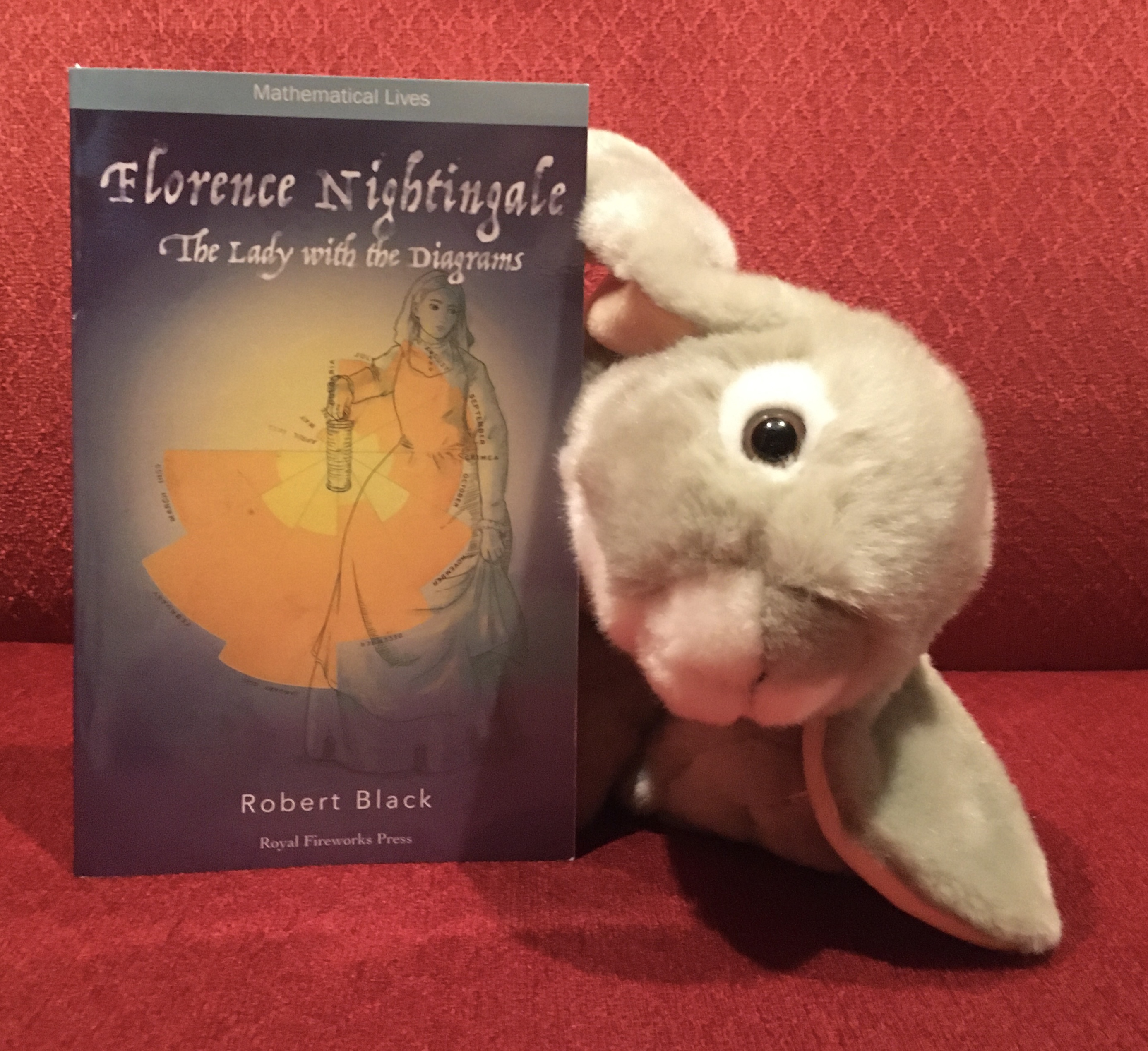
Sprinkles is posing with, and then reading Florence Nightingale: The Lady with the Diagrams (2019) by Robert Black.
Next let me tell you a bit about Florence Nightingale: The Lady with the Diagrams (2019). This is the story of Florence Nightingale (1820-1910), the lady with the lamp, as she was called by many who wanted to remember her role in modernizing the world of nursing (and along with it, updating the whole medical establishment of her times) during and after her service as part of the British corps of nurses in the Crimean War of 1853-1856. In this book we learn about her other (but related) heritage: the statistical work she did to bring attention to the many challenges of hospital care during the war.
After a short prologue that quickly brings the reader up to speed about the general outlines of Nightingale’s life and how her work related to the modernization of nursing (“The Lady with the Lamp”), the book starts with a chapter titled “Misfit in an English Lady’s World”. We learn about Florence as a young girl, her family background, and the general societal expectations from a young woman of her upbringing. We follow Florence as she grows up, learn more about her interests and concerns, and eventually, arrive at the path that takes her to the military hospital in Scutari (today’s Üsküdar, which English-speaking folks might know from this rendition of a classic Turkish song by Eartha Kitt).
Soon math, or more specifically statistics, comes up as Florence looks for a way to help the data tell the right story about the problems she has observed during the war time: how poor sanitary conditions were leading to significant loss of life and how certain standards of care could improve the situation. Florence develops novel and creative visualization methods that finally allow her to tell the whole story clearly to the public as well as the folks in power who can, and eventually do, make the necessary changes.
The math content of this book, just like in all the other books in the series, is distributed among many chapters, showing up in digestible chunks. Some of this content is directly related to what Florence herself did, and some of it is provided as background for the reader to understand how her work fits in with the main history of the development of the field. All in all, the reader gains a solid understanding of the life and times of Florence Nightingale, as well as her significant mathematical contributions, all within about a hundred pages. The book, just like all the other books in the series, concludes with an appendix titled “Doing the Math”, where the author offers some concrete problems for the interested readers to play with and take their understanding further.
Sprinkles is posing with, and then reading David Blackwell and the Deadliest Duel (2019) by Robert Black.
The third book from Black’s Mathematical Lives series that I read was David Blackwell and the Deadliest Duel (2019). David Blackwell (1919-2010) was a mathematician who made significant contributions to game theory, probability theory, information theory, and statistics. He was a brilliant theory builder as well as a problem solver, a great communicator as well as an educator.
David Blackwell and the Deadliest Duel (2019) is organized in a way similar to all the other books in the series. The life story of David Blackwell is intertwined organically with some of the most curious problems that Blackwell worked on and the theories he made significant advances in. We learn about the mathematical study of games, and duels in particular, which Blackwell thought deeply and productively about. We also learn about Bayesian probability theory, which approaches the problems of probability in the background context of what we know and what we believe. These topics could get very hairy and pretty incomprehensible very quickly, but the author skillfully manages to give us exactly what we need to get a a general sense of the theories, only focusing on a handful of concrete situations that clearly display the mathematics without making things too complicated.
David Blackwell had an illustrious career, spanning several decades, and today he is remembered as a brilliant mathematician. There is a well-known theorem and an annual award named after him. However, his story also reflects many instances of how things were a lot more difficult for a black person in the United States, no matter how brilliant. Robert Black, the author, does not shy away from this dimension of Blackwell’s life story, and I believe that young bunnies will be able to appreciate Blackwell’s achievements even more, given this background.
All books in the series include a “For Further Reading” section at the end, right after the “Doing the Math” appendix. In David Blackwell and the Deadliest Duel (2019), this section includes a link to a video recording of a special lecture Blackwell gave many years ago titled “Predicting at Random”. The link provided did not work for me, but luckily, I was able to find it at https://www.maa.org/david-blackwell-predicting-at-random. If you are at all interested in seeing this great mathematician in his element, sharing some math he likes with a wider audience and doing a great job with it, check it out. But even if you are not such a math fan, the book is worth reading, as it tells a unique tale, involving math, sure, but also a whole lot of humanity. A crisp snapshot of the whole twentieth century comes along as a bonus.
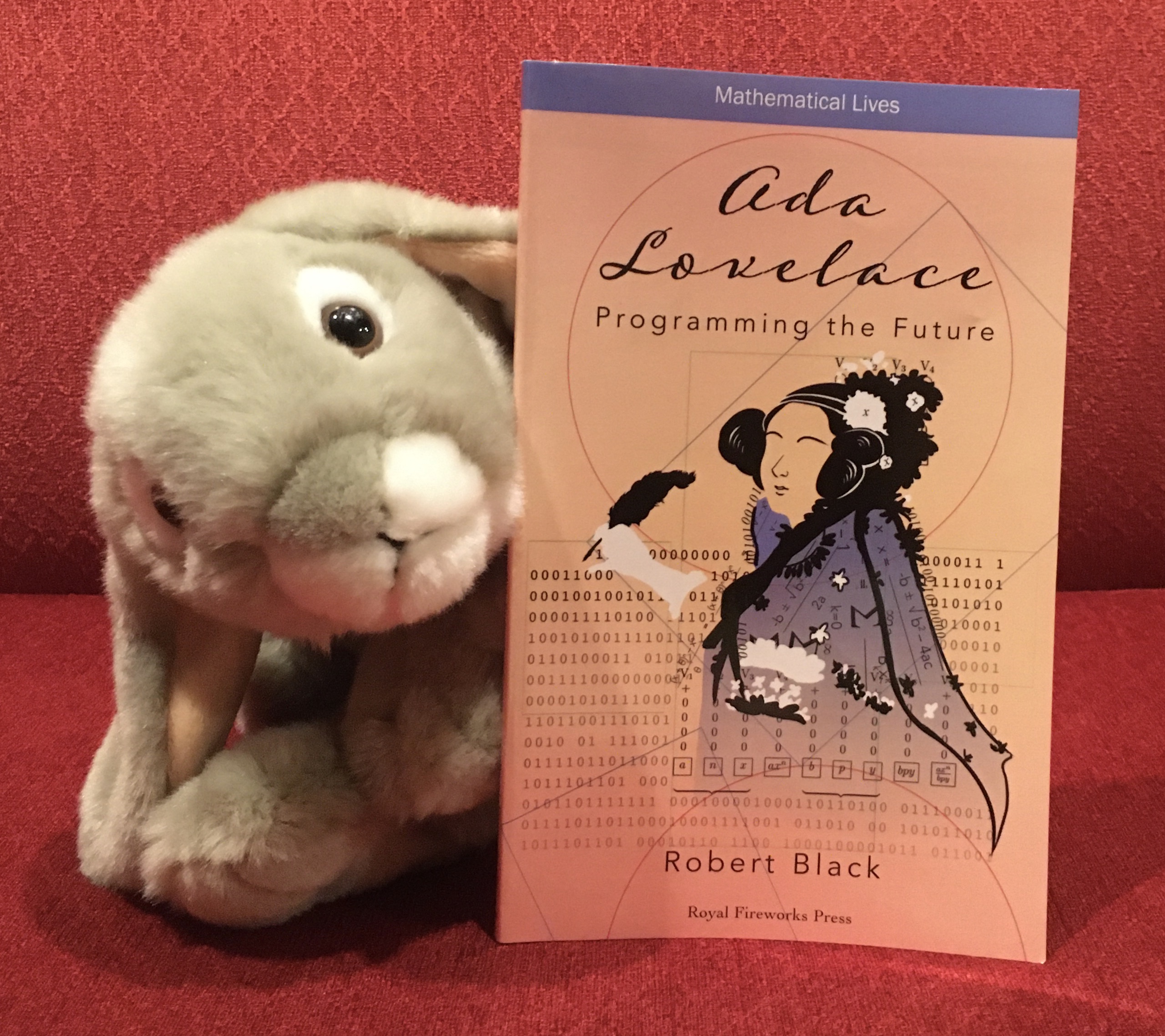
Sprinkles is posing with, and then reading Ada Lovelace: Programming the Future (2020) by Robert Black.
I approached Ada Lovelace: Programming the Future (2020), Black’s book about Ada Lovelace (1815-1852), the woman who is today recognized as the first computer programmer in the world, with some unease. I read a lot about Ada Lovelace. And as I mentioned above, I have reviewed several books about her written for a younger audience. I have also read a lot of books about her written for a more mature audience. In short, I already knew a lot about her and her work, so I was wary. I was also a bit worried that I would find something I did not agree with in Black’s presentation, something that would not sound right to me, and that would taint my positive opinion of his meticulous work, which so far seemed to me to be not only accessible and engaging but also mathematically accurate to a surprising level (I say “surprising” because it is often really difficult to explain sophisticated technical content to a young audience, and Black has done an outstanding job with it).
Let me quickly say that my concerns were unwarranted. I liked the book a lot. Black does an excellent job telling the story of Ada, as well as the technical work she contributed to. The many mathematical ideas presented in the book are accurately described, and Black does not withhold from his reader the historical debate about exactly what parts of the work credited to her actually belongs t0 Ada. All in all this is a well-written, well-balanced account of Ada Lovelace and her achievements.
Once again Black develops the life story of his main character within the broader historical, cultural, and social context of her time. The mathematical context is presented clearly as well. Black is also an excellent storyteller. Even though I knew almost everything in the book (having already read over thirty books on Lovelace myself), I enjoyed reading it page by page, line by line, eagerly looking forward to seeing how he would tie things up.
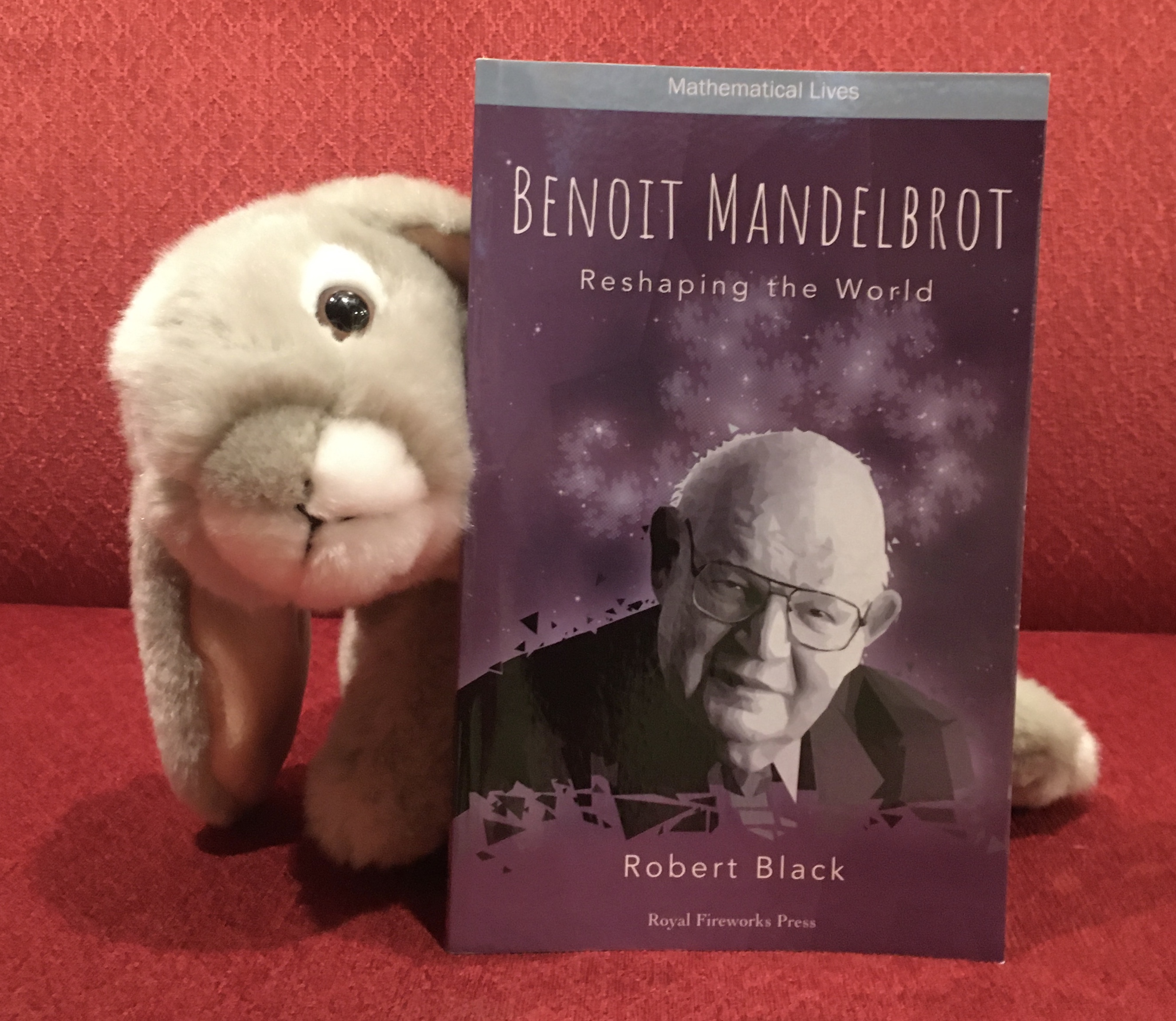
Sprinkles is posing with, and then reading Benoit Mandelbrot: Reshaping the World (2021) by Robert Black.
The fifth book in Robert Black’s Mathematical Lives series is Benoit Mandelbrot: Reshaping the World (2021). The book tells the story of Benoit Mandelbrot (1924-2010), who is known as the father of fractals. Even if you have not engaged with theoretical mathematics in the past, you must have seen or heard of fractals. Even Elsa mentions them in her famous song “Let It Go”.
Here is the amazing fractal called the Mandelbrot set (named after the guy this particular book is about, because he is the one who discovered its construction and explored some of its complex features):
You can read more about the Mandelbrot set here. But let us get back to the book.
We start with a prologue as always. This one is titled “Clouds Are Not Spheres”, a quote from Mandelbrot himself, whose work offers us an alternative way to think about the world around us, different from the standard one we are taught at school geometry classes, with their emphasis on Euclidean geometry (triangles, circles, spheres, and so on). The prologue whets our appetite, but as usual, the first chapter begins with the childhood of young Benoit and his early life with his family. We travel with the Mandelbrots as they move from one place to another, trying to find a place that is safe for their Jewish family (which, given the time period, was exceptionally difficult to do in Europe). We see Benoit thrive mathematically nonetheless.
The mathematics incorporated into this book, as I expected after having read the previous four books, reflects its main character, and is as eclectic as the person who created said mathematics. One of Mandelbrot’s main strengths seems to have been bringing together seemingly disparate ideas and seeing the connections between them in the form of certain simple rules describing complex systems. And the disparate ideas he brought together are really diverse. The book tells a fascinating story, and shows us some of the connections Mandelbrot does make, and overall, Benoit Mandelbrot: Reshaping the World is a very satisfying read.
Sprinkles is posing with, and then reading Edward Lorenz and the Chaotic Butterflies (2022) by Robert Black.
The most recent book in Black’s Mathematical Lives series is Edward Lorenz and the Chaotic Butterflies (2022), which is about Edward Lorenz (1917-2008). Some of the adult bunnies reading this review might know that his name is closely associated with that of Benoit Mandelbrot from the previous book. The longer story is told exquisitely in a 1989 book which has now become a classic Chaos: Making a New Science by James Gleick. But the shorter story, as told in the two volumes by Black, is still fascinating.
Lorenz and Mandelbrot did not really work together, but their work complements one another. Lorenz began in the world of meteorology and his explorations to understand and predict weather patterns took him from computer modeling to the more general exploration of dynamical systems which are extremely sensitive to changing initial conditions. He discovered various contexts where simple tweaks on the settings of a given system led to drastically different behavior. This in turn led him to the theory of chaos.
Black once again tells his story within a completely developed context. We read about Edward Lorenz, and his childhood days. We read about how he found his way into meteorology, and how his interest in weather modeling was influenced by the Second World War. We learn about other pioneers of weather modeling and how Lorenz built upon their work. And here and there, we get a good number of glimpses into the actual math involved.
Sprinkles thinks that the books in the Mathematical Lives series by Robert Black make for excellent reading, both for young bunnies and the adult ones. From left to right: Pascal and Fermat: The Probability Pen Pals (2019), Florence Nightingale: The Lady with the Diagrams (2019), David Blackwell and the Deadliest Duel (2019), Ada Lovelace: Programming the Future (2020), Benoit Mandelbrot: Reshaping the World (2021), and Edward Lorenz and the Chaotic Butterflies (2022).
Overall I think that each of the books in the Mathematical Lives series by Robert Black make for excellent reading, both for young bunnies and the adult ones. Young readers should probably already be somewhat curious about math to be able to get much out of the books, but once they are interested enough to pick up a book about “some guy who seems to have done some neat math” or “some lady who apparently did some cool math”, these books will definitely carry them along all the way to the end. They are well written and engaging enough to keep the reader’s attention, for sure.
Now for the adults: I am not sure anyone who is not already somewhat curious about math or mathematicians would be picking up a book of this sort, but I wish they would. These books show that math is not a stuffy subject, that math is alive, and that the people who create it, who live their lives filled with it, are fully human, with human challenges and human concerns. The historical, cultural, and the social contextualization provided in each of the books also allows us to see where we are today and how we got here from where the characters of the book were when they lived. Furthermore, the books make so many concrete connections with the real world that it is almost impossible for anyone to say math is a useless game of pure abstractions.
In some ways, these concrete connections may be a bit disturbing. War plays a significant role in the lives and the mathematics of at least three of the mathematicians in these books: Florence Nightingale in Florence Nightingale: The Lady with the Diagrams (2019), David Blackwell in David Blackwell and the Deadliest Duel (2019), and Edward Lorenz in Edward Lorenz and the Chaotic Butterflies (2022). (Especially in Lorenz’s story, we read about some pretty terrible war acts though Lorenz himself is not directly connected to them in any way whatsoever.) War also shows up in Ada Lovelace: Programming the Future (2020), when Alan Turing and the story of the breaking of the Enigma code come up, and in Benoit Mandelbrot: Reshaping the World (2021), when we see how significantly the Second World War impacted Mandelbrot.
But I still very much appreciated reading each and every one of these books. The war connections did not undermine the achievements of these amazing people for me. The problems they solved, they believed they were solving to help humanity. And for the thrill, the curiosity, the challenge of the problems themselves, which is itself such a human thing! (Of course it should also be acknowledged that mathematicians and others who work in problem-solving oriented disciplines like engineering and technology should always keep in mind to what use their efforts are being put to.)
In the end what is my answer to my original question of why the author might have chosen to focus on these six people? Without actually asking the author himself, my answer would merely be a conjecture, but here it goes: I think the author is writing about people and mathematics that he himself finds interesting and important. I am saying this because while reading these six books, I could distinctly sense the tangible, genuine interest of the author in his characters, as well as his fascination and excitement about the math he was writing about.
Also mathematically there are common themes among the works of the mathematicians in these six books. In each book, the math never stands alone; there are always clear real-world connections, both in the origins and the eventual applications of the problems they involve. And the author’s focus on these connections make the books and the math extremely engaging. The probability theory first developed by Blaise Pascal and Pierre de Fermat described in Pascal and Fermat: The Probability Pen Pals (2019) finds its fruits in some of the statistical work done by Florence Nightingale in Florence Nightingale: The Lady with the Diagrams (2019), and the game theory and probabilistic modeling done by David Blackwell in David Blackwell and the Deadliest Duel (2019). The theories of computation that Ada Lovelace’s work is a natural foundation for as described in Ada Lovelace: Programming the Future (2020) eventually allow Benoit Mandelbrot in Benoit Mandelbrot: Reshaping the World (2021) and Edward Lorenz in Edward Lorenz and the Chaotic Butterflies (2022) to see patterns and emergent phenomena that could not be easily seen without computers.
I recommend these six books to anyone willing to check them out, with no reservations, and with the strongest enthusiasm. You will learn some cool math, you will meet some very interesting people, and you will understand our current world so much better.
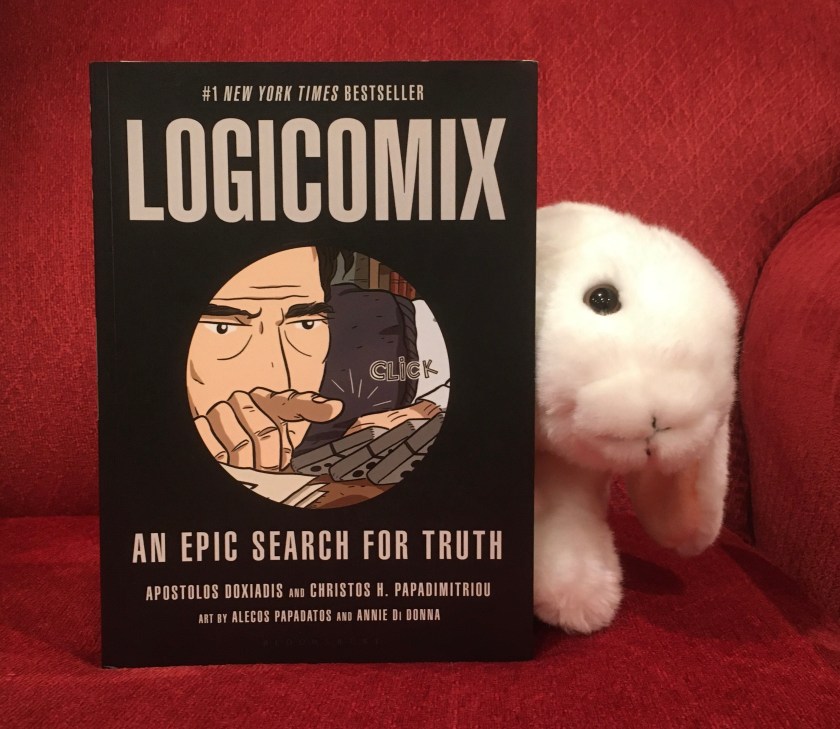
Marshmallow recently got her paws on Logicomix, a graphic novel telling of the first two-thirds of philosopher-mathematician Bertrand Russell‘s life, as it is intertwined with the story of the stormy events related to the philosophical foundations of mathematics that occurred in the early twentieth century. The book is most likely not intended for young readers, but Marshmallow found it interesting and wanted to review it for the book bunnies blog. Below is her conversation with Sprinkles about this book, written by Apostolos Doxiadis and Christos H. Papadimitriou, and illustrated by Alecos Papadatos and Annie di Donna.
Marshmallow reviews Logicomix, written by Apostolos Doxiadis and Christos H. Papadimitriou, and illustrated by Alecos Papadatos and Annie di Donna.
Sprinkles: So Marshmallow, tell us a little about this book.
Marshmallow: The first thing I want to say is that this is not a children’s book. It’s not necessarily inappropriate for children, but some concepts might be confusing for young bunnies.
S: Why did you read it?
M: It looked interesting. It is a graphic novel and I like those.
S: I see. So tell us what it is about.
M: It’s about Bertrand Russell. He is a philosopher. Basically it is about his life.
S: And the book has a really intriguing subtitle: “An Epic Search for Truth”. How is that related to Russell?
M: I think it’s because he spent a lot of time thinking about what truth means, the true meaning of “true”.
S: Yes, Russell is a foundational figure for modern mathematical logic today. I find his story fascinating and I really liked this book myself when I read it. So what else do you want to tell us?
M: There are parts of the book where the two authors, the illustrators, and a researcher who is helping them with the project are talking among themselves. And there are the other parts where we basically follow Bertrand Russell give a speech about his life and his work in logic. The speech is supposed to be about “the role of logic in human affairs” and apparently Russell did not give any such speech.
S: But it probably makes a good plot device to tell us about his life, I guess.
M: Yes, I think it works.
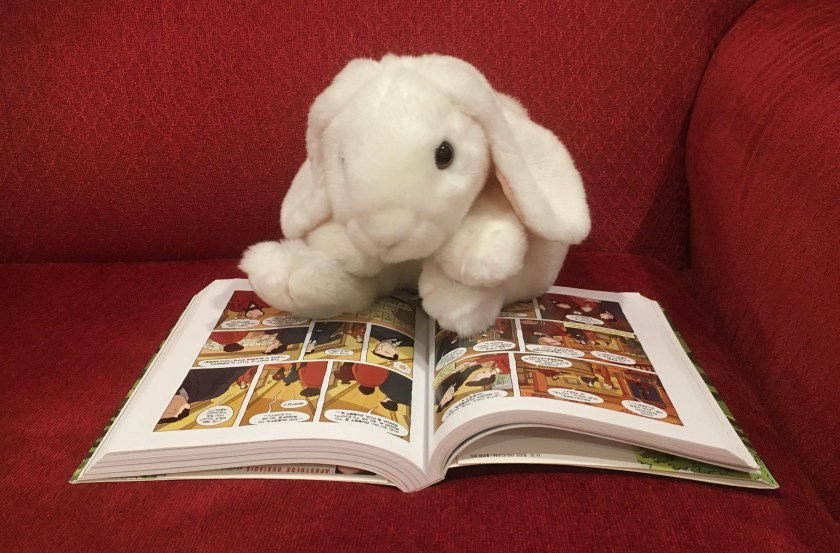
Marshmallow is reading Logicomix, written by Apostolos Doxiadis and Christos H. Papadimitriou, and illustrated by Alecos Papadatos and Annie di Donna.
S: So did you know about Bertrand Russell before reading this book?
M: No.
S: What do you think about him now, after having read it?
M: I think he is an interesting person. But according to this book review you showed me, not everything in the book is accurate.
S: Yes, I think the authors themselves say they took some artistic license with some of the facts. And that book review is a careful scholarly overview of the book that readers who might be curious about the accuracy of the text might check out. But let us get back to your reading of the book. What appealed to you most about this book?
M: Well, I liked the switch between the creators of the book and the subject of the book. It made things interesting. I also did not know about Russell and Wittgenstein and Gödel, and any of those philosophers, so I learned a lot.
S: And the book does cover a lot of ground in terms of the foundational debates of the early twentieth century. How did all that work out for you?
M: What do you mean by foundational debates?
S: I mean, the questions about the foundations of mathematics, of logic, of truth. How these folks were trying to understand why mathematics was true, how it worked, and so on.
M: I think some of that went over my head. But I did find it cool that people were thinking so hard about why math is true.
S: I know you find philosophical questions intriguing. The ones in this book are quite specific to math, it seems at first, but then if you think about it, we all want to know what is true, what makes something true, as opposed to false, fake news, or disinformation, or misinformation.
S: Yes, I really liked your project! So we know it is sometimes hard to know what is true and what is not. And this book is about some philosophers who are trying to think about these questions very carefully and trying to see how to connect them to math.
M: Yes, I think that makes sense.
S: So I know you were not looking for philosophy or math when you started. Did all that overwhelm you when you were reading it?
M: No. I think they explained things in ways people could understand. I guess some things are a bit confusing, and I probably did miss some things, and maybe younger bunnies might not get any of the philosophical stuff, but it was interesting for me.
S: That’s great Marshmallow! And maybe you will come back to this book in a few years’ time if you are curious to dig deeper into the philosophical questions in it. I’m glad you read it!
M: Me too.
S: So as we wrap up this review, I’ll ask how you rate the book…
M: I rate this book 95%.
S: Sounds good! I know you always like to end our chats the way Caramel ends his reviews. So go ahead!
M: Stay tuned for more book bunny reviews!
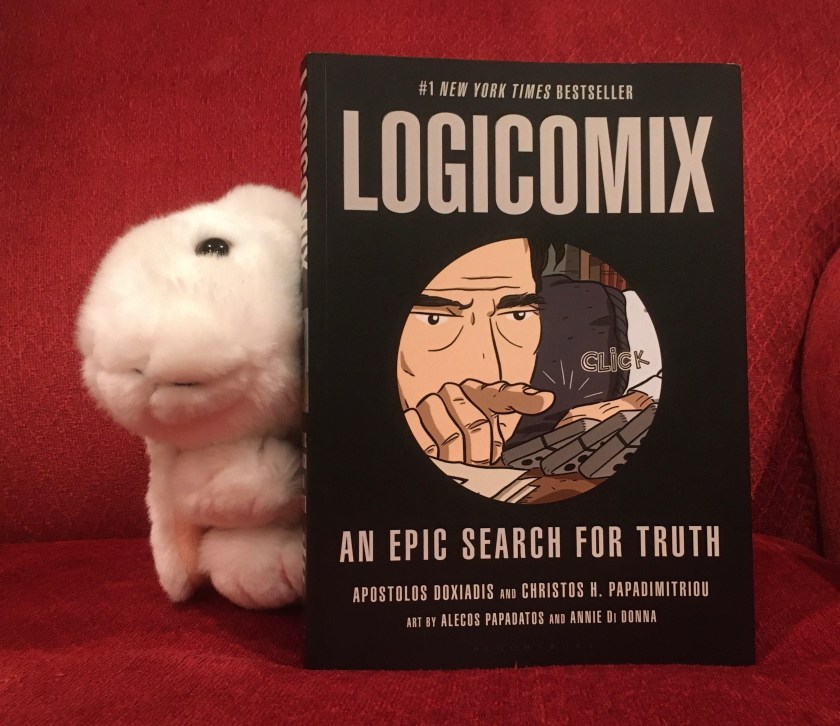
Marshmallow has enjoyed reading Logicomix, written by Apostolos Doxiadis and Christos H. Papadimitriou, and illustrated by Alecos Papadatos and Annie di Donna and rates it 95%.







 BookBunnies