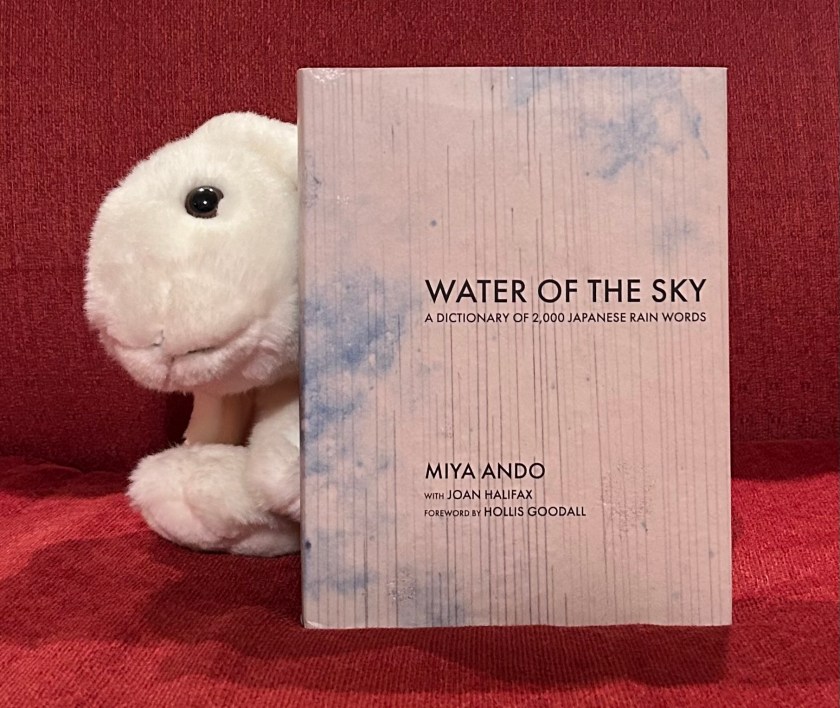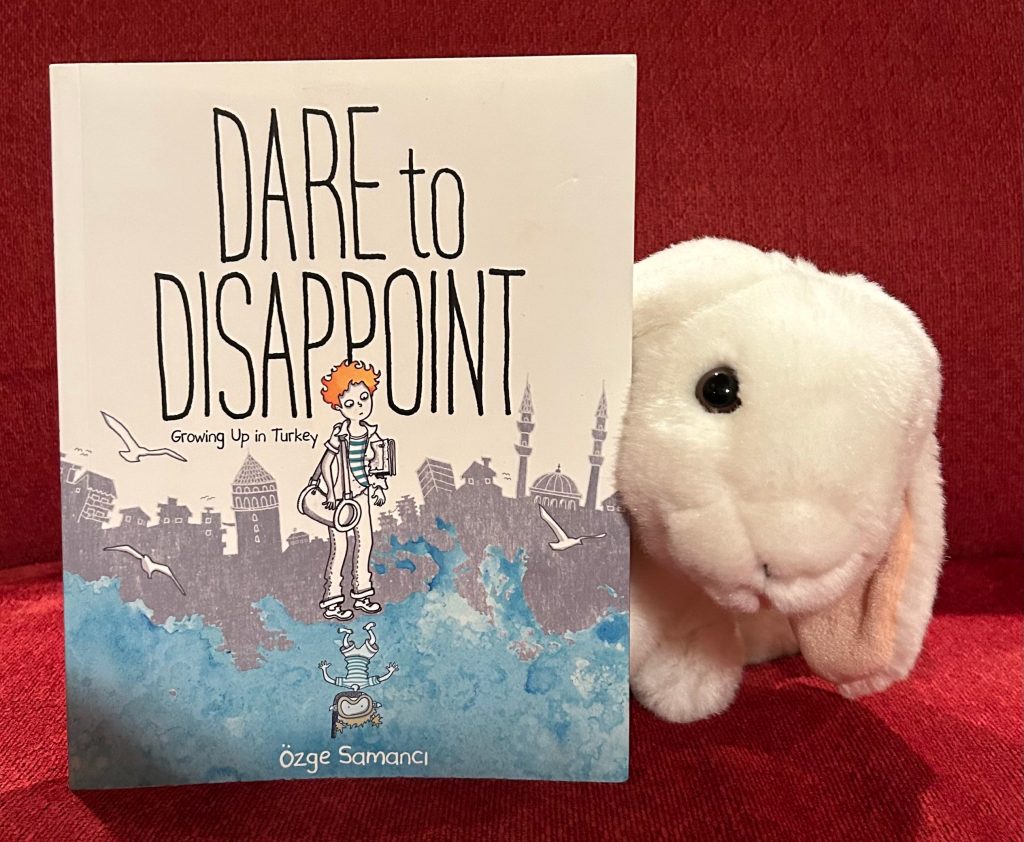
Marshmallow reviews Dare to Disappoint by Özge Samancı

Today Marshmallow reviews the autobiographical graphic novel Dare to Disappoint by Özge Samancı, first published in 2015.

Marshmallow reviews Dare to Disappoint by Özge Samancı.

Marshmallow’s Quick Take: If you like graphic novels or if you enjoy reading books about growing up in general, then this might be the book for you. 

Marshmallow’s Summary (with Spoilers): Özge Samancı grew up in Izmir, Turkey (in late 1970s and early 1980s). Ever since she was very young, she was obsessed with the idea of going to school and loved the school uniforms. Her family’s house was across the street from her older sister’s elementary school, and everyday, Özge and her mother would wave at the sister who was at school. Özge longed to be on the other side, waving back home from behind the school fence. Finally, when she started to go to elementary school, she idolized her first-grade teacher (Turkey did not have a kindergarten grade at the time). But one day, after talking about a bizarre incident on the television, Özge was beaten by her teacher with her pink ruler. Her entire class was punished as well. Özge was confused as to what she or any of her other classmates had done.

As Özge grew older, the political tension in Turkey increasingly impacted her family and her family’s life and lifestyle. Knowing that education was a way for her to gain a steady, stable life, Özge set her mind up to enter a prestigious public high school. She, along with her sister, studied obsessively so they could do well in the test that would determine their high school placement and (practically) the rest of their academic lives.

When she began attending college, Özge found herself drawn to art, theater, and other creative endeavors. However, her father wanted her to study more practical and pragmatic fields like engineering or medicine. Eventually, Özge faced a decision: do what her father wants her to do or live a life of uncertainty on her own terms. Read to find out how she resolved this issue…

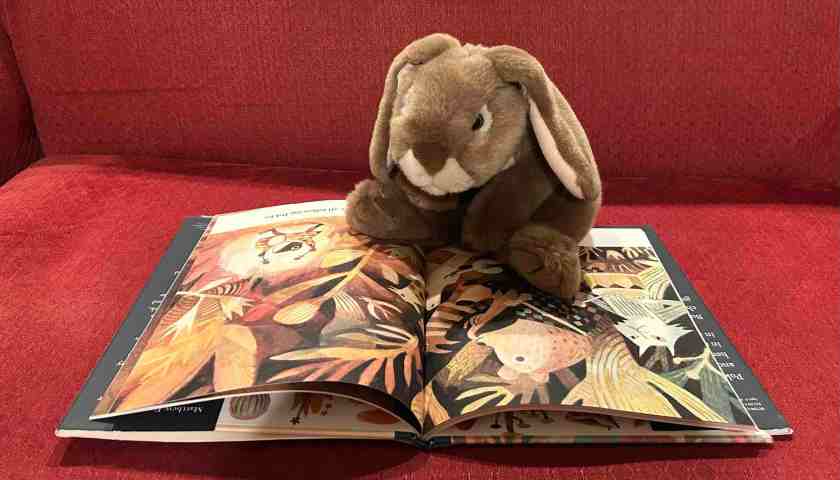
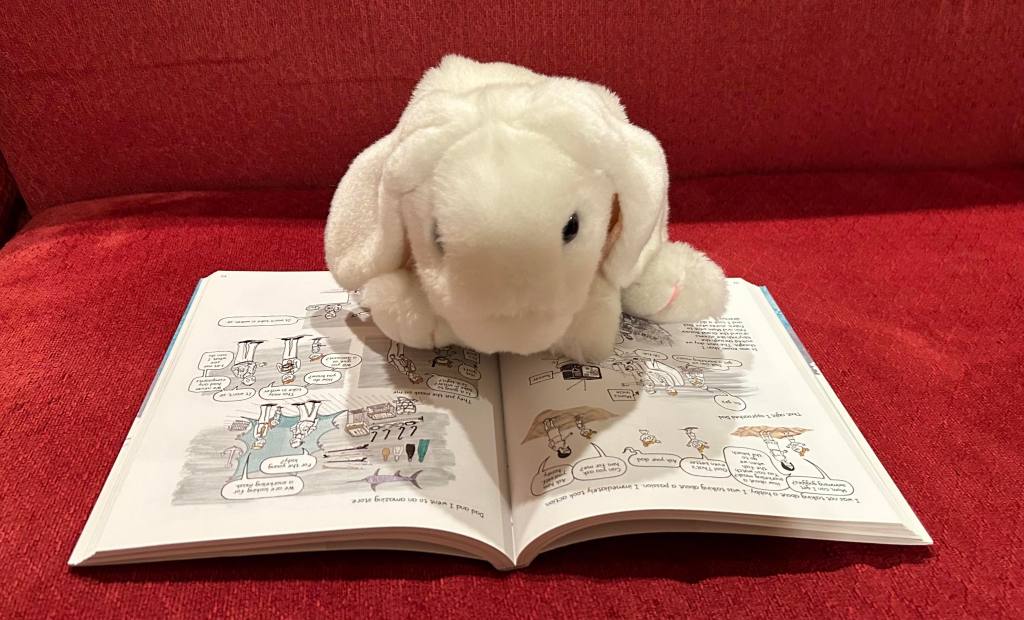
Marshmallow is reading Dare to Disappoint by Özge Samancı.

Marshmallow’s Review: Dare to Disappoint is an interesting and entertaining book. It describes a young person’s search for her own artistic and creative identity in the context of a loving but perhaps somewhat rigid family. It also offers insight as to what life was like for a young child in Turkey in the 1980s. It was especially interesting for me to see the many details of life in a different time and different place than what I have experienced so far.

I liked reading Dare to Disappoint. The author’s voice is down to earth and relatable. The plot and storyline of the book are easy to understand and follow. This is a graphic novel, and the illustrations are really cute, but also detailed and expressive. Color is sparse, but well distributed. Additionally, photos of 3-D objects are inserted and sort of interwoven with the author’s drawings. Today Samancı is a media artist who also teaches at a university. It was cool to read about her earlier life in this format and have the opportunity to learn about her path to finding her own artistic voice.

Though the illustrations are vivid and cute, and the author voice is friendly and accessible, Dare to Disappoint may not be appropriate for very young bunnies. My only concern is that at some point, the author is physically attacked and is almost sexually assaulted, which might be too scary for some younger readers. But other than that, I think that the book tells a beautiful and very personal story, and bunnies of all ages can appreciate the tale of an artist’s childhood and growing up into her own.

Marshmallow’s Rating: 100%. 

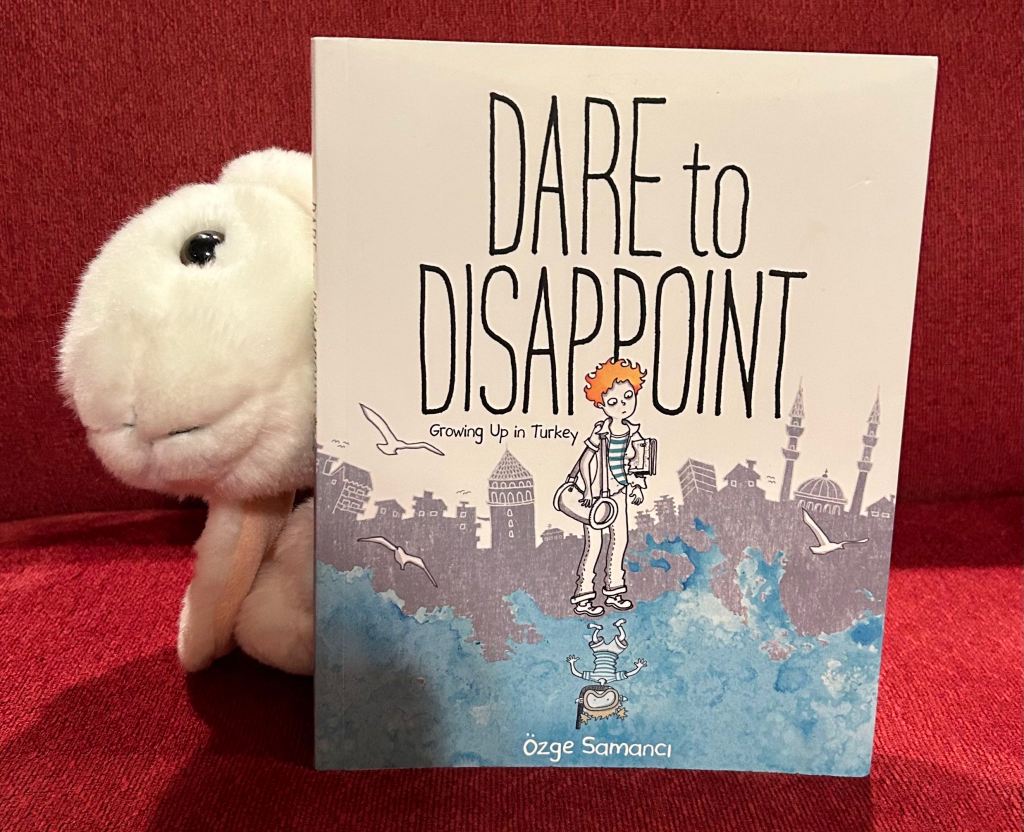
Marshmallow rates Dare to Disappoint by Özge Samancı 100%.

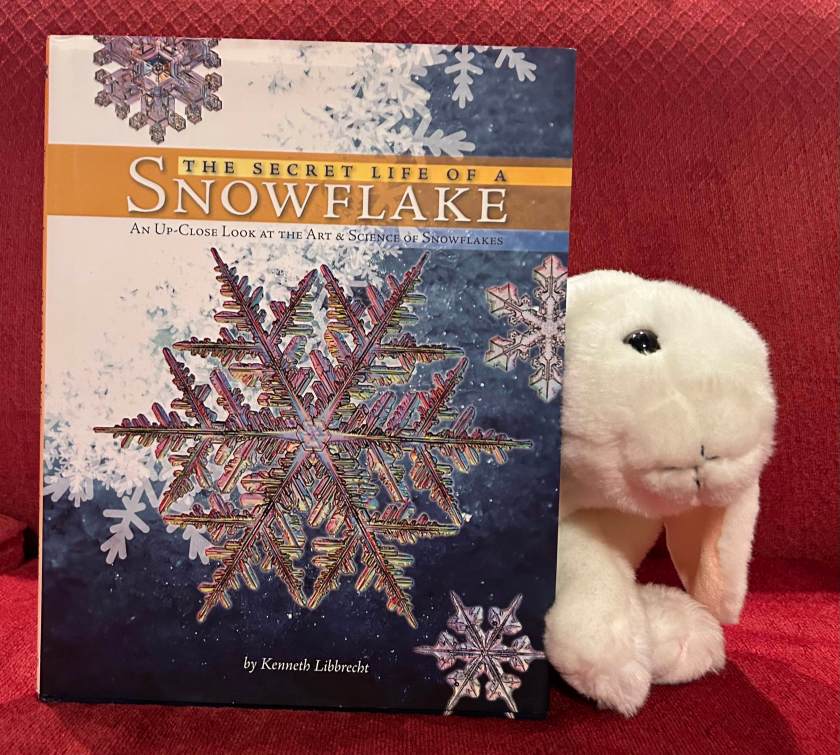
Marshmallow reviews The Secret Life of a Snowflake by Kenneth Libbrecht

Today Marshmallow reviews a beautiful book she really likes: The Secret Life of a Snowflake: An Up-Close Look at the Art and Science of Snowflakes by Kenneth Libbrecht, published first in 2009. Sprinkles is asking questions and taking notes.

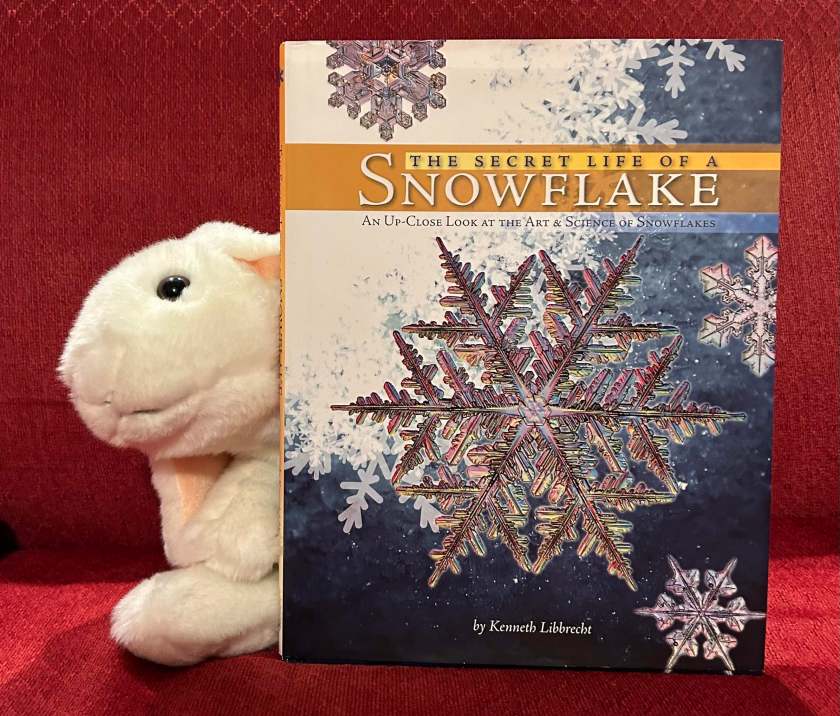
Marshmallow reviews The Secret Life of a Snowflake: An Up-Close Look at the Art and Science of Snowflakes by Kenneth Libbrecht.

Sprinkles: So Marshmallow, you decided to talk about The Secret Life of a Snowflake today. This book has been on our bookshelves for a while now. I’m glad you picked it up for the blog today. Can you tell us a bit about it?

Marshmallow: This is a book written by a physicist named Kenneth Libbrecht who loves and studies crystals. And snowflakes are crystals, and he loves to take their photos. There are lots of photos in the book, and I love looking at them.

S: I know. I love looking at this book, too. It is just beautiful.

M: Yes! But the author is a scientist, so he also explains a bit about how snowflakes are formed and also about how clouds are formed, why snow is white, and so on.

S: Caramel would like this book, right?

M: Of course. He would love it because it is so “factful”!

S: Exactly.

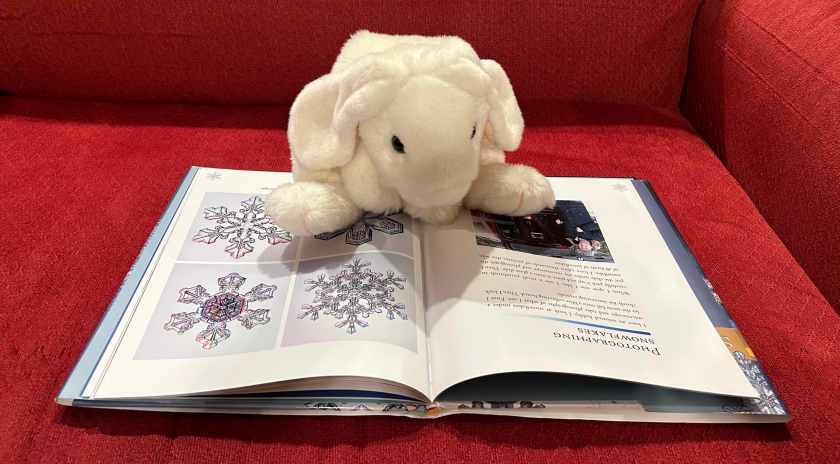
Marshmallow is reading The Secret Life of a Snowflake: An Up-Close Look at the Art and Science of Snowflakes by Kenneth Libbrecht.

S: Did you know that the author has a website where he has a lot more information and photos about snowflakes?

M:Well, I did not, until you told me. And then we went and checked it out together. Our readers should check it out too: http://snowcrystals.com/

S: Yes. There are lots of exciting things there.

M: Exciting and beautiful. I found the section about designer snowflakes especially interesting.

S: There is also a special page for a monster snowflake which is apparently almost comparable to a penny in size! But back to the book. I know reading it once or twice, you get the science down. But I saw you read this book many many more times.

M: Yes. Because I really like the pictures in it. They calm me and comfort me.

S: And they make you smile. I saw.

M: Yes. They are very pretty, and each snowflake is so different, so pretty in a different way.

S: They are all very symmetric. I think that can feel somewhat calming.

M: Yes, maybe.

S: So if you were to rate this book, what would your rating be?

M: 100%. Definitely. I think this could be a really neat book for young bunnies to read with their parents, because it has science, it has beautiful pictures; it has all kinds of good things. The writing is simple, but very clear. And it gets a lot of information across.

S: Agreed. But I think bunnies can definitely read it on their own and enjoy it too, no matter how old they are.

M: Yes. Or it could make a great gift, especially for a winter holiday…

S: What a neat idea! Okay, Marshmallow. I think this is a good time to wrap up this review. What would you like to tell our readers?

M: Stay tuned for more amazing reviews from the book bunnies!

Marshmallow rates The Secret Life of a Snowflake: An Up-Close Look at the Art and Science of Snowflakes by Kenneth Libbrecht 100%.

Marshmallow reviews The Dot by Peter H. Reynolds

A couple years ago, Caramel reviewed Stink: The Incredible Shrinking Kid, a 2005 book written by Megan McDonald and illustrated by Peter H. Reynolds. Soon after, Marshmallow reviewed Judy Moody Goes to College, yet another book written by McDonald and illustrated by Reynolds. But Peter Reynolds is not just an illustrator who works on other people’s books; he has his own books as well. Today Marshmallow reviews one of his most cherished books, The Dot, on its twentieth anniversary. Sprinkles is taking notes and asking questions.
Marshmallow reviews The Dot by Peter H. Reynolds.

Sprinkles: So Marshmallow, can you tell us a bit about this book?

Marshmallow: This is a book about creativity and artistic expression, even when you do not think you have it in you to be creative.

S: That is a neat recap of this book Marshmallow. So maybe let us go a bit into details. What exactly is the plot?

M: There is a little kid named Vashti and she thinks she cannot draw. So at the end of art class, her paper is still empty. And her teacher says, just make a mark and see where it takes you. And so she does. She stabs the paper and makes a dot.

S: Okay, then what happens?

M: Her teacher tells her to sign it.

S: Just a dot?

M: Yes.

S: Then what happens?

M: Well, I don’t want to give away the full story, but her teacher supports Vashti by showing that she values Vashti’s work even when Vashti does not think much of it. And then Vashti gets inspired to create more and more. And in the end, we see her encouraging another young person like her, who believes they are not creative at all, by telling them to “just make a mark and see where it takes you”.

S: So the idea is that you just get started, and then things go from there. Right?

M: Yep. You do not have to feel creative, you do not have to think you know what you are doing. But just get started, and just make your mark. The rest will follow.

Marshmallow is reading The Dot by Peter H. Reynolds.

S: The author / illustrator dedicated this book to Mr. Matson, his seventh grade math teacher who “dared” him “to make [his] mark”. So even though the book is about art, it could be seen as a fable that is about any other thing we are not confident about, no?

M: Yes, I think so. I think the book is really inspiring.

S: I agree. What do you think of the illustrations and the visual aspects of the book?

M: I really like Peter Reynolds’ style. It is very simple, minimalistic, and sparse. But with the very few strokes of his pen, he draws really effective images.

S: Agreed.

M: I also like the way he uses color. Most of the book is in black and white but there are several well-placed splashes of color, which bring attention to specific items on the page. They add a lot to the feel of the whole book. By the way, the illustrations were apparently done with water color, ink, and tea. I wonder how he uses tea.

S: I have no idea!

M: I would like to know. But anyways, all in all I think this is a really neat book.

S: I agree. But Marshmallow, this is a picture book, and you do not review picture books much anymore. Do you perhaps not think this is for young bunnies only?

M: No, I think it can be inspirational for any bunny. Everyone needs some encouragement now and then.

S: Alright, that works for me. Maybe it is time to wrap up this review. What do you want to tell our readers?

M: Stay tuned for more amazing reviews from the book bunnies!

Marshmallow enjoyed reading The Dot by Peter H. Reynolds and recommends it to all bunnies little and big who need a little bit of courage to get started.

Caramel reviews Opposites Abstract by Mo Willems

Caramel has been a Mo Willems fan forever. He has already reviewed a book from his Pigeon series, another from his Elephant and Piggie series, and yet another from his Unlimited Squirrels series for the book bunnies blog. When Sprinkles heard about a new book by Mo Willems offering a different kind of art, she wanted to see what Caramel would think of the book. Below is Caramel’s review of Opposites Abstract. As usual Sprinkles is taking notes and asking questions.

Caramel reviews Opposites Abstract by Mo Willems.

Sprinkles: So Caramel, I know you loved all the pigeon stories of Mo Willems, and you even reviewed one for our blog. Now Willems has written a book for baby bunnies and other young ones called Opposites Abstract. And you have read it just recently. Can you tell our readers a bit about the book? What is it about? How is it organized?

Caramel: It starts inside the front cover by saying “This is STARTING”, and in the end, on the very last page, it says “This is FINISHED”. All pages have either a picture or three words. The pictures are very colorful and the words are like this: “Is this DARK?” or “Is this MECHANICAL?” or “Is this SOFT?”

S: So it seems like one of those books you and I used to read together and look at the pages and learn about opposites.

C: Yes. I think that is the idea.

S: So what are some examples of opposites from the book?

C: I already told you about STARTING and FINISHED. Another was DARK and LIGHT. The opposite of MECHANICAL is ORGANIC, and the opposite of SOFT is HARD.

S: SOFT / HARD and DARK / LIGHT are quite standard in this kind of a book, but the STARTING / FINISHED one is a good one. I also did not see MECHANICAL / ORGANIC in this kind of book before.

C: There is more that is not that typical. There is the INDIVIDUAL and the GROUP. And INCLUSION and EXCLUSION.

S: Those are interesting choices. What kind of picture is drawn for the INDIVIDUAL and the GROUP?

C: The picture of the INDIVIDUAL is like an eye, a single circle, it could also be a head, or a little dandelion. And the GROUP has many many circles and they are all connected to one another.

S: I can see how that is an abstraction of the idea of a group of people, being connected to one another, and the other one is all alone, but also bigger and in the center. That is cool.

C: But some of the circles in the GROUP are bigger than the others, too. Maybe it is kind of like “all animals are equal but some animals are more equal”.

S: I see what you did! We should put a link to Marshmallow’s review of The Animal Farm here.

C: Yep.

Caramel is reading Opposites Abstract by Mo Willems.

S: I know you like mechanical things. What did you think of the picture for MECHANICAL?

C: It was interesting. There are pulleys, and a rectangular pulley system, and kind of looks like there is some mechanical production going on. Circles on the end of the pulleys and lights.

S: What is the opposite picture like then?

C: The opposite is ORGANIC. There are ovals, they look like cells or single-cell organisms.

S: So they look more alive and organic, I suppose.

C: Yep, and that is the word: ORGANIC. O-R-G-A-N-I-C.

S: That is neat! I am guessing you will not forget how to spell “organic” ever again. Anyways, what did you think of the pictures?

C: I think they are awesome. They are very colorful and they fit the word they are supposed to describe. Sometimes it takes me a while to think about them, but I do see them in the end.

S: I know, right? They are just ripe for discussion. So I can see an adult bunny reading this together with a young bunny and them talking about each picture together. There is a lot to open up.

C: Yes, you and I did talk a bunch about each picture. The word CALM reminded you of a book I reviewed before, and when you told me that, I remembered it was Albert’s Quiet Quest by Isabelle Arsenault. So much to think about and talk about!

S: So do you think other young bunnies would like to read this book with their adults?

C: YES!

S: Okay, so tell me your three words for the book and then we can wrap this up.

C: Colorful, wordless–

S: I guess you could say “sparse”.

C: Sparse works. And “opposites”. It is full of them!

S: I think that would work. So what do you want to tell our readers as we wrap up this review?

C: Stay tuned for more book bunny reviews!
Caramel loved reading Opposites Abstract by Mo Willems and will likely keep looking at its colorful pages for a lot more times in the coming weeks and months.