Marshmallow reviews Lucy and Andy Neanderthal by Jeffrey Brown

Marshmallow reviews Lucy & Andy Neanderthal, the first book in the Lucy & Andy Neanderthal series of Jeffrey Brown.

Marshmallow and Caramel recently got their paws on books by Jeffrey Brown. A couple weeks ago, Caramel reviewed his, My Teacher is a Robot. Today Marshmallow reviews hers, the first book in the Lucy & Andy Neanderthal series of Jeffrey Brown: Lucy & Andy Neanderthal.

Marshmallow reviews Lucy & Andy Neanderthal by Jeffrey Brown.

Marshmallow’s quick take: If you like comic books or fiction books that also have some facts about interesting stuff, then this might be the book for you.

Marshmallow’s Summary (with spoilers): Lucy & Andy Neanderthal is a comic book about a brother and a sister, Lucy and Andy Neanderthal, who are two Neanderthal kids living in the Stone Age. They have a little brother, Danny, and share their cave with a few other people including two older kids, Phil and Margaret. Andy really wants to join their family when they go to hunt, but his parents will not let him because hunting mammoth is too dangerous. 

Lucy and Andy have many adventures. One of them, “Substitute Babysitters”, starts with a rock Andy throws that hits Phil on the head by accident. Phil’s head swells. Lucy, Andy, and Margaret take Phil to Lucy and Andy’s mother so she can help him. She goes looking for medicine, and leaves Andy and Lucy to look after their little brother, Danny, while Margaret looks after Phil. 

Danny finds a stick and starts banging it around. Lucy takes the stick from him, and Andy gives another stick to Danny. Lucy keeps finding a problem with the sticks Andy offers to Danny, like how it is too small and how Danny could choke on it. Then Danny starts crying and Andy gives him another stick, but Danny slaps it away. Then they follow Danny to the cave where Margaret offers him some berries. Danny eats the berries and then he throws up. Lucy has Andy clean it up and then Andy gets mad and imitates Lucy. Lucy farts and then blames it on Andy. In the midst of this chaos, Danny sneaks away. 

Once the older kids realize that Danny sneaked away, they start to panic. They start looking for Danny and find Danny’s pants. Phil thinks that Danny must have been eaten, but Andy says that Danny always takes his pants off. Eventually they find Danny and get him to come back to the cave. 

The above probably already gives you a sense of the kinds of stories in the book. They are always hilarious! But close to the end of the book, the Neanderthals meet the humans. The humans invite the Neanderthals over to dinner because they ate the leftovers of the mammoth that the Neanderthals hunted. Will the two groups be friends or mortal enemies?

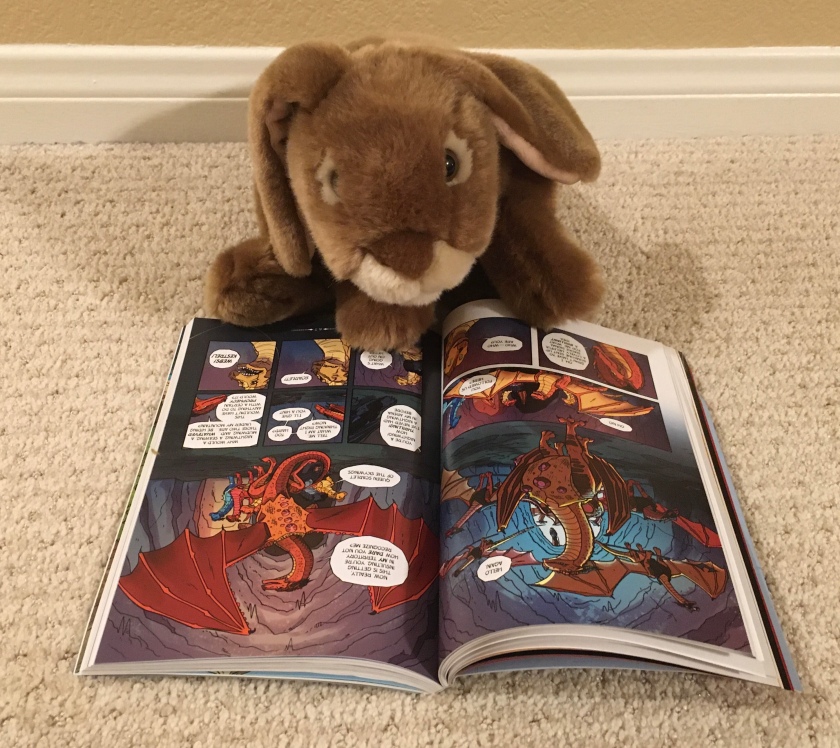
Marshmallow is pointing to a typical page of Lucy & Andy Neanderthal by Jeffrey Brown.

Marshmallow’s review: Lucy & Andy Neanderthal is a very funny book. Jeffrey Brown’s drawings are very successful, and the writing is very clear, so even a reader who has never read a comic book before can enjoy reading the book. 

The main characters are fictional Neanderthals living in the Stone Age, but there are also two scientist characters who tell us facts that relate to the stories. They tell us about the first toothbrush for instance, and the differences between the modern humans and the Neanderthals. There are more facts at the end of the book. For instance, you can learn there that Neanderthal women hunted, too:

“Scientists still debate whether men hunted more, but Neanderthal women at least participated in some, if not all, hunting.”

I enjoyed this book very much and reread it many times. I highly recommend it to people who like comic books and Neanderthals. Of course you might not know you like Neanderthals before reading the book. So why don’t you just give it a try?

Marshmallow’s rating: 100% 

Marshmallow rates Lucy & Andy Neanderthal by Jeffrey Brown 100%.

Caramel reviews Totem Tale: A Tall Story from Alaska by Deb Vanasse

Caramel reviews Totem Tale: A Tall Story from Alaska written by Deb Vanasse and illustrated by Erik Brooks.

Today Caramel wanted to talk about one of his favorite books: Totem Tale: A Tall Story from Alaska written by Deb Vanasse and illustrated by Erik Brooks. Sprinkles is asking questions along the way and taking notes.

Caramel reviews Totem Tale: A Tall Story from Alaska written by Deb Vanasse and illustrated by Erik Brooks.

Sprinkles: Let us talk about this book Caramel. What is it about?

Caramel: It is about a totem pole which is enchanted.

S: In what way?

C: When it’s a full moon, it comes to life. The whole totem pole.

S: Tell me more. What is a totem pole?

C: A totem pole is a tall pole made of wood, with animals carved into parts of it. And it is painted. Here is what Wikipedia says about them: totem poles are “monumental carvings, a type of Northwest Coast art, consisting of poles, posts or pillars, carved with symbols or figures”.

S: And this one is a totem pole in Alaska, according to the book title. And again according to Wikipedia, a totem is “a spirit being, sacred object, or symbol that serves as an emblem of a group of people, such as a family, clan, lineage, or tribe.” So how does this particular totem pole come to life? Tell me more Caramel.

C: I can just read from the book:

“Deep in a cedar forest stood a totem pole, stark and still. Long ago a carver stacked the totem animals and then forgot them.”

S: Well, maybe he did not forget them. Since it was a long ago, maybe he died. Maybe his people had to leave the forest.

Caramel invited a green friend to read Totem Tale: A Tall Story from Alaska. Can you see him?
Caramel invited a green friend to read Totem Tale: A Tall Story from Alaska with. Can you see his tail?

C: Yes, that is possible too. Let me continue to read.

“One night the moon rose low and full. Washed in the light of moonbeams, the totems SPRANG to life.”

S: That sounds exciting! So then what happens?

C: They go have fun for a night. As real living animals.

S: Then what happens?

C: Then before the sun rises they have to return to the pole or else they will have never been. Which is sad. Really sad.

S: Yes, it is sad! Then what happens?

C: None of them can remember the order of the totem pole. How they started in the beginning, like who was on top, who was under, and so on. They all brag about themselves and try to take the supposedly place of honor on the very top.

Caramel and his friend the Loch Ness Monster are reading Totem Tale: A Tall Story from Alaska together.

S: But most of their attempts fail, right?

C: Yes, they fail and come tumbling down to the ground.

S: Until … well maybe we shouldn’t give away the whole thing.

C: Okay, fine.

S: So what do you like about this book most Caramel?

C: I like the animals. They’re so cute! Like us bunnies!

S: So what animals are there among the totems?

C: Let me see. There is a frog, there’s a beaver, an eagle, a bear, and a wolf, and a raven. That is the order of the totem pole.

S: Really? How can the frog carry the bear?

C: I don’t know. Well they’re all made of wood, aren’t they?

S: And of course this is a story! it doesn’t have to make sense in all ways.

C: But in the end the order does make sense. And the Raven explains it.

S: Ok, let’s not give away any more. But this is a magical story really. And I totally understand why you like it so much. Alright, this is a good place to end this review. What last thing do you want to tell our readers?

C: Stay tuned for more book bunny adventures!

Caramel loves to read and reread Totem Tale: A Tall Story from Alaska written by Deb Vanasse and illustrated by Erik Brooks.

Sprinkles reviews Women Who Count: Honoring African American Women Mathematicians by Shelly M. Jones

Sprinkles reviews Shelly M. Jones’ book Women Who Count: Honoring African American Women Mathematicians (illustrated by Veronica Martins).

Sprinkles got her paws on Dr. Shelly M. Jones’ book Women Who Count: Honoring African American Women Mathematicians (illustrated by Veronica Martins) recently and enjoyed it so much that she wanted to review it here. Below is her review. Enjoy!

Sprinkles reviews Women Who Count: Honoring African American Women Mathematicians, written by Shelly M. Jones and illustrated by Veronica Martins.

There have been several books and films about African American women mathematicians and their contributions recently, following the release of the amazing 2016 movie Hidden Figures. A well-rounded collection of books, toys, and posters celebrating Katherine Johnson is reviewed at the A Mighty Girl blog. I have mentioned a couple of related books here myself at the end of my review of children’s books about Ada Lovelace. But the book I am going to tell you about today is a quite different type of book. And I believe any parent wanting to encourage their young ones to find joy in mathematics and learn about possibilities of a wide range of futures in STEM might appreciate this book.

The book introduces through brief biographical essays and clean illustrations a selection of 29 African American women who have found their career paths through mathematics. Among them are mathematicians, atmospheric scientists, computer engineers, and education researchers. In four sections, the book introduces the first three African American women with mathematics PhDs, nine pioneering mathematicians who led the way for many others along the path to a mathematical career, four of the women making up the six hidden figures in the eponymous 2016 book by Margot Lee Shetterly, and finally thirteen contemporary mathematicians who bring us to today.

Sprinkles is reading the pages about Dr. Evelyn Boyd Granville, the second African American woman to earn a PhD in mathematics.

Dr. Shelly Jones writes in her introduction:

“I am proud to have the opportunity to share the stories of these 29 extraordinary women so that [you] can benefit from learning about a variety of occupational fields related to mathematics. … You may use this book as a springboard into the world of mathematics. Have you ever heard of a magic square, a tessellation, or sudoku? … There is something for everyone in this book.”

Indeed the book is chock-full of fun activities that will engage young ones (aiming for both elementary and middle school kids here). There are coloring pages, there are puzzles and mazes, and there are learning activities about a range of mathematical topics which are typically not a part of a school curriculum but will be accessible to and entertaining for young people.

Sprinkles is pointing towards the page where Dr. Erica Walker, a professor of mathematics education at Teachers College, Columbia University, is introduced. The page is accompanied by another where readers are invited to play with colors and symmetry.

But of course this is not just a standard math-is-fun activity book. The author adds in her introduction:

“Have fun doing the activities, but don’t forget to read and learn about these wonderful women who happen to love mathematics!”

And that is what makes this book special. The stories of these women are inspirational and inviting. The reader is invited to think about mathematics as an exciting career path, or, perhaps more accurately, as a gateway to many different exciting career paths. In particular, seeing the illustrations of these women (and photos of the contemporary ones) might help all children see mathematics as a real possibility for themselves and their friends. As Dr. Reagan Higgins, one of the women portrayed in this book writes:

“It is important we show children who and what they can be.”

Children early on start to digest the prevalent societal message that mathematics (and more generally STEM) is for men. Furthermore, standard curricula and mainstream depictions of STEM do not offer young children of color many role models in STEM that they can identify with. This book is a neat addition to kid-friendly content created by people trying to change this status quo.

The activities are not “girly” in particular; boys and girls alike can enjoy them. And it is good for both boys and girls, of any background, to be exposed to examples of mathematicians and mathematical scientists who do not fit stereotypes and societal assumptions of who can do math. I would strongly recommend Women Who Count: Honoring African American Women Mathematicians, written by Shelly M. Jones and illustrated by Veronica Martins. to any parent interested in encouraging their young ones to engage with the ideas and people of mathematics.

The book started as a Kickstarter project and is currently published by the American Mathematical Society.

Sprinkles enthusiastically recommends Women Who Count: Honoring African American Women Mathematicians, written by Shelly M. Jones and illustrated by Veronica Martins.

Caramel reviews Engineering: An Illustrated History from Ancient Craft to Modern Technology, edited by Tom Jackson

Caramel loves to read and review books which are about real things, see his reviews of books on samurai, dinosaurs, knights and castles, and dental health . He also loves building and making things. So it was only natural that when he discovered Engineering: An Illustrated History from Ancient Craft to Modern Technology, edited by Tom Jackson, in the book bunnies’ home library, he had to read it immediately. Below he shares some of his thoughts on this reference text. Sprinkles is taking notes as usual and asking followup questions.

Caramel reviews Engineering: An Illustrated History from Ancient Craft to Modern Technology, edited by Tom Jackson.

Sprinkles: How should we start this review Caramel?

Caramel: You just did!

S: Yeah, I did, didn’t I? So what next? What do you want to say about this book?

C: It’s a good book. If you are a bunny who wants to be an engineer when you grow up, this might be the book for you.

S: Why do you say that?

C: The book has a bunch of engineering examples.

S: Yes, the back cover advertises “100 achievements that changed history”. So there are 100 different engineering-related entries in the book, going more or less in chronological order. That means they are listed from the oldest to the newest. Can you tell us a few of your favorites?

C: 65 is Jet Power and it is one of my favorites. But my favorite in the whole book is 73: SR-71 Blackbird.

S: What is that?

C: It’s a spy plane.

S: What does that mean?

C: It means they spy on the enemy. It says it is radar-absorbing, which makes it harder to detect. I also like 82: Stealth Plane, a lot.

Caramel is pointing at one of his favorite entries in Engineering: An Illustrated History from Ancient Craft to Modern Technology: Stealth Planes.

C: And there is 75: Apollo Spacecraft. The NASA program for it was launched in 1961, it says.

S: And there is more information on it on Wikipedia in case others are interested. So each of these entries is about one page, right?

C: Yes. Exactly one page. And there are pictures and I like looking at them. 

S: Then there is text, describing the entry, and telling some of its history, right?

C: Yes. 

S: So what is the first entry?

C: Let me see. First there is some stuff about engineering and applied science. Then they start with 1: Stone Technology. And 2 is Taming Fire. 3 is The First Boats. 

S: Wow! It goes way back! So how far back does it go?

C: It goes way back. Let me read the beginning of 1 to you:

“Engineering with stone technology is older than the human race. Distant ancestors of homo sapiens (modern humans) began making and using stone tools as long as 3.3 million years ago.”

S: That is a long time ago. To compare, do you remember how long ago the dinosaurs went extinct? 

C: About sixty-five million years ago. I already reviewed a book about them!

S: So dinosaurs were around even earlier. 

C: That’s for sure. 

S: So what is the last achievement they list in the book?

C: 100 is Solar Power. Then there is a long section called Engineering 101: The Basics.

S: What’s in that section? 

C: There is a part named Imponderables where they ask questions like: “Will space planes change transportation?”, “What will graphene do for us?”, “Will we run out of raw materials?”, “Can engineering solve climate change?”, “Can screens replace paper?”

S: Very interesting questions. The one about screens and paper is about books and reading, I think. We still love reading paper books, right?

C: Yes. This book for instance. It has lots of colorful pictures I can look at. 

S: Screens could have colored pictures, too, of course, but holding a book in your paws is a neat experience. So are we done with the review? 

C: Yes. Stay tuned for more Book Bunnies adventures!

Caramel really enjoys reading sections from Engineering: An Illustrated History from Ancient Craft to Modern Technology, edited by Tom Jackson.