Marshmallow reviews The Inquisitor’s Tale by Adam Gidwitz

Today Marshmallow is reviewing The Inquisitor’s Tale: Or, The Three Magical Children and Their Holy Dog, the 2016 novel by Adam Gidwitz which won a Newberry Honor in 2017. (Coincidentally she had already reviewed the book that won the Newberry Medal that same year: The Girl Who Drank the Moon by Kelly Barnhill.) Following Marshmallow and her recommendation, Sprinkles also read the book, which offers a lot of food for thought, both for young bunnies and the not-so-young ones. The two bunnies discuss the book together below.
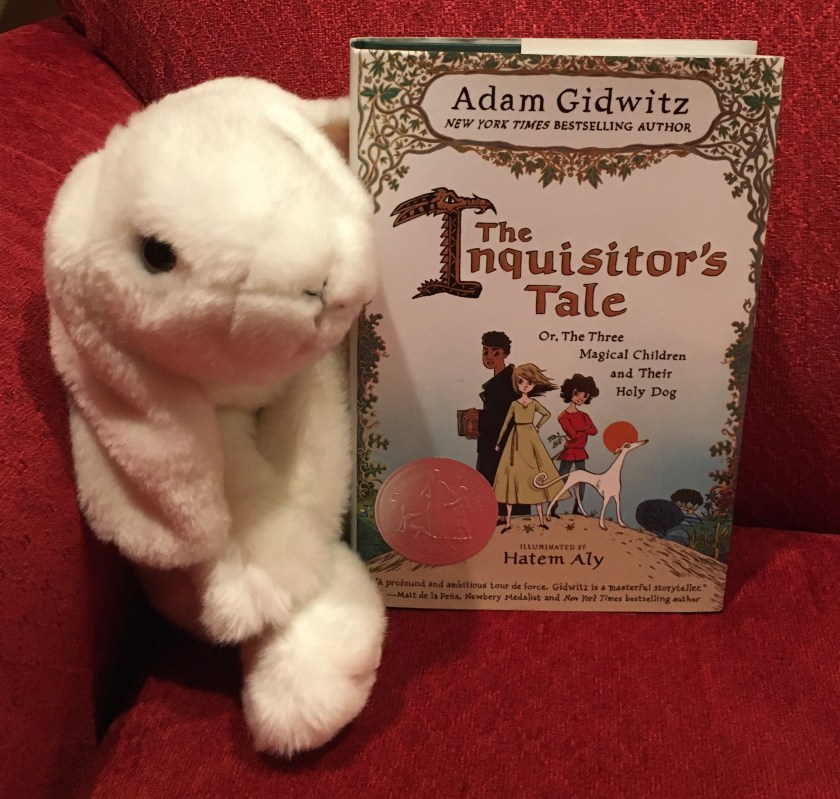
Marshmallow reviews The Inquisitor's Tale: Or, The Three Magical Children and Their Holy Dog, written by Adam Gidwitz and illuminated by Hatem Aly.
Marshmallow reviews The Inquisitor’s Tale: Or, The Three Magical Children and Their Holy Dog, written by Adam Gidwitz and illuminated by Hatem Aly.

Sprinkles: So Marshmallow, why don’t we start with a brief introduction to the book? What is the book about?

Marshmallow: This book is about three kids, named Jeanne, William, and Jacob, and their dog, named Gwenforte. The kids have superpowers. Jeanne has fits and can see the future when having them. William is tall and very very strong. And Jacob has the power to heal people, but at an uncanny level. Even the dog seems magical. She died and then many years later reappeared above the plot of land she was buried in.

S: The subtitle of the book sort of hints at this, right? Three magical children and their holy dog?

M: Yes. And they are living in France, in the middle ages.

S: Yes, the story starts in 1242, and there are a lot of historical facts and people who show up in the book.

M: Yes, for example the king is Louis IX, the ninth Louis, and we also get to meet his mother Blanche of Castille. They are both real people from the history of France.

S: So in some very real sense this is historical fiction, which according to Wikipedia is “a literary genre in which the plot takes place in a setting related to the past events, but is fictional”.

M: Yes, but if we want to talk about genre, I think we might also have to talk about magical realism. Remember, I reviewed two books that I thought fit this category before: Ikenga and Hurricane Child.

S: Why would you say that?

M: Because everything seems real and like things are in the real world, but every now and then some weirdly magical stuff happens. And some of the characters interpret them as magic, and some think they are miracles. But they are almost always extraordinary and supernatural.

S: Can you give an example?

M: Jeanne has visions of the future for example. And then there is a dragon whose fart causes things to burst into flames. And everyone acts as if dragons are real and the main issue is that this dragon’s fart is unexpectedly deadly.

S: Yes, there is a farting dragon, and I am sure Caramel would love to learn more about that. And you are right, I think. I’d agree that this book is somewhere between magical realism and historical fiction. In fact at the end of the book, there is a section where the author explains which parts of the book are real history, which storylines he took from legends and myths and other stories of medieval times, and which he himself totally made up. All together these all add up to make a really rich story, don’t you think?

M: Yes. And the book is written like a medieval manuscript. There are illustrations on most pages, and they are credited as “illuminations by Hatem Aly”. Illuminations are the decorative illustrations that were sprinkled here and there in medieval manuscripts. We learned about them in history class when learning about the middle ages.

S: I can see why the author and the illustrator and the publisher decided to call these illuminations, besides the historical connection. I think they are not just illustrations that would accompany the text and depict some event happening in there. Sometimes they do not seem to be directly related to the story at all.

M: Yes, I think that is a good point. Then again, I think the illustrations by Jim Kay in the illustrated editions of the Harry Potter books I reviewed (Harry Potter and the Sorcerer’s StoneHarry Potter and the Chamber of SecretsHarry Potter and the Prisoner of Azkaban, and Harry Potter and the Goblet of Fire) are also like that. Sometimes they just decorate the page, make it look nice.
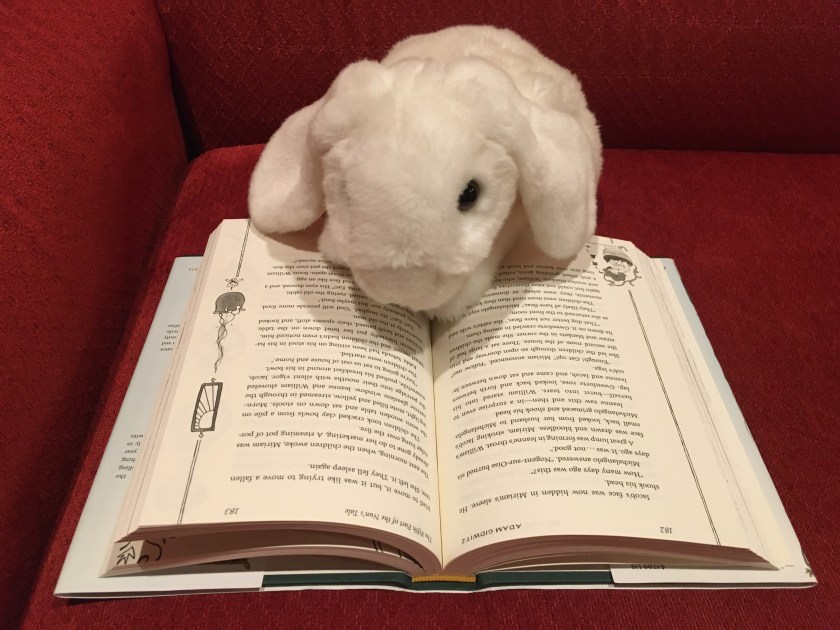
Marshmallow is reading The Inquisitor's Tale: Or, The Three Magical Children and Their Holy Dog, written by Adam Gidwitz and illuminated by Hatem Aly.
Marshmallow is reading The Inquisitor’s Tale: Or, The Three Magical Children and Their Holy Dog, written by Adam Gidwitz and illuminated by Hatem Aly.

S: So you read this book a while ago and really wanted me to read it, too, so we could discuss it. Can you tell me why?

M: Because this book, more than any other book I read or reviewed recently, talks about religion at length, and I wanted to think out loud about some of the themes that came up together with you.

S: You are right of course. The book talks a lot about religion. Europe of the thirteenth century was almost a Christian continent, and we see this in the characters and their world views very clearly throughout the book. And Jacob, one of the three magical children, is Jewish, and we also see the tension between his world and the world of the other characters involved. In fact one of the main challenges the children have to face involves the king’s decision to burn all copies of the Talmud in France so as to get rid of all non-Biblical wisdom available to the Jews. And this was actually a real event that happened. Some background can be found in this Wikipedia article about the Disputation of Paris. Did you know what the Talmud was before reading this book?

M: No, I did not. But reading this book made me curious. It seemed to be really important to the Jewish communities and it seemed like Louis IX was trying to destroy something sacred to and vital for them. Then I learned from the relevant Wikipedia article that the Talmud is a collection of writings of more than a thousand Jewish scholars that addresses all sorts of theological and philosophical issues as well as very practical ones, like how to live one’s life.

S: So the children set out to try and save the copies of the Talmud that would be burned. Why did they want to do that? Only Jacob is Jewish. How come the other children agreed too that this was an important thing to do?

M: Because it was centuries of knowledge and wisdom collected and cared for by generations of people. And of course it was not fair to the Jewish communities who had so cared for these volumes of books one generation after another.

S: Yes, there is a part of the book when the children realize how each book is written and illuminated by a person who dedicates years of their lives to this work. And I really liked this because, even though we have the publishing press today and books can be published much faster, a book is still the product of many years of hard work of many many people.

M: And I like books! I mean I can like some books more than others, but every book I read takes me to a different world! I would not want even the worst novel I read to be burnt. And these are not novels. They contain sacred wisdom of a whole people. It just seems pretty terrible.

S: Yes, and the children can see beyond their own differences of world views, their own religious backgrounds, to see the value of these books and the cruelty of burning them.

M: Of course they are kind of guided to this by Michelangelo of Bologna, “the red, fat, and wicked” priest who begins as their nemesis and ends up being their friend and mentor. And in the end he turns out to be–

S: Wait, let us not spoil that. That is revealed all the way at the end and we don’t want to spoil it for our readers.

M: Okay.

S: How about we instead talk about one of the big questions of all time that shows up in the book? The question of evil? The question of the reason and the justification of the existence of evil in a world created by a good God?

M: Yes. Some really bad things happen in the book, and at some point the children are so sad that they ask why God ever allows for such bad things to happen if He is good. And I think this is a really tough question. I don’t know how to answer it.

S: I think you are not alone Marshmallow. This is a big question for a lot of theologians and philosophers. What did you think of the answers offered in the book?

M: I’m not sure I totally understood them.

S: Well, the main Christian answer is, I think, captured in the Book of Job, and the drunk friar named Roger Bacon recites a part of that book to explain that the living are too small to understand the grand plans of God. What may seem like evil to us may not be. What we find wrong and bad may not be.

M: And then there is a troubadour (apparently that is a “a French medieval lyric poet composing and singing in Provençal in the 11th to 13th centuries, especially on the theme of courtly love”) who gives a different answer. He says God is a troubadour. I did not quite get that answer.

S: Yes, there is a part of the story when a troubadour sings The Song of Hildebrand, a story of a father and son who meet in battle. The father recognizes his son but cannot convince him that he is his father, so they go on and battle and it is all pretty bad and sad all around. And the troubadour sings this song and the song is sad, too, but it is also beautiful. And then he says that this is how our lives are. When we live them, it may be sad and ugly and terrible and we cannot make any sense of it. But all in all, there is a song that God is putting together and that song is beautiful. I think in a way this is the same answer as the answer from the Book of Job. While we are in the thick of things, going through the rollercoaster of life, we cannot appreciate the big picture. But the faithful believe that there is a meaning to it all, and it is known to God.

M: Hmm, I will have to think more about that.
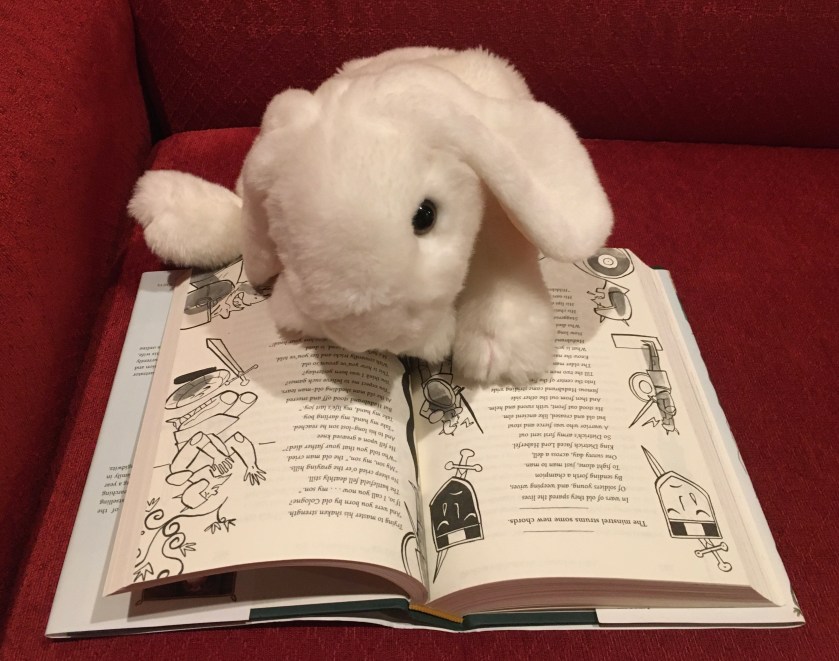
Marshmallow is reading The Song of Hildebrand in The Inquisitor's Tale: Or, The Three Magical Children and Their Holy Dog, written by Adam Gidwitz and illuminated by Hatem Aly.
Marshmallow is reading The Song of Hildebrand in The Inquisitor’s Tale: Or, The Three Magical Children and Their Holy Dog, written by Adam Gidwitz and illuminated by Hatem Aly.

S: Okay, then let us get back to the form of the book. What can you tell us about the general organization of the book?

M: Well, there are twenty-seven chapters. Each of them is titled The Innkeeper’s Tale, the Nun’s Tale, and so on. Each is told through the perspective of someone else who knows a part of the story of the three children and their dog. And slowly, chapter by chapter, we get to learn their story as it unfolds. Also there is a main narrator, who is the “I” of the main story. And he is trying to learn about the children and what happened to them and so on.

S: So maybe it makes sense to also tell our readers that the story starts in an inn and the different people talking are all at that inn, taking turns, telling us the story of the children, in more or less chronological order.

M: Yes, I guess that would also be useful to know.

S: In that way the book resembles some medieval stories, in particular The Canterbury Tales and the earlier Decamoeron, which were each written as collections of tales told by a handful of characters one after another.

M: I did not know about those earlier books. But looking them up on Wikipedia, I see that they were both written in the middle ages, so it makes sense that the author chose this form. I like that!

S: Me too. It somehow gives the book an even more authentic feel.

M: Agreed.

S: Okay, Marshmallow, this is already a pretty long review. Let us try and wrap things up. Who is your favorite character?

M: I liked the children a lot. They are all good people. And they are also in some ways very realistic even though they have some strange super powers. They act like real children.

S: True. Which super power among the three would you have liked to have if you could choose?

M: Probably the healing power of Jacob. I think that would be really good, so I could help a lot of people.

S: Did you know the author would choose William’s strength? He says “Well, Jeanne has visions of the future. That could only screw you up psychologically. Jacob has the power to heal wounds—which just means I’d be running around like an EMT all day. William has incredible strength. That I would take.” (This is from a longer interview with the author, which you can find here.)

M: I guess I can understand that.

S: You have also read and reviewed A Tale Dark and Grimm, by the same author. Do you see any similarities between the two books?

M: That was a lot of fun to read but also kind of scary. This too has some scary things that happen. So maybe both would be more appropriate for older bunnies, like me, rather than Caramel.

S: I see. This one also engages with some pretty mature themes, so I agree that perhaps it is best for more mature readers, like you. So finally how would you rate this book Marshmallow?

M: I’d rate it 95%.

S: And what do you want to tell our readers as we wrap up this review?

M: Stay tuned for more amazing book reviews from the book bunnies!

Marshmallow enjoyed reading and discussing The Inquisitor's Tale: Or, The Three Magical Children and Their Holy Dog, written by Adam Gidwitz and illuminated by Hatem Aly, and rates it 95%.
Marshmallow enjoyed reading and discussing The Inquisitor’s Tale: Or, The Three Magical Children and Their Holy Dog, written by Adam Gidwitz and illuminated by Hatem Aly, and rates it 95%.

Caramel reviews Escaping Peril (Book Eight of the Wings of Fire series) by Tui Sutherland

Caramel has been reviewing Tui Sutherland’s Wings of Fire books one by one, and today he is talking about the eighth book: Escaping Peril. As usual Sprinkles is taking notes and asking followup questions.

Before reading this review you might wish to check out Caramel’s reviews of the graphic novel versions of the first five books (The Dragonet Prophecy,  The Lost Heir,  The Hidden KingdomThe Dark Secret, and The Brightest Night), as well as his review of the very first book (The Dragonet Prophecy, the sixth book (Moon Rising), and the seventh (Winter Turning). Also beware: there might be more spoilers in this review than our usual fare.

Caramel reviews Escaping Peril (Book Eight of the Wings of Fire series) by Tui Sutherland.

Sprinkles: So Caramel, you are back to reading another Wings of Fire book!

Caramel: Yup. This one is called Escaping Peril, and it is all about Peril, a Skywing with the firescales.

S: Hmm, I know each of these books is focusing on one of the main characters. So is Peril someone we just met?

C: No, she appears in the very first book actually, The Dragonet Prophecy. And I reviewed that book twice, the graphic novel version and the original book. So I know what is in it pretty well.

S: I see. So we have met Peril before. How is the Peril in this book different from the other depictions of her?

C: Well, in the other books Peril is always seen from the outside. We don’t ever hear her thoughts or feelings. Even Darkstalker and Moonwatcher who can hear other dragons’ thoughts cannot read her mind. All Moon can see in Peril’s mind is walls of fire actually.

S: Oh yes I remember Moon from your review of Moon Rising. So Peril has been a mystery to the readers for a while now.

C: Yes I think you can say that. And in this book, we finally learn her version of the story. She is actually not so mean and wants to have friends but thinks nobody would ever like her because she is so mean. But she does actually have a friend, Clay, and we met Clay all the way back in the first book.

S: Oh, I like how all these characters and their stories are so intertwined with one another! The author must be a master weaver of story threads!

C: I guess you could say that too. I like these stories so much!

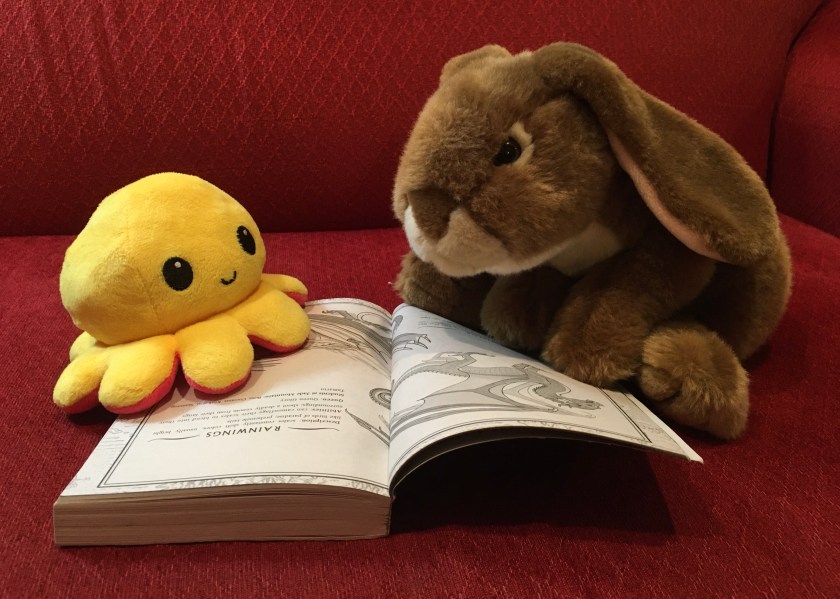
Caramel and a happy friend are reading Escaping Peril (Book Eight of the Wings of Fire series) by Tui Sutherland.

S: So maybe tell us a bit more about the actual story line of this particular book.

C: This is about Peril trying to find the ex-queen Scarlet.

S: Wait, you mentioned a Queen Scarlet before.

C: Yes, she calls herself a queen but she is no longer a queen actually. But Peril is faithful to her and wants her to become the queen again. Of course we learn that she was enchanted and that is why she is so loyal to Scarlet. And eventually she rips off the enchantment and burns it–

S: Wait, I think we are very close to or already past the line for too many spoilers!

C: But Queen Scarlet is killed, Ruby kills her–

S: Wait, that is even more spoilers. I think we should not give away too much.

C: Well, I disagree. It is more fun to talk about what actually happens in the book.

S: Okay, but there might be folks reading this without having read the book itself. So for those people, let us be more cautious, and leave some things in the book for them to discover on their own.

C: Okay, I can see how that would be more thoughtful, I suppose.

Caramel and his happy friend are discussing the various types of dragons in Escaping Peril (Book Eight of the Wings of Fire series) by Tui Sutherland.

S: Okay, so having read these eight books (and actually, you jumped ahead and read the eleventh one too), who is your favorite character?

C: I still like Qibli. He is still the funniest character, though I am not quite sure if I am pronouncing his name correctly. And even my happy octopus friend agrees that Qibli is the best character.

S: I see. But I think Qibli is not a main character, no?

C: I think he will be, in the tenth book. But you are right, so far, he is not one of the main characters.

S: So among the eight main characters you met so far, which one is your favorite?

C: I like all of them. Because we get to see the world through their eyes and we can understand them.

S: I see. That is nice Caramel, that you can empathize, even with dragons!

C: Why wouldn’t I? I love dragons. Anyways I also kind of wish the author would write a book about Kinkajou, the RainWing. I think it would be interesting because she is always so positive–

S: You mean like optimistic?

C: Yes.

S: Okay, so what three words would you use to describe Escaping Peril?

C: Descriptive, because there is a lot of description. Especially in the gory parts.

S: So it is also gory?

C: A bit. Like when Ruby rips off Queen Scarlet’s wing–

S: Wait, that does sound vicious.

C: Yes. But Ruby is actually nice and this happens in a duel to the death so Ruby has to kill Scarlet.

S: That does sound a bit too much.

C: Yes, there is gore but it is only in some small parts. And war is violent and vicious and pretty terrible, always, so why hide it?

S: Wow, Caramel, that is unfortunately true and pretty wise for a little bunny. Okay, so descriptions, gore, what else is worth pointing out about this book? What would be your third word?

C: Funny. It is still funny.

S: So are you and your happy friend ready to move on to book nine?

C: Yes, and then book ten, and then book eleven–

S: Okay, I get the point. Then let us wrap up this review. What do you want to tell our readers?

C: Stay tuned for more book bunnies reviews!

Caramel and his happy friend loved reading Escaping Peril (Book Eight of the Wings of Fire series) by Tui Sutherland, and recommend it to all little bunnies (and little happy octopi, too) who like dragons.

Marshmallow reviews Clarice the Brave by Lisa McMann

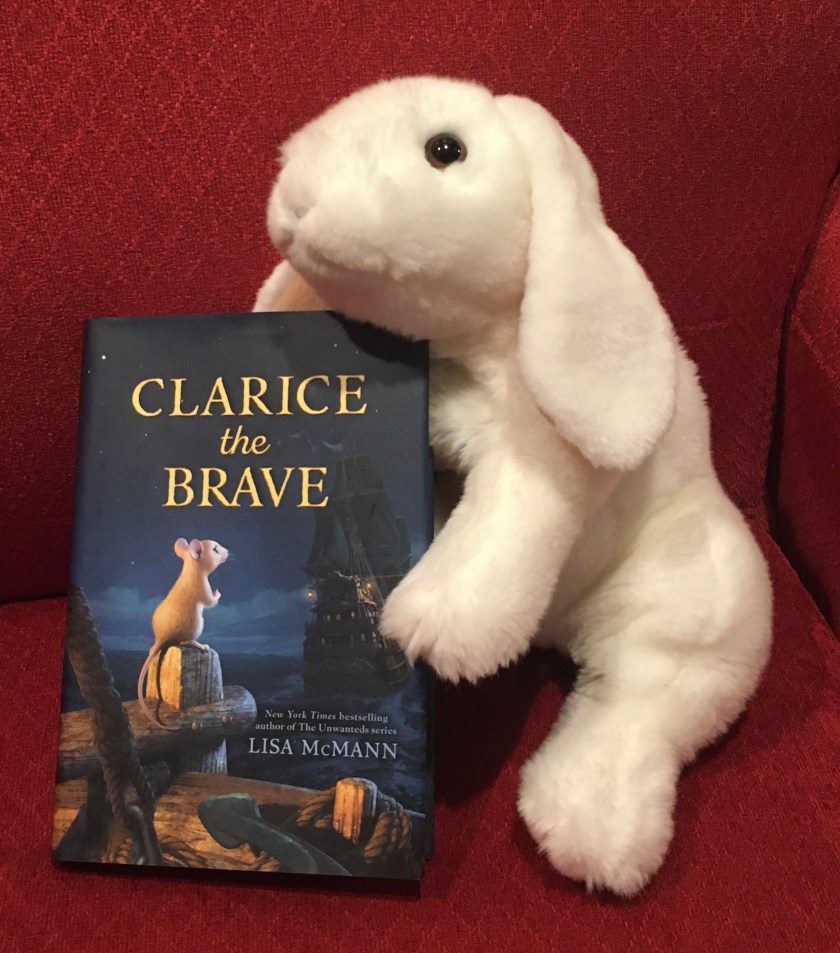
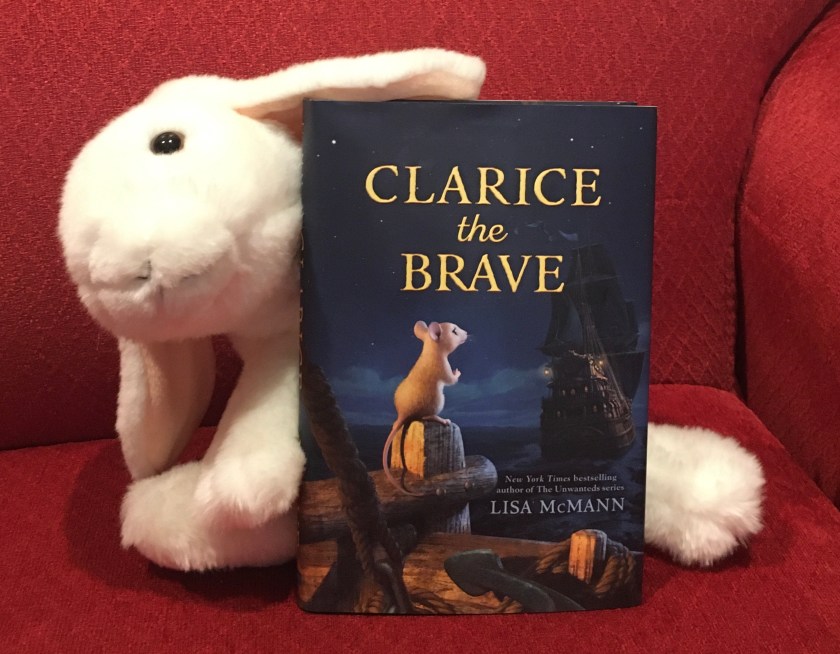
Today Marshmallow reviews Clarice the Brave, a 2021 novel by Lisa McMann.

Marshmallow reviews Clarice the Brave by Lisa McMann.

Marshmallow’ Quick Take: If you like books about animals, friendship, or family, then this might be the book for you.

Marshmallow’s Summary (with Spoilers): Clarice and her brother Charles Sebastian are ship mice. Their mother was born on land, but all Clarice has known is the vicious ocean. She doesn’t understand why her mother chose to live at sea, especially since it is so dangerous; Clarice’s mother drowned in the ocean during a storm. And that’s just the beginning of Clarice’s problems. The crew of the ship she lives on recently had a mutiny. The Captain and those loyal to him were shipped off to die on the open ocean. Unfortunately, Clarice and the Captain’s cat were also put on that boat, while her brother is stuck on the ship with the mutineers. The Captain’s cat, named Special Lady, killed and ate Clarice’s older sister. However, Clarice soon realizes that she and Special Lady must cooperate to survive. Eventually, Clarice and Special Lady start to sneak each other food, in a sort of trade. This leads, slowly, to their eventual friendship.

Meanwhile, on the ship with the mutineers, Charles Sebastian is left alone without his family. Charles Sebastian was always an unusual mouse, and so Clarice is very worried about whether he will be able to take care of himself. Charles Sebastian starts to hang out with a young girl named Benjelloun who is imprisoned by the mutineers, because she heard about their mutiny, which is illegal. Benjelloun is mistreated by the crew, left outside in the storm, and such. Eventually, Charles Sebastian learns that not all humans are bad.

Clarice has one goal: to find her brother again. But the odds seem impossible. Perhaps, with the help of Special Lady, she can see him once more. And the big question is: will they survive and live happily ever after?

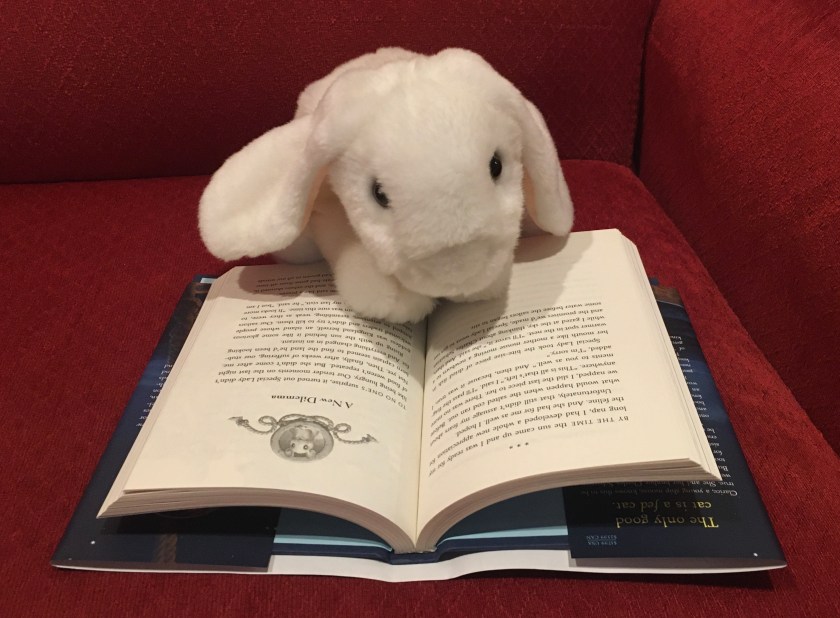
Marshmallow is reading Clarice the Brave by Lisa McMann.

Marshmallow’s Review: Clarice the Brave tells a very touching tale. I think that the book is also interesting because the story is told from the perspective of two mice. In some ways the book reminded me of Poppy and Rye and the rest of the stories of the mice of Dimwood Forest that Caramel has reviewed. But unlike in those books, each chapter in this book is actually narrated by one of the mice, either Clarice or her brother Charles Sebastian. Chapters narrated by each can be identified easily; at the start of each chapter, there is a small portrait of the specific mouse narrating that chapter.

There are also a few full-page illustrations throughout the book. They are done by Antonio Caparo, and they help the reader visualize some of the events going on.

It was really interesting to see how the characters develop through the book. For example, Charles Sebastian grows up into a braver version of himself as he needs to take care of himself all by himself. Charles Sebastian’s friendship with Benjelloun and the friendship between Clarice and Special Lady were both well developed.

This sweet story could be enjoyed by bunnies of all ages; I think bunnies seven and up could appreciate the tale of Clarice the Brave and her friends.

Marshmallow’s Rating: 95%.

Marshmallow rates Clarice the Brave by Lisa McMann 95%.

Caramel reviews Somewhere, Right Now by Kerry Docherty

Today Caramel reviews Somewhere, Right Now, a 2022 picture book written by Kerry Docherty and illustrated by Suzie Mason. As usual Sprinkles is taking notes and asking questions.

The book bunnies received this book as a review copy.

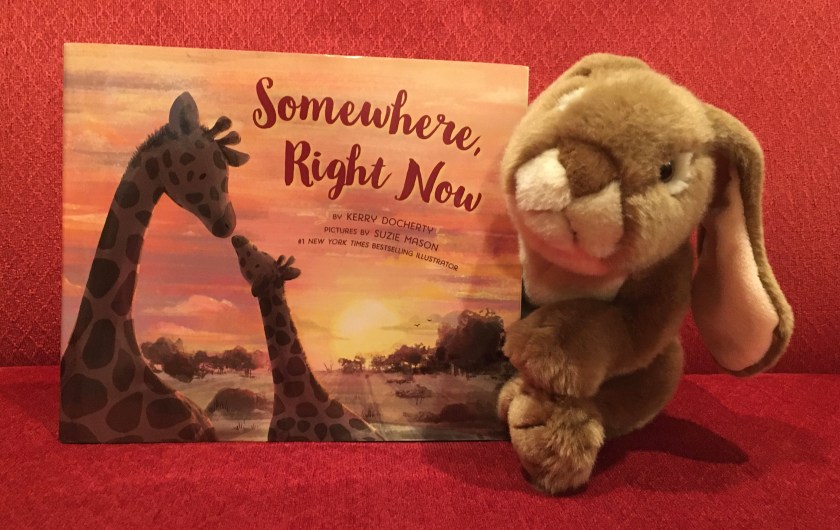
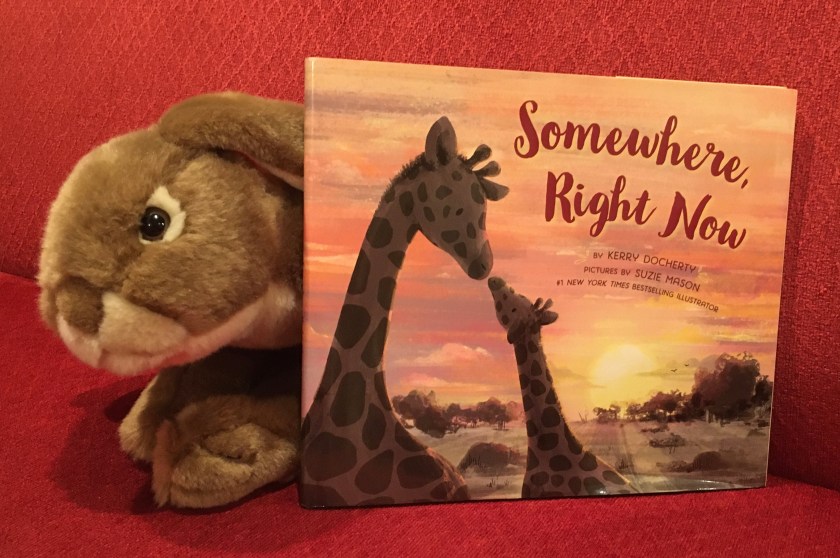
Caramel reviews Somewhere, Right Now, written by Kerry Docherty and illustrated by Suzie Mason.

Sprinkles: So Caramel, tell us a bit about this book.

Caramel: This book is about a girl named Alma who is scared and then her mom helps her by making her think of some nice thing happening somewhere right now. Then her brother gets mad, and then Alma helps him the same way. Then the father is sad and then the mom is overwhelmed, and they all help one another, all the same way.

S: So it is about a family who has a lot of small disappointments through their day and they support each other through it all?

C: Yes, pretty much. And I really like how they do it. They think about how somewhere there is something nice going on.

S: So having some perspective about things, that life might be upsetting in some ways for you right now, but look at the big picture: somewhere something good is happening. It’s like that?

C: Yes. For example there is a happy giraffe and a mommy whale and a baby whale and so on.

S: So it is almost like a game, right? If you are not feeling good about your life right now, say you are sad or angry, or disappointed or something, you can think about something nice. I like the idea. Almost like Pollyanna and her glad game. So let us think about something happening somewhere right now that could help us smile.

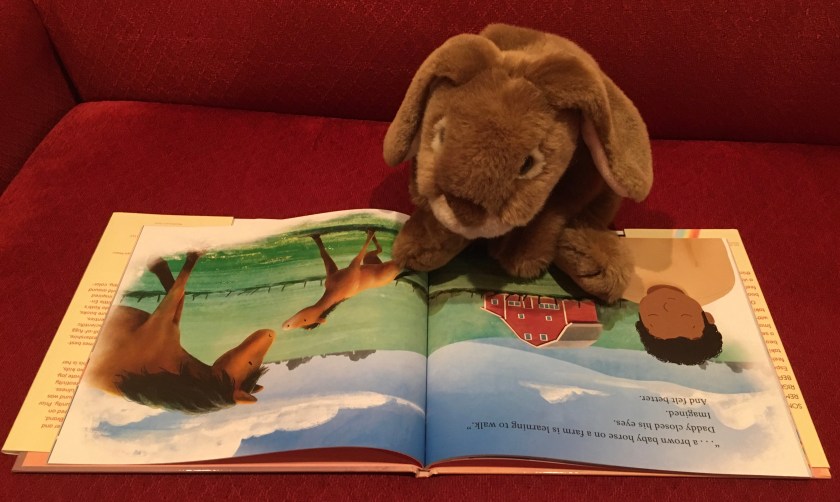
C: In the book there is a baby horse learning to walk. That made me smile.

S: Yes, me too! But I want you to come up with something yourself. Can you imagine something like that that could help you feel better?

C: Okay, so I’ll “close my eyes and imagine that somewhere, right now” … a bunny is getting sleepy and snuggling near his mommy.

S: Hmm, I think I know exactly where that bunny is!

C: Yes you do. Sitting right next to you.

S: Okay. I think that our readers might find that smile-worthy. I do. Let me try too. I’ll “close my eyes and imagine that somewhere, right now” … there is a beautiful sunrise over a green bay.

C: I like that!

Caramel is reading Somewhere, Right Now, written by Kerry Docherty and illustrated by Suzie Mason.

S: So what did you think about the illustrations in the book?

C: I think they are cute. I especially like the baby horse learning to walk.

S: True. This is a really sweet book all around. I also thought the family members looked like one another, but not completely. So they could really be a family, don’t you think?

C: Yes. I agree. And the girl Alma has a little brother Jack. Like Marshmallow has me.

S: Yes, that is true too. Did you know there is a song to accompany this book?

C: No! Can we listen to it?

S: Sure. I will also embed it here:

Somewhere, Right Now Song | Kindergarten and Preschool Songs – YouTube (posted by the publisher Penguin Kids).

S: The song makes me think of the times we have been stuck at home and got really bored and frustrated. At such times, we could have played the “somewhere, right now” game and imagine something good happening somewhere.

C: Now we can. Hey, I have another one! Somewhere, right now, I think a baby polar bear might be playing with his mommy. Or maybe sleeping next to her because it is actually kind of late.

S: I see you are trying to send me a signal Caramel.

C: Yes.

S: This book made me want to snuggle too. I think it is a very good book for snuggling with one’s favorite little bunny and reading together.

C: Yes. I think so too. How about we do just that?

S: I think we might. But before that, tell me three words to describe the book.

C: Colorful, happy, and sweet.

S: I agree with all three of your words Caramel! So let us wrap up this review then. What do you want to tell our readers?

C: Stay tuned for more book bunny reviews! Oh and May the Fourth be with you!

Caramel enjoyed reading Somewhere, Right Now, written by Kerry Docherty and illustrated by Suzie Mason, and recommends it to all the little bunnies (and the big bunnies they read together with) for snuggle time.