Marshmallow reviews Slow Productivity by Cal Newport

Last year Marshmallow reviewed two advice books by cal Newport directed towards students: How to Become a Straight-A Student and How to Be a High School Superstar. This week she got into Newport’s most recent book Slow Productivity, published in March 2024. Sprinkles enjoyed reading this book immensely, so she wanted to join Marshmallow in this review.

Marshmallow reviews Slow Productivity by Cal Newport while a friendly but slightly annoying little duckling observes.

Sprinkles: So Marshmallow, this is your third book by Cal Newport, isn’t it?

Marshmallow: Yes. I find him to present very thought-provoking ideas.

S: I find his books interesting as well. So we both read this one. It is titled Slow Productivity. I think he was inspired by the slow food movement, where you emphasize slowness and quality and community and local ingredients instead of mass-produced generic fast food. I also read a book a while back about slow teaching; it was also cool. So can you tell us briefly what Newport means by slow productivity? 

M: Slow productivity is the idea of decreasing your workload so you can increase the quality of your work to reach certain, specific goals all the while making sure you are living a sustainable life. 

S: That sounds like a very appealing goal. Tell us more. 

M: So his method, Newport promises, will decrease the familiar overwhelming anxiety and stress the modern knowledge worker experiences.

S: Wait, what is a knowledge worker? 

M: According to IBM, a knowledge worker is “a professional who generates value for the organization with their expertise, critical thinking and interpersonal skills.” So someone who uses computers for accounting, writes code to solve specific business problems, works as a professor, or is a freelance writer, or stuff like that. So unlike the previous Cal Newport books I’ve reviewed (which were intended to help students), Slow Productivity is aimed at adults who have already begun their careers.

S: Yes, I think so too. So I was surprised when you picked it up. But you seem to have enjoyed it, seeing how you have finished it already. 

M: Yes! I started reading it so that I could be prepared for when I grow up and have my own career. I think adults are always too stressed. I wanted to go into my career with ideas on how to be productive in a healthy manner that yields professional success. I also thought this book might still have principles and methods that could be helpful to me as a student.

S: That second part makes total sense, but the first part is really interesting and would probably be surprising for most folks. Especially if they do not know you well… I am sure you are one of only a few little bunnies your age who are thinking of reading about how to be a productive well-balanced adult! Okay so tell us a bit more about the book. How do we do this slow productivity thing?

M: Well, there are three principal ideas of slow productivity. And these are: do fewer things, work at a natural pace, and obsess over quality. The book utilizes a plethora of “case studies” (as Newport calls them) to prove the author’s suggestions and theories. From each of these examples, he synthesizes (or reiterates) the related slow productivity lesson. 

S: I think these are good principles for almost anyone. I mean, they are definitely meaningful for me as a working adult and parent, but also for you. You are now a busy kid going to school and doing a lot of extracurricular activities. And these principles seem to agree with the advice he gives students. Do not cram too many activities just to impress. Do fewer things but do those at such a high level that you will be impressive that way. 

M: Yes, I’ve recently seen this idea of his show up in the Atlantic under the name of a spike applicant (one who is exceptionally good at one thing.
Marshmallow is reading Slow Productivity by Cal Newport while the friendly but slightly annoying little duckling is joined by several others.

S: I remember a colleague who said, “Everyone talks about well-rounded students; what is wrong with a sharp knife?” I loved his analogy. I think this spike idea is similar. I mean not everyone is or needs to be a sharp knife, but we do need sharp knives, and they often find their niche. But I also think it makes sense for young bunnies to explore different types of activities to see what they enjoy and what they are good at. Those explorations provide a lot of insight and you can be surprised by what you end up liking and being good at. 

M: Yes. In this book though, Cal Newport focuses on maintaining a low, easy workload so you can finish larger goals over long periods of time and build your expertise in your field. 

S: That is a different life stage than the exploration stage I was talking about. Of course, his student advice is also about being selective with extracurricular activities, but one needs to figure out what they like and what they want to productively focus on. There is serendipity, some portion will always be about chance, but one also needs time to try out new things. At least that is what I think. But what do I know? I have not written any productivity books!

M: Well that’s okay! Cal Newport gives you the tips so you can focus on other things you like to do and how you can become a fuller person as a whole by managing your workload. In his book for high school students, he focuses on becoming a more interesting person for the sake of college applications (personal growth too I suppose, but primarily applications). In this book, he focuses more on the idea of growing yourself to be a more complete, content individual. I found his idea of pseudo-productivity being unnatural to be quite stimulating. Cal Newport’s books all have this underlying idea that the general consensus (whether in college apps or in careers) is bad because it has been unnaturally perverted towards pseudo-productivity, or doing things just to seem like you’re productive. His main mission is to convince you that this is not the correct way of things and that the situation can be improved by acting in a more natural, original way. 

S: Yes, I think that is a good way to put his message in these three books together. I too find his books always give me good ideas. And I am glad you appreciated this book too. 

M: Yes! I found his ideas to be very useful, even as a child bunny. 

S: This is already quite a long post. Shall we wrap it up?

M: Sure! In summary, I would really recommend this book for all adults who work in the knowledge sector. Even as a bunny in school, I can see that the current work system is set up in a way that is not sustainable for individuals and society as a whole. I hope the situation improves before I join the workforce for my sake. But for the sake of others, I hope this book is more widely read so more people can enjoy full lives with more success.

S: That is a nice sentiment! So how would you rate this book?

M: I would rate this book at 100%. I really liked it and I found it to be very helpful. Cal Newport’s methods are quite logical. 

S: That sounds just about right! Okay, what do you want to tell our readers as we wrap this up?

M: Stay tuned for more amazing reviews from the book bunnies!

Marshmallow rates Slow Productivity by Cal Newport 100% and hopes it will provide some cover, while the ducklings continue to amass.

Caramel reviews Warhammer 40000: Core Book

Today Caramel is talking to Sprinkles about his new Warhammer 40,000: Core Book.

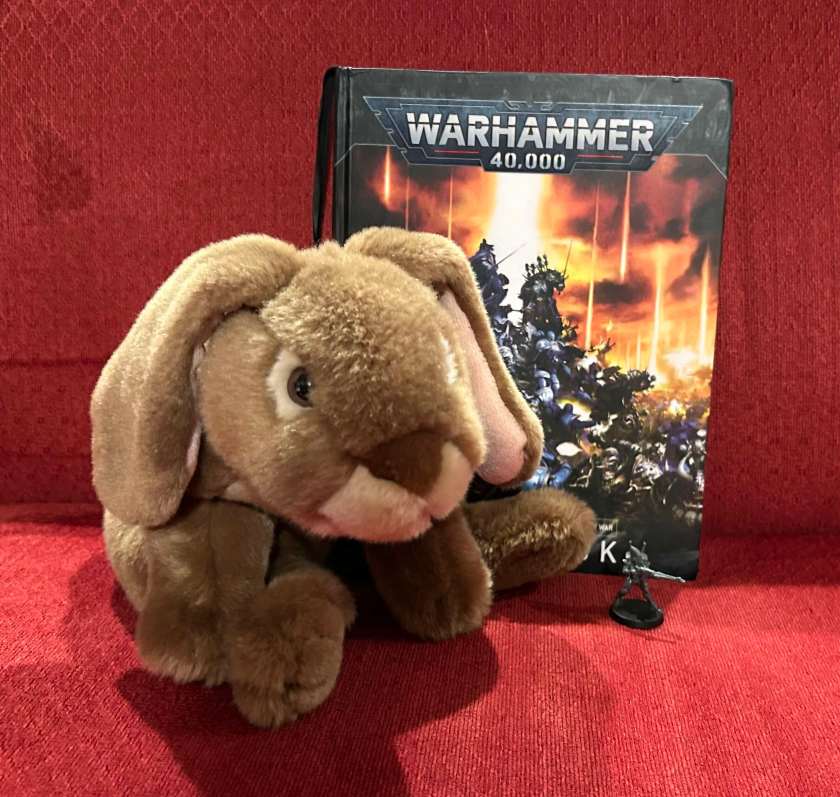
Caramel reviews Warhammer 40000: Core Book as his Aeldari friend watches.

Sprinkles: So Caramel, today we are talking about your new Warhammer 40000: Core Book. So maybe start by telling us a bit about it?

Caramel: Sure, this book is a rule book for the Warhammer 40,000 game. It includes a description for every army in the game and tells you about some of the units in the army.

S: Wait, let us start a bit slower. I know you like this game but honestly I do not know much about it. On the book website I read “In the grim darkness of the far future, there is only war.” That sounds utterly terrifying. 

C: Yeah, I suppose.

In the grim darkness of the far future, there is only war.

In the 41st Millennium, warring factions from ancient civilisations and upstart empires fight endless battles across innumerable worlds. Humanity stands alone, beset on all sides by the heretic, the mutant, and the alien. There is no mercy. There is no respite. Prepare yourself for battle.

– https://warhammer40000.com

S: So this is supposed to be the future of our universe, right?

C: Yes, we are in the 41st century 

S: And there are no humans or bunnies, I presume?

C: No, there are humans, but they mainly worship the God Emperor of Mankind. 

S: Hmm, not loving that at the moment, but okay. And are they based on Planet Earth or is the main scene elsewhere in the universe? And are they the main heroes or villains or just one among many other races? 

C: They are somewhere in between, not too evil, but not great people, either. And they do inhabit thousands of planets but their civilization has stagnated. Not terribly optimistic.

S: I see. So the game you play takes place about forty thousand years in the future when there is constant war in the universe. So what is the game like? Do you role play individual heroes? Do you lead armies or nations or planets? 

C: You lead a single army, and the size of the army is determined by a point system. You usually have 1000 points, but in some game rounds, you can have more or less.

S: And do you cooperate with friends when you are playing with them? Or are you usually battling one another? 

C: Both. Occasionally you have allies. At other times, it is just you and your army against all the other players’ armies. 

S: I see. So are the battles random battles for power over a resource or a planet? Or is there an overarching goal, like beating the main baddies of the galaxy or pushing back invaders and reestablishing the dominion of an empire? 

C: I think usually it is a battle over resources or knowledge that causes battles.

S: So why do you like this game? Because it is a neat strategy game? 

C: Yes, I like the strategy needed to win.. 

S: And you like having an excuse to hang out with friends for an extended period of time?

C: Yes.

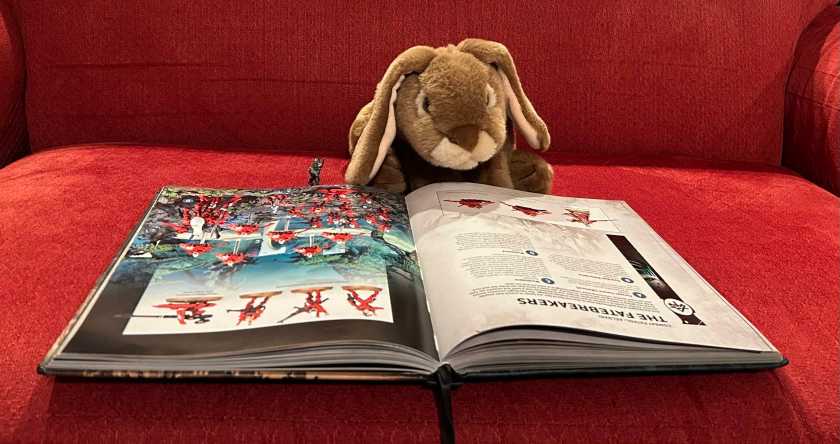
Caramel and Aeldari friend are reading and enjoying Warhammer 40000: Core Book.

S: Alright, let us get back to the book. So the book is the rule book for the game then, right? But you were playing the game without it, so it is not only a rule book, is it?

C: Oh, it is a rule book. The way I was playing was by asking my friends about the rules. 

S: So this is more like the Dungeons and Dragons type of thing, where the rules are quite complex and there is a wide range of things you can do or types of beings you can be. 

C: Yes, kind of, but in Warhammer you control an army, In D&D, you control one person.

S: I understand that, I think. Okay, so tell me more about the book. It is a large-format and full-color book, printed on rather nice paper and with solid binding. I am assuming you look a lot at the pictures.

C: Yes, that is what I do a lot, but I also read the rules and the descriptions.

S: So do you think you will keep it as a reference book as you continue to play the game with your friends? 

C: Yes, I think I will. 

S: But you have already read this whole book from cover to cover? How long is it? How many pages does it have? It does look pretty thick.

C: It has 220 pages.

S: Hmm, so not too thick, you have read much thicker books before. So maybe it is the high quality paper that makes it so thick. Okay. But you have not yet answered all my questions. Maybe I should have asked them one at a time. So I will ask again. Have you read the whole book from cover to cover yet? 

C: Yes, many, many times.

S: Well, that sounds very much like a strong endorsement! So I am guessing you like the book then. 

C: Yes, greatly.

S: Here is the hard question though: would you have enjoyed this book at all if you did not know about Warhammer or did not like to play it already?

C: Well, I probably wouldn’t have gotten the book if I didn’t like the game, but I think maybe, the pictures and stories might have drawn me in if i just got to look at the book a bit. 

S: Yeah, I can see that. You already like space-related things, you like Star Wars, you enjoy reading and learning about wars more generally, and you like fiction with aliens and spaceships. You also like role-playing games. I am guessing this has a lot of the things that you would like.

C: Yes, that is true. This Warhammer book has almost everything that I like: spaceships, robots, elves, and to top it all off, PICTURES!!!

S: There are elves?! That is awesome!

C: Well, technically they are called the Aeldari, but they are basically space elves with guns and cool armor, but I might be biased.

S: That does sound cool! But I think I know why you said almost everything though. There are no dragons!

C: Well, they have these things called heldrakes, which are robot dragons, but they are kind of sadistic.

S: I see. You probably prefer the dragons in Wings of Fire or How to Train Your Dragon. The ones who have different kinds of personalities, but can be kind and friendly and generous as well, right?

C: Yes, I do. 

S: Okay, Caramel, I think this is already a very long post. So let us wrap things up. What would you like to tell our readers?

C: Stay tuned for more book bunny reviews!

Caramel and Aeldari friend will continue to read and enjoy Warhammer 40000: Core Book for many months and years to come.

Marshmallow reviews The Lost Words: A Spell Book by Robert Macfarlane and Jackie Morris

Today Marshmallow reviews a beautiful large-format book by Robert Macfarlane and Jackie Morris: The Lost Words: A Spell Book, published in 2017. Sprinkles is taking notes and asking questions.

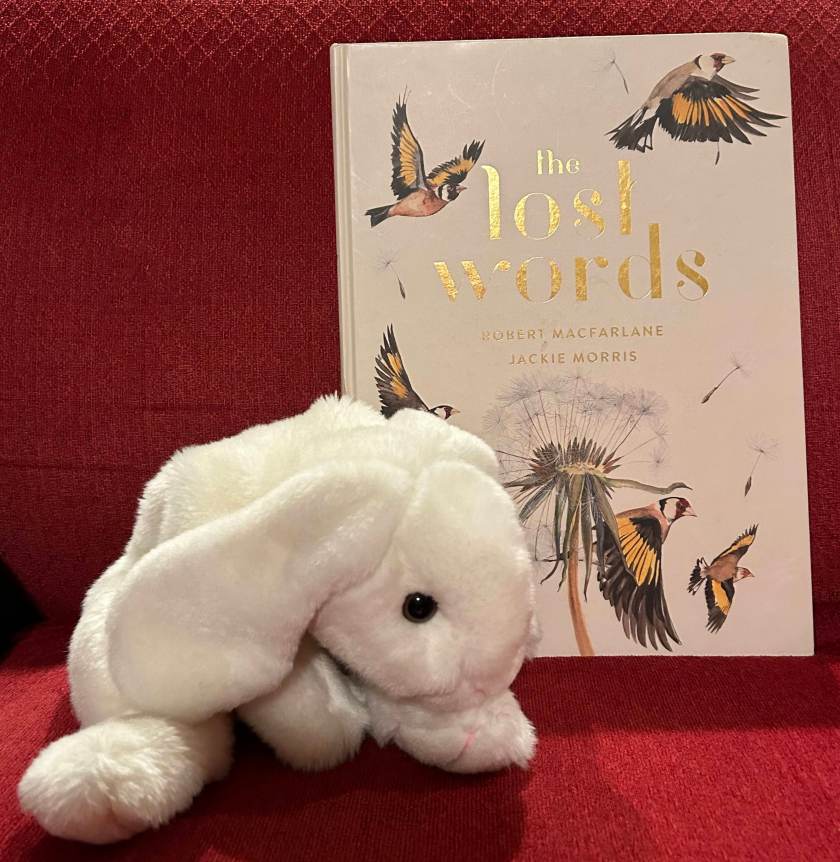
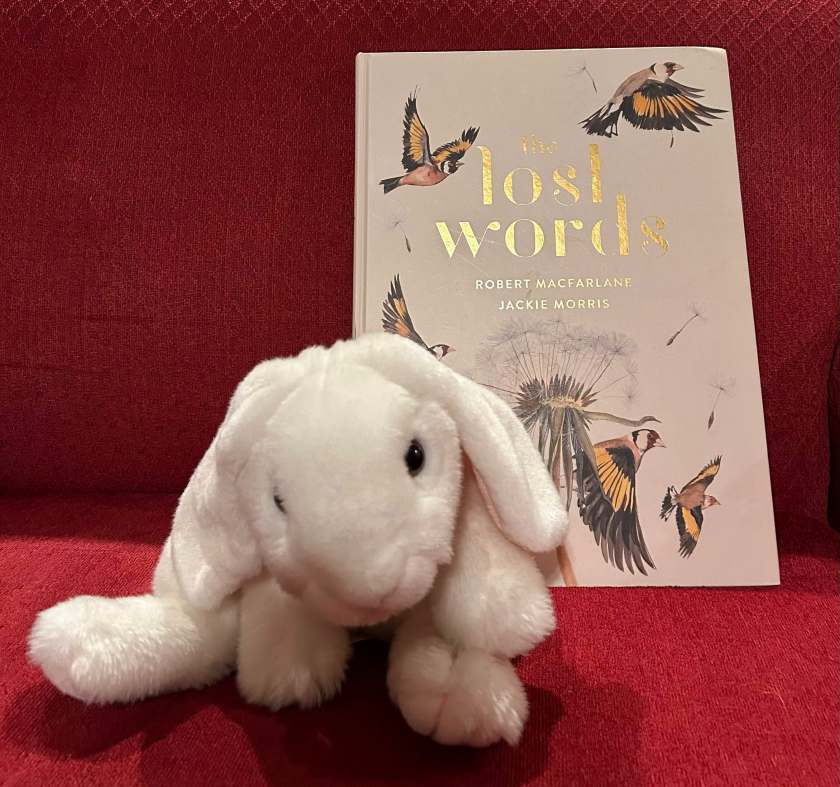
Marshmallow reviews The Lost Words: A Spell Book written by Robert Macfarlane and illustrated by Jackie Morris.

Sprinkles: So Marshmallow, let us begin. I thought this was a beautiful book, so I am very happy we get to talk about it today.

Marshmallow: Yes, it is a really beautiful book. Majestic, I could say. Each page is almost like a work of art.

S: I heard about this book a while back. I read the following and it stuck with me:

The book began as a response to the removal of everyday nature words – among them “acorn”, “bluebell”, “kingfisher” and “wren” – from a widely used children’s dictionary, because those words were not being used enough by children to merit inclusion. But The Lost Words then grew to become a much broader protest at the loss of the natural world around us, as well as a celebration of the creatures and plants with which we share our lives, in all their wonderful, characterful glory. –https://www.thelostwords.org/lostwordsbook/

M: Well, I did not know about this when I began reading the book. But it totally makes sense. The book is kind of like a children’s alphabet book. Approximately one word for each letter of the alphabet. For “A” for example there is an entry for “acorn” and another for “adder”. And for “B”, there is “bluebell” and “bramble”. but there is nothing for “E” for example. But anyways, each word chosen is a word for an animal or plant, some object of nature that used to be more familiar to young bunnies many years ago, but now that most of us live in much more urbanized environments, we do not always see or hear about them. So I really like that the authors decided to bring back these words to us.

S: Yes, me too! Okay, so then there should be about twenty-five words, then.

M: Not quite. There were apparently forty words that were dropped from that children’s dictionary, and the people who created this book picked twenty of those words and focused on those.

S: The book is not only twenty pages though.

M: Of course not, Sprinkles! That would be kind of too short. There are six pages for each word.

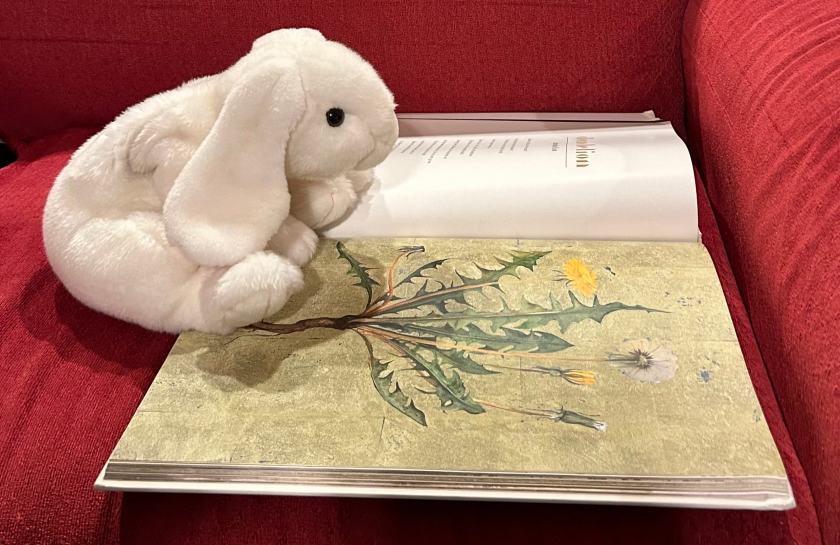
Marshmallow is reading The Lost Words: A Spell Book written by Robert Macfarlane and illustrated by Jackie Morris.

S: I see. So what happens on each of those pages?

M: What they do with each word is actually really amazing. For each word, there is first a two-page spread showing the letters making up the word in a way that is aesthetically pleasing. The letters making up the word are kind of hiding among many other letters, kind of reminding us that the word is lost somehow, but if we look carefully, we will find it again.

S: That is beautiful, Marshmallow.

M: Yes, the book is really beautifully designed. Anyways, after the first two-page spread, then there is a second two-page spread for the word. The left hand side there is an acrostic poem describing the word, and on the right hand side there is a water color painting of the animal or plant that the word depicts.

S: Remind our readers what an acrostic poem is maybe?

M: Sure. Basically when you take the letters of the first word on each line and put them in a vertical line, they make up a word. So for example here is the poem for IVY:

ivy

I am ivy, a real high-flyer.
Via bark and stone I scale tree and spire.
You call me ground-cover; I say sky-wire.

S; That is lovely!

M: It really is! I love the paintings! They are kind of like portraits! And then there is a final two-page spread, which is a large picture showing the animal or plant in its natural environment. Again the paintings are beautiful.

S: I agree with you completely Marshmallow. I have been looking through the pages for the last hour or so and I am amazed. The poems are quite neat too.

M: Yes, agreed. Each poem has a deeper meaning; they do not just provide a physical description, but also what it might represent, what makes it unique and special, and how it is a part of nature. I really liked the book!

S: I can see that. So if you were to rate it–

M: -I’d rate it 100% for sure!

S: That is wonderful Marshmallow. I am glad we were able to read this book.

M: Yes.

S: So let us wrap up this review then. What would you like to tell our readers?

M: Stay tuned for more amazing reviews from the book bunnies!

Marshmallow rates The Lost Words: A Spell Book written by by Robert Macfarlane and illustrated by Jackie Morris 100%.

Caramel reviews My Friend John by Arleen McCarthy

Today Caramel is talking to Sprinkles about a brand new book, My Friend John by Arleen McCarthy, which just came out on Friday November 8.

The book bunnies received this book from the publisher as a review copy.

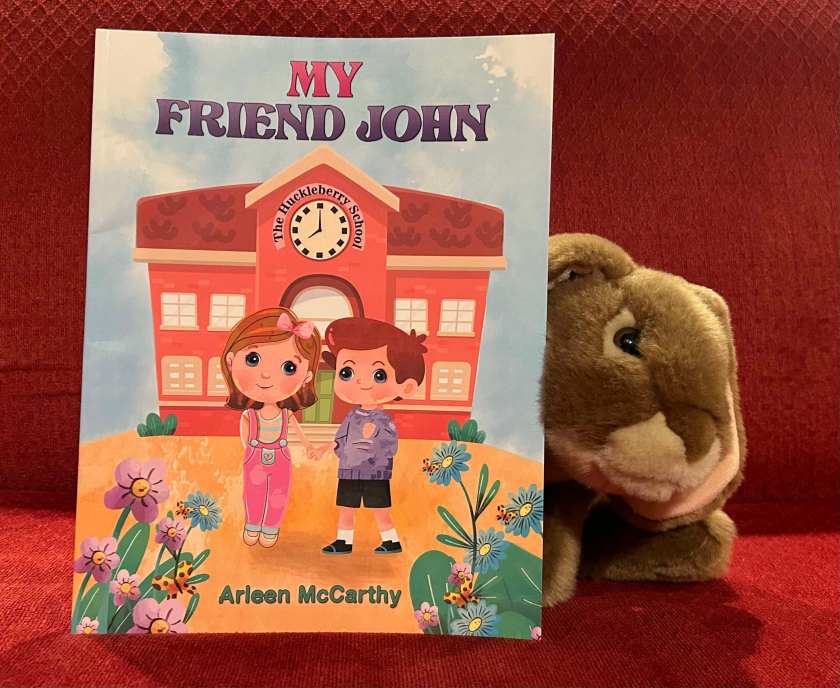
Caramel reviews My Friend John by Arleen McCarthy.

Sprinkles: So Caramel, here we are again, this time to talk about this book about a boy named John. So maybe start by telling us a bit about it?

Caramel: Sure. In this book the main character is a girl. 

S: Wait, the girl is named John?

C: No. Wait, I am getting there. The girl is in class one day when the teacher announces that there is going to be a new kid, named John. At lunch the main character invites John over to sit with her, and he says thank you. Later the kid John makes a noise and shakes, then goes back to normal.

S: What kind of noise? 

C: i think that he says something like “tak”.

S: So maybe something that does not mean anything to the other people? Maybe something in a different language? 

C: No, it is not quite that. Later John doesn’t come to school because in class this same kind of thing happens, too, and the rest of the class makes fun of him.

S: Oh, I see. He is not really in control when he is making the sounds and shaking, right? 

C: Yes, in fact I was going to get to that. Later the teacher tells her that John has Tourette Syndrome, and that is why he made those noises and started to shake.

S: I see. Of course the other kids did not know about Tourette Syndrome so they just ended up making fun of him and making him feel bad. 

C: Yes, but eventually the girl who is the main character understands this and later tells the class that the reason John did not come to school is because they made fun of him.

S: I see. I guess it is normal for most children not to know about this syndrome, but they did not need to make fun of someone just because they are behaving differently or unexpectedly. 

C: Yeah, I agree.

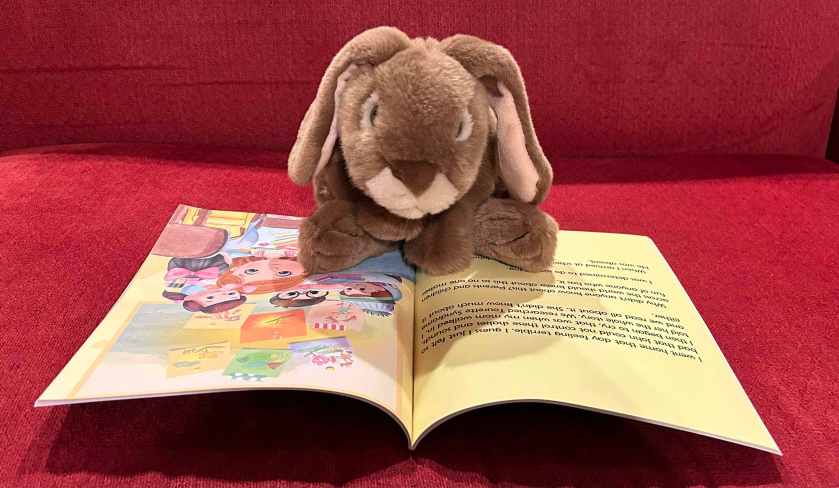
Caramel is reading My Friend John by Arleen McCarthy.

S: Did you know about Tourette Syndrome before reading this book?

C: Yes, a little.

S: Same here. I knew of the syndrome but I do not think I have met someone with a severe case of it. I can imagine it can be surprising to children if they have never seen someone with it, but that is no reason to make fun of the person. 

C: Yes, I suppose that is true; sometimes little bunnies can be cruel. But not me, right?

S: Right, not you. I know you are always trying to be kind, and you always want to help and include other bunnies. But I think it is in all of us to want to push away different people because we might be afraid. Many bunnies want to be with bunnies like themselves. It probably feels more comfortable. But we must choose to be kind whenever we can. And to know that many bunnies are different from one another, and differences do not have to separate us. I am happy that you consciously choose to be kind whenever you can. You only tease Marshmallow and me. 

C: Yes, I do.

S: We usually can handle it! Anyways, so what did you think about this book overall? I feel like there is always room for a new book about being kind. 

C: Yeah, agreed. This is a good book. And I learned about Tourette syndrome and you know I always like to learn new things. 

S: I know! So maybe this is a good time to wrap things up. Can you give me a description of the book in three to five words?

C: Positive and full of color. That is exactly five words, right?

S: Yes, that is perfect, thank you! And now what would you like to tell our readers?

C: Stay tuned for more book bunny reviews!

Caramel appreciated reading My Friend John by Arleen McCarthy and learning about ways we can support friends with differences.