Today Marshmallow reviews a classic, The Great Gatsby by F. Scott Fitzgerald, originally published in 1925.
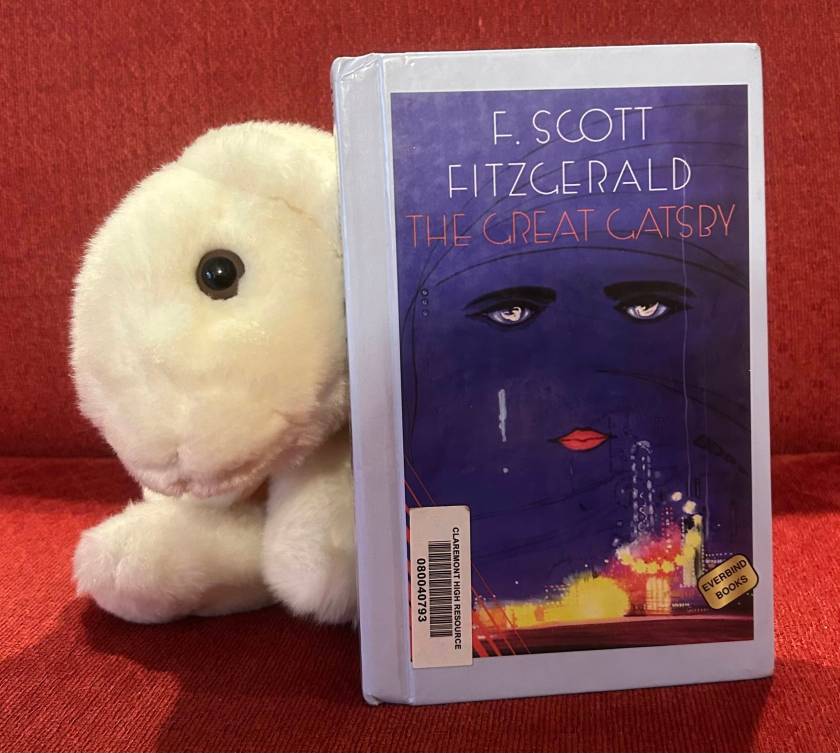
Marshmallow’s Quick Take: If you like reading celebrated classics, then this is the book for you!
Marshmallow’s Summary (with Spoilers): Nick Carraway is a man from the Midwest who came to New York City to work in the bond business. Living in West Egg (a peninsula home to the newly rich), Nick regularly visits his cousin Daisy and her husband Tom Buchanan, both of whom reside in East Egg (the peninsula across the water from West Egg where the wealthy, “old money” families live). As an outsider to the East Coast’s culture, he views himself as an honest, open-minded man with a perspective free of bias and judgement. His next door neighbor is a mysterious man who remains shadowed in uncertainty though.
This man is the titular Gatsby. He hosts extravagant parties with hundreds of guests, many of whom aren’t invited to be there but show up nonetheless. His house is beautiful, hinting unsubtly at how great his wealth must be. His origins are the focus of much speculation, but–because nobody is particularly close to him–no one is really able to discern much. Gatsby is somewhat like the Wizard of Oz: idolized in a distant, cryptic way with an impenetrable past but a present power that seems to know no bounds.
As Nick eventually gets closer to this new neighbor, he learns that there are indeed limits to his powers. Gatsby is infatuated with Daisy Buchanan, whose house is just alluringly across the water from his own. They had a passionate romance five years ago, but she agreed to marry Tom while Gatsby was at Oxford after the first World War. In a way, this reveals a tinge of superficiality within her. Yet, she is still as perfect as ever for Gatsby, who views her as the pinnacle of womanhood, grace, charm, beauty, wealth, and achievement. He wants nothing more than for her to openly declare to Tom that she never loved him. After all, Tom is busy having an affair with a middle-to-lower class woman in the “Valley of Ashes” (a much less wealthy part of the city).
Amidst this chaotic mess, Nick positions himself as the objective narrator watching the ideals of America degrade in the lap of luxury. Regarded as “the great American novel,” The Great Gatsby similarly casts itself as the defining text of its era, quietly revealing the reality of the 1920s Jazz Age and how America reached both new heights and horrific lows during that unforgettable time.
Marshmallow’s Review: This is perhaps one of the best classics to read for younger bunnies. Even though it was written a whole century ago, I found the style to be the most comprehensible and understandable from the very start. Fitzgerald has a very clear style of prose and surprisingly lacks the extravagant descriptions that often characterize most ‘great works’ of literature. This was both a blessing and a curse in a way. I liked how pleasant it felt to understand the language of this book so easily, but it definitely left more to the imagination than most books. I suppose that might have been better in the long run though because I still had a very abstract yet meaningful image of the setting within my head by the end of the book.
Of course, the setting and time period are undeniably discernible from the dialogue and character behavior; certain characters (e.g. Tom Buchanan, Nick Carraway) describe events and people in ways that are not acceptable today. However, if one is mindful, this is not a major distraction; I find it interesting though how this reveals imperfections in Fitzgerald’s prose, much like how Carraway’s narration is frequently brought into question by literary critics. The main focus of the book is on examining America during that period and specifically within the context of the American Dream. And today, a century later, there are still a lot of things this book can tell us about the United States.
There are so many wonderful, online resources that go into a heartening level of detail and depth. Reading this book slowly is definitely a must; reading it slowly and then checking in with what others have synthesized from it is even better! Each of the characters have such depth and nuance, gently accumulated over the years through different perspectives and lenses. I personally doubt that Fitzgerald intended for everything to be viewed the way it has been. While I think the claim that Nick is gay might have merit, for example, I cannot confirm 100% that Fitzgerald meant for him to be so. Other interpretations (such as the common claim that Daisy represents the allure of wealth, Nick Carraway serves to contrast Midwestern ideals with the supposedly morally bankrupt East, etc.) are similarly interesting and worth investigating. Such research after or during the reading of this book is imperative, and I feel doing this deeper dive has expanded my understanding and appreciation of this book in more than one dimension.
Overall, I really enjoyed unfolding different aspects of this book. Even though it is quite a short book (taking up less than two hundred pages in the edition I read), the sheer amount of detail and depth there is to uncover is a joy in its own right. It might take some time, but it is worth it.
I would recommend The Great Gatsby to almost everyone; it lacks the sexual content, confusing verbiage, and obfuscatory abstractness that often bars youth and the general public from enjoying what is deemed as great literature. With The Great Gatsby, the only thing that determines your ability to appreciate the first “American novel” is your willingness to.
Marshmallow’s Rating: 100%.


RG’s comments:
A real classic! I am not surprised how timeless this book is.
There have been several versions of the story made into a movie. Perhaps the best is the 1974 version, with Robert Redford playing Gatsby. This version is widely considered the best adaptation by book purists and if Marshmallow gets a chance to see it, she would like it.
KG’s comments:
Looking back through all her reviews, Marshmallow has sure grown up.
LikeLiked by 1 person