Marshmallow reviews Zenobia by Morten Dürr and Lars Horneman

Today Marshmallow reviews a graphic novel with very few words, Zenobia, written by Morten Dürr, illustrated by Lars Horneman, and published in English for the first time in 2018.

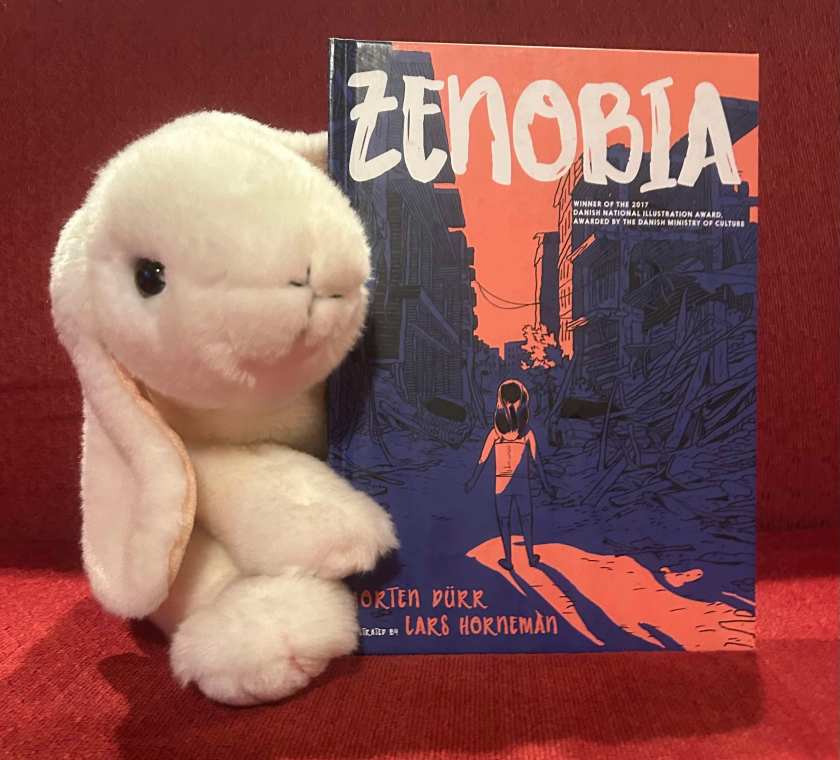
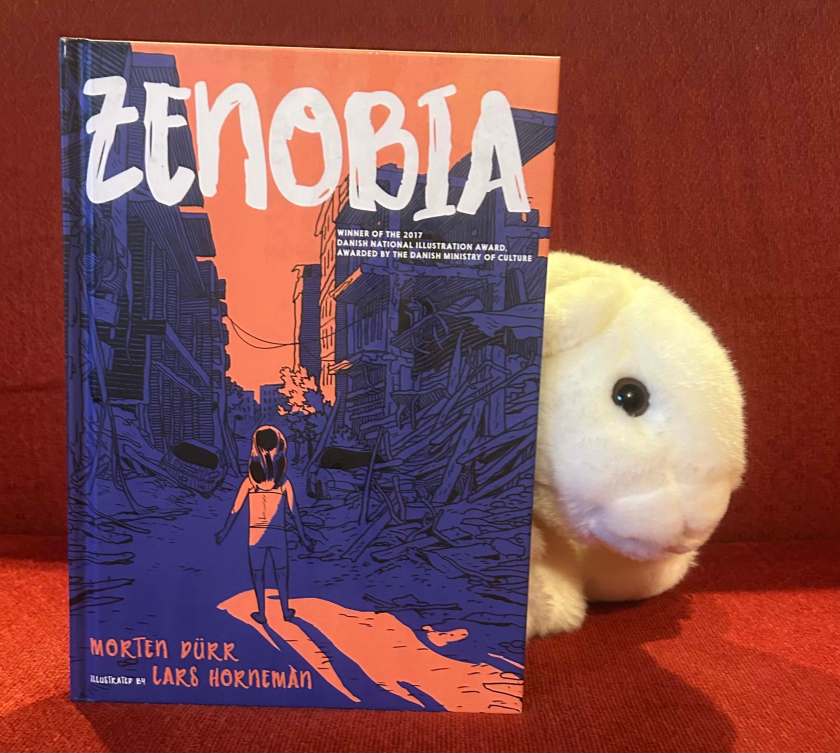
Marshmallow reviews Zenobia, written by Morten Dürr and illustrated by Lars Horneman.

Marshmallow’s Quick Take: If you like reading books that have a deep meaning and require thoughtful discussion, then this is the book for you. 

Marshmallow’s Summary (with Spoilers): Zenobia was the queen of Syria long ago. She was regarded as the world’s most beautiful woman and led like a man. She was powerful. Now, Amina—a young Syrian girl fleeing her country—uses that image to stay strong.

The story starts on a boat full of refugees all escaping Syria. The boat is small and stuffy and dangerous. When the boat is hit by waves, Amina is thrown overboard, off the boat and into the cold sea. As she sinks slowly, she thinks of her family and the last few days before the present day.

Amina and her mother used to play hide and seek. But on the day the mother had to leave her home, the two had been making dolmas. They had only salt and rice to use though. Her parents left to go to town to get more ingredients but never returned. Amina’s uncle came to the door, where she was sitting waiting, and told her they had to leave. They crossed a Syria devastated by war. The buildings and homes were demolished, while tanks proudly paraded around the ruined streets. Amina and her uncle found a man who would take them to a place “without soldiers,” but could only pay for one passenger. Her uncle selflessly gave Amina the seat, the only way out of Syria. She boarded the boat, and we come to understand that this is the one she is thrown off of by the merciless waves.

As Amina sinks to the bottom of the sea, she sees a sunken boat, overtaken by the ocean and covered in sea life: its name is Zenobia. 

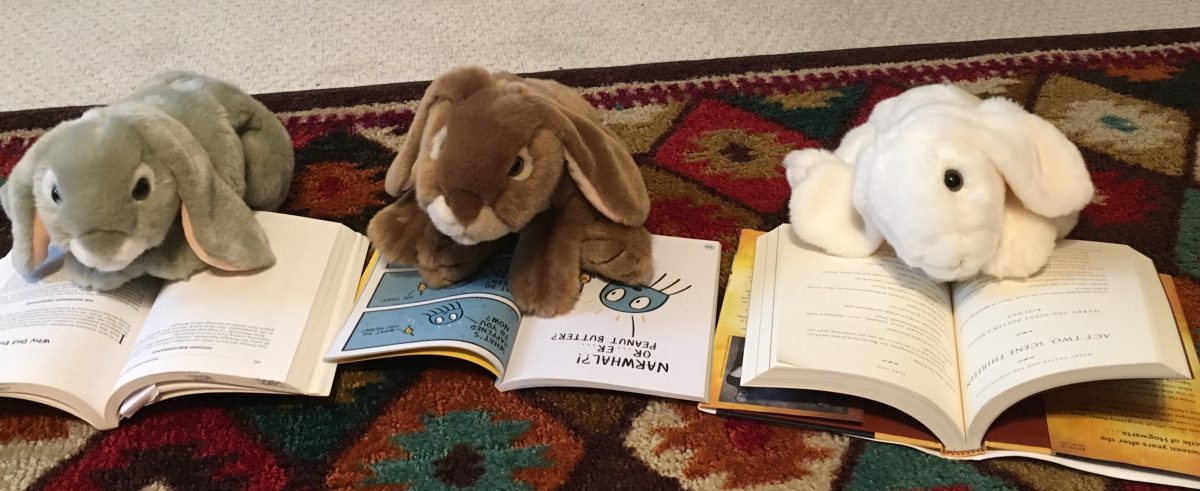
Marshmallow is reading Zenobia, written by Morten Dürr and illustrated by Lars Horneman.

Marshmallow’s Review: This was a heartbreaking story. I am not sure if it was inspired by a specific person’s story, but it is heartbreaking that many people have undoubtedly suffered similar fates. Zenobia is a book every person should read. There is no reason not to; it is easy to understand, quick to skim, and has a message that should not be missed. I read it and was not expecting a graphic novel or—is it even a graphic novel?—to be so moving. The ending seemed to be surreal since I didn’t think such a short book would be so heartbreaking.

Exposure to these kinds of stories makes it hard to hold onto hope. The world can be a terrifying, terrible place. Books like Zenobia and Refugee (another book that needs to be read by all) show what so many people are going through, all to reach a foreign country that is their only hope. Seeing what refugees are forced through just to try to get the normal, safe life they deserve is an experience we all need in the un-empathetic world we have made.

But there is undeniably hope. This book is a lesson that we all need. But we all need to also hold onto hope and do something to make our world better. In trying times, as cliche as this sounds, empathy and sympathy, love and compassion, understanding and action are what we need. It’s clear we are divided today, but we can come together and make beautiful things; we can make this world beautiful. At least, that’s what this bunny thinks. 

Marshmallow’s Rating: 100%.

Marshmallow rates Zenobia, written by Morten Dürr and illustrated by Lars Horneman 100%.

Caramel reviews Warhammer 40000: Core Book

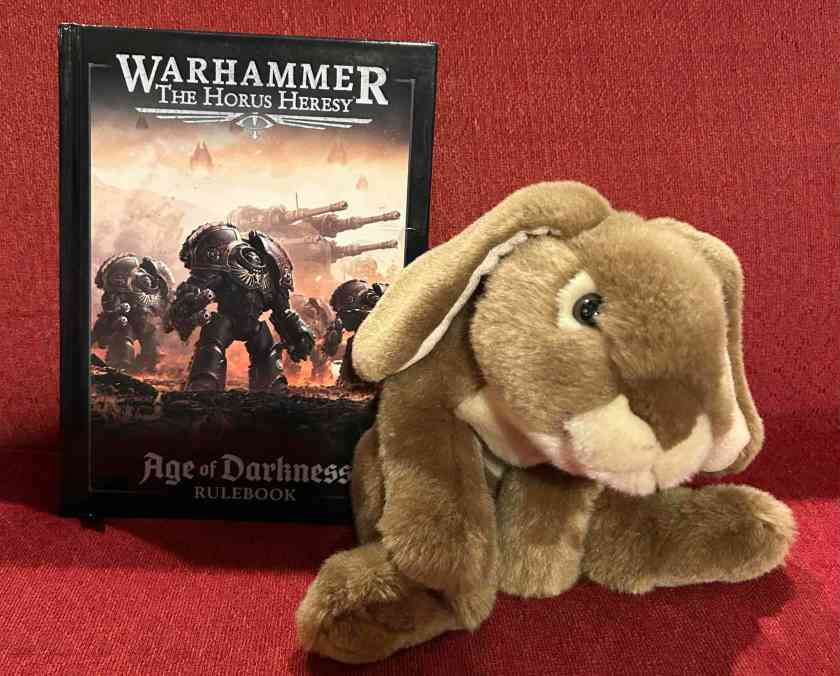
Today Caramel is talking to Sprinkles about his new Warhammer 40,000: Core Book.

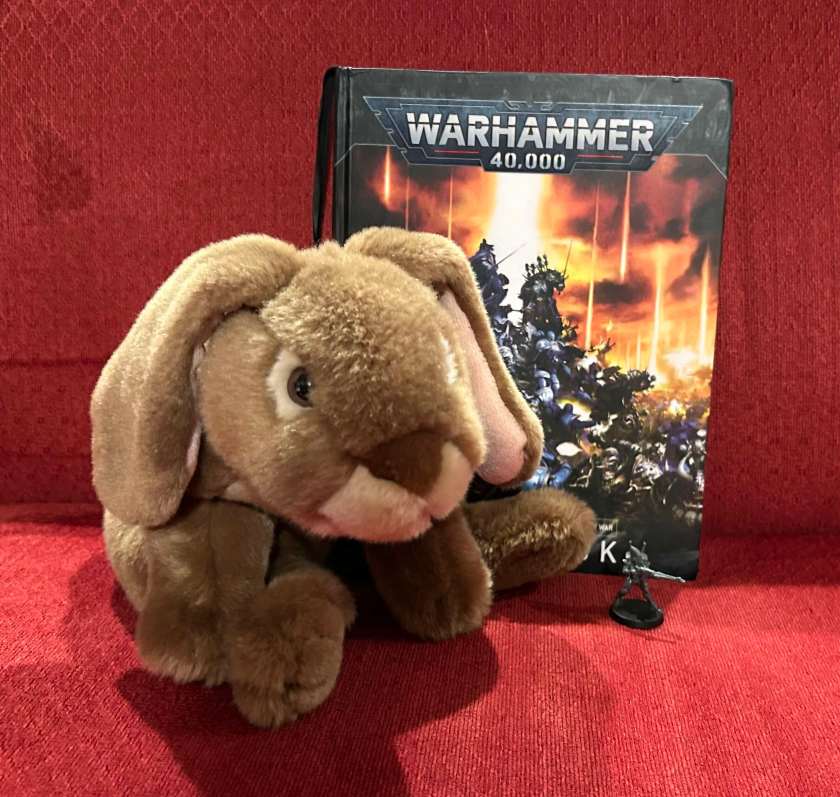
Caramel reviews Warhammer 40000: Core Book as his Aeldari friend watches.

Sprinkles: So Caramel, today we are talking about your new Warhammer 40000: Core Book. So maybe start by telling us a bit about it?

Caramel: Sure, this book is a rule book for the Warhammer 40,000 game. It includes a description for every army in the game and tells you about some of the units in the army.

S: Wait, let us start a bit slower. I know you like this game but honestly I do not know much about it. On the book website I read “In the grim darkness of the far future, there is only war.” That sounds utterly terrifying. 

C: Yeah, I suppose.

In the grim darkness of the far future, there is only war.

In the 41st Millennium, warring factions from ancient civilisations and upstart empires fight endless battles across innumerable worlds. Humanity stands alone, beset on all sides by the heretic, the mutant, and the alien. There is no mercy. There is no respite. Prepare yourself for battle.

https://warhammer40000.com

S: So this is supposed to be the future of our universe, right?

C: Yes, we are in the 41st century 

S: And there are no humans or bunnies, I presume?

C: No, there are humans, but they mainly worship the God Emperor of Mankind. 

S: Hmm, not loving that at the moment, but okay. And are they based on Planet Earth or is the main scene elsewhere in the universe? And are they the main heroes or villains or just one among many other races? 

C: They are somewhere in between, not too evil, but not great people, either. And they do inhabit thousands of planets but their civilization has stagnated. Not terribly optimistic.

S: I see. So the game you play takes place about forty thousand years in the future when there is constant war in the universe. So what is the game like? Do you role play individual heroes? Do you lead armies or nations or planets? 

C: You lead a single army, and the size of the army is determined by a point system. You usually have 1000 points, but in some game rounds, you can have more or less.

S: And do you cooperate with friends when you are playing with them? Or are you usually battling one another? 

C: Both. Occasionally you have allies. At other times, it is just you and your army against all the other players’ armies. 

S: I see. So are the battles random battles for power over a resource or a planet? Or is there an overarching goal, like beating the main baddies of the galaxy or pushing back invaders and reestablishing the dominion of an empire? 

C: I think usually it is a battle over resources or knowledge that causes battles.

S: So why do you like this game? Because it is a neat strategy game? 

C: Yes, I like the strategy needed to win.. 

S: And you like having an excuse to hang out with friends for an extended period of time?

C: Yes.

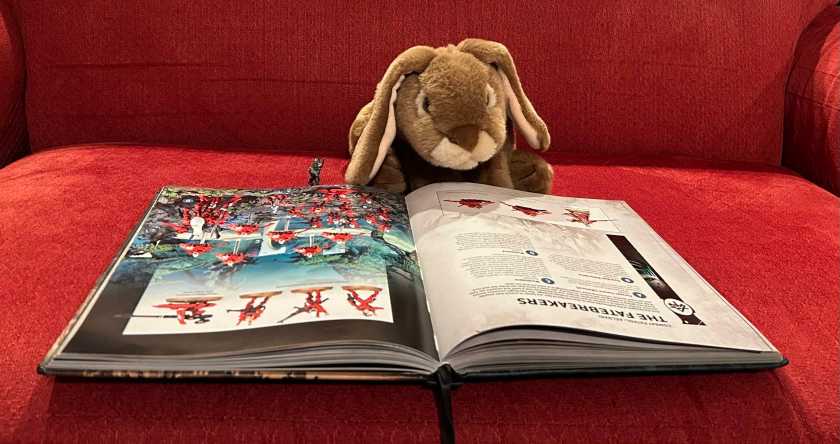
Caramel and Aeldari friend are reading and enjoying Warhammer 40000: Core Book.

S: Alright, let us get back to the book. So the book is the rule book for the game then, right? But you were playing the game without it, so it is not only a rule book, is it?

C: Oh, it is a rule book. The way I was playing was by asking my friends about the rules. 

S: So this is more like the Dungeons and Dragons type of thing, where the rules are quite complex and there is a wide range of things you can do or types of beings you can be. 

C: Yes, kind of, but in Warhammer you control an army, In D&D, you control one person.

S: I understand that, I think. Okay, so tell me more about the book. It is a large-format and full-color book, printed on rather nice paper and with solid binding. I am assuming you look a lot at the pictures.

C: Yes, that is what I do a lot, but I also read the rules and the descriptions.

S: So do you think you will keep it as a reference book as you continue to play the game with your friends? 

C: Yes, I think I will. 

S: But you have already read this whole book from cover to cover? How long is it? How many pages does it have? It does look pretty thick.

C: It has 220 pages.

S: Hmm, so not too thick, you have read much thicker books before. So maybe it is the high quality paper that makes it so thick. Okay. But you have not yet answered all my questions. Maybe I should have asked them one at a time. So I will ask again. Have you read the whole book from cover to cover yet? 

C: Yes, many, many times.

S: Well, that sounds very much like a strong endorsement! So I am guessing you like the book then. 

C: Yes, greatly.

S: Here is the hard question though: would you have enjoyed this book at all if you did not know about Warhammer or did not like to play it already?

C: Well, I probably wouldn’t have gotten the book if I didn’t like the game, but I think maybe, the pictures and stories might have drawn me in if i just got to look at the book a bit. 

S: Yeah, I can see that. You already like space-related things, you like Star Wars, you enjoy reading and learning about wars more generally, and you like fiction with aliens and spaceships. You also like role-playing games. I am guessing this has a lot of the things that you would like.

C: Yes, that is true. This Warhammer book has almost everything that I like: spaceships, robots, elves, and to top it all off, PICTURES!!!

S: There are elves?! That is awesome!

C: Well, technically they are called the Aeldari, but they are basically space elves with guns and cool armor, but I might be biased.

S: That does sound cool! But I think I know why you said almost everything though. There are no dragons!

C: Well, they have these things called heldrakes, which are robot dragons, but they are kind of sadistic.

S: I see. You probably prefer the dragons in Wings of Fire or How to Train Your Dragon. The ones who have different kinds of personalities, but can be kind and friendly and generous as well, right?

C: Yes, I do. 

S: Okay, Caramel, I think this is already a very long post. So let us wrap things up. What would you like to tell our readers?

C: Stay tuned for more book bunny reviews!

Caramel and Aeldari friend will continue to read and enjoy Warhammer 40000: Core Book for many months and years to come.

Marshmallow reviews Mockingjay by Suzanne Collins

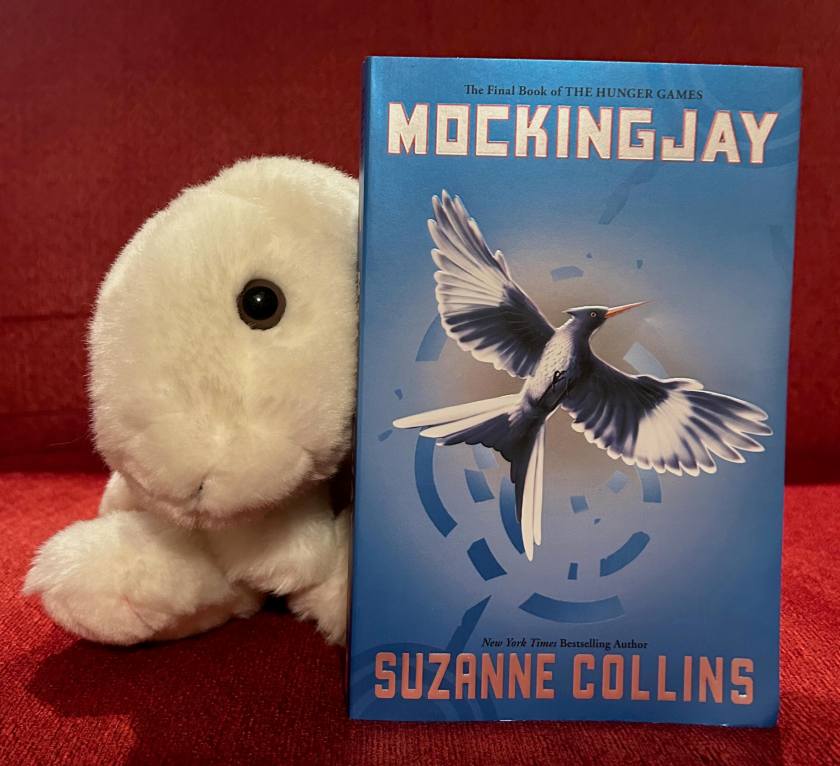
Marshmallow has already reviewed the first two books of the Hunger Games trilogy by Suzanne Collins: The Hunger Games and Catching Fire. Today she reviews the third and last book: Mockingjay, first published in 2010. Sprinkles is taking notes and asking questions.
(Marshmallow wants to warn readers that there may be some spoilers in what follows.)

Marshmallow reviews Mockingjay by Suzanne Collins.

Sprinkles: So Marshmallow, as your first post post-summer break, you chose to tell us a bit about Mockingjay. Let’s get started.

Marshmallow: Sure. Mockingjay is the third and final book in Suzanne Collins’s Hunger Games series. And I think it wraps up the story really realistically. It does not simplify or dismiss the bloodiness and complications of revolutions.

S: Okay, let us step back. So being the third book in a series, readers should probably have read the first two books, right?

M: Yes. So they should definitely have read The Hunger Games and Catching Fire. The story begins more or less when the second book ends. So Katniss Everdeen is the champion of District 12 in the seventy-fourth Hunger Games at the end of the first book, and then in the second book, she is forced to take part in the seventy-fifth one. And she and Peeta, her partner from District 12, survive that game too. But at the end of the second book, we are kind of left at a cliffhanger, because it seems that Katniss is taken by rebels, and Peeta is taken by the forces from the Capitol. So when the third book starts, Katniss is with the rebels from District 13. Oh, we should say there may be some spoilers here.

S: Okay, I will add a note to the beginning of the post about that. So wait, District 13. Wasn’t that destroyed in the rebellion against the Capitol seventy-five years ago, before the Games began?

M: So that is what everyone thought, but in reality they had survived and they went underground. Literally they began to live under the ground, and they are pretty strong because they have nuclear power. And they support the rebels. So Katniss learns about all this at the very end of the second book.

S: I see.

M: Then this book is about the rebels trying to take down the Capitol and President Snow, while Katniss has a lot of mixed feelings about being involved.

S: How come?

M: Well, she has suffered a lot of trauma, her entire District was destroyed, and she is seriously injured. She has healed but has many permanent scars, physical and emotional. Also Peeta is in the hands of the Capitol, and she is scared of how they might be torturing him.

S: I see.

Marshmallow is reading Mockingjay by Suzanne Collins.

S: So the narrative is still first person, right? We still see the world and the events through Katniss’ eyes?

M: Yes. And that was one of the reasons why the book shook me so much. The reader is going through all the emotional stuff together with Katniss.

S: I know. I saw how shaken you were by the end of the book.

M: Yes. Even though in some ways the end can be called a happy end, I was very unsettled about everything. Because Collins, the author, does not spare any details. She makes things so realistic. Both sides do terrible things, and there is really no winner. Lots of losers, but even those one could say won have so many permanent scars inside and out…

S: I understand. So all in all, it was a very powerful read it seems like.

M: Yes, I was emotionally very moved. The series, I think, is very important for all bunnies to read, at some point, because it shows how horrific all human suffering is and how violence is never, should never, be the answer. And it also shows how trauma, pain, and violence can shape others to become like the ones who hurt them.

S: Those are some tough lessons Marshmallow. I am guessing you think this book is not very suitable for very young bunnies.

M: I don’t know. I have friends who read this when they were twelve and they loved it. But personally I was affected very strongly by this book, and I think that maybe it is better suited to older bunnies than twelve.

S: That makes sense to me. It is also possible that people of different ages can read the book at different levels. But all in all, did you like this book as the end of the series? Having read all three, are you going to recommend people to do so themselves?

M: Yes. I definitely think so. I’d rate Mockingjay 100%, but also I think this whole series is very important. Not just a good book series to read, but as I said before, it is important for young people to be aware of the horrors of war, violence, human suffering.

S: Thank you, that works for me. So let us wrap up this review then. What would you like to tell our readers?

M: We are back! And stay tuned for more amazing reviews from the book bunnies!

Marshmallow rates Mockingjay by Suzanne Collins 100%.

Marshmallow reviews The English GI by Jonathan Sandler and Brian Bicknell

Marshmallow, just like Caramel, enjoys and appreciates graphic novels of various types. As such she has reviewed several of these books for the book bunnies blog. Today she reviews another recent graphic novel, The English GI: World War II Graphic Memoir of A Yorkshire Schoolboy’s Adventures in the United States and Europe, written by Jonathan Sandler and illustrated by Brian Bicknell. Sprinkles was curious about the book too, and so she is taking notes while asking questions.

The book bunnies received this book as a review copy.

Marshmallow reviews The English GI: World War II Graphic Memoir of A Yorkshire Schoolboy's Adventures in the United States and Europe, written by Jonathan Sandler and illustrated by Brian Bicknell.
Marshmallow reviews The English GI: World War II Graphic Memoir of A Yorkshire Schoolboy’s Adventures in the United States and Europe, written by Jonathan Sandler and illustrated by Brian Bicknell.

Sprinkles: So Marshmallow, let us start with a quick summary. What is this book about?

Marshmallow: This book is about Bernard Sandler, a seventeen-year-old boy from Yorkshire, England, who goes on a school trip to the US. Then the second world war starts and he cannot go back home. He has to find his own way through life in a new country. And he eventually joins the US army and fights in the war too.

S: That sounds like a really rough path for a young person.

M: I think so too. But he does survive and he lives a good life. And the author is his grandson who wanted to tell his story.

S: That is so neat! A lot of families have stories to tell, but not everyone ends up writing them up for others to learn about. So the book is not fiction, then?

M: No. In fact there is a long epilogue at the end of the book, which takes almost a fourth of it actually, and it gives a lot of details about Bernard’s life and his family.

S: I did see that. It looked really well documented. And in some ways it reminded me of two books you reviewed before.

M: Which ones?

S: Nothing But The Truth by Avi and They Called Us Enemy by George Takei.

M: I see how the second one is similar. That too was about real life, written by George Takei, whose childhood was during the second world war, and he went through a lot of difficult times. How do you connect this book to Avi’s?

S: That book also had a lot of documentation, no? Though of course that was fiction, and this is a real story.

M: Hmm, I see. Yes, you are right. This is not quite a typical graphic novel; first off it is true, and then it has a lot of historical documentation that connects it to history.

Marshmallow is reading The English GI: World War II Graphic Memoir of A Yorkshire Schoolboy's Adventures in the United States and Europe, written by Jonathan Sandler and illustrated by Brian Bicknell.
Marshmallow is reading The English GI: World War II Graphic Memoir of A Yorkshire Schoolboy’s Adventures in the United States and Europe, written by Jonathan Sandler and illustrated by Brian Bicknell.

S: So what else would you like to tell us about the book?

M: I really liked the illustrations.

S: They are black and white, no?

M: Well, they are more or less grayscale, but you can see a lot of details, and they are almost like photos, and since it is a history being told, I think it fits really well.

S: That totally makes sense.

M: Also I’d like to say that this would be appropriate for readers of all ages.

S: Especially if someone is a history buff, no? I think a lot of people like to read and learn about the second world war. This could be really perfect for such a reader.

M: Yes, but even if you are not particularly interested in that war, this is a good book. It has a really interesting story. And there is not much that would be difficult for young bunnies, except of course it is about war, which is a terrible thing, and Bernard has to separate from his original family and his original country, so those could be too sad for really young bunnies.

S: I agree with you Marshmallow. Some young bunnies might be really sad, so for them, this might not be a good choice. But if a bunny is willing to read a book about the war, and if they are keen on graphic novels, this would be a neat book for them.

M: Yes.

S: So did you learn some things from this book?

M: Yes. It was like looking through a window to see what life was like for a young person during the war. So I found it very interesting that way.

S: Did you know what a G.I. is?

M: I knew of the G.I. Joe action figures, but I did not know exactly what the initials meant, so I had to look it up! Wikipedia says: “G.I. are initials used to describe the soldiers of the United States Army and airmen of the United States Air Force and general items of their equipment. The term G.I. has been used as an initialism of “Government Issue”, “General Issue”, or “Ground Infantry”, but it originally referred to “galvanized iron”, as used by the logistics services of the United States Armed Forces.”

S: The evolution is interesting, isn’t it?

M: Yes.

S: So maybe it is about time to wrap up this review. How would you rate the book overall Marshmallow?

M: I’d rate it 97%. I like how it is a real story and I like the illustrations.

S: That’s great Marshmallow. So what do you want to tell our readers then?

M: Stay tuned for more amazing book reviews from the book bunnies!

Marshmallow rates The English GI: World War II Graphic Memoir of A Yorkshire Schoolboy's Adventures in the United States and Europe, written by Jonathan Sandler and illustrated by Brian Bicknell 97%.
Marshmallow rates The English GI: World War II Graphic Memoir of A Yorkshire Schoolboy’s Adventures in the United States and Europe, written by Jonathan Sandler and illustrated by Brian Bicknell 97%.