Today Marshmallow wanted to talk to Sprinkles about The Illustrated Happiness Trap by Russ Harris and Bev Ausbett, first published in 2014.
Sprinkles: So Marshmallow this time you chose a book that is not really intended for a young audience.
Marshmallow: Yeah, I suppose.
S: This book is apparently an illustrated and abbreviated version of a more normal-sized book which could be considered a self-help book. And we have not really gone into the self-help book genre here much.
M: True. I did review a book about confidence, a book about time management for teenagers, and two books about how to be a good student. But we do not typically review self-help books, you are right.
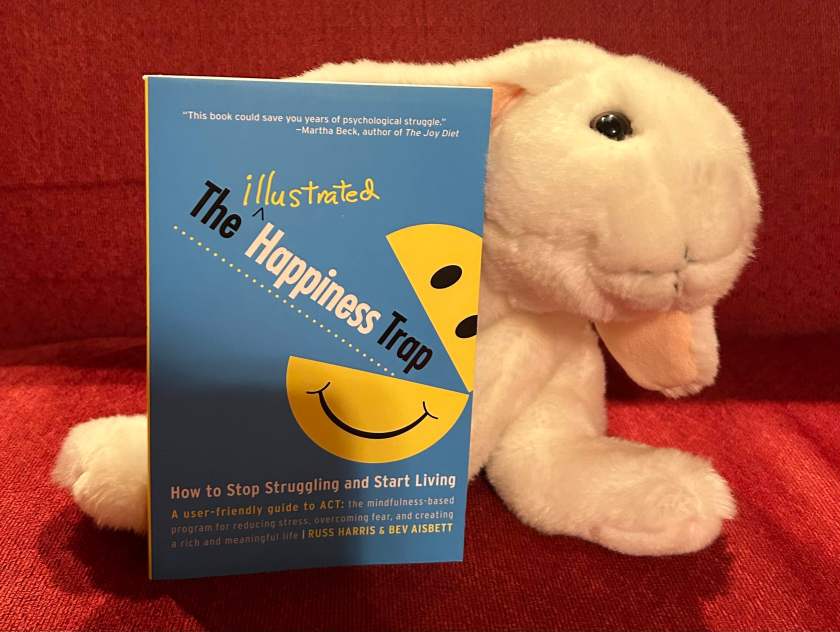
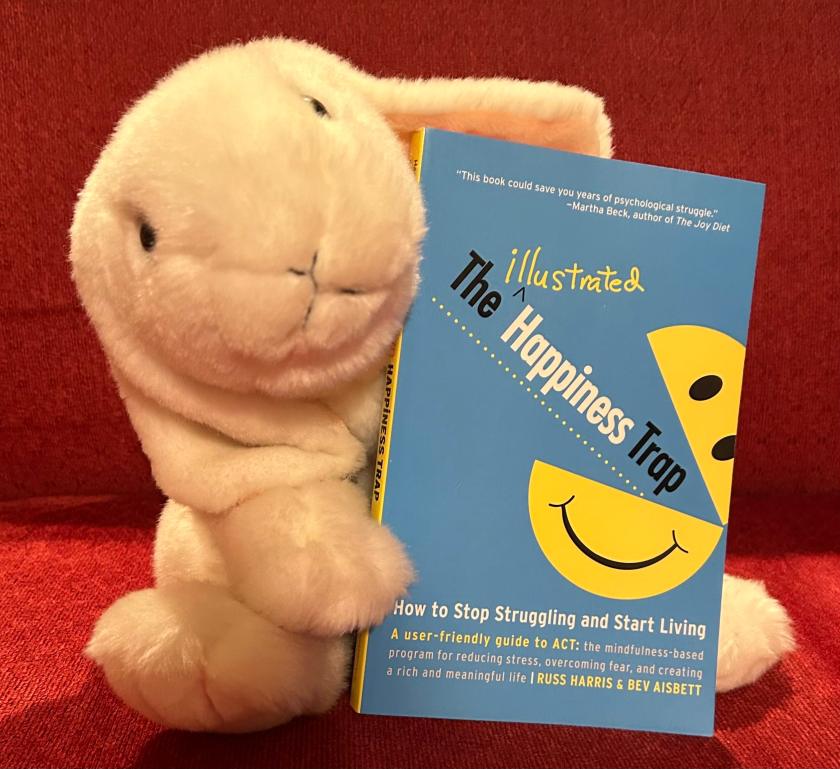
S: But I think the title and the cover page of this book are both very intriguing, aren’t they?
M: Yes, I like how it has a Pac-Man style half-split smiley face.
S: Yes, it is quite striking how the smiley who could represent authentic happiness, but also a fake version of it, is somehow split open with the title.
M: Yeah.
S: So I had only read a little bit of the book before you took it from me and I know you have finished reading it quite fast. I understand it is about happiness?
M: Yes, kind of. It is basically about how we should not be going after happiness as our goal in life.
S: Hmm, this reminds me of a very interesting young person in one of my classes who had said that they did not necessarily want happiness for their child. They wanted them to find purpose.
M: Yeah, it is kind of like that. The main goal of the book is to dispel the myth that happiness is the right goal for one’s life. The goal should instead be to figure out your values and live your life accordingly. Once you know your values, the goals you set for yourself should reflect those values and be feasible. And along the way, you are likely to be unhappy at times, and that is not a disaster.
S: I see. So the title is basically saying that the idea that you should always be happy is flawed.
M: Yes, and that pursuing the goal of living a life where you are always to be happy and have no negative feelings leads to only unhappiness.
S: I see. That makes sense to me. I also saw that the book mentions explicitly four myths. Can you tell us what they are?
M: Okay. So the first one is “Happiness is the natural state for human beings.” The second is “If you are not happy, you are defective.” The third is “To create a better life, we must get rid of negative feelings.” And the fourth one is “You should be able to control what you think and feel.”
S: I can see how the first three are wrong, if we accept the main thrust of the book. And I already did not believe some of them myself. Like there are sometimes very good reasons not to be happy. But the fourth one is hard for me to accept. It feels kind of disempowering.
M: I agree with you. But I think the idea behind their stance, which they call Acceptance and Commitment Therapy, is that basically you should accept your feelings and decide what to do with them in a productive manner. As you learn to do this better and more effectively, your emotional state can change, too, and improve, but that is not the main goal.
S: So Marshmallow, I think these are all rather hefty thoughts and a bit heavier than some of the things we read and talk about here in this blog.
M: True, but we have talked about all sorts of other heavy things like war and slavery and so on. So talking about mental health challenges should not be totally out of bounds, I think.
S: Oh I agree.
M: And we have talked about mindfulness before. Actually you and Caramel talked about a book about how breathing could be helpful. And then there were those two books about dragons and anger management.
S: True. And the topic is actually quite relevant to a lot of bunnies.
M: Yes,. sure, this is not really quite meant for little bunnies, but maybe a bunny around my age would be perfectly fine with it. And I think they could learn from it.
S: I am glad you found the book helpful.
M: I did. I found it resonating a bit with the Getting Things Done book I reviewed before. Both books say that figuring out your values and building your life around them is a good idea.
S: I can see how that could be helpful for teenagers who are looking to build their lives, preparing to grow up into adult bunnies. So if you were to rate the book then, what would you rate it?
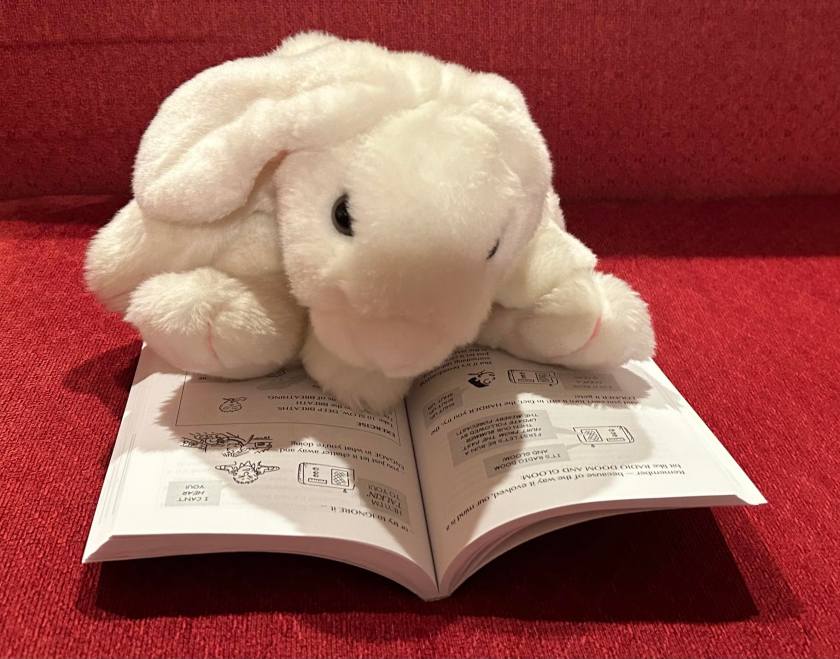
M: I’d rate it 95%. I especially liked the illustrations and how they made the book so much easier and quicker to read. Because it is kind of stressful to read a book about mindfulness sometimes. I feel like I am losing time, but this book is so quick and you learn a lot.
S: Great! I will now take it from your paws then and finally get the chance to finish it myself. What would you like to tell our readers as we wrap up this review?
M: Stay tuned for more amazing reviews from the book bunnies!
 BookBunnies