Today Marshmallow is writing about The Color of Water: A Black Man’s Tribute to His White Mother, written by James McBride and first published in 1995.
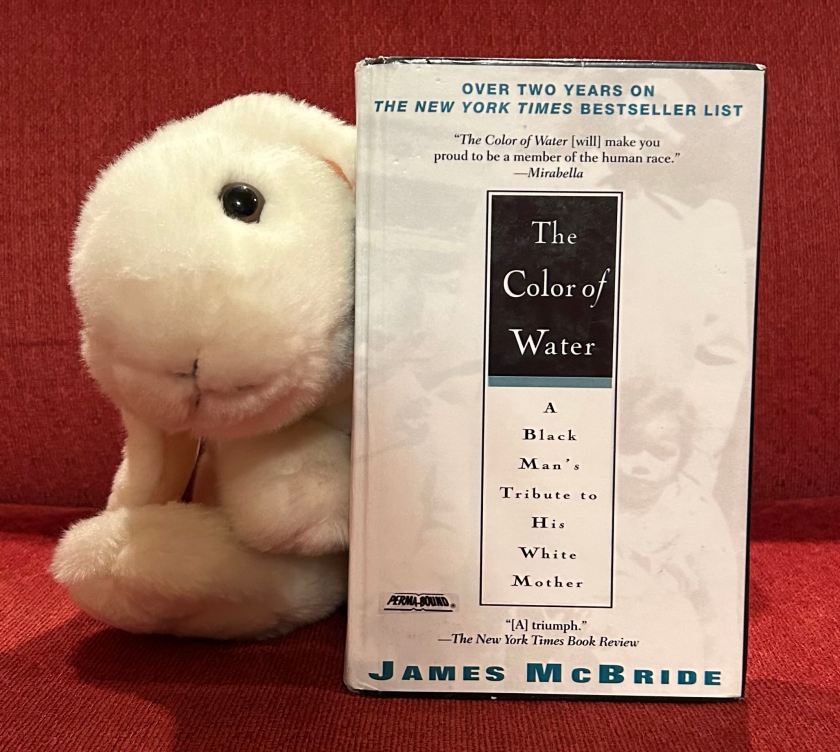
Marshmallow’s Quick Take: If you like biographies that reveal nuanced stories about race, family, identity, and love, then this is the book for you!
Marshmallow’s Summary (with Spoilers): James McBride is a Black man with a White mother. Today, this would likely not be considered much of a big deal. After all, mixed race marriages are something relatively commonplace in the United States today and are the simple result of the fact that love generally does not see color. However, back in the 1960s, such relationships were demonized and the pair separated by all means possible; Loving v. Virginia, the landmark decision of the U.S. Supreme Court on interracial marriage was only passed in 1967.
For James’ mother Ruth, this was yet another struggle in a long, seemingly endless line of strife. She was born in America to two Polish Jews and, due to the fact that her father was a “lousy rabbi,” her family had to keep moving to find new places of work for him. Eventually, they settled down in Suffolk, Virginia. There, Ruth felt discrimination firsthand constantly, with classmates calling her “Jew baby” or worse. But she also witnessed the overt racism directed towards Black people around her. Her first boyfriend, Peter, was a Black man and the young couple kept their relationship a secret out of fear of the KKK. Ruth also faced consistent abuse at home from a father that emotionally, physically, and sexually tormented her; yet, despite all of this, she persevered quietly and eventually built a family. She then kept rebuilding every time she was torn down.
In The Color of Water, the author James McBride tells the story of Ruth’s life intertwined with segments of his own autobiography in between. McBride describes his chaotic environment growing up as the eighth child out of twelve total. While he knew he was loved, there was unending pressure from Ruth to be academically successful, and within such a large family, there was not enough attention to go around. As James grew older, he started recognizing that his mother’s race was different from his own and that race was a construct that society unfortunately valued in countless ways. In seeking to uncover the details of his mother’s life, James simultaneously searches for his own identity and the role that race has in America. This likely won’t come as a surprise to anyone, but the answer is nuanced and riddled with mystery—much like Ruth herself.
Marshmallow’s Review: I found The Color of Water: A Black Man’s Tribute to His White Mother to be a very interesting book. As a mixed race bunny growing up in a quite mixed neighborhood and school district, I have never really felt any need to ‘discover myself’ because I already knew what I was. However, James’ identity quest is understandable, especially because race was even more central to society in those times. Today, of course, race is still an issue, but seeing the way our nation was back then gives you a better sense of the role of race over time.
The Color of Water: A Black Man’s Tribute to His White Mother examines race on a national scale by specifically analyzing its role within a family setting. James’ story is rather unique, but the themes throughout the book (abuse, race, search for security, selflessness, grief, etc) are representative of the general human experience in certain ways. I think the fact that his life is sort of a more extreme version of general experiences helps highlight how remarkable the people in his life—and most people in general—are.
The book is relatively easy to read and I think the author wrote it for a broad audience. There are mentions of sexual abuse, drug use, and violence, so some parts might make this better for older readers (maybe twelve and older?) But overall, The Color of Water is a very important book that reveals simple truths about love, humanity, and America—such as the obvious fact that race should never dictate anything, especially love.
Marshmallow’s Rating: 100%.




 BookBunnies