Marshmallow reviews The Lost Words: A Spell Book by Robert Macfarlane and Jackie Morris

Today Marshmallow reviews a beautiful large-format book by Robert Macfarlane and Jackie Morris: The Lost Words: A Spell Book, published in 2017. Sprinkles is taking notes and asking questions.
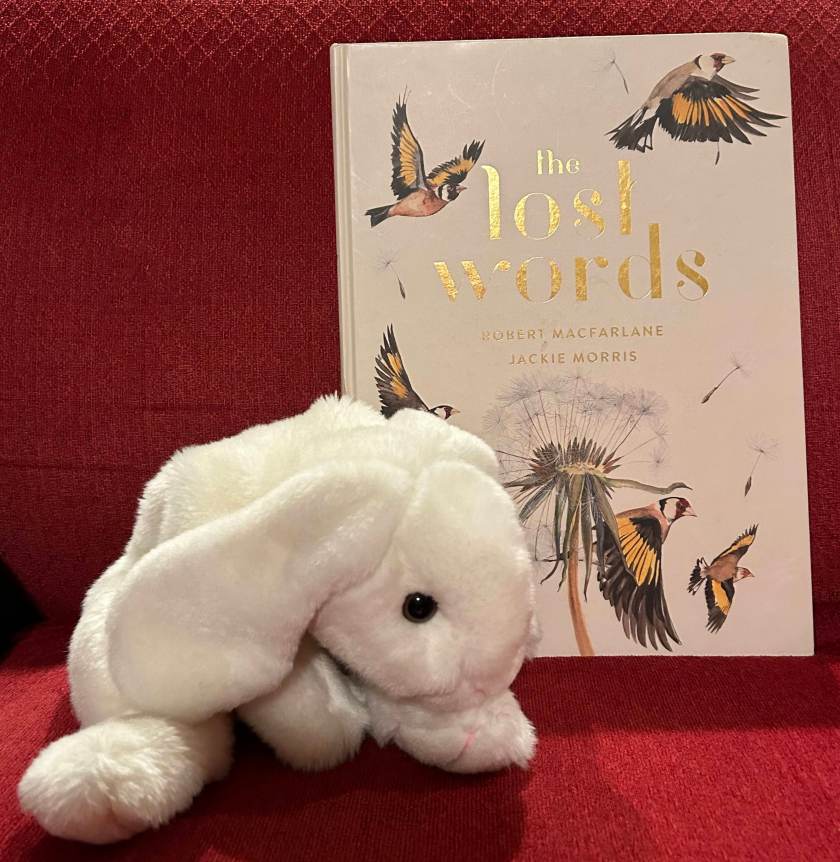
Marshmallow reviews The Lost Words: A Spell Book written by Robert Macfarlane and illustrated by Jackie Morris.

Sprinkles: So Marshmallow, let us begin. I thought this was a beautiful book, so I am very happy we get to talk about it today.

Marshmallow: Yes, it is a really beautiful book. Majestic, I could say. Each page is almost like a work of art.

S: I heard about this book a while back. I read the following and it stuck with me:

The book began as a response to the removal of everyday nature words – among them “acorn”, “bluebell”, “kingfisher” and “wren” – from a widely used children’s dictionary, because those words were not being used enough by children to merit inclusion. But The Lost Words then grew to become a much broader protest at the loss of the natural world around us, as well as a celebration of the creatures and plants with which we share our lives, in all their wonderful, characterful glory. –https://www.thelostwords.org/lostwordsbook/

M: Well, I did not know about this when I began reading the book. But it totally makes sense. The book is kind of like a children’s alphabet book. Approximately one word for each letter of the alphabet. For “A” for example there is an entry for “acorn” and another for “adder”. And for “B”, there is “bluebell” and “bramble”. but there is nothing for “E” for example. But anyways, each word chosen is a word for an animal or plant, some object of nature that used to be more familiar to young bunnies many years ago, but now that most of us live in much more urbanized environments, we do not always see or hear about them. So I really like that the authors decided to bring back these words to us.

S: Yes, me too! Okay, so then there should be about twenty-five words, then.

M: Not quite. There were apparently forty words that were dropped from that children’s dictionary, and the people who created this book picked twenty of those words and focused on those.

S: The book is not only twenty pages though.

M: Of course not, Sprinkles! That would be kind of too short. There are six pages for each word.
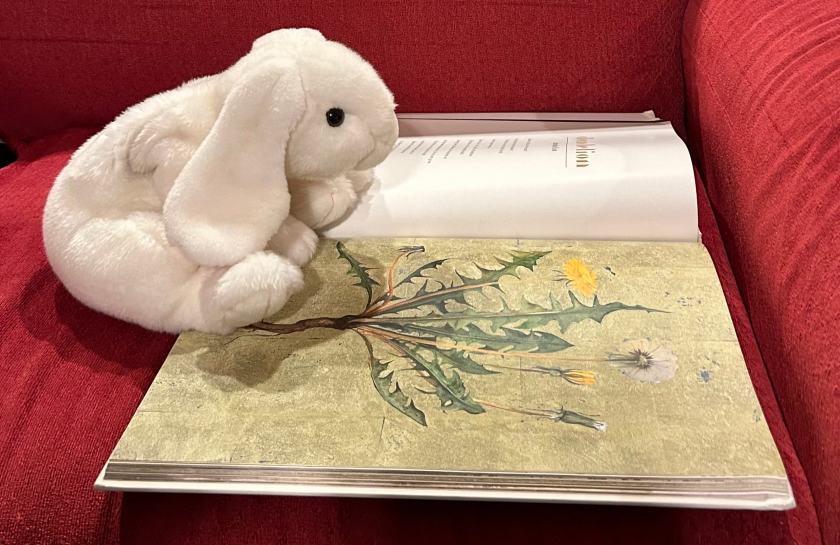
Marshmallow is reading The Lost Words: A Spell Book written by Robert Macfarlane and illustrated by Jackie Morris.

S: I see. So what happens on each of those pages?

M: What they do with each word is actually really amazing. For each word, there is first a two-page spread showing the letters making up the word in a way that is aesthetically pleasing. The letters making up the word are kind of hiding among many other letters, kind of reminding us that the word is lost somehow, but if we look carefully, we will find it again.

S: That is beautiful, Marshmallow.

M: Yes, the book is really beautifully designed. Anyways, after the first two-page spread, then there is a second two-page spread for the word. The left hand side there is an acrostic poem describing the word, and on the right hand side there is a water color painting of the animal or plant that the word depicts.

S: Remind our readers what an acrostic poem is maybe?

M: Sure. Basically when you take the letters of the first word on each line and put them in a vertical line, they make up a word. So for example here is the poem for IVY:

ivy

I am ivy, a real high-flyer.
Via bark and stone I scale tree and spire.
You call me ground-cover; I say sky-wire.

S; That is lovely!

M: It really is! I love the paintings! They are kind of like portraits! And then there is a final two-page spread, which is a large picture showing the animal or plant in its natural environment. Again the paintings are beautiful.

S: I agree with you completely Marshmallow. I have been looking through the pages for the last hour or so and I am amazed. The poems are quite neat too.

M: Yes, agreed. Each poem has a deeper meaning; they do not just provide a physical description, but also what it might represent, what makes it unique and special, and how it is a part of nature. I really liked the book!

S: I can see that. So if you were to rate it–

M: -I’d rate it 100% for sure!

S: That is wonderful Marshmallow. I am glad we were able to read this book.

M: Yes.

S: So let us wrap up this review then. What would you like to tell our readers?

M: Stay tuned for more amazing reviews from the book bunnies!
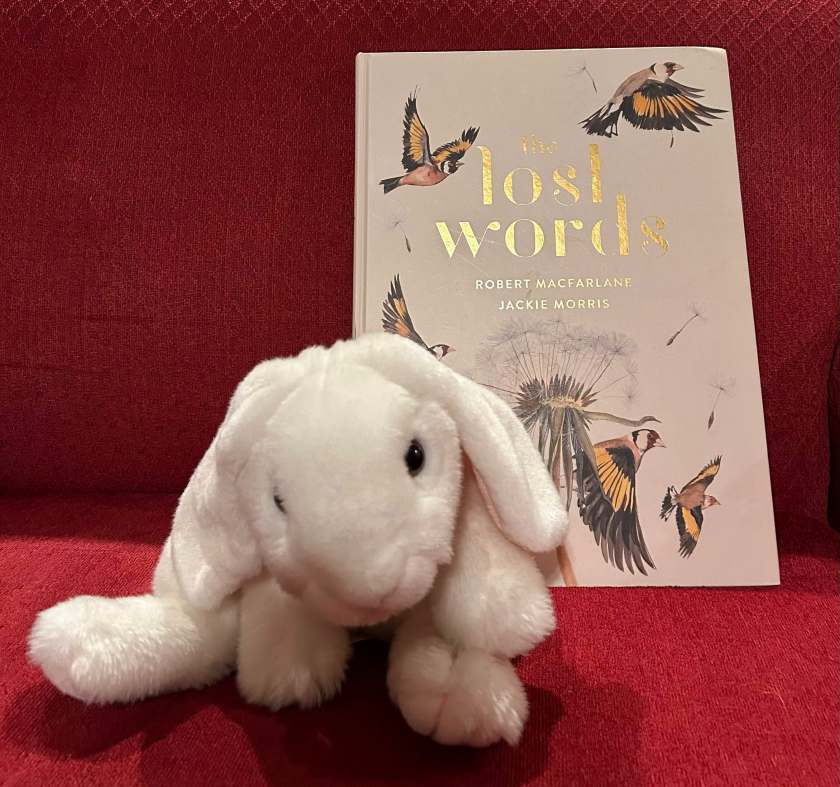
Marshmallow rates The Lost Words: A Spell Book written by by Robert Macfarlane and illustrated by Jackie Morris 100%.

Marshmallow reviews Long Way Down by Jason Reynolds

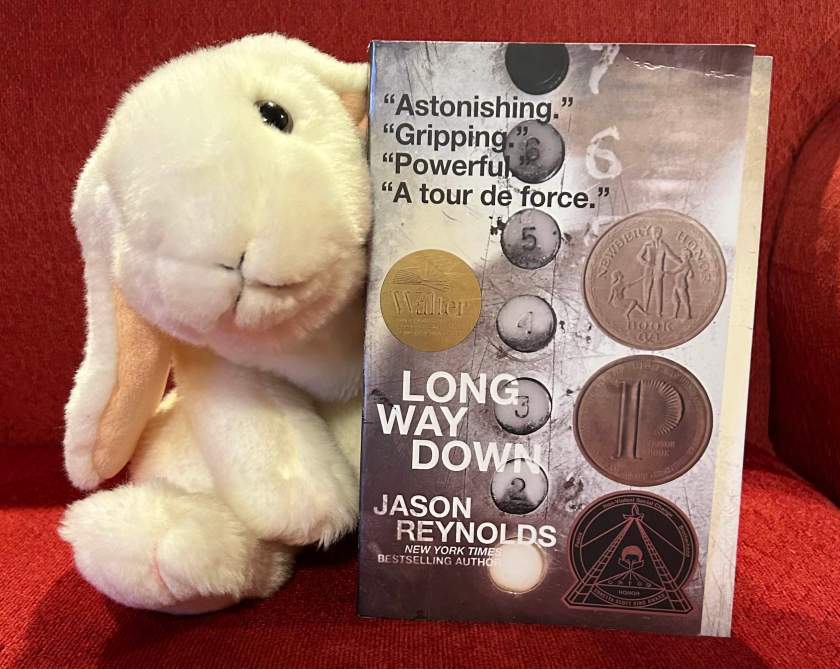
In her second review for 2024, Marshmallow talks about Long Way Down by Jason Reynolds, first published in 2017, and awarded the Newberry Honor in 2018.

Marshmallow reviews Long Way Down by Jason Reynolds.

Marshmallow’s Quick Take: If you are interested in reading books about family, gang violence, growing up against significant challenges, and morality, then this might be the book for you.

Marshmallow’s Summary (with Spoilers): Will’s brother, Shawn, was just shot in front of him. They live only a couple blocks away from the territory of the Dark Suns, a dangerous local gang, and Shawn had gone into their territory to get a special soap for their mother’s eczema. Will is sure that he knows who is responsible for his brother’s death: Riggs. And he is going to make sure that Riggs pays for it.

See, Will lives in a hard, tough neighborhood. There are gangs, shootings, murders, and violence regularly. And everyone follows the Rules. Shawn, in fact, was the one who taught them to Will:

  • Number 1: No crying,
  • Number 2: No snitching,
  • Number 3: Get revenge if someone hurts your loved ones.

Will is determined to follow the Rules. He sure is not going to cry or “snitch” to the police, but he is going to try to get revenge on Riggs. He takes his brother’s old gun (which is fully loaded except for missing only one bullet) and heads out of his apartment on the eighth floor, to get to where he thinks Riggs is as soon as possible. He gets on the elevator and presses “L”, for lobby.

Unfortunately for Will, it is a long way down and the elevator stops at each level, a person getting on at each. What is more, these are not normal people. These are dead people who Will knew. First, it’s a friend of Shawn. Next, it’s Will’s old friend who was shot at a playground with him. And so on.

Each person Will meets in this short elevator ride that takes the whole book is important to him in some way. His mindset, originally so focused on revenge, starts to loosen. Once the elevator reaches the last floor, will Will continue with his plan or will he make a different choice?

Marshmallow is reading Long Way Down by Jason Reynolds.

Marshmallow’s Review: I think that Long Way Down is a very successfully written book, in more ways than one.

I, personally, do not always love books written in verse; I sometimes find it hard to discern the plot and I feel like it limits character growth. Before this book, Starfish by Lisa Fipps was the only such book I really appreciated. So when I started reading this book and realized it was in verse, I was a little disheartened. However, I feel like this book was very successful in all the categories most good novels excel in. The narration through Will’s eyes and voice worked well, the characters introduced came across quite clearly, and the events unfolded effectively. The free-style though structured poetry added to the feeling of confinement in an elevator.

Both the plot and the premise of Long Way Down are most intriguing; the whole book takes place in the course of one fateful elevator ride as conversations unfold in front of Will. I do want to warn readers that there is a cliffhanger at the end of the book, and this is not part of a series. However, the journey to that point is worth it. The author did not leave things hanging just for the sake of it of course; the end makes the reader think hard about what will happen next and process the message of the book even more carefully. I can see this book successfully paired with The Outsiders by S. E. Hinton in important discussions young people can have about gangs and violence.

If it is not clear already, let me say explicitly that I think Long Way Down is important for bunnies of all ages to read. There is some slang used, and of course the weight of gang violence might make the book a bit inappropriate for the youngest bunnies. But for bunnies reading middle grades books, it is an important (and quick, breathless) read. Will’s story makes you realize the harsh reality of gang violence if it is not your own actual reality. Many people, pop culture, and the media glorify gangster culture, but this book shows what happens to the people who are affected. 

Marshmallow’s Rating: 100%. 

Marshmallow rates Long Way Down by Jason Reynolds 100%.

Sprinkles reviews Stopping by Woods on a Snowy Evening by Robert Frost and Susan Jeffers

Readers have already seen several books reviewed on this blog which had poetry as a significant theme. See, for example, Marshmallow’s reviews of How to Find What You’re Not Looking For by Veera Hiranandani and Starfish by Lisa Fipps. However, we have only reviewed one full book of poetry so far (A Light in the Attic by Shel Silverstein); that is, if we do not count the humorous BrainJuice American History: Fresh Squeezed! by Carol Diggory Shields. Today, we finally begin to remedy this situation. Below, Sprinkles writes about a book that the book bunnies household read together many times with much joy: Stopping by Woods on a Snowy Evening, an illustrated children’s book presenting the famed poem of Robert Frost with the same name, published first exactly a hundred years ago, in 1923.

[If you have any recommendations of poetry books and such for young ones, please let us know. Sprinkles is planning to put together a more extensive post on poetry in the near future, and your input would be much appreciated.]

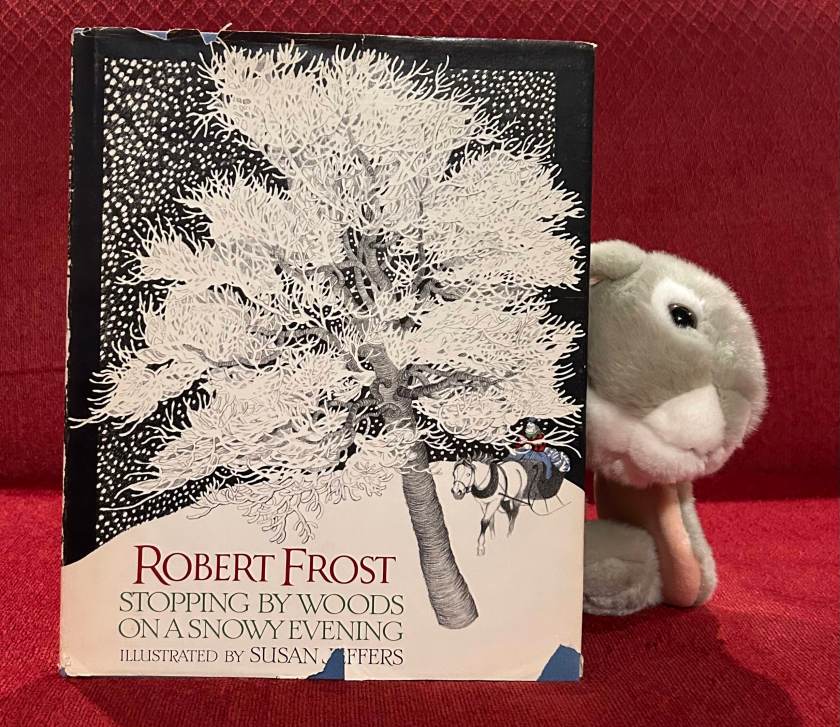
Sprinkles reviews Stopping by Woods on a Snowy Evening, written by Robert Frost and illustrated by Susan Jeffers.

A lot of people read or hear about the American poet Robert Frost some time in their school years. And, originally published in 1923, “Stopping by Woods on a Snowy Evening” might be his most famous poem; it is so famous that it has its own Wikipedia entry! Especially the last stanza:

The woods are lovely, dark and deep,
But I have promises to keep,
And miles to go before I sleep,
And miles to go before I sleep.

has inspired and held the imagination of many people since then.

The simple words and sentences used through the poem make it quite accessible, and the iambic tetrameter (where each line of the poem is made up of four syllable-pairs with one emphasized and the other not) as well as the simple rhyme scheme used (AABA BBCB CCDC DDDD) make it melodic and easy to recite. So it is a natural choice for the text of a children’s book. The book I am writing about today is just that: Frost’s poem makes up the whole text, and the illustrations by Susan Jeffers complete the rest.

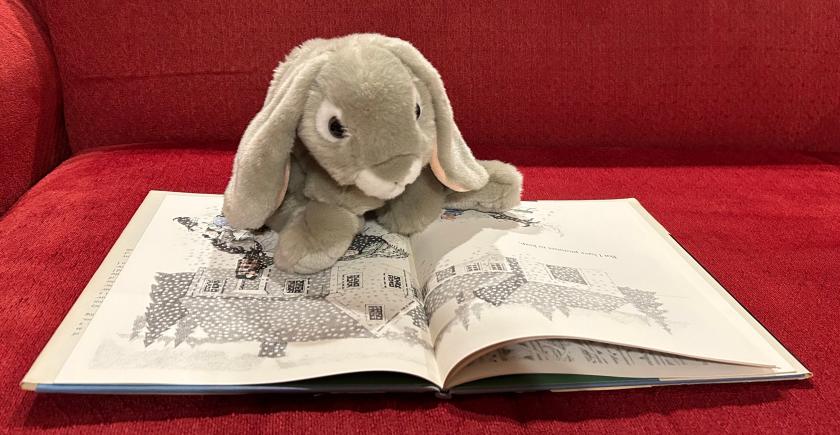
First published in 1978, the book uses a two-page spread for more or less every pair of lines from the poem. So you often get a full picture for each complete sentence of the poem.

Sprinkles is reading Stopping by Woods on a Snowy Evening, written by Robert Frost and illustrated by Susan Jeffers. Here she is looking at the two-page spread where the narrator of the poem is saying, "But I have promises to keep."
Sprinkles is reading Stopping by Woods on a Snowy Evening, written by Robert Frost and illustrated by Susan Jeffers. Here she is looking at the two-page spread where the narrator of the poem is saying, “But I have promises to keep.”

The pictures, illustrated by the established illustrator Susan Jeffers, are mostly black and white, with only a few color touches on each. The sparse coloring directs our attention to the quiet and serene whiteness of the snowy woods. The way the poem is spread out through the pages allows us to read it more slowly and savor it.

The poem is lovely, and it is a joy to share it with young bunnies. In today’s busy world, we often miss out on finding those moments of joy in little things, like reading a well-worn poem with a young one.

Some might like to hear the poet read it himself:

Robert Frost reads “Stopping by Woods on a Snowy Evening” – from YouTube.

I also like this version, read by Susan Sarandon: https://vimeo.com/172768932. Someone uploaded a version to Youtube, too:

Susan Sarandon reads “Stopping by Woods on a Snowy Evening” – from YouTube.

Sarandon reads the poem most exquisitely. And at the end of this video there are a few children describing what they think poetry is. So it is definitely worth a watch.

Incidentally, this second video was created as part of a larger project focusing on introducing young ones to classical poetry. You can find some more information about it here: http://www.amyschatzproductions.com/classical-baby-im-grown-up-now-the-poetry-show. Another one of my favorites from this series is “How Do I Love Thee?” by Elizabeth Barrett Browning, read, I think, by Gwyneth Paltrow:

“How Do I Love Thee?” by Elizabeth Barrett Browning, read, I think, by Gwyneth Paltrow – from YouTube.

No matter how much I like these videos however, I still prefer reading poetry together with little ones myself. Stopping by Woods on a Snowy Evening, written by Robert Frost and illustrated by Susan Jeffers, gave me many opportunities to snuggle with one of my little bunnies and read it together. My copy was secondhand at least, and it was already somewhat worn out when I held it in my paws for the first time. The book has led to many joyful times nonetheless. I encourage all other adult bunnies who love poetry to find ways of sharing it with your little ones.

Sprinkles encourages all adult bunnies who love poetry to check out books like Stopping by Woods on a Snowy Evening, written by Robert Frost and illustrated by Susan Jeffers, which can help some of our favorite poems come to life for our little ones. And she would love to hear any recommendations of poetry books and such for young ones if you have any. She is hoping to put together a more extensive post on poetry in the near future, and your input would be much appreciated.

Marshmallow reviews How to Find What You’re Not Looking For by Veera Hiranandani

Today Marshmallow reviews How to Find What You’re Not Looking For, a 2021 novel by Veera Hiranandani.

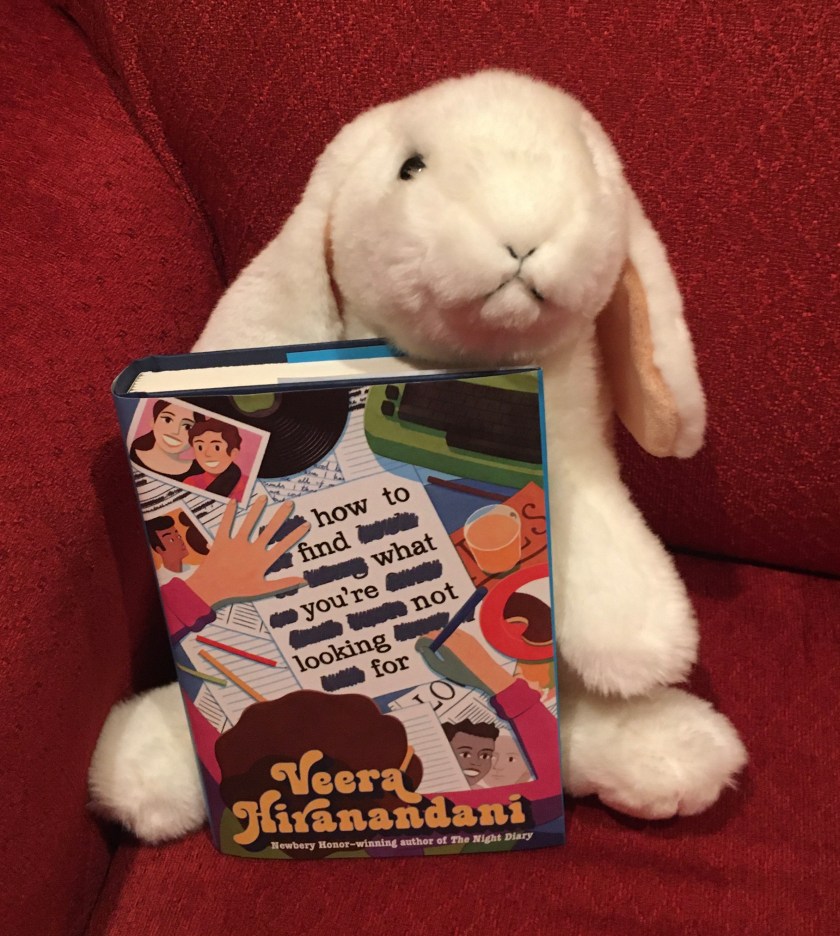
Marshmallow reviews How to Find What You're Not Looking For by Veera Hiranandani.
Marshmallow reviews How to Find What You’re Not Looking For by Veera Hiranandani.

Marshmallow’s Quick Take: If you like books about family, friends, or historical fiction, then this might be the book for you. 

Marshmallow’s Summary (with Spoilers): Ariel Goldberg’s life is drastically changed forever when her older sister Leah elopes with a man from India.

The book starts in the summer of 1967. Interracial marriage is now legal, however, stigma and bias remain, even in Ariel’s parents. Leah tells Ariel about her relationship with Raj, an Indian college student, and says that they have plans for the future, which greatly worries Ariel. When the girls’ parents meet Raj, they don’t like him. This is mainly because Ariel’s family is Jewish, and Raj is not; they don’t want their daughter to marry a person who is not Jewish. Ariel likes Raj, but she definitely doesn’t want her sister to marry anyone yet. But then one day, Leah and Raj elope, and Ariel’s life is forever changed. 

Besides all that is going on in her home life, Ariel has been having problems at school. There seems to be a new rift between her and her best friend, Jane. Ariel is also bullied by a boy who hates Jewish people. On top of all this, Ariel also has trouble writing. Her new teacher, Miss Field, believes that she has dysgraphia. Miss Field brings a typewriter for her to use and asks Ariel to write short poems to practice writing. 

Ever since Leah left, Ariel’s life seems to be falling apart. Can Ariel put it back together?

Marshmallow is reading How to Find What You're Not Looking For by Veera Hiranandani.
Marshmallow is reading How to Find What You’re Not Looking For by Veera Hiranandani.

Marshmallow’s Review: How to Find What You’re Not Looking For raises many complex issues such as racial and religious bias in a way that teaches but also gives hope. It shows that bias is not just in other people but everywhere. It also shows that there might be reasons for behavior that looks excluding, such as people wanting to sustain their family culture and identity, but it does clearly show that stigma and bias are not okay. 

I found it interesting how the main character wrote poems to express what is happening in the book. I found it to be a good way for the author to tell the reader how the main character, Ariel, is feeling. The poems really add something to the book. 

The story is set in 1967; the author uses words like “groovy” to show how the narrator is living in the past. The narrator is also always using the second person “you” and everything is told in the present tense. This gives the story a more urgent tone somehow and like everything is happening all at once, as you read the book.

This book includes information about the Loving vs. Virginia case from 1967 and the ideas around interracial marriage play a significant role in its plot. Martin Luther Jr.’s murder from 1968 is also mentioned. In other words, How to Find What You’re Not Looking For talks about racial and religious injustice very openly. This makes me think that this book would be more appropriate for older bunnies, from 10 and up. There isn’t really any inappropriate content for younger bunnies, so younger readers could also enjoy it, but I think 10 and up would be able to understand the context better and so get the most out of this book. 

Marshmallow’s Rating: 95%.

Marshmallow rates How to Find What You're Not Looking For by Veera Hiranandani 95%.
Marshmallow rates How to Find What You’re Not Looking For by Veera Hiranandani 95%.