Caramel reviews Easy Aircraft Origami by Jayson Merrill

Today Caramel reviews Easy Aircraft Origami, a book by Jayson Merrill first published in 2020. As usual, Sprinkles is taking notes and asking questions.

Caramel reviews Easy Aircraft Origami by Jayson Merrill.

Sprinkles: So Caramel, tell us a bit about this book.

Caramel: So this book has fourteen different planes that you can make that are supposedly easier than some other possible origami.

S: I hear a “but” coming.

C: Yep, you do! So the book says the projects are easy and for “less experienced folders”, but some of them are actually hard. Marshmallow is the most experienced origamist in our home, but even she had difficulty with the Razorback, which looks really cool, but I don’t really know how it flies because I still have not been able to make one.

S: Hmm, I see. So some of them are really hard. But why are we reviewing this book then? Did you at least make some of the planes?

C: Well, I tried to make some of them. For example I tried to make Hex, but I failed several times on my own. Then we made it together, you and me, and then it worked!

S: Yes, we had to be a bit careful and so on, but we did make it in the end. And it flies really well, doesn’t it?

C: But it was hard to fold the paper that many times.

S: I think our paper was a bit thick. If we had used thinner paper, maybe it could have been easier.

C: I guess. But we used a pretty large paper, and it was thick, but it folded well. And the plane is big, too, so I am happy with the paper.

S: No problem then, as long as you are happy!
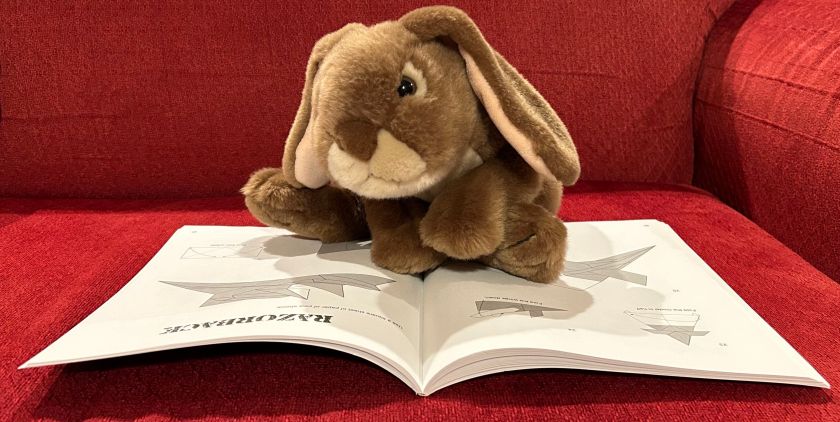
Caramel is reading Easy Aircraft Origami by Jayson Merrill.

S: So it seems to me that even though some of the projects are hard, you are probably not giving up on the book any time soon.

C: No, I’m not. The Hex flies so well that I am thinking I want to make all of them. But I might need help.

S: I know. Marshmallow and I can help you if you want.

C: That would be good.

S: I saw that among the fourteen projects there are two which are circular; they do not look at all like paper planes.

C: Yes, they are called Stratus and Cirrus. They kind of look like frisbees.

S: I thought they looked like UFOs.

C: I guess that works too. If someone saw them flying and didn’t know what they were, they would really be UFOs. Unidentified Flying Objects, get it?

S: Yep. Do you know what Stratus and Cirrus are?

C: No.

S: They are types of clouds.

C: I did not know that.

S: This page describes the cirrus clouds as “wispy, feathery, and composed entirely of ice crystals”. Apparently they occur higher in the atmosphere and are often “the first sign of an approaching warm front or upper-level jet streak”.

C: That is interesting. What about stratus clouds?

S: The page says that stratus clouds show up in the lower levels of the atmosphere, closer to the ground, and they are “uniform and flat, producing a
gray layer of cloud cover which may be precipitation-free or may cause periods of light precipitation or drizzle”.

C: I knew that clouds looked different from one another but I did not know that the different kinds had names. That’s cool!

S: I agree! But so these two circular ones are named after clouds. Does that make sense to you?

C: Yes. Because maybe the names mean that they will go high as the clouds.

S: We can only hope! So it is about time to wrap up this review Caramel. What would you like to tell our readers?

C: Stay tuned for more book bunny reviews!
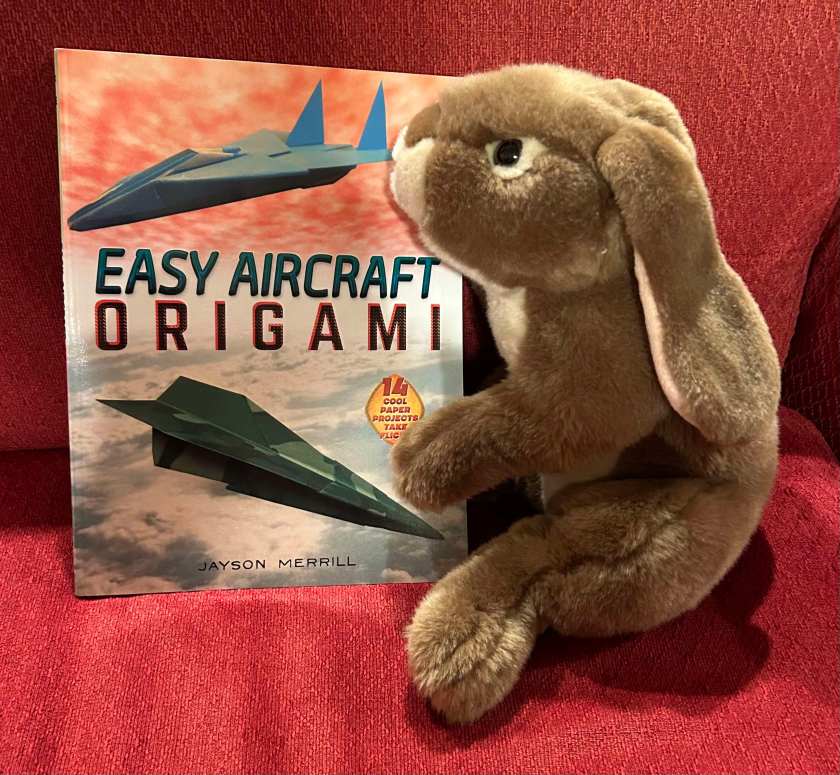
Caramel has enjoyed reading Easy Aircraft Origami by Jayson Merrill and is planning to make many of the aircraft projects in it in the coming weeks.

Marshmallow reviews Akira Yoshizawa: Japan’s Greatest Origami Master

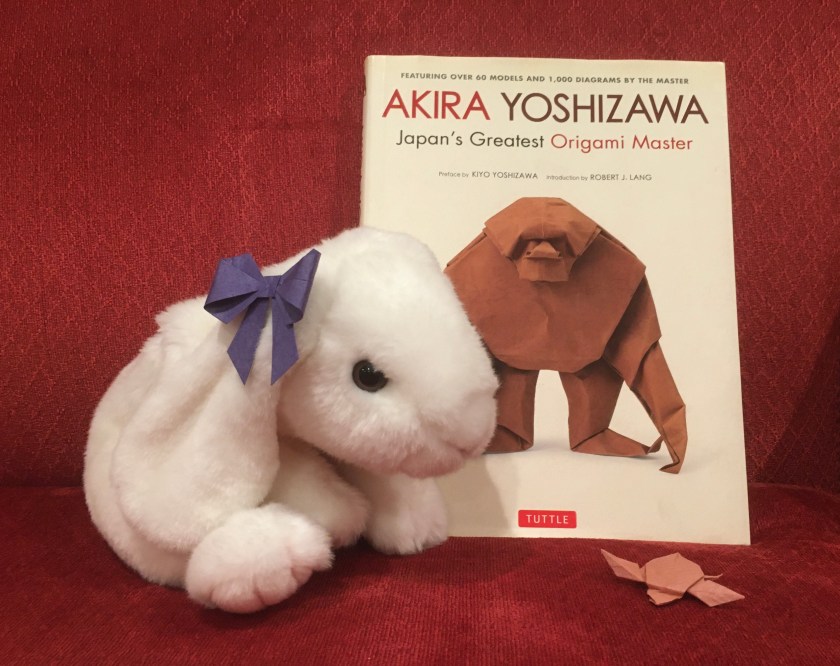
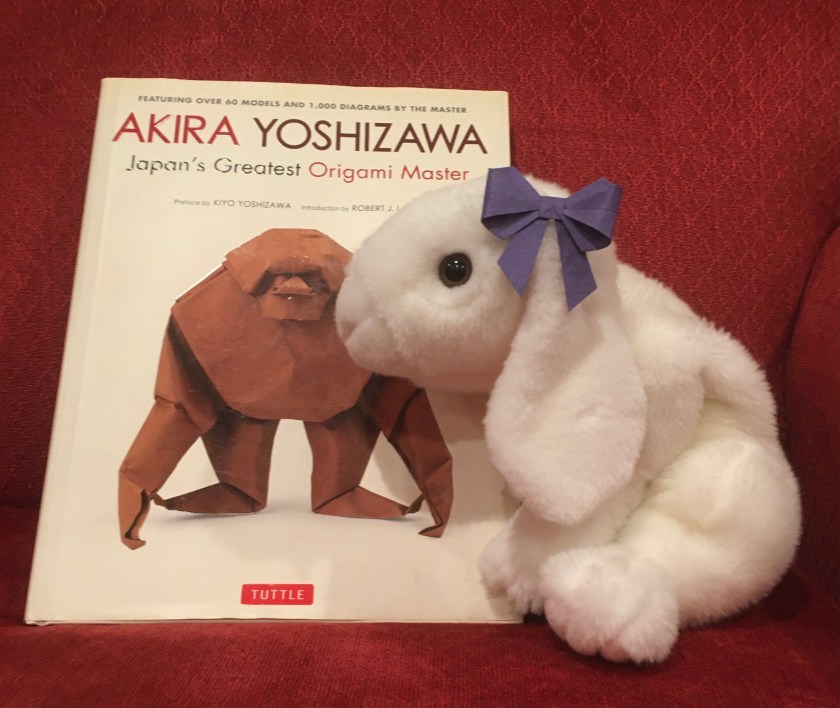
This week Marshmallow shares her thoughts on Akira Yoshizawa: Japan’s Greatest Origami Master, a beautiful book with “Texts, Original Diagrams, and Models” by Akira Yoshizawa, a preface by Kiyo Yoshizawa, and an introduction by Robert J. Lang. Accompanying her in this review is her little friend for the day: Turtle.

Marshmallow reviews Akira Yoshizawa: Japan’s Greatest Origami Master, with text, diagrams, and models by Akira Yoshizawa. Accompanying her is her little friend, Turtle.

Marshmallow’s Quick Take: If you like books that teach you how to do stuff, or if you ever wanted to see really cool origami models of all sorts of animals and things, then this might be the book for you. 

Marshmallow’s Summary (with Spoilers): This book does not tell a story. It teaches the reader how to make the origami pieces in the book, though the origami in this book is not easy. This is not a book for people who don’t know what origami is. 

Here is Wikipedia’s definition of origami:

“Origami (折り紙, Japanese pronunciation: [oɾiɡami] or [oɾiꜜɡami], from ori meaning “folding”, and kami meaning “paper” (kami changes to gami due to rendaku)) is the art of paper folding, which is often associated with Japanese culture. In modern usage, the word “origami” is used as an inclusive term for all folding practices, regardless of their culture of origin.”

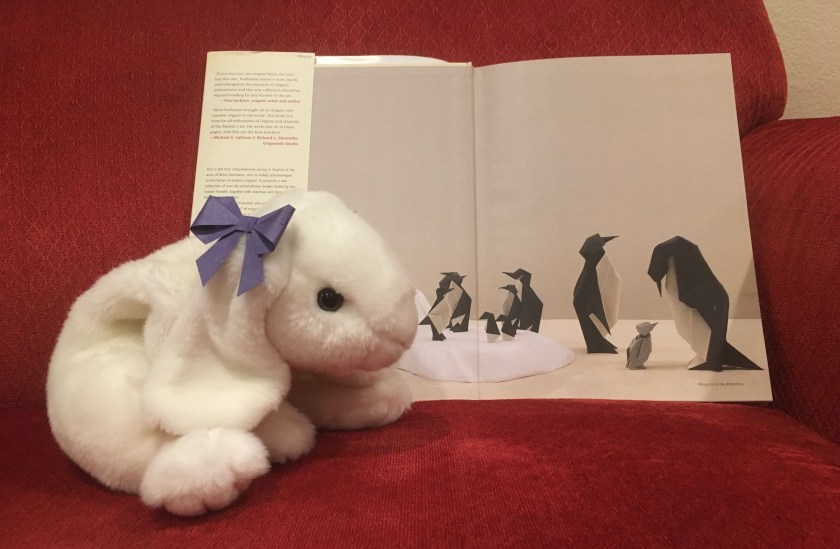
In this book, there is a detailed introduction written by an American origami expert, Robert Lang, where readers can learn about Akira Yoshizawa and his origami work. In the next few pages of the book, there are many pictures of Mr. Yoshizawa and his incredible origami works. Then most of the rest of the book is made up of Yoshizawa’s models of different types of animals and things. For example, there are models for making origami rabbits, sea turtles, small birds, wild geese, angel fish, butterflies, flying carpets, children from Snowland, lighthouses, seesaws, planes, and all sort of other neat things. There are step-by-step instructions and folding directions for each of these.

Marshmallow is pointing to the inside cover pages of Akira Yoshizawa: Japan’s Greatest Origami Master, with text, diagrams, and models by Akira Yoshizawa.

Marshmallow’s Review:  Reading Akiro Yoshizawa’s book, you can learn how to make some pretty complex pieces of origami. If you can’t or don’t want to try to make the origami, then you can just look at the pictures, which are in color and are very impressive. Mr. Yoshizawa’s origami animals and other origami are all very realistic.

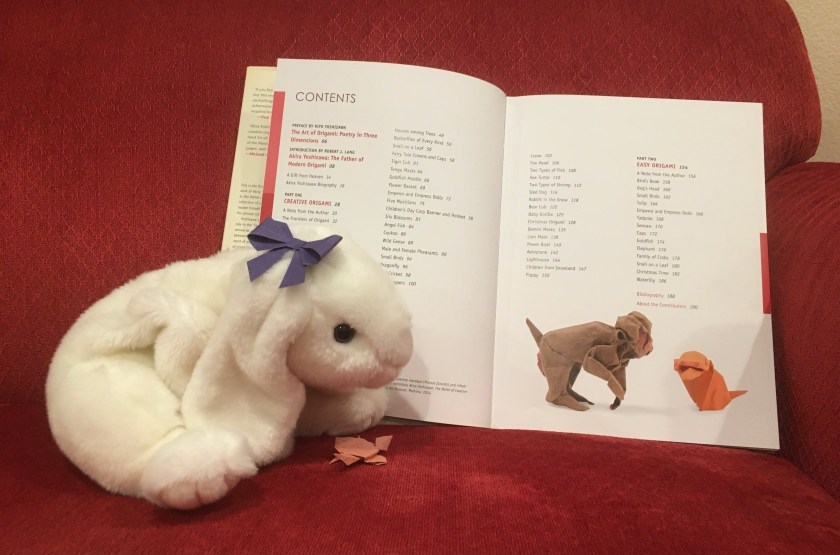
Marshmallow and Turtle are looking at the table of contents of Akira Yoshizawa: Japan’s Greatest Origami Master, with text, diagrams, and models by Akira Yoshizawa.

If you want to make the origami in the book you need to have origami paper, but there is a way that you can make square origami paper with normal paper. Still, real origami paper might make your origami look prettier.

Some of the pieces of origami in this book require cutting or glue or multiple pieces of paper to finish. And almost all the models are pretty hard to do. I was able to make only a few of them, mostly the simpler ones, but still I enjoyed looking through the more complex ones, too.  

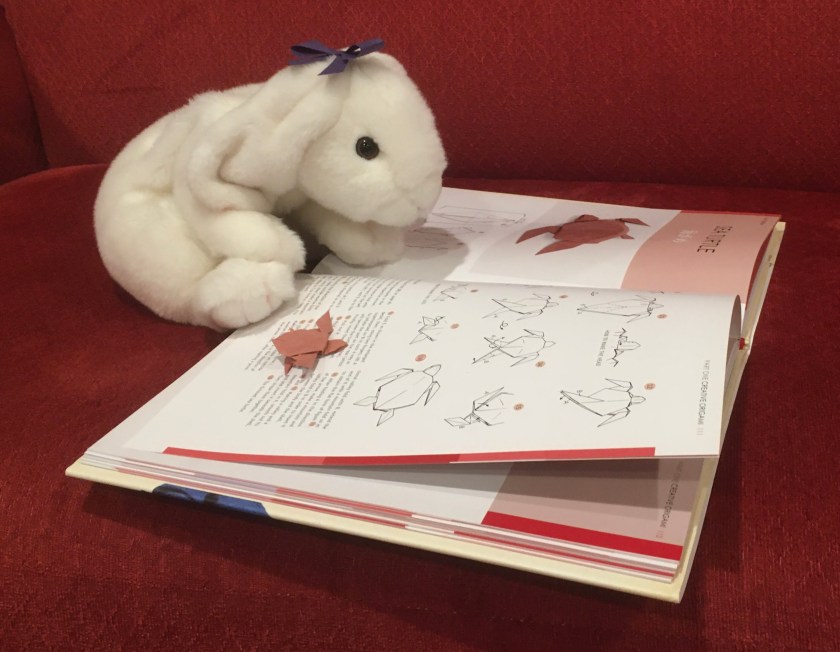
Marshmallow and Turtle are looking at the directions to make a sea turtle in Akira Yoshizawa: Japan’s Greatest Origami Master, with text, diagrams, and models by Akira Yoshizawa.

I think that this is a very good book for the whole bunny family; it can be read by many types of people. Younger bunnies will enjoy looking at the pictures, and older bunnies might want to try to make some of the origami pieces.

This book might also inspire the reader to go and try to learn more about origami, either about its history, or more about how to make more. (I know Caramel enjoys making samurai hats for example!) I really enjoyed trying to make the origami in this book, even when I couldn’t make it exactly the same as it was in the book.

Marshmallow’s Rating: 100%.

Marshmallow rates Akira Yoshizawa: Japan’s Greatest Origami Master, with text, diagrams, and models by Akira Yoshizawa, 100%.