Marshmallow reviews We Should All Be Feminists by Chimamanda Ngozi Adichie

Today Marshmallow picked up a short little book from the book bunnies’ home library: We Should All Be Feminists by Chimamanda Ngozi Adichie, first published in 2014. Below she shares some of her thoughts on this little book.

Marshmallow reviews We Should All Be Feminists by Chimamanda Ngozi Adichie.

Marshmallow’s Quick Take: If you are feeling up for a short, non-fiction book with an important message, then this might be the book for you.

Marshmallow’s Summary (without Spoilers): I’d like to start off by saying that this book is adapted from Chimamanda Ngozi Adichie’s TEDx talk which is also titled “We should all be feminists”. I would recommend watching the video of her talk before or after reading this book.

In this book, Ngozi Adichie covers her experiences as a feminist. She explores what it means to be a feminist, how we can raise feminist children of both genders, and how we can strive towards a future where we are all feminists. 

The author starts off by talking about her first encounter with the word “feminist”. The first time she was called a feminist, the word “feminist” was something akin to terrorist, used as an insult and an accusation. However, as we follow her, we learn that feminism is nothing to be afraid of and that instead it should be something we all should strive for.

Ngozi Adichie points out something insightful in this book when she states that the word “feminist” is often associated with the idea of being un-feminine. Ngozi Adichie writes that she enjoys wearing high heels and shiny lip gloss, even though she is a feminist. The author emphasizes that being a feminist doesn’t mean that you are unfeminine; it simply means that you believe that men and women deserve equal rights and prospects in life. The author specifically examines the treatment of women and men in Nigeria, offering examples and anecdotes from her personal experience. Though her examples were mostly from Nigeria, she does allow us to recognize that many women around the world are often ignored and silenced. 

The author also talks about how men fit into feminism. She says that being a feminist doesn’t mean believing in female superiority; it means believing in female equality. Ngozi Adichie writes that ideas of masculinity also feed into the unjust sexism that exists in all cultures. Ngozi Adichie talks about how we must change the perspectives on gender, for both genders, for the sake of women and men. 
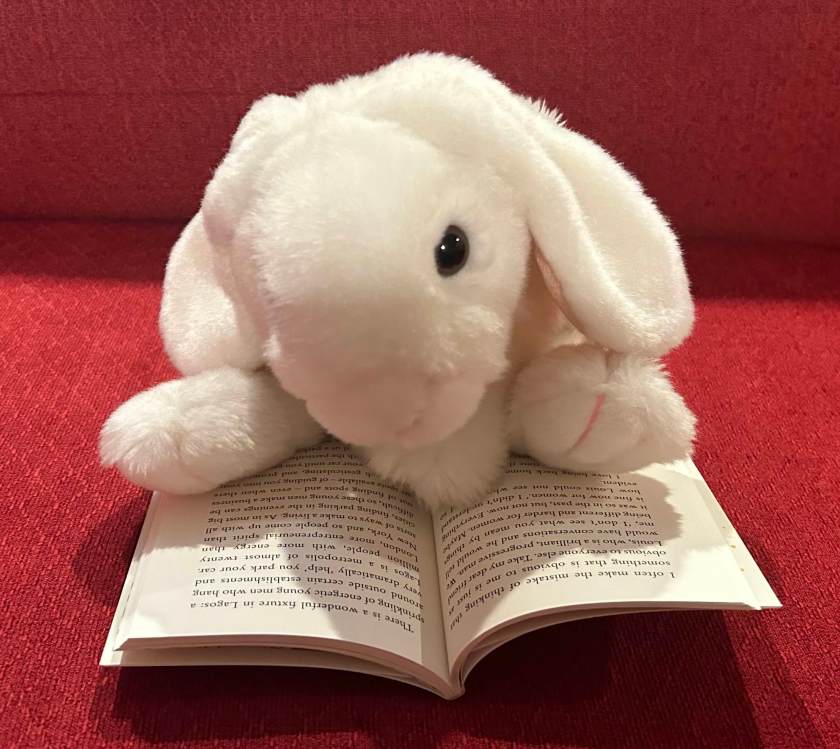
Marshmallow is reading We Should All Be Feminists by Chimamanda Ngozi Adichie.

Marshmallow’s Review: I really liked this book. I completely agreed with practically everything in this book and felt verified by some of her statements. As a female bunny, I think books like this are important for change, especially this book. This book is very short and concise. The writing style is fresh and engaging, easy to follow and easy to understand. Yet the simplicity is most successful because of the way the author is so persuasive.

We Should All Be Feminists is a great book to give to someone who might not recognize the issues that women still face today. This is a very important message for everyone because feminism isn’t about pushing men down at all. It’s about focusing on what we have in our brains, rather than what sex chromosomes we have. 

Overall, We Should All Be Feminists is very meaningful, easy to understand, and appropriate for all ages. I would recommend that everyone reads this book or at least watch the TEDx version of it

Marshmallow’s Rating: 100%

Marshmallow rates We Should All Be Feminists by Chimamanda Ngozi Adichie 100%.

Marshmallow reviews How to Speak Emoji by Fred Benenson

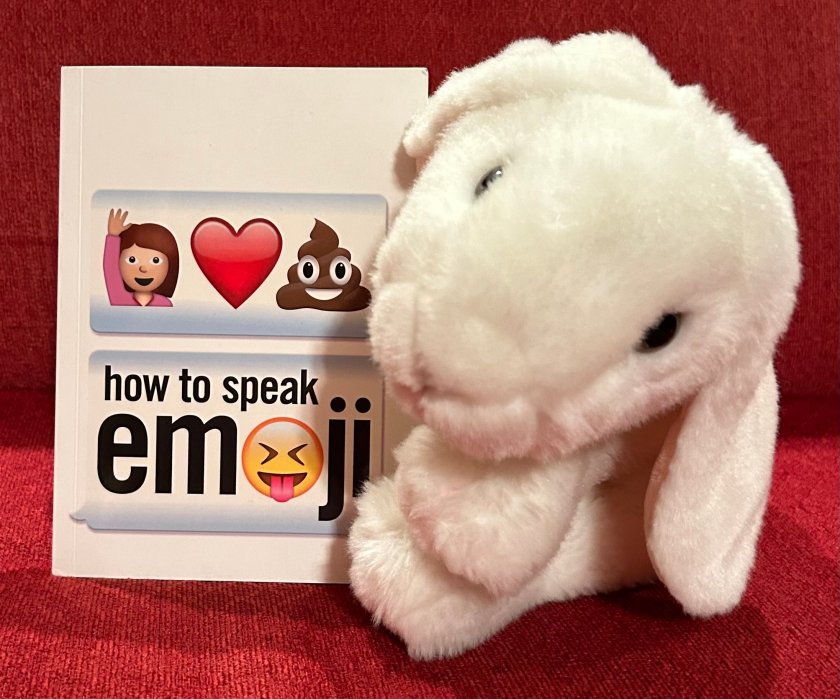
Today Marshmallow wanted to talk about a little book on emoji originally published in 2015: How to Speak Emoji by Fred Benenson.

Marshmallow reviews How to Speak Emoji by Fred Benenson.

Marshmallow’s Quick Take: If you like funny books about how to do something or books about popular culture, then this might be the book for you. 

Marshmallow’s Summary (with Spoilers): In this book, Fred Benenson creates a useful glossary that you can use to navigate text conversations using emojis. Though this book is nonfiction, and is meant to be informative, some of the emoji strands have humorous meanings.

In the first part of the book, there is a list of the meanings of singular, specific emojis. These can get a bit subjective. For example, the author writes that the 💅 emoji means “Ooh, fancy!” And the 🆗 emoji means “grudging approval”.

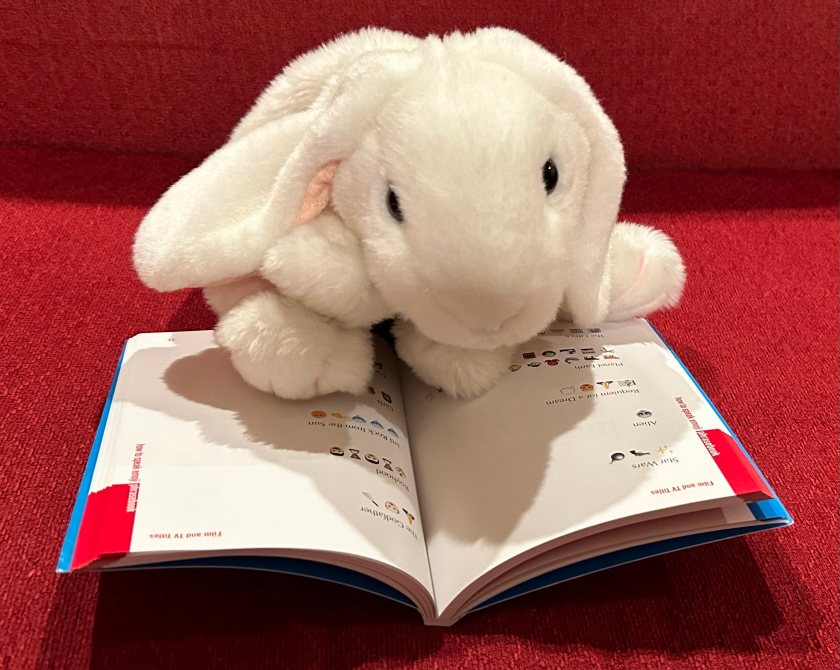
After the initial, brief glossary, there is an emoji phrase book. The phrases in this vary by section. There is one section for pickup lines (which get pretty, um, weird 🫤), a section for food and drink 🍔, a section for insults, and many more (including but not limited to technology, travel, medical/emergency, weather, the Twelve Days of Christmas, etc ♾️). Idioms like “an elephant never forgets” become 🐘🚫💭 and “above and beyond” becomes 👆➕🔭🌌 (this is in the idioms section). These sections are all very entertaining, and it is interesting to see how the author translates standard phrases and sayings into emojis. 

Marshmallow is reading How to Speak Emoji by Fred Benenson.

Marshmallow’s Review: You might be wondering, “Marshmallow 🤨🧐🤔 why would I want a book about the meaning of emojis when I can just google them?” My response to that question is that this book is also funny and teaches you how to communicate with emojis by themselves, which, admittedly, is not necessarily an essential skill but is definitely fun. And how can you not love a book which has the smiling poop emoji on its cover? I was a little sad to see that my favorite melting 🫠 emoji was not mentioned. However, it makes total sense because that is a new, quite recent (2023) addition to the vast army of emojis and only came out after this book was written (2015).

As a bunny who enjoys using emojis for the sake of using emojis, I liked this book a lot. Sometimes I find emojis that I don’t understand the meaning of, like this one: 🙃. And it is fun to learn how to use emojis to make phrases, and decoding them can be a fun game with friends and family. However, I would say that some of the content in this book is not appropriate for young bunnies, let us say, under the age of thirteen. Some of the phrases can be overly sexual. I just skimmed over those to get to the ones that were more amusing in my opinion. Otherwise however, this would be a very fun book for all readers. The sheer number of emojis and their complex meaning is fascinating 🤩 and this book does a good job explaining them.

Overall, this is a cute guide to using emojis 🥰 and I will take my knowledge gained from this to write this phrase: ⤵️📻➕😎📚🐰🐰🐰📋. (If you want, you can put your guess of what it means in the comments below!)

Marshmallow’s Rating: 98%

Marshmallow rates How to Speak Emoji by Fred Benenson 98%.

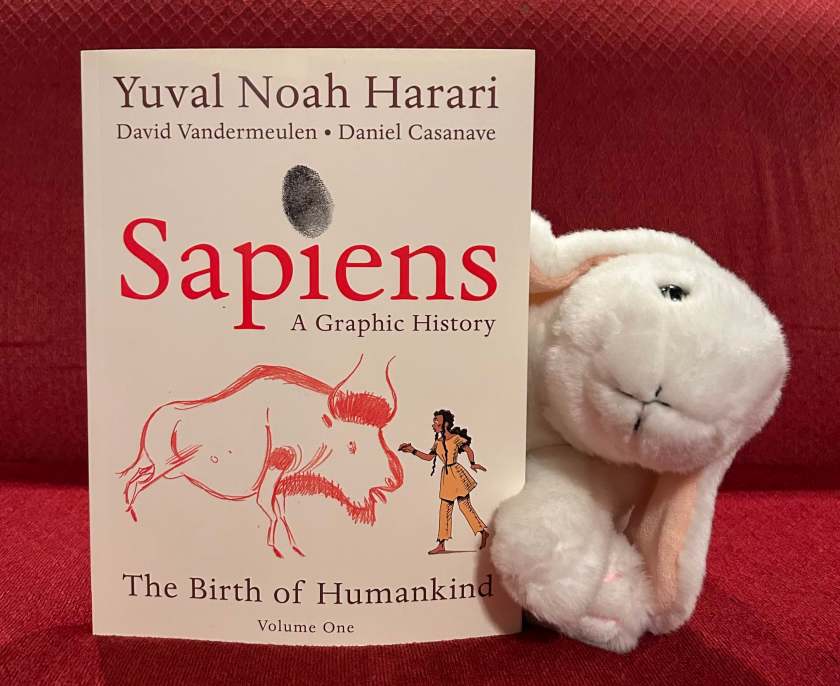
Marshmallow reviews Sapiens – A Graphic History: The Birth of Humankind by Yuval Noah Harari, David Vandermeulen, and Daniel Casanave

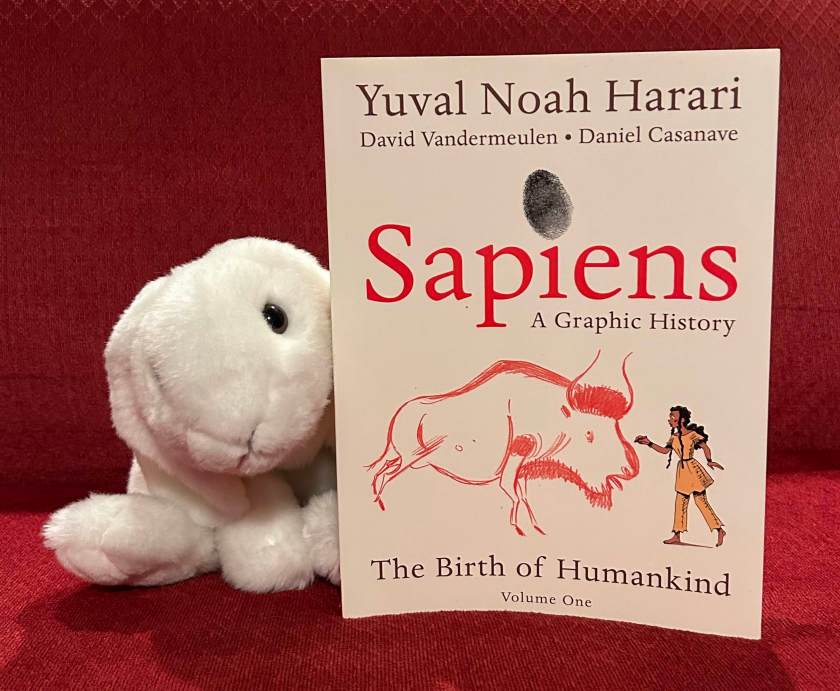
Today Marshmallow reviews Sapiens – A Graphic History: The Birth of Humankind, the first volume, published in 2020, of the multi-volume graphic novelization of Yuval Noah Harari’s 2011 book Sapiens – A Brief History of Humankind. Sprinkles is taking notes and asking questions.

Marshmallow reviews Sapiens - A Graphic History: The Birth of Humankind by Yuval Noah Harari, David Vandermeulen, and Daniel Casanave.
Marshmallow reviews Sapiens – A Graphic History: The Birth of Humankind by Yuval Noah Harari, David Vandermeulen, and Daniel Casanave.

Sprinkles: I know you enjoy graphic novels, just like Caramel does, so I was not too surprised when you decided to pick up this book.

Marshmallow: Yep, and I actually enjoyed reading it too. And I think that, if you like books that ask deep questions or investigate human history, then this is the book for you! 

S: Hmm, I see what you did there. You begin all your reviews with this kind of an invitation. I think it works well here too! So what is this book about?

M: It is basically about the entire history of humanity’s origins.

S: That sounds ambitious!

M: It is. So I think this will take him four or five volumes, but he is trying to tell in graphic novel form what he writes in his original book from 2011. It’s pretty novel I’d say.

S: I see. Tell me more.

M: So in this book, human evolution is portrayed as a reality TV show. And mass extinction becomes a crime investigation. We follow the author Yuval and his niece Zoe as they investigate the meaning of labels like “species” and “genus” with Professor Saraswati. Each character is drawn as a little caricature. Then we see Yuval and Zoe watching “The Greatest Show on Earth!”, or “Evolution!” This leads to an investigation of why and how the species of Homo Sapiens dominates the Earth today. After all, there were several other species in the human genus. 

S: I can see that you are using some big words, maybe from your biology class?

M: Well, not quite. The book uses them, so I think it makes sense for me to use them too.

S: Makes sense to me.

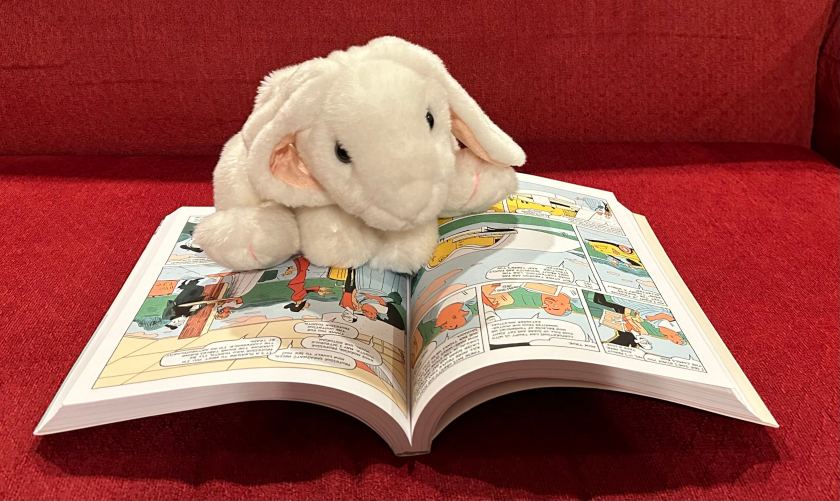
Marshmallow is reading Sapiens - A Graphic History: The Birth of Humankind by Yuval Noah Harari, David Vandermeulen, and Daniel Casanave.
Marshmallow is reading Sapiens – A Graphic History: The Birth of Humankind by Yuval Noah Harari, David Vandermeulen, and Daniel Casanave.

S: So I know that after reading this book, you also followed up with some reviews of it to see how it was received.

M: Yes. Because the author intends to share some possibly controversial ideas about the history of humanity, there was a lot I did not know about in the book, so it was really interesting to read. But I wanted to know if what he was saying was really correct. This is a graphic novel after all, and though some graphic novels have extensive footnotes and such, this one has none, and it has no references. So I wanted to check to see what others who know more about the topic thought.

S: So what did you find out?

M: Well, our readers can start by checking the Wikipedia article on the original book. The original book sold really well and got a lot of great reviews from well-known and highly regarded people. But it seems like some of the more scientific takes on the book are not as complimentary. A lot of them do like it actually, but there are some folks that say that there is not that much that is new in the book and whatever is new and original is not accurate.

S: I see. Now it is not terrible if there is nothing new for scientists, because no matter what they all know, their knowledge is not always accessible to the general audience.

M: Exactly. The graphic novel format is a really good way to reach a lot more people. So some apparently called it “infotainment,” but maybe that is actually not a terrible thing. I think the Lucy & Andy Neanderthal series that I read and reviewed is also kind of infotainment but I still found it extremely educational.

S: I agree with you there. Those books are a lot of fun and teach you a lot too.

M: Even our reviews are probably infotainment – fun yet informative, I hope. The accuracy concern is more difficult to dismiss though. Not being a scientist, I am not great at gauging that. So my advice for curious bunnies is to read this because it is a great story, and you will learn a lot, but still take it with a grain of salt, because if some parts of it feel really out there, maybe they are. So it might be worth double-checking things out on your own.

S: I think that is a very prudent and thoughtful recommendation, Marshmallow.

M: I’m a very prudent and thoughtful bunny. And now we are both using big words!

S: Yep, it must be this book!

M: We must be smarter or something! Maybe we are evolving.

S: Okay, okay, hold it there. Maybe this is a good place to end this review. So if you were to rate this book what would your rating be?

M: I really really enjoyed it, and I’d say 100% but then again the accuracy question makes me say 95%.

S: That’s fair. Okay, thanks for your neat review, Marshmallow. What would you like to tell our readers as we wrap it up?

M: Stay tuned for more amazing reviews from the book bunnies!

Marshmallow rates Sapiens - A Graphic History: The Birth of Humankind, by Yuval Noah Harari, David Vandermeulen, and Daniel Casanave, 95%.
Marshmallow rates Sapiens – A Graphic History: The Birth of Humankind, by Yuval Noah Harari, David Vandermeulen, and Daniel Casanave, 95%.

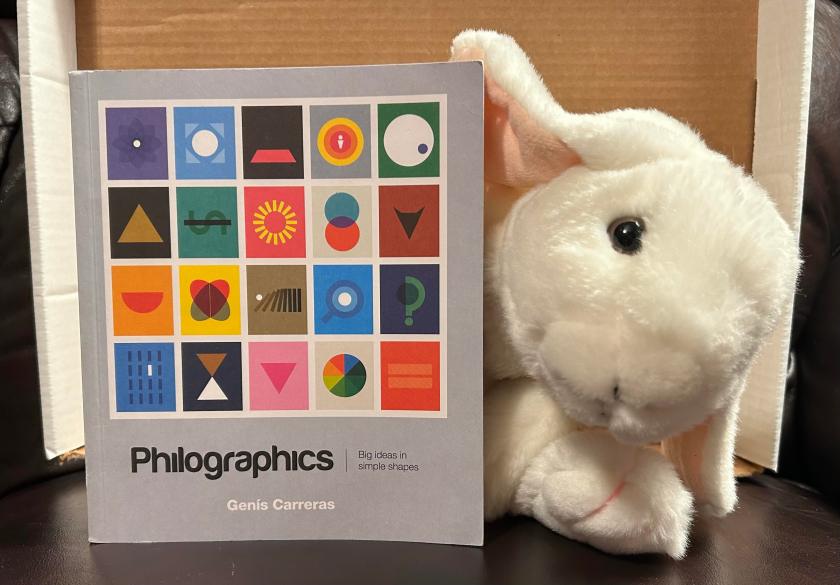
Marshmallow reviews Philographics: Big Ideas in Simple Shapes by Genís Carreras

As she is getting older, Marshmallow has been getting more and more interested in philosophical ideas. Today she reviews Philographics: Big Ideas in Simple Shapes, written by Genís Carreras and published in 2013. Sprinkles, who is also interested in the book, is asking questions and taking notes.

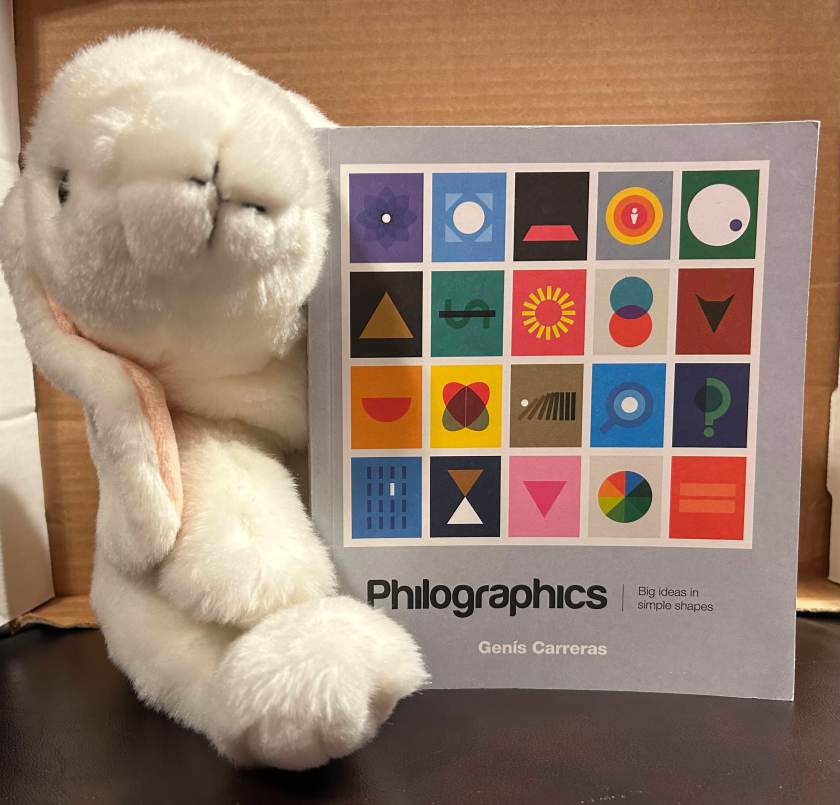
Marshmallow reviews Philographics: Big Ideas in Simple Shapes by Genís Carreras.

Sprinkles: So Marshmallow, I am so excited you wanted to review this book!

Marshmallow: Always happy to make you happy!

S: Thank you! Okay, so can you tell us a bit about what this book is about?

M: Well, the title is kind of self-explanatory. The book is about philosophy, more specifically about a hundred or so philosophical terms. The author of the book, or rather the artist Genís Carreras, uses two pages, side by side, for each term. Sort of reminded me of the book I recently reviewed about logical fallacies (An Illustrated Book of Bad Arguments by Ali Almossawi) in terms of the format.

S: I can definitely see that. So on each two-page spread, what do you see?

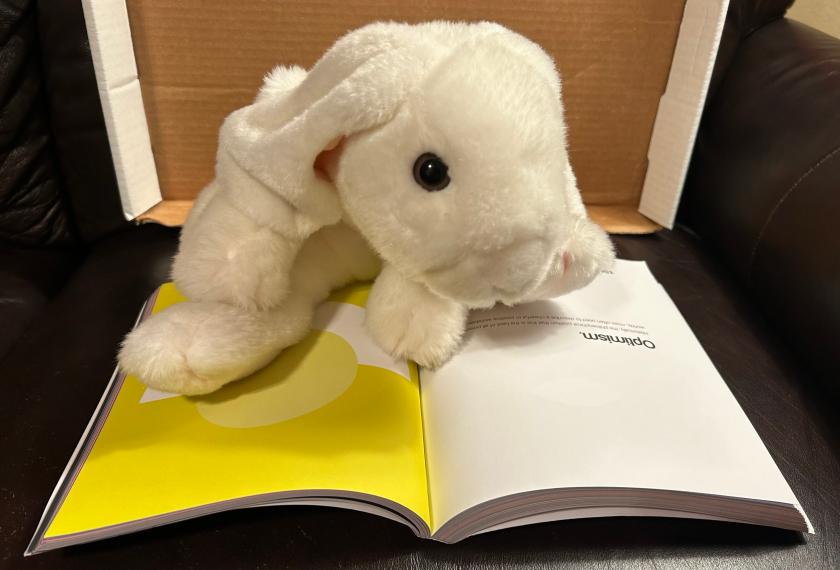
M: On the left page, there is a short, one-sentence definition of the term, apparently written by Chris Thomas, a friend of Carreras. And on the right side, there is a graphic depiction of the term, created by Carreras himself.

S: Oh, that kind of reminds me of a book Caramel reviewed way back: Opposites Abstract by Mo Willems.

M: Yes, you are right! But in that book there was no explanation, just a term on one side and a graphic on the other.

S: I guess that is why the Mo Willems book is more of a children’s book and this is not.

M: Yes, also this one has a lot of big ideas. The terms are all ordered in alphabetical order, and most of them are -isms. I mean, they are terms like feminism, optimism, realism, capitalism, nihilism, aestheticism, spiritualism, atomism, historicism, and so on.

S: Yes, this could be a really good dictionary of -isms.

M: Yes. But there are also some terms that don’t end with -ism that belong to philosophy. Like free will, extropy, dogma, and utopia.

Marshmallow is reading Philographics: Big Ideas in Simple Shapes by Genís Carreras.

S: I think maybe the definition of realism (“the philosophical view that asserts that reality is fundamentally based on, and is shaped by, ideas and mental experience, rather than material forces”) is not quite accurate, but one mistake in such a neat book is not a big deal.

M: Yes, I can see how the book’s definition of realism is not quite in line with what Wikipedia or the Stanford Encyclopedia of Philosophy say. But other than that, I think we did not find anything else that sounded off.

S: Yes, the project is an awesome idea. And I think it is carried out quite superbly.

M: Yes, I totally think so. The graphics are so simple, and yet, they are most evocative. And I really like the use of bright colors in most of them.

S: Did you know that Carreras has a website where one can see many of the graphics from the book?

M: No! But we should definitely put a link to it!

S: Of course. Here it is: https://studiocarreras.com/philographics

M: All in all, I think this is a really neat book and it would be a great starting point if you are interested in big ideas. Carreras offers us a great way to get introduced to these big -isms and the connections between them.

S: How so?

M: At the bottom of most pages, there are some symbols that tell you what philosophical field the term belongs to. Like politics, religion, metaphysics, and ethics. And sometimes there are page numbers to send you to ideas that are directly related to the term on the page.

S: I see. That is really neat! And I agree that this book can be a neat guide to getting into philosophy.

M: Yep!

S: So how would you rate this book?

M: I’d rate it 100%.

S: Sounds good! So let us wrap this review up. What would you like to tell our readers?

M: Stay tuned for more amazing reviews from the book bunnies!

Marshmallow rates Philographics: Big Ideas in Simple Shapes by Genís Carreras 100%.