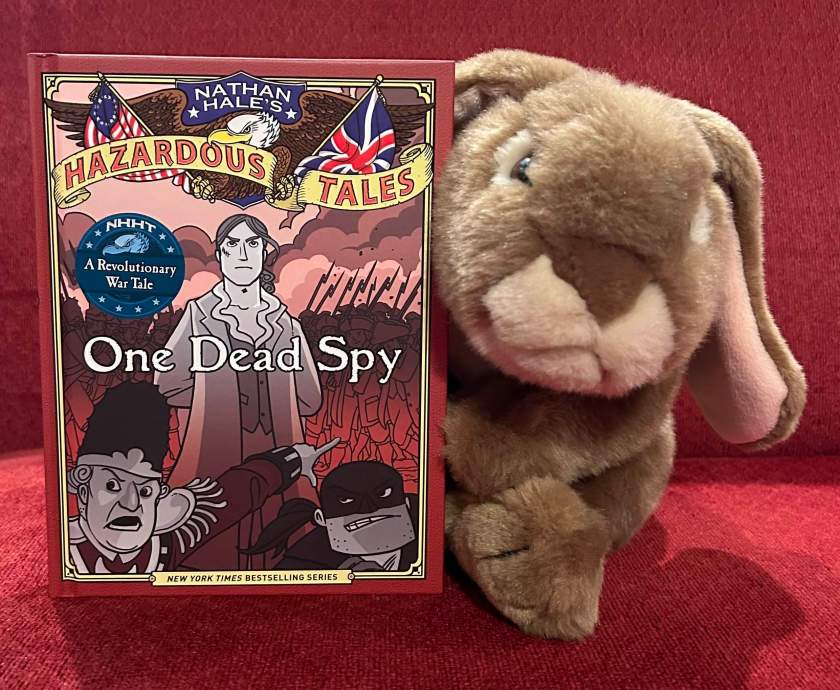
Today Caramel is talking to Sprinkles about the 2012 graphic novel One Dead Spy, the first book in the Nathan Hale’s Hazardous Tales series, recommended to the book bunnies by one of our friendly readers.
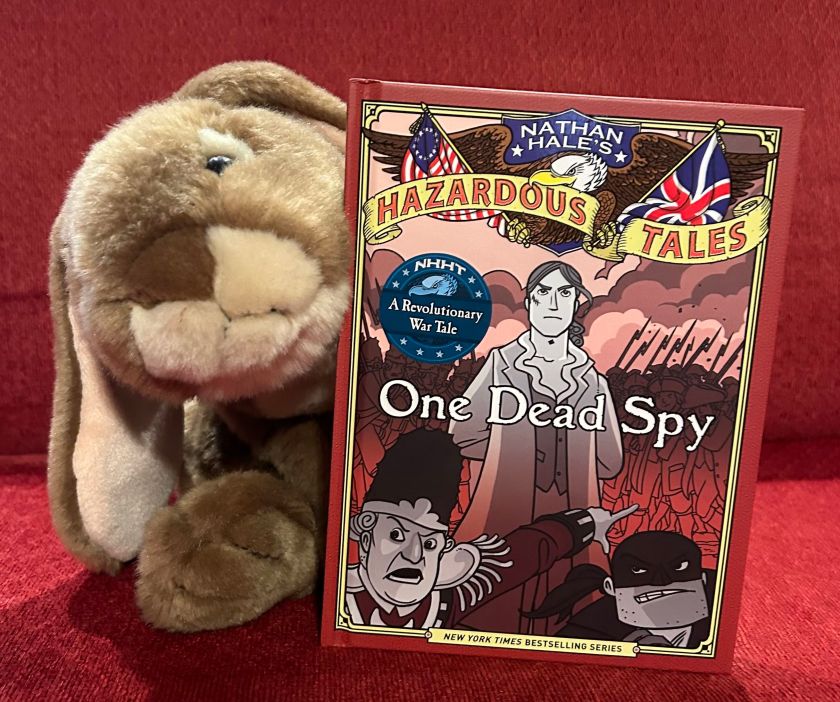
Caramel reviews Nathan Hale’s Hazardous Tales #1: One Dead Spy by Nathan Hale.
Sprinkles: So Caramel, you were talking about finding a new series last week. It looks like you found one!
Caramel: Yup.
S: So tell me about this new series of yours.
C: This is a series called Nathan Hale’s Hazardous Tales. There are many books in it. They are all graphic novels about some history stuff.
C: Well, kind of but also kind of not. I mean, the books are written by a guy named Nathan Hale, so it makes sense that the series would have his name on it.
S: I see.
C: But also the very first book in the series, the one we are talking about today, is about the spy Nathan Hale.
S: Oh, that is neat! So a guy named Nathan Hale writing a book about another guy named Nathan Hale.
C: Yep.
S: So this One Dead Spy is the story of Nathan Hale the spy, right?
C: Yep.
S: I see. So tell us about the story a bit.
C: The book starts with him being on the gallows about to get hanged. He says his famous words: “I regret that I have but one life to give for my country.” And then the gallows turn into a history book and then the book eats Nathan Hale.
S: Wait, what?
C: Yup.
S: I’m sure that’s not how it happened.
C: Not in real life. But this is fiction, Sprinkles, don’t forget.
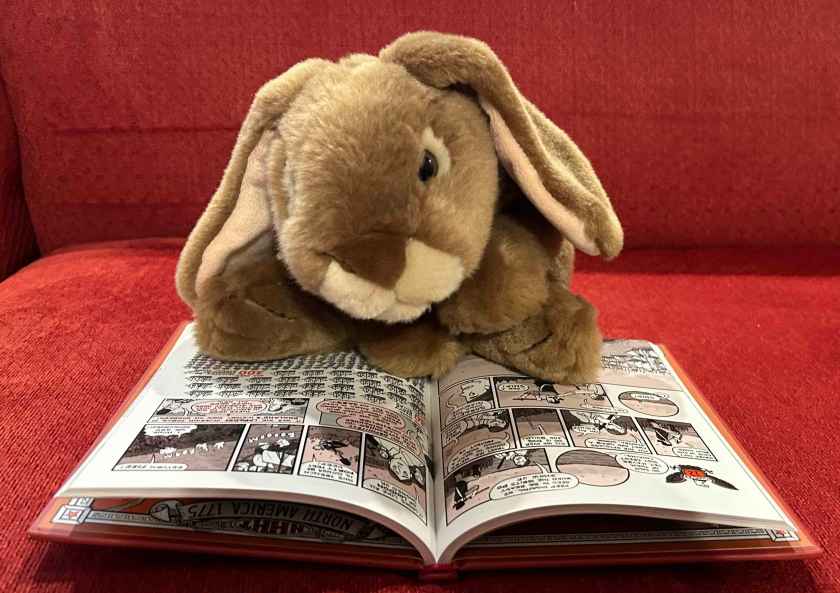
Caramel is reading Nathan Hale’s Hazardous Tales #1: One Dead Spy by Nathan Hale.
S: Alright, after the book eats Hale, what happens then?
C: Then he comes back and he knows the entirety of U.S. history. The rest of the book is about the American Revolutionary War.
S: Oh, then if he will be narrating the other books, too, I can see why the series would be called Nathan Hale’s Hazardous Tales.
C: Yup.
S: Did you know about Nathan Hale before reading this book?
C: I learned a little in school. But also remember, in the Spy School series, Ben’s best friend Erica is Erica Hale, and she is a descendant of Nathan Hale. So that is fiction, too, but I think reading that made me remember the school stuff better.
S: Hmm, that is cool, actually.
C: It is. Reading is useful, Sprinkles!
S: I agree! So tell me, this is a graphic novel about history. Did you like this format for this kind of story?
C: Yes. I love graphic novels and I love facts. So this is basically two things I love put together.
S: That is wonderful Caramel. I am so happy you found a new series!
C: Me, too!
S: So maybe it is time for you to move on to the next book. And we can wrap this up then. What would you like to tell our readers?
C: Stay tuned for more book bunny reviews!
Caramel loved reading Nathan Hale’s Hazardous Tales #1: One Dead Spy by Nathan Hale and is ready for the next book in the series.
It has been a while since Sprinkles posted a review to this blog. So Marshmallow and Caramel agreed that she was due for another. This is that long-awaited review!
In October 2021, Sprinkles reviewed a few children’s books about gender identity. Then in October 2022, she reviewed children’s books about where babies come from. Today she reviews a handful of children’s books about puberty. In this particular context, the books are mainly split into boy books and girl books. As a result Sprinkles will review these in two separate posts. The review below is the first of two, about books written for girls.
This review is intended for parents and guardians.
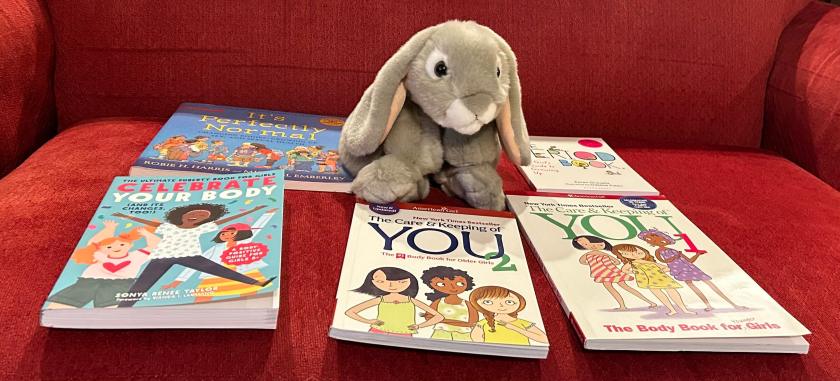
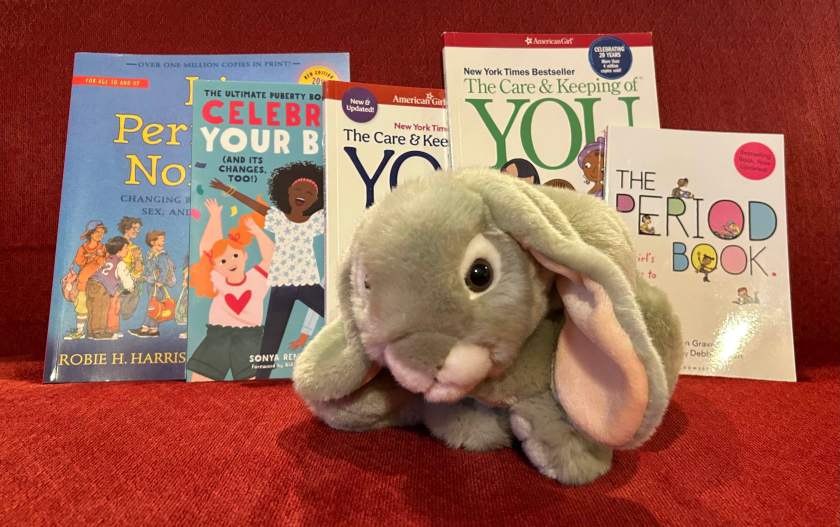
Sprinkles poses with five children’s books about puberty, four meant for girls and one for a wider audience.
Today I am writing about five books, each with its own strengths, intended to help young bunnies learn about the changes their bodies will go through during puberty. Puberty can be a challenging time for young bunnies. I think the main source of the challenge is the uncertainty of it all: the not knowing what is going on and not knowing whether what is going on is normal or not. These books aim to answer the most natural questions a young bunny may have as she begins to notice changes in her own body and those of her friends.
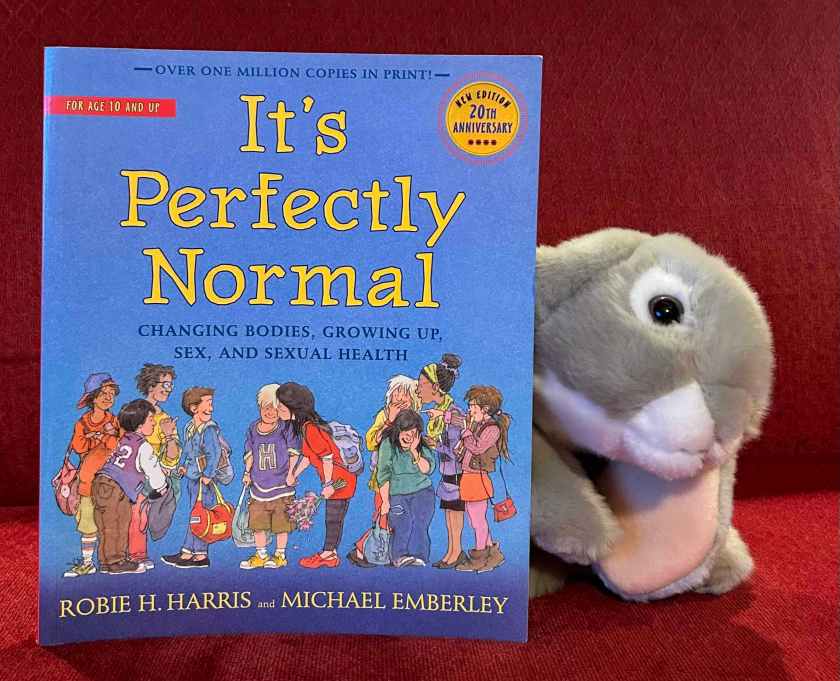
Unlike most of the books about gender identity and where babies come from that I have reviewed earlier, the books in this genre, that is, children’s books that aim to explain puberty, seem to come in two versions, one for the girls and one for the boys. There are of course exceptions, and I want to start this post with one such exception: the 1994 classic It’s Perfectly Normal: Changing Bodies, Growing Up, Sex, and Sexual Health, by Robie H. Harris and Michael Emberley, the team who also brought us It’s NOT The Stork: A Book About Girls, Boys, Babies, Families, and Friends and It’s SO Amazing: A Book About Eggs, Sperm, Birth, Babies, and Families, which I have already written about in my post on books about where babies come from.
Sprinkles reviews It’s Perfectly Normal: Changing Bodies, Growing Up, Sex, and Sexual Health, written by Robie H. Harris and illustrated by Michael Emberley.
It’s Perfectly Normal is perhaps the most well-known book in this genre; it even has its own Wikipedia page! As readers can also see from that page, this is a somewhat controversial book as it depicts naked human bodies (in caricature) and certain sexual acts (also in caricature). It also introduces ideas of gender diversity (Chapter 5 is titled “Who You Are: Straight, Lesbian, Gay, Bisexual, transgender, +”) and discusses masturbation and abortion (Chapter 16: “Perfectly Normal: Masturbation” and Chapter 24: “Laws and Rulings: Abortion”, respectively). So even parents who might find these topics suitable for their young ones might wish to review the book on their own before sharing it with them.
All that being said, I found the book very informative and generous. The laws in the United States are in constant flux in relation to abortion, but other than that, most of the information in the book is up to date and seemed to me to be more than relevant to a young bunny growing into her own body. The generosity I am talking about is in the compassionate ways the book explains differences of opinion about controversial topics like abortion and LGBTQ+ issues, as well as the many ways people can form families by methods such as in-vitro fertilization and adoption. And the bird and the bee that we had met in the other books by Harris and Emberley apparently first made their debut in this book, and they are just the same funny odd couple they were in those other books. Their reactions to the illustrations as well as the content of the text reflect the many types of natural reactions a young bunny may have to them. The bird is often the more enthusiastic one, enthusiastic about learning everything there is to learn, while the bee is often the one who is a little overwhelmed with it all and wants to quit talking about it. Both are natural reactions, and I have seen them in my own children at times when these issues came up. I think therefore that their presence through the book might help a young bunny reading the book to feel seen.
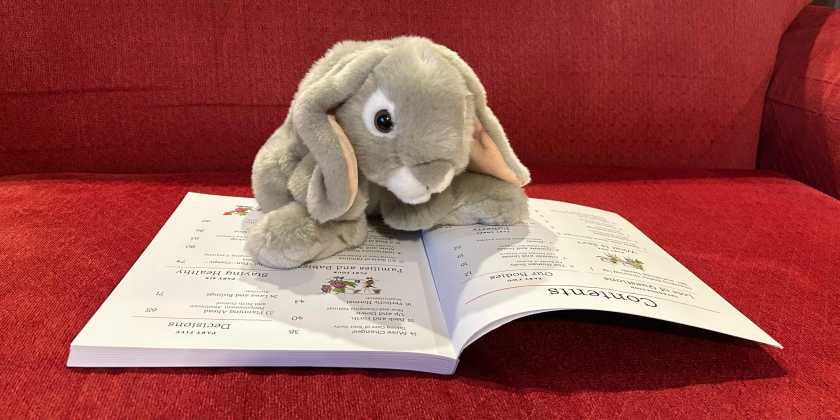
Sprinkles is reading It’s Perfectly Normal: Changing Bodies, Growing Up, Sex, and Sexual Health, written by Robie H. Harris and illustrated by Michael Emberley.
It’s Perfectly Normal is organized into six parts: Part One is titled “What is Sex”, and it includes five introductory chapters (Chapters 1-5) on sex, reproduction, babies, gender identity, and sexual intercourse. Part II is titled “Our Bodies”, and includes four chapters (Chapters 6-9) on human bodies both female and male, and both inside and outside. Part Three is the central part for our review, and is titled “Puberty”. This is the longest part, with seven chapters (Chapters 10-16) on distinct changes to the female and the male body as they go through different stages of puberty, as well as other changes that impact feelings. Part Four is titled “Families and Babies” and made up of six chapters (Chapters 17-22) about pregnancy, birth, families, as well as taking care of babies and genetics. Part Five is the shortest, titled “Decisions”, and includes a chapter on planning (Chapter 23: “Planning Ahead: Postponement, Abstinence, and Birth Control”) and one on abortion (Chapter 24: “Laws and Rulings: Abortion”). The sixth and final part is titled “Staying Healthy” and consists of five chapters (chapters 25-29) and focuses on issues involving sexual health, sexual abuse, sexually transmitted diseases and making responsible choices.
Though written earlier than It’s NOT The Stork: A Book About Girls, Boys, Babies, Families, and Friends and It’s SO Amazing: A Book About Eggs, Sperm, Birth, Babies, and Families, It’s Perfectly Normal is aimed for a more mature audience. If your young bunny has already read those two books, this book will be just the right next step for them. There is overlapping content but maybe that is fine for a young person facing so many new things in their lives. Some familiar content melded with some new stuff might just be the right way to avoid the overwhelm and actually make sense of what is going on.
**
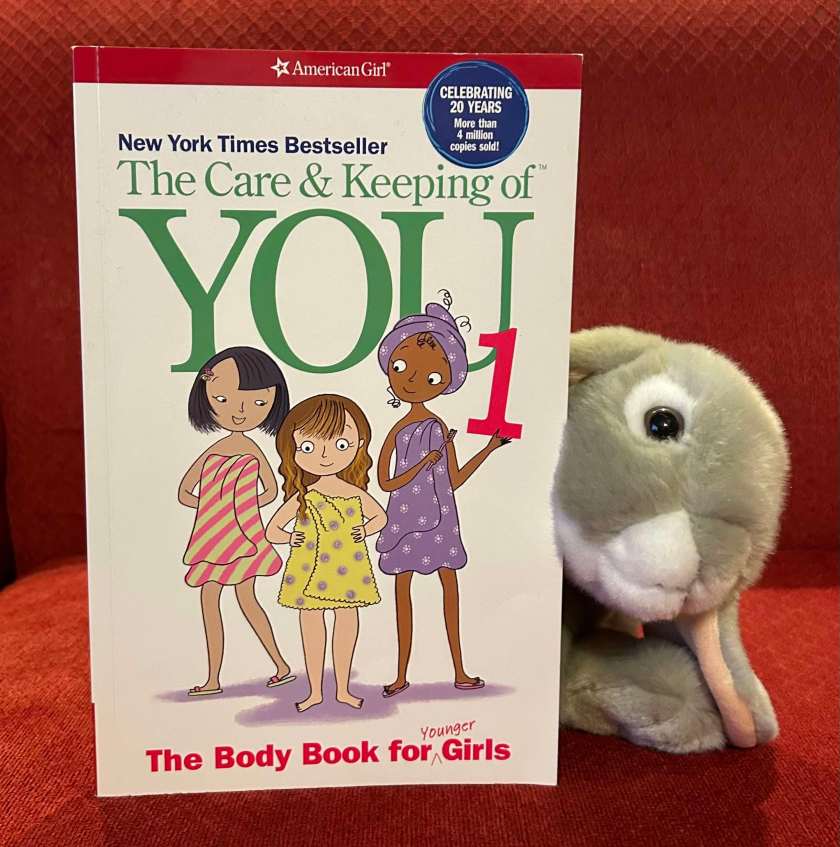
Next I would like to talk a bit about another series, published via the American Girl franchise, titled The Care & Keeping of You: The Body Book for Girls. The first book in the series, now called The Care & Keeping of You 1: The Body Book for (Younger) Girls, was written by Valorie Lee Schaefer and illustrated by Josée Masse and originally published in 1998. I happened to get my paws on a copy of its 2018 edition.
Sprinkles reviews The Care & Keeping of You 1: The Body Book for (Younger) Girls, written by Valorie Lee Schaefer and illustrated by Josée Masse.
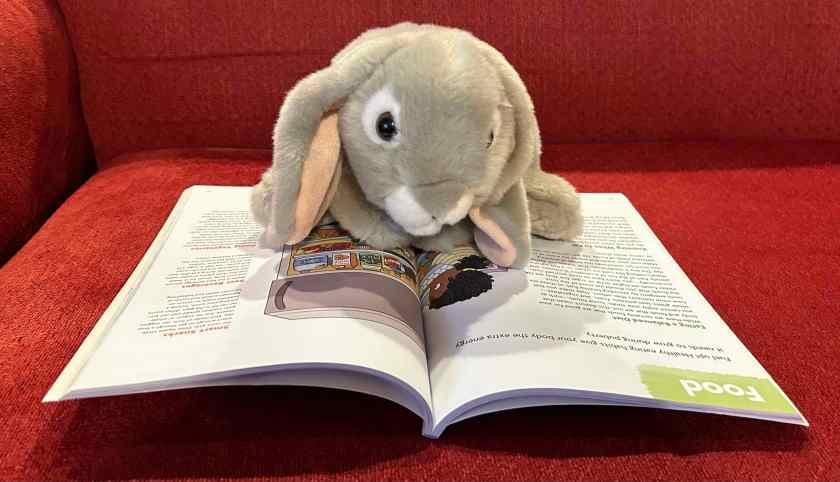
The Care & Keeping of You 1: The Body Book for (Younger) Girls is a tall book, and each two-page spread focuses on a specific topic. The topics covered are basic body parts (ears, hair, eyes, mouth, skin, hands, underarms, breasts, legs, feet, pubic area), health topics (food, acne, sports safety, sleep troubles), and other important parts of growing up (braces, bras, periods, changing feelings). The tone is light and the illustrations are bright and cheery.
Sprinkles is reading The Care & Keeping of You 1: The Body Book for (Younger) Girls, written by Valorie Lee Schaefer and illustrated by Josée Masse.
The Care & Keeping of You 1: The Body Book for (Younger) Girls is aimed mainly at tweens and written like a user’s manual. So it is not only about puberty, but rather about growing into one’s own, and knowing how to take care of one’s own body while doing so. The sections that probably explain the most significant changes in a tween girl’s body, about breasts and periods, are all surrounded by sections which cover topics that are a lot less emotionally overwhelming. So the book reads lightly, and the young one reading it will come away learning a lot and feeling comfortable and confident while doing so.
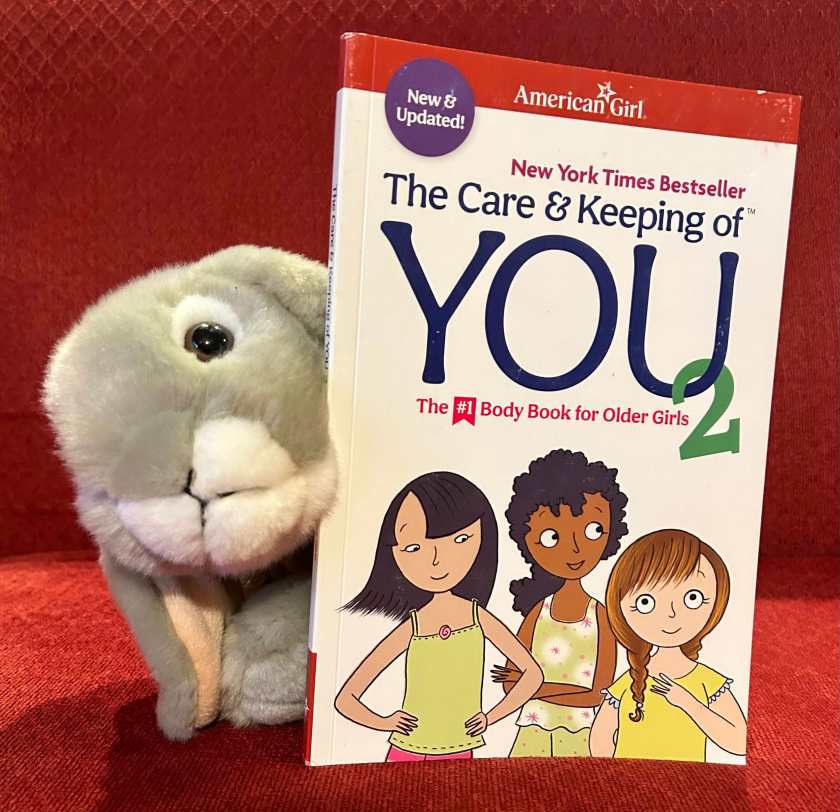
Sprinkles reviews The Care & Keeping of You 2: The Body Book for Older Girls, written by Cara Natterson and illustrated by Josée Masse.
The second book in the series, The Care & Keeping of You 2: The Body Book for Older Girls, was first published in 2012. It is written by Cara Natterson, who served as a medical advisor for the first book, and illustrated by Josée Masse, the same artist who illustrated the first book. So you can definitely sense a continuity between the two books. If your kiddo has read the first book and found it helpful, this second one might be a good next step for her.
Sprinkles is reading The Care & Keeping of You 2: The Body Book for Older Girls, written by Cara Natterson and illustrated by Josée Masse.
This second book can also stand on its own, as a book written for a slightly older crowd. It uses slightly smaller font, and the book itself is in a smaller format. And the girls in the cover of the first book also adorn the cover of this one, but now they are a bit older. In this book there are chapters on growing taller (or not), a more detailed discussion of the female body and physiology, some discussion of sleep and periods too. The content is organized into four main chunks: Back To Body Basics (about taking care of one’s changing body), Puberty Power (about periods, hormones, changing breasts, and body hair), Mental Health and More (about body image, exercise, mood swings), and Your Body, Your World (about family dynamics and peer pressure). Overall, this book does take the reader a bit more seriously and expects a bit more from them in return. There is also a Q&A section in each part where the author answers specific questions from readers.
Overall both these books can be helpful to a tween girl as she learns to take care of herself and understand the changes she is going through. As a package deal I think the two books cover a good amount of material, though perhaps they do not get into some of the more nuanced (and thus somewhat more controversial) topics that It’s Perfectly Normal goes into.
**
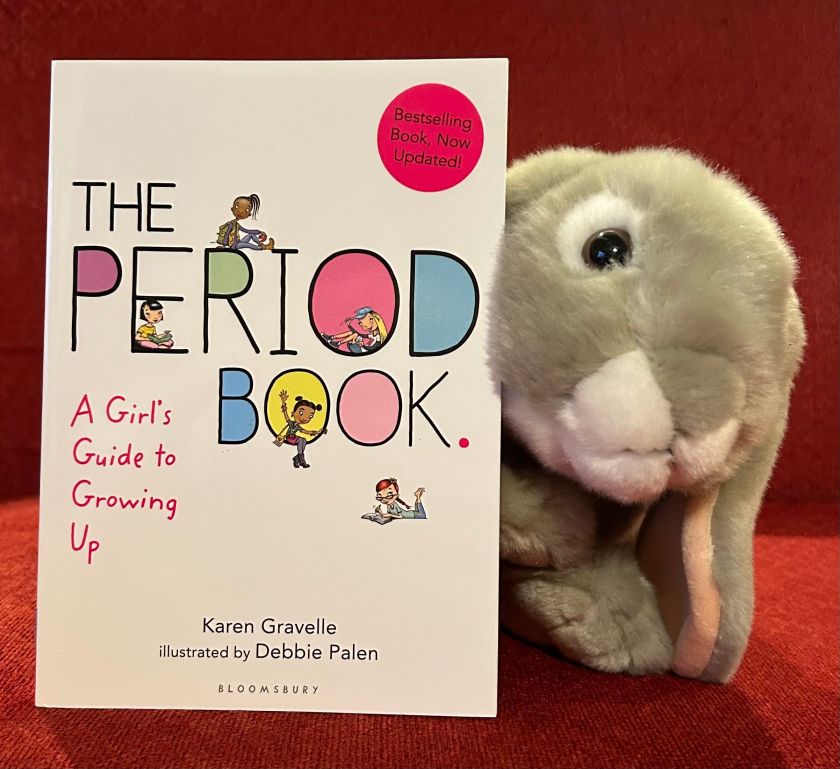
The next book I want to write about is The Period Book: A Girl’s Guide to Growing Up, written by Karen Gravelle with Jennifer Gravelle Stratton, and illustrated by Debbie Palen.
Sprinkles reviews The Period Book: A Girl’s Guide to Growing Up, written by Karen Gravelle with Jennifer Gravelle Stratton, and illustrated by Debbie Palen.
The Period Book, first published in 1996, was written by Karen Gravelle with the help of her niece Jennifer. For the current edition from 2017, the authors consulted a few young people, too, to make it more up to date and relevant to today’s youngsters. Indeed the authorial voice of the book reads really like a friendly aunt or a good older sister chatting with you and answering some real questions you might want to ask her. And it is not only about periods, even though that might be what the title leads one to believe at first.
Sprinkles is reading The Period Book: A Girl’s Guide to Growing Up, written by Karen Gravelle with Jennifer Gravelle Stratton, and illustrated by Debbie Palen.
The Period Book is a small format book, written in purple font with purple illustrations. It is a quick and easy read, and goes through the standard physiological changes, hormonal and emotional changes, and changes in friendships. Its twelve chapters, titled “Changes of Puberty–Those You Can See”, “Changes of Puberty–Those You Can’t See”, “Your Period”, “What to Wear”, “Is This Normal?”, “Puberty Bummers and How to Handle Them”, “What If …?”, “Braces–The Non-Bummer”, “No Body is Perfect”, “Changing Friendships”, “Romantic Feelings”, and “Dealing with Harassment”, cover a good range of topics that will help a tween or a teen understand what is going on with her body while also getting some of her most salient questions answered. And since the author is a cool aunt, she will not laugh at your questions, so you can ask her anything. At least that is how this book feels. However keep in mind that such a cool aunt is probably not going to be too embarrassed to talk about how to put in a tampon and what vaginas look like, and there are indeed accompanying illustrations for these topics, too.
**
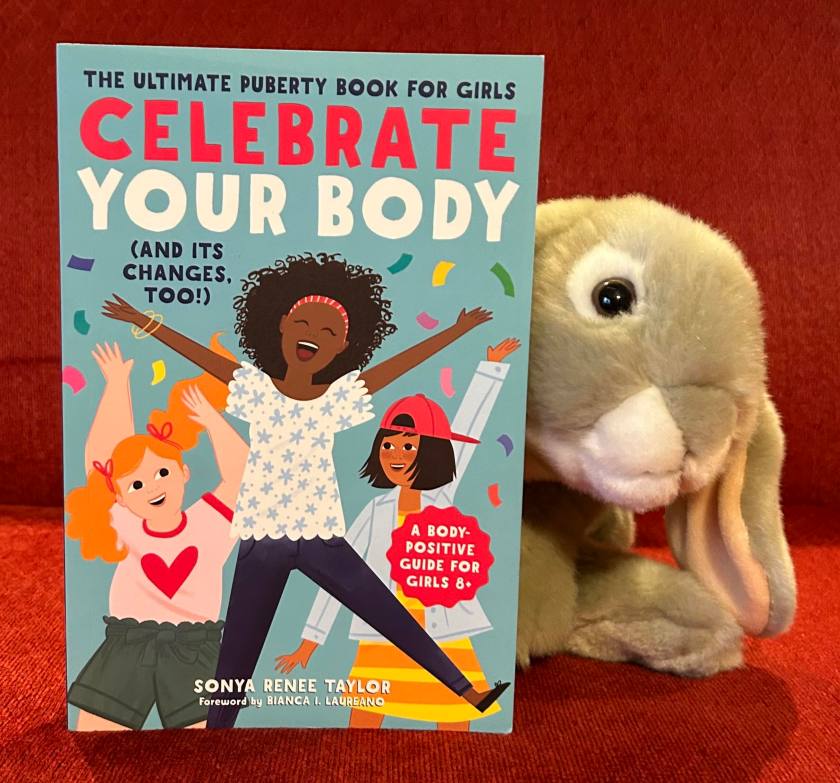
The last book I want to talk about in this review is Celebrate Your Body (And Its Changes, Too!): A Body-Positive Guide for Girls 8+, written by Sonya Renee Taylor and illustrated by Cait Brennan.
Sprinkles reviews Celebrate Your Body (And Its Changes, Too!): A Body-Positive Guide for Girls 8+, written by Sonya Renee Taylor and illustrated by Cait Brennan.
Celebrate Your Body (And Its Changes, Too!), published in 2018, is the newest of the books I read for this blog post. At 156 pages, it is also the longest. But I did not feel like this would make it more of a burden to read. It is first of all very colorfully illustrated, and the author has a strong and supportive voice, once again kind of like that of an older sister. Her voice is maybe a bit less chill than the one you hear in The Period Book, but she does sound a lot more enthusiastic about supporting your young one in how she chooses to grow into her own body.
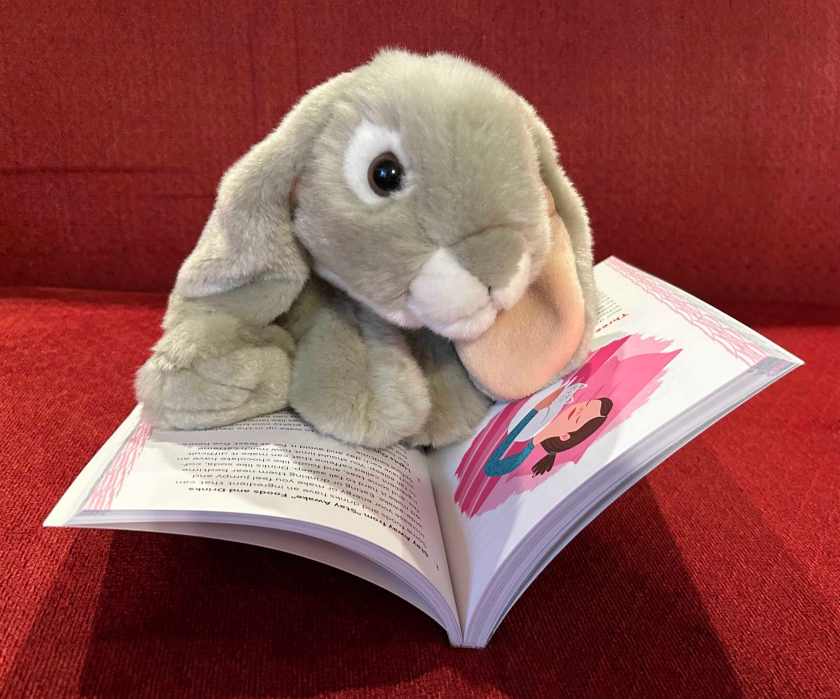
Sprinkles is reading Celebrate Your Body (And Its Changes, Too!): A Body-Positive Guide for Girls 8+, written by Sonya Renee Taylor and illustrated by Cait Brennan.
Celebrate Your Body is a newer book, and some of this shows in the way the author talks about gender identity and safe spaces. But it is all around sound advice, about understanding and taking care of one’s changing body, but also about alcohol and drugs, sleep, and changing friendships. The seven chapters of the book (“Fabulous You!”, “Your Changing Body”, “Breasts and Bras”, “Below your Belly Button”, “Your Period”, “Feeding and Fueling Your Body”, “Feelings and Friends”, and “Family and Other safe Spaces”) are well organized, and the young bunny who reads this book will leave it very well informed. Once again, there is an illustration of how to use a tampon, as well as a half-page vagina viewed straight ahead. These illustrations are definitely not indecent or sexually suggestive in any way, but of course families differ in how comfortable they are with these things. So if you are not willing to have your young bunny see these types of illustrations, this might not be the right book for you and your family. Otherwise, this is indeed a good book, and your young one might learn a lot and gain some confidence in her body along the way.
**
Having read all these books, I am most excited by the fact that today’s young bunnies have these kinds of options. When I was a young bunny going through my own changes, I did not have many books to turn to. My family was supportive and open in many ways, but of course, sometimes a book is easier to learn from, and one might not want to ask all their questions to their family. And sometimes older folks do not know how to approach these issues themselves, and they are even more embarrassed than the younger folks.
For parents, these books offer an excellent opportunity. Introduce one or more of these to your tween or teen, and let them have at it. Or if you have that kind of relationship with them, you might want to read one of these books together. In any case, it is best to have the young ones have access to these books, and also make sure they know that you are open to a conversation while or after they read them. It is important for young bunnies to have access to accurate information, and reading any one of these books can be an empowering experience for a young bunny in her tweens or early teens. But of course, most importantly we want to have our eyes and ears and minds open for when they are ready to talk.
Sprinkles has enjoyed and appreciated the opportunity to read each and every one of these books about puberty directed at tweens, and recommends that grownups of young bunnies consider sharing at least one of them with their young ones.
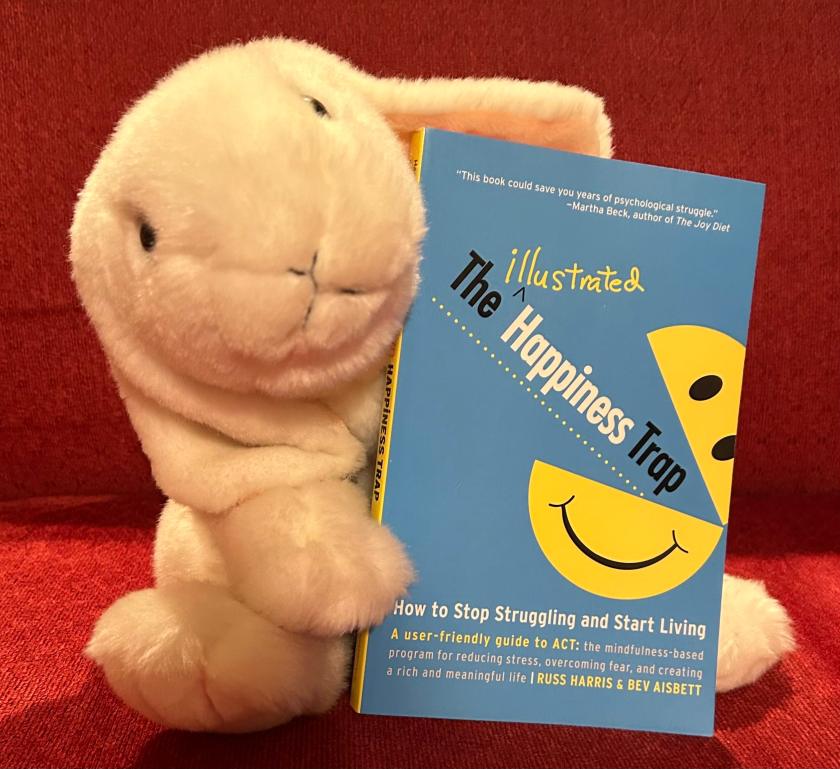
S: But I think the title and the cover page of this book are both very intriguing, aren’t they?
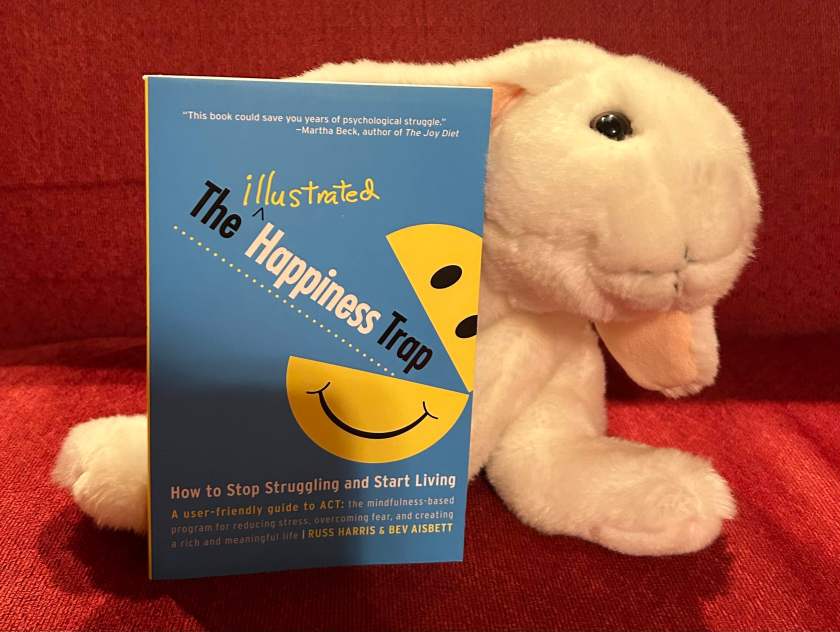
M: Yes, I like how it has a Pac-Man style half-split smiley face.
S: Yes, it is quite striking how the smiley who could represent authentic happiness, but also a fake version of it, is somehow split open with the title.
M: Yeah.
S: So I had only read a little bit of the book before you took it from me and I know you have finished reading it quite fast. I understand it is about happiness?
M: Yes, kind of. It is basically about how we should not be going after happiness as our goal in life.
S: Hmm, this reminds me of a very interesting young person in one of my classes who had said that they did not necessarily want happiness for their child. They wanted them to find purpose.
M: Yeah, it is kind of like that. The main goal of the book is to dispel the myth that happiness is the right goal for one’s life. The goal should instead be to figure out your values and live your life accordingly. Once you know your values, the goals you set for yourself should reflect those values and be feasible. And along the way, you are likely to be unhappy at times, and that is not a disaster.
S: I see. So the title is basically saying that the idea that you should always be happy is flawed.
M: Yes, and that pursuing the goal of living a life where you are always to be happy and have no negative feelings leads to only unhappiness.
S: I see. That makes sense to me. I also saw that the book mentions explicitly four myths. Can you tell us what they are?
M: Okay. So the first one is “Happiness is the natural state for human beings.” The second is “If you are not happy, you are defective.” The third is “To create a better life, we must get rid of negative feelings.” And the fourth one is “You should be able to control what you think and feel.”
S: I can see how the first three are wrong, if we accept the main thrust of the book. And I already did not believe some of them myself. Like there are sometimes very good reasons not to be happy. But the fourth one is hard for me to accept. It feels kind of disempowering.
M: I agree with you. But I think the idea behind their stance, which they call Acceptance and Commitment Therapy, is that basically you should accept your feelings and decide what to do with them in a productive manner. As you learn to do this better and more effectively, your emotional state can change, too, and improve, but that is not the main goal.
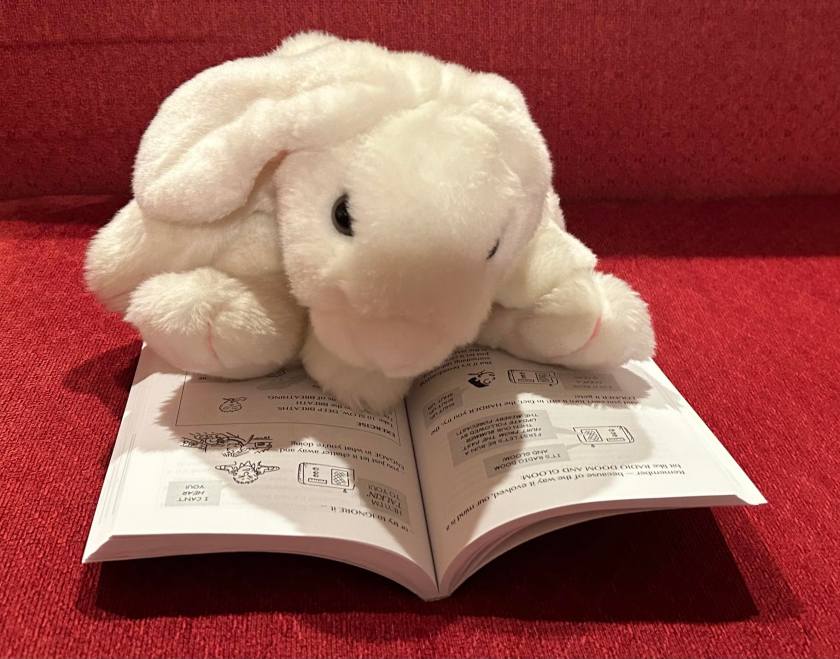
Marshmallow is reading The Illustrated Happiness Trap by Russ Harris and Bev Aisbett.
S: So Marshmallow, I think these are all rather hefty thoughts and a bit heavier than some of the things we read and talk about here in this blog.
M: True, but we have talked about all sorts of other heavy things like war and slavery and so on. So talking about mental health challenges should not be totally out of bounds, I think.
S: True. And the topic is actually quite relevant to a lot of bunnies.
M: Yes,. sure, this is not really quite meant for little bunnies, but maybe a bunny around my age would be perfectly fine with it. And I think they could learn from it.
S: I am glad you found the book helpful.
M: I did. I found it resonating a bit with the Getting Things Done book I reviewed before. Both books say that figuring out your values and building your life around them is a good idea.
S: I can see how that could be helpful for teenagers who are looking to build their lives, preparing to grow up into adult bunnies. So if you were to rate the book then, what would you rate it?
M: I’d rate it 95%. I especially liked the illustrations and how they made the book so much easier and quicker to read. Because it is kind of stressful to read a book about mindfulness sometimes. I feel like I am losing time, but this book is so quick and you learn a lot.
S: Great! I will now take it from your paws then and finally get the chance to finish it myself. What would you like to tell our readers as we wrap up this review?
M: Stay tuned for more amazing reviews from the book bunnies!
Marshmallow rates The Illustrated Happiness Trap by Russ Harris and Bev Aisbett 95%.
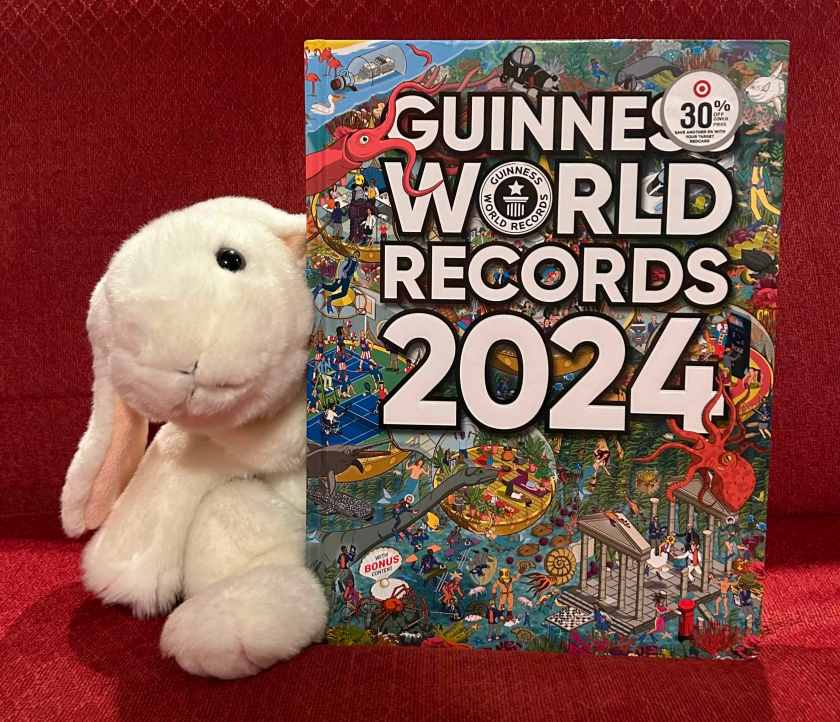
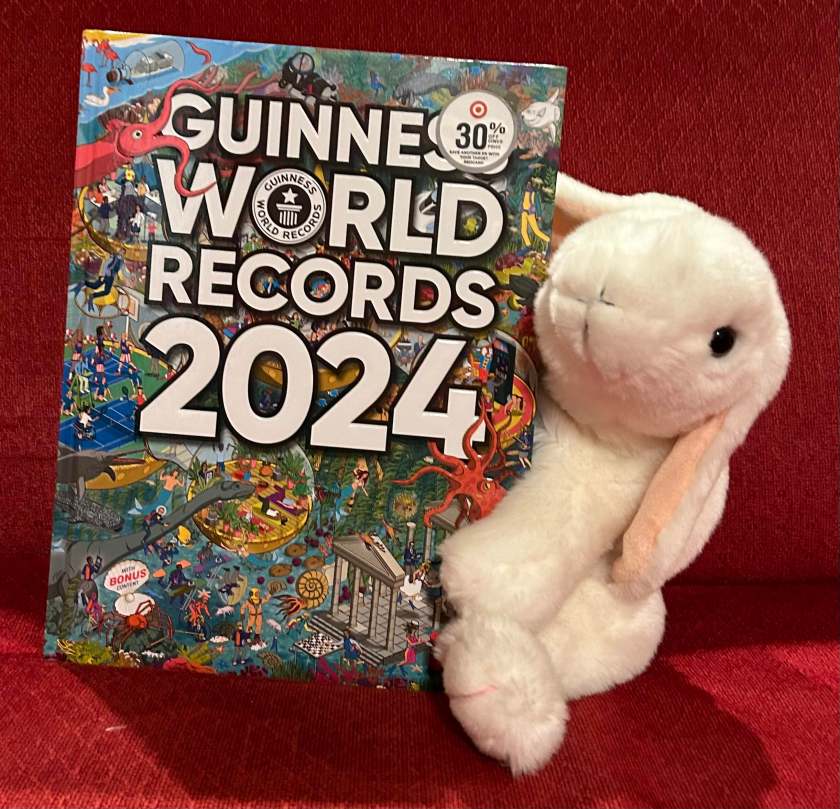
Today Marshmallow dives deep into Guinness World Records 2024, an outstanding book of records updated for 2024, created by a huge team of editors, contributors, and consultants, all listed at the end of the book, and illustrated by Rod Hunt. Sprinkles is taking notes and asking questions.
Marshmallow reviews Guinness World Records 2024.
Sprinkles: So Marshmallow I know you have been a fan of Guinness World Record books for a while now. How did you enjoy reading this 2024 edition?
Marshmallow: It was really interesting. It definitely kept me busy for a long time.
S: So this is a book full of facts. So Caramel will love to get his paws on it too. But I know you have a thing for these records, so it made total sense when you grabbed the book first and did not put it down until you were done. Tell me some of your favorites.
M: Sure. The fastest average solve for a 3x3x3 Rubik’s cube is 4.86 seconds.
S: Cool! I know you once solved it in under 47 seconds and that was pretty impressive for a little bunny.
M: Not in comparison to this guy!
S: Well he has opposable thumbs, which help I am sure.
M: True. Okay, here is another record: this person in Germany has a collection of 11,062 penguin related items!
S: That sounds awesome! The book bunny family adores penguins!
M: But we definitely do not have eleven thousand penguin-related things!
S: I know! That is wild. What else have you got?
M: Well, apparently there is this Turkish-American guy who spent a total of two years and three hundred and fifty four days of rowing all by himself in the ocean.
S: That’s almost three years. I’d be so lonely. And so homesick.
M: Yes… Me too.
S: So that is a record I might not want to challenge. But I bet you could like to be able to solve the cube in under five seconds.
M: That could be nice.
S: Give me another record you might want to be able to break yourself.
M: Well, I am not sure. But the biggest doughnut in the world weighs 226 pounds, and it is pink and has sprinkles on it.
S: Hmm, I think we could like that.
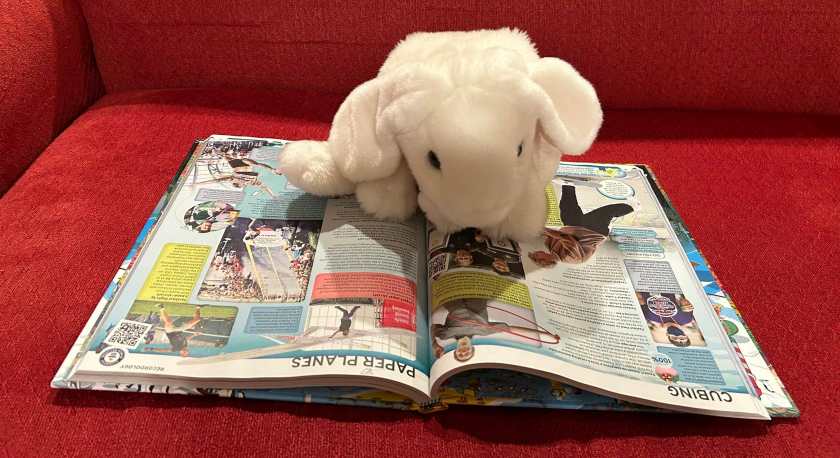
Marshmallow is reading Guinness World Records 2024.
S: So tell me more about this book. I am thinking you have not really read it from cover to cover in that order, right?
M: Well, I think I read everything in it eventually, but yes, I skipped around a lot at first. And it is actually quite fun to do that. The pages are very colorful, and many of the facts are quite weird. For example, thirty-four couples got married under water on Valentine’s Day 2001 in Thailand. And there is apparently a guy who married more than twenty six times and has allegedly fathered 41 children. Wait, here is the Wikipedia page for the guy. I cannot understand why someone would marry so many times.
S: It is really strange. But I can see how this book could really be entertaining. And the records are organized in some fashion, right?
M: Well, there is a table of contents. For example there is a section on sports, art and media, science and technology, and so on. But did you know that they do not have records for some things because they could be unethical? Here is a Wikipedia page of discontinued records due to a range of ethical and moral issues. There are more details on the Guinness World Records policy page.
S: Wow! That is actually good to know. Thank you for sharing Marshmallow. So maybe this is a good time to end this review. How would you rate the book overall?
M: I’d rate it 100%. I love reading about these records!
S: That sounds wonderful Marshmallow. I’m glad we got a copy of this book then. What would you like to tell our readers as we wrap this up?
M: Stay tuned for more amazing reviews from the book bunnies!
Marshmallow rates Guinness World Records 2024 100%.

 BookBunnies