Marshmallow reviews Fail, Fail Again, Fail Better: Wise Advice for Leaning into the Unknown by Pema Chödrön

The book bunnies are back! Today in her first review for the new 2025-2026 season, Marshmallow is writing about Pema Chödrön’s short but impactful book, Fail, Fail Again, Fail Better: Wise Advice for Leaning into the Unknown, published first in 2015.

Marshmallow reviews Fail, Fail Again, Fail Better: Wise Advice for Leaning into the Unknown by Pema Chödrön.

Marshmallow’s Quick Take: If you like books about self-improvement, contemplation, and dealing with challenges, then this is the book for you!

Marshmallow’s Summary (with Spoilers): The book starts with a foreword by Seth Godin, in which he introduces an interesting phrase from the author: “getting all the frogs in the bowl.” This essentially means that, despite all efforts, if you’re trying to get frogs to stay in a bowl, there will always be some that hop right out–which I presume is a metaphor for the occasional, unavoidable failure. He describes his own past with failure, citing the plethora of publishing rejections he experienced. But Chödrön, he says, teaches one how to dance while the frogs continue to jump. This piqued my interest.

Godin also mentions the “infinite game” (one you play not to win, but simply to play). He ties this into the jumping frogs, claiming that perhaps the jumping frogs are the point, rather than the orthodox objective of just getting them to sit still in the bowl. I found this point a little more difficult to tie into the objective of the book. Rather than focusing on how to grow from failure, it suggests that the entire purpose of existence is failure. I felt that this is a separate thesis that is harder to defend. But the foreword made me excited to start. 

The central core of the book is derived from a speech Chödrön gave at her granddaughter’s college graduation. In it, she explains that she wasn’t sure her topic choice would be appropriate since preparation for failure (her topic choice) is superfluous–teachers and students hope–if one is taught to avoid mistakes in the first place. Yet, she says that the “fine art of failing” may be the most important lesson that these new graduates will learn in their entire lives.

Most of her speech centers on the topic of “welcoming the unwelcome.” Through this, Chödrön explains, one can turn towards their pain and their failures and learn from them by letting go.

Chödrön describes the two main responses we have towards failure: we often blame other people or other factors for it, and we almost always begin to experience some sort of self-identification with failure. The author describes how she hit rock bottom after leaving her second husband and found guidance with the founder of the college she is speaking at, Chögyam Trungpa Rinpoche. She also recounts an old story which I found fascinatingly eye-opening. The speech then ends, and rather abruptly, but she delivers her message effectively and really does not need to say much else. 

The third and final part of this book is an interview with the author conducted by Tami Simon. This section really goes way deeper on all the ideas introduced more briefly in the speech (which was shorter and interspersed with little calming illustrations). 

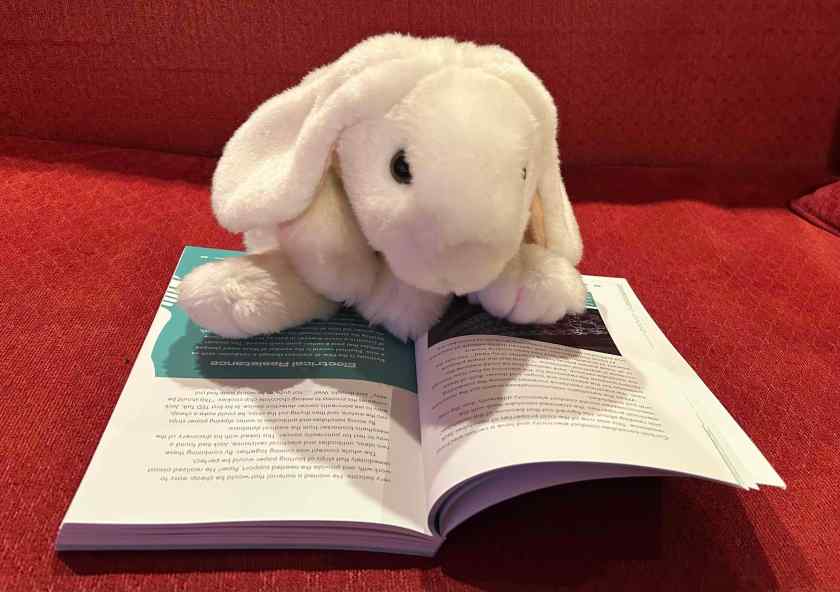
Marshmallow is reading Fail, Fail Again, Fail Better: Wise Advice for Leaning into the Unknown by Pema Chödrön.

Marshmallow’s Review: I found this to be a very engaging book. I agree with many of the ideas, and actually found that some of my own ideas appeared in this book. The author certainly has many novel, wise suggestions and is clearly trying to make the world and the reader better. I liked how the solution presented is more about addressing the pain of failure rather than how to prevent it because there are many amazing books about that too (see for example all the books by Cal Newport that I have already reviewed for our blog). But overall, the speech itself is like a calm, easy-to-read intro to the ideas that are expanded more in the interview.

I thought this was a very intellectually and emotionally engaging book. Overall, Fail, Fail Again, Fail Better: Wise Advice for Leaning into the Unknown is short, but engenders deep contemplation that will last for a long time.

Marshmallow’s Rating: 98%.

Marshmallow rates Fail, Fail Again, Fail Better: Wise Advice for Leaning into the Unknown by Pema Chödrön 98%.

Marshmallow reviews Beautiful News by David McCandless

Today Marshmallow chose to review a beautiful book of infographics by David McCandless published in 2022, aptly named Beautiful News: Positive Trends, Uplifting Stats, Creative Solutions.

Marshmallow reviews Beautiful News: Positive Trends, Uplifting Stats, Creative Solutions by David McCandless.

Marshmallow’s Quick Take: If you want hope (or if you simply like pretty pictures displaying lots of cool information), then this is the book for you!

Marshmallow’s Summary (with Spoilers): In today’s status quo, things are looking grim. Everyday everyone looks at the news and sees only darkness. Every headline promises impending doom, but each one is terrifying in its own separate way. Isn’t it great!?! More seriously though, this is a daily occurrence that everyone, regardless of the news and media type they consume (CNBC, CNN, Fox, New York Times… they are all extremely depressing), experiences. This is mostly due to a phenomenon known as negativity bias. But no matter how natural, the end result is universal hopelessness and—quite frankly—rampant depression. Birth rates are falling as youth start to equate having children to condemning them to a horrific future. But amidst this barrage of fear, sadness, and anger (all of which is undeniably present and must be recognized), there is also hope. Hope may initially feel like a fragile concept, but this book helps back it up with statistics and data.

The author David McCandless has compiled exactly what is written on the first page: “positive trends, uplifting stats, creative solutions.” After the table of contents, each page or two is a spread of data, with brilliant colors and clear infographics (a portmanteau word smashing together “information” and “graphics”). The book is divided into sections based on what topic the information is about. The sections are titled as follows: health, cleaner energy, progress, climate, money, nice!, nature, mixed, freedom and rights, women and girls, what to do?, and cool tech.

Every page in this book is bright and cheery and truly provides reasons to stay hopeful. For example, one beautiful graph shows that “Far More Unites Us Than Divides Us.” Apparently, between countries, 84% is the percent average similarity in common values between groups. Between religions, it’s 91%; between rich and poor, and between education levels, and between age groups, it’s 96%. Between genders, it’s 97%. This is just one example from the more-than-200 pages in this book! At the end, there is also a map of the world and each country is labeled with something that makes it special and good. This book truly is a candle—like the author’s name—in the dark.

Marshmallow is reading Beautiful News: Positive Trends, Uplifting Stats, Creative Solutions by David McCandless.

Marshmallow’s Review: I love this book! I have read so many amazing books, but this is my favorite one because it really embodies hope. I think I will definitely return to this book over and over again. If you can’t tell, I would highly recommend this book. I think it is great to read for oneself, but I think it could also make an amazing gift to a worried friend or source material to comfort them with facts to prove that there is always hope. (Here is one of my other favorite books about hope: I have already reviewed it for this blog. That was more of a narrative of hope however. This book just gives you proof! Colorful visuals and data! What more could one ask for?)

I was very small when I decided that hope is something one should always have, even when it seems false. What’s the point in giving up? Nothing is ever absolute. I think this book is really good because it shows that you don’t even need to follow that stubborn logic. There are reasons to have hope already.

I think everyone should be given a copy of this book. The only problem is that, being written 2022, the data is not the most recent. But the fact that most show trends of even longer periods of time is still encouraging. This can’t fix all existential dread or depression, but it can spark a bit of hope that can be nursed into a flame.

On this topic, if you cannot read this book for any reason, try visiting the Good News Network—an American online newspaper that focuses on good news only. So, in summary, I would highly recommend reading this book and treasuring it forever… but I would recommend keeping hope even more.

Marshmallow’s Rating: 150%. Yes, I am that excited about this book!

Marshmallow rates Beautiful News: Positive Trends, Uplifting Stats, Creative Solutions by David McCandless 150%!

Caramel reviews Great Minds and Finds in Antarctica by Robin Koontz

Today Caramel is talking to Sprinkles about Great Minds and Finds in Antarctica by Robin Koontz, first published in 2021.

Caramel reviews Great Minds and Finds in Antarctica by Robin Koontz.

Sprinkles: So Caramel, what do you have for us today?

Caramel: We have a book about the coolest place in the world.

S: And where would that be?

C: Antarctica!

S: Oh I think you were being a bit punny, weren’t you? 

C: Yep, I was. Antarctica is cool because it is interesting, but also it is very very very cold, so doubly cool! 

S: I like that! So okay, the book is about Antarctica. So it is a book of facts, right?

C: Yep, it’s mostly facts, my favorite.

S: Yay! So what was a fun fact you learned in this book?

C: I learned that in Antarctica, they have this thing called the Antarctic hair grass. 

S: What’s that?

C: It’s a type of grass, and I find it cool because they look like a person’s hair if it was green..  

S: I guess that is why they are called hair grass. Wikipedia says they are one of only two species of flowering plants native to Antarctica. 

C: That is cool too! 

S: What else did you learn from the book?

C: Many many things. For example, some really cool animals live in Antarctica, like the yeti crab, which has hairy arms. 

S: I knew that some penguins lived there, but I did not know about the yeti crabs. They do look weird! 

C: A lot of other weird things live there, too. Another one is the skua. It is a bird, looks kind of like a pigeon. 

S: I did not know about the skua either! Apparently, it is kind of a vicious bird. It kills penguin babies. 

C: Oh, yeah, that’s not cool. They are predators and so are very aggressive. But they too have their own predators. It is a wild world out there. 

Caramel is reading Great Minds and Finds in Antarctica by Robin Koontz.

S: Agreed. So let us get back to the book itself. Is the book a random collection of facts about Antarctica or is there some sort of an organization?

C: Well, there are chapters, and many of them are really cool. For example, the first one is: “Where in the World is Antarctica?”

S: That makes sense, to start with the geographic location. 

C: Yes. Then there is the second chapter, called “Giant Ice and Extreme Life”. There is a chapter on “Ancient Remains”, a chapter called “A Mysterious Continent”, another called “Protecting Icy Life”. The others are called “Life Underwater”, “Changing Climate”, and “Amazing Antarctica”.  

S: That sounds like a good spread of topics. But I am curious. What is “A Mysterious Continent” about?

C: It is about how the first European people to explore Antarctica thought it was haunted, because of the cold.

S: That is interesting. So kind of like a brief history of its discovery. Is the chapter “Ancient Remains” also about history then?

C: Yes, but it is even more ancient history, like the animals frozen in the ice from many centuries ago. 

S: That is cool! Okay so it seems like this was a good book for you, with so many facts. Did you know that the same author has several other books in this same series called “Discoveries Around the World”, and the whole series has one book for each continent?

C: Oh, I didn’t know that! Maybe we can read some of those other books, too. 

S: Yeah, I will see if we can get a hold of any of the others. It is kind of nice to think about the world in terms of its continents. Not countries and national borders and such but purely geographical and physical borders. 

C: Yep, isn’t it cool? That is how we bunnies see the world. Maybe humans could too, one day. 

S: Oh Caramel! How I wish! Okay, so last question about the book. It looks like a very colorful one with lots of pictures. Can you tell us a bit about the pictures? Are they hand-drawn illustrations or photographs or maps?

C: They are mostly pictures, but they have some drawings, too. They are, as you said, all very colorful. And I thought they were informative. I learned a lot. 

S: What more could one ask of a book? Thanks Caramel. I think we have enough for a post. Let us wrap this up.

C: Okay. I can always go and read another book.

S: Sure. So what do you want to tell our readers as we wrap it up?

C: Stay tuned for more book bunny reviews!
Caramel enjoyed reading Great Minds and Finds in Antarctica by Robin Koontz and recommends it to all little bunnies who are curious about the world.

Caramel reviews Nathan Hale’s Hazardous Tales #9: Major Impossible by Nathan Hale

Caramel has been going through the books in the Nathan Hale’s Hazardous Tales series one by one and today he is talking to Sprinkles about Major Impossible, the ninth book in the series by Nathan Hale, first published in 2019.

Caramel reviews Nathan Hale’s Hazardous Tales #9: Major Impossible by Nathan Hale.

Sprinkles: So today we are talking about another Nathan Hale book. This is called Major Impossible. Can you please tell us about it?

Caramel: It is about a guy named John Wesley Powell, who started a journey to the Grand Canyon, and nearly died multiple times.

S: Wow! That sounds fascinating! So when is this happening?

C: 1869. 

S: Cool. Okay, so why does he nearly die multiple times? Tourists go to the Grand Canyon by the millions today. 

C: Well, at that time, it was not as safe, and they had to go through all of the rapids and things. The Colorado River is a serious, big river. 

S: I can see that. The place is a lot more accessible today but I think it is still a place where people could get hurt if they are not careful. And Caramel, you have not been to the Grand Canyon yet. Did this book make you want to visit it?

C: No, I feel safer here, thank you very much.

S: I like that you feel safe at home but Caramel, I do hope you will see the Grand Canyon some time. It is the only monument I have seen, natural or manmade, that I think is more impressive than its best promotional pictures. So I do hope one day you will get the chance to experience that. 

C: Maybe I will, but not for a while. 

S: Yes, maybe when you are a bit older, we can go there together on a family trip. 

C: That may be interesting.

S: Okay, back to the book. Why is it titled Major Impossible?

C: Well, John Wesley Powell was a major in the Union army during the Civil War. And he is trying to do something that seems almost impossible. So Major and Impossible. I think it makes sense.

S: Yes, it sure does.

Caramel is reading Nathan Hale’s Hazardous Tales #9: Major Impossible by Nathan Hale.

S: So is the book only about John Wesley Powell and his Grand Canyon expedition? Or do we learn more about the Canyon or the Colorado River? Or do we learn more about Powell’s life before the expedition or after? 

C: We learn about his childhood and what led to his interesting life. For example, when he was a little kid, he was hit with a rock because his father was disliked by everyone in his town for being a preacher. This made him very angry. He was working hard and not being appreciated. 

S: Hmm, that is rough. 

C: Yep, it feels so unfair!

S: Yes, and any child would be sad and angry. Does the book also talk about Powell’s life after the expedition? Apparently, he served as the second director of the U.S. Geological Survey from 1881 to 1894.

C: Huh, that’s cool to know. But no, the book does not go there. 

S: Does it then end with the successful completion of the expedition?

C: Yeah, it does. But at the end of the book, after the “The End” note, there are a few more pages about what happened to the others on the team. A couple died, but many of them lived. 

S: I know you enjoy graphic novels and these are also fact-full, so I am guessing you enjoyed this book too?

C: Yep, very fact-full, I loved it.

S: So does this read like a typical graphic novel? 

C: Mostly. But it is cool that it is about real people and real events. And there are a lot of maps and such, they are all very useful to see how the canyon looked back then. I mean, I saw pictures of the Grand Canyon before, but most of those were the promotional photos you mentioned earlier, so they do not give you a real sense of the dangers that Powell and his men were facing. 

S: That all sounds great Caramel. It seems like you enjoyed the book a lot and you learned a lot from it, too. What is not to like? So this is probably a good place to wrap up this review. 

C: Sure. It is almost my bedtime, so I can go to my room and read… 

S: Yes. So what would you like to tell our readers?

C: Stay tuned for more book bunny reviews!
Caramel loved reading Nathan Hale’s Hazardous Tales #9: Major Impossible by Nathan Hale and recommends it to all other young bunnies who are curious and want to know more about the world.