Marshmallow reviews Maus: A Survivor’s Tale by Art Spiegelman

Today Marshmallow reviews the first volume of Maus: A Survival Tale, Art Spiegelman’s graphic novel first published in 1986. Sprinkles is taking notes and asking questions.

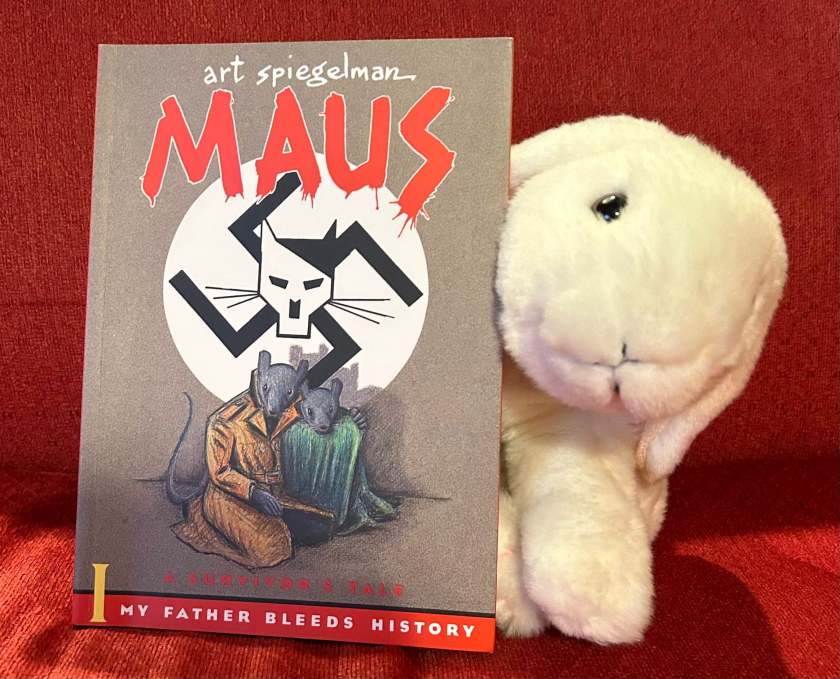
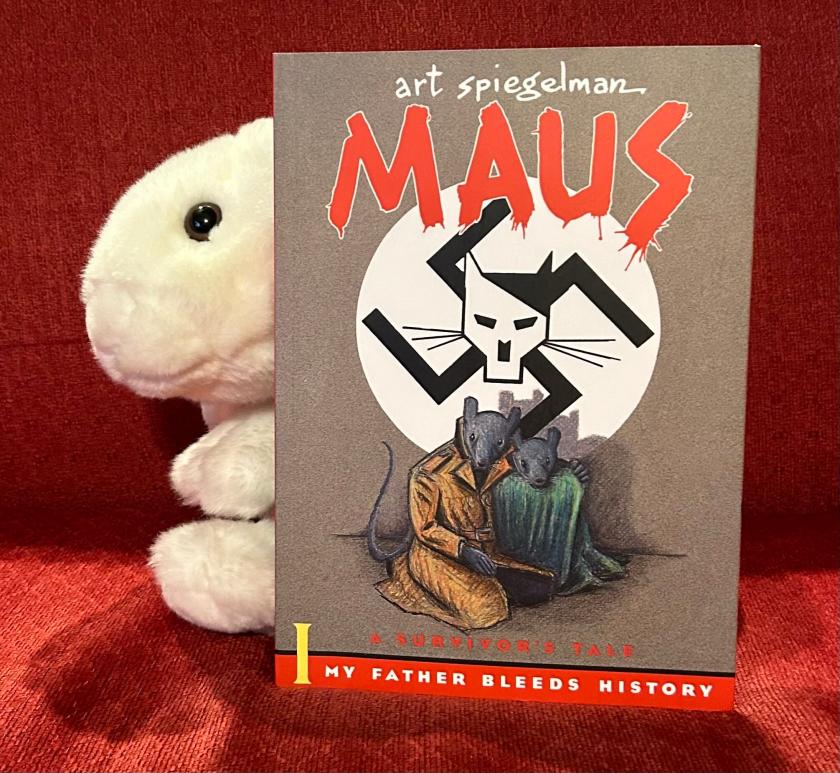
Marshmallow reviews Maus: A Survivor's Tale - I: My Father Bleeds History by Art Spiegelman.
Marshmallow reviews Maus: A Survivor’s Tale – I: My Father Bleeds History by Art Spiegelman.

Sprinkles: So Marshmallow, you chose to talk about a classic graphic novel today.

Marshmallow: Yes, we are talking about Maus: A Survivor’s Tale. This is in fact the first of two volumes, and Art Spiegelman published the second volume in 1991.

S: Okay, thanks for that important note. Wikipedia tells us that this is the first graphic novel that won a Pulitzer Prize. So I am glad you have read it and will talk with me about it.

M: I can see why it would get such an important prize. It is a very important book and it has a very important message.

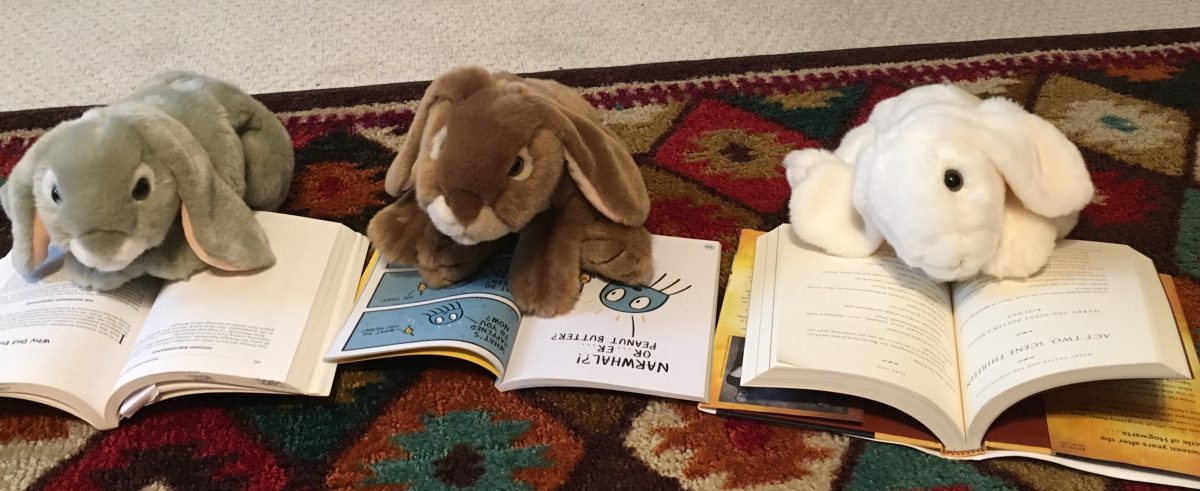
S: Okay, so maybe it is about time to tell our readers what this book is about. They have already seen your photos with it, and they must be wondering.

M: Yes, sure. The book is about the Holocaust, and the imagery in the front cover is basically describing the main metaphorical device used in the story.

S: How so?

M: This is a graphic novel, as we said before, and all characters are animals. There are mice, and those are supposed to be the Jews, and then there are cats. Those are the Nazi Germans. Then there are pigs, who are supposed to be the non-Jewish Poles. And as I said before, the story takes place around the time of the Second World War.

S: I see. When you tell me all this, I am thinking of how sometimes a cat could be playing with a mouse just to have fun and even kill it with no remorse even when it does not need to eat it. I can see how the cat-mouse-pig metaphor could work.

M: Yes. The story is basically about Vladek who is the author’s father, and his experiences before and during the war. Vladek lived in Poland before the war, and when Germany invaded Poland, he and his family continued to live there. For a while they try to survive but eventually they are sent to the Auschwitz concentration camp.

S: That sounds intense!

M: It is. There is also a second story line, which is more or less the present day, or rather around the time this book was first published. The main story is basically the author’s father’s story, and the second story line is about the author as a grownup trying to connect with his father.

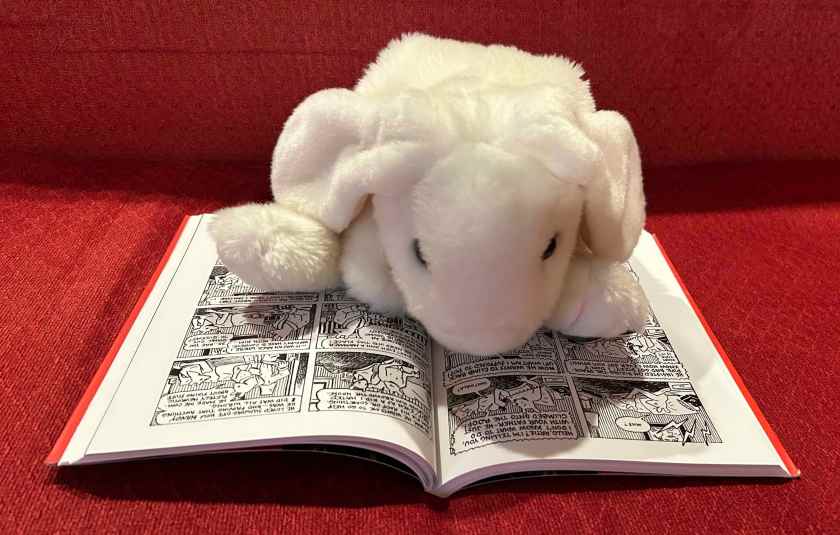
Marshmallow is reading Maus: A Survivor's Tale - I: My Father Bleeds History by Art Spiegelman.
Marshmallow is reading Maus: A Survivor’s Tale – I: My Father Bleeds History by Art Spiegelman.

S: Okay, so now we know the main plot lines and so on, but tell me Marshmallow, how was it like reading such a tough story in graphic novel form?

M: I thought it worked really well. It was very easy to visualize things, even though the characters are mice and cats and so on, because they had already been visualized for you. The book and its visual nature show the undeniably horrific nature of the Holocaust. You fully feel the pain of the mice, and knowing that these events actually happened to people, it makes the whole book even more impactful.

S: I wonder if the harshness of the realities the book is depicting can be related to why some people want to ban this book from school libraries. Some people want us to forget and never talk about these historical events, I am not talking about those people. But even those who believe we should teach this history might think that these stories are too hard to share with young people.

M: I understand why you want us to emphasize that the themes and imagery of the book might be disturbing to very young readers. There is violence in the book. But I also think it is very important for young bunnies to know what happened. And this book does a very good job in telling exactly what happened. And maybe ironically, the use of animal characters allows you to end up seeing the humanity of the victims of the Holocaust very clearly.

S: You make a very good point Marshmallow.

M: Thank you. I also wanted to say the book reminded me of Animal Farm a bit because it shows the worst aspects of humanity under the guise of animals. The animal characters allow us to look at ourselves and see how terrible we truly are or can be. Since we are not seeing humans, we can see things more objectively.

S: That makes sense to me, too, Marshmallow. Okay, this is already a pretty long post. Before we wrap things up, can you tell me how you would rate this book?

M: I’d rate it 100%. It is a striking and impactful book. And I recommend it strongly. It is important for bunnies to understand the magnitude and the impact of these events.

S: Okay, thank you Marshmallow. So last words?

M: Stay tuned for more amazing reviews from the book bunnies!

Marshmallow rates Maus: A Survivor's Tale - I: My Father Bleeds History by Art Spiegelman 100%.
Marshmallow rates Maus: A Survivor’s Tale – I: My Father Bleeds History by Art Spiegelman 100%.

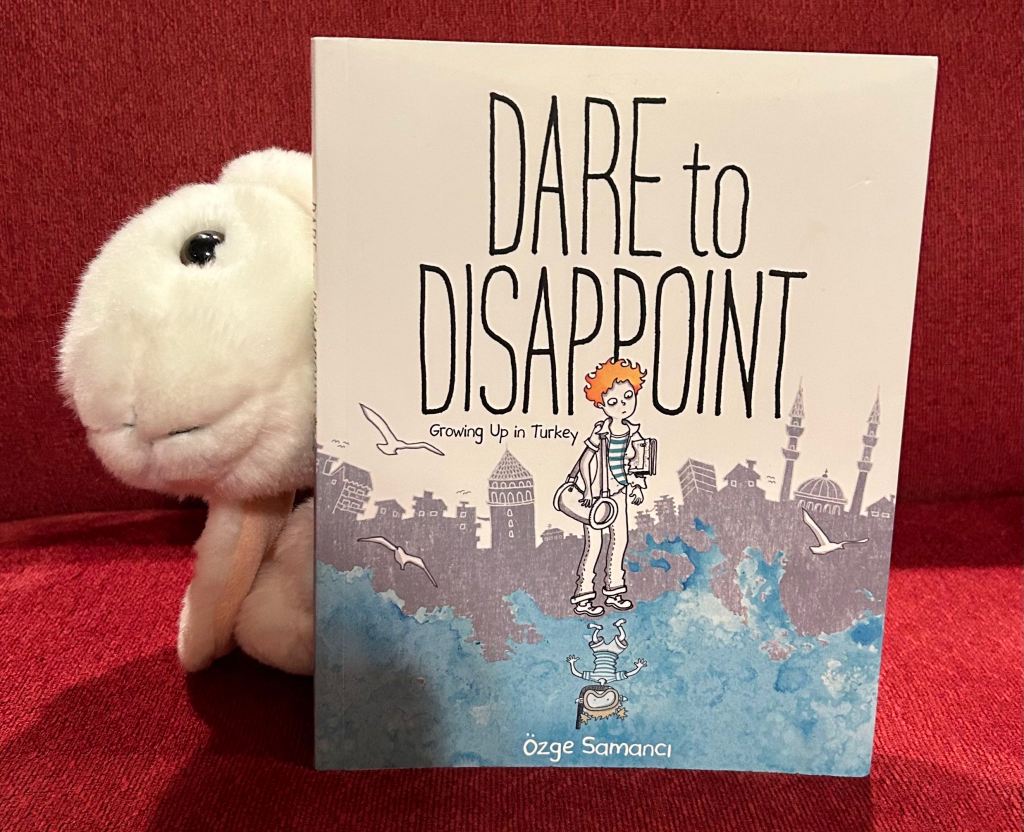
Marshmallow reviews Dare to Disappoint by Özge Samancı

Today Marshmallow reviews the autobiographical graphic novel Dare to Disappoint by Özge Samancı, first published in 2015.

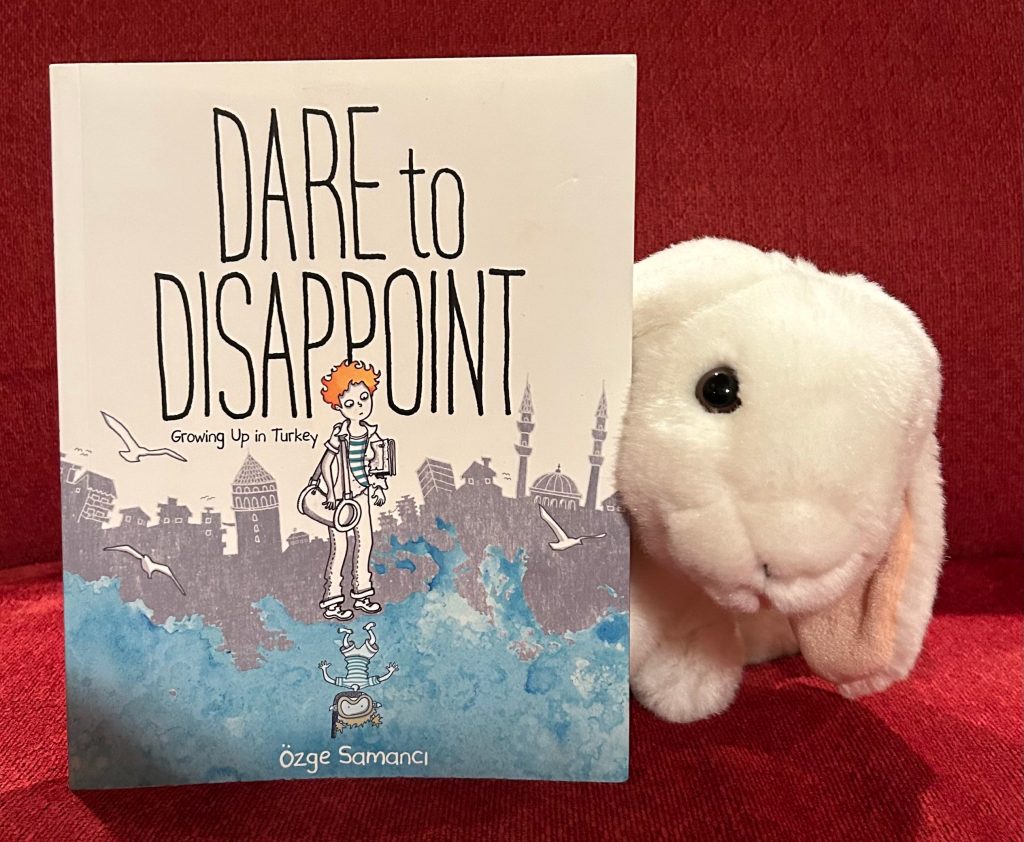
Marshmallow reviews Dare to Disappoint by Özge Samancı.

Marshmallow’s Quick Take: If you like graphic novels or if you enjoy reading books about growing up in general, then this might be the book for you. 

Marshmallow’s Summary (with Spoilers): Özge Samancı grew up in Izmir, Turkey (in late 1970s and early 1980s). Ever since she was very young, she was obsessed with the idea of going to school and loved the school uniforms. Her family’s house was across the street from her older sister’s elementary school, and everyday, Özge and her mother would wave at the sister who was at school. Özge longed to be on the other side, waving back home from behind the school fence. Finally, when she started to go to elementary school, she idolized her first-grade teacher (Turkey did not have a kindergarten grade at the time). But one day, after talking about a bizarre incident on the television, Özge was beaten by her teacher with her pink ruler. Her entire class was punished as well. Özge was confused as to what she or any of her other classmates had done.

As Özge grew older, the political tension in Turkey increasingly impacted her family and her family’s life and lifestyle. Knowing that education was a way for her to gain a steady, stable life, Özge set her mind up to enter a prestigious public high school. She, along with her sister, studied obsessively so they could do well in the test that would determine their high school placement and (practically) the rest of their academic lives.

When she began attending college, Özge found herself drawn to art, theater, and other creative endeavors. However, her father wanted her to study more practical and pragmatic fields like engineering or medicine. Eventually, Özge faced a decision: do what her father wants her to do or live a life of uncertainty on her own terms. Read to find out how she resolved this issue…

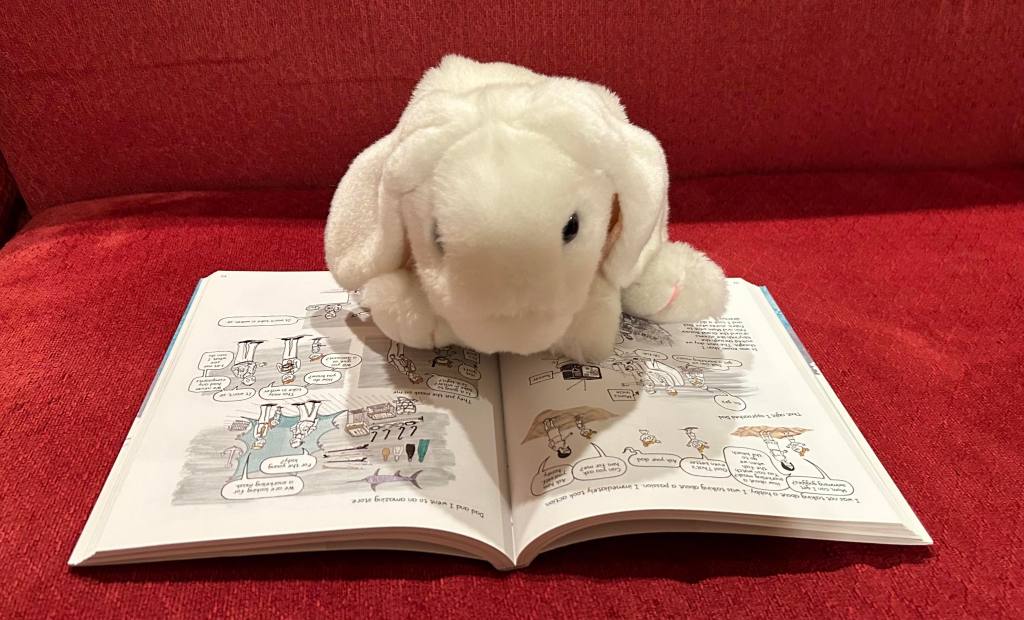
Marshmallow is reading Dare to Disappoint by Özge Samancı.

Marshmallow’s Review: Dare to Disappoint is an interesting and entertaining book. It describes a young person’s search for her own artistic and creative identity in the context of a loving but perhaps somewhat rigid family. It also offers insight as to what life was like for a young child in Turkey in the 1980s. It was especially interesting for me to see the many details of life in a different time and different place than what I have experienced so far.

I liked reading Dare to Disappoint. The author’s voice is down to earth and relatable. The plot and storyline of the book are easy to understand and follow. This is a graphic novel, and the illustrations are really cute, but also detailed and expressive. Color is sparse, but well distributed. Additionally, photos of 3-D objects are inserted and sort of interwoven with the author’s drawings. Today Samancı is a media artist who also teaches at a university. It was cool to read about her earlier life in this format and have the opportunity to learn about her path to finding her own artistic voice.

Though the illustrations are vivid and cute, and the author voice is friendly and accessible, Dare to Disappoint may not be appropriate for very young bunnies. My only concern is that at some point, the author is physically attacked and is almost sexually assaulted, which might be too scary for some younger readers. But other than that, I think that the book tells a beautiful and very personal story, and bunnies of all ages can appreciate the tale of an artist’s childhood and growing up into her own.

Marshmallow’s Rating: 100%. 

Marshmallow rates Dare to Disappoint by Özge Samancı 100%.

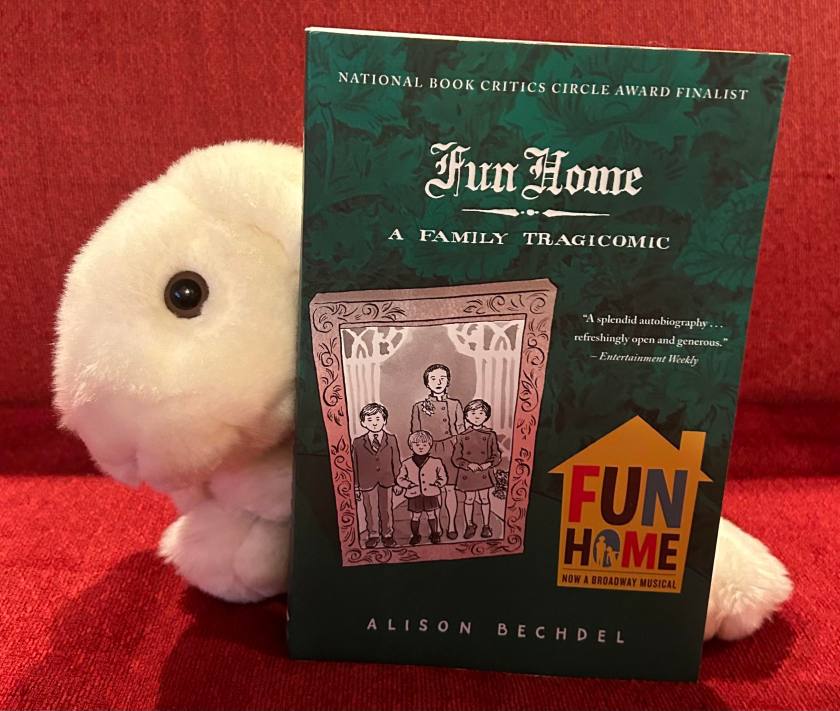
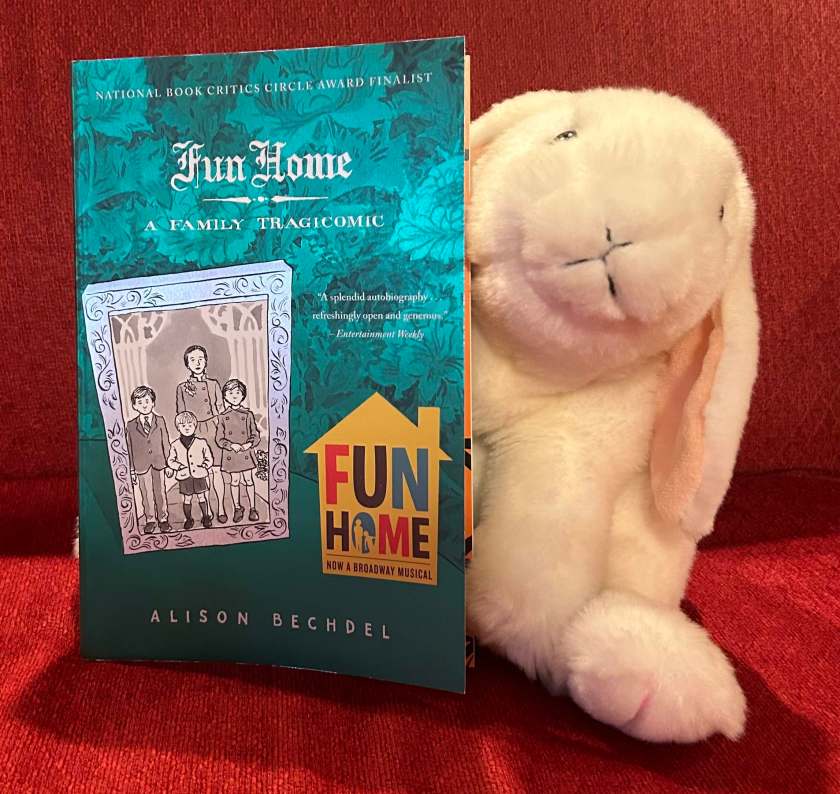
Marshmallow reviews Fun Home by Alison Bechdel

Today Marshmallow reviews Fun Home: A Family Tragicomic by Alison Bechdel, published first in 2006. Sprinkles is taking notes and asking questions.

Marshmallow reviews Fun Home: A Family Tragicomic by Alison Bechdel.

Sprinkles: I know you enjoy reading graphic novels, Marshmallow, so I thought this book might be right up your alley. Let us talk about it. Can you tell our readers first what the book is about?

Marshmallow: The book is about Alison Bechdel herself, who is a cartoon artist. The story is about her growing up and figuring out her sexual orientation and coming out to her parents.

S: That is a pretty serious topic.

M: It is. But it is not all. There is also the fact that her father is also gay, and she eventually figures this out and wants to feel close to him, similar to him.

S: So why is the book called Fun Home?

M: Because her family is running a funeral home, and when they talk of the business, they jokingly call their home the fun home.

S: Is the book funny?

M: I did not think that was the main point of the book. It is essentially a memoir, the artist coming to terms with her sexuality and her family.

S: So the themes seem to me to be more appropriate for older bunnies, would you agree?

M: Yes, probably high school or above. There is some somewhat explicit sexual content, and there is some mention of drug use as well. Caramel wanted to read it too, but I think he might not yet be ready for it.

S: Hmm, I see. Did you know that the book was banned in some places because it was deemed to be immoral?

M: I could imagine. A lot of books about different sexual orientations seem to bother a lot of people.

Marshmallow is reading Fun Home: A Family Tragicomic by Alison Bechdel.

S: Did you know this book was made into a Broadway musical?

M: It says so on the cover of the book. So we looked it up and found some of the songs. It apparently won lots of awards! I also remember that Alison Bechdel appeared in a Simpsons episode we saw recently, the one where Lisa and Marge write a graphic novel called Sad Girl.

S: Yes, that is true. And the Bechdel test was mentioned in that episode, too, do you remember? Do you know what the Bechdel test is?

M: Wikipedia says that it is “a measure of the representation of women in film and other fiction. The test asks whether a work features at least two women who talk to each other about something other than a man. The requirement that the two women be named is sometimes added.” That Simpsons episode talked about that too.

S: It is a neat idea, isn’t it?

M: And kind of sad that it is a thing actually.

S: Agreed. Anyways, back to Fun Home. All in all, I am glad you read this book, and we got to talk about it. It is an important book in many ways.

M: I can appreciate that. But I do think it is not very suitable for young bunnies.

S: I get it. So if you were to rate it what would you rate it as?

M: I’d rate it 90%. It is well written, well drawn, and tells an important story. But it is not quite appropriate for young bunnies, and parents and other adults responsible for young bunnies should read it before sharing with their young ones.

S: Fair enough. So let us wrap up this review. What would you like to tell our readers?

M: Stay tuned for more amazing reviews from the book bunnies!

Marshmallow rates Fun Home: A Family Tragicomic by Alison Bechdel 90%.

Marshmallow reviews Victory. Stand! Raising My Fist for Justice by Tommie Smith

Readers probably already know that Marshmallow enjoys reading graphic novels which are fictional, but she has occasionally also read memoirs or biographies written in graphic novel format and reviewed them for the book bunnies blog. (See, for example, her reviews of They Called Us Enemy by George Takei and The English GI by Jonathan Sandler and Brian Bicknell.) Today she writes about a 2022 book in this genre: Victory. Stand! Raising My Fist for Justice, by Tommie Smith, co-written by Derrick Barnes and illustrated by Dawud Anyabwile.

Marshmallow reviews Victory. Stand! Raising My Fist for Justice, by Tommie Smith, written together with Derrick Barnes and illustrated by Dawud Anyabwile.

Marshmallow’s Quick Take: If you like autobiographies or books about recent history, or if you want to read specifically about one of the consequential events in the history of the Civil Rights and Black Power movements in the United States, then this might be the book for you. 

Marshmallow’s Summary (with Spoilers): Tommie Smith is an American athlete, who is the first person to run 200 meters in under 20 seconds. In this book, Smith shares his experiences and retells the events leading up to and after his famous 1968 Olympics Black Power salute.

The narrative starts by showing the beginning of Smith’s Olympic finals race. Then we are shown his earlier life. As a young child, Tommie and his family were sharecroppers, meaning that they worked on land owned by someone else. Tommie did chores and picked cotton with his family. Even at a young age, Tommie could see injustice. He watched his parents and siblings work so hard everyday, toiling in the sun, while the white family who owned the land had a better, bigger house and did not have to work as much. However, things soon got even worse, and mechanized equipment and the drop in cotton prices took jobs away from sharecroppers. As a result, Tommie and his family moved to a labor camp in Stratford, California. There Tommie began to attend school regularly and “had to make sense of something that made no sense at all”. The white children in his class had several privileges, and the teachers saw them raise their hands, but they never seemed to see Tommie’s.

Everything changed, however, after a momentous race with his sister. Tommie realized that he could achieve anything, and he joined his school’s track team. This led him to becoming a star, winning almost every single competition he entered. By the time he graduated high school, he had accolades in multiple sports and several scholarship offers.

Tommie became a star athlete, and eventually, he made it to the Olympics. But he never lost his sense of justice and equality. He raised his fist at the 1968 Games to protest the racism and the many injustices in the United States at the time. Afterwards, there was a lot of push-back, and Smith faced a lot of difficulties as a result, but also a lot of people felt seen and heard. The book ends in the present, mentioning a few other athletes who have made similar protests after Smith in the intervening years.

Marshmallow is reading Victory. Stand! Raising My Fist for Justice, by Tommie Smith, written together with Derrick Barnes and illustrated by Dawud Anyabwile.

Marshmallow’s Review: I really enjoyed reading Victory. Stand! Raising My Fist for Justice. It is very informative, and I learned a lot that I did not know before. I think it is very important to know and remember such acts of bravery and the people who committed them. 

The drawings are really good. I think that they show movement, especially running, very well. I have reviewed historical graphic novels before, and I appreciated them too, but the drawing style in this one was unique and enjoyable. I also enjoyed the writing style of the author. The writing paired with the drawings made this a really good book overall.

Victory. Stand! Raising My Fist for Justice mentions horrible things that some people have done and has one image that is disturbing. Additionally, it does have some derogatory words. But the message of the book is vital. I think this is a book that every young bunny should read at least once. The story of Tommie Smith’s courageous life and his raised fist is a touching story that gives us hope for the future. 

Marshmallow’s Rating: 100%.

Marshmallow rates Victory. Stand! Raising My Fist for Justice, by Tommie Smith, written together with Derrick Barnes and illustrated by Dawud Anyabwile, 100%.