Marshmallow reviews Night by Elie Wiesel

Today Marshmallow reviews Night by Elie Wiesel, first published in Yiddish in 1956 and in English in 1960. Wiesel won the Nobel Peace Prize in 1986 “for being a messenger to mankind: his message is one of peace, atonement and dignity”.

A small caveat: The book as well as the review below involve historical events that depict harsh realities. They may not be appropriate for younger readers.
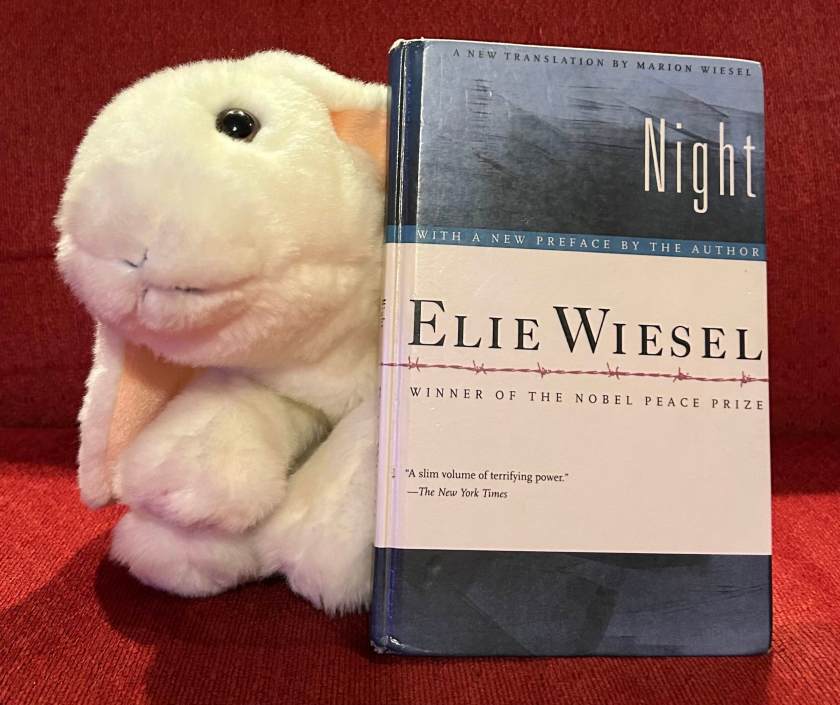
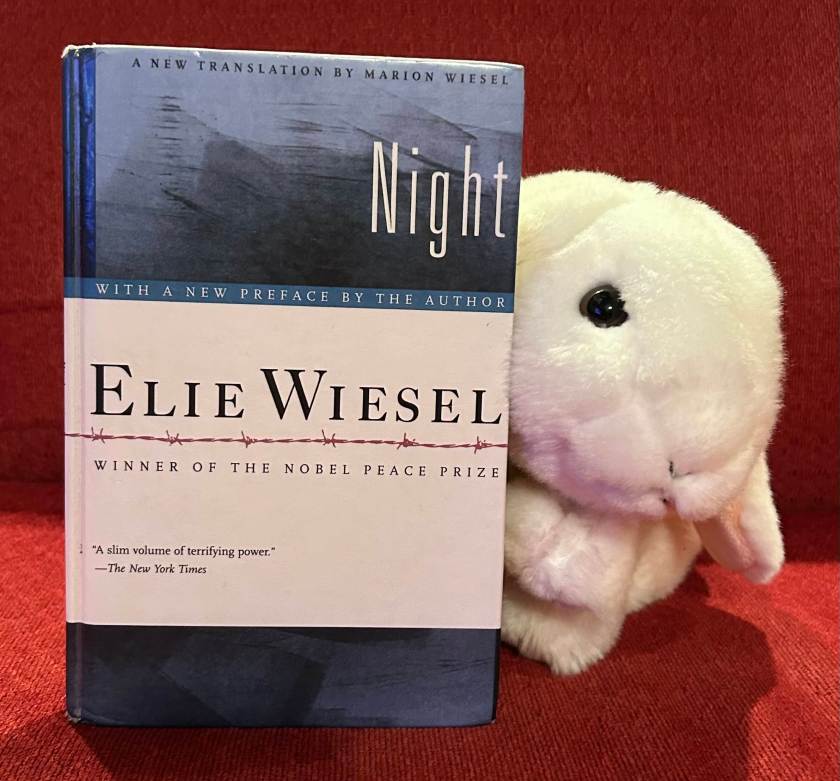
Marshmallow reviews Night by Elie Wiesel.

Marshmallow’s Quick Take: If you are a person of reasonable maturity and ability to process and handle important historical events, then this is the book for you.

Marshmallow’s Summary (with Spoilers): Elie Wiesel was a young Jewish boy in Romania during the Second World War. The book is more or less a memoir of his youth.

Elie is a young boy, extraordinarily devout at a remarkably young age, seeking out a religious mentor in Moishe the Beadle. It is from him that the town of Sighet—located in Transylvania—first hears of the Nazis’ proximity. Since Moishe is a foreign Jew, he is forced to leave first. But he luckily escapes the Nazis who leave him for dead due to his bleeding, shot leg. Moishe walks on foot an unbelievably long journey back to Sighet to warn the very people who look down on him of how dangerous the Nazis are. None of the residents believe him. Elie worries for his mentor, as many adults around him say the Beadle is mad.

Many of the Jews of Sighet do not believe that the Germans could reach them. Others believe that the war would end before Germany’s reach expanded far enough to affect them. It is heartbreaking to say that they are wrong. The Nazis show up on Sighet’s streets within a matter of days.

The Jews are first forced into ghettos, condemned to smaller slums as though they are not deserving of being able to choose where to live. Soon they are forced out of their homes, able to take only what they could carry. They are made to wait on scorching sidewalks and soon after chased towards cattle carts that take them to the concentration camps. Elie and his family, which includes his father Shloma, his mother Sarah, his two older sisters, and his seven-year-old younger sister Tzipora, are taken to Auschwitz. He loses his mother Sarah and Tzipora to the gas chambers and the Nazis on the first day, though he does not know it for certain until later. He and his father are forced into labor camps and the horror continues.

Wiesel’s suffering is conveyed through his own testimony in Night. He and so many others, millions of Jews, Gypsies, and other undesirables in the Nazis’ eyes, suffered so much as the hands of humans who were in all aspects but one the same. This story is one that everyone must read.
Marshmallow is reading Night by Elie Wiesel.

Marshmallow’s Review: This book is simply vital. I think everyone must read it once they are old enough to understand why we must remember. Elie Wiesel is one of the strongest humans to walk this Earth and he is also one of the wisest. Through this book, he passes on the story of the Nazi camps and their horrors designed to exterminate the Jews. He describes things that provoke a deep silence after reading, a deep silence that necessitates thought and great gratitude that one is not in such a situation. Wiesel is a hero by the virtue that he survived. But there are so many who did not and, for their sake and Wiesel’s, this story cannot be forgotten.

Night was assigned as reading in my English class and that is one of the best decisions a teacher can make. This story has impacted so many and Wiesel is truly one of the few people who can be described as a master of prose and a witness of humanity. In words, Wiesel has described the indescribable.

Thanks to Wiesel’s wife Marion who translated it into English for a larger audience, Night is written in simple and clear language, with few ornate embellishments. The horrific events make it seem so already, so Wiesel says things in a way that never makes the story seem unreal.

It is really remarkable and heartbreaking that Wiesel never viewed himself as exceptional. He wonders several times why he survived. He says he was never special or had any sort of skills or attributes that made him deserving of life. But everyone is deserving of life and yet so many were robbed of it. It is truly heartbreaking. Yet, his thoughts and perseverance, his selflessness and his determination (though these words have lost much of their weight and meaning through superfluous use) make him one of the most admirable human beings. He cared unwaveringly for his father though they were both suffering. He never stopped looking after him, even though Wiesel himself thought he failed in this. Wiesel was truly, indescribably a remarkable person with a profound impact. His book Night must be read.

Marshmallow’s Rating: 200%.
Marshmallow rates Night by Elie Wiesel 200%.

Marshmallow reviews Fearless by Lauren Roberts

Last year Marshmallow reviewed Powerless and Reckless by Lauren Roberts, the first two books of her Powerless trilogy. Then earlier this year, she reviewed Powerful, a novella that recounts events taking place in the same story world as the trilogy, involving some of the same characters that we met in those first two books. Today she is finally ready to talk about Fearless, the third and last book of the trilogy that was published just this April.

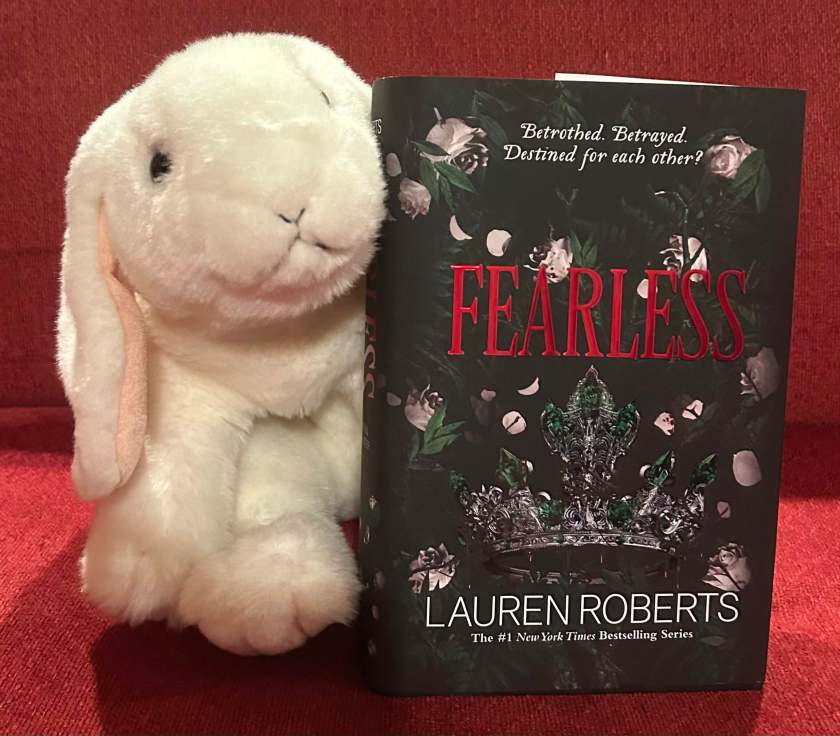
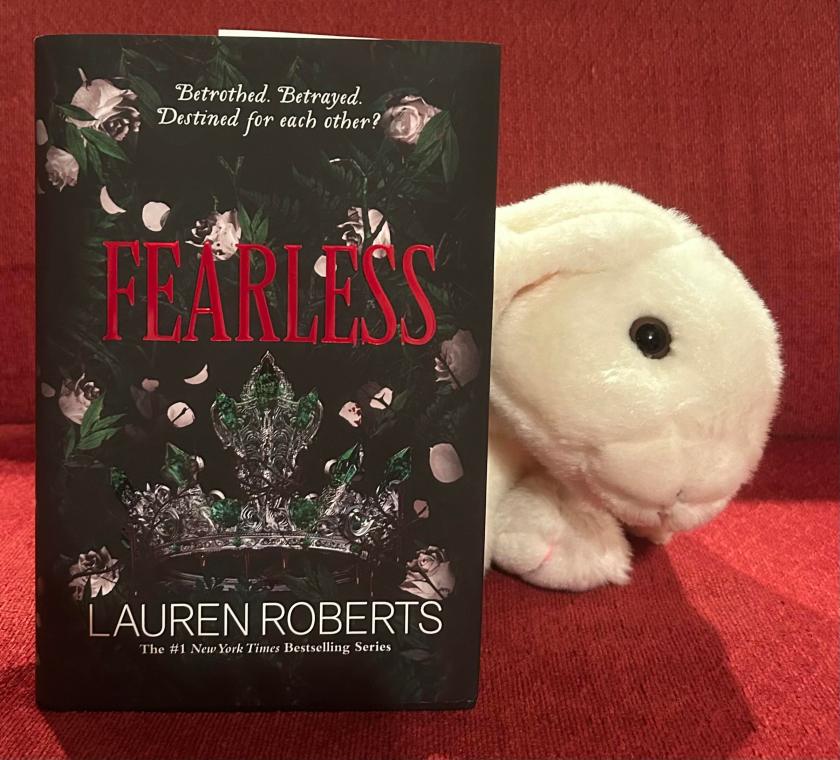
Marshmallow reviews Fearless by Lauren Roberts.

Marshmallow’s Quick Take: If you liked Lauren Roberts’ previous books in her Powerless series, then this is definitely the book for you—though probably you had already been waiting for it!

Marshmallow’s Summary (with Spoilers): [For most of the background, readers should probably begin with my review of the first book, Powerless, and my review of the second book, Reckless.]

At the end of Reckless, Paedyn Gray returns to Ilya as a prisoner believing she is approaching her own execution. Her captor is none other than her beloved Kai, who is bound by duty to bring her to his brother Kitt. However, it turns out that Kitt wanted Paedyn brought back to Ilya so he could propose to her. This is a shocking turn of events since she had killed their father—the king of Ilya—in the first book. (She did have a valid justification of self-defense.) After a while though, Kai has forgiven her. Kitt, on the other hand, seems to be stuck somewhere entirely different from the spectrum of forgiveness and hate.

Paedyn accepts Kitt’s proposal because she believes it will help bring equality in Ilya between the Ordinaries and the Elites. But even though she is now engaged to Kitt, Paedyn finds herself still pining for Kai. Once again, their love seems impossible. But they separately start to realize two things: first, Kitt has changed and no longer seems like himself, and secondly, they cannot be apart. Luckily for them, Kitt has arranged new Trials for Paedyn in order for her to prove herself as an Ordinary to the Elites of Ilya. She must retrieve ancient artifacts, gain the trust of foreign kingdoms, and make the ultimate sacrifice.

I won’t spoil more. But if you thought Roberts’ plot was complex in the first two books, you will be happy to know that the story ends in a most satisfactory way, though with many twists and turns along the way that I never saw coming. Will Paedyn, Kai, and Kitt all make it to their happy ending? Or will one or more get lost along the way?

Marshmallow is reading Fearless by Lauren Roberts.

Marshmallow’s Review: Fearless is a really complicated book that adds a lot of depth to the original story, the fictional world, Ilya’s history, the characters, and the series. Ultimately, the ending is bittersweet, but I can say that things are resolved pretty well. I was not disappointed with the end and I felt like this is probably the best way for the series to end without leaving a majority of the readers bawling with tears in their eyes. That said, it is still touching and emotional. In Fearless, Roberts reveals many layers of Ilya and the entire world that had been previously unseen. These revelations make the end an even more satisfying one because the story becomes a lot richer with detail.

I will say though that I did notice some things were a little too similar to the Hunger Games series to be coincidental. The Purging Trials of Ilya are almost carbon copies of Panem’s Hunger Games, and Paedyn in many aspects seems like a reflection of Katniss. I know a lot of readers are disappointed by these striking parallels. Many have pointed to several other books that Roberts seems to have “taken inspiration from.” I haven’t read all of the books they list, but I can see why some say that some aspects of Roberts’ work are a little suspiciously close to other peoples’ work. However, I found the plot twists in this book unique and these make all the difference. The twists in this third installment were so unexpected yet so well-executed that I could not put the book down till it was done.

I’m a little sad the series is over, and I do wonder if this emotional journey with Paedyn has been beneficial to me. (The series is rough on the tear ducts!) But overall, this was a very well-done conclusion for a very well-done series! Not all fans will be happy, but when have we readers ever agreed on an ending? Overall, I would recommend this third book because I really appreciate how, despite all the darkness in the previous books, it ends on a hopeful note.

Marshmallow’s Rating: 100%.

Marshmallow rates Fearless by Lauren Roberts 100%.

Marshmallow reviews On Tyranny: Graphic Edition by Timothy Snyder and Nora Krug

Today Marshmallow reviews the graphic edition of Timothy Snyder’s On Tyranny, originally published in 2017. The graphic edition was illustrated by Nora Krug and published in 2021.

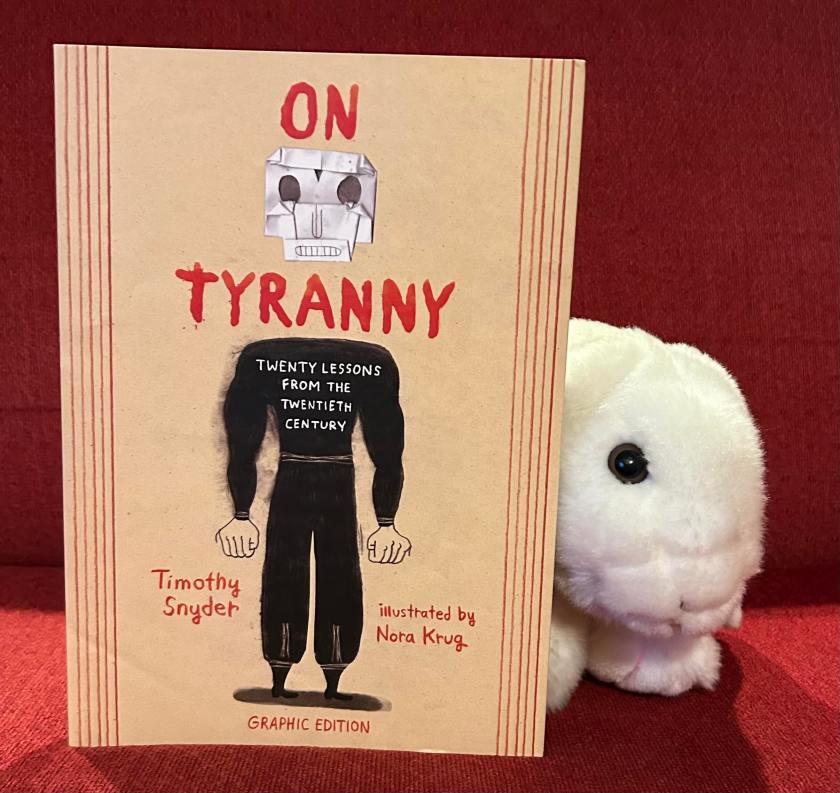
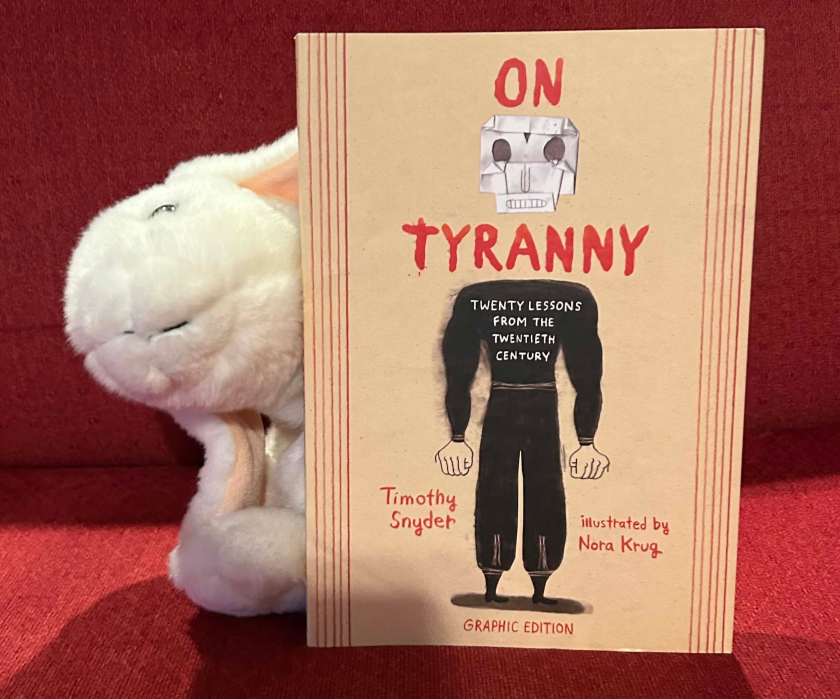
Marshmallow reviews On Tyranny: Graphic Edition, written by Timothy Snyder and illustrated by Nora Krug.

Marshmallow’s Quick Take: If you like reading books about current events and deep ideas about nations and history, then this is the book for you! If not, then this book is for you, too!

Marshmallow’s Summary (with Spoilers): This is a nonfiction book about the titular topic of tyranny. The dictionary defines tyranny as “oppressive power, especially oppressive power exerted by a government” and “a government in which absolute power is vested in a single ruler”. So On Tyranny is about oppressive government structures and how they come to be.

More specifically, the book is divided into twenty main lessons we can learn from the history of the twentieth century. Historian Timothy Snyder dives into what happened—in Europe mostly—during the twentieth century, examining the ways in which those past democracies were systematically replaced by tyrannical, manipulative dictators who seized control of their countries using several tactics some leaders are using today. Because I think these lessons are of utmost importance, I’ll put them here on this post for those who don’t plan on purchasing the book:

“Do not obey in advance. Defend institutions. Beware the one-party state. Take responsibility for the face of the world. Remember professional ethics. Be wary of paramilitaries. Be reflective if you must be armed. Stand out. Be kind to our language. Believe in truth. Investigate. Make eye contact and small talk. Practice corporeal politics. Establish a private life. Contribute to good causes. Learn from peers in other countries. Listen for dangerous words. Be calm when the unthinkable arrives. Be a patriot. Be as courageous as you can.”

Now, it’s simple to read these simple-sounding phrases and think, “I just learned everything this book has to offer.” But I cannot think of another book that I believe should be read more than this one. I think this book should be mandatory reading because it is an instruction manual for how to protect democratic governments. Democracy is the best way for peoples to govern themselves, but it can be vulnerable; it needs to be protected from enemies within and outside the borders of any nation that wishes to uphold democratic institutions.

The ideals of democracy, the book’s author conveys, are things that cannot be taken for granted. The people must be able to think for themselves, ask questions, and know when those in power are starting to sound a little too much like the tyrants in the history books. This book uses quotes, stories, facts, and nuanced, yet time-tested ideas to compellingly create the ultimate survival guide for a democratic nation. Telling us exactly what the downfall of a democracy would look like, this book offers its readers ways to prevent such an end. 

Marshmallow is reading On Tyranny: Graphic Edition, written by Timothy Snyder and illustrated by Nora Krug.

Marshmallow’s Review: In case you couldn’t tell from my little sermon above, I should explicitly write out that I think this book needs to be read by any and every person who is a part of a modern society today. The book is a timely warning and a critical manifesto that we all need to read, now more than ever.

As one of the wisest humans I know once said, “Nothing in this world is free. Freedom is not free.” We all have a responsibility to protect the blessings that liberal democracy has given us. Various forces are trying to tear democratic nations apart and rebuild them into their own image, Frankenstein-like and through fear. This book looks at history and pulls from what happened in the past to show us how people were manipulated into submission so today’s people don’t fall for the same tricks.

The book is definitely written with an American perspective, and I expect that there will be some who disagree with the author’s political views on contemporary U.S. politics. However, the history presented is still relevant, to each and every one of us living today. We all need to know what mistakes people like us made when they thought nothing bad could happen in their country. We need to understand their mistakes to recognize when we might be about to make our own. 

As is natural for all young bunnies, I love my country. If you love your country, too, then read this book so you know how to protect it.

Marshmallow’s Rating: 100%.

Marshmallow rates On Tyranny: Graphic Edition, written by Timothy Snyder and illustrated by Nora Krug 100%.

Marshmallow reviews The 50 States by Kana Kavon

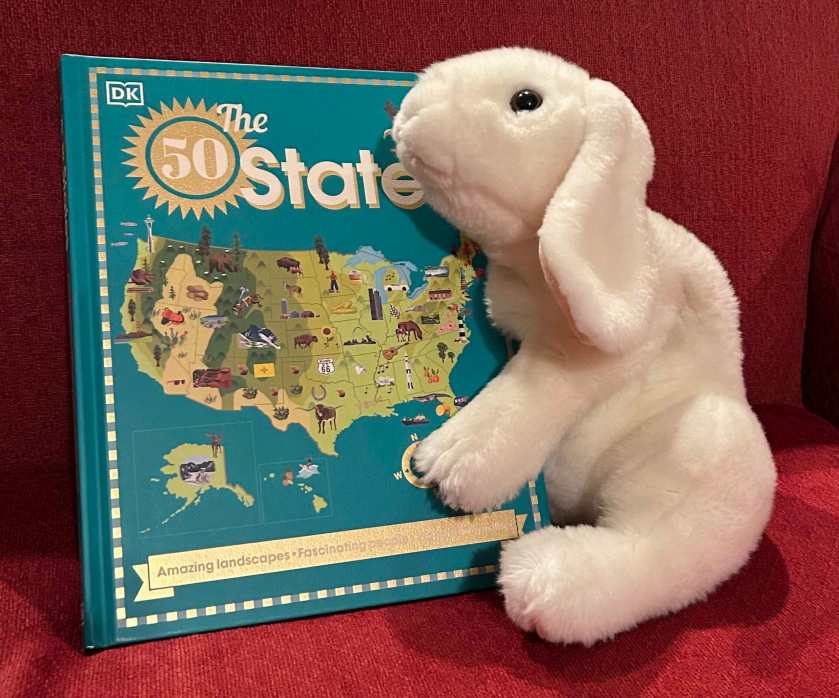
Today Marshmallow reviews a beautiful large-format book, The 50 States by Kana Kavon, first published in 2021.

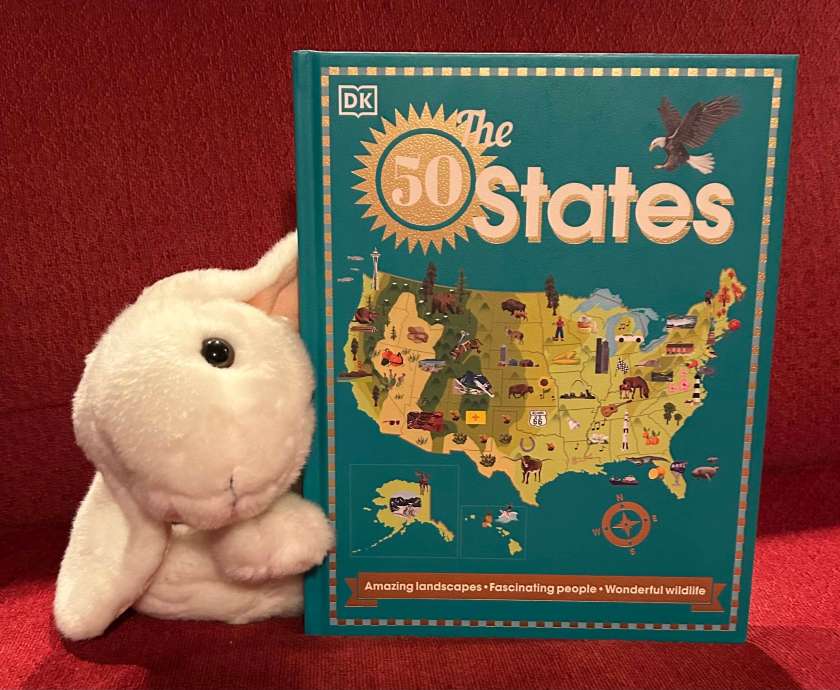
Marshmallow reviews The 50 States by Kana Kavon.

Marshmallow’s Quick Take: If you like books with beautiful images and illustrations with fascinating facts, then this is the book for you!

Marshmallow’s Summary (with Spoilers): Given the title, one could likely assume that this book is about the fifty states of the United States of America. And it is exactly that, but also so much more! There are seven sections which divide the states—and territories—up by their geographical location. They are as follows: the Northeast, the Southeast, the Midwest, the Southwest, the West, Noncontiguous States, and U.S. Territories. The Table of Contents itself hints that this book will be full of very aesthetically-pleasing visuals like drawings and photos! There are so many amazing, astonishing images of the natural beauty of the U.S. and almost every page (if not every page) has one such photo. There are also unique facts about state and territory that helps introduce the reader to each one. Every state has a two-page spread, and every territory has about one page. All are like collages with drawings and photos layered in a manner that is easy to absorb and understand for the reader. The state animal and the state flower for every state are shown, and cool historical tales are described. For example, did you know that the first Black, female millionaire (named Madame C. J. Walker) was an entrepreneur based in Indiana? I didn’t…until I read this book!

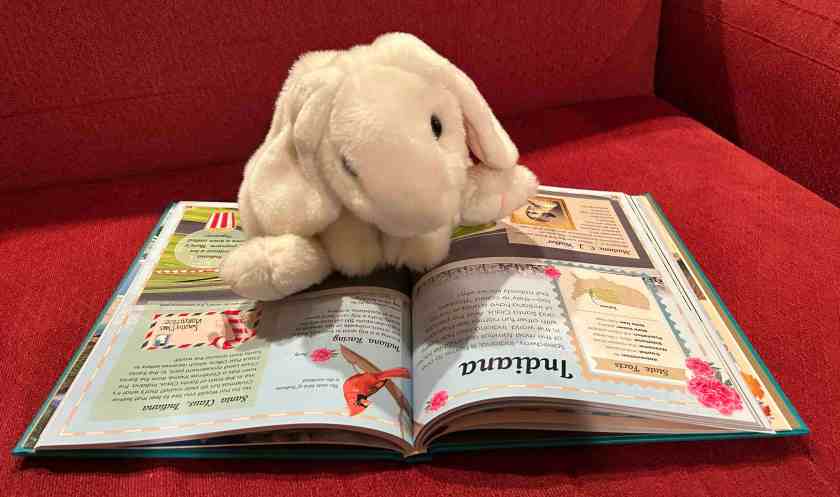
Marshmallow is reading The 50 States by Kana Kavon.

Marshmallow’s Review: I really loved reading this book! It is beautifully written with simplicity and clarity. But it is also beautifully designed and decorated! I found it very calming to read and also very eye-opening. I never knew how unique each state is. They all have their own character, their own history, and their own quirks that make American history even richer. I especially loved the images of the natural beauty found in each state. Being from only one, I’ve only ever been most able to appreciate the beauty of one. But this book showed me how there is beauty to be seen and appreciated in each and every state and territory. It was really nice that the territories were included as well, and the way each grouping of the states / territories was labelled by geography helped me place them better on a mental map.

I think books like these are eye-opening and help humanize people. During a time of unprecedented polarization, tensions between the American people are higher than ever. State lines have begun literally dividing us as a populace and animosity is growing as states become identified solely by which way they vote. This book helps show us that every state has something beautiful to offer to the great American Experiment and that is something we all need to appreciate in order to truly be able to come together as one indivisible nation with freedom and justice for all.

Marshmallow’s Rating: 100%

Marshmallow rates The 50 States by Kana Kavon 100%.