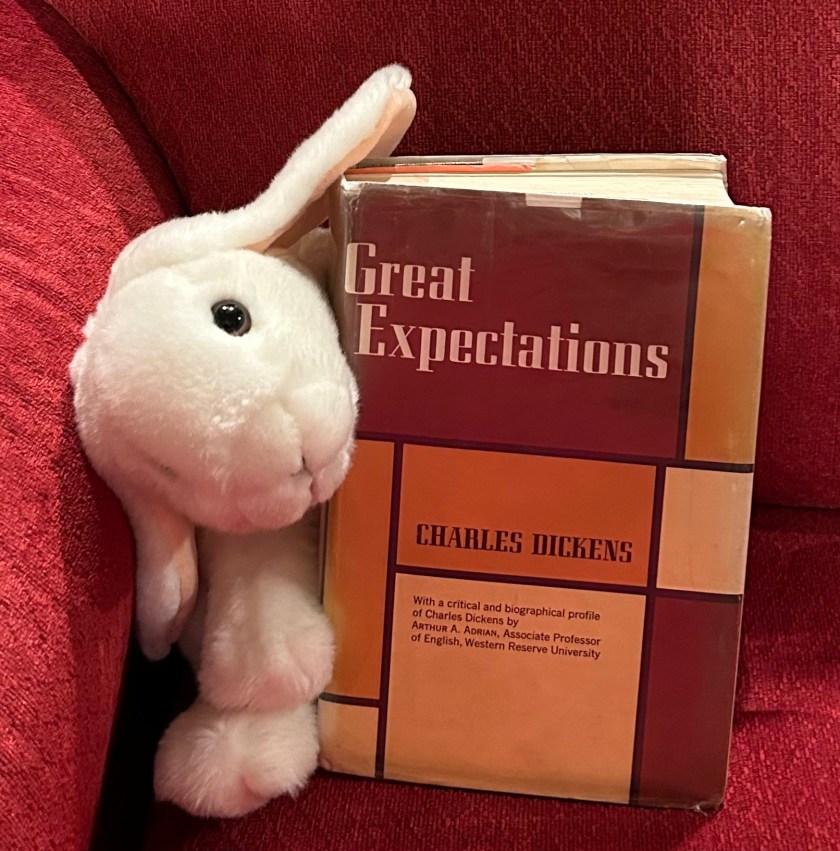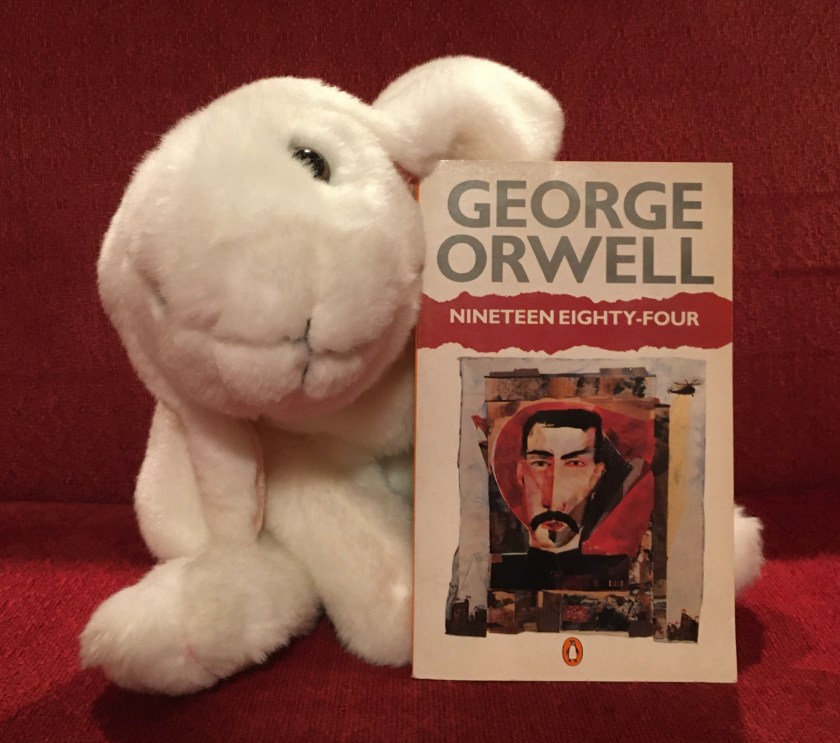
Marshmallow reviews Nineteen Eighty-Four by George Orwell

Last week while talking about Flowers for Algernon, Marshmallow and Sprinkles touched upon a book by George Orwell, Nineteen Eighty-Four, first published in 1949. This week, Marshmallow thought it might be a good idea if they picked up this book on its own and chatted a bit about it together.

Marshmallow reviews Nineteen Eighty-Four by George Orwell.

Sprinkles: So Marshmallow let us start with a quick recap of the book.

Marshmallow: Okay. Winston Smith, the main character of the book, lives in this weird futuristic world. The year is 1984, but even though 1984 is a long time ago for us today, it was a long time in the future when the book was written. The world Smith lives in is controlled by a government, run by the Party, which has several departments with contradictory names. For example there is the Ministry of Peace which deals with war. The Ministry of Truth deals with information and basically propaganda and the brainwashing of the population. And there is a Ministry of Love and a Ministry of Plenty.

S: I remember the Ministry of Truth and the Ministry of Peace, but I did not remember the Ministry of Plenty and the Ministry of Love. What do they do?

M: Ministry of Plenty deals with economic affairs, and the Ministry of Love deals with law and order.

S: Oh, yes, now I remember the Ministry of Love, of course. It involves the citizens’ love of Big Brother.

M: Yes, it seems that is the main goal of all punishment. It is creepy; everywhere the people are reminded that the Big Brother is watching them.

S: That phrase has now taken on a life of its own; people use the Big Brother to talk about government surveillance, and sometimes even corporate surveillance.

M: Yes, you even have a poster that says “Big Brother Is Watching You” in your office.

S: I think it is a good reminder. Even though we are not living in Winston Smith’s world of Oceania, I think it is always a good idea to remember that everything you do can be tracked, especially these days, especially if you are doing anything online.

M: Sounds a bit paranoid, no?

S: Well, I don’t really mean it quite that way. I mean it is always a good idea to think about what bread crumbs you leave for people out there. And it can always be worse, of course. There are many places in the world today, and there have been many societies throughout the world in all its history, where saying things and doing things that the governing people did not approve of would be met with harsh retaliation. We are quite lucky that we are not living in such a system, but it is always good to keep in mind what could have been or what could eventually come to happen.

M: I guess that is why George Orwell wrote this book, right? To warn us?

S: I think so. He was very concerned about the rise of the totalitarian Soviet regime and wanted to describe what could be its ultimate end point.

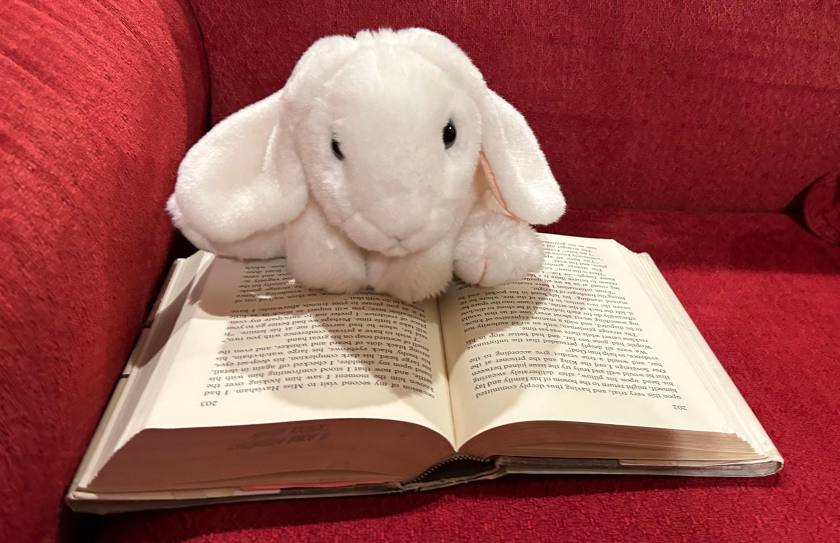
Marshmallow is reading Nineteen Eighty-Four by George Orwell.

M: In that way, this book does relate to Orwell’s other book that I reviewed for the blog, Animal Farm. That book, too, was a warning in some ways.

S: I agree. But would you want to open that up a bit?

M: That book was about how power corrupts and how governments can fail to represent their constituents’ needs when they are overtaken by ambitious individuals who manipulate the public to their own advantage. Here, too, power shows up. The Party is very much interested in staying in power. In fact that is part of Winston Smith’s job. At the beginning of the book, he is working at the Ministry of Truth and his job is to change the history and the complete record of things when the Party decides to support an alternative interpretation of the facts or sometimes even alternative facts.

S: That phrase has become quite famous these days too. Right?

M: That’s true! But I am also intrigued by the Party. We don’t ever really know what the Party is. And it is not even clear if there is a rebellious faction or if there is any other country out there, or anything else, any other possibility for the people in this world.

S: The Party’s rule is so complete, isn’t it? When I read this book for the first time, I was flabbergasted by the very end. It shook me, and I could not get over it for a while. I guess the total in totalitarian is real.

M: The thing that really got to me is that everything all goes back to the Party, even the illegal activities seem to be led and facilitated and controlled and crushed by the Party as the Party finds fit. It is so weird.

S: No way out. That is how I felt.

M: Yes, it was pretty hopeless. The overwhelming feeling I got was that if you find yourself in this situation, there is no way of getting out.

S: I guess Orwell wanted to warn us that such a future could happen, and once it did, there would be no way out, so we’d better not get ourselves to that point.

M: Makes sense to me.

S: So having read two of his most famous books, which of Orwell’s two books do you like more?

M: I still like Animal Farm more. I especially liked the fable nature of it. It seems to be about these farm animals, but it is so clearly about humans! And it also showed how even though the animals had good intentions at the beginning, they slowly went astray, in small steps. You could see the development, and it was very depressing, too, but you could see the steps that led them astray and you could see the end result would be pretty terrible. Having read Nineteen Eighty-Four, I think it is basically the end result of Animal Farm.

S: It is also a lot shorter and perhaps a bit easier, right? So would you recommend other bunnies to read either of the books?

M: I think both of them are books everyone should read. They are both heavy, but they point to very important issues. So I’d say to all bunnies that they should read both of the books. Not to depress yourself, but to start seeing possibilities and to try and avoid them. There is some sexual relation stuff in Nineteen Eighty-Four, as we spoke about in my review of Flowers for Algernon (though not as much as there was in that book), so perhaps Animal Farm is more appropriate for younger bunnies. And as you say, that book is shorter than this one, so it would be easier to read for that reason, too.

S: I tend to agree with you Marshmallow. I think we have said enough for one review today. As we wrap it up, tell us how you would rate this book.

M: I’d rate it 95%. Very good book, left me quite disturbed in the end.

S: And what else would you like to say to our readers?

M: Stay tuned for more amazing reviews from the book bunnies!

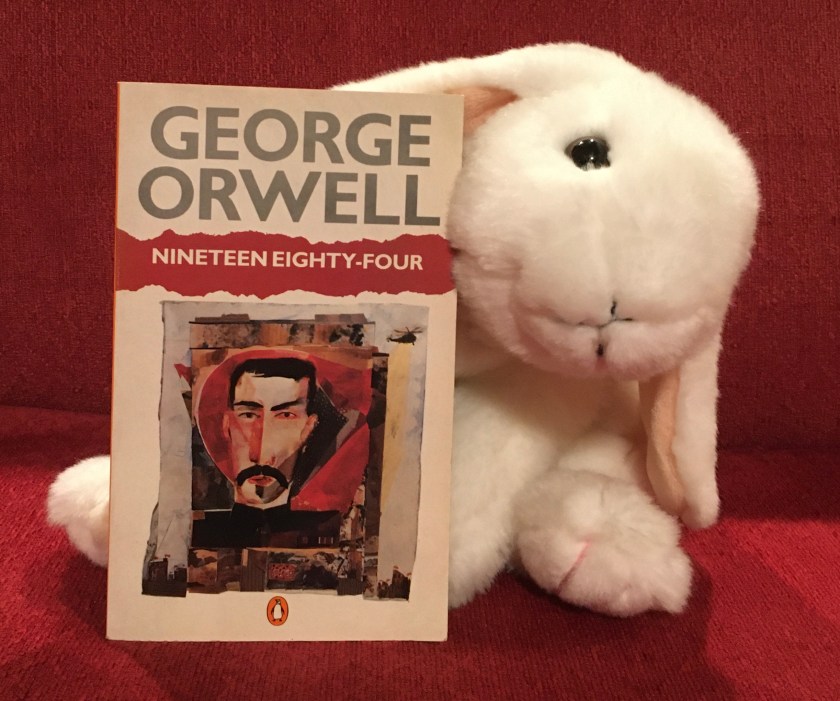
Marshmallow rates Nineteen Eighty-Four by George Orwell 95%.

Marshmallow reviews Flowers for Algernon by Daniel Keyes

In the last few weeks, Marshmallow and her English class have been reading a version of the classic novel Flowers for Algernon by Daniel Keyes, first published as a short story in 1959 and then expanded by its author to be published as a full novel in 1966. Sprinkles was excited to see Marshmallow getting into the story because she remembers it fondly from her own time reading the same book in school decades ago. In the blog post below, the two bunnies discuss the full book.

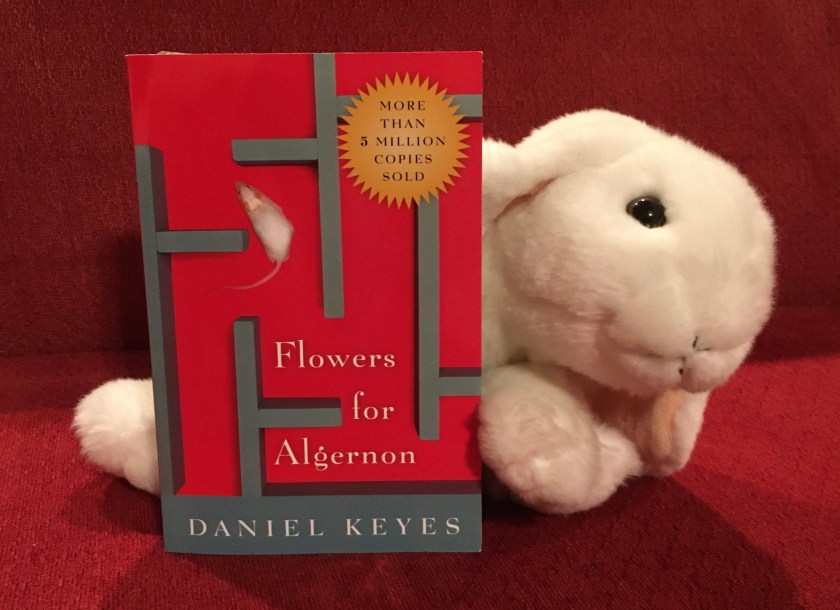
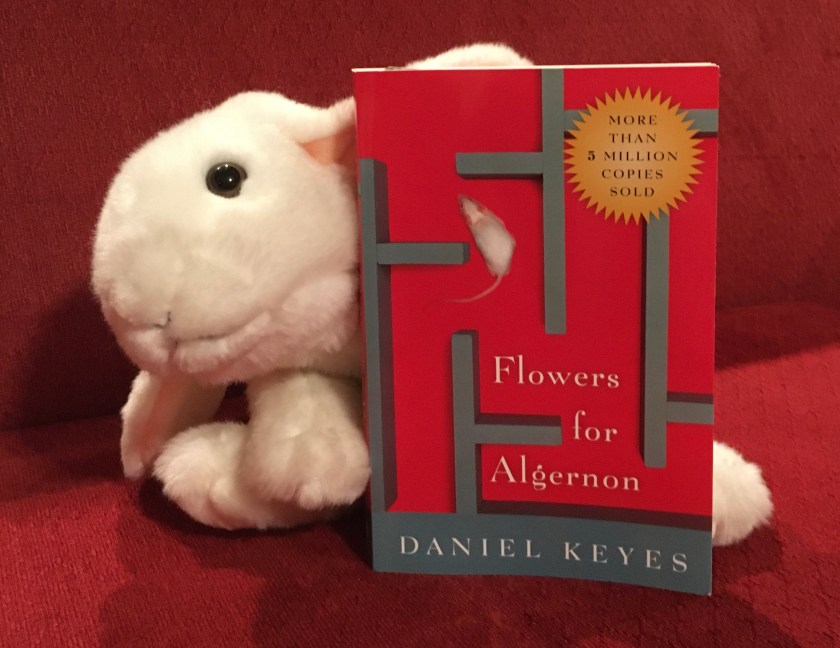
Marshmallow reviews Flowers for Algernon by Daniel Keyes.

Sprinkles: So Marshmallow, why don’t we start with your usual short overview of the book?

Marshmallow: Why not? If you like books about growing up or living through a big change, this might be the book for you.

S: I think that is a good way to describe the book. The main character is originally a mentally challenged adult, so he is not really growing up, but he undergoes an experimental treatment which enhances his mental capabilities immensely, and so he is going through a big change.

M: Yes. The main character is Charlie Gordon, and he is the one narrating the story. The book is written as a series of progress reports, all through his perspective.

S: Yes, the entries are like diary entries, right?

M: Yes, most of them. And at the beginning he is using very simple sentences and basic words and sometimes has very poor spelling. As the treatment takes effect, he begins to write more complex sentences and use bigger words. He also starts to write about more personal and complicated things and has to confront some past emotional trauma. So, for example, I should warn all bunnies that the book does have some explicit descriptions of certain sexual feelings and acts. As Charlie gets more and more mentally capable, he begins to notice his attraction to women.

S: Even before the operation, he might have felt some such feelings, but would perhaps not write about them?

M: I’m not sure. It seems to me that Charlie had the mind of a three year old before the operation, and so he did not have any sexual impulses.

S: Hmm, that sounds somewhat unrealistic to me, given that he has the body of a full-grown man; his hormones and related needs and desires would probably be quite typical.

M: Well, I don’t know, but he seems to become more interested in things like that, and that was quite a bit different from the version we have been reading at school. In that version, we do not see any of this stuff. Which is in some ways easier to read.

S: I can understand that. Perhaps that is why a lot of school districts have had discussions about this book, and apparently some have even removed it from their libraries. The sexual content might be a lot for some younger bunnies to handle, even though I was not bothered by them when I was a young bunny reading the book. Then again, I might have been a little older than you… Or who knows? Maybe I read an abridged version, too, and I do not recall very well.

M: Maybe. I don’t know. But the full book is a bit more adult than my usual reading fare. The only other book I have read that is kind of like this one is 1984 by George Orwell, which also had some explicit scenes.

S: I understand. I’d say that both books have very serious messages, and the sexually explicit scenes in both books play significant roles in clarifying those messages. So for example in 1984, the sexual scenes show us the main character’s difficulties with intimacy and the oppressiveness of the general climate. In this book, I think the sexual scenes are a part of Charlie becoming more aware of his body, his personality, his needs and desires, as well as how the outside world views him.

M: I can see that.

Marshmallow is reading Flowers for Algernon by Daniel Keyes.

S: So who or what is Algernon? Why is the book titled Flowers for Algernon?

M: Algernon is a mouse. He has gone through the same operation that Charlie has, and in some ways, the changes he goes through are similar to what happens to Charlie. So Charlie begins to really like and care for Algernon, because Algernon is more or less the only other creature in the world who is going through the same thing that Charlie is. And then —

S: Wait, don’t give everything away!

M: Okay, no more spoilers. But things do get pretty sad, and the title of the book is in the very last sentence of the book.

S: Yes, that is true. What did you think of Charlie? Did you like him or sympathize with him?

M: I liked him, more at some times and less at others. He is a childlike and kind person at the beginning, and that I really liked. But then as the operation takes effect and he begins to get more and more intelligent, he becomes more arrogant and he does not even realize that. I did not like him that much then. But eventually he does begin to understand other people better, and he remembers and tries to process some of the emotional trauma from his childhood. He justifiably gets angry at some people who mistreated him when he did not know they were being mean. And there I could of course sympathize with him. And he wants to be accepted most of all.

S: I guess that is a very understandable need. We are social creatures and we want to belong.

M: Yes. I think so. So when he becomes too intelligent, that is also isolating. Certain people used to feel better about themselves by putting him down, but now they feel inferior to him and begin to fear and avoid him. In some ways, those people were not good people to have as friends anyways, but Charlie did not know. In any case, in the end —

S: Wait, remember, we don’t want to be giving away too much…

M: Hmm, okay, I guess I should stop here.

S: Alright. Let us do that. Would you recommend this book to other young bunnies? Or perhaps, you’d recommend the abridged version?

M: I think young bunnies might really like the abridged version. Charlie’s story is a lot simpler in it and it is a lot easier to read. And you get to really like him and feel for him, and and the story is still sad but beautiful.

S: Okay. That makes sense to me. Full-blown people are all pretty complex, and I think the original book captures that really well. Charlie is a complex person with a complex story, and the book does give us a lot more to chew on. But the main message can come through quite clearly in the abridged version, too, without the distractions of the sex dimension and the emotional trauma. So how do you want to end this review?

M: I can say my usual: Stay tuned for more amazing reviews from the book bunnies!

Marshmallow appreciated reading Flowers for Algernon by Daniel Keyes and recommends it to her peers but emphasizes that perhaps some might prefer an abridged version.

Marshmallow reviews The Final Gambit by Jennifer Lynn Barnes

Marshmallow has already reviewed the first two books of the Inheritance Games trilogy of Jennifer Lynn Barnes. Today she reviews The Final Gambit, the third and final book of the series that was just published at the end of this August.

You might like to check out Marshmallow’s reviews of The Inheritance Games (2020), the first book, and The Hawthorne Legacy (2021), the second book, before you move on with this review.

Marshmallow reviews The Final Gambit by Jennifer Lynn Barnes.

Marshmallow’s Quick Take: If you like books about mystery, family secrets and / or romance, then this might be the book for you. 

Marshmallow’s Summary (with Spoilers): Around a year ago, Avery Kylie Grambs was left billions of dollars in the will of a very wealthy man named Tobias Hawthorne. Tobias Hawthorne was very fond of riddles, puzzles, games, and pretty much everything that requires investigation and deep thought. Even after he died, this did not change. Post-mortem, Tobias has been vexing Avery and her friends in a series of mysteries and puzzles he left Avery and his family.

Mr. Hawthorne had two daughters and four grandsons (all from his youngest daughter who planned to have the inheritance go to her children). In previous books, it was discovered that Tobias wished Avery and his grandsons to find and bring his supposedly dead son (Toby) back to the Hawthorne family. However, this was complicated significantly by the fact that Avery still did not know why she was chosen to inherit this fortune. Additionally, an invisible enemy seemed to be attacking her from everywhere and also has captured Toby.

In The Hawthorne Legacy, the second book of this trilogy, Avery believed that Toby was her father. However, in the end of that book, we learned that she is not. We also learned that he nonetheless did have a daughter named Eve. In The Final Gambit, we meet Eve. And Avery meeting Eve causes the start of a brand new puzzle set up by Tobias Hawthorne. This time, the stakes are higher. This will be the final countdown and we will finally see whether or not Avery can finalize the transaction of inheritance.

Marshmallow is reading The Final Gambit by Jennifer Lynn Barnes.

Marshmallow’s Review: The Final Gambit is a fascinating read! And I was very glad that I finally learned why Avery was chosen. (No spoilers!) The book is well written and the mystery is resolved satisfactorily, but you do have to wait till the end.

Overall, the three books make a great trilogy. I do think you would need the first two books to make any sense of this third one. But the books are quite easy to read quickly, because all chapters are very short and the twists and turns the mystery takes make you want to keep reading on.

On a different note, this is definitely written for young adults. There is a lot of romance, and this third book gets a lot more mature in terms of a lot of kissing / making out, and the occurrence of some sexual acts may or may not have been hinted at. I would recommend this book for bunnies 14 and up, and if a bunny is younger than that, then that said bunny’s parents might want to read the book first and decide if it is for them.

Marshmallow’s Rating: 95%.

Marshmallow rates The Final Gambit by Jennifer Lynn Barnes 95%.

Marshmallow reviews The Hawthorne Legacy by Jennifer Lynn Barnes

Almost a year ago, Marshmallow reviewed The Inheritance Games by Jennifer Lynn Barnes, the first of a mystery trilogy about a high school student, Avery Kylie Grambs, who inherits a large sum of money unexpectedly and has to deal with the consequences. This week, Marshmallow has finally read the second book, The Hawthorne Legacy (2021), and shares her thoughts on it here, before diving into the third and final book of the series, which was just published at the end of this past August.

Marshmallow reviews The Hawthorne Legacy by Jennifer Lynn Barnes.

Marshmallow’s Quick Take: If you like books about mystery, family secrets, and / or romance, then this might be the book for you. 

Marshmallow’s Summary (with Spoilers): Avery Kylie Grambs used to live in her car, but after one of the richest men in America (Tobias Hawthorne) left her his fortune, she is now practically America’s richest teenager. However, she legally doesn’t receive the fortune until she lives in the Hawthorne Mansion for a year. Unfortunately, several people would be very happy if she didn’t get the fortune or “expired” before the year ended.

The main question is why Tobias Hawthorne left his fortune to Avery who seems to be completely unrelated to him, when he has two daughters and four grandsons, to whom he left very little. At the end of the first book, The Inheritance Games, Avery had found enough clues to believe that Tobias’ son Toby, who supposedly died in a fire, is still alive and that she had to find him. In this book however, we learn, along with Avery, that the truth is a lot more complicated. To find out why she was left the money, Avery needs to find out who Toby was, what he did, and where he is now. And to do this, she must first learn who she really is. 

Marshmallow is reading The Hawthorne Legacy by Jennifer Lynn Barnes.

Marshmallow’s Review: I found this to be a fascinating book. I really wanted to find out why the money was left to Avery, but apparently we will all need to wait until the next book, The Last Gambit, to find out. Still The Hawthorne Legacy was a fun and exciting read, and I enjoyed it a lot. I really liked all of the twists and turns in the plot. This is one of the best mysteries I’ve read, and I still have no idea why the fortune was left to Avery. I look forward to reading the next book of the series. 

The main character Avery, like many young adult novel characters, struggles with her love life and feelings, which causes issues for her. Relatedly, I felt that The Hawthorne Legacy had much more adult details than the first book in the series. This book, like the School for Good and Evil series, is written for older (teen?) audiences. I would say that this is probably best for 14 and up. And I would suggest that parents of younger bunnies might want to read it first to gauge whether they think the book is suitable for them.

Marshmallow’s Rating: 95%. 

Marshmallow rates The Hawthorne Legacy by Jennifer Lynn Barnes 95%.