Marshmallow reviews The Hunger Games: The Illustrated Edition by Suzanne Collins and Nico Delort

Marshmallow has read and reviewed all three books making up the Hunger Games trilogy by Suzanne Collins. This week she was excited to get her paws on the new and illustrated edition of the first book: The Hunger Games: The Illustrated Edition. Sprinkles is taking notes and asking questions.

[You can check out Marshmallow’s reviews of the three Hunger Games books here: The Hunger Games, Catching Fire, Mockingjay.]
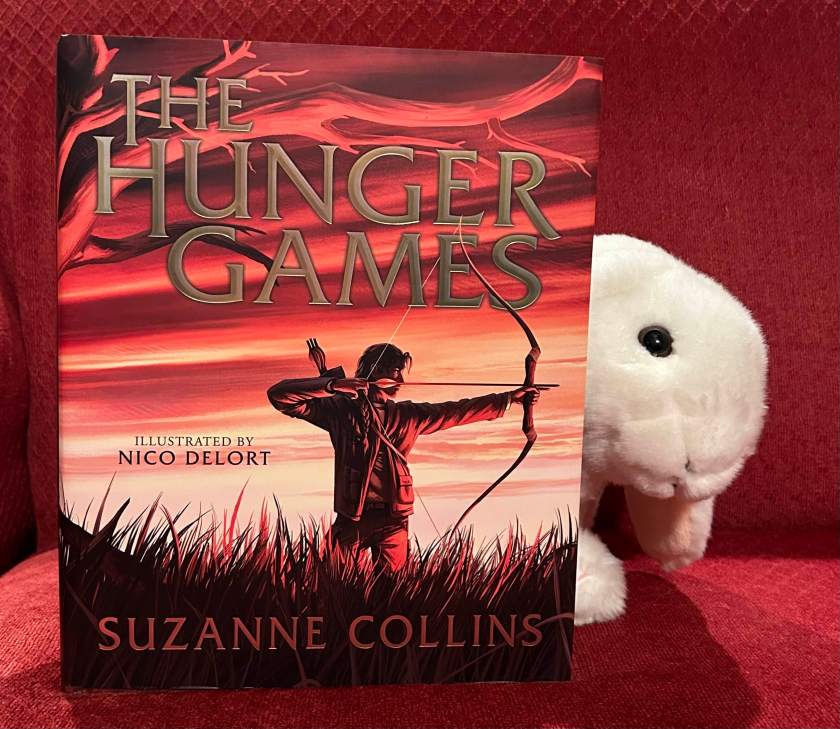
Marshmallow reviews The Hunger Games: The Illustrated Edition written by Suzanne Collins and illustrated by Nico Delort.

Sprinkles: So Marshmallow you read the original book and then watched the movie. How did this illustrated edition work for you?

Marshmallow: As far as I could tell, the text was the same as in the original book. But the illustrator added images every now and then, giving the book a fancy fairy tale feel.

S: I saw the illustrations. They look realistic but are all in black and white. I felt like maybe that matches the overall gloomy nature of the world the story is taking place in.

M: I think you might be right. The cover illustrations have other colors, too, but the illustrations inside the book are all in black and white, like you said. And the world of Katniss Everdeen is really gloomy.

S: Okay, maybe it makes sense for us to give our readers a quick recap of the main plot lines of the book. We cannot assume everyone has already read the original book or seen the movie version.

M: Well, I could just repeat what I said earlier: The book is set in a dystopian future, in North America. There are twelve districts and a Capitol city that make up a country named Panem. Katniss Everdeen, the main character, lives in District 12 with her mother and younger sister Prim. Everyone is very poor, except for the people of the Capitol, which hosts the Hunger Games every year. The Hunger Games are a big spectacle: Two children ages 12 to 18 are selected from each district. And they are brought to the Capitol and are to fight to the death in these Hunger Games. Katniss ends up being the girl representing her district in that year’s Games, along with a boy named Peeta. The book is about their trip to the Capitol and their time during the Games.
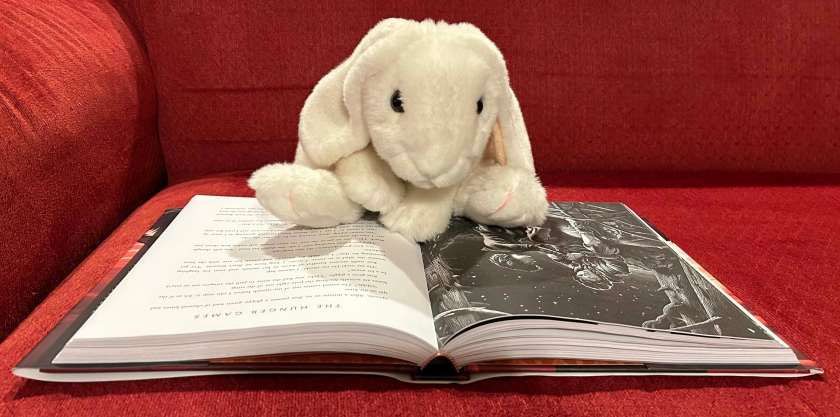
Marshmallow is reading The Hunger Games: The Illustrated Edition written by Suzanne Collins and illustrated by Nico Delort.

S: Okay, so the book is basically the same but there are illustrations in this version, right?

M: Yes. The format of the book is also bigger and the paper the pages are made of is much heavier, thicker paper. And there are a lot more words on a page. I think.

S: How many pages is it overall?

M: 357.

S: Comparing with the original paperback edition you read, which is 374 pages, do you think it is abridged?

M: I don’t think so. It seems that the large format allows more words on each page.

S: I see. So if the text is the same, then one could simply read this one instead of the original paperback you read.

M: Yes, and that could be a different kind of experience, I am sure. I mean, when you read the book, especially if you read it before having seen the movie, you completely are free when you are imagining Katniss and visualizing Panem. The illustrations would change that experience a bit. But I do not think it would be in a bad way.

S: So did you think the imagery was consistent with the book and how you imagined things to look like?

M: Yes. They match the movie images too. I mean Katniss is not Jennifer Lawrence in the illustrations, but the world and how every scene looks really resemble the movie images. But I am not saying the illustrations sort of simply copy the images form the movie. I thought the movie imagery was very faithful to the book, and only made the world seem richer and crisper. The illustrator of this book is very faithful to the book too, and the images just fit the mood of the book very well. Even, like you say, the fact that the illustrations are all in black and white adds to the general heaviness of the story.

S: Okay, that sounds like the illustrator did a really good job then.

M: Yes. I think if you want to read The Hunger Games series, this illustrated edition could be a good book to start your journey with.

S: So I am guessing you would rate this book rather highly?

M: Yes. Great story as before and very evocative imagery, so I’d rate it 100% for sure.

S: Thanks Marshmallow, this is all good to know. So maybe this would be a good time to wrap up this review. What would you like to tell our readers?

M: Stay tuned for more amazing reviews from the book bunnies!
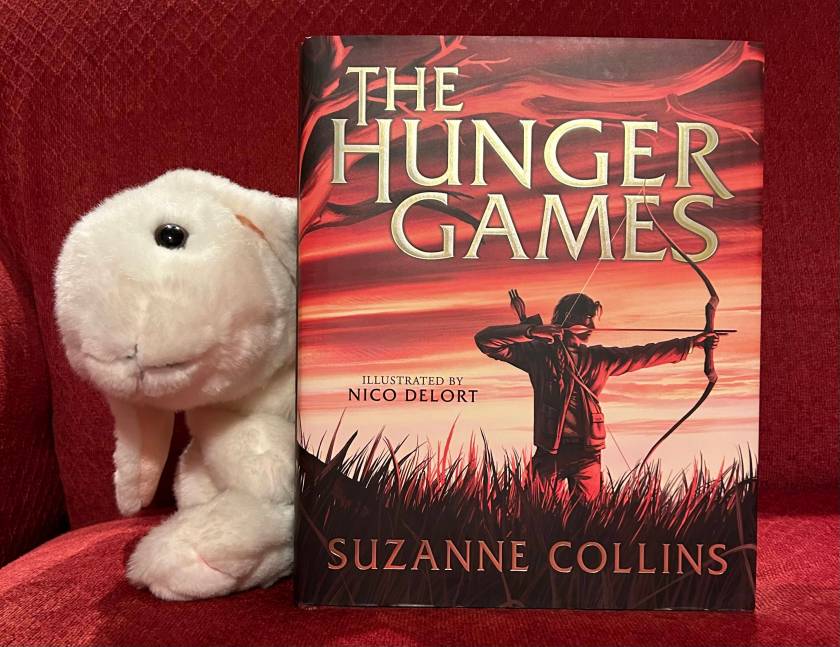
Marshmallow rates The Hunger Games: The Illustrated Edition written by Suzanne Collins and illustrated by Nico Delort 100%.

Marshmallow reviews Murder by Milkshake: A Sweet Dreams Mystery by Elizabeth Maria Naranjo

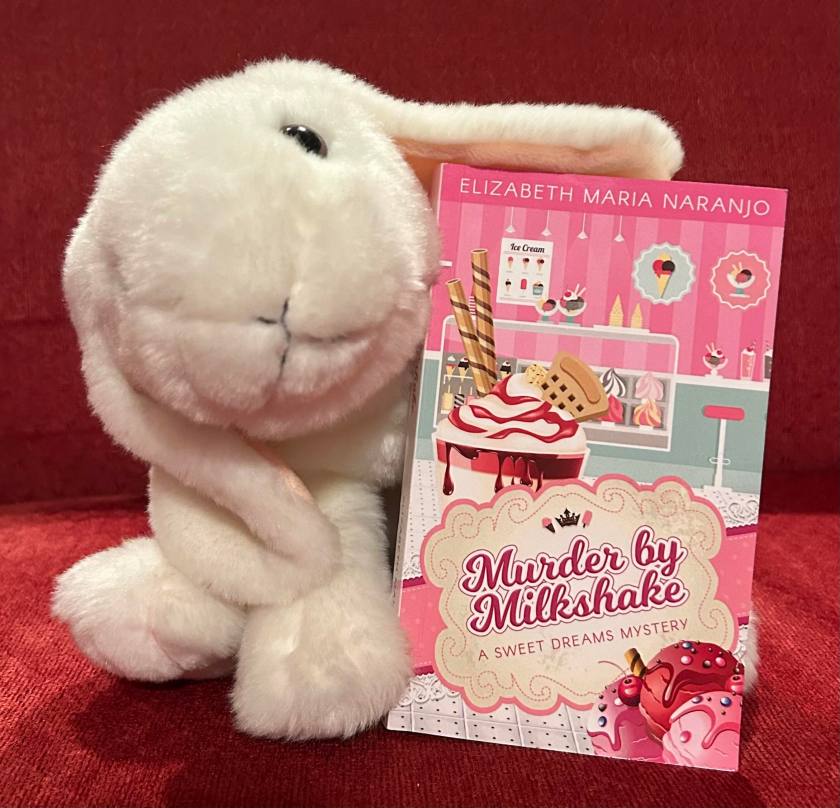
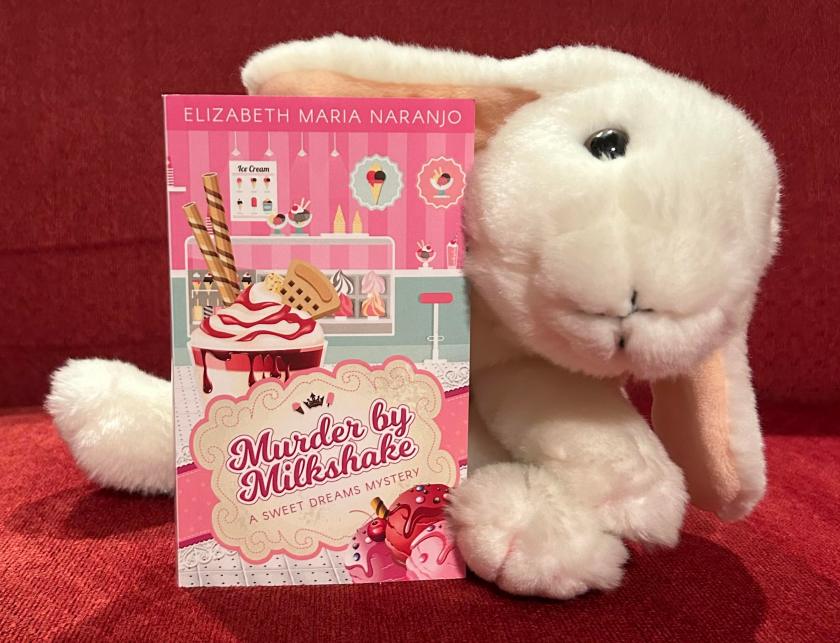
Today Marshmallow reviews a brand new book, Murder by Milkshake: A Sweet Dreams Mystery , written by Elizabeth Maria Naranjo and published in 2024.

The book bunnies are delighted to be reviewing this book as part of a Blog Tour for Murder by Milkshake organized by WOW! Women On Writing.

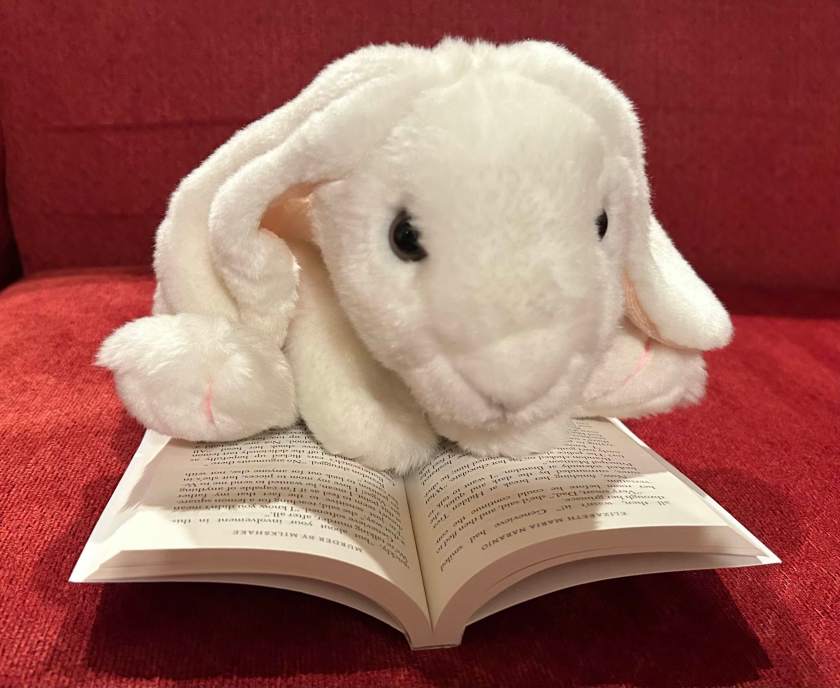
Marshmallow reviews Murder by Milkshake: A Sweet Dreams Mystery by Elizabeth Maria Naranjo.

Marshmallow’s Quick Take: If you like mystery books about unexpected detectives and murders, then this is the book for you!

Marshmallow’s Summary (with Spoilers): Genevieve Winterland’s passion is bringing joy to others through her job working at her father’s Sweet Dreams Ice Cream Parlour in Pinewood, Arizona. As a high school senior approaching graduation, she already knows that she wants to spend her life as a business owner (getting a business degree through online courses), continuing the shop her father created. However, her father doesn’t want her to make any hasty decisions, especially since he worries he has influenced them too much. Wishing that she explores the world outside of Pinewood, he convinces her to apply to colleges that require her to leave her hometown. But before any of this can come to fruition, there is plenty of learning to do before graduation.

At school (before Genevieve’s shift starts), drama about a teaching position unfolds. The economy teacher Mr. Garcia is fired for violence against a student, and popular substitute teacher Miss Love is hired to fill in. However (through methods of borderline espionage), Genevieve learns that Miss Love is receiving death threats. Soon after this discovery, Miss Love goes missing and is replaced by the extremely unpopular substitute, Ms. Pierce. Ms. Pierce says a couple suspicious things that raise Genevieve’s interest, and after some investigation, Genevieve becomes convinced that Ms. Pierce must have been the one sending the death threats.

Meanwhile, a string of robberies have been shaking Pinewood residents’ sense of security and safety in this small town. So to protect Genevieve while she works, her father hires a second worker during her shift. This worker, Tyler, is moody, quick to anger, and clearly doesn’t want to work at Sweet Dreams. After a bizarre reaction to a comment, Tyler becomes a object of suspicion for Genevieve. 

With her best friend Brandon (whose family owns the Hidden Treasures Bookshop across the street from Sweet Dreams) and Butterscotch (an abandoned dog whom Brandon’s family has temporarily taken in), Genevieve is determined to find out why and where Miss Love is and why Ms. Pierce is (supposedly) sending the death threats. However, soon a shocking death shakes up her deconstruction of the whole mystery and the town of Pinewood. Genevieve must uncover the truth before it’s too late. (Dun dun dun!!!)

Marshmallow is reading Murder by Milkshake: A Sweet Dreams Mystery by Elizabeth Maria Naranjo.

Marshmallow’s Review: This book is difficult to place in terms of mystery genre. Some might say it is a cozy mystery (which I just learned is a genre), and it does have most of the elements of that type. As far as I understand, this genre is supposed to be soft and sweet. However, I wouldn’t let this book’s soft and sweet setting fool you into thinking that it is not a serious mystery. There are a lot of twists and turns in this book and I definitely didn’t see most of them coming. The characters are all deeply developed, and the cutesy aspects of the book (which I really liked) should not make you underestimate the complexity of the full plot. I originally thought the murder would be pretty open-and-shut and was surprised that there was a ton of pages afterwards. However, the twists kept coming, and I am quite satisfied with the ending. While I originally may have thought this was a simpler story, the “softness” of the story setting and other aspects made the mystery much more startling and intriguing. I look forward to reading the next book of this series! 

Marshmallow’s Rating: 100%

Marshmallow rates Murder by Milkshake: A Sweet Dreams Mystery by Elizabeth Maria Naranjo 100%.

Marshmallow reviews Enola Holmes: The Case of the Missing Marquess by Nancy Springer

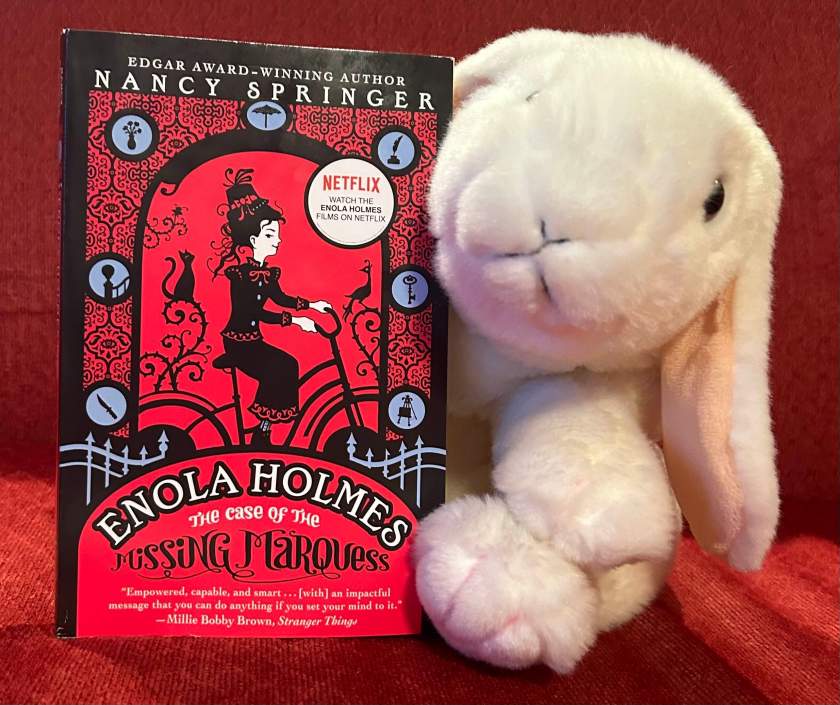
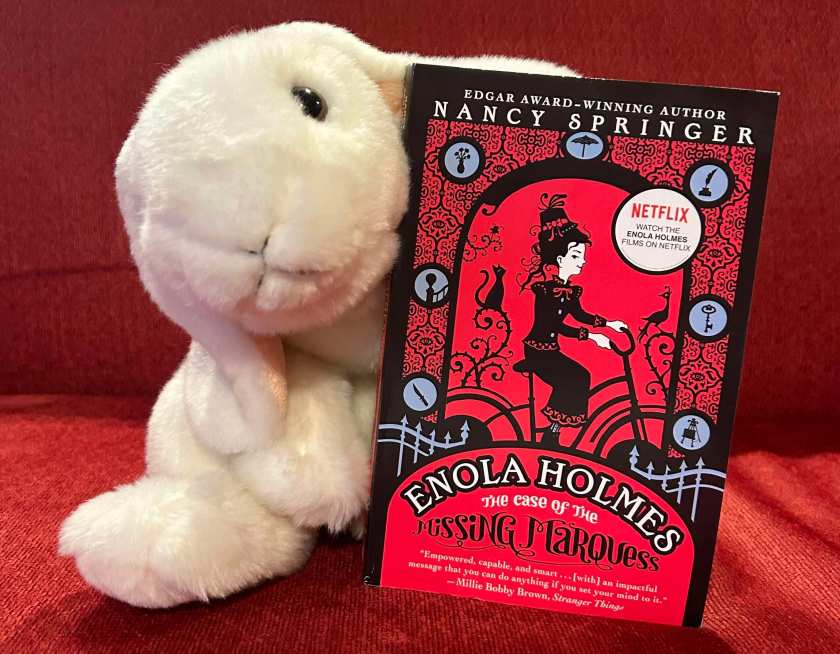
Today Marshmallow reviews the first book in Nancy Springer’s Enola Holmes series: The Case of the Missing Marquess, first published in 2006. Sprinkles, who loves detective stories, is asking questions and taking notes.

Marshmallow reviews Enola Holmes: The Case of the Missing Marquess by Nancy Springer.

Sprinkles: So Marshmallow, I am really eager to hear your thoughts about this book. I know that there is a TV movie made about Enola Holmes, the main character of this book series, who is supposed to be the teenage sister of the famed fictional detective Sherlock Holmes created by Arthur Conan Doyle. I have always enjoyed Sherlock Holmes and his many incarnations, especially a recent version depicted by Benedict Cumberbatch. So I really want to know what you thought of this book.

Marshmallow: I thought it was quite good!

S: Well, that’s a good start. Tell us what the book is about.

M: I saw the movie version first but reading the book, they are really very different.

S: Okay, I saw the trailer but did not see the movie myself. So let us start with the book then. What is it like? What is the story basically?

M: The story is about Enola, who is the younger sister of the famed detective Sherlock Holmes and Mycroft Holmes. Enola has been raised by her mother, who often leaves her alone, in a giant estate called Ferndell Hall. But one day, on her birthday actually, Enola wakes up to find that her mother is gone. She tries to get the older brothers to help her find their mother, but they instead dismiss her and say that she has “a limited cranial capacity”.

S: Ouch, so they are really saying she is stupid.

M: Yes, they are quite sexist. I mean, I guess it was the Victorian era and such, and women were not really thought to have been very smart back then, but these two brothers should have known better. But the book is pretty cool. She basically outsmarts them all!

S: I like that! Okay, so is the book basically about Enola’s search for her mom?

M: Well, it starts there, but along the way Enola gets involved with the kidnapping of the Marquess of Basilwether, who is a twelve-year-old boy. (In the movie, the marquess is a lot older and seems to even become a love interest, almost.) And of course she will solve the mystery, but she also has to keep evading her brothers who want to put her up in a boarding school for young ladies, which sounds like torture to her. Like they have to wear corsets which they progressively tighten so the ladies will have really tiny waists. And it is quite like physical torture. Enola hears that one girl even died from these!

Marshmallow is reading Enola Holmes: The Case of the Missing Marquess by Nancy Springer.

S: Okay, so the plot sounds quite captivating even though the story is supposed to be historical fiction. How is the language used?

M: I think the author wants Enola to sound like a real teenager from that era, and as she is the narrator, the language of the book is not really modern. But it works well and it is still perfectly understandable.

S: I understand that Enola is pretty smart. Is she also funny?

M: Not specifically. The book is really entertaining but the narrator does not try to be funny exactly.

S: Is it a good detective story? You are a fan of Nancy Drew and have read a lot of Agatha Christie.

M: Yes. I think it really is a neat detective novel too. I am quite intrigued and I want to read more from this series.

S: That sounds great! Maybe you can move on to the second book and I can read this one.

M: Sounds like a good plan to me!

S: Okay, so let us wrap up this review then. How would you rate the book overall?

M: I’d rate it 100%. It is fun and empowering and clever, too.

S: Great! I really want to read it now. So what would you like to tell our readers as we end this post?

M: Stay tuned for more amazing reviews from the book bunnies!
Marshmallow rates Enola Holmes: The Case of the Missing Marquess by Nancy Springer 100%.

Marshmallow reviews Maus: A Survivor’s Tale by Art Spiegelman

Today Marshmallow reviews the first volume of Maus: A Survival Tale, Art Spiegelman’s graphic novel first published in 1986. Sprinkles is taking notes and asking questions.

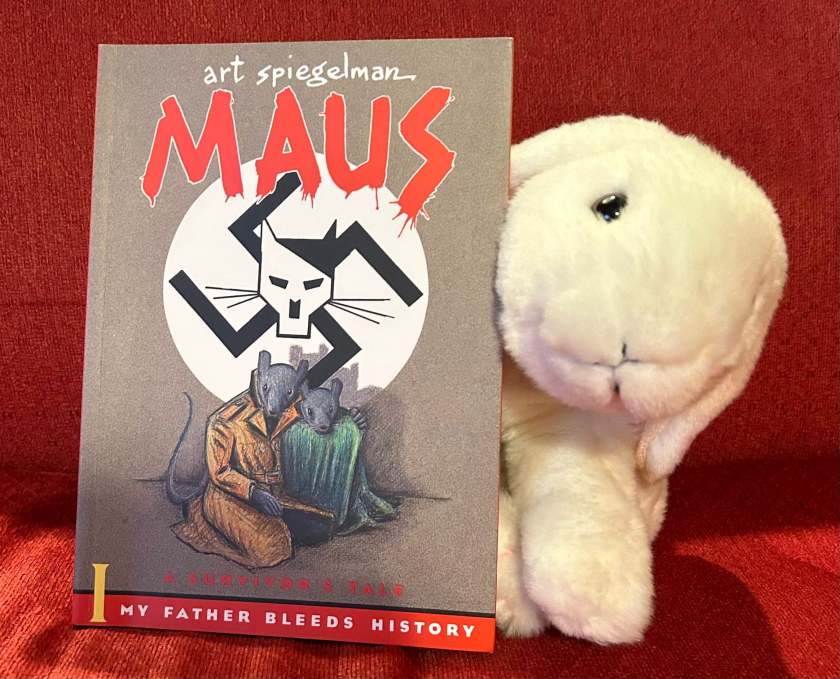
Marshmallow reviews Maus: A Survivor's Tale - I: My Father Bleeds History by Art Spiegelman.
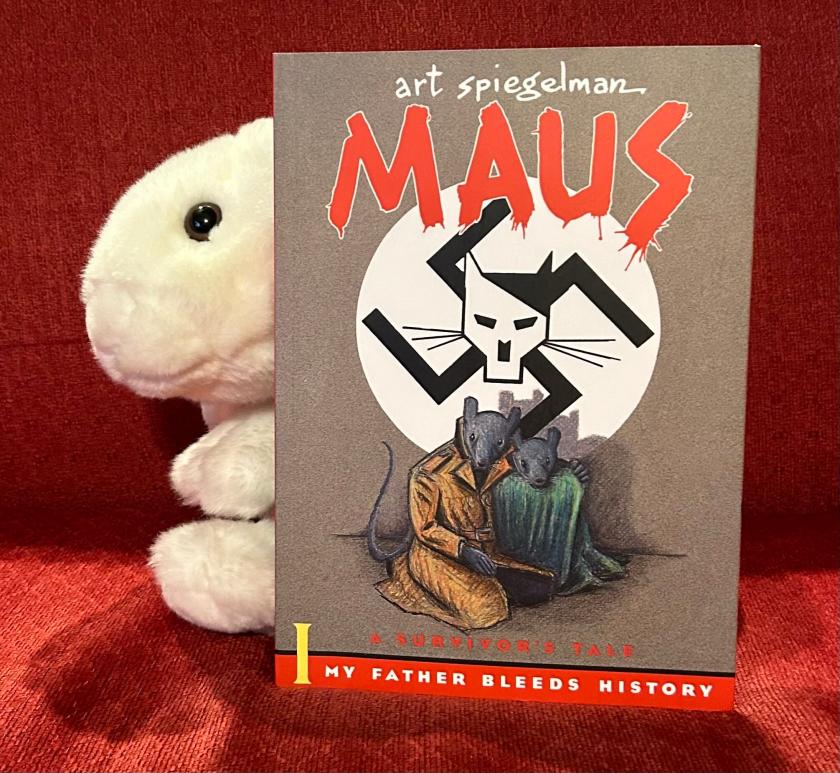
Marshmallow reviews Maus: A Survivor’s Tale – I: My Father Bleeds History by Art Spiegelman.

Sprinkles: So Marshmallow, you chose to talk about a classic graphic novel today.

Marshmallow: Yes, we are talking about Maus: A Survivor’s Tale. This is in fact the first of two volumes, and Art Spiegelman published the second volume in 1991.

S: Okay, thanks for that important note. Wikipedia tells us that this is the first graphic novel that won a Pulitzer Prize. So I am glad you have read it and will talk with me about it.

M: I can see why it would get such an important prize. It is a very important book and it has a very important message.

S: Okay, so maybe it is about time to tell our readers what this book is about. They have already seen your photos with it, and they must be wondering.

M: Yes, sure. The book is about the Holocaust, and the imagery in the front cover is basically describing the main metaphorical device used in the story.

S: How so?

M: This is a graphic novel, as we said before, and all characters are animals. There are mice, and those are supposed to be the Jews, and then there are cats. Those are the Nazi Germans. Then there are pigs, who are supposed to be the non-Jewish Poles. And as I said before, the story takes place around the time of the Second World War.

S: I see. When you tell me all this, I am thinking of how sometimes a cat could be playing with a mouse just to have fun and even kill it with no remorse even when it does not need to eat it. I can see how the cat-mouse-pig metaphor could work.

M: Yes. The story is basically about Vladek who is the author’s father, and his experiences before and during the war. Vladek lived in Poland before the war, and when Germany invaded Poland, he and his family continued to live there. For a while they try to survive but eventually they are sent to the Auschwitz concentration camp.

S: That sounds intense!

M: It is. There is also a second story line, which is more or less the present day, or rather around the time this book was first published. The main story is basically the author’s father’s story, and the second story line is about the author as a grownup trying to connect with his father.

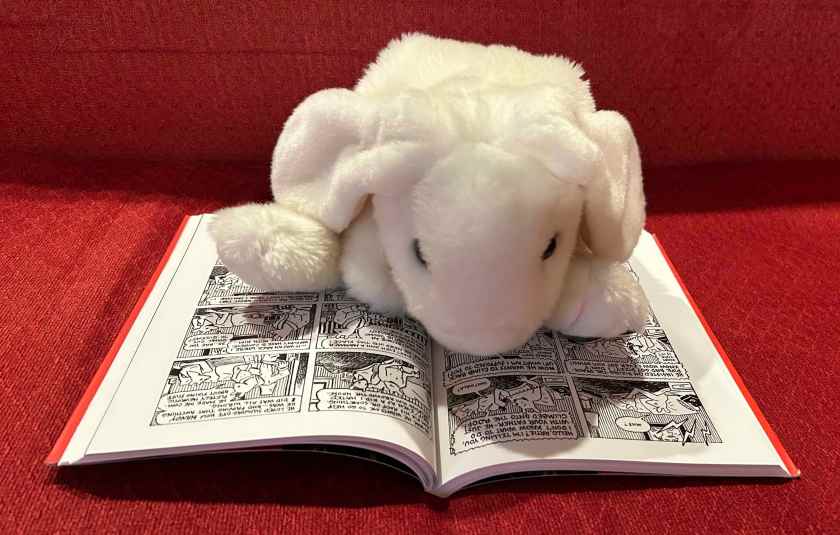
Marshmallow is reading Maus: A Survivor's Tale - I: My Father Bleeds History by Art Spiegelman.
Marshmallow is reading Maus: A Survivor’s Tale – I: My Father Bleeds History by Art Spiegelman.

S: Okay, so now we know the main plot lines and so on, but tell me Marshmallow, how was it like reading such a tough story in graphic novel form?

M: I thought it worked really well. It was very easy to visualize things, even though the characters are mice and cats and so on, because they had already been visualized for you. The book and its visual nature show the undeniably horrific nature of the Holocaust. You fully feel the pain of the mice, and knowing that these events actually happened to people, it makes the whole book even more impactful.

S: I wonder if the harshness of the realities the book is depicting can be related to why some people want to ban this book from school libraries. Some people want us to forget and never talk about these historical events, I am not talking about those people. But even those who believe we should teach this history might think that these stories are too hard to share with young people.

M: I understand why you want us to emphasize that the themes and imagery of the book might be disturbing to very young readers. There is violence in the book. But I also think it is very important for young bunnies to know what happened. And this book does a very good job in telling exactly what happened. And maybe ironically, the use of animal characters allows you to end up seeing the humanity of the victims of the Holocaust very clearly.

S: You make a very good point Marshmallow.

M: Thank you. I also wanted to say the book reminded me of Animal Farm a bit because it shows the worst aspects of humanity under the guise of animals. The animal characters allow us to look at ourselves and see how terrible we truly are or can be. Since we are not seeing humans, we can see things more objectively.

S: That makes sense to me, too, Marshmallow. Okay, this is already a pretty long post. Before we wrap things up, can you tell me how you would rate this book?

M: I’d rate it 100%. It is a striking and impactful book. And I recommend it strongly. It is important for bunnies to understand the magnitude and the impact of these events.

S: Okay, thank you Marshmallow. So last words?

M: Stay tuned for more amazing reviews from the book bunnies!
Marshmallow rates Maus: A Survivor's Tale - I: My Father Bleeds History by Art Spiegelman 100%.
Marshmallow rates Maus: A Survivor’s Tale – I: My Father Bleeds History by Art Spiegelman 100%.