Marshmallow reviews Slow Productivity by Cal Newport

Last year Marshmallow reviewed two advice books by cal Newport directed towards students: How to Become a Straight-A Student and How to Be a High School Superstar. This week she got into Newport’s most recent book Slow Productivity, published in March 2024. Sprinkles enjoyed reading this book immensely, so she wanted to join Marshmallow in this review.

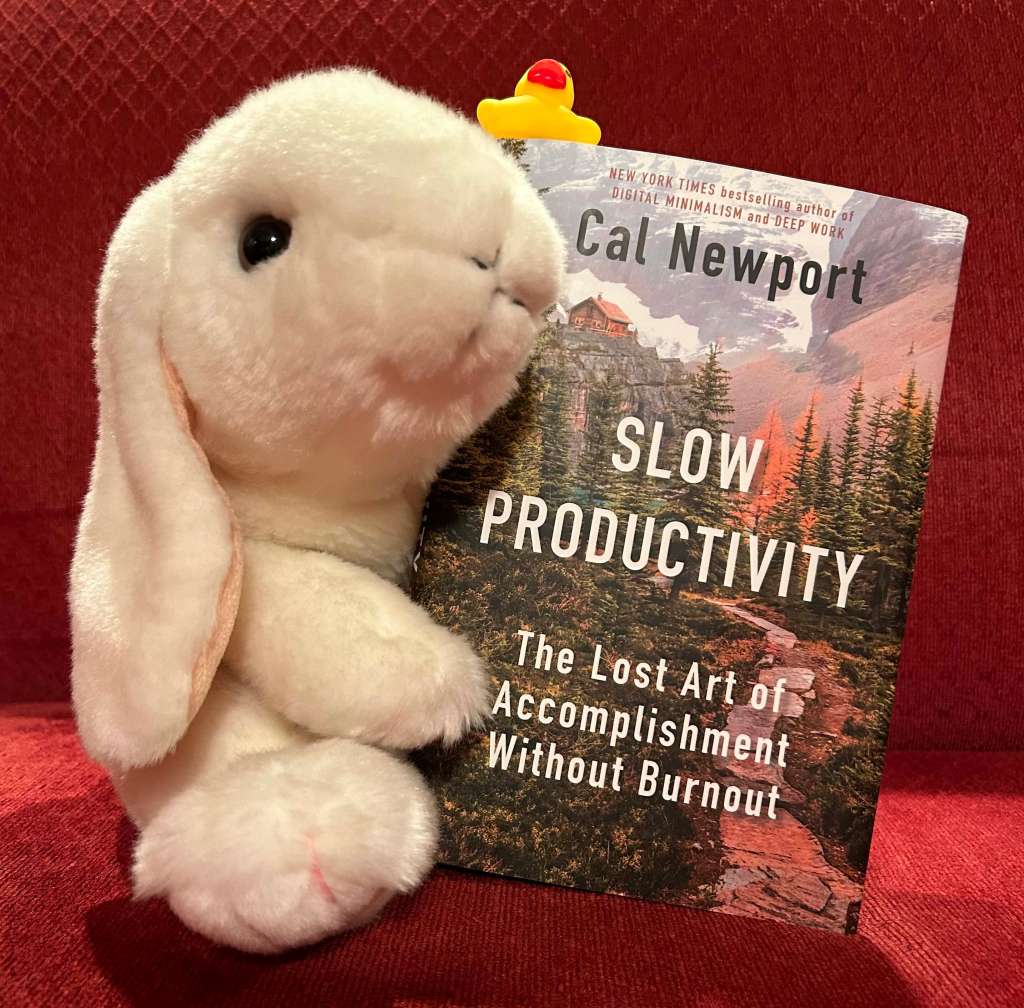
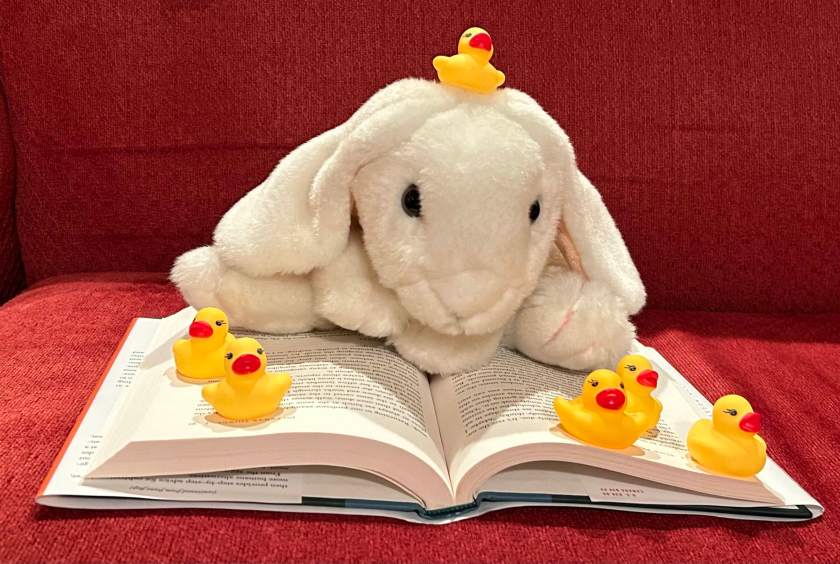
Marshmallow reviews Slow Productivity by Cal Newport while a friendly but slightly annoying little duckling observes.

Sprinkles: So Marshmallow, this is your third book by Cal Newport, isn’t it?

Marshmallow: Yes. I find him to present very thought-provoking ideas.

S: I find his books interesting as well. So we both read this one. It is titled Slow Productivity. I think he was inspired by the slow food movement, where you emphasize slowness and quality and community and local ingredients instead of mass-produced generic fast food. I also read a book a while back about slow teaching; it was also cool. So can you tell us briefly what Newport means by slow productivity? 

M: Slow productivity is the idea of decreasing your workload so you can increase the quality of your work to reach certain, specific goals all the while making sure you are living a sustainable life. 

S: That sounds like a very appealing goal. Tell us more. 

M: So his method, Newport promises, will decrease the familiar overwhelming anxiety and stress the modern knowledge worker experiences.

S: Wait, what is a knowledge worker? 

M: According to IBM, a knowledge worker is “a professional who generates value for the organization with their expertise, critical thinking and interpersonal skills.” So someone who uses computers for accounting, writes code to solve specific business problems, works as a professor, or is a freelance writer, or stuff like that. So unlike the previous Cal Newport books I’ve reviewed (which were intended to help students), Slow Productivity is aimed at adults who have already begun their careers.

S: Yes, I think so too. So I was surprised when you picked it up. But you seem to have enjoyed it, seeing how you have finished it already. 

M: Yes! I started reading it so that I could be prepared for when I grow up and have my own career. I think adults are always too stressed. I wanted to go into my career with ideas on how to be productive in a healthy manner that yields professional success. I also thought this book might still have principles and methods that could be helpful to me as a student.

S: That second part makes total sense, but the first part is really interesting and would probably be surprising for most folks. Especially if they do not know you well… I am sure you are one of only a few little bunnies your age who are thinking of reading about how to be a productive well-balanced adult! Okay so tell us a bit more about the book. How do we do this slow productivity thing?

M: Well, there are three principal ideas of slow productivity. And these are: do fewer things, work at a natural pace, and obsess over quality. The book utilizes a plethora of “case studies” (as Newport calls them) to prove the author’s suggestions and theories. From each of these examples, he synthesizes (or reiterates) the related slow productivity lesson. 

S: I think these are good principles for almost anyone. I mean, they are definitely meaningful for me as a working adult and parent, but also for you. You are now a busy kid going to school and doing a lot of extracurricular activities. And these principles seem to agree with the advice he gives students. Do not cram too many activities just to impress. Do fewer things but do those at such a high level that you will be impressive that way. 

M: Yes, I’ve recently seen this idea of his show up in the Atlantic under the name of a spike applicant (one who is exceptionally good at one thing.

Marshmallow is reading Slow Productivity by Cal Newport while the friendly but slightly annoying little duckling is joined by several others.

S: I remember a colleague who said, “Everyone talks about well-rounded students; what is wrong with a sharp knife?” I loved his analogy. I think this spike idea is similar. I mean not everyone is or needs to be a sharp knife, but we do need sharp knives, and they often find their niche. But I also think it makes sense for young bunnies to explore different types of activities to see what they enjoy and what they are good at. Those explorations provide a lot of insight and you can be surprised by what you end up liking and being good at. 

M: Yes. In this book though, Cal Newport focuses on maintaining a low, easy workload so you can finish larger goals over long periods of time and build your expertise in your field. 

S: That is a different life stage than the exploration stage I was talking about. Of course, his student advice is also about being selective with extracurricular activities, but one needs to figure out what they like and what they want to productively focus on. There is serendipity, some portion will always be about chance, but one also needs time to try out new things. At least that is what I think. But what do I know? I have not written any productivity books!

M: Well that’s okay! Cal Newport gives you the tips so you can focus on other things you like to do and how you can become a fuller person as a whole by managing your workload. In his book for high school students, he focuses on becoming a more interesting person for the sake of college applications (personal growth too I suppose, but primarily applications). In this book, he focuses more on the idea of growing yourself to be a more complete, content individual. I found his idea of pseudo-productivity being unnatural to be quite stimulating. Cal Newport’s books all have this underlying idea that the general consensus (whether in college apps or in careers) is bad because it has been unnaturally perverted towards pseudo-productivity, or doing things just to seem like you’re productive. His main mission is to convince you that this is not the correct way of things and that the situation can be improved by acting in a more natural, original way. 

S: Yes, I think that is a good way to put his message in these three books together. I too find his books always give me good ideas. And I am glad you appreciated this book too. 

M: Yes! I found his ideas to be very useful, even as a child bunny. 

S: This is already quite a long post. Shall we wrap it up?

M: Sure! In summary, I would really recommend this book for all adults who work in the knowledge sector. Even as a bunny in school, I can see that the current work system is set up in a way that is not sustainable for individuals and society as a whole. I hope the situation improves before I join the workforce for my sake. But for the sake of others, I hope this book is more widely read so more people can enjoy full lives with more success.

S: That is a nice sentiment! So how would you rate this book?

M: I would rate this book at 100%. I really liked it and I found it to be very helpful. Cal Newport’s methods are quite logical. 

S: That sounds just about right! Okay, what do you want to tell our readers as we wrap this up?

M: Stay tuned for more amazing reviews from the book bunnies!

Marshmallow rates Slow Productivity by Cal Newport 100% and hopes it will provide some cover, while the ducklings continue to amass.

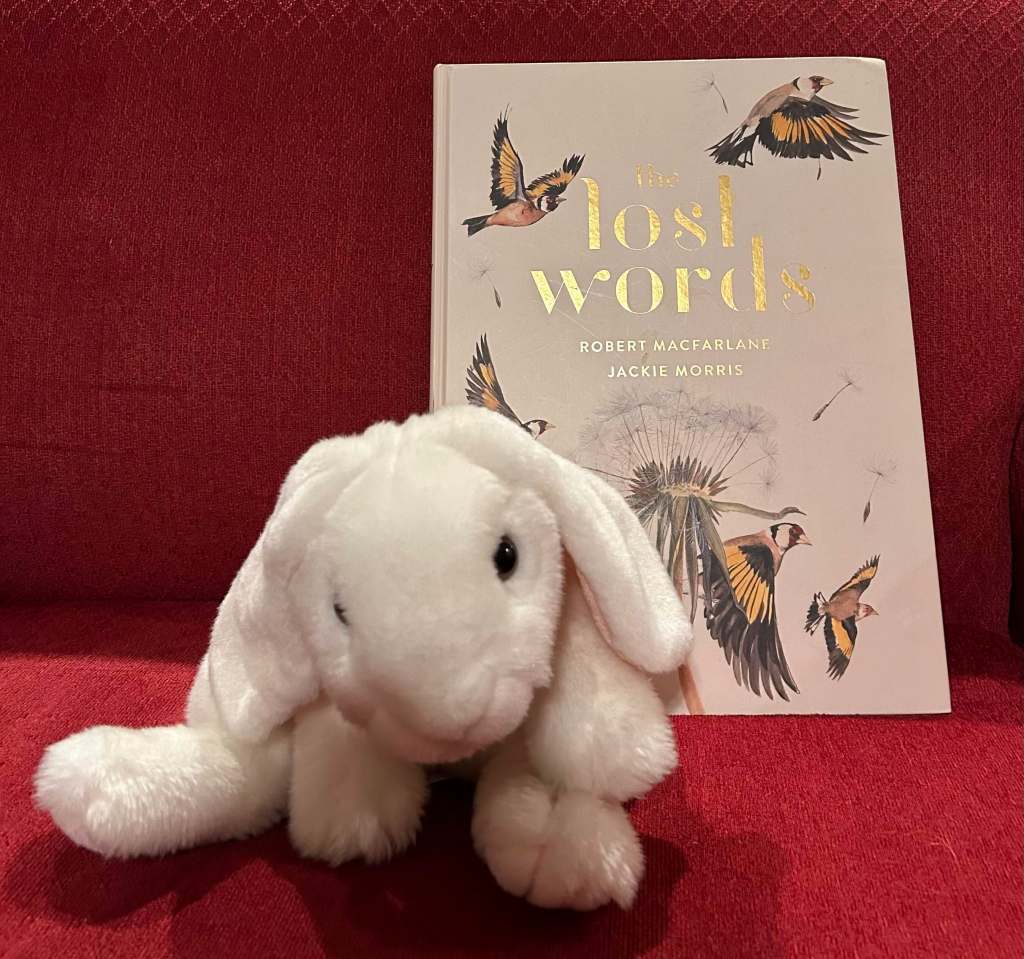
Marshmallow reviews The Lost Words: A Spell Book by Robert Macfarlane and Jackie Morris

Today Marshmallow reviews a beautiful large-format book by Robert Macfarlane and Jackie Morris: The Lost Words: A Spell Book, published in 2017. Sprinkles is taking notes and asking questions.

Marshmallow reviews The Lost Words: A Spell Book written by Robert Macfarlane and illustrated by Jackie Morris.

Sprinkles: So Marshmallow, let us begin. I thought this was a beautiful book, so I am very happy we get to talk about it today.

Marshmallow: Yes, it is a really beautiful book. Majestic, I could say. Each page is almost like a work of art.

S: I heard about this book a while back. I read the following and it stuck with me:

The book began as a response to the removal of everyday nature words – among them “acorn”, “bluebell”, “kingfisher” and “wren” – from a widely used children’s dictionary, because those words were not being used enough by children to merit inclusion. But The Lost Words then grew to become a much broader protest at the loss of the natural world around us, as well as a celebration of the creatures and plants with which we share our lives, in all their wonderful, characterful glory. –https://www.thelostwords.org/lostwordsbook/

M: Well, I did not know about this when I began reading the book. But it totally makes sense. The book is kind of like a children’s alphabet book. Approximately one word for each letter of the alphabet. For “A” for example there is an entry for “acorn” and another for “adder”. And for “B”, there is “bluebell” and “bramble”. but there is nothing for “E” for example. But anyways, each word chosen is a word for an animal or plant, some object of nature that used to be more familiar to young bunnies many years ago, but now that most of us live in much more urbanized environments, we do not always see or hear about them. So I really like that the authors decided to bring back these words to us.

S: Yes, me too! Okay, so then there should be about twenty-five words, then.

M: Not quite. There were apparently forty words that were dropped from that children’s dictionary, and the people who created this book picked twenty of those words and focused on those.

S: The book is not only twenty pages though.

M: Of course not, Sprinkles! That would be kind of too short. There are six pages for each word.

Marshmallow is reading The Lost Words: A Spell Book written by Robert Macfarlane and illustrated by Jackie Morris.

S: I see. So what happens on each of those pages?

M: What they do with each word is actually really amazing. For each word, there is first a two-page spread showing the letters making up the word in a way that is aesthetically pleasing. The letters making up the word are kind of hiding among many other letters, kind of reminding us that the word is lost somehow, but if we look carefully, we will find it again.

S: That is beautiful, Marshmallow.

M: Yes, the book is really beautifully designed. Anyways, after the first two-page spread, then there is a second two-page spread for the word. The left hand side there is an acrostic poem describing the word, and on the right hand side there is a water color painting of the animal or plant that the word depicts.

S: Remind our readers what an acrostic poem is maybe?

M: Sure. Basically when you take the letters of the first word on each line and put them in a vertical line, they make up a word. So for example here is the poem for IVY:

ivy

I am ivy, a real high-flyer.
Via bark and stone I scale tree and spire.
You call me ground-cover; I say sky-wire.

S; That is lovely!

M: It really is! I love the paintings! They are kind of like portraits! And then there is a final two-page spread, which is a large picture showing the animal or plant in its natural environment. Again the paintings are beautiful.

S: I agree with you completely Marshmallow. I have been looking through the pages for the last hour or so and I am amazed. The poems are quite neat too.

M: Yes, agreed. Each poem has a deeper meaning; they do not just provide a physical description, but also what it might represent, what makes it unique and special, and how it is a part of nature. I really liked the book!

S: I can see that. So if you were to rate it–

M: -I’d rate it 100% for sure!

S: That is wonderful Marshmallow. I am glad we were able to read this book.

M: Yes.

S: So let us wrap up this review then. What would you like to tell our readers?

M: Stay tuned for more amazing reviews from the book bunnies!

Marshmallow rates The Lost Words: A Spell Book written by by Robert Macfarlane and illustrated by Jackie Morris 100%.

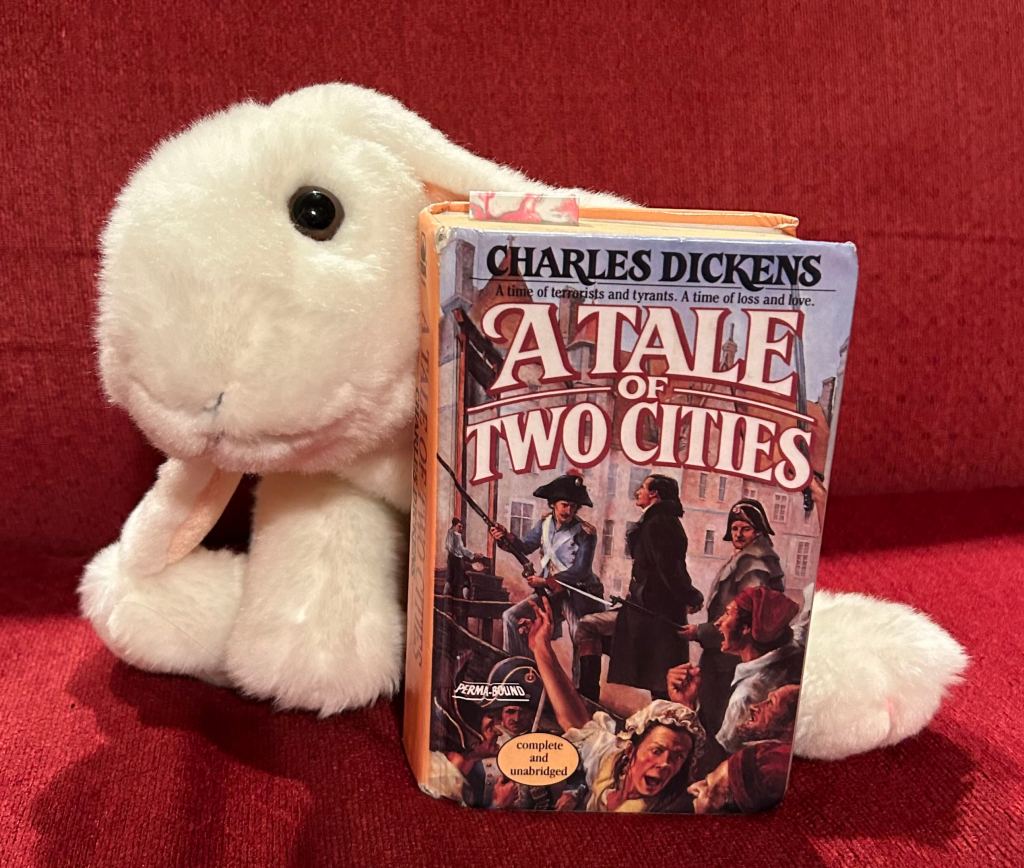
Marshmallow reviews A Tale of Two Cities by Charles Dickens

Marshmallow has been reading A Tale of Two Cities by Charles Dickens at school and so thought it would be a good idea to review it for the blog. Below are her thoughts on this classic from 1859.

Marshmallow reviews A Tale of Two Cities by Charles Dickens.

Marshmallow’s Quick Take: If you like historical fiction, famous books about the French Revolution, family, and fate, then this is the book for you!

Marshmallow’s Summary (with Spoilers): Set during the years 1775-1792 in London and Paris, this really is a tale of two cities. The book travels between London and Paris, with the French Revolution developing throughout and playing a major role in the storyline.

The book begins with the introduction of both places and the presentation of the plot: Lucie Manette, a seventeen year old French girl living in London, learns from a banker named Mr. Jarvis Lorry that her father Dr. Manette is alive after being imprisoned for eighteen years in the Bastille. She believed him to be dead, but after this shocking revelation, sets out with Mr. Lorry to Paris to find him. They discover that, upon his release, Dr. Manette was taken in by his old servant Monsieur Defarge and his wife Madame Defarge. We learn that Dr. Manette has been driven insane by his time in the Bastille, obsessively making shoes to cope. But Lucie’s love and faithful devotion begins to heal him back to himself. They all travel back to London, and he recovers over the next five years.

Then, in 1780 in London, another character named Charles Darnay is put on trial for treason against England (being a spy). Lucie and her father are called to testify against him. Two witnesses (both English spies) testify against him as well, but Lucie’s pity for Charles begins to sway the jury in his favor. After Sydney Carton, one of Charles’ defense lawyers, points out the striking resemblance between himself and his client, the verdict of not guilty is declared and Charles Darnay and both of his defense lawyers become close family friends of the Manettes and Mr. Lorry.

Sydney Carton is a drunken, unstable man who is subservient to the other defense lawyer. For reasons unknown, he seems to have given up on himself and his potential, wasting away his talents, believing that he is worthless and lacks any ability to be good. The other defense lawyer is Mr. Stryver, an overly-ambitious man whose only goal is furthering his own status in the world.

Mr. Stryver, Carton, and Charles Darnay all begin to fall in love with Lucie, but all in different ways and for different reasons. Mr. Stryver believes that she fulfills his social expectations for a wife and would be beneficial for his life goals, while Carton loves her for being the only person who believes that he has the possibility of good within him (when he himself doesn’t believe so). Mr. Stryver plans to propose, but decides not to after Mr. Lorry (in a very passive-aggressive fashion) tells him that he would be rejected. Carton confesses his love to Lucie (who cares for him in a motherly way), but tells her that he knows she cannot and should not love a man like him who has given up on everything: life, love, himself, and the world; he swears to protect her and everyone she loves when the time comes. But in the end, it is Charles Darnay who wins Lucie’s hand in marriage. He fell for her because of her compassion for him while on trial, her deep love and dedication to her father, and her beauty. After getting her father’s blessing, the two get married.

Charles wants to tell Dr. Manette his real last name before the marriage, but is told by Dr. Manette himself to wait till the wedding day. On that day, Charles in true honesty informs Dr. Manette that he is an Evrémonde, an aristocratic family from France. As a result, Dr. Manette relapses back into his old insanity right after the couple leaves for their honeymoon. Mr. Lorry helps Dr. Manette return to himself before the couple return and the breakdown is kept secret from Lucie.

In 1789, in France, the Defarges lead the famous Storming of the Bastille, and Monsieur Defarge finds a note written by Dr. Manette hidden in his old cell. The French Revolution is becoming increasingly bloody and aristocrats like Marquis St. Evrémonde (Charles’ uncle) are being slaughtered for their past insensitivity and cruelty towards the impoverished. One of the Marquis’ servants is put on trial and sends a letter to Charles (in London), asking for his help. After leaving letters of explanation, Charles secretly leaves his family in London to return to France. He is captured and put on trial, essentially for being an aristocrat, despite the fact that he denounced his family’s immoral behavior and fled from France to London to escape his name Evrémonde.

Mr. Lorry, on business in Paris, unexpectedly meets Lucie and Dr. Manette who came to France right when they read Charles’ letters. Dr. Manette, a former Bastille prisoner and thus a hero of the Revolution, uses his influence to get Charles a trial. But with the revolutionary bloodlust unquenchable, nothing can save Charles from La Guillotine, except for an act of true love. 

Marshmallow is reading A Tale of Two Cities by Charles Dickens.

Marshmallow’s Review: A Tale of Two Cities is an amazing book. It’s really hard to read in the beginning, but after the first couple of chapters, it gets pretty easy to understand. Dickens uses a lot of old language so it is difficult by today’s standards. But I’ve never read a book that has completely changed my view of the world to such an extent.

This book is amazingly written because its plot is touching and exciting, but it also shows the development and the impacts of the French Revolution, a chilling period of human history. Dickens shows us our fragility, through Dr. Manette’s insanity, and the violence that we create when others have wronged us. But Dickens also shows our graces: Lucie’s never-ending compassion, faith, love, kindness, and devotion to others.

I chose to read this book for an English unit, and I’m so glad I did because this book is absolutely beautiful; it is truly a masterpiece. The world the author shows us immerses you as you read and shows you glimmers of a past far behind. However, the past is sometimes the clearest mirror. Throughout this book, the most poignant message I uncovered was this: when destiny mercilessly takes what one loves, those who were hurt can lose their mercy too. This is how the frenzied violence of the French Revolution occurred: the horrific treatment of the lower classes by the elites made the Revolutionaries utterly empty of empathy for the aristocrats when La Guillotine (as they referred to it) descended. The world’s harshness hardens humanity which turns into (perhaps righteous) hatred, something we still see today.

This disturbing reality of human nature is so profoundly portrayed by Dickens that this story is uniquely compelling in a way like no other. A Tale of Two Cities really made me reflect on us and our society as a whole. When we break one another, the broken become capable of breaking others without feeling empathy and perhaps it’s not completely their fault. But if humanity is to become better, if we are to avoid another bloodbath like the French Revolution, if our world is to become brighter and more prosperous for all, we need to learn to fix each other’s humanity, not break one another apart till we become capable of inhumanity. I might just be a bunny, but this book makes it obvious for all. 

Marshmallow’s Rating: 110%.

Marshmallow rates A Tale of Two Cities by Charles Dickens 110%.

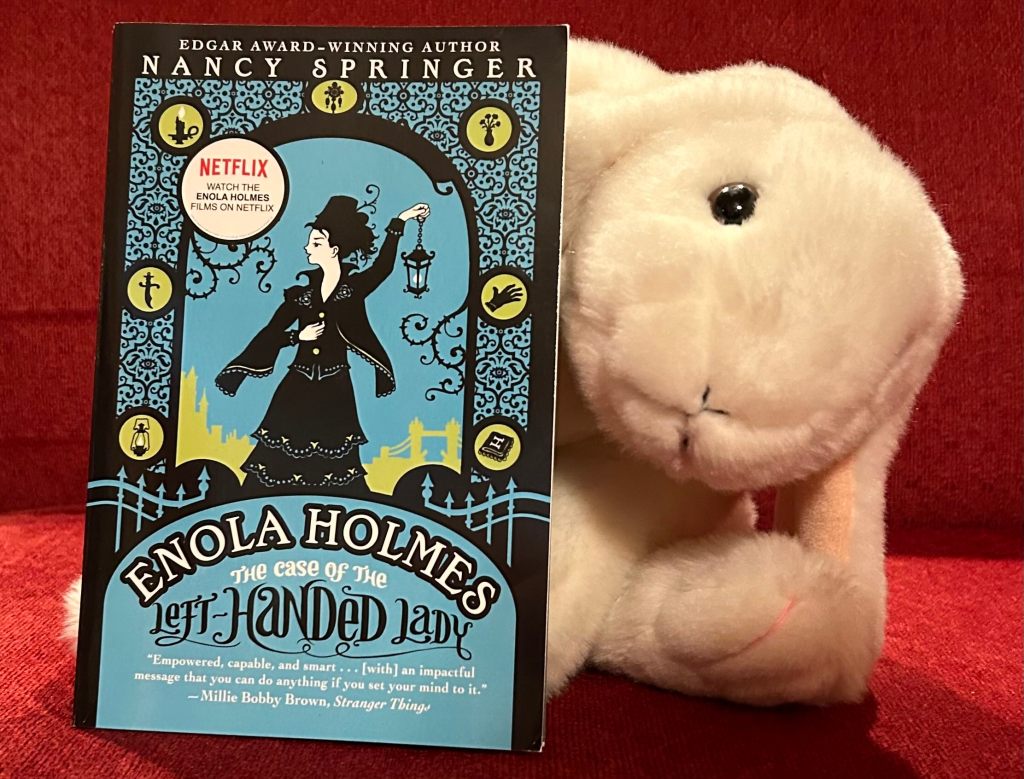
Marshmallow reviews Enola Holmes: The Case of the Left-Handed Lady by Nancy Springer

Today Marshmallow reviews the second book in Nancy Springer’s Enola Holmes series: The Case of the Left-Handed Lady, first published in 2007. Sprinkles, who loves detective stories and has already read the first book in the series, is asking questions and taking notes.

Marshmallow reviews Enola Holmes: The Case of the Left-Handed Lady by Nancy Springer.

Sprinkles: So Marshmallow, tell us about this second book.

Marshmallow: Well, it is another book with Enola Holmes as the main character. This time she is working in London as a detective, or rather a finder of things, under the name of a man. So the man is totally made up ,and she is acting as if she is his assistant because she knows that nobody will hire her if they know she is a woman.

S: I see. That makes sense.

M: Yes. And she uses all these disguises to get answers to questions she could not have gotten otherwise. I thought this was very clever. In fact the whole book is full of clever ideas like this, which made it a very satisfying read.

S: That sounds great Marshmallow! So tell us about the left-handed lady from the title.

M: So there is supposed to be a girl who is “kidnapped” and she is noble so she is a lady.

S: What do you mean by “kidnapped”?

M: Well, people think that she ran away with a guy. So the mystery is not publicized because the family is embarrassed.

S: So they discreetly hire Enola Holmes?

M: Yes, they hire her cover person. And Enola goes to examine the evidence as his assistant, because they would not take her seriously if she were not working for a man. Really annoying!

S: I can see that!

M: She discovers these paintings made by the girl who disappeared. And they lead her to realize that the girl is more interested in socioeconomic issues rather than a man.

Marshmallow is reading Enola Holmes: The Case of the Left-Handed Lady by Nancy Springer.

S: So that plot sounds nothing like the second Enola Holmes movie.

M: Yes, that is true. They are both about a lost girl but the girl in the movie is not a noblewoman.

S: I understand that the movie version is actually about a real person named Sarah Chapman, who led a women workers’ strike.

M: That sounds really cool! The book is totally fictional, as far as I can tell. But there are a lot of political issues that are mentioned.

S: That sounds neat. I found the first book really easy to read, and it kept my full attention the whole time. Is this second book like that, too?

M: Yes. I did feel the plot was a little bit more complicated however. The other felt more like a game set up, but this was wilder somehow… Still a lot of fun to read!

S: So does that mean you will go on to reading the next book?

M: Yes, I hope to read it and review it next.

S: Sounds great to me! In the meantime, I will happily take this off your hands and read it myself.

M: Sure, you do that, Sprinkles.

S: Okay, so as we wrap this up, how would you rate the book overall?

M: I’d rate it 100%. It is a neat mystery, and the social commentary is very much welcome, too.

S: Great! So what would you like to tell our readers?

M: Stay tuned for more amazing reviews from the book bunnies!

 Marshmallow rates Enola Holmes: The Case of the Left-Handed Lady by Nancy Springer 100%.
Marshmallow rates Enola Holmes: The Case of the Left-Handed Lady by Nancy Springer 100%.