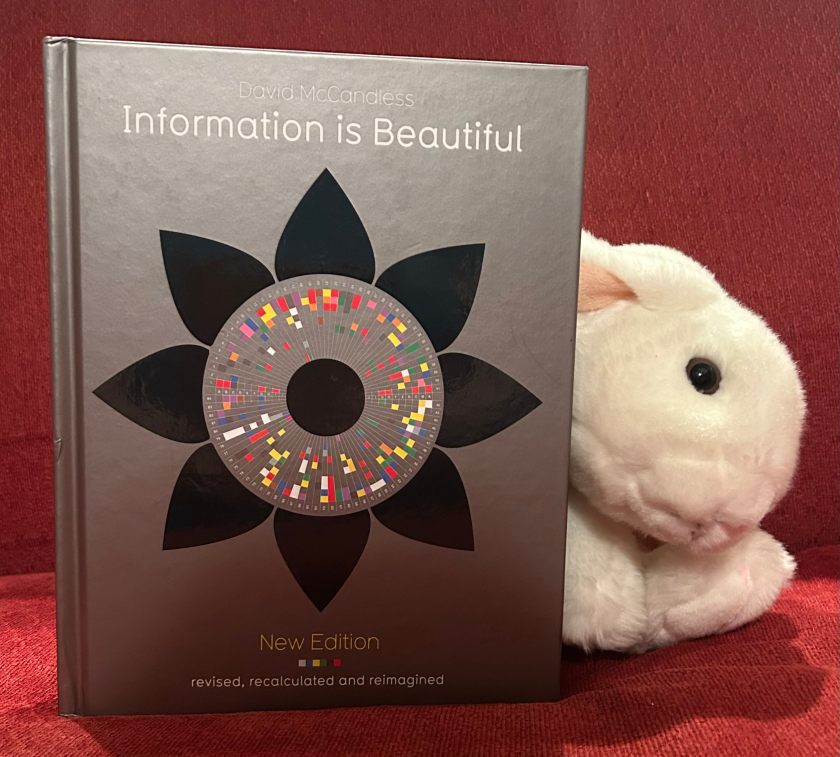
Marshmallow reviews Information is Beautiful by David McCandless

In June, Marshmallow reviewed Beautiful News: Positive Trends, Uplifting Stats, Creative Solutions by David McCandless, a beautiful book full of inspiring and visually stimulating infographics. Today she reviews an earlier book by David McCandless: Information is Beautiful, originally published in 2009 and revised in 2012.

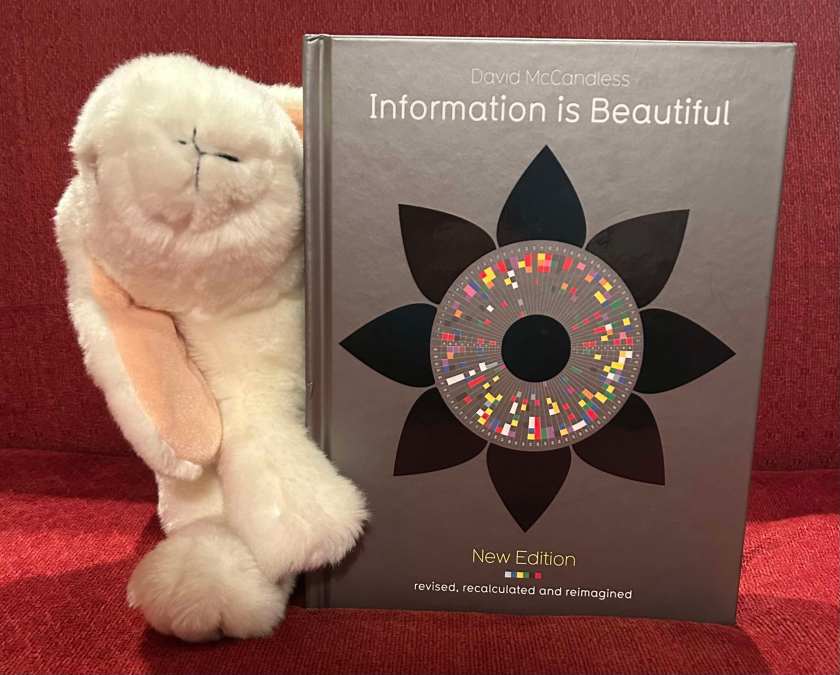
Marshmallow reviews Information is Beautiful by David McCandless.

Marshmallow’s Quick Take: If you like non-fictional books that are interesting and eye-opening, then this is the book for you!

Marshmallow’s Summary (with Spoilers): A few weeks ago, I reviewed another book by David McCandless called Beautiful News. This book is a little different though. The author explains in the introduction:

“I went for subjects that sprang from my own curiosity and ignorance […] So, that’s what this book is. Miscellaneous facts and ideas, interconnected visually. A visual miscellaneum. A series of experiments in making information approachable and beautiful.”

That pretty much sums up this book! Every page (like the other book) is full of vivid colors, smooth and sharp shapes, and fascinating data.

One of the pages that stood out to me most contained a colorful spiral of increasingly smaller circles; each circle contained a cause of death and the chance of it occurring to you. Essentially, as you read closer to the center of the spiral, you see rarer and rarer ways of dying which was definitely interesting, but also terrifying. For some reason it felt like one of those choose-your-own-way books but a Wednesday Addams edition.

Another, less morbid and more cheerful page announced the most popular U.S. girls’ names–the following spread was about the most popular boy names too. Unfortunately, I didn’t see Marshmallow at the top.

I did really like one page that shows the global map and then covers what is succinctly described as “Man’s Humanity to Man” (philanthropy, free education, and other great things!) For example, I liked how it highlighted some bloodless revolutions like the Serbian Bulldozer Revolution in 2000. Not all the details are given, but I did learn a little bit about some things I didn’t know anything about.

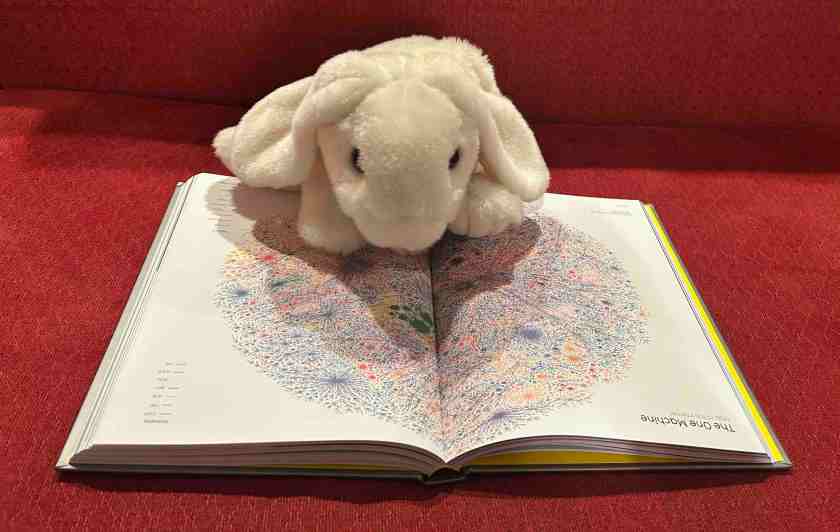
Marshmallow is reading Information is Beautiful by David McCandless. Here you see her viewing the two-page spread titled "The One Machine: Map of the Internet".
Marshmallow is reading Information is Beautiful by David McCandless. Here you see her viewing the two-page spread titled “The One Machine: Map of the Internet”.

Marshmallow’s Review: Information is Beautiful is simply a beautiful book. I loved how every page is extremely visually appealing. That is definitely a reason to read the book on its own. I’m sure it would be a really fun picturebook for small bunnies! I did think it was interesting how the cover of this one is grayish and definitely less colorful than that of the other book of McCandless that I had reviewed earlier. Beautiful News was more directed and had a more specific message: hope. Information is Beautiful, on the other hand, is more about exposing the reader to the good, the bad, and the ugly.

I really enjoy books that reveal the depth and complexity of the world we are living in—something that is so easy to miss when all our screens seem to promise an abundance of simplistic solutions to boredom. In particular, the book brings together a great many disparate topics, and that opens the door to a room for the light of curiosity to explore. Basically, if you are interested in learning more about a topic you see in this book, you can Google it, look it up on Wikipedia, and go from there. In other words, this book can really be viewed as a collection of random bits of information, but I think it randomness is one of its strengths: there is bound to be something interesting for any bunny who looks inside.  

I was a bit concerned about one of the displays called “Behind Every Great Man … Dictators’ Wives”. The display focused on the wives of the horrible dictators of the twentieth century, like Hitler, Stalin, Marcos, and so on. Honestly, I was disturbed by the title for the display, because these men were all terrible people. They themselves may have thought of themselves as great, but today historians would most likely not use that word, even in quotes.

But overall, I liked reading Information is Beautiful, and I appreciated the author’s goal to make information approachable and beautiful. But I must admit that I like McCandless’ other book a little more because it’s more uplifting. But this one is really fascinating in a different way, and I definitely recommend reading it!

Marshmallow’s Rating: 90%.

Marshmallow rates Information is Beautiful by David McCandless 90%.

Marshmallow reviews The Brief and Frightening Reign of Phil by George Saunders

Today Marshmallow reviews The Brief and Frightening Reign of Phil by George Saunders, published originally in 2005.

Marshmallow reviews The Brief and Frightening Reign of Phil by George Saunders.

Marshmallow’s Quick Take: If you like clever, thought-provoking books akin to those of George Orwell, then this is the book for you! 

Marshmallow’s Summary (with Spoilers): Set in a truly bizarre world, this story starts in Inner Horner which is a nation literally so small that only one of its seven citizens can fit in it at a time. What do the other six unfortunate Inner Hornerites have to do in the meantime? They basically sit in this tiny area called the Short-Term Residency Zone, located in Outer Horner. The Outer Hornerites naturally feel very superior in comparison to their miniscule neighbors. Suddenly, Inner Horner shrinks to be even smaller so that only one fourth of a citizen can inhabit the nation. This turns out to cause quite the issue with the Outer Horner Militia who feel that this constitutes an “Invasion in Progress” as they say.

While the militia deliberate on what course of action to take, Phil comes in and suggests taxing the Inner Hornites for every day that they infringe on Outer Horner. Phil is described as “a slightly bitter nobody” who fell in love with Carol–an Inner Hornite who fell in love with and married another Inner Hornite, much to Phil’s despair. With the birth of her child, Phil’s despondency contorted to more closely resemble anger. Utilizing his constituents’ naïveté and gullability, Phil convinces the Militia that the Inner Hornites are inferior to the Outer Hornites, something that confirms most of the Outer Hornites’ inner thoughts.

As the book progresses, the Inner Hornites are treated increasingly worse and worse as Phil rises from a nobody to the leader of Outer Horner. While the characters are not humans (they are all amalgamations of objects, biological parts, and machinery it seems), the plot draws a line definitively parallel to some of humanity’s worst times. 

Marshmallow is reading The Brief and Frightening Reign of Phil by George Saunders.

Marshmallow’s Review: This book was really bizarre. The world, the nations’ names, the characters are all just weird, but all this weirdness makes the book stand out even more in my opinion. There is not very much description of the surroundings other than it seems like Earth. There are trees and rivers and dirt and apparently a cafe in Outer Horner, but, other than that, not much else is given. The citizens are all described and drawn as being some sort of strange creatures, but none of them are the same. For example, the president of Outer Horner is described as “consisting of a jumble of bellies, white mustaches, military medals, and dignified double chins, all borne magnificently aloft on three thin wobbly legs.” Suffice it to say, they all look pretty unusual.

But the differences between us and them pretty much end there. Phil’s rise to power and the suppression of the Inner Hornites honestly follows the same course human history has too many times (this disturbingly reminded me of what I learned about pre-WWII Germany). I wonder if the weird descriptions of the characters represent some deeper analogy. The plot is intriguing and the ending was definitely very interesting.

I read The Brief and Frightening Reign of Phil in an hour and five minutes, so it’s definitely pretty short. There are some drawings that made me feel like this book is a little similar to The Phantom Tollbooth. Of course one also cannot help but think of Animal Farm, another short allegorical tale about the rise of tyranny.

Overall, The Brief and Frightening Reign of Phil was a fascinating book and I would recommend it to almost all ages. It is slightly amusing yet intriguing in a bizarre way that is hard to explain; the way to best understand what I mean is to read it!

Marshmallow’s Rating: 100%.

Marshmallow rates The Brief and Frightening Reign of Phil by George Saunders 100%.

Marshmallow reviews Fail, Fail Again, Fail Better: Wise Advice for Leaning into the Unknown by Pema Chödrön

The book bunnies are back! Today in her first review for the new 2025-2026 season, Marshmallow is writing about Pema Chödrön’s short but impactful book, Fail, Fail Again, Fail Better: Wise Advice for Leaning into the Unknown, published first in 2015.

Marshmallow reviews Fail, Fail Again, Fail Better: Wise Advice for Leaning into the Unknown by Pema Chödrön.

Marshmallow’s Quick Take: If you like books about self-improvement, contemplation, and dealing with challenges, then this is the book for you!

Marshmallow’s Summary (with Spoilers): The book starts with a foreword by Seth Godin, in which he introduces an interesting phrase from the author: “getting all the frogs in the bowl.” This essentially means that, despite all efforts, if you’re trying to get frogs to stay in a bowl, there will always be some that hop right out–which I presume is a metaphor for the occasional, unavoidable failure. He describes his own past with failure, citing the plethora of publishing rejections he experienced. But Chödrön, he says, teaches one how to dance while the frogs continue to jump. This piqued my interest.

Godin also mentions the “infinite game” (one you play not to win, but simply to play). He ties this into the jumping frogs, claiming that perhaps the jumping frogs are the point, rather than the orthodox objective of just getting them to sit still in the bowl. I found this point a little more difficult to tie into the objective of the book. Rather than focusing on how to grow from failure, it suggests that the entire purpose of existence is failure. I felt that this is a separate thesis that is harder to defend. But the foreword made me excited to start. 

The central core of the book is derived from a speech Chödrön gave at her granddaughter’s college graduation. In it, she explains that she wasn’t sure her topic choice would be appropriate since preparation for failure (her topic choice) is superfluous–teachers and students hope–if one is taught to avoid mistakes in the first place. Yet, she says that the “fine art of failing” may be the most important lesson that these new graduates will learn in their entire lives.

Most of her speech centers on the topic of “welcoming the unwelcome.” Through this, Chödrön explains, one can turn towards their pain and their failures and learn from them by letting go.

Chödrön describes the two main responses we have towards failure: we often blame other people or other factors for it, and we almost always begin to experience some sort of self-identification with failure. The author describes how she hit rock bottom after leaving her second husband and found guidance with the founder of the college she is speaking at, Chögyam Trungpa Rinpoche. She also recounts an old story which I found fascinatingly eye-opening. The speech then ends, and rather abruptly, but she delivers her message effectively and really does not need to say much else. 

The third and final part of this book is an interview with the author conducted by Tami Simon. This section really goes way deeper on all the ideas introduced more briefly in the speech (which was shorter and interspersed with little calming illustrations). 

Marshmallow is reading Fail, Fail Again, Fail Better: Wise Advice for Leaning into the Unknown by Pema Chödrön.

Marshmallow’s Review: I found this to be a very engaging book. I agree with many of the ideas, and actually found that some of my own ideas appeared in this book. The author certainly has many novel, wise suggestions and is clearly trying to make the world and the reader better. I liked how the solution presented is more about addressing the pain of failure rather than how to prevent it because there are many amazing books about that too (see for example all the books by Cal Newport that I have already reviewed for our blog). But overall, the speech itself is like a calm, easy-to-read intro to the ideas that are expanded more in the interview.

I thought this was a very intellectually and emotionally engaging book. Overall, Fail, Fail Again, Fail Better: Wise Advice for Leaning into the Unknown is short, but engenders deep contemplation that will last for a long time.

Marshmallow’s Rating: 98%.

Marshmallow rates Fail, Fail Again, Fail Better: Wise Advice for Leaning into the Unknown by Pema Chödrön 98%.

Marshmallow reviews Onyeka and the Rise of the Rebels by Tọlá Okogwu

A while back Marshmallow read Onyeka and the Academy of the Sun by Tọlá Okogwu and, as you can see from her review, enjoyed it a lot. Today she reviews Onyeka and the Rise of the Rebels, the second story recounting Onyeka’s adventures, published in 2023.

The book bunnies will be taking off for a short summer break during the month of July. We look forward to seeing you in August with many new books!

Marshmallow reviews Onyeka and the Rise of the Rebels by Tọlá Okogwu.

Marshmallow’s Quick Take: If you like books about magic, friends, family, and new magical worlds, or have enjoyed reading the previous Onyeka book, then this is the book for you!

Marshmallow’s Summary (with Spoilers): When Onyeka first came to the Academy of the Sun, she learned that there is a whole new world of magic hidden in Nigeria. The Academy shelters and teaches Solari children and young adults, who all have Ike or special magical powers. Doctor Dòyìnbó, who runs the Academy, trained them all to “serve Nigeria” with their Ikes. Until recently, Onyeka believed–just like all the other Solari–that their powers came from exposure to a leaked material. At the end of the first Onyeka book, she learned that the material was leaked by Doctor Dòyìnbó, who intentionally “gave” the Solari their Ike. While this might sound noble, the children who gained Ike were taken from their families to be trained by Dòyìnbó at the Academy to “serve Nigeria,” or more precisely himself. Naturally, once Onyeka and her friends discovered that basically everything Doctor Dòyìnbó told them was a lie, they rebelled.

Now at the beginning of this second book, they are hiding as fugitives since the whole Academy has turned against them, with Doctor Dòyìnbó keeping the truth secret from the rest of the students and staff of the Academy. Onyeka, her friends, and her aunt have to plan their next course of action, and find themselves at a crossroads: they can storm the Academy to try to reveal the truth, or they can search for the Rogues (a group Dòyìnbó characterized as the Solaris’ enemy, likely because they uncovered his plan) to join forces.

At the same time, Onyeka’s scientist aunt has been working to fabricate a formula that corrects the Ike’s negative side effects; normally, all Solari suffer from nausea, sickness, and, after years of using their Ike, death. Luckily, she figures it out! Onyeka and her friends soon elect to find the Rogues, yet Onyeka is reluctant to trust them. After Dòyìnbó’s betrayal and elaborate falsities, she feels as though it is too risky. She does not tell the Rogues (who are also Solari, but they live in a secret base hidden from Dòyìnbó and the Academy) about the formula they made, waiting for proof that they won’t misuse it.

Onyeka, her friends, and the Rebels mount their defenses and plan for how they will overtake Dòyìnbó. But the whole time, Onyeka has been visited by Dòyìnbó in her dreams. She keeps this a secret too. But as Paul Tournier once said, “Nothing makes us so lonely as our secrets.” Throughout the book, Onyeka faces inner turmoil like nothing she has experienced before as secrets are revealed, wars are waged, and her life is forever changed.

Marshmallow is reading Onyeka and the Rise of the Rebels by Tọlá Okogwu.

Marshmallow’s Review: I think that this was a very well thought-out book. Onyeka’s character is front and center, but I am also glad that we got to see more of the other characters. That said, I was so mad that she does the same “I have to be the hero” thing as every other teenage protagonist (*cough, cough* Harry Potter). I would have presumed she would have been able to think about the situation with more understanding of depth. But she still makes the same mistakes because she is looking at everything in a very 2D way. I was a little surprised because her struggles and thoughts were almost identical to Harry Potter’s, which shows how this book is also another great fantasy series. However, I would also warn readers that you might be tempted to yell at the book because of how precisely she follows the same silly hero pitfalls. The plot is definitely unique though and the same can be said for the world Okogwu has created. I really love how the new magical aspects of the Academy and the futuristic tech the Solari use blend into the rich Nigerian culture the characters celebrate. That really makes this book special.

I think reading books like Onyeka and the Rise of the Rebels is definitely vital for a diverse society. It is neat to see heroes from different backgrounds that many people have never really been able to see before. It’s heart-warming to see that there are more and more stories like this! But setting that aside, Onyeka and the Rise of the Rebels is a really good book on its other merits too. The plot is on-point, sharp, and doesn’t lull. Even when the characters are not physically doing much, there is still a lot going on in terms of social dynamics and emotions. This is a really good book and–though it resolves at the end, sort of–I am excited to read the next one!

This being our last post till August, I have to say… Happy summer reading and stay tuned for more amazing reviews from the Book Bunnies!

Marshmallow’s Rating: 100%.

Marshmallow rates Onyeka and the Rise of the Rebels by Tọlá Okogwu 100%.