Marshmallow reviews Powerful by Lauren Roberts

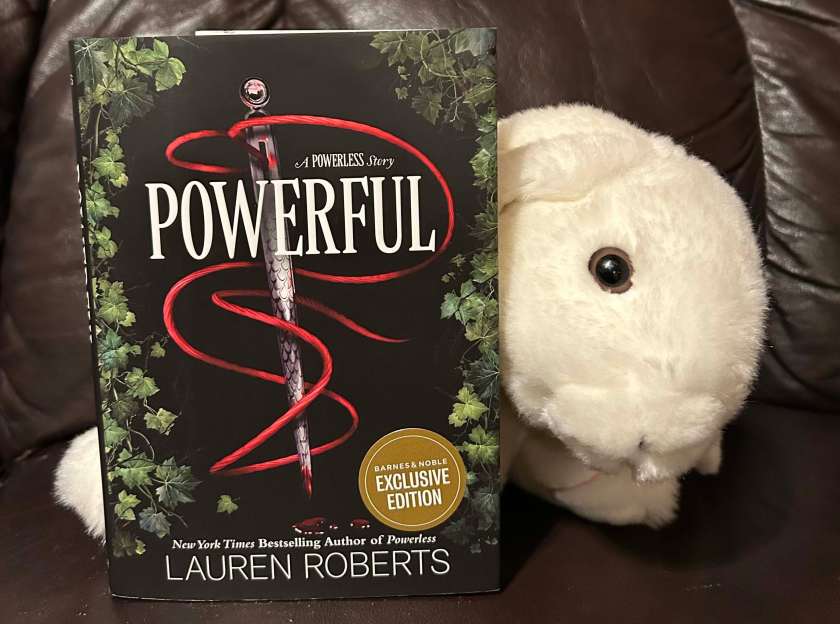
Last year Marshmallow reviewed Powerless and Reckless by Lauren Roberts, the first two books of her Powerless trilogy. As we are getting ready for the release of the third book in the series, she finally decided to take a look at Powerful, a book published in 2024, which is set in the same world as the books of the trilogy, and placed in between the first two books chronologically.
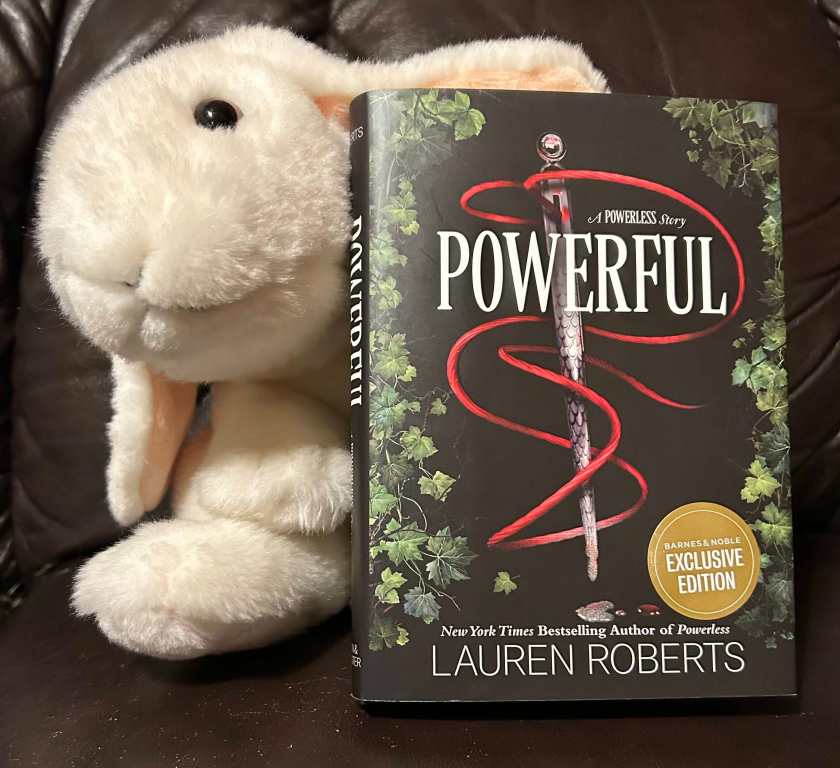
Marshmallow reviews Powerful by Lauren Roberts.

Marshmallow’s Quick Take: If you liked Lauren Roberts’ previous books or enjoy ‘romantasy’ novellas, then this is the book for you!

Marshmallow’s Summary (with Spoilers): Adena is a seamstress. She and Paedyn found each other whilst living—or trying to continue to do so—in the slums of Ilya. (Both Adena and Paedyn are from Powerless, so readers should probably have read that book before diving into this one.) Since then, they’ve been inseparable. Lauren Roberts’ previous books centered on Paedyn but, in this novella, Adena and Mak are the main characters. Mak is a new addition to the world of the Powerless series. He shows up in this book only (so far), but many fans of the book hope he will make an appearance in the main trilogy. During the main books, Paedyn gets selected to compete in the Trials so Adena is left alone in the slums. Before, Paedyn—an adept thief—would steal food for the both of them, while Adena sold her skilled handiwork. As a result of this arrangement, Adena is unable to procure food alone. So when Mak needs help (and offers to feed her in return), she cautiously accepts. Like Paedyn, Hera who is a person very dear to Mak was also chosen for the Trials. Mak wants Adena’s help in making a guard uniform so he can sneak into the king’s castle and say goodbye to her. He and Adena become allies with a shared goal. Buuuuttt, as expected, they start sharing more than just goals…namely, feelings—the romantic kind. Apparently, their dynamic is regarded as a classic trope: the grumpy sunshine trope. I’m not too into romance, but this was well-executed. Adena is somehow the sweetest person, despite having had to grow up in the slums. Mak is sarcastic, harsh, and (in my opinion) a little too mean to her. But over time, they start to warm to one another and find that they can share things with each other that they haven’t with anyone else. But as the Trials draw to an end, readers of the Powerless series will know, so is Adena.
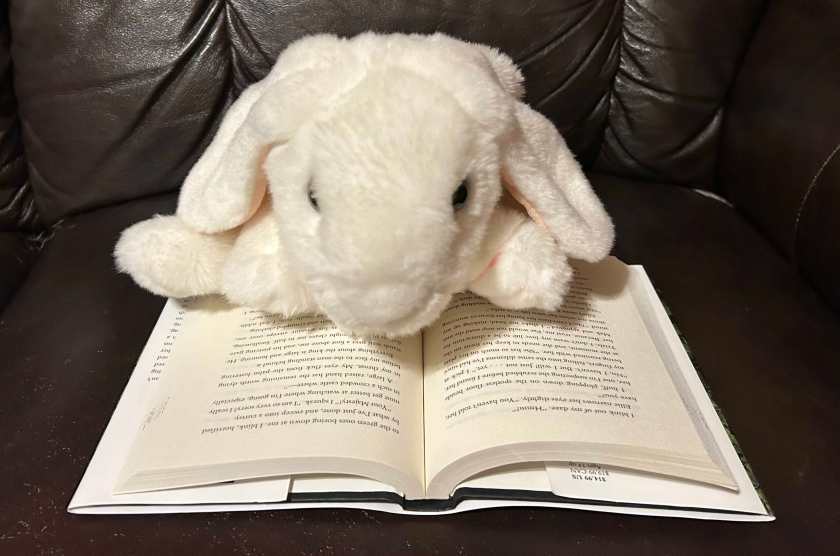
Marshmallow is reading Powerful by Lauren Roberts.

Marshmallow’s Review: This book, along with the Hunger Games trilogy, is one of the few books that have ever made me cry so hard. 🚨🚨🚨 MASSIVE SPOILER ALERT 🚨🚨🚨 In the main Powerless series, we saw Adena die, but I was in no way, shape, or form prepared for this to be so impactful. Caramel actually read this book before me and said it was really sad. But he must have a higher tolerance because this book made me contemplate how cruel the world is, that of Ilya and our own. This was a heart-shattering novella. Adena’s death in this book was much more impactful, partly because we saw her more. It shows that getting to know someone impacts how much empathy you have for them. I think books like these are necessary so we understand how human everyone is, even if you’re from different places with different beliefs. Even if you’re a bunny. Everyone deserves empathy, even if they’re not as pure and kind as Adena. I would definitely recommend this to everyone, because (like The Hunger Games and A Tale of Two Cities) I think this book has really made me think about what kind of bunny I want to be, how I want to act, how I want to live my life, and how I want to make the world a better place for all bunnies.

But this was such an emotionally devastating experience that I would not recommend it to children younger than fourteen. There is some romantic  tension throughout, but it doesn’t culminate into anything too inappropriate. There is passionate kissing but nothing at the level of the Me series (which in my opinion, was a little too much). The ending is also very graphic and disturbing. Psychologically and philosophically, I found this to be a very disturbing book. This definitely made me think a lot about how humans can be cruel in ways I literally cannot seem to find words for. Again, I would not give this to a child younger than fourteen, unless they’re able to think about and comprehend the moral and emotional implications. Even without thinking about how this reflects on our world, I think this book is an amazing work of art. Considering the meaning makes this a masterpiece that reveals what is left out in so many stories. How many times has the extra who got killed off in season one gotten a story? Adena was more than that for the series, but this book pays homage to all those people who were an afterthought in the plot. 

Marshmallow’s Rating: 100%

Marshmallow rates Powerful by Lauren Roberts 100%.

Marshmallow reviews There’s A Hair In My Dirt! A Worm’s Story by Gary Larson

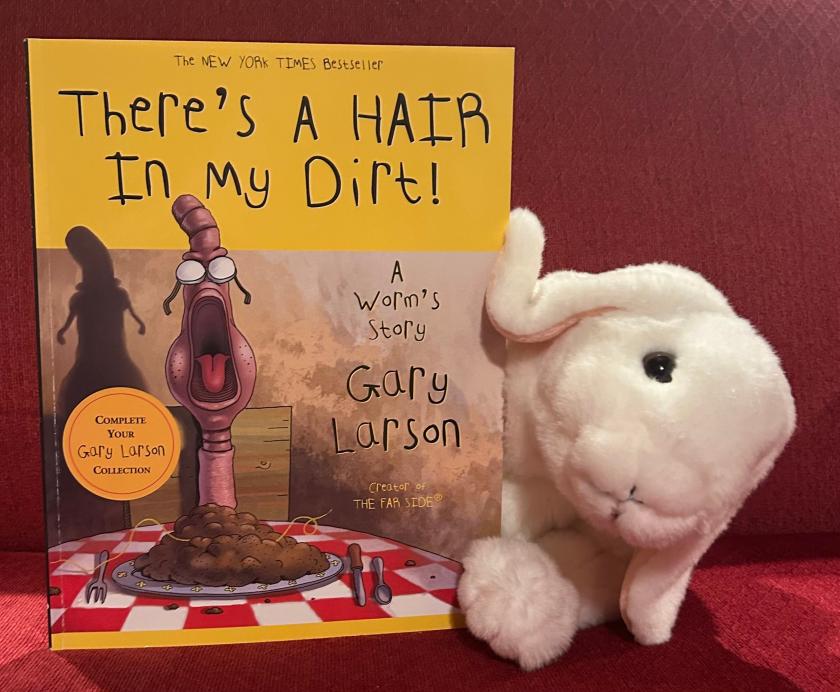
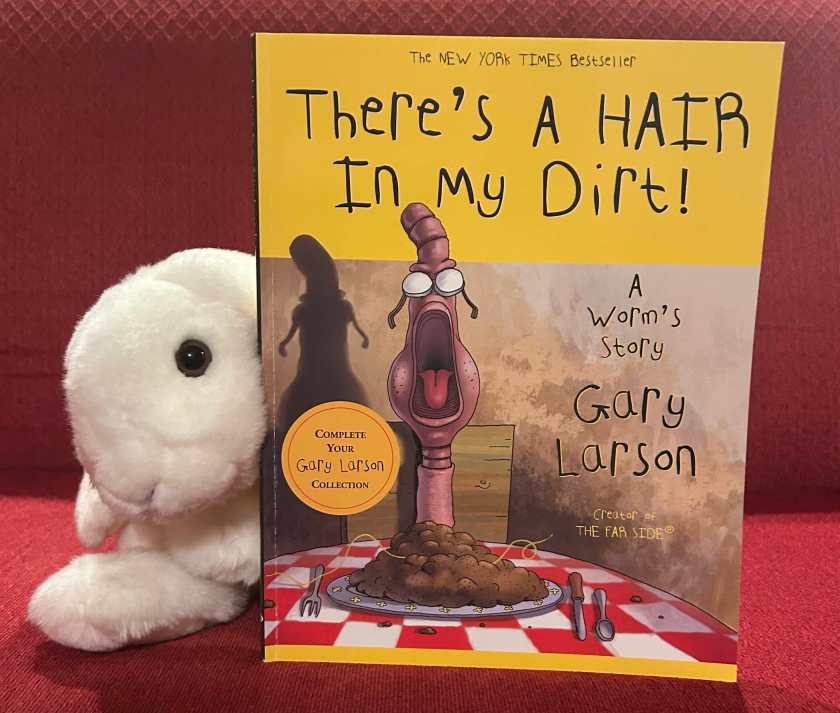
Today Marshmallow is reviewing There’s A Hair In My Dirt! A Worm’s Story by Gary Larson, first published in 1998. A fan of Larson’s The Far Side, Sprinkles is asking questions and taking notes.

Marshmallow reviews There's A Hair In My Dirt! A Worm's Story by Gary Larson.
Marshmallow reviews There’s A Hair In My Dirt! A Worm’s Story by Gary Larson.

Sprinkles: So Marshmallow, tell us a bit about what you thought when you first saw this book.

Marshmallow: I felt very surprised that Gary Larson had written a children’s book. I really like his Far Side comics, and we have a collection of them at home –and maybe we should review them some time!

S: Yes, maybe we should some day. But you are right. Larson is most well-known for his Far Side cartoons. But then you read this book and realized that maybe it is not quite a children’s book, right?

M: Nope. Do not have your children read this book!

S: Wait! Really? I mean, it is a bit rough for younger bunnies, and it is quite long for them, too, at 64 page, but older bunnies like yourself can appreciate it, I thought.

M: Yeah, I guess so. But it is kind of dark and even morbid. Then again, it is kind of a fable, with some underlying messages, which are thought-provoking. You are right, I guess bunnies my age and the like might appreciate the book. But I was definitely surprised and was not expecting how dark it would get.

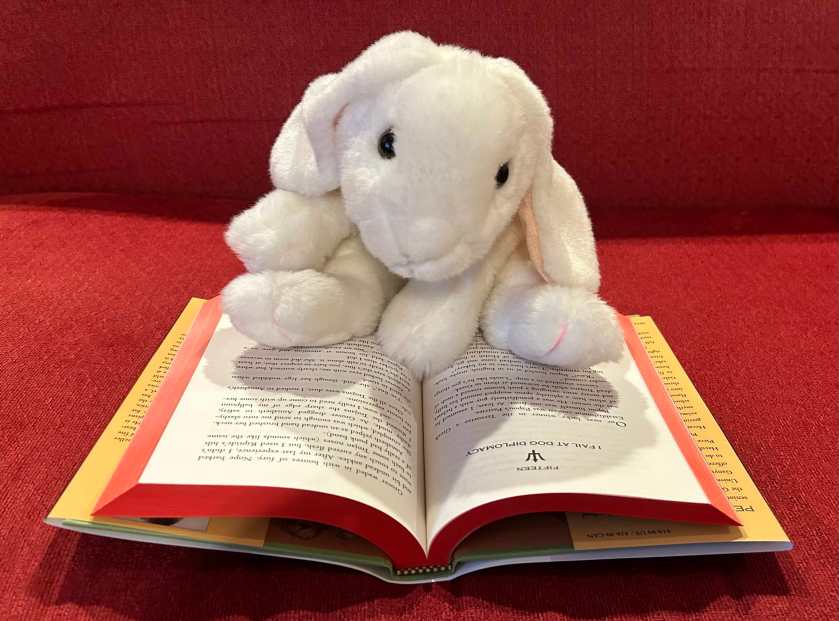
Marshmallow is reading There's A Hair In My Dirt! A Worm's Story by Gary Larson.
Marshmallow is reading There’s A Hair In My Dirt! A Worm’s Story by Gary Larson.

S: Okay, so maybe we should start from the beginning and tell our readers what the book is about.

M: Sure. This book is about a little earthworm who is eating his dirt dinner in his family’s hole in the ground. And he finds a hair in his dirt and starts complaining to his earthworm parents. He hates being an earthworm, he hates living underground. He hates not having legs and having to eat dirt. And so on.

S: Totally understandable of course.

M: Of course. But then his father starts to tell him a story about a girl named Harriet. And then the rest of the book is basically Harriet’s story. Harriet lives near a forest and goes through the forest one day, seeing all sorts of animals interacting with one another, and she always has a positive outlook, thinking about Nature admiringly and yet not really comprehending what is really going on around her.

S: Yes, the foreword for the book is written by the famous biologist Edward O. Wilson and he writes “The maiden, as you will see as the narrative unfolds, might have enjoyed her saunter better if she understood.”

M: And it is not just a matter of enjoying; it costs her dearly that she does not understand. It is a little disturbing actually, because Harriet loves Nature, or what she thinks it is. And she wants to help and she is trying to be a good steward of living things, but since she does not know how things are all connected, she ends up harming the forest and herself.

S: This reminds me of this song “We Are All Connected” which some people made by putting together a few words from four outstanding science communicators:

M: Yeah, I like that song!

S: But let us not go further into the story because I think we might be getting too close to giving away some of the plot. Tell me, Marshmallow, what did you think about the illustrations?

M: It is in full color, and obviously it is Gary Larson, so all characters are distinctive, and they have very evocative expressions. It is very amusing to study them actually. The topic is complicated and nuanced, that we are all connected, and that, as Edward O. Wilson puts it, “Life is tough!” But Gary Larson’s drawings are often hilarious and you can’t help but laugh on almost every single page. Or raise your eyebrows in a shocked and yet amused manner. The mother earthworm is wearing those cat-eye glasses!

S: I know, right? Each page is itself a Far Side comic, almost. But they are all telling a coherent story, and it is an important one.

M: I agree. I do not really love the last page, but I agree. The message is important. And no, if you get a hold of this book, please do not just turn it to the last page to see what I mean! It will work much better if you read the book in the proper way.

S: And I agree with you, Marshmallow. This is a thought provoking book, not as light reading as one might imagine, but definitely amusing to look at, too. So maybe this is a good place to wrap up our review. What do you think?

M: Sure. Let’s.

S: What would you like to tell our readers?

M: Stay tuned for more amazing reviews from the book bunnies!

Marshmallow rates There's A Hair In My Dirt! A Worm's Story by Gary Larson 100%.
Marshmallow rates There’s A Hair In My Dirt! A Worm’s Story by Gary Larson 100%.

Marshmallow reviews The Rabbits’ Rebellion by Ariel Dorfman and Chris Riddell

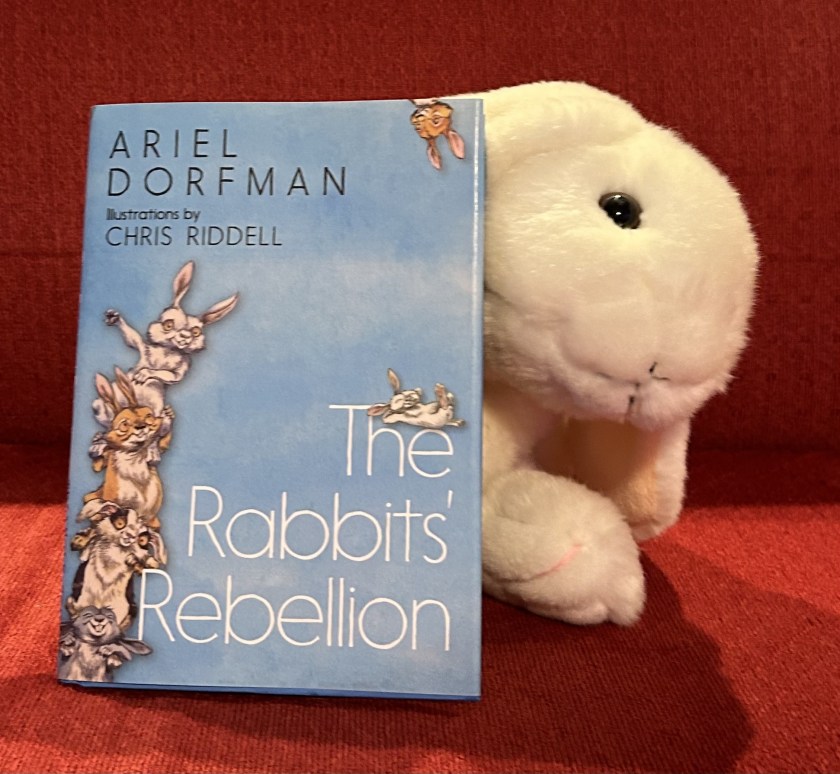
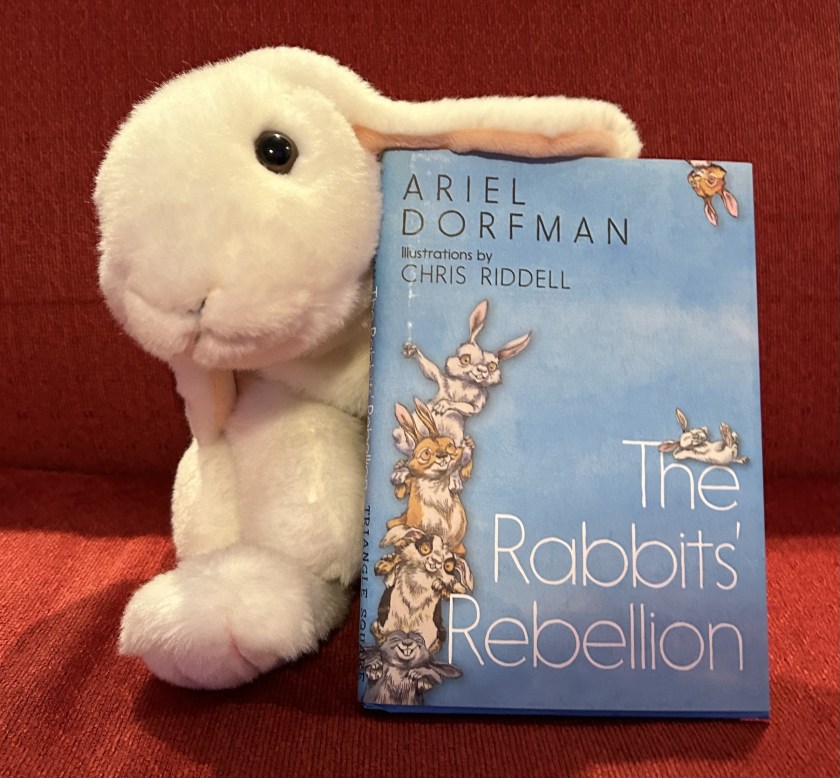
Today Marshmallow reviews a little book with a big message, first published in 2020: The Rabbits’ Rebellion, written by Ariel Dorfman and illustrated by Chris Riddell.

Marshmallow reviews The Rabbits' Rebellion, written by Ariel Dorfman and illustrated by Chris Riddell.
Marshmallow reviews The Rabbits’ Rebellion, written by Ariel Dorfman and illustrated by Chris Riddell.

Marshmallow’s Quick Take: If you like children’s books about animals and clever political commentary, then this is the book for you!

Marshmallow’s Summary (with Spoilers): When the wolves invade the land of the rabbits, the Wolf of all Wolves crowns himself king and begins to make some wild claims. First of all, he—feeling quite omnipotent that day—declares that rabbits don’t exist. He bans any reference to them in books (by personally crossing them all out) or in conversation. Unfortunately, birds can fly and report seeing some, which spread rumors that perhaps rabbits do exist.

The king then decides then, if (as his fox advisor says) “seeing is believing,” he’ll make his subjects see exactly what type of a ruler he is. So he commands an old monkey to take regal photos of him to be put up in every town square, every neighborhood, and in every house. He forces the birds to carry these posters, tying their feet to an “endless” cord to make sure they can’t escape. Naturally, the old monkey is terrified of the king and bends to his every whim and want. In other words, he says, too, that rabbits don’t exist. On the other hand (or paw!), the monkey’s daughter—with the fearlessness of innocence—knows that rabbits do exist even though her parents make sure to censor her whenever it becomes necessary.

But that’s just the beginning of the old monkey’s struggles. Every time he takes a photo of the wolf king, there is some hint of a rabbit in the background. When the king shatters the beavers’ dam (which took them three years to build), there are two rabbits sitting on the grass in front of the camera. When the king snarls in the most ‘majestic’ manner, a long, fuzzy ear shows up in the corner. This is most problematic because the monkey can’t show the king photos that go against his rule that rabbits don’t exist. So he doctors his photos after they develop, erasing any and every trace of rabbit hair, ears, or tails.

As the king becomes increasingly more controlling, more egotistical, and more tyrannical, the monkey must keep taking photos and editing them. Despite the king’s advisor tightening security around the photo shoots (he doesn’t want the king to know about the rabbits either—it would look bad on him), the rabbits persistently keep up their rebellious photo-bombing. But how could they, when they don’t exist?

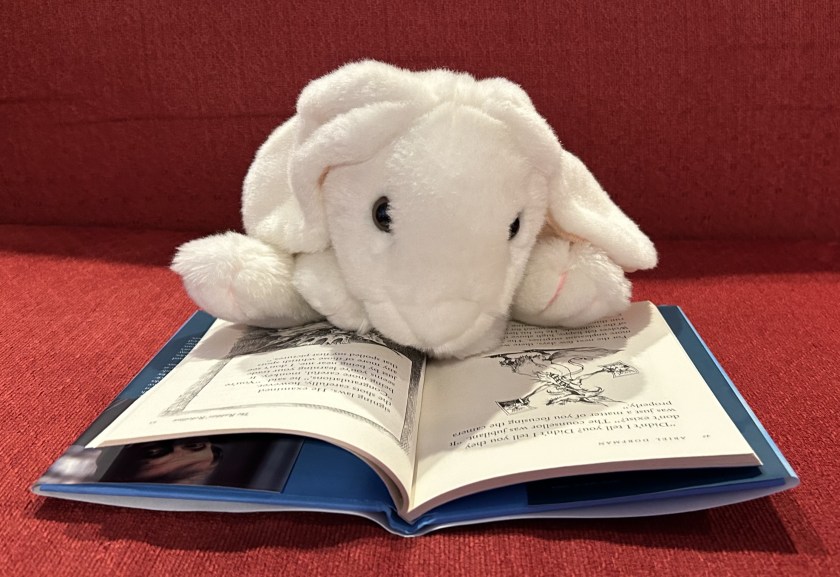
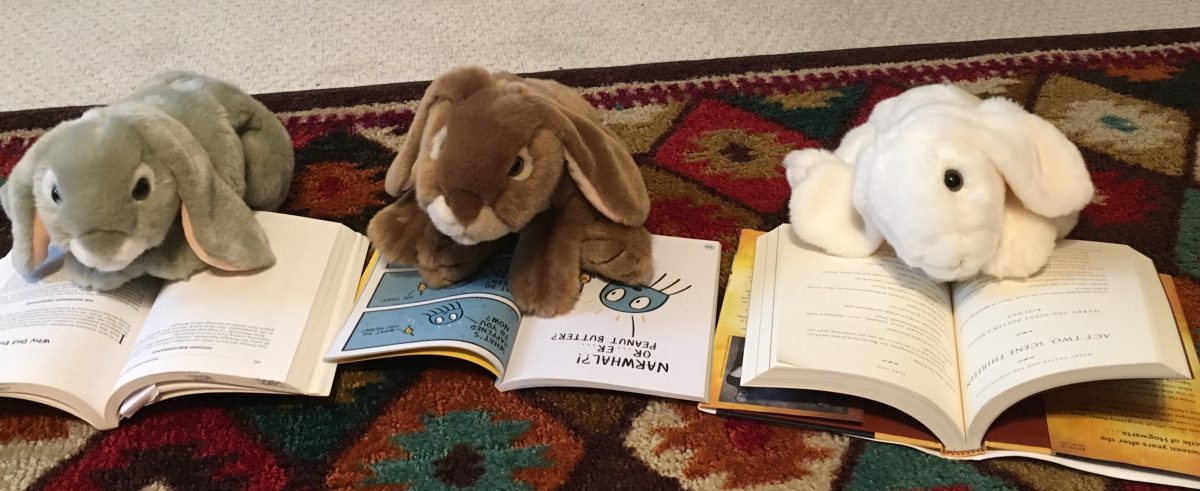
Marshmallow is reading The Rabbits' Rebellion, written by Ariel Dorfman and illustrated by Chris Riddell.
Marshmallow is reading The Rabbits’ Rebellion, written by Ariel Dorfman and illustrated by Chris Riddell.

Marshmallow’s Review: The Rabbits’ Rebellion is a really good book! It is written as a book for little children, and it reminds me of some Roald Dahl books I read earlier. Roald Dahl was unique in a way because his books could be read as childish tales, but they also touched on deeper topics. Likewise, the meaning of Dorfman’s book might not be understood by very young readers even though they would still enjoy reading about these mischievous rabbits who insist on existing! (Go, bunnies! Of course I cannot be too impartial here.)

At its core, The Rabbits’ Rebellion is about authoritarianism and dictatorship. The king’s suppression of truth, especially a truth that is so obvious, is in a way an almost comically extreme example of an Orwellian dystopia. In a way, this book is like Animal Farm or Nineteen Eighty-Four for young children. Except—spoiler alert—this one ends better than both of those books.

The Rabbits’ Rebellion is entertaining even if you don’t catch this theme. It is kind of like how one might enjoy reading parts of Animal Farm even without digging into the allegory. But Animal Farm ends at a quite depressing place for young bunnies to really enjoy it all the way to the end. Similarly, I learned that some parents have complained that the ending of The Rabbits’ Rebellion is too graphic to make it appropriate for a calm bedtime. So readers beware!

I found it interesting that the world of this book is so different yet also very similar to ours. There is no magic, but they do have cameras and books. Remember how in Maus the whole story only involved mice and a few other types of animals, but we could see our own world in it? Just in the same way, the differences and the similarities despite those differences help convey Dorfman’s message very clearly.

All in all, The Rabbits’ Rebellion has a really poignant yet simple plot and is a very thought-provoking book even though it is extremely short (only 63 pages). Written in large font and with really beautiful illustrations that evoke a serious, fairy-tale feel, it is quite easy to read, too. I think it could be a great way to introduce children to political thought and discussion. (I might reread Nineteen Eighty-Four as a result of reading The Rabbits’ Rebellion, because this book really reminded me of it.) Overall, I would definitely recommend this book to bunnies young and old, who both will find it entertaining (perhaps intellectually) and thought provoking. 

Marshmallow’s Rating: 100%.

Marshmallow rates The Rabbits' Rebellion, written by Ariel Dorfman and illustrated by Chris Riddell 100%.
Marshmallow rates The Rabbits’ Rebellion, written by Ariel Dorfman and illustrated by Chris Riddell 100%.

Marshmallow reviews The Wrath of the Triple Goddess (Book 2 of Percy Jackson and the Olympians: The Senior Year Adventures) by Rick Riordan

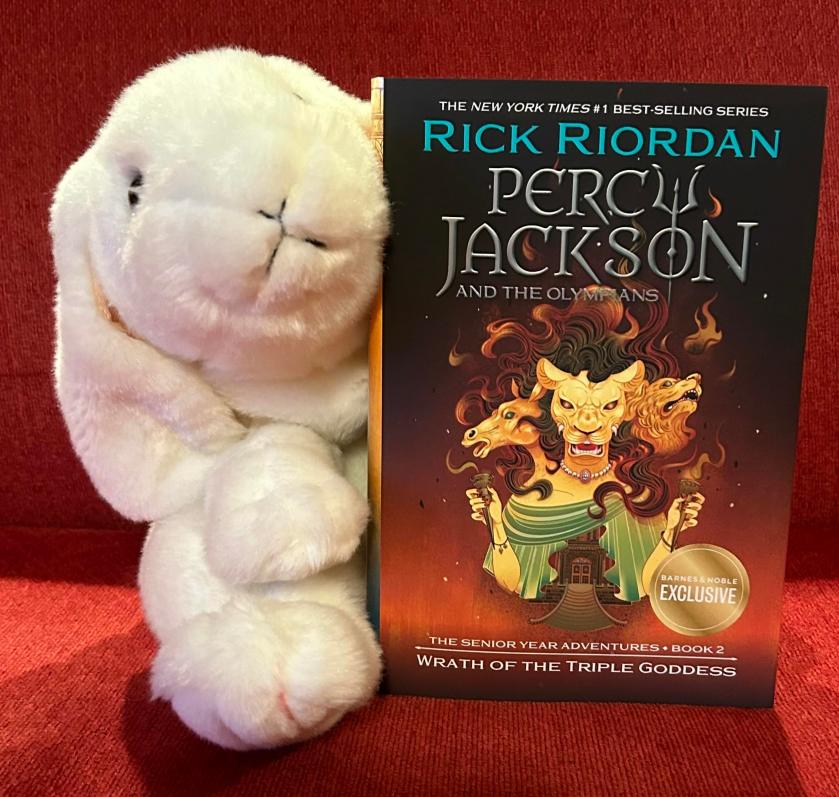
The book bunnies have read and reviewed many books by Rick Riordan through the years. Today Marshmallow reviews a relatively new one: The Wrath of the Triple Goddess was published in September 2024 as the second book of Riordan’s new series: Percy Jackson and the Olympians: The Senior Year Adventures.

(Marshmallow had already reviewed the first book in the series, The Chalice of the Gods back in September 2023.)

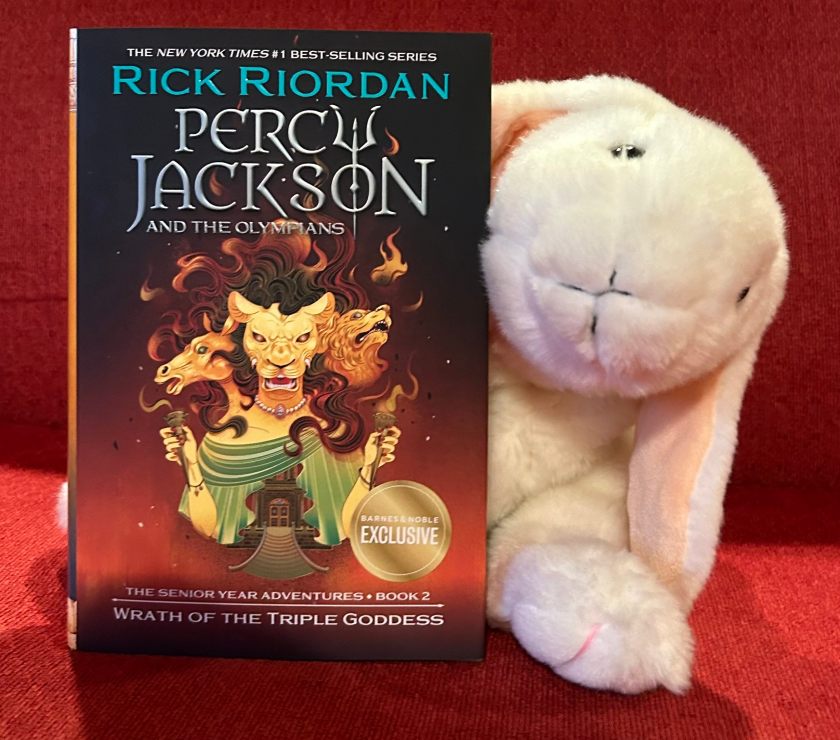
Marshmallow reviews The Wrath of the Triple Goddess (Book 2 of Percy Jackson and the Olympians: The Senior Year Adventures) by Rick Riordan.

Marshmallow’s Quick Take: If you liked Rick Riordan’s previous books, enjoy books based on Greek history and mythology, or just like reading fun books about family and friendship, then this is the book for you!

Marshmallow’s Summary (with Spoilers): Percy Jackson has had enough to worry about. As the son of Poseidon, his world is one of danger and death. Sure, he has an amazing family, awesome friends, and heroic adventures, but his senioritis is starting to get to him. As he approaches his graduation for New York City’s Alternative High School, Percy wants to apply to New Rome University, located in Camp Jupiter (the protective home of the Roman demigods, which was first introduced in The Lost Hero). Specifically, he wants to go to New Rome to be with his girlfriend Annabeth (a fellow demigod and the daughter of Athena) with whom he has shared many trials and tribulations. But in order to get into New Rome University, he has to get three letters of recommendation from three different Greek gods for completing quests for them.

In the first book of The Senior Year Adventures series, Percy got one from Ganymede, the cupbearer of the gods for retrieving the titular Chalice of the Gods. Now, he has been tasked with another quest, this time by Hecate the goddess of magic: he has to babysit her pet polecat Gale and hellhound Hecuba during the week of Halloween. Simple, right?

Percy accepts the assignment for two reasons. First, he’d probably end up as some unsavory type of animal if he didn’t, and, secondly, he needs that letter. So Percy, Annabeth, and Grover (Percy’s best friend who happens to be a satyr) stay over at Hecate’s house to complete this quest. But magical pets cause magical problems that need to be fixed … especially when Grover accidentally sets them loose in New York City. Can Percy and his friends find them before Hecate turns them all into candy corn?

Marshmallow is reading The Wrath of the Triple Goddess (Book 2 of Percy Jackson and the Olympians: The Senior Year Adventures) by Rick Riordan.

Marshmallow’s Review: I really enjoyed reading this book! It gave me nostalgia for the original Percy Jackson series while simultaneously getting me hooked on this new one. I don’t always like add-on series for franchises—for example, I love the Harry Potter series, including many of the supplements like The Unofficial Ultimate Harry Potter Spellbook and The Unofficial Harry Potter Bestiary, but in retrospect, I didn’t like The Cursed Child quite as much. But—perhaps because the time jump is not as jarring—this book makes an excellent addition to the Percy Jackson world of Greek mythology and magical adventure. Rick Riordan clearly hasn’t lost his touch and his authentic writing voice that makes his books so amazing to read! I love the way The Wrath of the Triple Goddess jumps right back into his world, starting to further develop the characters and their lives.

Overall, there wasn’t a single part of the plot that made me sad or disappointed in this book. I can’t speak for all Rick Riordan book fans, but I found The Wrath of the Triple Goddess to be a really fun addition to the franchise and I didn’t find any flaws.

I should also note that while this book was really fun, it was also surprisingly nuanced. This is something I think Riordan excels at. He composes text that is extremely exciting and entertaining to read, but he also makes the reader think. I think Riordan is very sensitive and finds a way to make all of his characters have many dimensions. Even in the original series, all the heroes and—most admirably—villains are fully developed characters who have stories and backgrounds that have shaped them to be the way they are in the story. In this book, in particular, I thought that Riordan did a great job for Gale (the polecat), Hecuba (the hellhound), and Hecate (the goddess of magic). For example, Riordan introduces Gale as a comedic, farting pet but eventually peels back the layers to reveal the deep injustice of her past, her astounding strength, and her raw talent. Hecuba, who is set up as a dog who is hard to walk, is transformed into a tragic hero. And Hecate’s history is uncovered by Riordan, step by step. Riordan, I have noticed, has a remarkable ability to paint these Greek gods as powerful, immortal, incomprehensible beings, yet also simultaneously and unmistakably human. This level of nuance and depth is not as recognized as it should be, given the fact that Riordan accomplishes this in a children’s book while writing the funniest lines known to bunnykind. 

On a final note, the plot is fantastic! I am really excited for the third book of The Senior Year Adventures to come out. Riordan Wiki and Reddit claim the next book will be out some time in 2025 or 2026. I can’t wait to read it!

Marshmallow’s Rating: 100%

Marshmallow rates The Wrath of the Triple Goddess (Book 2 of Percy Jackson and the Olympians: The Senior Year Adventures) by Rick Riordan 100%.