Marshmallow reviews How to Speak Emoji by Fred Benenson

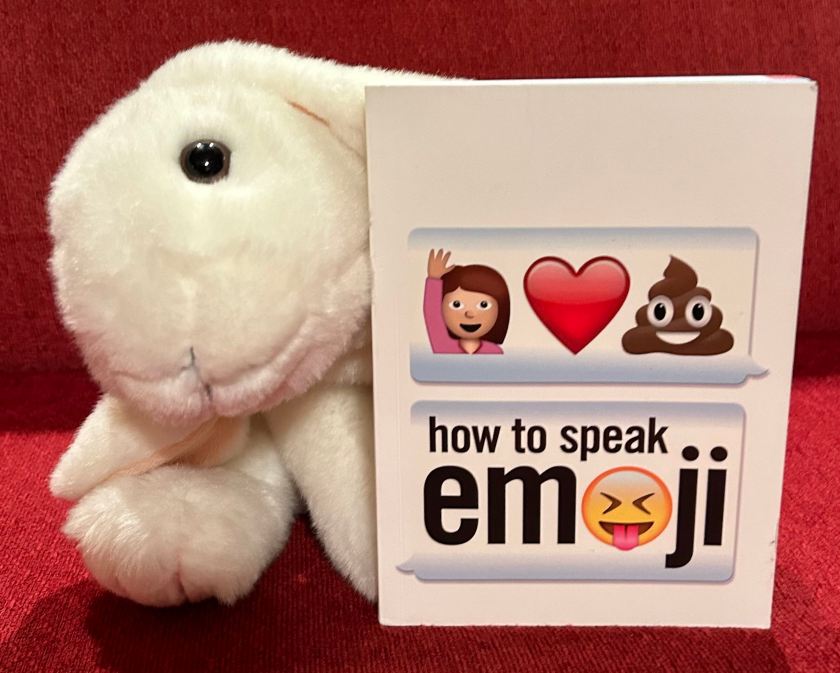
Today Marshmallow wanted to talk about a little book on emoji originally published in 2015: How to Speak Emoji by Fred Benenson.
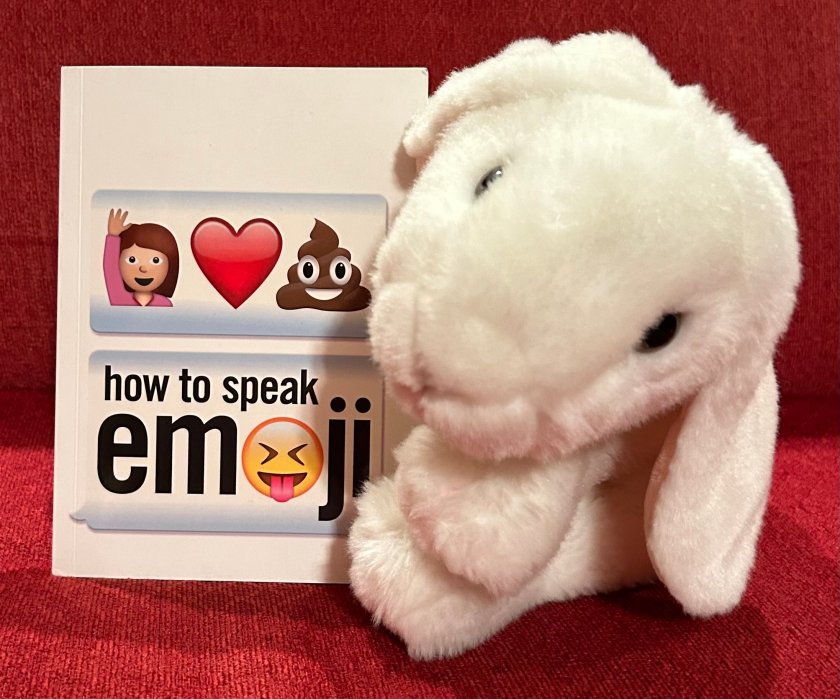
Marshmallow reviews How to Speak Emoji by Fred Benenson.

Marshmallow’s Quick Take: If you like funny books about how to do something or books about popular culture, then this might be the book for you. 

Marshmallow’s Summary (with Spoilers): In this book, Fred Benenson creates a useful glossary that you can use to navigate text conversations using emojis. Though this book is nonfiction, and is meant to be informative, some of the emoji strands have humorous meanings.

In the first part of the book, there is a list of the meanings of singular, specific emojis. These can get a bit subjective. For example, the author writes that the 💅 emoji means “Ooh, fancy!” And the 🆗 emoji means “grudging approval”.

After the initial, brief glossary, there is an emoji phrase book. The phrases in this vary by section. There is one section for pickup lines (which get pretty, um, weird 🫤), a section for food and drink 🍔, a section for insults, and many more (including but not limited to technology, travel, medical/emergency, weather, the Twelve Days of Christmas, etc ♾️). Idioms like “an elephant never forgets” become 🐘🚫💭 and “above and beyond” becomes 👆➕🔭🌌 (this is in the idioms section). These sections are all very entertaining, and it is interesting to see how the author translates standard phrases and sayings into emojis. 
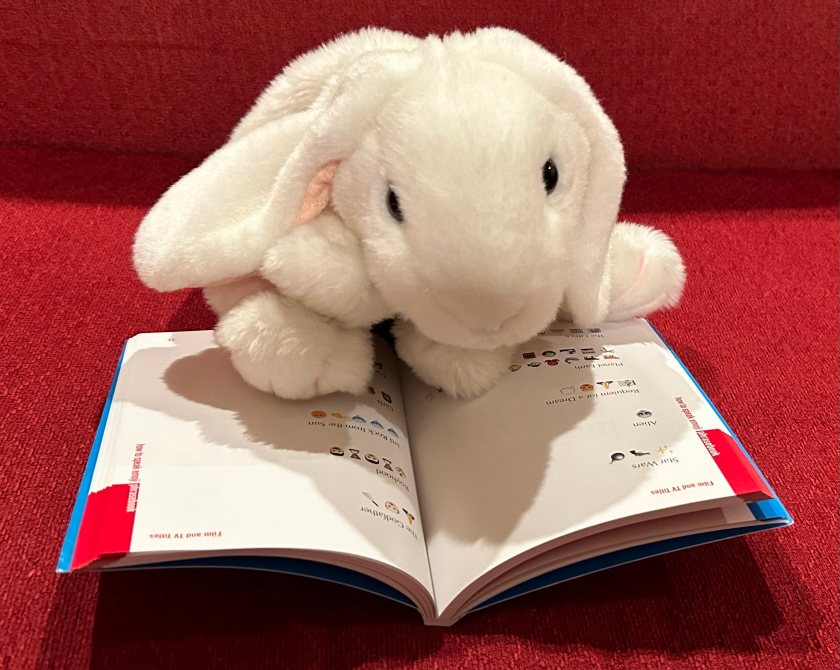
Marshmallow is reading How to Speak Emoji by Fred Benenson.

Marshmallow’s Review: You might be wondering, “Marshmallow 🤨🧐🤔 why would I want a book about the meaning of emojis when I can just google them?” My response to that question is that this book is also funny and teaches you how to communicate with emojis by themselves, which, admittedly, is not necessarily an essential skill but is definitely fun. And how can you not love a book which has the smiling poop emoji on its cover? I was a little sad to see that my favorite melting 🫠 emoji was not mentioned. However, it makes total sense because that is a new, quite recent (2023) addition to the vast army of emojis and only came out after this book was written (2015).

As a bunny who enjoys using emojis for the sake of using emojis, I liked this book a lot. Sometimes I find emojis that I don’t understand the meaning of, like this one: 🙃. And it is fun to learn how to use emojis to make phrases, and decoding them can be a fun game with friends and family. However, I would say that some of the content in this book is not appropriate for young bunnies, let us say, under the age of thirteen. Some of the phrases can be overly sexual. I just skimmed over those to get to the ones that were more amusing in my opinion. Otherwise however, this would be a very fun book for all readers. The sheer number of emojis and their complex meaning is fascinating 🤩 and this book does a good job explaining them.

Overall, this is a cute guide to using emojis 🥰 and I will take my knowledge gained from this to write this phrase: ⤵️📻➕😎📚🐰🐰🐰📋. (If you want, you can put your guess of what it means in the comments below!)

Marshmallow’s Rating: 98%

Marshmallow rates How to Speak Emoji by Fred Benenson 98%.

Marshmallow reviews The Phantom Tollbooth by Norton Juster

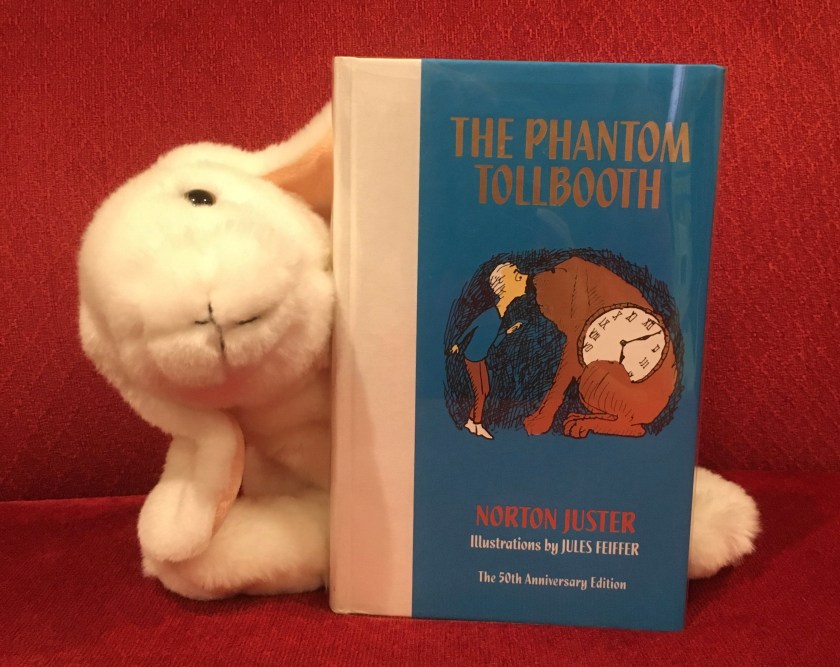
Today Marshmallow writes about The Phantom Tollbooth, written by Norton Juster and illustrated by Jules Feiffer. Marshmallow read the 50th Anniversary Edition of this 1961 classic.

Marshmallow reviews The Phantom Tollbooth, written by Norton Juster and illustrated by Jules Feiffer.

Marshmallow’s Quick Take: If you enjoy reading classics or appreciate books that make you think, then this might be the book for you. 

Marshmallow’s Summary (with Spoilers): Milo is a boy who doesn’t want to do anything. He wants to be in school when he isn’t; when he is in school, he wants to be out of it. Then one day, he receives a large package. Inside is a small tollbooth. As he has nothing to do, he starts to play with the tollbooth and finds himself in a strange land when he drives his toy car through it. Luckily, the tollbooth came with a map of this place, and he was driving around in a small motorized car.

As he drives around in this new land, he goes to many strange places. In one place, he becomes friends with a literal watchdog, Tock, who is a dog with a clock on his side. He goes to the kingdom of Dictionopolis where he meets strange people and learns that Rhyme and Reason, two princesses, have been locked away in a Castle in the Air, because the king of Dictionopolis, Azaz the Unabridged, and the king of Digitopolis, the Mathemagician, who also happens to be Azaz’s brother, disliked one of their verdicts. The Princess of Pure Reason and the Princess of Sweet Rhyme were asked by Azaz the Unabridged and the Mathemagician whether numbers or letters were more important. When Rhyme and Reason said that both were equally important, the two kings banished the princesses.

Milo and Tock, accompanied by the Humbug, who was assigned to be their guide by Azaz, must go and rescue the two princesses. But unfortunately, demons and monsters guard the Castle in the Air. Milo, Tock, and the Humbug will need to journey across the “Land Beyond”, the name of the place Milo is in, to return Rhyme and Reason to their land. 

Marshmallow is reading The Phantom Tollbooth, written by Norton Juster and illustrated by Jules Feiffer.

Marshmallow’s Review: The Phantom Tollbooth is a great read, especially if you like language and wordplay. I really like how the author Norton Juster plays with words, like how one character is a watchdog, that means he is a dog with a watch in its side. Another character, the Which, is sort of like a witch, her real name being Faintly Macabre, meaning faintly gruesome, grim, morbid, hideous, or horrific.

I think that the wordplay must be a very big part of why this book is so widely read. Another reason might be because it is good for all ages, not too complicated or scary, though some of the wordplay might not make sense for younger readers. (I did not get most of them when I read it years ago.) I would highly recommend this book to everyone. In fact, I think I will suggest Caramel to read it too, soon. 

Marshmallow’s Rating: 100%.

Marshmallow rates The Phantom Tollbooth, written by Norton Juster and illustrated by Jules Feiffer, 100%.

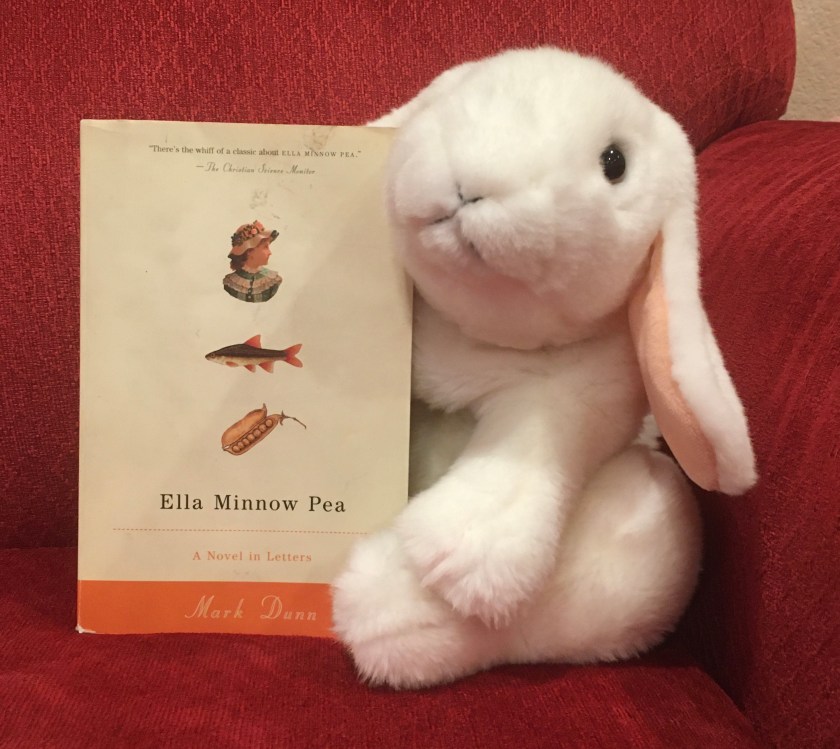
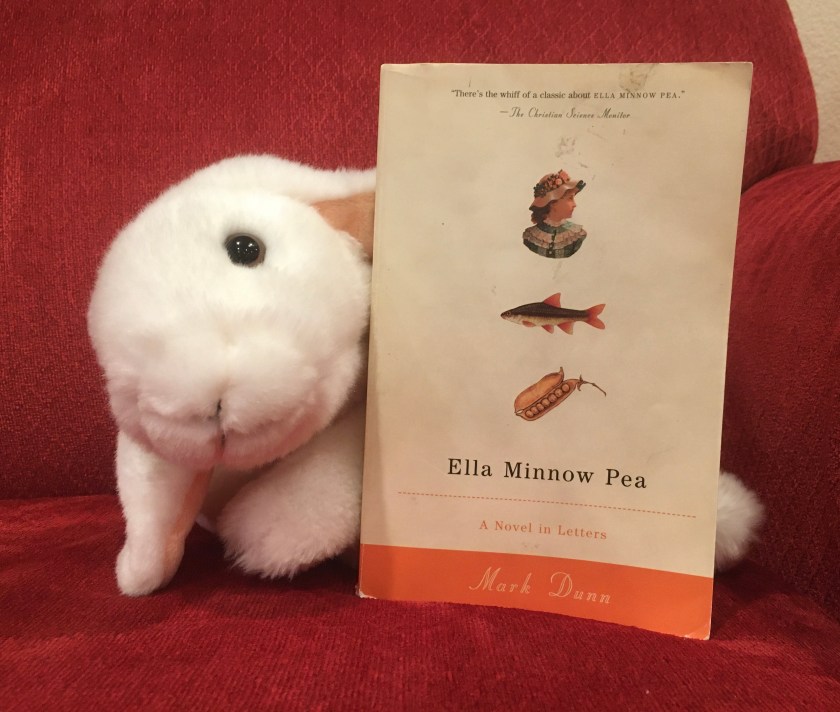
Marshmallow reviews Ella Minnow Pea by Mark Dunn

Today Marshmallow reviews the epistolary novel Ella Minnow Pea: A Novel of Letters by Mark Dunn, a book recommended to her by her school teacher.

Marshmallow reviews Ella Minnow Pea by Mark Dunn.

Marshmallow’s Quick Take: If you like books about free speech or books about fighting against suppression, or alternatively if you like playing with letters and thinking about language, then this might be the book for you. 

Marshmallow’s Summary (with Spoilers): Ella Minnow Pea lives on the fictional island of Nollop, which is home to Nevin Nollop, who is the supposed creator of the famous sentence, “The quick brown fox jumps over the lazy dog”, a sentence that contains all letters of the English alphabet. This sentence is on a memorial statue of Nevin Nollop in the island.

The people of Nollop think very highly of Mr. Nollop, so when the letters of the sentence on the memorial statue start to fall off, the Council says that it is Mr. Nollop who has spoken from beyond the grave. They claim that it is Mr. Nollop’s will that people stop using the letters that have fallen. So you can’t use words, or read books, or write words that have the letters that have fallen. Even if you use them by mistake, you are still punished. For the first offense, you are scolded publicly. For your second offense, you get lashing or stocks, the violator can choose. A third offense is punished by banishment, and if the violator refuses, death. You can see how this would make things difficult! As the story progresses, things get more and more complicated. 

Marshmallow is reading Ella Minnow Pea by Mark Dunn.

Marshmallow’s Review: I think that Ella Minnow Pea is a great book for kids eight and up because it has a well-written plot and developed characters. I say eight and up, because the plot is a bit complicated, so younger bunnies might have a harder time trying to understand what is happening.

This is especially true since Ella Minnow Pea is written in letters, like the book To Night Owl From Dogfish, which I reviewed before for this blog. It is interesting to read a book written in letters, because then you can see multiple people’s views, especially if they write in different styles.

Still if little bunnies want to read Ella Minnow Pea, they can read with their parents. This way if the younger ones don’t understand something, they can ask their parents. This can also help open up some of the important themes of the book.

The main theme in Ella Minnow Pea is freedom of speech because the Council is trying to have everyone stop using the words that fell from the statue. Once they lose the letter “D” they even change the names of the days, with Sunday becoming “Satto-gatto” for example. The book is about the importance of speech and language and how important it is for these to be free. In the end it is language (and people’s determination of course!) that saves the world.

Marshmallow’s Rating: 100%.

Marshmallow rates Ella Minnow Pea by Mark Dunn 100%.