Marshmallow reviews The Adventures of Tintin: The Calculus Affair by Hergé

Marshmallow likes graphic novels. And today she is talking to Sprinkles about a comic book that was published many years ago in 1956 though she only read recently: The Adventures of Tintin: The Calculus Affair by Hergé.
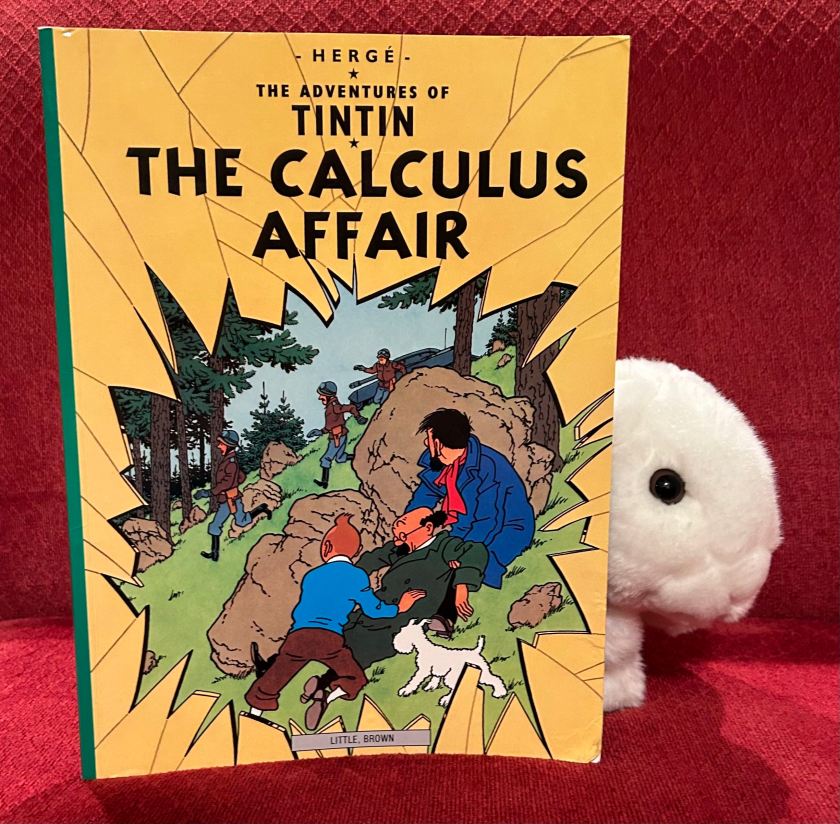
Marshmallow reviews The Adventures of Tintin: The Calculus Affair by Hergé.

Sprinkles: So Marshmallow this book was apparently published in 1956. Can you tell?

Marshmallow: I can tell that it is not contemporary. But I cannot really tell exactly what time the story is supposed to be happening.

S: That’s not too bad then. Tell me about the story.

M: What happens is that Tintin is visiting his friend Captain Haddock when suddenly everything in the house starts to break. They eventually learn that Professor Calculus has invented a device that can shatter glass. And soon this puts Calculus in danger because some people want to use his invention to make weapons.

S: And the book is about Tintin and Haddock trying to protect Calculus?

M: No. Calculus gets kidnapped so they have to find and rescue him.

S: Oh my. That sounds dangerous.

M: It does get a bit dangerous.

S: But of course since Tintin is the main hero, and Professor Calculus is apparently a recurring character in the series, we can imagine that he will be saved.

M: Yep. But no spoilers!

S: Okay. You are right.
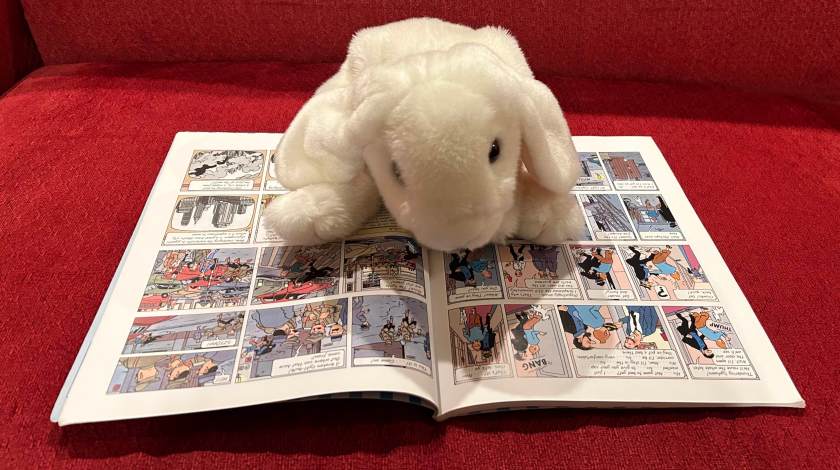
Marshmallow is reading The Adventures of Tintin: The Calculus Affair by Hergé.

S: I think this is the first Tintin story you have read, right?

M: Yes. I looked at it before but it did not seem too interesting for some reason. But when I picked it up this time, I was kind of drawn into the story much easier. Maybe it is more appealing to older readers.

S: Maybe. My sister really liked Tintin, but I never read his adventures. As you know I am not very good with graphic novels. But I knew there are a lot of fans of Tintin all around the world. So I am glad you read this. According to some, this is one of the best books in the whole series, and there are about 23 or 24 books.

M: Well, I am glad I read it, too. I really liked the drawings. I felt like they were really detailed and you could see or even feel the movement in some of them. When I was reading, I felt enveloped in the world of the story.

S: I think, given that you have read a lot of graphic novels, Marshmallow, that is pretty high praise from you. Especially for a book that is older than even me!

M: Well, what can I say? I think it is very well done.

S: Do you think you might want to know more about Tintin and maybe read more of the series?

M: Yes. I did read the Wikipedia article about it a bit and learned that Tintin is a Belgian journalist who solves mysteries. But I also learned that at least one of the earlier books was eventually seen to be seriously racist.

S: I can unfortunately imagine that something written about Africa in 1930s by a Belgian could be racist about Africans.

M: You know, the back of the book I have read does not even list that particular adventure. So I am guessing they do not want to even bring it up.

S: I can understand that too. I don’t think we will be reading that book any time soon.

M: Definitely not. But I might want to read some of the other books.

S: Alright. We will look into that then. Let us wrap this up now. How would you rate the book Marshmallow?

M: I’m rating it 95% because of the really awesome drawing and the interesting story.

S: That’s great, thank you. And what do you want to tell our readers?

M: Stay tuned for more amazing book reviews from the book bunnies!
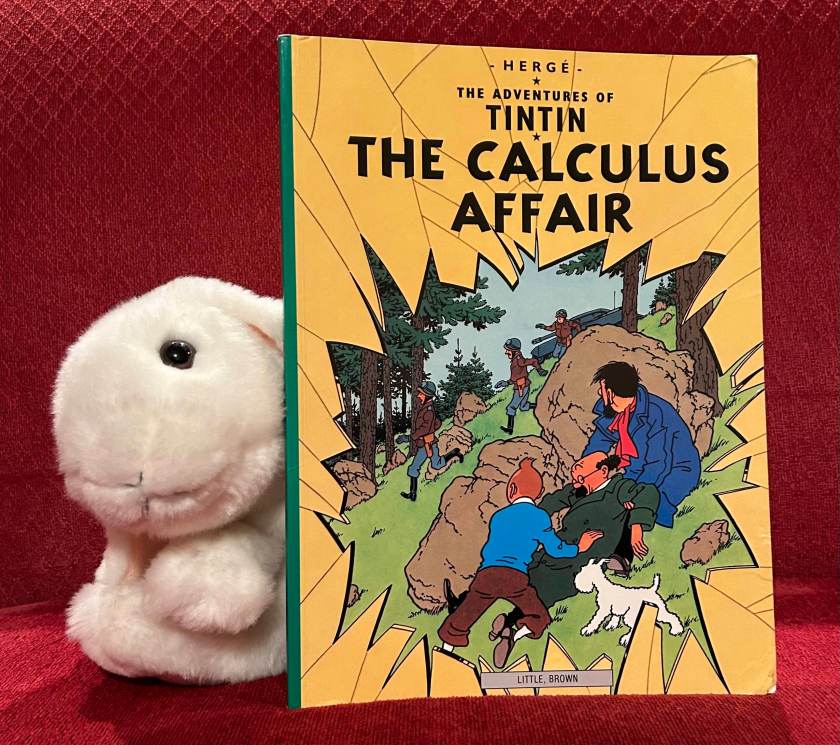
Marshmallow rates The Adventures of Tintin: The Calculus Affair by Hergé 95%.

Caramel reviews Moon Rising (Book Six of Wings of Fire) by Tui Sutherland and Mike Holmes

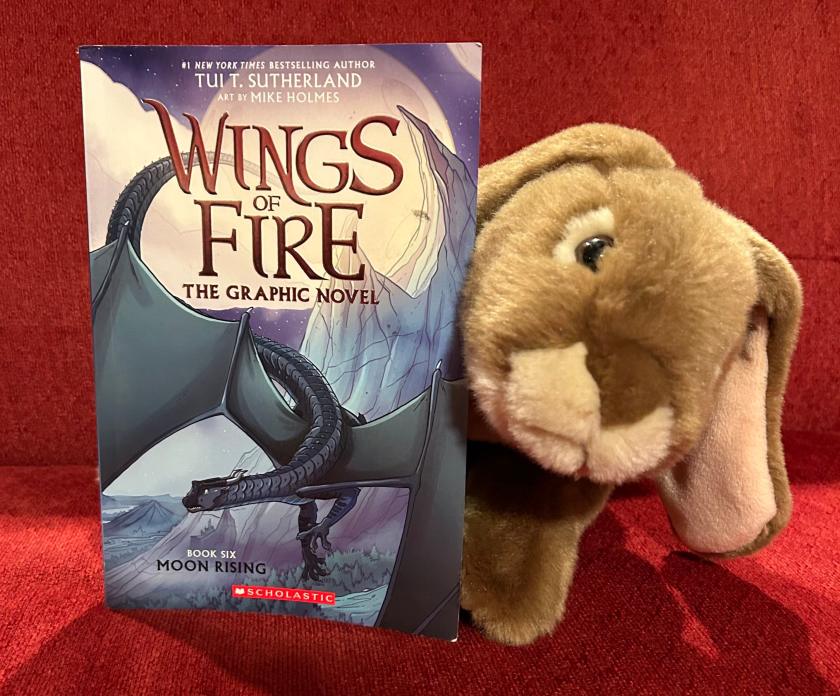
Caramel reviews the graphic novel version of Moon Rising (Book Six of Wings of Fire) by Tui Sutherland (with art work by Mike Holmes).

Caramel is a young bunny who loves dragons. In these last couple years, he has gone through all fifteen books of Tui Sutherland’s Wings of Fire series, and reviewed most of them. (His review of the fifteenth book, The Flames of Hope, contains links to all his reviews of the previous books.) He also loves graphic novels. So it was totally expected that when the graphic novel version of the sixth book in the series (Moon Rising) appeared, he just had to get his paws on a copy. Today, for his first review for the new year of 2023, he chose to talk about this book, written by Tui Sutherland, adapted by Barry Deutsch and Rachel Swirsky, with art work by Mike Holmes, and color by Maarta Laiho. As always, Sprinkles is taking notes and asking questions.

[You can see Caramel’s reviews of the graphic novel versions of the first five books here: The Dragonet Prophecy,  The Lost Heir,  The Hidden KingdomThe Dark Secret, and The Brightest Night.]

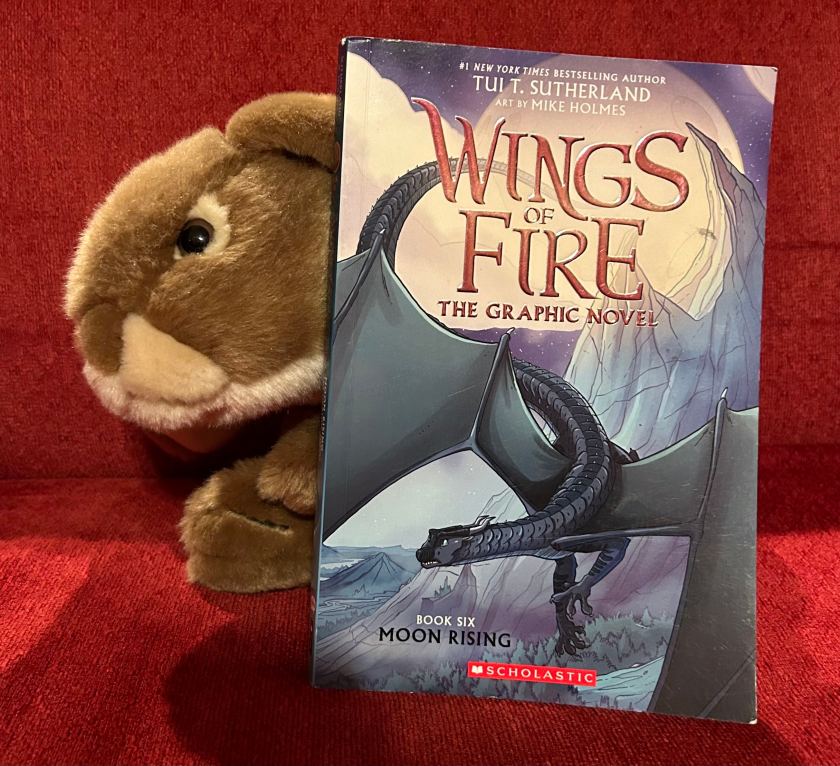
Caramel reviews Moon Rising (the graphic novel version of Book Six of Wings of Fire) by Tui Sutherland and Mike Holmes.

Sprinkles: So here we are, Caramel, back from our January break, and you have yet another Wings of Fire book to talk about!

Caramel: Yes! This is Moon Rising, the sixth book of the series. It is the first book of the second arc, Jade Mountain.

S: You reviewed the original version of Moon Rising for the blog before. And I know it was one of your favorites in the series.

C: Yes, I think it is my favorite after the fifteenth, fourteenth, and the tenth.

S: Well, that means it is one of your top three. That is neat. It means you really liked the book. How is this one?

C: Good. But different. The graphic novel versions are all really really different from the actual books.

S: How so?

C: I guess they have similarities, I mean the characters, the main plot lines, and so on, but the original books, they have so much more detail, it feels like you are there.

S: Well, the graphic novel usually does not have as much room for as many words, but the images can help you see the story, perhaps?

C: Yes, I like the pictures in the graphic novels.

S: Does how they depict the characters visually fit your view of them?

C: I guess. You mean do they look like what I think they should look like?

S: Yep.That’s what I mean.

C: Then yes. They do kind of look like what I think they should look like.

S: And since you have read the first five graphic novels before moving into the actual series, maybe they already set some of the imagery in your mind.

C: Maybe.

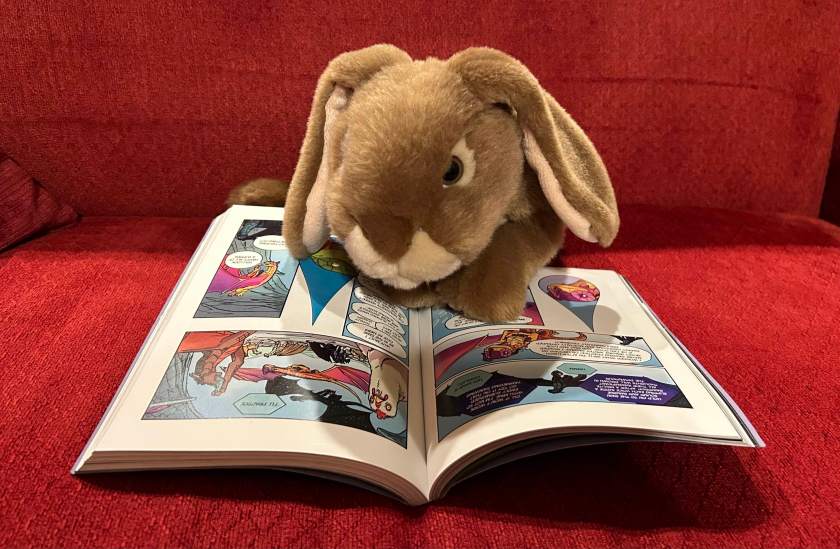
Caramel is reading Moon Rising (the graphic novel version of Book Six of Wings of Fire) by Tui Sutherland and Mike Holmes.

S: So let us come back to Moon Rising. Can you remind our readers what the plot line is?

C: This is about Moonwatcher, who is a NightWing, and she has a dark secret. She has three dark secrets actually, but I will only tell one.

S: Okay, do tell.

C: She can read minds!

S: Oh yes, I seem to remember that from your review of the original version of the book.

C: Well, the story is the same as that one. With few minor differences. In the original book, there is a little bit more said about MoonWatcher’s secret, and there are more clues to her other dark secrets. But I won’t tell you more about those!

S: I guess I will have to wait and see for myself when we get to the book in audio. Perhaps this is a good time to tell our readers that we as a household are listening to the Wings of Fire books as audio books, and we are only in the third book (Hidden Kingdom).

C: Yes, but we are going kind of slow.

S: I know. We only listen to one chapter a night, and that is optimistic, some nights we don’t listen at all.

C: That happens way too often.

S: I know you like these books a lot, and listening to them, I can actually see why. The characters are all so vividly developed, though so far I only really met Clay, Tsunami, and Glory as the main narrators of the first three books, and the latter two are both too sure of themselves. Not like confidence isn’t nice, but theirs is more like, I know how to do all things and I don’t need help.

C: Yes, but both of them learn that they do need their friends.

S: I guess I can see that happened to Tsunami in the second book and might eventually happen to Glory in the third. So how about the central character of Moon Rising? Is Moonwatcher also very confident?

C: No she is the complete opposite. She doesn’t believe she can ever do anything right. But she is actually pretty awesome too.

S: Okay, so you liked this book!

C: Yes, I liked the original too, but the graphic novel is also pretty great. I already read it like fifty times.

S: I’d not doubt that. I have been seeing it in your paws for a while now.

C: Yep. I like reading it and rereading it. And I can’t wait till the seventh book comes out as a graphic novel.

S: I know! You do love these books. I think it might be time to wrap up this review though. What would you like to tell our readers as we do that?

C: Stay tuned for more book bunny reviews!

Caramel loved to have the chance to finally read Moon Rising (the graphic novel version of Book Six of Wings of Fire) by Tui Sutherland and Mike Holmes and is eagerly awaiting the graphic novel version of the seventh book.

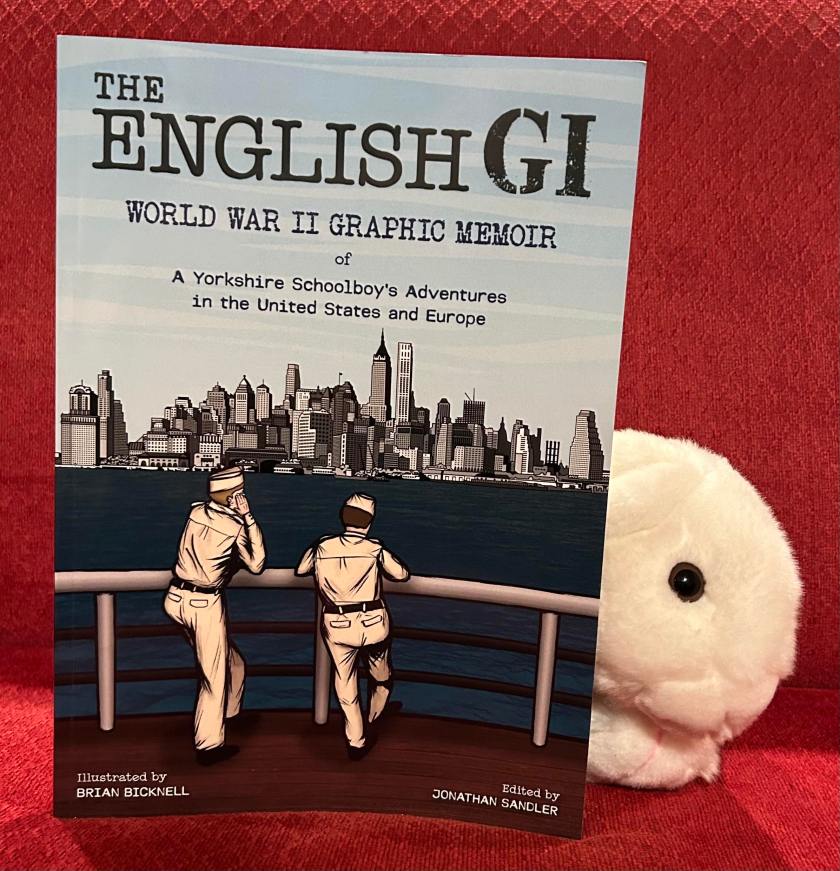
Marshmallow reviews The English GI by Jonathan Sandler and Brian Bicknell

Marshmallow, just like Caramel, enjoys and appreciates graphic novels of various types. As such she has reviewed several of these books for the book bunnies blog. Today she reviews another recent graphic novel, The English GI: World War II Graphic Memoir of A Yorkshire Schoolboy’s Adventures in the United States and Europe, written by Jonathan Sandler and illustrated by Brian Bicknell. Sprinkles was curious about the book too, and so she is taking notes while asking questions.

The book bunnies received this book as a review copy.

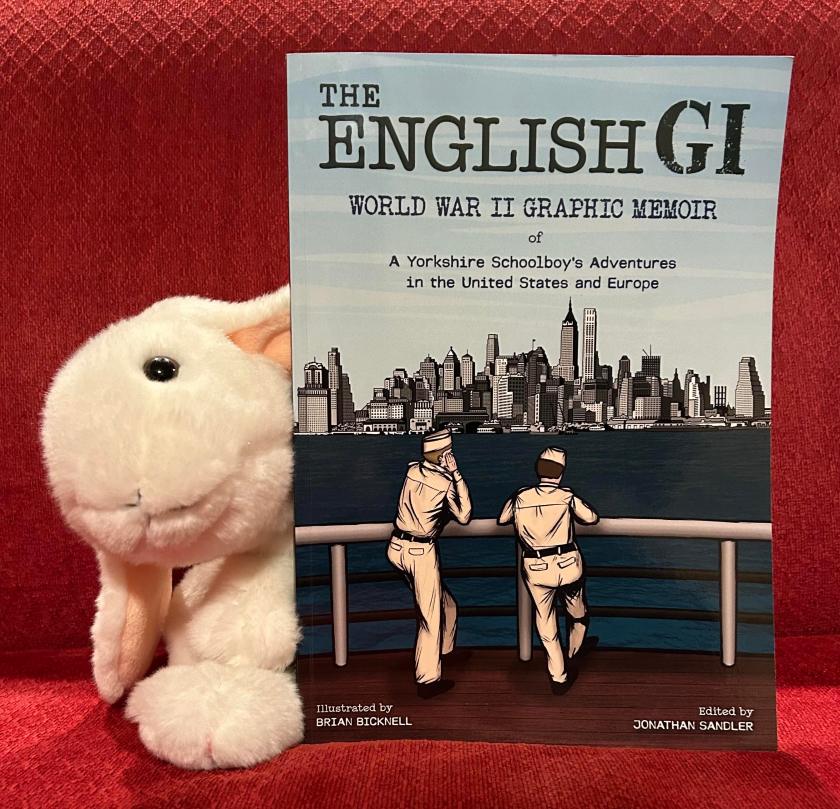
Marshmallow reviews The English GI: World War II Graphic Memoir of A Yorkshire Schoolboy's Adventures in the United States and Europe, written by Jonathan Sandler and illustrated by Brian Bicknell.
Marshmallow reviews The English GI: World War II Graphic Memoir of A Yorkshire Schoolboy’s Adventures in the United States and Europe, written by Jonathan Sandler and illustrated by Brian Bicknell.

Sprinkles: So Marshmallow, let us start with a quick summary. What is this book about?

Marshmallow: This book is about Bernard Sandler, a seventeen-year-old boy from Yorkshire, England, who goes on a school trip to the US. Then the second world war starts and he cannot go back home. He has to find his own way through life in a new country. And he eventually joins the US army and fights in the war too.

S: That sounds like a really rough path for a young person.

M: I think so too. But he does survive and he lives a good life. And the author is his grandson who wanted to tell his story.

S: That is so neat! A lot of families have stories to tell, but not everyone ends up writing them up for others to learn about. So the book is not fiction, then?

M: No. In fact there is a long epilogue at the end of the book, which takes almost a fourth of it actually, and it gives a lot of details about Bernard’s life and his family.

S: I did see that. It looked really well documented. And in some ways it reminded me of two books you reviewed before.

M: Which ones?

S: Nothing But The Truth by Avi and They Called Us Enemy by George Takei.

M: I see how the second one is similar. That too was about real life, written by George Takei, whose childhood was during the second world war, and he went through a lot of difficult times. How do you connect this book to Avi’s?

S: That book also had a lot of documentation, no? Though of course that was fiction, and this is a real story.

M: Hmm, I see. Yes, you are right. This is not quite a typical graphic novel; first off it is true, and then it has a lot of historical documentation that connects it to history.

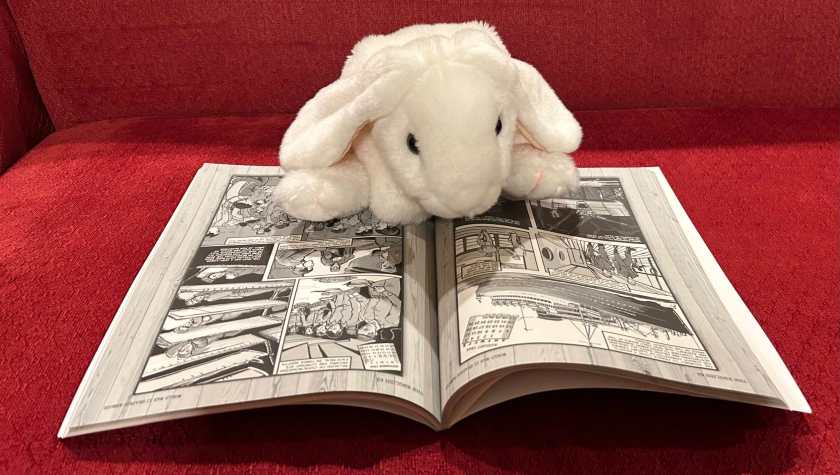
Marshmallow is reading The English GI: World War II Graphic Memoir of A Yorkshire Schoolboy's Adventures in the United States and Europe, written by Jonathan Sandler and illustrated by Brian Bicknell.
Marshmallow is reading The English GI: World War II Graphic Memoir of A Yorkshire Schoolboy’s Adventures in the United States and Europe, written by Jonathan Sandler and illustrated by Brian Bicknell.

S: So what else would you like to tell us about the book?

M: I really liked the illustrations.

S: They are black and white, no?

M: Well, they are more or less grayscale, but you can see a lot of details, and they are almost like photos, and since it is a history being told, I think it fits really well.

S: That totally makes sense.

M: Also I’d like to say that this would be appropriate for readers of all ages.

S: Especially if someone is a history buff, no? I think a lot of people like to read and learn about the second world war. This could be really perfect for such a reader.

M: Yes, but even if you are not particularly interested in that war, this is a good book. It has a really interesting story. And there is not much that would be difficult for young bunnies, except of course it is about war, which is a terrible thing, and Bernard has to separate from his original family and his original country, so those could be too sad for really young bunnies.

S: I agree with you Marshmallow. Some young bunnies might be really sad, so for them, this might not be a good choice. But if a bunny is willing to read a book about the war, and if they are keen on graphic novels, this would be a neat book for them.

M: Yes.

S: So did you learn some things from this book?

M: Yes. It was like looking through a window to see what life was like for a young person during the war. So I found it very interesting that way.

S: Did you know what a G.I. is?

M: I knew of the G.I. Joe action figures, but I did not know exactly what the initials meant, so I had to look it up! Wikipedia says: “G.I. are initials used to describe the soldiers of the United States Army and airmen of the United States Air Force and general items of their equipment. The term G.I. has been used as an initialism of “Government Issue”, “General Issue”, or “Ground Infantry”, but it originally referred to “galvanized iron”, as used by the logistics services of the United States Armed Forces.”

S: The evolution is interesting, isn’t it?

M: Yes.

S: So maybe it is about time to wrap up this review. How would you rate the book overall Marshmallow?

M: I’d rate it 97%. I like how it is a real story and I like the illustrations.

S: That’s great Marshmallow. So what do you want to tell our readers then?

M: Stay tuned for more amazing book reviews from the book bunnies!
Marshmallow rates The English GI: World War II Graphic Memoir of A Yorkshire Schoolboy's Adventures in the United States and Europe, written by Jonathan Sandler and illustrated by Brian Bicknell 97%.
Marshmallow rates The English GI: World War II Graphic Memoir of A Yorkshire Schoolboy’s Adventures in the United States and Europe, written by Jonathan Sandler and illustrated by Brian Bicknell 97%.

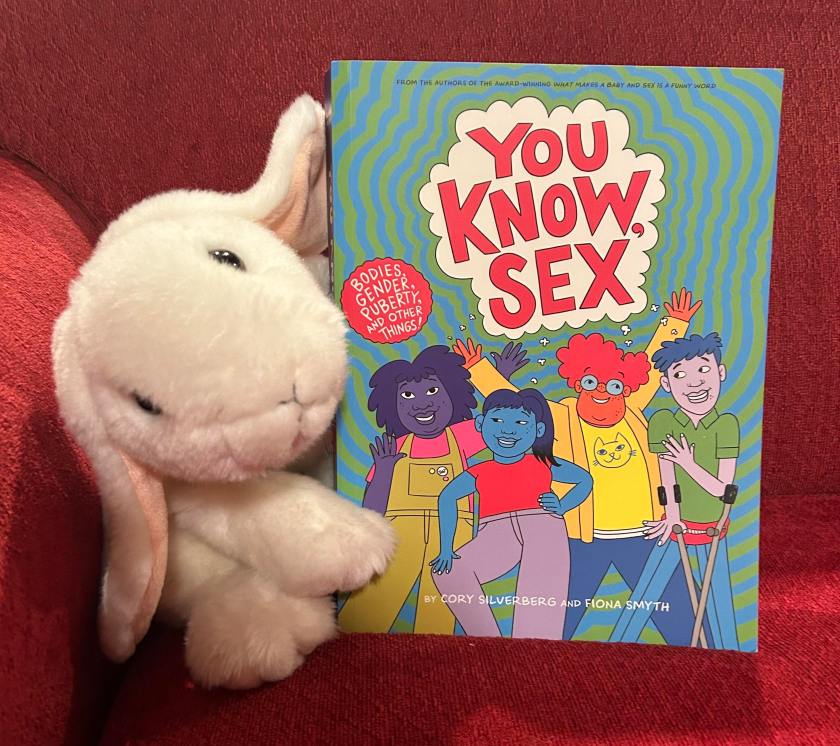
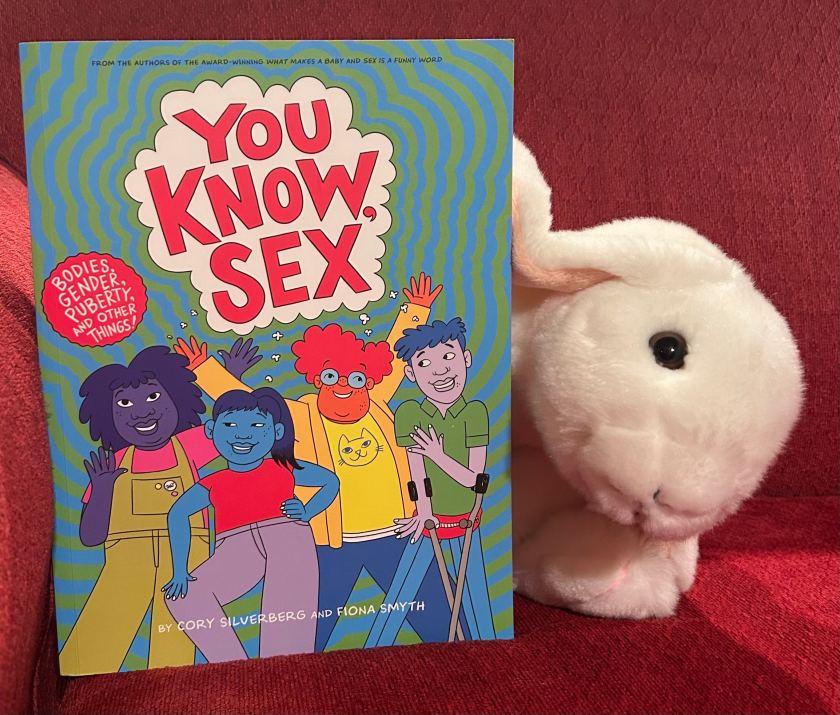
Marshmallow reviews You Know, Sex by Cory Silverberg and Fiona Smyth

Marshmallow is reading about growing up and this week she wanted to talk about a recent book she read about puberty, growing up, and sex written for young people who are around her age: You Know, Sex: Bodies, Gender, Puberty, and Other Things by Cory Silverberg and Fiona Smyth. Sprinkles is taking notes and asking questions.

Marshmallow reviews You Know, Sex: Bodies, Gender, Puberty, and Other Things by Cory Silverberg and Fiona Smyth.

Sprinkles: First of all, as we begin this review, I want to thank you for reading this book, Marshmallow. After reviewing a collection of books about where babies come from, I had intended to write a post about a handful of books about puberty next. And one of the books I chose was this one, a huge, 432-page tome written in graphic novel form. But when I began to read it, I realized that my personal discomfort with the form (due to my poor eyesight) would mean I would probably not be able to give it its full due. So thank you for helping me out and checking the book out on your own.

Marshmallow: Well, that’s alright, Sprinkles. It was an interesting read.

S: That’s good to know. Can you tell us a bit about the specifics of the book?

M: Sure. You already said it is big, and has 432 pages. And you said it is written as a graphic novel.

S: The two who wrote this book also were the writer and the illustrator of What Makes A Baby?, one of the books I read for that review of books about where babies come from. And the pictures have the exact same style.

M: Yes, there are people with many different skin colors, like orange and purple and green and blue, and many different shapes and sizes.

S: Does that work well?

M: Yes, it is interesting. I think the people all look quite unique.

S: Well, I guess that makes the book more realistic, right? We are all quite different from one another.

M: Yes.

S: So tell us more about the book.

M: There are eleven chapters. They are titled: What is Sex? Bodies, Gender, Puberty, Feelings, Consent, Talking, Relationships, Reproduction, Touching, and Safety.

S: So the book covers a lot of ground.

M: Yup. It is also very contemporary.

S: What do you mean by that?

M: It has some ideas which I think are contemporary. They talk about gender identity and sexual orientation, transgender and non-binary people, and people having relationships with multiple partners.

S: The last one does not sound too contemporary to me. Polygamy and polyamory have been around for a long time. They have not always been accepted or legal though. I guess the authors are trying to teach the reader to be open minded about different arrangements.

M: I am not sure all readers would be too open to all of these ideas at this point.

S: I agree with that. Actually I too find some of these ideas challenging, especially polygamy. Though rabbits are typically not monogamous, according to Wikipedia, “scientific studies classify the human mating system as primarily monogamous, with the cultural practice of polygamy in the minority”. In any case, it is good to learn about how different people can relate with others.

M: Well, the book does not talk so much about polygamy as polyamory. But yes, it is good to learn about these different things.

Marshmallow is reading You Know, Sex: Bodies, Gender, Puberty, and Other Things by Cory Silverberg and Fiona Smyth.

S: They also talk about the changes a young bunny goes through in puberty, and more generally about biology and mechanics of sexual reproduction, right?

M: Well, yes. There are also very vivid depictions of things. They make an effort to show all kinds of things, so that the reader does not end up assuming that a body part has to look in one specific way. And they show people doing all kinds of different things together or alone.

S: I did look through the pages a lot, too, and I’d say there really are a lot of illustrations that some parents may not be comfortable with.

M: The self-discovery and self-exploration parts might also be kind of touchy topics for some folks, I’d imagine.

S: I did see a section on pornography, and that too is a very challenging topic. Perhaps grownup bunnies should read this book together with their young ones when they feel like the conversations about the various themes and issues that come up will be constructive.

M: I’d agree with that.

S: What were some of the other topics in the book? What topics did you find were most important?

M: They talk a lot about relationships, and I thought it was useful to learn about that. They talk about consent and power in relationships, and sometimes how people talk about being with people as a competition.

S: Yes, I did see that page about how sometimes people talk about “scoring” and the book instead encourages young people to think about “trust, respect, justice, joy, and choice”.

M: Yes, I did find those parts useful. All in all, it is an interesting and useful book, but I think grownups should probably check it out before sharing with their little ones.

S: Agreed. So what would you tell our readers as we wrap up this review?

M: Stay tuned for more amazing book bunny reviews!

Marshmallow appreciated reading You Know, Sex: Bodies, Gender, Puberty, and Other Things by Cory Silverberg and Fiona Smyth, and she thinks all growing bunnies should read a book along these lines; she also suggests grownups check it out before sharing with their little ones.