Marshmallow reviews The Hunger Games by Suzanne Collins

Today Marshmallow reviews The Hunger Games by Suzanne Collins, first published in 2008. Sprinkles has watched the movie version and is chatting with Marshmallow about the book.

Marshmallow reviews The Hunger Games by Suzanne Collins.

Sprinkles: So Marshmallow, let us start with a brief overview. Can you tell us a bit about the plot of Hunger Games?

Marshmallow: The book is set in a dystopian future, in North America. There are twelve districts and a Capitol city that make up a country named Panem. Katniss Everdeen is the main character. She lives in District 12 with her mother and younger sister Prim. All the districts are very poor, or maybe, I should say, everyone is very poor, except for the people of the Capitol. Every year, the Capitol hosts the Hunger Games, which are a big spectacle. Two children are selected from each district, a boy and a girl, ages 12 to 18. And they are brought to the Capitol and are to fight to the death in these Hunger Games.

S: That sounds pretty vicious. Children fighting to the death.

M: Yeah. It is really vicious. Also because it is kind of as a revenge of sorts. The twelve districts rebelled against the Capitol a while ago, and so they are paying tribute for their betrayal.

S: That sounds terrible actually.

M. Well, I did say it was dystopian.

S: You did.

M: Anyways, so Katniss ends up being the girl representing her district in that year’s Games. Along with a boy named Peeta. The book is about their trip to the Capitol and their time during the Games. The Games are rough, violent, and sadistic. They are almost like the gladiator games in the Roman Colosseum. The audience is watching and keeping track of who is surviving and the children playing the game are creating alliances and such. However, since there is only supposed to be one winner, everyone is actually working against everyone else, and they are all trying to kill each other.

S: So some of this reminds me of the Triwizard Tournament from Harry Potter and the Goblet of Fire by J.K. Rowling.

M: Yes, but actually I think it is more similar to the Purging Trials in Powerless by Lauren Roberts. They are both more vicious and are made to honor horrific events. The Triwizard Tournament is not supposed to be lethal even though it ends up being that way in Harry Potter and the Goblet of Fire.

Marshmallow is reading The Hunger Games by Suzanne Collins.

S: I know this book made a huge splash when it came out and it and its sequels were made into movies. I have not read the books yet, and only watched the first movie so far. But I think the plot and the setting of the book are quite fascinating. You watched the first movie with me. Can you tell me a bit about how the book compares with the movie?

M: I read the book before watching the movie. So I had a pretty good idea what the plot would be. But even then, the suspense built in the movie was very deep, and I really liked the way Katniss Everdeen’s world was portrayed on screen. I think the film was very well done. Maybe we can put a link to the trailer for the movie here.

S: Sure. Here it is:

The Hunger Games (2012 Movie) – Official Theatrical Trailer (YouTube).

M: Great, thanks!

S: So were there any significant differences between the book and the movie you noticed?

M: I did not notice really, but the book is written in present tense and in first person, so of course they could not really depict that style. However, I think they did a really good job creating the world Katniss is living in, and I would recommend the movie to bunnies who enjoy the book.

S: But they should read the book first?

M: Well, you did not. So maybe it does not matter too much.

S: Hmm, this is a book blog, remember?

M: Well, then maybe I should say read the book first. But the movie is pretty good too.

S: Okay, then, maybe this is a good time to wrap up this review. What would you rate the book?

M: I’d rate it 100%. It is really good. But it might be a bit too mature for some younger bunnies. It is about a very grim topic, a violent world and terrible tragedy.

S: I see. What would you say to our readers as we wrap things up?

M: Stay tuned for more amazing reviews from the book bunnies!
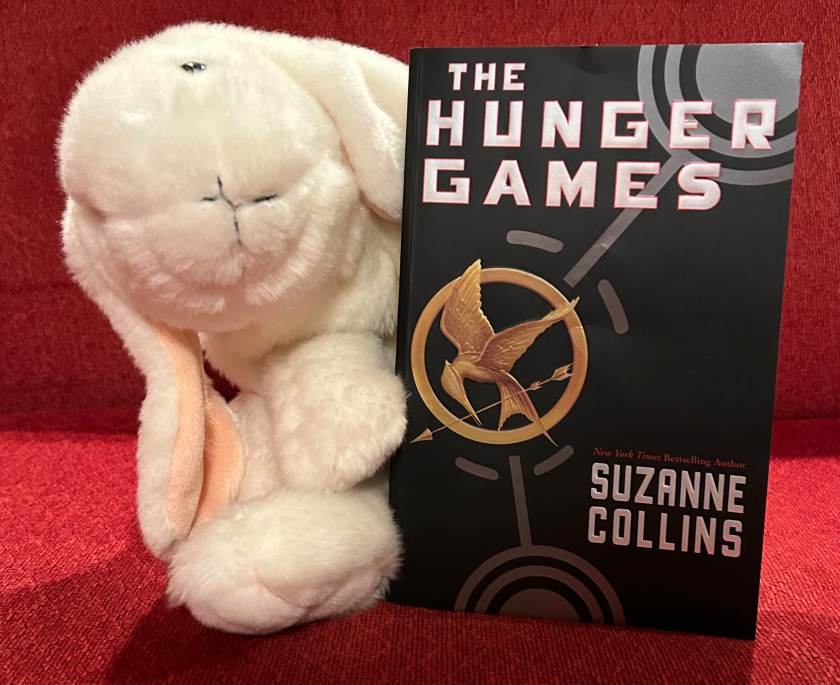
Marshmallow rates The Hunger Games by Suzanne Collins 100%.

Caramel reviews Ricky, The Rock That Couldn’t Roll by Mr. Jay and Erin Wozniak

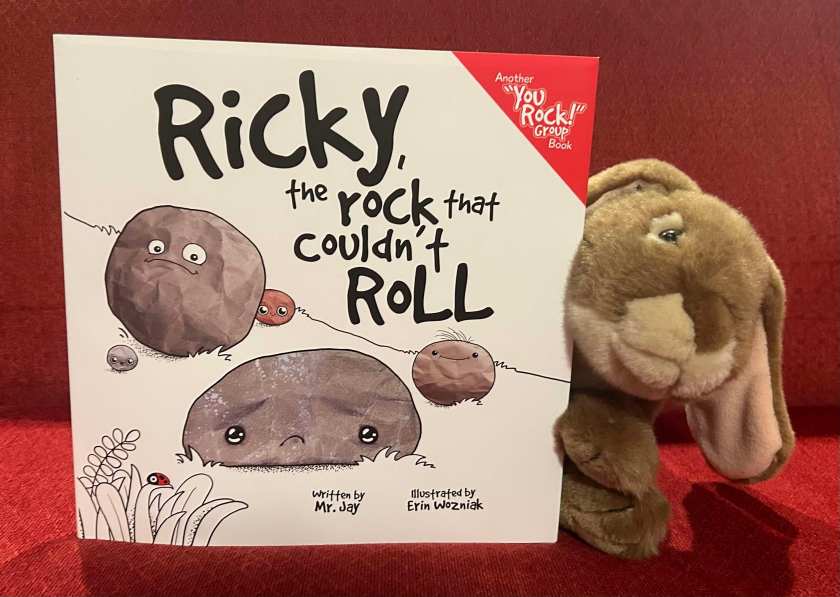
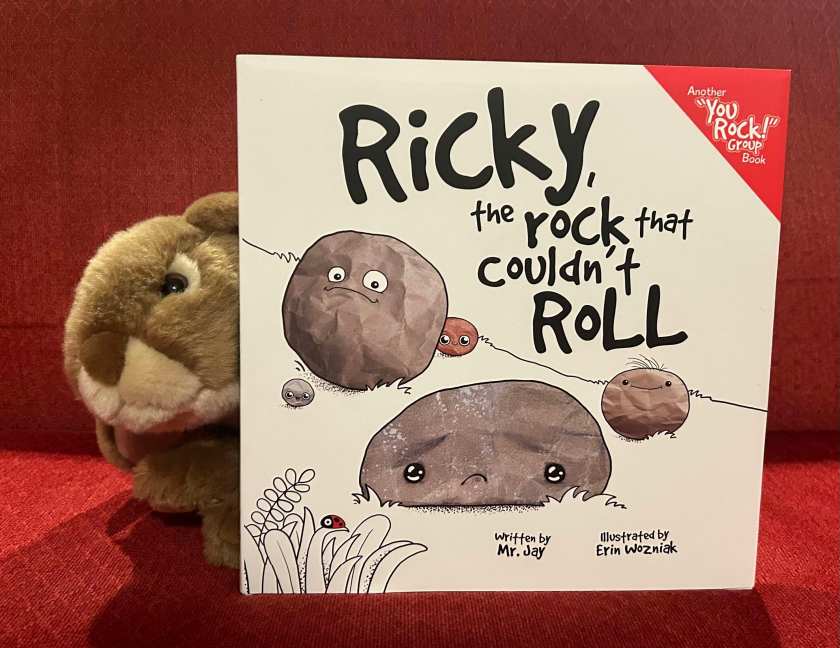
Today Caramel reviews a cute picture book from 2017, Ricky, The Rock That Couldn’t Roll, written by Mr. Jay (Jay Miletsky) and illustrated by Erin Wozniak. As usual, Sprinkles is taking notes and asking questions.

Caramel reviews Ricky, The Rock That Couldn't Roll, written by Mr. Jay and illustrated by Erin Wozniak.
Caramel reviews Ricky, The Rock That Couldn’t Roll, written by Mr. Jay and illustrated by Erin Wozniak.

Sprinkles: So Caramel, tell me a bit about this book.

Caramel: This book is about a rock named Ricky and about friendship.

S: Wait, now we are naming rocks?

C: No. This book is naming them. The book has a lot of talking rocks.

S: I see. So there are these talking rocks and one is called Ricky.

C: Yes. Unfortunately for Ricky, Ricky is different from his friends.

S: In what way?

C: Well, as the book title says, he can’t roll! He is flat on one side. All his friends are round. So they can all roll, but Ricky can’t.

S: I see. How does this make Ricky feel?

C: Sad because he feels left out.

S: I can understand that. If all your friends were ice skating, and you could not skate, it would not be too fun.

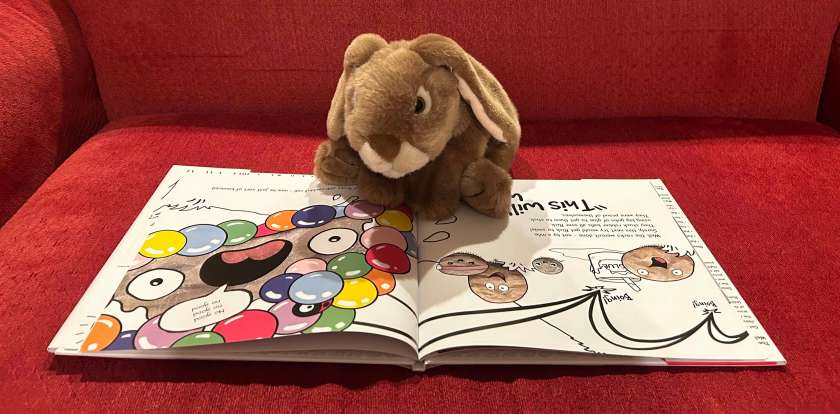
C: Exactly. But Ricky has really good friends. And they try to help him. They come up with many many ideas. Most of them fail, of course. They try to wrap him up with balloons and such, and that fails miserably.

S: But at least they are trying to help. I see now why you said the book is about friendship. Good friends help one another.

C: Yep. And in the end they succeed!

S: Okay, so let us not totally spoil the fun of reading the book, but that means that in the end Ricky will be happy, right?

C: Yup.

Caramel is reading Ricky, The Rock That Couldn't Roll, written by Mr. Jay and illustrated by Erin Wozniak.
Caramel is reading Ricky, The Rock That Couldn’t Roll, written by Mr. Jay and illustrated by Erin Wozniak.

S: So then I am assuming you liked this book?

C: Yes. It made me happy.

S: I can understand why. You like books with happy endings.

C: Yes.

S: What you told me about the book reminded me of another book you reviewed a while back: The Missing Piece Meets the Big O by Shel Silverstein. Do you remember that book?

C: Yes. And you are right, there are some similarities. There too there is a thing, called the Missing Piece, that wants to roll on its own but cannot. But there, the Missing Piece eventually figures out that by trying, it can smooth out its rough pointy corner and become rounder so it can roll. It does this more or less on its own. That book is not really about friendship. It is more about perseverance.

S: You are very wise Caramel. And that is a big word for a little bunny your age! But there is perseverance in this book, too. Ricky and his friends do not give up. They try and fail over and over again, but they do not give up, until they eventually solve the problem.

C: That is true.

S: But I can see how this book is more about friendship. So if you were to describe the book using three to five words, how would you do it?

C: Cute story about friends helping friends.

S: That works! So let us wrap this review up then. What do you want to tell our readers?

C: Stay tuned for more book bunny reviews!

Caramel appreciated reading Ricky, The Rock That Couldn't Roll, written by Mr. Jay and illustrated by Erin Wozniak, and recommends it to other young bunnies who can't always do everything their friends can do.
Caramel appreciated reading Ricky, The Rock That Couldn’t Roll, written by Mr. Jay and illustrated by Erin Wozniak, and recommends it to other young bunnies who can’t always do everything their friends can do.

Marshmallow reviews All-American Boys by Jason Reynolds and Brendan Kiely

Today Marshmallow reviews All-American Boys by Jason Reynolds and Brendan Kiely, first published in 2015.

Marshmallow reviews All-American Boys by Jason Reynolds and Brendan Kiely.

Marshmallow’s Quick Take: If you would like to read a book about social justice, friendship, bravery, and family, then this might be the book for you. 

Marshmallow’s Summary (with Spoilers): Rashad Butler has worked hard to be an All-American boy. His father believes that the military is the best option for a young Black man in America, so Rashad is in the ROTC drill team at Springfield Central High School. One Friday, Rashad is preparing to go to a party. While he is buying chips in a store, he leans down and reaches into his bag on the floor to get his phone to text his brother. A woman trips over him, and a police officer comes over to see what’s happening. He presumes that Rashad is trying to steal the chips. He drags him outside, handcuffs him, pushes him to the ground, and starts beating him. Rashad is arrested and sent to the hospital with a broken nose, several broken ribs, and internal bleeding. 

Quinn also goes to Rashad’s school. Quinn’s father died in Afghanistan and is viewed as a hero. Quinn feels constantly pressured to be a perfect All-American boy, living under his father’s shadow, even after his death. He’s doing a pretty good job, however, playing on the school’s basketball team competitively. Within a couple weeks, scouts from colleges and universities will be watching their games, and Quinn is determined to be seen.

That very Friday, Quinn and his friends are at the same store, waiting outside to find an adult who could buy them alcohol. Quinn is still there when the police officer beats Rashad viciously and remains there long enough to recognize the officer, Paul, who is like a father figure to him. After his father died, Quinn was taken care of, taught, and protected by Paul who filled the part of a family for Quinn that his mother and brother didn’t. Quinn and his friends flee the scene, and Quinn tells his friend Guzzo (Paul’s brother) what he saw. 

Soon, Rashad’s beating is covered by the news, so much so that Rashad sees this all over the TV while in the hospital. He is confused as to what to do next. His brother Spooney is enraged and helps organize a protest about police brutality. His mother is devastated and tries to stay strong. His father, on the other hand, is conflicted. His father, who was in the military and in the police force, believes that Black men should be disciplined and look like it, because that will prevent anything bad from happening to them. He doesn’t even believe Rashad in the beginning when he says he wasn’t stealing the chips. 

Quinn is also conflicted. He has known Paul for such a long time, and his mind cannot connect the violent officer he saw to the caring, protective figure he’s known for so long. As a family friend to Paul and Guzzo’s family, his “allegiance” to Paul is presumed, but inside he is unsure. He knows that Rashad didn’t deserve to be beaten. 

After that Friday, the city of Springfield is torn into chaos. Sides are taken and lines are drawn. “Loyalties” are put into question while citizens work to fight against social injustice and stereotypes. Meanwhile, Rashad and Quinn live in two different worlds, in two different situations, struggling to make sense of what just happened. 

Marshmallow is reading All-American Boys by Jason Reynolds and Brendan Kiely.

Marshmallow’s Review: I think All-American Boys is a very meaningful book. I have read and reviewed a book about police brutality from the perspective of a witness before (The Hate U Give). However, All-American Boys is unique because it is written in two different perspectives: the victim’s and the witness’s. So we see the narrative through the eyes of people with fundamentally different experiences. Rashad is Black and gets beaten by Paul, while Quinn is White and had been raised loving and respecting Paul. As expected, the two boys have a fundamentally different experience with racism. Each chapter is written from either Rashad’s or Quinn’s perspective, and they mostly alternate between the two narratives. Rashad’s chapters are written by Reynolds and Quinn’s are by Kiely, which adds depth and more detail to the storyline. The characters have a very realistic, down-to-earth feel (for example we get to connect with Rashad beyond his victimization as a young person who draws to express himself), as well as the school and small-town environment created by the authors. I find it impressive how the two authors wrote such a cohesive book together.

I have read another book by one of the authors (Jason Reynolds) before: Long Way Down. I have deeply enjoyed reading both, and I think this book, as well as that one, should be read by all. It is important for everyone to read and understand the perspectives of others, especially given how some situations are experienced in extremely different ways by different people based on their race.

All-American Boys might be more appropriate for bunnies older than ten because it has a lot of cursing, and the topic might be a bit heavy for younger ones. Otherwise, I would definitely recommend this book to all because of its well-written storyline, characters, and important message. 

Marshmallow’s Rating: 100%

Marshmallow rates All-American Boys by Jason Reynolds and Brendan Kiely 100%.

Caramel reviews The Red Book by Barbara Lehman

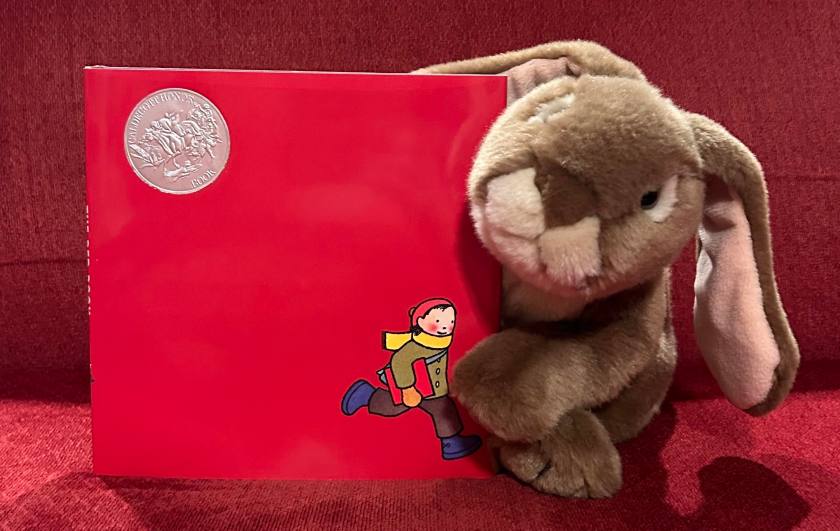
Today Caramel reviews The Red Book by Barbara Lehman, first published in 2004. As usual, Sprinkles is taking notes and asking questions.

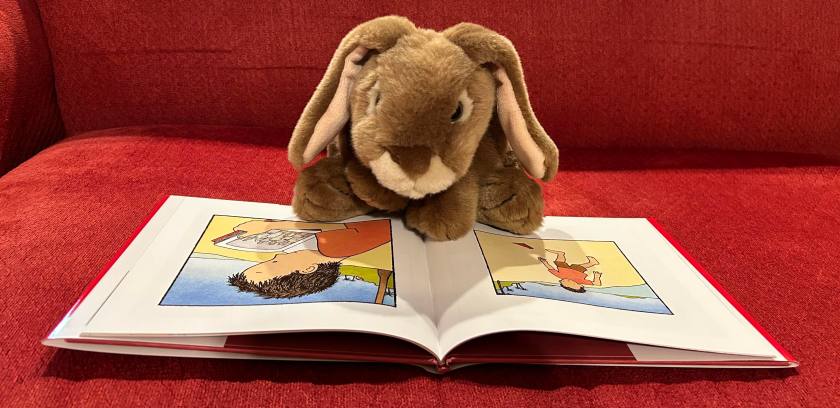
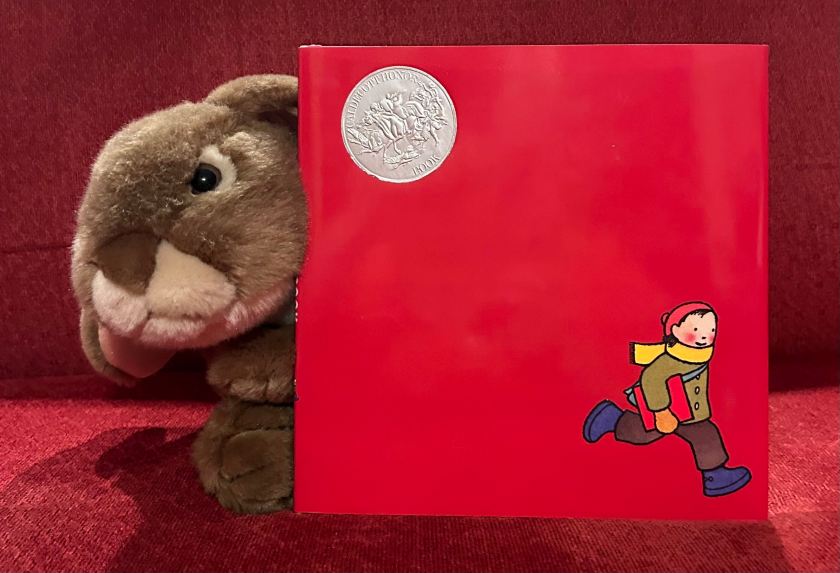
Caramel reviews The Red Book by Barbara Lehman.

Sprinkles: So Caramel, you chose a beautiful picture book for today’s review. Can you tell us a bit about it?

Caramel: Yes. This book has no words. So any bunny can read it!

S: That sounds interesting!

C: It is! Remember that book I reviewed way back, The Book With No Pictures? This is kind of the opposite. There are pictures but no words.

S: But there is a story?

C: Yes. It is kind of complicated though.

S: How so?

C: So there is a girl walking in the snow in a big city, and she finds a red book in the snow.

S: Is it not destroyed in the snow?

C: No. And she opens the red book and begins to look through its pages and finds the picture of an island in the middle of an ocean. And then she looks more closely and on the island is a boy who is reading a red book of his own. And here is the shocking part: In the red book the boy is holding you can see the girl from the big city!

S: Wait! So the girl’s book shows the boy whose book shows the girl?

C: Yes. Like when you have two mirrors and you see the reflection of your reflection.

S: Okay. I can see how you could make such a comparison.

C: But wait! The weirdness is not over yet. The girl in the city finds a lot of balloons and then flies into the air and gets herself to the boy’s island. And then we see both of them sitting on the beach. And then the red book closes! And there is another person who finds the book and takes it with him.

S: That is interesting Caramel! Very self-referential! Do you know what that means?

C: Yes I think so. I think it means when you talk about yourself. And the red book is talking about itself. Because we are reading the red book which is telling a story about a red book, in which there is another red book…

S: Yes! It really is like the infinitely many reflections you can see in two mirrors facing one another!

C: But that can be confusing! This is not. This is just nice.

Caramel is reading The Red Book by Barbara Lehman.

S: I agree Caramel. This is really a very sweet book. What did you think about the drawings?

C: I thought they were pretty good. They are simple, but they do not need to be more complicated anyways. I like how the red book is always sticking out on the pages you can see it.

S: True! I like that too! So how did it feel to read a book that did not have any words?

C: Good. The story was nice so I really liked it.

S: You also read and reviewed another book which had no words: Robot Dreams by Sara Varon.

C: I remember that book! And it was a good book and it was about friendship too. But that was kind of sad and this one is just happy.

S: And you like that of course!

C: Of course!

S: Okay, so maybe this is a good time to wrap up this review. What would you like to tell our readers Caramel?

C: Stay tuned for more book bunny reviews!

Caramel loved reading The Red Book by Barbara Lehman and recommends all bunnies to check it out.