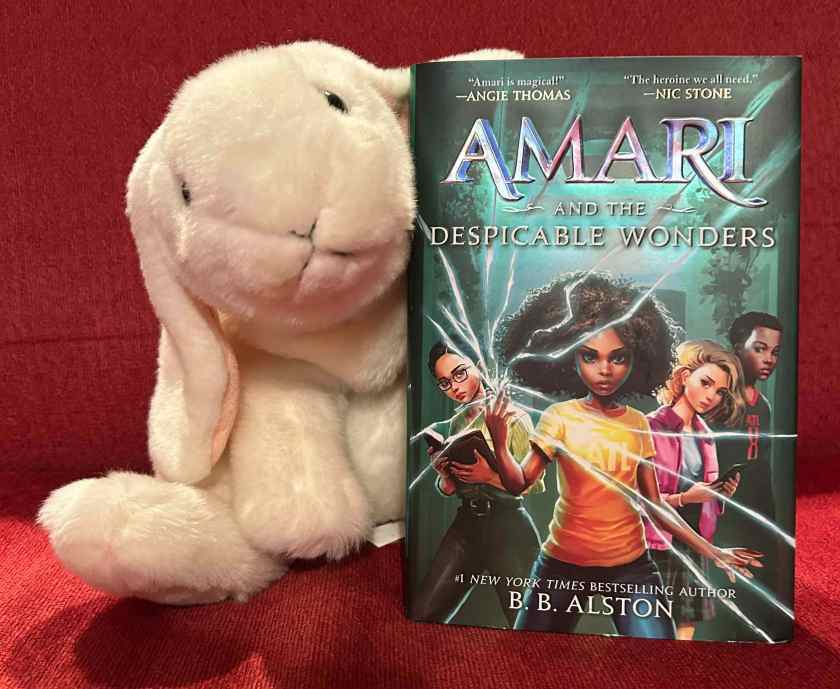
Marshmallow reviews Amari and the Despicable Wonders by B.B. Alston

Marshmallow had already reviewed Amari and the Night Brothers and Amari and the Great Game, the first two books of the Supernatural Investigations series by B.B. Alston. Today she reviews the third book, Amari and the Despicable Wonders, which was published in 2024.

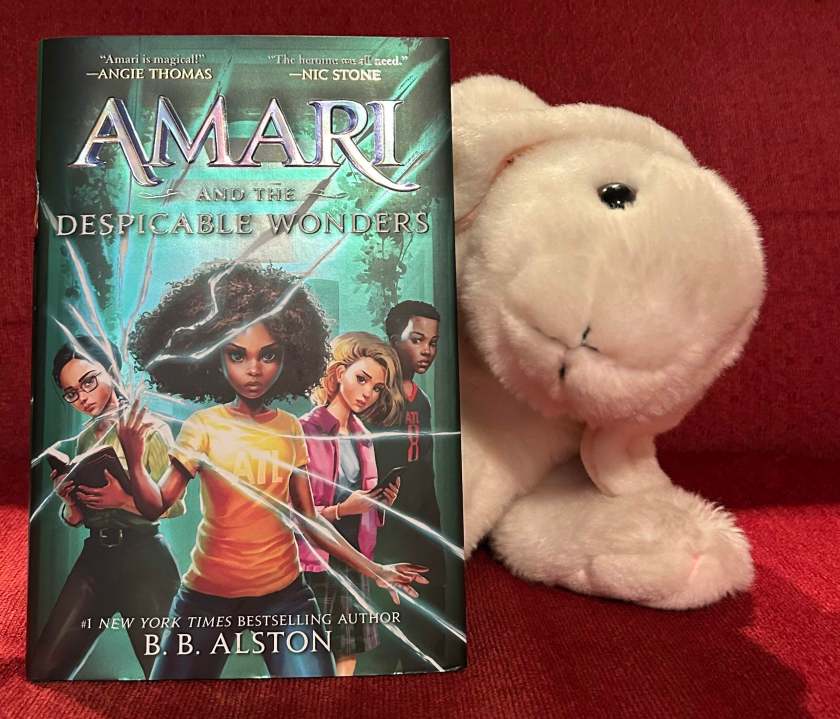
Marshmallow reviews Amari and the Despicable Wonders by B.B. Alston.

Marshmallow’s Quick Take: If you like books about family, friends, and magic with a strong, smart female protagonist, then this is the book for you!

Marshmallow’s Summary (with Spoilers): The supernatural world is on the brink of war with their risk of being revealed to the human world increasing by the minute. The Bureau of Supernatural Affairs, which functions as this world’s government and has been responsible for keeping the supernatural unseen by humans, has recently been taken over by Elaine Harlowe. Harlowe is a faun who has the ability to control others with her voice and now is the Director of the Bureau. The previous head of the Bureau was the one and only Merlin; unfortunately, he had to freeze himself along with all of the other leaders of the magical world in order to protect them from an unseen attack. Amari Peters, a Junior Agent training to work in the Bureau who is our protagonist, discovered this in the last book. However, the world’s leaders are still stuck in this time freeze, leaving Harlowe in charge. Unfortunately, Harlowe is very biased against magicians, which is not a great perspective to have during a time of great tension between the Bureau and the League of Magicians. The Bureau is the government of the supernatural world, but in this world, magicians and all their creations are viewed as UnWanteds. Unlike in the world of Harry Potter, being told “You’re a wizard, Harry” is something that would cause different reactions: first, self-loathing and fear of being discovered, and second, confusion at being called Harry.

Amari is a magician, but so far, she’s been sort of viewed as a good one, in comparison to the evil Night Brothers or Dylan Van Helsing. Unfortunately, the League of Magicians has been corrupted by Dylan, who wants to use foul magic to make magicians respected through fear and intimidation. Amari and her friends (Elsie, Jayden, and Lara) have been fighting against Dylan’s magician movement, but they also need to worry about what the Bureau is doing too. Magician-hating Harlowe fears that Amari will reveal to the public how she rose to power so quickly (with her mind-controlling powers), so Harlowe declares Amari an enemy of the Bureau which many believe because she is a magician.

In this book, Amari, Elsie (who is extraordinarily smart and can transform partly into a dragon), Jayden (a boy who can talk to animals, though I predict he will be talking to Amari a lot more soon 😉), Lara (Dylan’s non-magician sister who has recently allied herself with Amari), and Quinton (Amari’s famous Bureau Agent brother) are now working against the clock to prevent the Bureau and the League from going to full-on war—especially since the stakes have never been higher.

Amari learns that Dylan plans to use anti-magick to fight the Bureau and all those who oppose magicians. Just like anti-matter, anti-magick destroys all things with magic, which includes just about everything and everyone in the supernatural world. In order to utilize and then control this power, Dylan must find the Despicable Wonders: eight ancient items made long ago by the first magician. The only thing that can save the supernatural world from complete ruin is if Amari, her family, and friends can find the Wonders first and stop Dylan. The clock is ticking though, and he has a head start.

Can Amari catch up and should she? Perhaps this is all according to his plan… dun dun dun!!!

Marshmallow is reading Amari and the Despicable Wonders by B.B. Alston.

Marshmallow’s Review: This was a very good book. I will say there are a lot of parallels to be drawn between Amari’s world and that of J.K. Rowling’s Harry Potter series. Throughout this series, I definitely felt a lot of nostalgia because of the similarities to previous fantasy books for young adults and children. However, I would like to focus on what makes this series unique.

The world is definitely Alston’s own and it is not in any means identical. The premise starts off similarly, with a young child being told they are part of a magical world, and that they are exceptional even there. But this story evolves in a different direction. It focuses a lot more on equality, and fighting bias and hate. Amari is a magician, a group of supernaturals who are looked down upon. There is a lot of mistrust towards all magicians, and most live in hiding their whole lives. Amari’s perspective sheds light on the inequities in both the supernatural and natural world. This is clearly a statement, shown by the not-so-stark contrast between our world and theirs. This makes the story of Amari a lot more compelling and connects the reader more to her magical world.

That said, the characters are also very compelling. They develop in very human ways, even though not all of them are human. Even the enemy is clearly a thinking, breathing, feeling person and doesn’t start off as the embodiment of evil. The progression of the plot is both calculated and unexpected. It never feels slow though it is always very thoughtful. B.B. Alston is definitely, undoubtedly a very good author.

I really enjoyed reading Amari and the Despicable Wonders, and I am waiting excitedly for the fourth book to come out. The ending was bittersweet (because all the characters were so well-developed!), and while there was not really a defined cliffhanger, there are still unanswered questions. 

Marshmallow’s Rating: 100%.

Marshmallow rates Amari and the Despicable Wonders by B.B. Alston 100%.

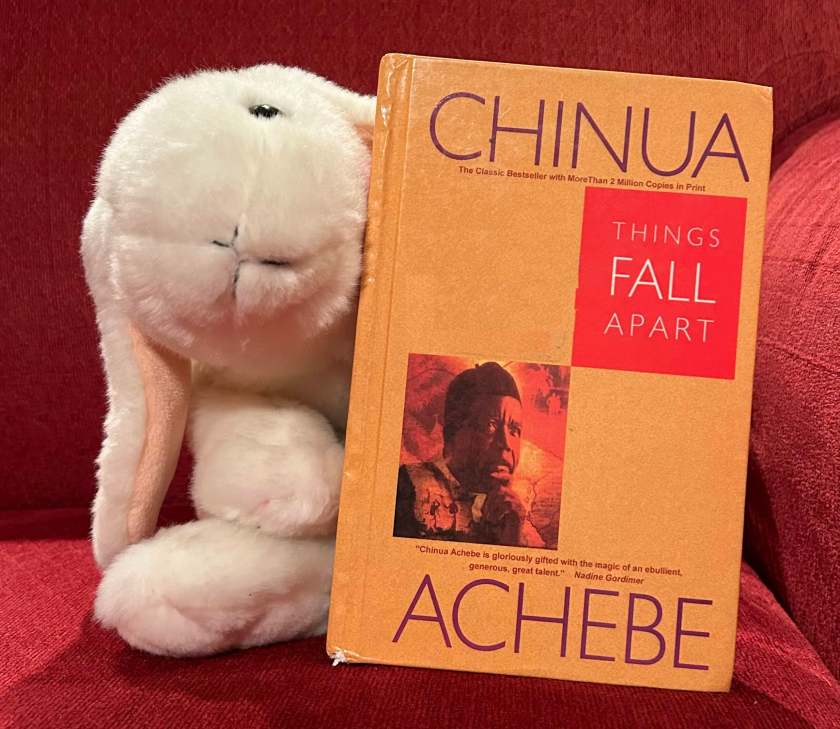
Marshmallow reviews Things Fall Apart by Chinua Achebe

As the first review of the book bunnies blog this new year, we present to you Marshmallow’s review of Chinua Achebe’s Things Fall Apart. First published in 1958, Achebe’s novel is a modern classic, and Marshmallow has read it in school.

Marshmallow reviews Things Fall Apart by Chinua Achebe.

Marshmallow’s Quick Take: If you like historical fiction books about colonialism in Africa or books that make you think or feel, then this is the book for you!

Marshmallow’s Summary (with Spoilers): Set in the Nigerian Ibo society during the 1890s, this book starts with the introduction of Okonkwo. Okonkwo is a highly-respected man in his village Umuofia. Through his victories in battle and his defeat of the Cat (a famous wrestler), Okonkwo is a powerful man. As a result (as is Ibo culture), he has three wives, many children, a successful farm, and on occasion drinks palm wine out of his first human skull. He is what is called a “strong man.” However, his success and strength is a result of fear. His drive to succeed is fueled by a fear of being similar to his father, who was a efulefu (or worthless man). Okonkwo’s father was lazy and debt-ridden; thus, Okonkwo compensates for his father’s failures by working obsessively. Luckily for Okonkwo, in Ibo society, a man is not judged by his father, but by his own merit. Eventually, his success seems cemented. Yet, he is still controlled by anxiety, fear, anger, and violence. His household, though it reflects the traditional Ibo setup of its time, is a model case of domestic abuse.

Meanwhile, a woman from Umuofia is killed in a neighboring village. To avoid war with the fear-inspiring Umuofia, this village sends a virgin girl and a young boy to compensate. For the purposes of the plot, the boy (named Ikemefuna) is most important. Umuofia doesn’t immediately decide what to do with the boy, taking several years to do so. During this, he is placed in Okonkwo’s household and soon becomes fast friends with Okonkwo’s son, Nwoye. Over time, Okonkwo starts to view Ikemefuna as a son. 

But when tragedy strikes, Okonkwo finds himself in a situation that pits his “strong man” facade against his heart. And as the book progresses, Okonkwo continually finds himself at odds with the changing village. The question is, how much more can he take before he falls apart?

Marshmallow is reading Things Fall Apart by Chinua Achebe.

Marshmallow’s Review: I think reading this book is an extremely important experience that all people and bunnies should have. Chinua Achebe–the author–wrote it in simple, easy to read English specifically so it would be accessible to all; this makes it a good book for all ages and levels of reading ability. But ultimately, this book is remarkably subtle and nuanced. The author’s tone is simple and unique, while startlingly complex at the same time. The plot evolves elegantly and the author creates compelling characters that make you need to see the storyline though. Additionally, Achebe successfully grapples with and portrays issues like colonialism, racism, and toxic masculinity. This book is incredible because of the insights it gives on such topics. It also shows the reader what (some) life and culture was like in Nigeria before colonialism.

Additionally, this book’s themes are philosophically, historically, psychologically, and culturally intriguing. Throughout, Achebe weaves in the concept of facades: facades of strength, of stability, of security, of trustworthiness, of happiness, of truth. Achebe’s work is remarkable, and the astute reader will recognize and appreciate the importance of such work.

Overall, I highly recommend this book to all because it’s imperative to understand what others in the world experience and experienced, especially in a world of such divided opinions and narrow perspectives. 

Marshmallow’s Rating: 100%.

Marshmallow rates Things Fall Apart by Chinua Achebe 100%.

Caramel reviews Watership Down: The Graphic Novel by Richard Adams, James Sturm, and Joe Sutphin

Many years ago, over the course of a few days, the book bunnies listened all together as a family to an unabridged version of Watership Down, the 1972 classic by Richard Adams. Recently Caramel got his paws on a new (2023) graphic novel adaptation of the book by James Sturm and Joe Sutphin and read it over the course of a few hours. Today he is talking to Sprinkles about the book.

Caramel reviews Watership Down: The Graphic Novel, written by Richard Adams, adapted by James Sturm, and illustrated by Joe Sutphin.

Sprinkles: I remember how we listened to this whole story when you all were so much younger. So when I saw that there was a graphic novel adaptation, I knew you would want to read it. 

Caramel: Yes, I guess you were right! You know me well.

S: I think I do! Okay can you tell us a bit about the story?

C: Sure. In this book there are bunnies like us, but they are wild and are trying to escape from a great evil that was foretold by one of them named Fiver.

S: Oh, I think I remember Fiver. Isn’t he the dreamer one? Kind of like an oracle?

C: Yeah, kind of. He can see the future and warns the others of the dangers so they can survive.

S: Okay, so here is a group of rabbits living in a warren. That is, my dictionary tells me, a network of interconnecting rabbit burrows. And they are living a normal wild rabbit life. But then some great evil thing happens, is that it?

C: Yes, it is kind of like that. However not everyone believes Fiver, and so not all of them make it.

S: Well, I can see how not everyone would immediately believe some little bunny saying something terrible will happen, without evidence. But his brother believes him, right?

C: Yep, so Hazel, that is Fiver’s brother, gathers everyone who believes Fiver and they run. 

S: So they leave their warren and wander away, and try to find a new place to settle down at?

C: Yep. Along the way they find a different warren in which there are some not-so-nice bunnies who try to kill the main character bunnies, but thankfully the good bunnies make it out, and they get two new bunnies from that warren.

S: Cool! Okay, so Fiver is the dreamer, oracle bunny. Hazel is the main leader bunny. Are there other characters that you especially liked or remembered from when we listened to the book those many years ago?

C: Fiver is my favorite, I don’t know why but he is my favorite bunny in the book.

S: He is a gentle soul, as far as I remember. He is sensitive and kind. 

C: Yeah, but he can also see the future, and that is cool.

S: Yes, that is really cool, I agree. I do remember another character, Bigwig, I think. He is a fighter, and a good one too. 

C: Yeah, he is also really cool, but Fiver is still my favorite character. There is also a big bird who helps the bunnies occasionally, His name is Kehaar. 

S: That is cool! I liked that character, too. 

Caramel is reading Watership Down: The Graphic Novel, written by Richard Adams, adapted by James Sturm, and illustrated by Joe Sutphin.

S: Okay, so when we listened to this book many years ago, we had no images to attach to the main characters. But a graphic novel of course will have faces attached to each character. Did these work for you? Did you like the illustrations? Is the world of Fiver and Hazel how you had imagined it to be?

C: Yeah, it is a lot like what I thought. The bunnies are all very realistic looking, too, and exactly how I imagined them to be. 

S: That sounds great! I was just going to ask you if they were more cartoonish or more realistic. So this was perhaps the longest graphic novel you have ever read, right? 

C: Yep, it was 382 pages!

S: That is long for a graphic novel. But the original book is a very long one, too, so that makes sense. Anyways, did you know that the original book was banned in some places because it was too violent and there was a lot of brutality depicted explicitly? 

C: Oh no. I did not think it was too violent. 

S: Well, then again, you do like the Wings of Fire series and those are also kind of violent. So maybe your generation of bunnies is a bit more used to violence… 

C: No, I would hope not.

S: I see what you mean Caramel. Yes you are right, it is not a good thing to get used to violence. Maybe I should have said that you can handle some more violence. I think that especially when they made the animated movie in 1978, the movie started out looking like a typical Disney movie, with cute bunnies who speak and are living in this idyllic natural place, but then things get dark very fast, and terrible things happen, bunnies killing each other, getting killed by humans, and so on. So maybe it shocked people a lot more back then. 

C: Maybe. 

S: I also read that it was banned in China for a while because it depicted animals and humans as equals or at least somewhat on a similar level, and this was unacceptable. 

C: Hmm, they probably would not like Animal Farm either, then. Or us.

S: Yes, you have a point there Caramel. Bunnies talking about books would probably not be okay. Anyways, we are bunnies who love to read and talk about books. So let us get back to the book. So overall, did you enjoy this graphic novel?

C: Yes, greatly. And I recommend it to all young bunnies who like to read about other bunnies being heroic. 

S: Cool! Okay let us wrap this up then. What would you like to tell our readers?

C: Stay tuned for more book bunny reviews!

Caramel enjoyed reading Watership Down: The Graphic Novel, written by Richard Adams, adapted by James Sturm, and illustrated by Joe Sutphin, and recommends the book to all young bunnies who like to read about other bunnies being heroic.

Marshmallow reviews Thornhedge by T. Kingfisher

Today Marshmallow is talking to Sprinkles about Thornhedge, a 2023 book by T. Kingfisher that won the Hugo Award for Best Novella in 2024.

Marshmallow reviews Thornhedge by T. Kingfisher.

Sprinkles: So Marshmallow, I know you love retellings of fairy tales, so I thought you would appreciate this book. Was I right?

Marshmallow: Yes.

S: Yay! I liked it too. So tell us a bit about the book.

M: This is a retelling of the Sleeping Beauty story. I had already read and reviewed Thornwood, another retelling of Sleeping Beauty, and that was pretty good too, but this one turns things even more upside down.

S: What do you mean?

M: Well, first of all, the narrator is a timid creature who calls herself Toadling, and we eventually learn that she is the fairy godmother who was the one to put the princess to sleep. But nothing is as we think we knew it to be.

S: You are being quite cryptic Marshmallow.

M: Yes, I am a very cryptic bunny.

S: That might not be optimal for one who is reviewing a book!

M: Well, I do not want to spill all the beans!

S: Okay, yes, you do have a point, but maybe then let us give the readers just a bit more.

M: So as I said, the book tells the story of the fairy godmother of Sleeping Beauty. It turns out that she was a human child, and she was kidnapped from the castle of her parents, a king and a queen, by evil fairies who replaced her with a changeling. Changelings are powerful creatures that seek to cause mischief or even worse. There is a deeper reason for why they cause mischief, but maybe this is enough for the time being.

S: Okay, so changelings in the sense of European folk stories.

M: Yes, not like the changelings of Star Trek Deep Space Nine.

S: Okay, I see.

M: When Toadling was replaced by a changeling, she was taken to the fairy world and was raised there by some frog-like fairy creatures called greenteeth. Then she is then somewhere else by a hare goddess and trained to be a fairy godmother.

S: Ooh, I like it when there are bunnies in the story!

M: Well, I am not sure this hare goddess is a very nice bunny. Anyways, time passes differently in the fairy world and the regular world. So by the time Toadling has spent nine years with the greenteeth and one year in training, the changeling named Fayette has just been “born”. So Toadling goes and becomes her doppelganger’s godmother.

S: That is interesting. Do her parents recognize her?

M: No. The nine years she spent with the greenteeth underwater have changed her and morphed her into a toadlike creature. She can look humanlike, but also can transform into a toad when she wants.

S: I see. So why is Fayette sleeping though?

M: Well, she is not, when Toadling comes by, but Toadling is supposed to do some magic and make her not harm anyone but she is sidetracked somehow and misses the opportunity to do her magic fully. So she ends up trying to stay around the child to make sure she will not harm anyone. But as the child grows up, she becomes more and more unruly, and at some point even starts torturing animals and shows no remorse or pity. So Toadling decides to put her to sleep.

S: That is awful! So these changelings are pure evil?

M: Well, in some sense yes, they are evil. But there is actually a reason for this. The changelings who are placed in human families are also babies when the switch occurs. However, these changelings belong to another plane of existence (the fairy world, I think), so nothing feels real to them. They grow up never really feeling anything, never being able to taste any food, and having metallic things burn them upon touch. The changelings grow up in a world without their kind, knowing in the back of their mind that this was not where they were supposed to be. Ultimately, they grow up confused and alone, and to them, human life is insignificant in this fake, foreign world.

S: Yes, but so was Toadling taken and placed in a totally different world. And she did not become wantonly cruel. She wants to help she wants to diminish people’s pains.

M: You have a point, so maybe the changelings have some tinge of evil in them from the start. But then again, Toadling was in some sense lucky. The greenteeth were kind to her and loved her.

S: But a family whose baby has been replaced by a changeling would also love that changeling, not knowing that it is not their original baby.

M: Yeah, I guess. But I kind of want to believe that nothing is born evil.

S: I can totally understand that and sympathize.

Marshmallow is reading Thornhedge by T. Kingfisher.

S: Okay back to the story though. So Toadling put the changeling to sleep and then what happens?

M: Well, lots of time passes. Centuries. And Toadling stays around the castle and grows a thorn hedge around it to keep people out. She hopes that people will eventually forget the castle, the story of the princess who fell asleep and so on. Unfortunately people do spread the story, and even though she hides things so well that most do forget, there comes a knight one day who wants to save the princess. But maybe it is not the princess who needs saving but Toadling herself!

S: Ooh, that is a great way to wrap up your summary and keep things still open!

M: Thank you.

S: Okay, so now tell me a bit about the book in terms of style.

M: I liked how the author used a very simple voice but still managed to capture a fairy-tale atmosphere for the story. And she created this character, a timid human-fairy child, that is very likeable. She was only ten when she became this fairy godmother, but then she lived outside the castle for centuries, determined to keep the world safe from the changeling-princess. So she grows up and maybe more mature but she still has this childlike innocence.

S: I agree.

M: I also like how the author develops two themes throughout the book; these were the two I caught: first magic being intertwined and represented and talked about as water. And second how beauty is not surface-level, that beauty is not what you see on the outside, but something else entirely. The changeling looks like a beautiful child, but she is evil and to Toadling she looks terrifying. The greenteeth would look ugly to us probably but to Toadling they are strong, and they define beauty for her. It is somehow related to their strength and skills.

S: But she likes them, they are kind to her, and they are her family.

M: Yes, but it goes beyond that I think. Toadling is raised in this other world based on scavenging and surviving, so she learns to appreciate totally different things, not superficial beauty but something beyond. She values traits like skilled hunting over things like soft smooth skin.

S: That makes sense to me Marshmallow. So this short little book was worth reading then?

M: Yes, 100%. Which is also, coincidentally, how I’d rate it.

S: I was just going to ask that!

M: Well, now you don’t have to!

S: Yes, thank you. Okay, let us wrap this review then. What would you like to tell our readers?

M: Stay tuned for more amazing reviews from the book bunnies!

Marshmallow rates Thornhedge by T. Kingfisher 100%.