Marshmallow reviews The Dot by Peter H. Reynolds

A couple years ago, Caramel reviewed Stink: The Incredible Shrinking Kid, a 2005 book written by Megan McDonald and illustrated by Peter H. Reynolds. Soon after, Marshmallow reviewed Judy Moody Goes to College, yet another book written by McDonald and illustrated by Reynolds. But Peter Reynolds is not just an illustrator who works on other people’s books; he has his own books as well. Today Marshmallow reviews one of his most cherished books, The Dot, on its twentieth anniversary. Sprinkles is taking notes and asking questions.
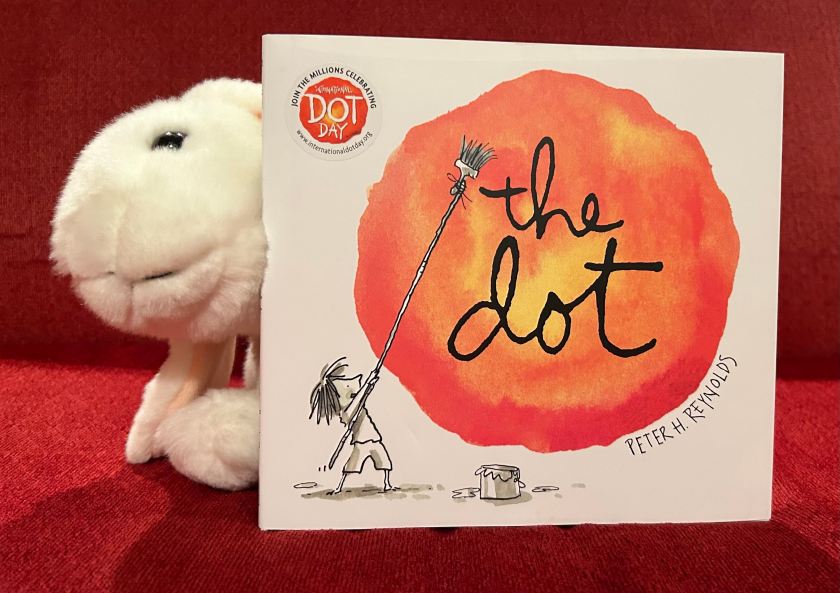
Marshmallow reviews The Dot by Peter H. Reynolds.

Sprinkles: So Marshmallow, can you tell us a bit about this book?

Marshmallow: This is a book about creativity and artistic expression, even when you do not think you have it in you to be creative.

S: That is a neat recap of this book Marshmallow. So maybe let us go a bit into details. What exactly is the plot?

M: There is a little kid named Vashti and she thinks she cannot draw. So at the end of art class, her paper is still empty. And her teacher says, just make a mark and see where it takes you. And so she does. She stabs the paper and makes a dot.

S: Okay, then what happens?

M: Her teacher tells her to sign it.

S: Just a dot?

M: Yes.

S: Then what happens?

M: Well, I don’t want to give away the full story, but her teacher supports Vashti by showing that she values Vashti’s work even when Vashti does not think much of it. And then Vashti gets inspired to create more and more. And in the end, we see her encouraging another young person like her, who believes they are not creative at all, by telling them to “just make a mark and see where it takes you”.

S: So the idea is that you just get started, and then things go from there. Right?

M: Yep. You do not have to feel creative, you do not have to think you know what you are doing. But just get started, and just make your mark. The rest will follow.
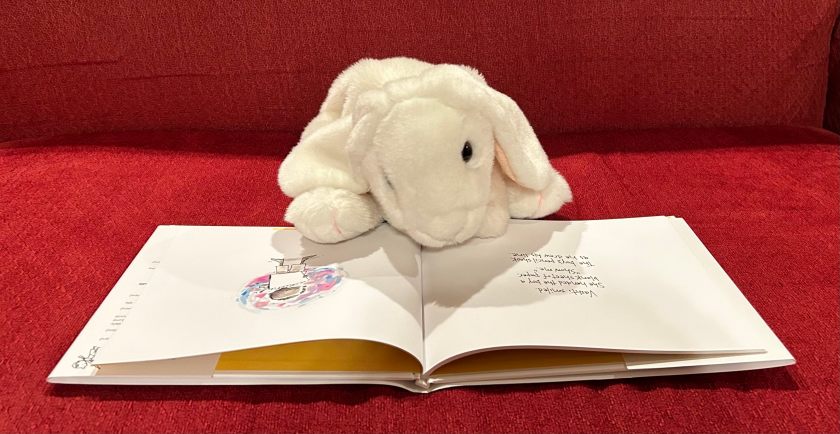
Marshmallow is reading The Dot by Peter H. Reynolds.

S: The author / illustrator dedicated this book to Mr. Matson, his seventh grade math teacher who “dared” him “to make [his] mark”. So even though the book is about art, it could be seen as a fable that is about any other thing we are not confident about, no?

M: Yes, I think so. I think the book is really inspiring.

S: I agree. What do you think of the illustrations and the visual aspects of the book?

M: I really like Peter Reynolds’ style. It is very simple, minimalistic, and sparse. But with the very few strokes of his pen, he draws really effective images.

S: Agreed.

M: I also like the way he uses color. Most of the book is in black and white but there are several well-placed splashes of color, which bring attention to specific items on the page. They add a lot to the feel of the whole book. By the way, the illustrations were apparently done with water color, ink, and tea. I wonder how he uses tea.

S: I have no idea!

M: I would like to know. But anyways, all in all I think this is a really neat book.

S: I agree. But Marshmallow, this is a picture book, and you do not review picture books much anymore. Do you perhaps not think this is for young bunnies only?

M: No, I think it can be inspirational for any bunny. Everyone needs some encouragement now and then.

S: Alright, that works for me. Maybe it is time to wrap up this review. What do you want to tell our readers?

M: Stay tuned for more amazing reviews from the book bunnies!
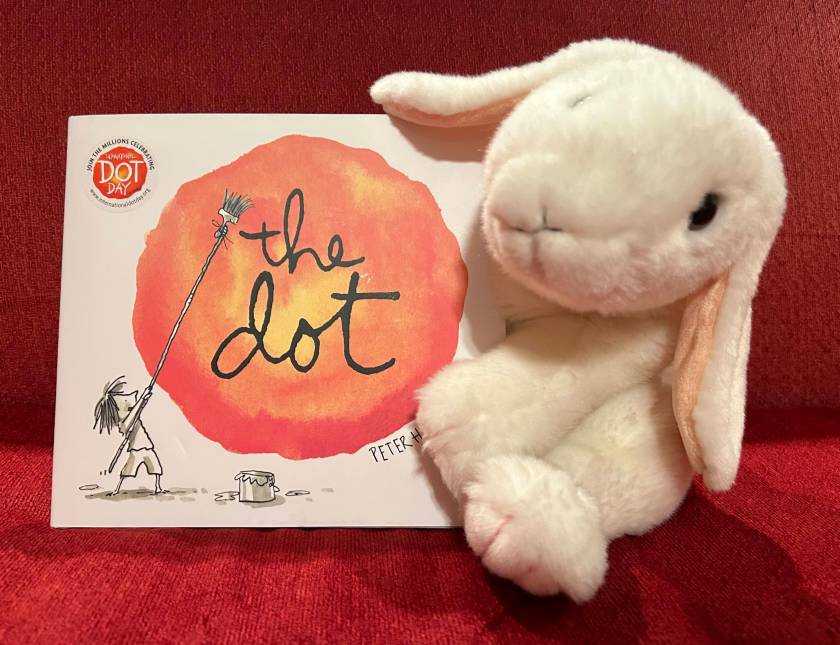
Marshmallow enjoyed reading The Dot by Peter H. Reynolds and recommends it to all bunnies little and big who need a little bit of courage to get started.

Marshmallow reviews Animal Farm by George Orwell

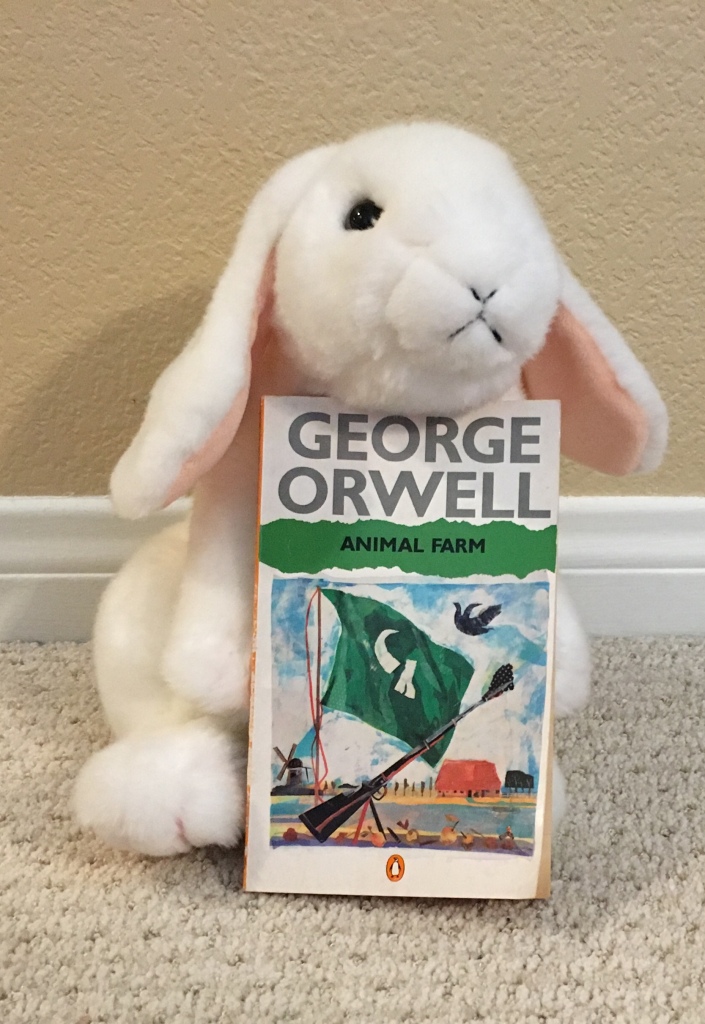
Marshmallow reviews Animal Farm by George Orwell (1945).

Marshmallow found a copy of George Orwell’s classic Animal Farm during her summer break and chose it for her first review of August 2019.

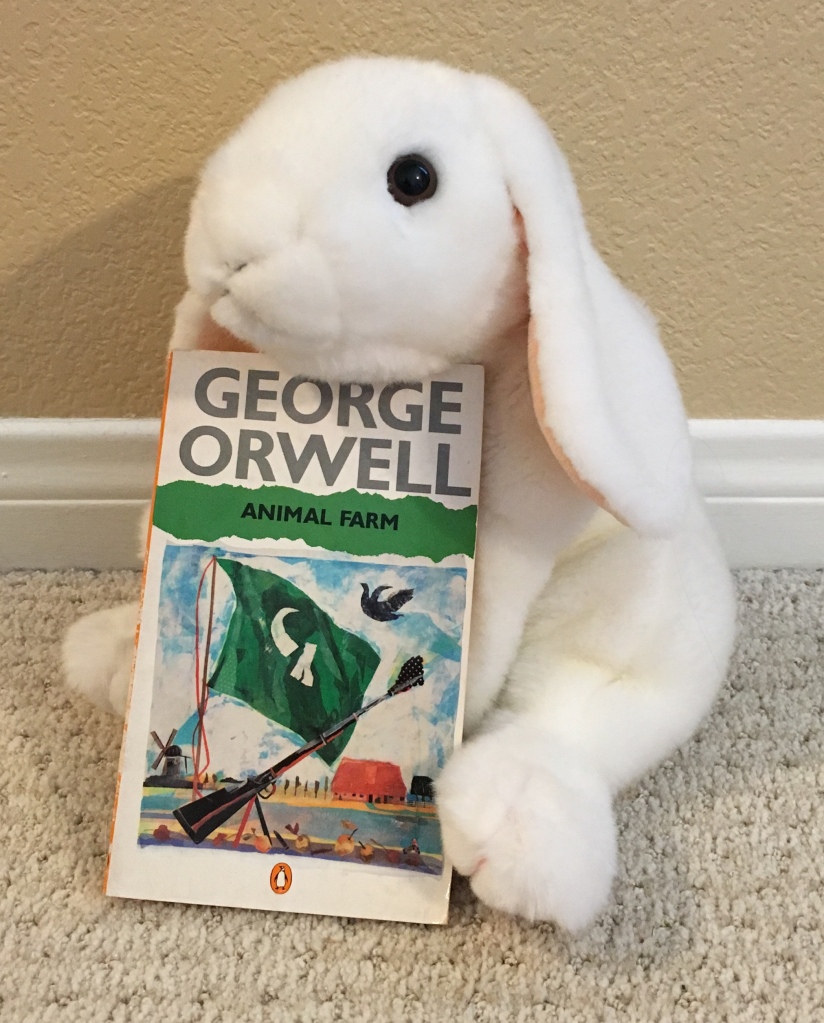
Marshmallow reviews Animal Farm by George Orwell.

Marshmallow’s quick take: If you like books that are about animals that act and talk like humans, then this might be the book for you.

Marshmallow’s Summary (with spoilers): The animals on Manor Farm gather to listen to the last speech made by Major, an old boar who is about to die. Major says in his speech that man is the real enemy and that if they overthrow the farmer then they can be free. He says that man does not produce anything like milk and eggs, but humans are still the top of the food chain. Three nights later Major passes away.

Soon after, three pigs named Napoleon, Snowball, and Squealer start a rebellion against humans, like Major said. They succeed and eventually overthrow the farmer Jones and his wife. The farmer runs away and leaves the farm to the animals. The animals rename the farm Animal Farm. But Jones does not want to give away the farm. He goes back to the farm to regain the farm. The humans lose and the animals remain the owners of the farm for the time being. 

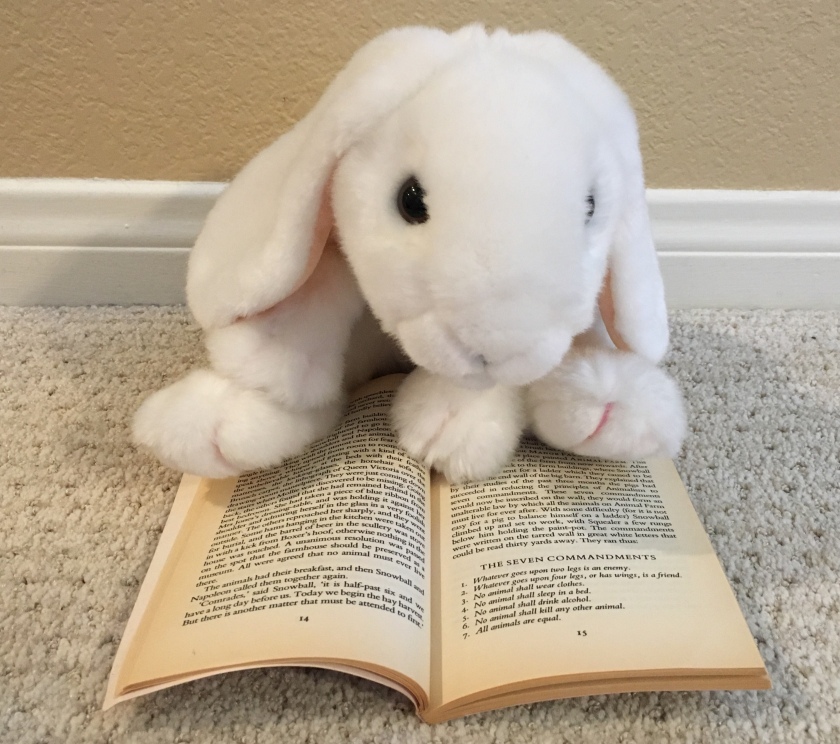
Before the fight, the animals establish a kind of law called The Seven Commandments.

The Seven Commandments

1Whatever goes upon two legs is an enemy.
2Whatever goes upon four legs, or has wings, is a friend. 
3No animal shall wear clothes.
4No animal shall sleep in a bed.   
5No animal shall drink alcohol.
6No animal shall kill any other animal.
7All animals are equal.

These rules will eventually change and change for the worst.

Marshmallow is pointing to the original seven commandments in George Orwell's Animal Farm.
Marshmallow is pointing to the original seven commandments in George Orwell’s Animal Farm.

Animal Farm is a happy place until the leaders start getting corrupted by greed for power and eventually turn against each other. Snowball proposes that they build a windmill to get electricity. Napoleon is against the idea. The two comrades turn against each other. Napoleon trains a few dogs to use as bodyguards and he frightens Snowball away with them. Then he eventually says that he had agreed with the windmill plan the whole time and that he was really just pretending to disagree. Napoleon also says that it turns out the Snowball was allies with the evil farmer Jones. They start to build the windmill. Once they finish the windmill, after a lot of tiresome work, the windmill breaks and Snowball is blamed for the destruction of the windmill.

This is only page 47; the book has 95 pages total. A lot more happens but I think this is enough to give you a taste of what is to come.

Marshmallow’s review: This book is an allegory about how people treat each other when they have too much power. It reminded me of Aesop’s fables where the main characters are animals acting like humans. But this is a much more political story than The Boy Who Cried Wolf.

“It is the history of a revolution that went wrong—and of the excellent excuses that were forthcoming at every step for the perversion of the original doctrine.”

wrote Orwell in the original blurb for the first edition of Animal Farm in 1945.

from the back cover.

As in fables you learn lessons from the story. It seems that pretty much anybody can be corrupted by power. Of course, the silence and cooperation of the farm animals who are all scared of being the next victim of Napoleon’s dogs allow his corruption to grow.

This book is quite pessimistic and does not have a happy end. But maybe we can learn from it some things. All in all I appreciated reading it and will likely read it again.

Marshmallow’s rating: 95%

Marshmallow rates George Orwell's Animal Farm 95%.
Marshmallow rates George Orwell’s Animal Farm 95%.