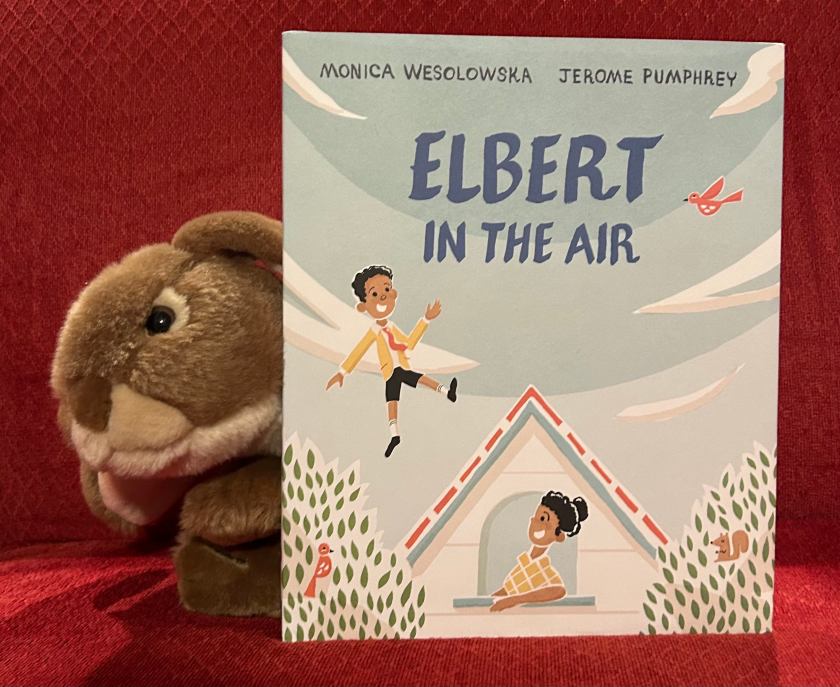
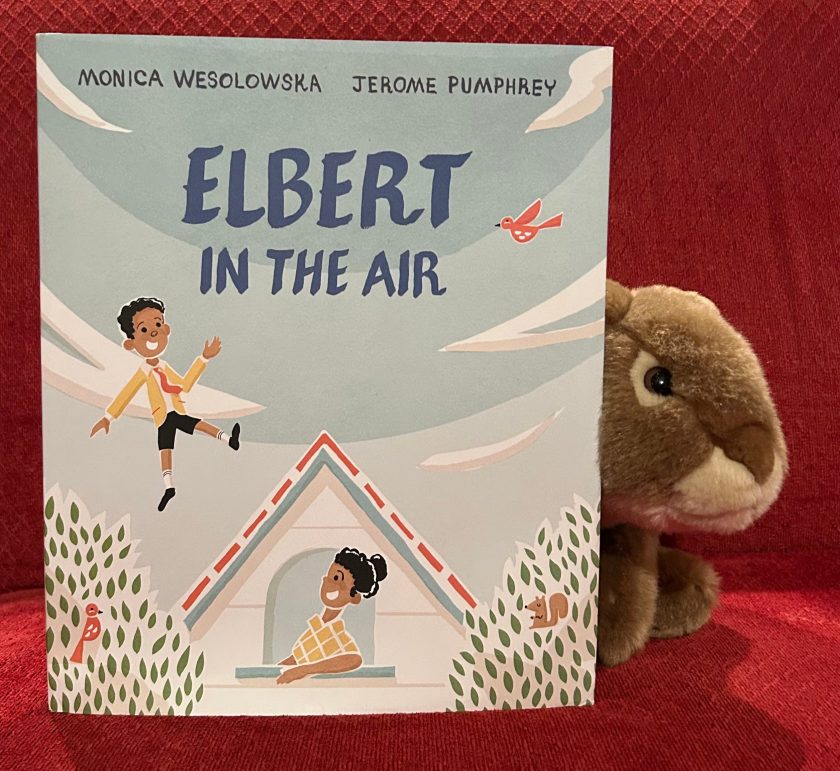
Today Caramel reviews a sweet picture book published in 2023 titled Elbert in the Air, written by Monica Wesolowska and illustrated by Jerome Pumphrey. As always, Sprinkles is taking notes and asking questions.
The book bunnies received this book as a review copy.
Caramel reviews Elbert in the Air, written by Monica Wesolowska and illustrated by Jerome Pumphrey.
Sprinkles: So Caramel, here we are, once again talking about a brand new picture book. What can you tell us about Elbert in the Air?
Caramel: This book is about Elbert, who is a kid who floats. Quite literally. I mean he can float in the air, and he could do so since the time he was a baby.
S: So like a balloon?
C: Kind of.
S: That is interesting. Can he control it?
C: Not really. He can only go up it seems like. He can’t go down. It is really sad actually. How would he get food? I mean, his mom gives him things, but she has to climb a tree and so on to reach him.
S: You are right Caramel. Floating like a balloon sounds fun at first, but I guess it can be lonely.
C: It could be cool if you could control it.
S: I agree Caramel. So do we know why Elbert floats?
C: Nope. He just does.
S: Okay, so what happens in the book?
C: He keeps flying and people are scared of him. They keep telling his mom how to control him and bring him down.
S: What does the mom do?
C: She does not do any of the things they tell her to. She says, “if Elbert was born to float, you should let him.”
S: I see. Do you think she is doing the right thing?
C: Yes.
S: She is not judging her child and trying to make him fit into other people’s expectations.
C: Yes, exactly. So I think she is doing the right thing.
S: But Elbert will be lonely if he is the only one floating.
C: Well, at some point he has regular friends while they can reach him, but then he flies up higher and regular folks cannot reach him. So for a while he is really lonely.
S: But at least he knows his mom is supporting him.
C: Yes.
S: Still it could be lonely…
C: Yes. I am sure it would be, but he does eventually find others who can float, and — wait, is that a spoiler?
S: Hmm, maybe.
C: Okay, I will say no more.
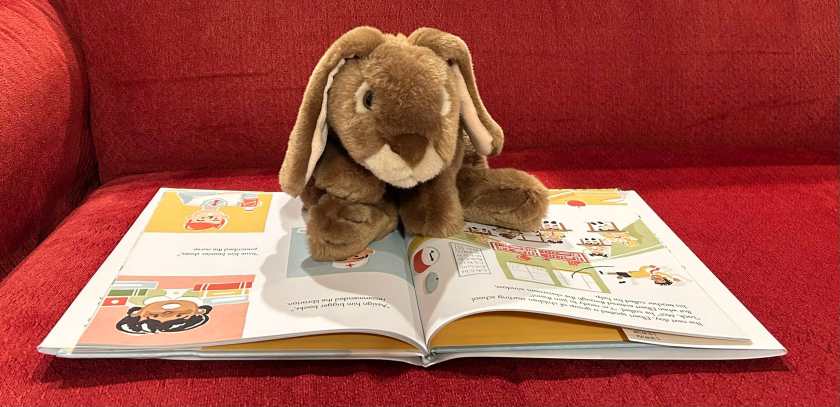
Caramel is reading Elbert in the Air, written by Monica Wesolowska and illustrated by Jerome Pumphrey.
S: Alright, so let us look at the book in other ways. What did you think of the illustrations?
C: I thought they were good. There are a lot of pale blue, orange, brown, black, red, white, and so on.
S: Somewhat muted and calming colors mostly?
C: Yes. Except the red and the orange. But those are fun colors too.
S: So you liked the colors! What was your favorite part of the book?
C: Well, I cannot tell, because it is at the end, and I do not want to spoil things any more than I did already.
S: That’s fair. Okay Caramel, so if you were to summarize this book in three words, what would you say?
C: Colorful, floating, and happy.
S: I like those!
C: Actually, maybe I’d say adventurous, too.
S: Alright, then. I think those are good words to summarize the book. Let us wrap up our review then. What would you like to tell our readers Caramel?
C: Stay tuned for more book bunny reviews!
Caramel enjoyed reading Elbert in the Air by Monica Wesolowska and Jerome Pumphrey, and recommends it to all the little bunnies all over the world.
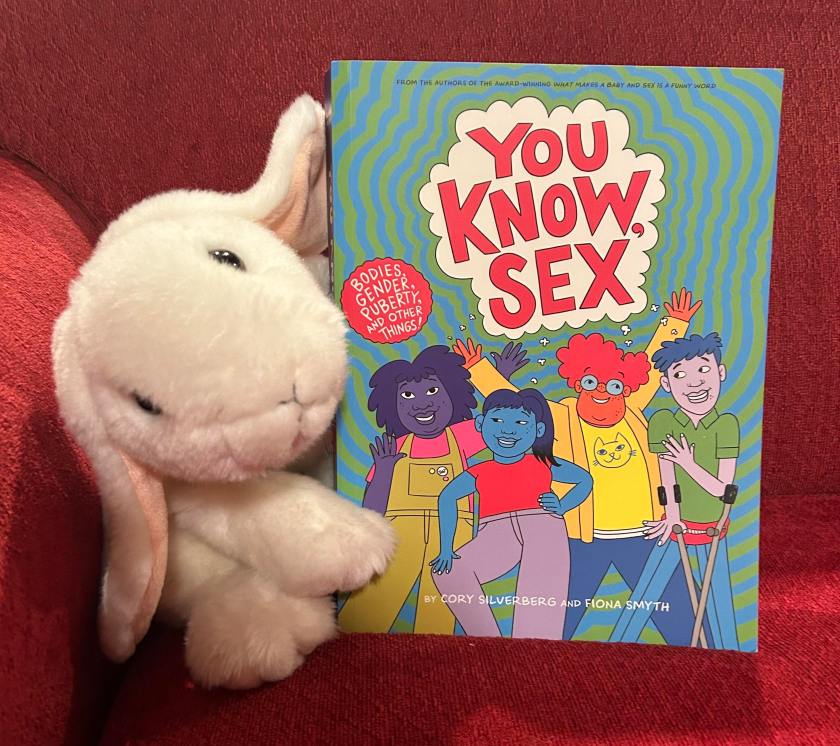
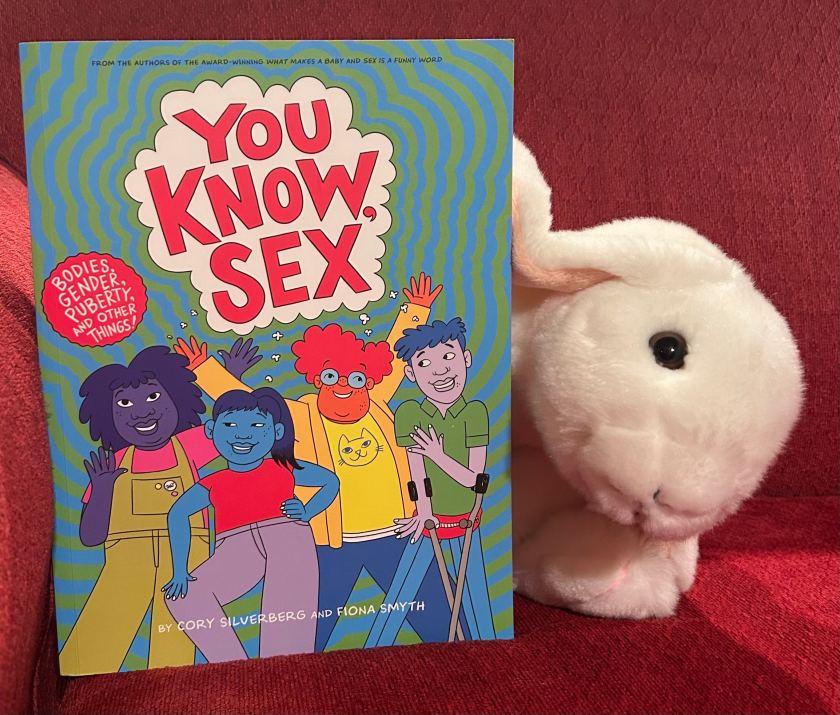
Marshmallow is reading about growing up and this week she wanted to talk about a recent book she read about puberty, growing up, and sex written for young people who are around her age: You Know, Sex: Bodies, Gender, Puberty, and Other Things by Cory Silverberg and Fiona Smyth. Sprinkles is taking notes and asking questions.
Marshmallow reviews You Know, Sex: Bodies, Gender, Puberty, and Other Things by Cory Silverberg and Fiona Smyth.
Sprinkles: First of all, as we begin this review, I want to thank you for reading this book, Marshmallow. After reviewing a collection of books about where babies come from, I had intended to write a post about a handful of books about puberty next. And one of the books I chose was this one, a huge, 432-page tome written in graphic novel form. But when I began to read it, I realized that my personal discomfort with the form (due to my poor eyesight) would mean I would probably not be able to give it its full due. So thank you for helping me out and checking the book out on your own.
Marshmallow: Well, that’s alright, Sprinkles. It was an interesting read.
S: That’s good to know. Can you tell us a bit about the specifics of the book?
M: Sure. You already said it is big, and has 432 pages. And you said it is written as a graphic novel.
S: The two who wrote this book also were the writer and the illustrator of What Makes A Baby?, one of the books I read for that review of books about where babies come from. And the pictures have the exact same style.
M: Yes, there are people with many different skin colors, like orange and purple and green and blue, and many different shapes and sizes.
S: Does that work well?
M: Yes, it is interesting. I think the people all look quite unique.
S: Well, I guess that makes the book more realistic, right? We are all quite different from one another.
M: Yes.
S: So tell us more about the book.
M: There are eleven chapters. They are titled: What is Sex? Bodies, Gender, Puberty, Feelings, Consent, Talking, Relationships, Reproduction, Touching, and Safety.
S: So the book covers a lot of ground.
M: Yup. It is also very contemporary.
S: What do you mean by that?
M: It has some ideas which I think are contemporary. They talk about gender identity and sexual orientation, transgender and non-binary people, and people having relationships with multiple partners.
S: The last one does not sound too contemporary to me. Polygamy and polyamory have been around for a long time. They have not always been accepted or legal though. I guess the authors are trying to teach the reader to be open minded about different arrangements.
M: I am not sure all readers would be too open to all of these ideas at this point.
S: I agree with that. Actually I too find some of these ideas challenging, especially polygamy. Though rabbits are typically not monogamous, according to Wikipedia, “scientific studies classify the human mating system as primarily monogamous, with the cultural practice of polygamy in the minority”. In any case, it is good to learn about how different people can relate with others.
M: Well, the book does not talk so much about polygamy as polyamory. But yes, it is good to learn about these different things.
Marshmallow is reading You Know, Sex: Bodies, Gender, Puberty, and Other Things by Cory Silverberg and Fiona Smyth.
S: They also talk about the changes a young bunny goes through in puberty, and more generally about biology and mechanics of sexual reproduction, right?
M: Well, yes. There are also very vivid depictions of things. They make an effort to show all kinds of things, so that the reader does not end up assuming that a body part has to look in one specific way. And they show people doing all kinds of different things together or alone.
S: I did look through the pages a lot, too, and I’d say there really are a lot of illustrations that some parents may not be comfortable with.
M: The self-discovery and self-exploration parts might also be kind of touchy topics for some folks, I’d imagine.
S: I did see a section on pornography, and that too is a very challenging topic. Perhaps grownup bunnies should read this book together with their young ones when they feel like the conversations about the various themes and issues that come up will be constructive.
M: I’d agree with that.
S: What were some of the other topics in the book? What topics did you find were most important?
M: They talk a lot about relationships, and I thought it was useful to learn about that. They talk about consent and power in relationships, and sometimes how people talk about being with people as a competition.
S: Yes, I did see that page about how sometimes people talk about “scoring” and the book instead encourages young people to think about “trust, respect, justice, joy, and choice”.
M: Yes, I did find those parts useful. All in all, it is an interesting and useful book, but I think grownups should probably check it out before sharing with their little ones.
S: Agreed. So what would you tell our readers as we wrap up this review?
M: Stay tuned for more amazing book bunny reviews!
Marshmallow appreciated reading You Know, Sex: Bodies, Gender, Puberty, and Other Things by Cory Silverberg and Fiona Smyth, and she thinks all growing bunnies should read a book along these lines; she also suggests grownups check it out before sharing with their little ones.
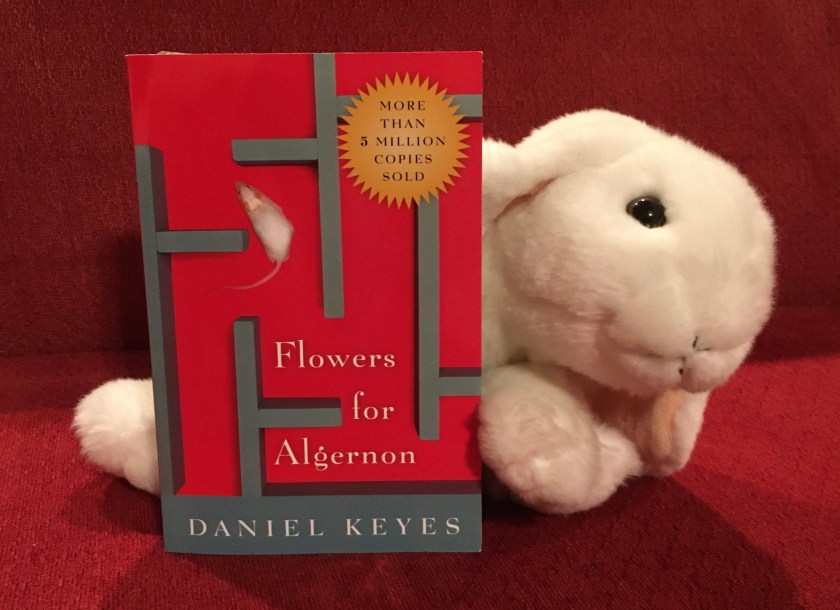
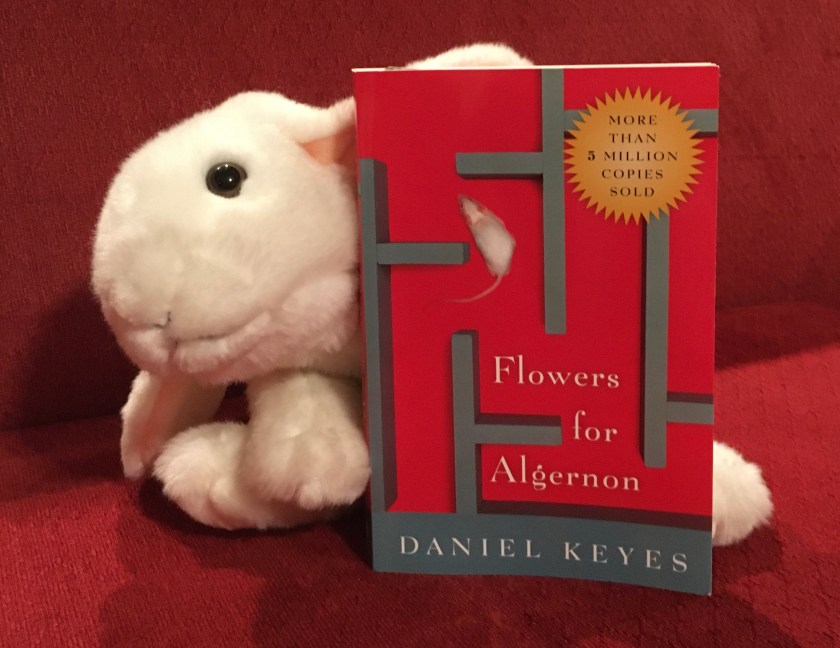
In the last few weeks, Marshmallow and her English class have been reading a version of the classic novel Flowers for Algernon by Daniel Keyes, first published as a short story in 1959 and then expanded by its author to be published as a full novel in 1966. Sprinkles was excited to see Marshmallow getting into the story because she remembers it fondly from her own time reading the same book in school decades ago. In the blog post below, the two bunnies discuss the full book.
Marshmallow reviews Flowers for Algernon by Daniel Keyes.
Sprinkles: So Marshmallow, why don’t we start with your usual short overview of the book?
Marshmallow: Why not? If you like books about growing up or living through a big change, this might be the book for you.
S: I think that is a good way to describe the book. The main character is originally a mentally challenged adult, so he is not really growing up, but he undergoes an experimental treatment which enhances his mental capabilities immensely, and so he is going through a big change.
M: Yes. The main character is Charlie Gordon, and he is the one narrating the story. The book is written as a series of progress reports, all through his perspective.
S: Yes, the entries are like diary entries, right?
M: Yes, most of them. And at the beginning he is using very simple sentences and basic words and sometimes has very poor spelling. As the treatment takes effect, he begins to write more complex sentences and use bigger words. He also starts to write about more personal and complicated things and has to confront some past emotional trauma. So, for example, I should warn all bunnies that the book does have some explicit descriptions of certain sexual feelings and acts. As Charlie gets more and more mentally capable, he begins to notice his attraction to women.
S: Even before the operation, he might have felt some such feelings, but would perhaps not write about them?
M: I’m not sure. It seems to me that Charlie had the mind of a three year old before the operation, and so he did not have any sexual impulses.
S: Hmm, that sounds somewhat unrealistic to me, given that he has the body of a full-grown man; his hormones and related needs and desires would probably be quite typical.
M: Well, I don’t know, but he seems to become more interested in things like that, and that was quite a bit different from the version we have been reading at school. In that version, we do not see any of this stuff. Which is in some ways easier to read.
S: I can understand that. Perhaps that is why a lot of school districts have had discussions about this book, and apparently some have even removed it from their libraries. The sexual content might be a lot for some younger bunnies to handle, even though I was not bothered by them when I was a young bunny reading the book. Then again, I might have been a little older than you… Or who knows? Maybe I read an abridged version, too, and I do not recall very well.
M: Maybe. I don’t know. But the full book is a bit more adult than my usual reading fare. The only other book I have read that is kind of like this one is 1984 by George Orwell, which also had some explicit scenes.
S: I understand. I’d say that both books have very serious messages, and the sexually explicit scenes in both books play significant roles in clarifying those messages. So for example in 1984, the sexual scenes show us the main character’s difficulties with intimacy and the oppressiveness of the general climate. In this book, I think the sexual scenes are a part of Charlie becoming more aware of his body, his personality, his needs and desires, as well as how the outside world views him.
M: I can see that.
Marshmallow is reading Flowers for Algernon by Daniel Keyes.
S: So who or what is Algernon? Why is the book titled Flowers for Algernon?
M: Algernon is a mouse. He has gone through the same operation that Charlie has, and in some ways, the changes he goes through are similar to what happens to Charlie. So Charlie begins to really like and care for Algernon, because Algernon is more or less the only other creature in the world who is going through the same thing that Charlie is. And then —
S: Wait, don’t give everything away!
M: Okay, no more spoilers. But things do get pretty sad, and the title of the book is in the very last sentence of the book.
S: Yes, that is true. What did you think of Charlie? Did you like him or sympathize with him?
M: I liked him, more at some times and less at others. He is a childlike and kind person at the beginning, and that I really liked. But then as the operation takes effect and he begins to get more and more intelligent, he becomes more arrogant and he does not even realize that. I did not like him that much then. But eventually he does begin to understand other people better, and he remembers and tries to process some of the emotional trauma from his childhood. He justifiably gets angry at some people who mistreated him when he did not know they were being mean. And there I could of course sympathize with him. And he wants to be accepted most of all.
S: I guess that is a very understandable need. We are social creatures and we want to belong.
M: Yes. I think so. So when he becomes too intelligent, that is also isolating. Certain people used to feel better about themselves by putting him down, but now they feel inferior to him and begin to fear and avoid him. In some ways, those people were not good people to have as friends anyways, but Charlie did not know. In any case, in the end —
S: Wait, remember, we don’t want to be giving away too much…
M: Hmm, okay, I guess I should stop here.
S: Alright. Let us do that. Would you recommend this book to other young bunnies? Or perhaps, you’d recommend the abridged version?
M: I think young bunnies might really like the abridged version. Charlie’s story is a lot simpler in it and it is a lot easier to read. And you get to really like him and feel for him, and and the story is still sad but beautiful.
S: Okay. That makes sense to me. Full-blown people are all pretty complex, and I think the original book captures that really well. Charlie is a complex person with a complex story, and the book does give us a lot more to chew on. But the main message can come through quite clearly in the abridged version, too, without the distractions of the sex dimension and the emotional trauma. So how do you want to end this review?
M: I can say my usual: Stay tuned for more amazing reviews from the book bunnies!
Marshmallow appreciated reading Flowers for Algernon by Daniel Keyes and recommends it to her peers but emphasizes that perhaps some might prefer an abridged version.
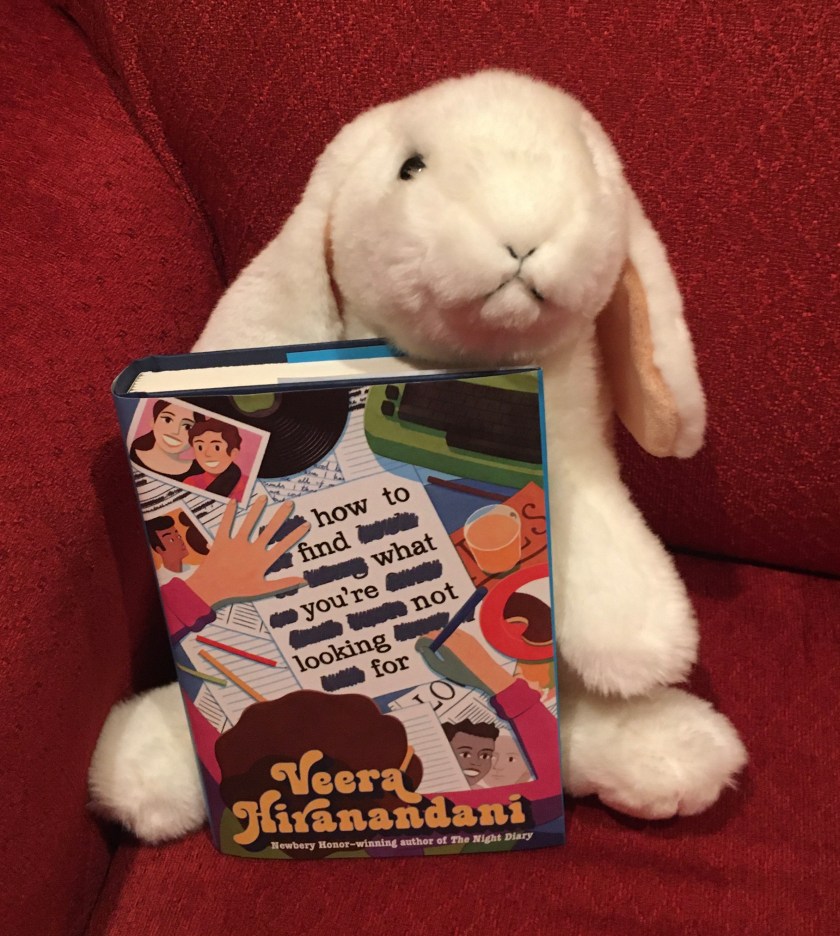
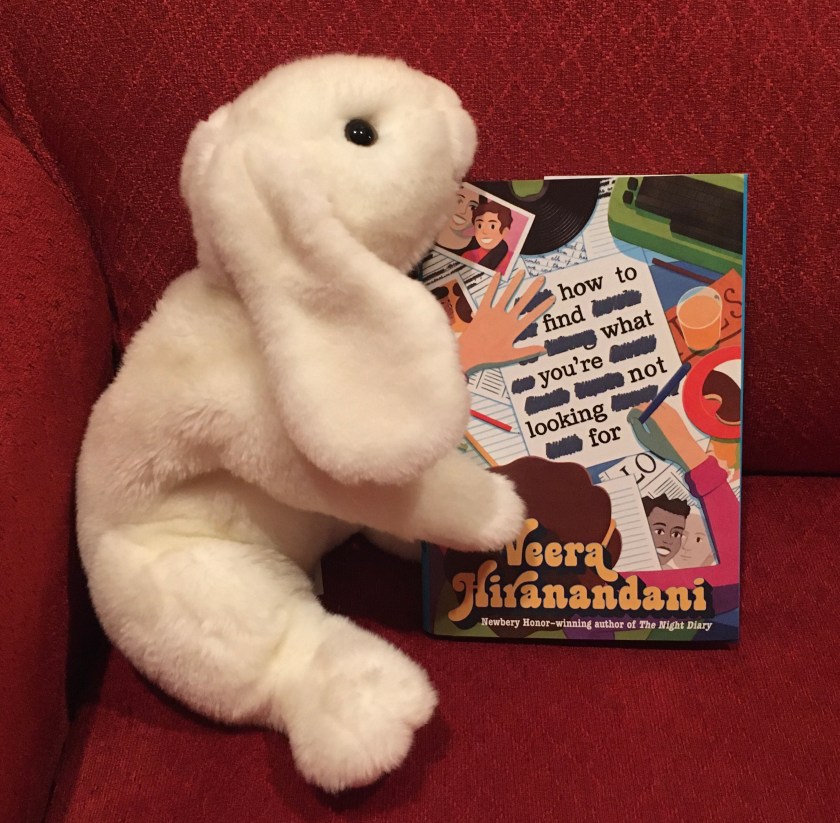
Today Marshmallow reviews How to Find What You’re Not Looking For, a 2021 novel by Veera Hiranandani.
Marshmallow reviews How to Find What You’re Not Looking For by Veera Hiranandani.
Marshmallow’s Quick Take: If you like books about family, friends, or historical fiction, then this might be the book for you.
Marshmallow’s Summary (with Spoilers): Ariel Goldberg’s life is drastically changed forever when her older sister Leah elopes with a man from India.
The book starts in the summer of 1967. Interracial marriage is now legal, however, stigma and bias remain, even in Ariel’s parents. Leah tells Ariel about her relationship with Raj, an Indian college student, and says that they have plans for the future, which greatly worries Ariel. When the girls’ parents meet Raj, they don’t like him. This is mainly because Ariel’s family is Jewish, and Raj is not; they don’t want their daughter to marry a person who is not Jewish. Ariel likes Raj, but she definitely doesn’t want her sister to marry anyone yet. But then one day, Leah and Raj elope, and Ariel’s life is forever changed.
Besides all that is going on in her home life, Ariel has been having problems at school. There seems to be a new rift between her and her best friend, Jane. Ariel is also bullied by a boy who hates Jewish people. On top of all this, Ariel also has trouble writing. Her new teacher, Miss Field, believes that she has dysgraphia. Miss Field brings a typewriter for her to use and asks Ariel to write short poems to practice writing.
Ever since Leah left, Ariel’s life seems to be falling apart. Can Ariel put it back together?
Marshmallow is reading How to Find What You’re Not Looking For by Veera Hiranandani.
Marshmallow’s Review:How to Find What You’re Not Looking For raises many complex issues such as racial and religious bias in a way that teaches but also gives hope. It shows that bias is not just in other people but everywhere. It also shows that there might be reasons for behavior that looks excluding, such as people wanting to sustain their family culture and identity, but it does clearly show that stigma and bias are not okay.
I found it interesting how the main character wrote poems to express what is happening in the book. I found it to be a good way for the author to tell the reader how the main character, Ariel, is feeling. The poems really add something to the book.
The story is set in 1967; the author uses words like “groovy” to show how the narrator is living in the past. The narrator is also always using the second person “you” and everything is told in the present tense. This gives the story a more urgent tone somehow and like everything is happening all at once, as you read the book.
This book includes information about the Loving vs. Virginia case from 1967 and the ideas around interracial marriage play a significant role in its plot. Martin Luther Jr.’s murder from 1968 is also mentioned. In other words, How to Find What You’re Not Looking For talks about racial and religious injustice very openly. This makes me think that this book would be more appropriate for older bunnies, from 10 and up. There isn’t really any inappropriate content for younger bunnies, so younger readers could also enjoy it, but I think 10 and up would be able to understand the context better and so get the most out of this book.
Marshmallow’s Rating: 95%.
Marshmallow rates How to Find What You’re Not Looking For by Veera Hiranandani 95%.