Caramel reviews Asterix Omnibus 1 by Rene Goscinny and Albert Uderzo

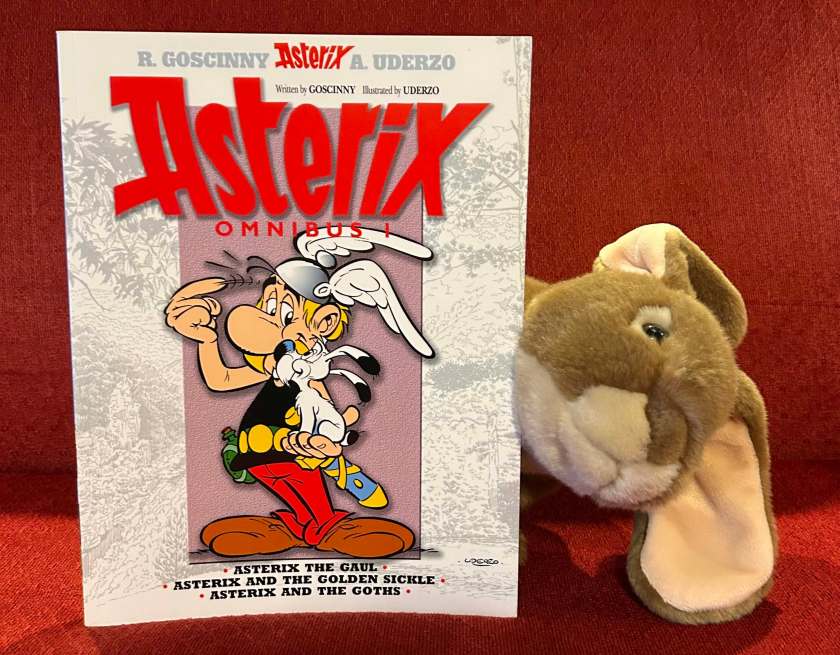
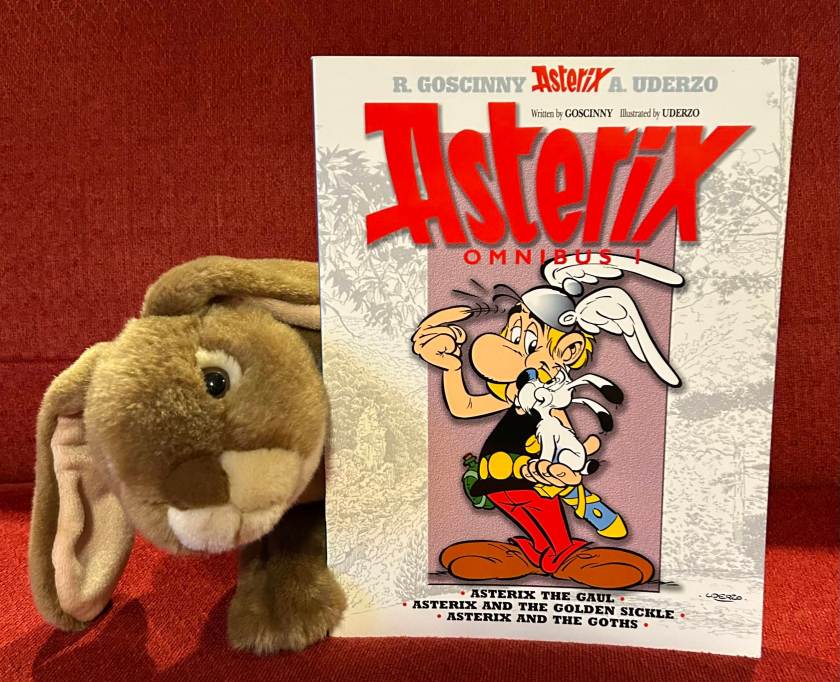
Today Caramel talks about Asterix Omnibus 1, written by Rene Goscinny and illustrated by Albert Uderzo, the 2011 edition that brings together the very first three adventures of Asterix the Gaul. As usual, Sprinkles is taking notes and asking questions.
Caramel reviews Asterix Omnibus 1, written by Rene Goscinny and illustrated by Albert Uderzo.

Sprinkles: So Caramel, you finally discovered our Asterix collection.

Caramel: Yes.

S: And it seems like you have enjoyed reading them.

C: Yes. That’s why I wanted to talk about this one today.

S: Okay, so let us start. What is this book in your paws?

C: This is a collection of three stories about Asterix the Gaul and his friends.

S: Okay, so maybe you can tell us a bit about Asterix.

C: He is a Gaul, living in the Roman times. Apparently his village is the only village in Gaul that is not yet captured by the Romans. And they keep driving the Romans mad by being independent and so on. In these three stories we also get to meet the people from the village. There is Asterix’s best friend Obelix, and there is the village chief, Vitalstatistics, and the village potion maker druid, Getafix.

S: Those are some ridiculous names! I am guessing they are not in the original French. Anyways, continue please.

C: Okay. So Getafix makes a magic potion that makes the person who drinks it very very strong, and that is how the village has been able to defend itself against the Romans. And Obelix is very strong always, because apparently he fell into the potion cauldron when he was a baby. Anyways, the three stories are about them having some fun adventures.

S: So this is supposed to be in the ancient past, right?

C: Yep. So apparently Gaul is a part of Europe which is today split between France, Belgium, and a bunch of other countries. Wikipedia says that Romans conquered most of Gaul by 52 BCE. So according to the Asterix books, though, they did not manage to conquer this one little village.

S: So this is around 50 BCE?

C: Yes, the first sentence is “The year is 50 BC.” But you could also tell probably because Julius Caesar is alive and leading the Romans. And apparently he died in 44 BCE.

S: That makes sense.

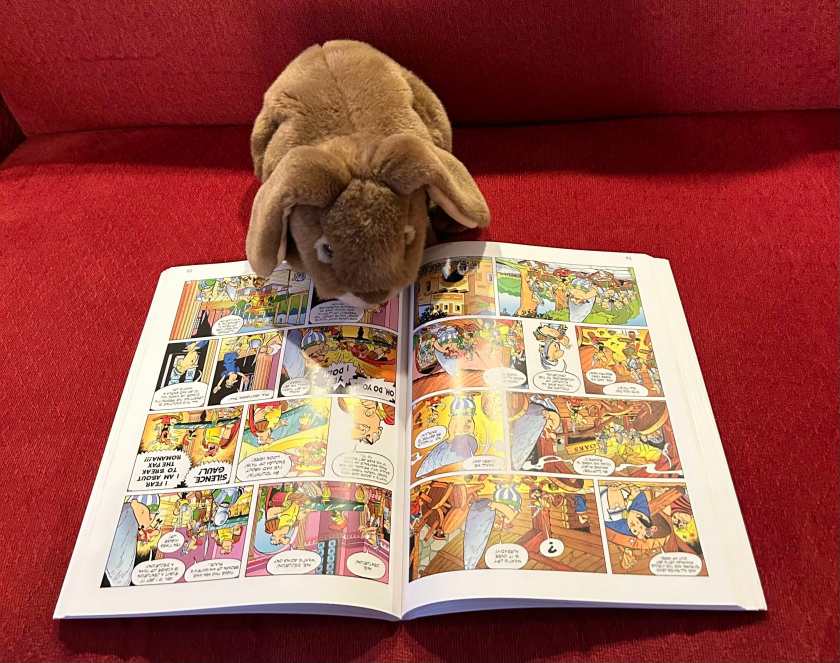
Caramel is reading Asterix Omnibus 1, written by Rene Goscinny and illustrated by Albert Uderzo.

S: So this is an omnibus, which, according to our trusted online dictionary, is “a volume containing several novels or other items previously published separately.” So which stories are in this one volume?

C: There are three. The first is called “Asterix the Gaul”. Then there is “Asterix and the Golden Sickle”. And finally “Asterix and the Goths”.

S: According to Wikipedia, these were first published in 1961, 1962, and 1963, respectively. That is a long time ago. Can you tell?

C: Not really. The stories all happen way back in time. And they are just as funny as they would be if they were written today. But I did read that some Asterix stories have issues with race. The way they represent people of African origin would be racist today, so those stories would probably not even be published.

S: That is a very sensitive issue Caramel. I am impressed that you took the time to learn about it and are sharing it with us.

C: At least those issues do not come up in these three stories. I mean, the Goths are pretty mean and sometimes stupid in the third story, and the Wikipedia article says that was because the authors had strong anti-German feelings because it was so soon after World War II. But that would not be racism even though it is still not a nice thing to do, stereotyping people like that.

S: You are right Caramel. Okay, let us move on to a lighter topic. I know my sister used to laugh out loud when reading these; did you find them funny too?

C: Yes. There is a funny thing on each page, and if you actually look carefully at the individual frames, there is a lot of other hilarious stuff happening, too. The characters are all funny themselves too.

S: They are all very caricaturish, actually. Some characters have huge noses, some are round like a ball, and so on. A lot of them have exaggerated features.

C: Yes, and that makes it funny. And the pictures are all very colorful.

S: I am getting the sense that you really enjoyed reading this book.

C: I did.

S: How would you describe it in three to five words?

C: Hilarious, cartoony, and Roman-ful.

S: Come on, those are not words!

C: Okay. Hilarious cartoons full of Romans. That’s five words!

S: Alright, that works. I think this is a good time to wrap up the review. What do you want to tell our readers?

C: Stay tuned for more book bunny reviews!

Caramel enjoyed reading Asterix Omnibus 1, written by Rene Goscinny and illustrated by Albert Uderzo, and recommends it to other bunnies who might enjoy reading about a stubborn village full of hilarious people standing up against the big Roman Empire.

Caramel reviews Amos & Boris by William Steig

It is February, and Caramel is back! Today he is talking to Sprinkles about Amos & Boris, a sweet book by William Steig first published in 1971.

Caramel reviews Amos & Boris by William Steig.

Sprinkles: So Caramel, it is another year, and here we are talking about another book.

Caramel: Yes. There are a lot of books out there.

S: Sure. So what can you tell us about this book you chose for today?

C: This is the story of two animals, named Amos and Boris, who become friends.

S: Tell me more.

C: Amos is a rat. Or a mouse, rather. And Boris is a whale.

S: Okay.

C: Amos wants to travel around the world, but he can’t swim, so Boris saves him. And then they travel together in the oceans for a while and they become friends.

S: So it is a friendship story, right?

C: Yes. It is very much a friendship story.

S: Do you get a good sense of these two characters?

C: Yes. Amos is very kind and caring. Boris is more confident but not arrogantly so. He is also kind.

S: So is kindness one of the messages of the book?

C: Yes. Especially because their kindness is what helps them help one another.

Caramel is reading Amos & Boris by William Steig.

S: I see. So what did you think of the story overall?

C: I thought it was very good. I thought it was excellent! Put a link to a meme of Mr. Burns saying “Excellent!”

S: Okay, let me try:

via GIPHY

C: That worked! Yay!

S: Okay, but I am not sure it relates to the book we are talking about.

C: Well, I said the book was excellent!

S: I see. So tell me what you liked about the book then.

C: I liked their friendship. How they helped each other.

S: I see. That is sweet Caramel! What else did you like? Did you like the illustrations?

C: Yes. They are very simple looking but when you look closely there are so many details in each of them! Also in many of them Boris the whale is smiling! And I like that! And sometimes the mouse Amos is also smiling, and that is also nice.

S: Yes, the pictures do look quite simple and simplistic, but now that you told me, I took a better look, and you are so right, there are so many details!

C: Well, I don’t want to say I am always right but you know…

S: Okay, let us not get ahead of ourselves. So you liked the pictures, you liked the characters, you liked the story.

C: Exactly. As I said before, channeling Charles Montgomery Plantagenet Schicklgruber “Monty” Burns, it is excellent!

S: Well, no wonder it is still in print after such a long time. Did you know that this book was first published in 1971? That is more than half a century ago. Does it feel old?

C: No not at all.

S: It makes sense though. From what you are telling me, it sounds like it is telling a timeless story, of friendship and kindness.

C: Yes.

S: And it sounds like you really appreciated it.

C: Yes.

S: Would you have liked it if I had read it to you when you could not read it yourself?

C: Yes. In fact, maybe after we finish this review, you can read it to me. I still like to read together with you.

S: Oh sweet Caramel, of course I will read it to you. Let us wrap this up then. What would you like to tell our readers?

C: Stay tuned for more book bunny reviews!
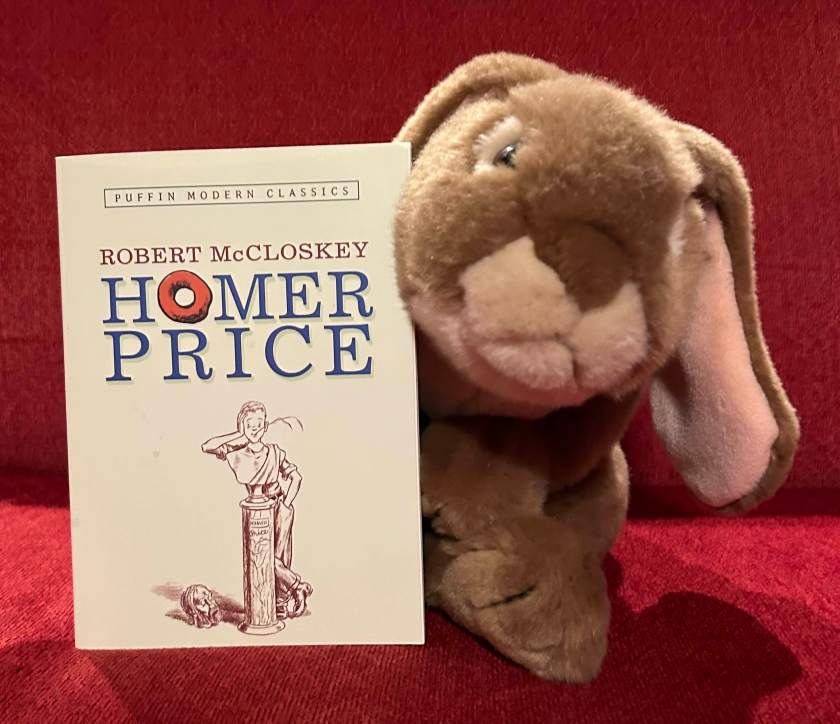
Caramel loved reading Amos & Boris by William Steig and recommends it to all young bunnies who love the sea, and even those who don't, because, why not?
Caramel loved reading Amos & Boris by William Steig and recommends it to all young bunnies who love the sea, and even those who don’t, because, why not?

Marshmallow reviews And Then There Were None by Agatha Christie

Sprinkles is an avid Agatha Christie fan, so she was very excited to introduce Marshmallow to her work. Earlier this year, Marshmallow reviewed her first Agatha Christie book, Miss Marple: The Complete Short Stories. And today, she talks to Sprinkles about And Then There Were None, the classic mystery novel, first published in 1939, known to be one of the best-selling books of all time.

Marshmallow reviews And Then There Were None by Agatha Christie.

Sprinkles: So Marshmallow how should we start talking about this book?

Marshmallow: I usually start my reviews with an overview. We could just do that.

S: Okay, so go for it!

M: If you like books about mystery or enjoy Agatha Christie’s works, then this might be the book for you.

S: That works. Okay, so can you tell us a bit about this book then?

M: Sure. Separately, eight people are invited to spend time at Soldier Island. They are all confused and do not fully understand why or by whom they were summoned to the island, because they do not know their host well or (in some cases) at all. They all travel to Soldier Island (for different reasons) and are ferried there together. They all have different ideas of who their host is; some suspect an eccentric billionaire while others think that the owner is a famous movie star. When they get to the island, they are also confused by the variety in their fellow guests: there is a judge, a doctor, two young men, a young woman, an older woman, a retired military man, and another man who we eventually find out is a former police inspector.

S: So there are eight guests. But the story needs ten people, right?

M: Right. There is a married couple in the single house on the island who are supposed to be the caretakers for the time the eight will be spending there. They make up the last two of the ten.

S: Then what happens?

M: The first night, during dinner, there is an eerie recording that plays and accuses each of the ten with murder. Each of the ten people, the eight guests and the two caretakers, were apparently involved with the death of at least one person, and the voice in the recording claims that they were guilty. Or rather it says “You are charged with the following crimes…” and goes on to list one by one whose deaths each of the guests and the caretakers was responsible for. And of course everyone is unsettled and some want to leave the island immediately but of course this turns out to be impossible. Then one by one, people start dying.

S: So somehow someone got them to this island to kill them off?

M: Yes, basically. After the first couple days the remaining ones figure out that there is nobody else on the island other than themselves, which leads them to the conclusion that the murderer must be among them. This leads to more mistrust and suspicion. While some of the people dismiss the accusations against them, others admit to them and show no remorse. The reader is left wondering how innocent some of the characters are and how they end up dying one by one.

S: How so?

M: There is a nursery rhyme hung up in every guest room called Ten Little Soldiers and it is a story about these ten little soldiers who die one by one in specific ways until there are none.

S: And so the title of the book is And Then There Were None.

M: Yes. This is the last line of the nursery rhyme.

Marshmallow is reading And Then There Were None by Agatha Christie.

S: The rhyme is pretty interesting. I even reviewed a children’s book about zombies that parodies this rhyme.

M: Actually, the nursery rhyme in the book is coming from a real nursery rhyme that the book’s original title was based on. The title of the book used to be something quite different, but was changed because the original nursery rhyme was very offensive. I am very glad to have read the more modern, updated version, because the older title and rhyme were extremely offensive. Interested readers might read more about the history of this rhyme here. And here is the version from the book now:

Ten little Soldier Boys went out to dine; 
One choked his little self and then there were nine.

Nine little Soldier Boys sat up very late;
One overslept himself and then there were eight.

Eight little Soldier Boys travelling in Devon;
One said he'd stay there and then there were seven.

Seven little Soldier Boys chopping up sticks;
One chopped himself in halves and then there were six.

Six little Soldier Boys playing with a hive;
A bumblebee stung one and then there were five.

Five little Soldier Boys going in for law;
One got in Chancery and then there were four.

Four little Soldier Boys going out to sea;
A red herring swallowed one and then there were three.

Three little Soldier Boys walking in the zoo;
A big bear hugged one and then there were two.

Two little Soldier Boys sitting in the sun;
One got frizzled up and then there was one.

One little Soldier Boy left all alone;
He went out and hanged himself and then there were none.

S: So, overall, what did you think about the book?

M: I was engrossed while reading it. I could not stop! And rereading it is still enjoyable, knowing now how things turn out and who did what and so on, it is really fun to read again, as I am doing now.

S: I know, right? Christie is a master of this genre!

M: I have not read much in the genre actually but I definitely liked this book. The plot is so tightly set up, and everything works out like clockwork, and it is simply captivating. I had to finish it!

S: I know. She is amazing and this is one of her best books. So what would you rate this book Marshmallow?

M: 100%, definitely.

S: I would too. To this day, I find it so intricately put together. I am honestly so happy that I could share this book with you Marshmallow! But this is probably a good time to wrap things up. What would you say to our readers while we do so?

M: Stay tuned for more amazing reviews from the book bunnies!

Marshmallow rates And Then There Were None by Agatha Christie 100%.

Marshmallow reviews Are You There God? It’s Me, Margaret by Judy Blume

A while back Marshmallow reviewed Blubber by Judy Blume. Today she reviews another classic by Blume: Are You There God? It’s Me, Margaret, first published in 1970. Sprinkles is asking questions and taking notes.

Marshmallow reviews Are You There God? It's Me, Margaret by Judy Blume.
Marshmallow reviews Are You There God? It’s Me, Margaret by Judy Blume.

Sprinkles: So Marshmallow, let us start at the beginning. Who do you think would appreciate this book?

Marshmallow: I think girls who are approaching adolescence and may have some concerns about growing up might find this book relatable. Also if you liked other books by Judy Blume, I think you would definitely like this too.

S: That is a good start. Okay, more specifically, tell us now about the plot.

M: Margaret is this girl who just moved to New Jersey. And she is starting a new school and she makes a new friend named Nancy Wheeler —

S: This Nancy Wheeler?

M: Yeah, no. Not the Nancy from Stranger Things. Though she is also a girl who is living in a suburb with her family and wants to fit in and so on.

S: Okay, so let us get back to Margaret.

M: Yes, so Margaret’s dad was raised Jewish and her mom was raised Christian, but their families did not approve so they eloped and did not dictate a religion on their daughter. And when she lived in New York, nobody seemed to be perplexed by this, but here in her new school, her friends seem to want her to choose to belong to one or the other community.

S: And she is talking to God all through the book, right? Which God is this one?

M: Well, it is definitely a personal God, and Margaret shares her concerns, fears, hopes, and desires with Him. but through the book, we see her not making a specific choice. Her new teacher, Mr. Benedict, wants each student in her sixth grade class to pick a topic that is personally important to them and spend time that whole year to research it. Margaret chooses religion, hoping that through the year, she will try to figure out whether she should be Christian or Jewish. Remember both her grandparents are religious, but the Christian ones, her maternal grandparents cut off their relationship with them. Margaret does have a close relationship with her father’s mother, Sylvia, who encourages her to explore her Jewish heritage.

S: So the book is partially about Margaret exploring religion. But it is also a lot about growing up, right?

M: Right. Margaret’s new friends are obsessed with their growing bodies, and wearing bras, and boys, and so on, and Margaret does not yet feel like she is that interested in any of these things, but she wants to fit in, and so she ends up sharing their obsessions. Which was kind of weird to me, actually, because this is not quite how the girls in my school have been acting.

S: But maybe some of the girls in your school, too, might be interested in these kinds of things. Not all bunnies are like you and your friends, Marshmallow.

M: Well, I did not mean to sound like I am all so much more mature…

S: You are a pretty mature young bunny. But when I was growing up, there were a lot of girls like Nancy and her friends, and I feel like a lot of girls must have sympathized with the characters of the book for this book to have become such an iconic book.

M: Yes. It might also be that they felt like they should act like Nancy but they were actually feeling like Margaret who is not quite there. And eventually she does start obsessing about similar things.

S: The desire to fit in is often very strong. Especially among teens and tweens, but more generally it seems to be pretty common.

M: Yes.

Marshmallow is reading Are You There God? It's Me, Margaret by Judy Blume.
Marshmallow is reading Are You There God? It’s Me, Margaret by Judy Blume.

S: So this book was iconic, but it was also banned in many places. Did you know that?

M: Yes, I did. It talks about menstruation and so on, which some people claimed were not appropriate. But also it talks about religion and how it is okay if you do not pick between Christianity or Judaism, and how there might be other ways to finding spirituality in your life. This probably came across as anti-religion to some very religious folks.

S: Well, maybe today we are a bit more open-minded about these things. And the United States is a lot more diverse today in terms of people’s religious affiliations.

M: Yes, Margaret said, for example, that she was not considering Islam or Buddhism because she did not know anyone from those religions.

S: But there are people from a few other religions in your class, right?

M: Yep.

S: So we have come a long way from the 70s in that regard.

M: I hope so!

S: Okay, did you like Margaret as a character?

M: She is okay, she is very genuine, and kind of bland, she does not have a very big and sharp personality, and maybe that is intentional because the reader can fill in the gaps and more easily identify with her.

S: That makes sense to me.

M: There is also a girl in the school who has already grown up in terms of her body, and all the other people think she is sticking out. They make up rumors about her, they gossip about her, and they are pretty mean.

S: That is not good.

M: I think they are jealous. And I don’t think the girl does anything to deserve it.

S: Middle school can be a cruel place.

M: Well, they are in sixth grade but I guess that is middle school in some places.

S: Yep. So we got a hold of this book because there is a new movie about it. Do you think we should see it?

M: Yes. The trailer looks fun. Can we put a link to it here?

S: Sure, let us embed it right now:

Are You There God? It’s Me, Margaret. (2023) Official Trailer, from YouTube.

S: Do the characters look the way you visualized them?

M: Not quite, but I think they are close enough.

S: So we should try and watch it then. Okay, how would you rate this book?

M: I’d rate it 95%.

S: Sounds good. And what do you want to tell our readers as we wrap things up?

M: Stay tuned for more amazing book reviews from the book bunnies!

Marshmallow rates Are You There God? It's Me, Margaret by Judy Blume 95%.
Marshmallow rates Are You There God? It’s Me, Margaret by Judy Blume 95%.