Today Marshmallow reviews the first volume of Maus: A Survival Tale, Art Spiegelman’s graphic novel first published in 1986. Sprinkles is taking notes and asking questions.
Sprinkles: So Marshmallow, you chose to talk about a classic graphic novel today.
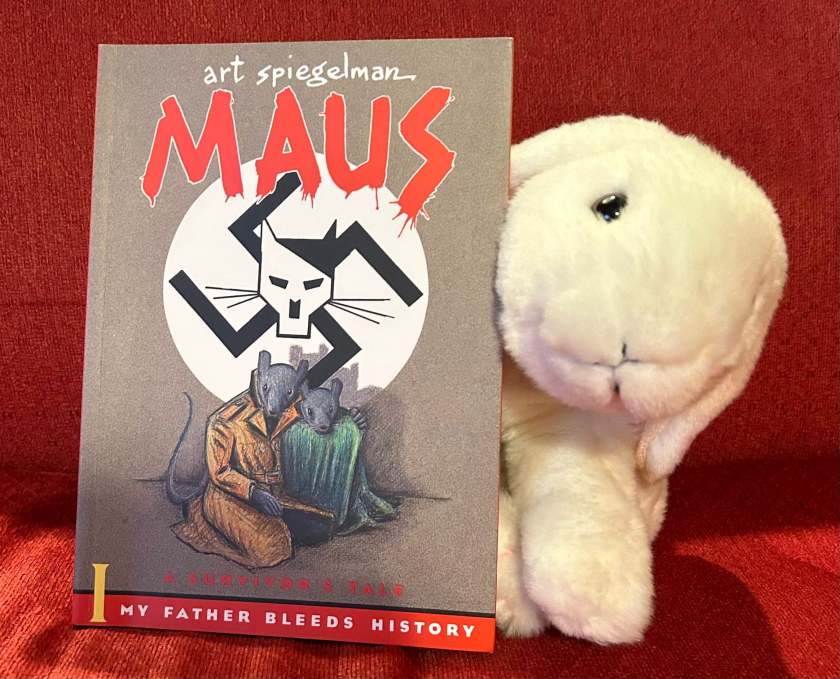
Marshmallow: Yes, we are talking about Maus: A Survivor’s Tale. This is in fact the first of two volumes, and Art Spiegelman published the second volume in 1991.
S: Okay, thanks for that important note. Wikipedia tells us that this is the first graphic novel that won a Pulitzer Prize. So I am glad you have read it and will talk with me about it.
M: I can see why it would get such an important prize. It is a very important book and it has a very important message.
S: Okay, so maybe it is about time to tell our readers what this book is about. They have already seen your photos with it, and they must be wondering.
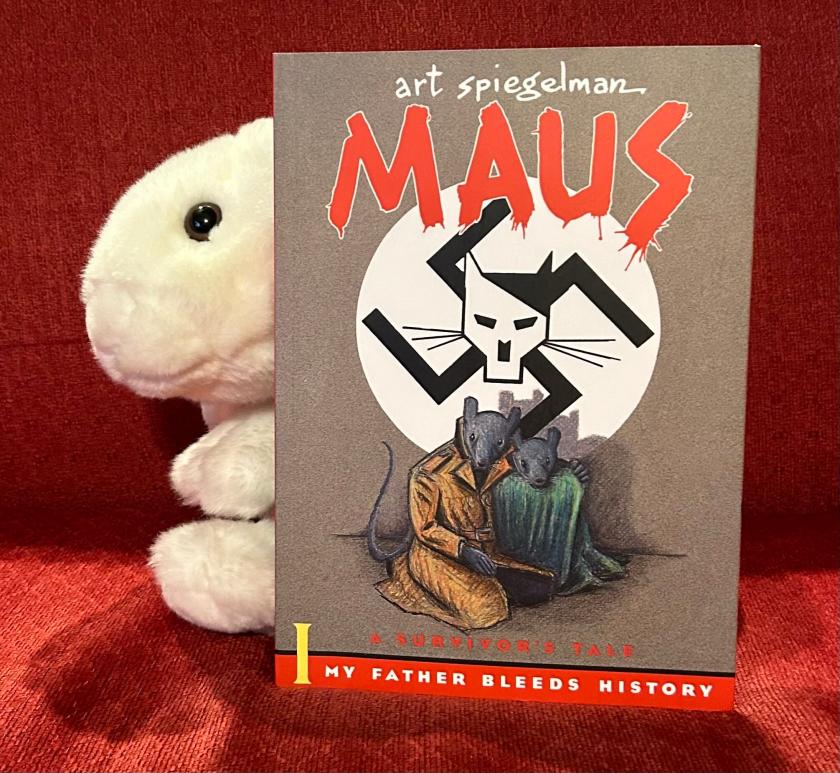
M: Yes, sure. The book is about the Holocaust, and the imagery in the front cover is basically describing the main metaphorical device used in the story.
S: How so?
M: This is a graphic novel, as we said before, and all characters are animals. There are mice, and those are supposed to be the Jews, and then there are cats. Those are the Nazi Germans. Then there are pigs, who are supposed to be the non-Jewish Poles. And as I said before, the story takes place around the time of the Second World War.
S: I see. When you tell me all this, I am thinking of how sometimes a cat could be playing with a mouse just to have fun and even kill it with no remorse even when it does not need to eat it. I can see how the cat-mouse-pig metaphor could work.
M: Yes. The story is basically about Vladek who is the author’s father, and his experiences before and during the war. Vladek lived in Poland before the war, and when Germany invaded Poland, he and his family continued to live there. For a while they try to survive but eventually they are sent to the Auschwitz concentration camp.
S: That sounds intense!
M: It is. There is also a second story line, which is more or less the present day, or rather around the time this book was first published. The main story is basically the author’s father’s story, and the second story line is about the author as a grownup trying to connect with his father.
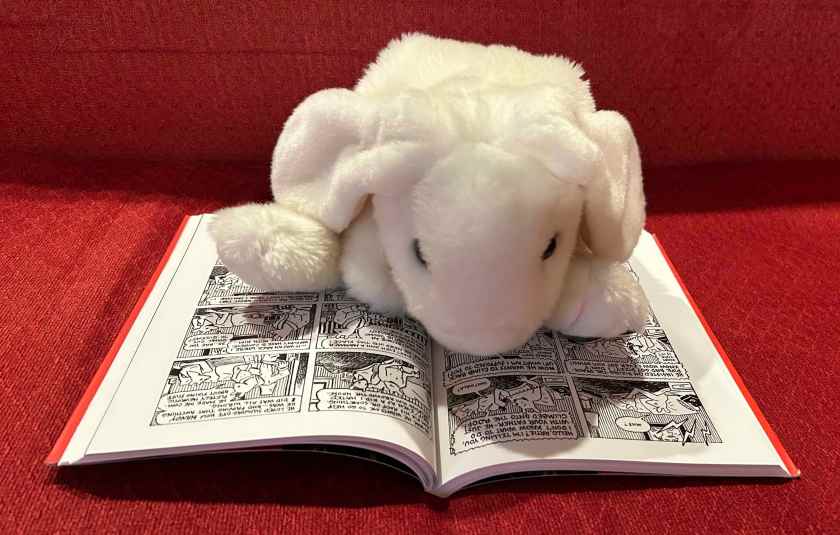
S: Okay, so now we know the main plot lines and so on, but tell me Marshmallow, how was it like reading such a tough story in graphic novel form?
M: I thought it worked really well. It was very easy to visualize things, even though the characters are mice and cats and so on, because they had already been visualized for you. The book and its visual nature show the undeniably horrific nature of the Holocaust. You fully feel the pain of the mice, and knowing that these events actually happened to people, it makes the whole book even more impactful.
S: I wonder if the harshness of the realities the book is depicting can be related to why some people want to ban this book from school libraries. Some people want us to forget and never talk about these historical events, I am not talking about those people. But even those who believe we should teach this history might think that these stories are too hard to share with young people.
M: I understand why you want us to emphasize that the themes and imagery of the book might be disturbing to very young readers. There is violence in the book. But I also think it is very important for young bunnies to know what happened. And this book does a very good job in telling exactly what happened. And maybe ironically, the use of animal characters allows you to end up seeing the humanity of the victims of the Holocaust very clearly.
S: You make a very good point Marshmallow.
M: Thank you. I also wanted to say the book reminded me of Animal Farm a bit because it shows the worst aspects of humanity under the guise of animals. The animal characters allow us to look at ourselves and see how terrible we truly are or can be. Since we are not seeing humans, we can see things more objectively.
S: That makes sense to me, too, Marshmallow. Okay, this is already a pretty long post. Before we wrap things up, can you tell me how you would rate this book?
M: I’d rate it 100%. It is a striking and impactful book. And I recommend it strongly. It is important for bunnies to understand the magnitude and the impact of these events.
S: Okay, thank you Marshmallow. So last words?
M: Stay tuned for more amazing reviews from the book bunnies!
 BookBunnies