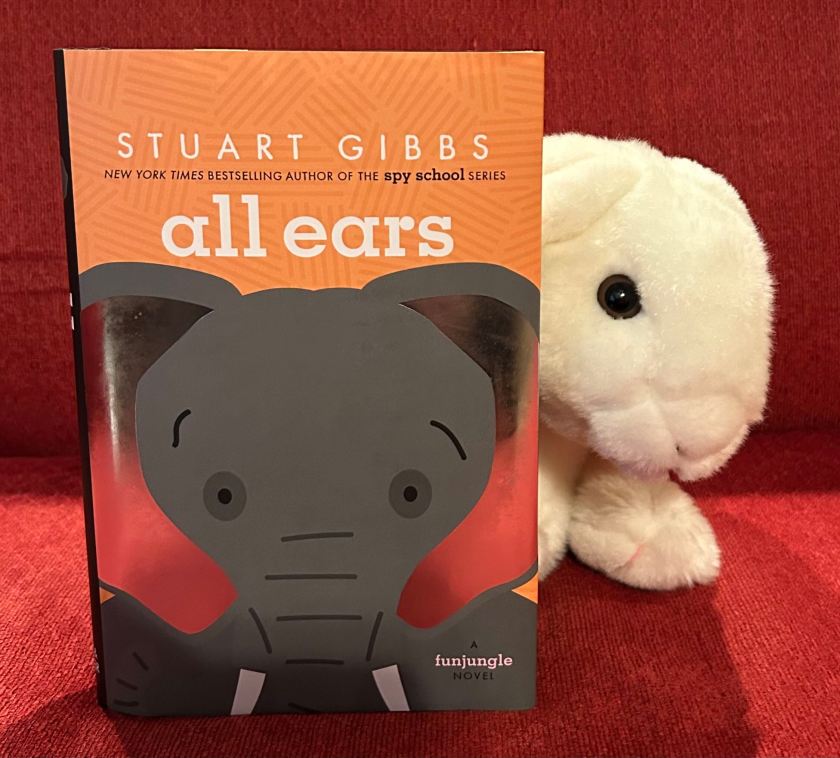
Marshmallow reviews All Ears by Stuart Gibbs

It must be obvious to the book bunnies blog readers that the book bunnies are huge fans of Stuart Gibbs and his books. While Caramel has read and reviewed all his Spy School books, Marshmallow has mostly read and reviewed his FunJungle books. Gibbs is a prolific author, and the most recent FunJungle book, All Ears, just came out a couple weeks ago on May 13. This week, Marshmallow was finally able to read this ninth book in the series and is ready to share her thoughts with our readers today.

Before starting reading this review, you might like to check out Marshmallow’s reviews of the first eight books of FunJungle: Belly Up, PoachedBig GamePanda-moniumLion Down, Tyrannosaurus Wrecks, Bear Bottom, and Whale Done.
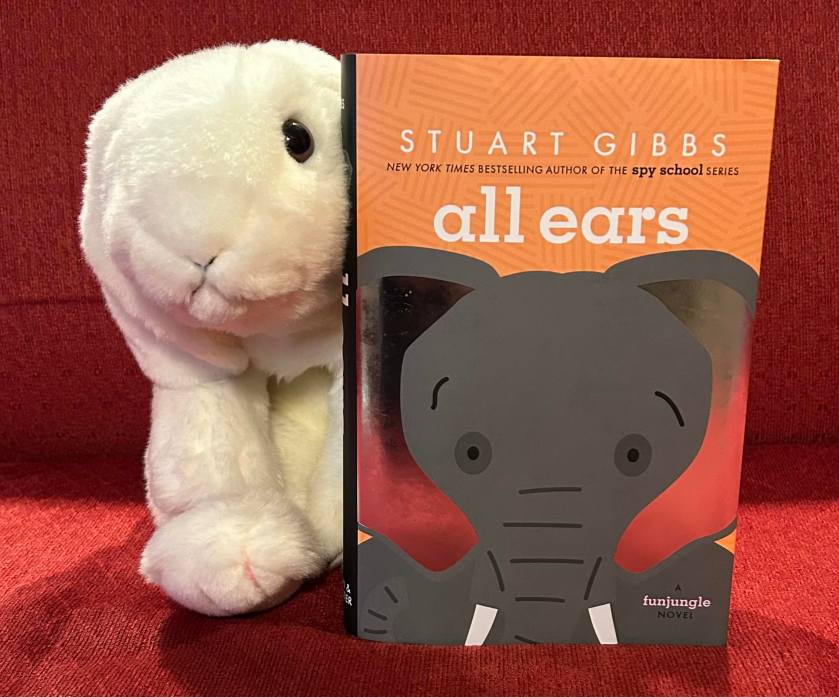
Marshmallow reviews All Ears by Stuart Gibbs.

Marshmallow’s Quick Take: If you liked the previous FunJungle books, like animals, reading about mysteries, or want to read a really entertaining novel, then this is the book for you!

Marshmallow’s Summary (with Spoilers): Teddy Fitzroy has proven himself as a remarkable detective. His parents both work at FunJungle, the largest zoo in America (if not the world). During his time living next to it, he has solved several high-profile and low-profile cases regarding the zoo or related to the surrounding Texan area. Since the first book in the series, Teddy has been good friends with Summer McCracken—the daughter of billionaire J.J. McCracken who owns FunJungle—and the two recently started dating . Teddy is also good friends with Xavier Gonzalez, a fellow animal-lover and student at his high school.

Sadly, Xavier gets arrested! He normally likes to look around for reptiles he can capture and examine (ethically and caringly, of course) but is found at a crime scene under suspicious circumstances. Being an ardent advocate for the environment, him being in an area that seemingly was vandalized by “eco-warriors” makes him look pretty guilty. So Xavier’s best course of action is to call in Teddy to prove him innocent.

Unfortunately, the call comes at a very inconvenient time. Teddy has been hired to solve another crime regarding a lost elephant. In Texas (and many other places), some ranch owners have taken to raising exotic animals either with the purpose of sheltering them or creating an area in which hunters can kill unusual creatures for an extravagant price. The Sinclairs have created a sanctuary for elephants that they aptly named The Sanctuary. But during a massive power outage in Texas, their herd escapes or is led out of their ranch. This causes some mayhem on a football field later, but eventually Tanzy, the sole African elephant (the rest are Asian), is discovered to be missing. Aside from the fact that rural Texas is not the native habitat of an African elephant, Tanzy could also be under threat from whomever took her.

Teddy now faces two mysteries to solve: where is Tanzy and who took her, and who really committed the crime Xavier’s accused of? Can he find the answer before time runs out … for Tanzy and Xavier?
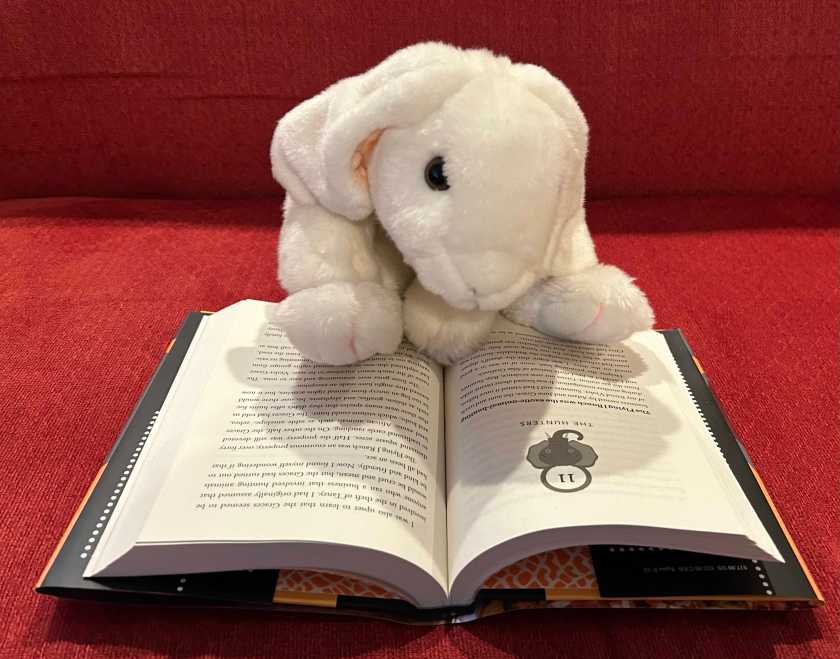
Marshmallow is reading All Ears by Stuart Gibbs.

Marshmallow’s Review: All Ears is a really good book! I’ve been waiting for the new FunJungle book to come out and for Stuart Gibbs to continue this series! I really, really, really love this series! All of the books have fascinating, interesting, and most importantly confounding mysteries that are perfect for readers of all ages. The characters are lively, intelligent, funny, and lovable—and the lack of cursing (except possibly in Tyrannosaurus Wrecks) makes them appropriate for everyone. And this book is no exception!

I really like how the FunJungle books tackle environmental issues and address the nuance of every topic. Even though he clearly finds these issues very important and harshly critiques greedy corporations, Gibbs never portrays them as completely evil. In particular, we often learn about a CEO’s perspective through a more human lens via J.J.’s character. Gibbs also doesn’t make the activists seem like saints. He explains how many hunters are good people too and really humanizes everyone. However, he does show the facts, many of which are truly disturbing. Gibbs doesn’t omit nuance; rather, he conveys a wide range of conflicting perspectives in a way that is palatable, comprehensive, and comprehensible to a wide audience, while still sending the message that action must be taken to protect the environment. All this makes All Ears worth reading: its message and its explanation and dialogue about the environment and the battle about how we should treat it.

But you should also read this book for fun! It is really funny and entertaining; there are so many twists and turns! Once I picked up this book, I could not put it down—literally. The emotional tension is also really well done throughout, and one can really feel the realness in Teddy’s situation, in which he is caught between a rock and a hard place as he tries to solve two mysteries at the same time.

I love the FunJungle series, the characters and the plot and the writing and everything about these books! They are really special to me! But I think they can be great for many new readers too! I would recommend reading the first couple of books in the series first, but honestly, one could just start here with All Ears, too. Whatever your age or background knowledge though, this book is definitely an amazing one to read for its message, style, and content! I can’t recommend it enough!

Marshmallow’s Rating: 101%

Marshmallow rates All Ears by Stuart Gibbs 101%.

Marshmallow reviews There’s A Hair In My Dirt! A Worm’s Story by Gary Larson

Today Marshmallow is reviewing There’s A Hair In My Dirt! A Worm’s Story by Gary Larson, first published in 1998. A fan of Larson’s The Far Side, Sprinkles is asking questions and taking notes.

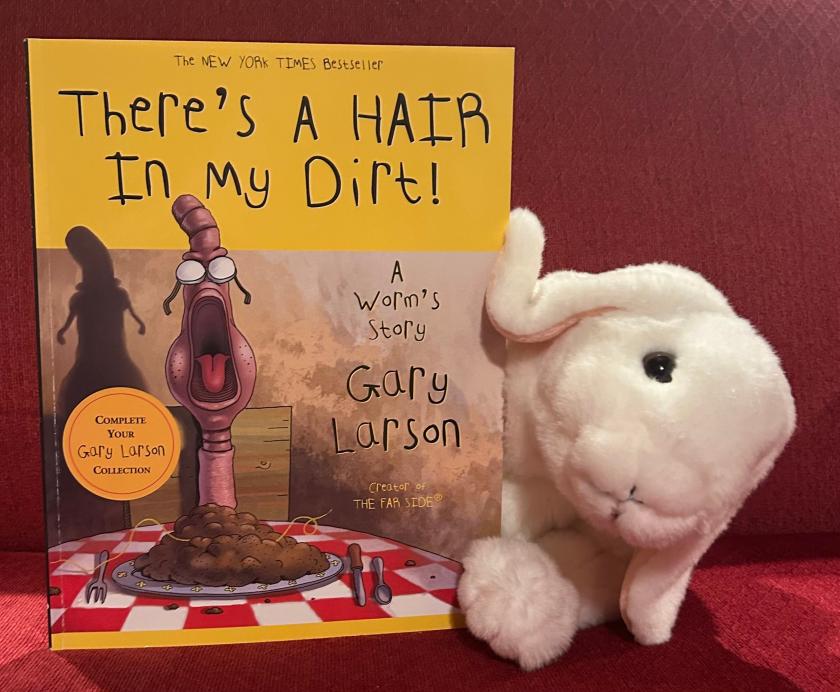
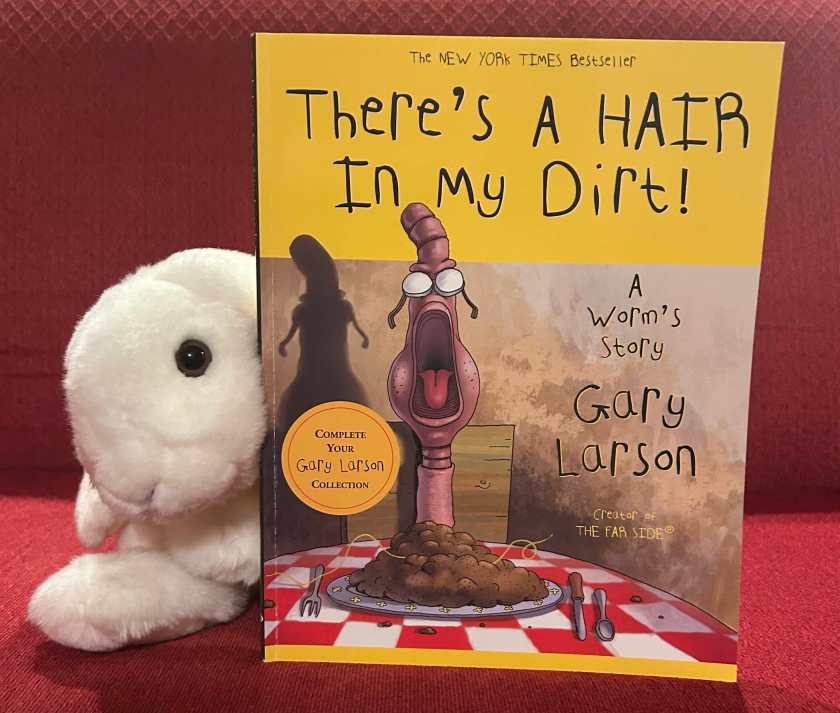
Marshmallow reviews There's A Hair In My Dirt! A Worm's Story by Gary Larson.
Marshmallow reviews There’s A Hair In My Dirt! A Worm’s Story by Gary Larson.

Sprinkles: So Marshmallow, tell us a bit about what you thought when you first saw this book.

Marshmallow: I felt very surprised that Gary Larson had written a children’s book. I really like his Far Side comics, and we have a collection of them at home –and maybe we should review them some time!

S: Yes, maybe we should some day. But you are right. Larson is most well-known for his Far Side cartoons. But then you read this book and realized that maybe it is not quite a children’s book, right?

M: Nope. Do not have your children read this book!

S: Wait! Really? I mean, it is a bit rough for younger bunnies, and it is quite long for them, too, at 64 page, but older bunnies like yourself can appreciate it, I thought.

M: Yeah, I guess so. But it is kind of dark and even morbid. Then again, it is kind of a fable, with some underlying messages, which are thought-provoking. You are right, I guess bunnies my age and the like might appreciate the book. But I was definitely surprised and was not expecting how dark it would get.

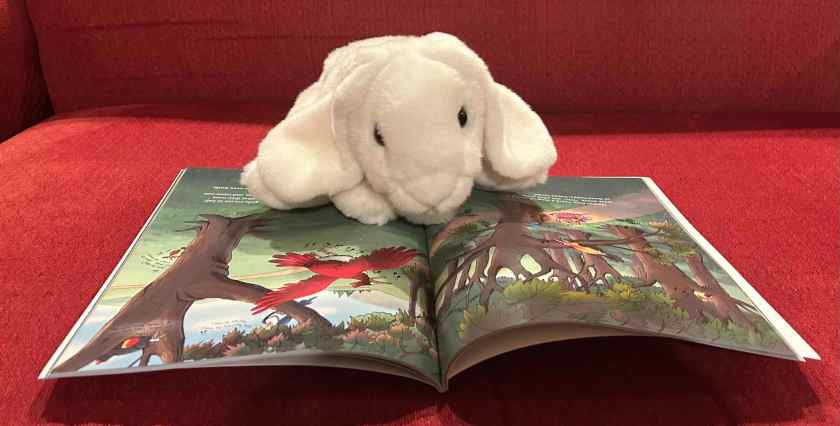
Marshmallow is reading There's A Hair In My Dirt! A Worm's Story by Gary Larson.
Marshmallow is reading There’s A Hair In My Dirt! A Worm’s Story by Gary Larson.

S: Okay, so maybe we should start from the beginning and tell our readers what the book is about.

M: Sure. This book is about a little earthworm who is eating his dirt dinner in his family’s hole in the ground. And he finds a hair in his dirt and starts complaining to his earthworm parents. He hates being an earthworm, he hates living underground. He hates not having legs and having to eat dirt. And so on.

S: Totally understandable of course.

M: Of course. But then his father starts to tell him a story about a girl named Harriet. And then the rest of the book is basically Harriet’s story. Harriet lives near a forest and goes through the forest one day, seeing all sorts of animals interacting with one another, and she always has a positive outlook, thinking about Nature admiringly and yet not really comprehending what is really going on around her.

S: Yes, the foreword for the book is written by the famous biologist Edward O. Wilson and he writes “The maiden, as you will see as the narrative unfolds, might have enjoyed her saunter better if she understood.”

M: And it is not just a matter of enjoying; it costs her dearly that she does not understand. It is a little disturbing actually, because Harriet loves Nature, or what she thinks it is. And she wants to help and she is trying to be a good steward of living things, but since she does not know how things are all connected, she ends up harming the forest and herself.

S: This reminds me of this song “We Are All Connected” which some people made by putting together a few words from four outstanding science communicators:

M: Yeah, I like that song!

S: But let us not go further into the story because I think we might be getting too close to giving away some of the plot. Tell me, Marshmallow, what did you think about the illustrations?

M: It is in full color, and obviously it is Gary Larson, so all characters are distinctive, and they have very evocative expressions. It is very amusing to study them actually. The topic is complicated and nuanced, that we are all connected, and that, as Edward O. Wilson puts it, “Life is tough!” But Gary Larson’s drawings are often hilarious and you can’t help but laugh on almost every single page. Or raise your eyebrows in a shocked and yet amused manner. The mother earthworm is wearing those cat-eye glasses!

S: I know, right? Each page is itself a Far Side comic, almost. But they are all telling a coherent story, and it is an important one.

M: I agree. I do not really love the last page, but I agree. The message is important. And no, if you get a hold of this book, please do not just turn it to the last page to see what I mean! It will work much better if you read the book in the proper way.

S: And I agree with you, Marshmallow. This is a thought provoking book, not as light reading as one might imagine, but definitely amusing to look at, too. So maybe this is a good place to wrap up our review. What do you think?

M: Sure. Let’s.

S: What would you like to tell our readers?

M: Stay tuned for more amazing reviews from the book bunnies!

Marshmallow rates There's A Hair In My Dirt! A Worm's Story by Gary Larson 100%.
Marshmallow rates There’s A Hair In My Dirt! A Worm’s Story by Gary Larson 100%.

Marshmallow reviews The Rabbits’ Rebellion by Ariel Dorfman and Chris Riddell

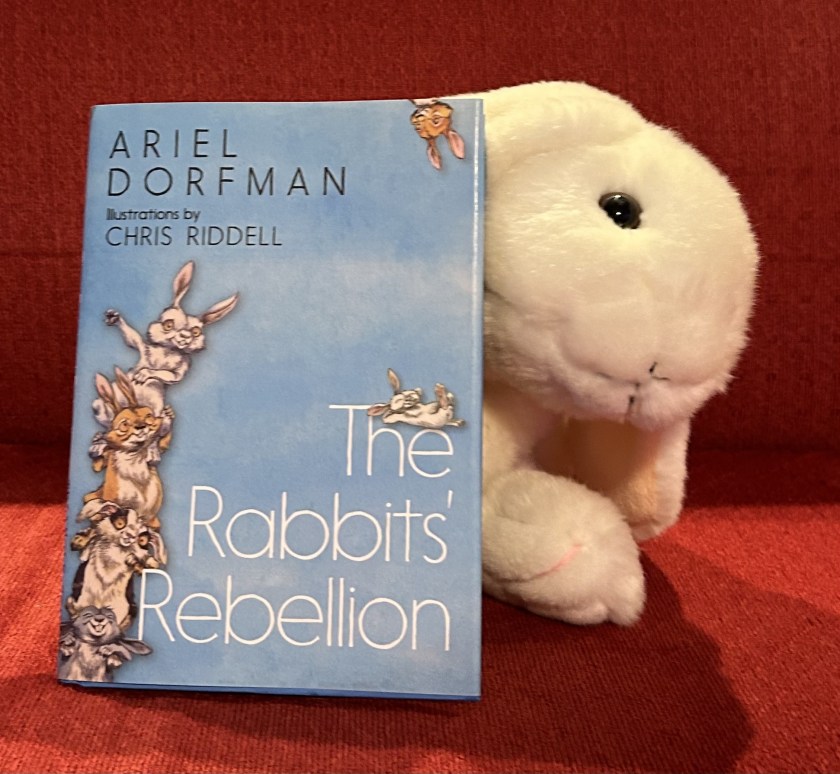
Today Marshmallow reviews a little book with a big message, first published in 2020: The Rabbits’ Rebellion, written by Ariel Dorfman and illustrated by Chris Riddell.

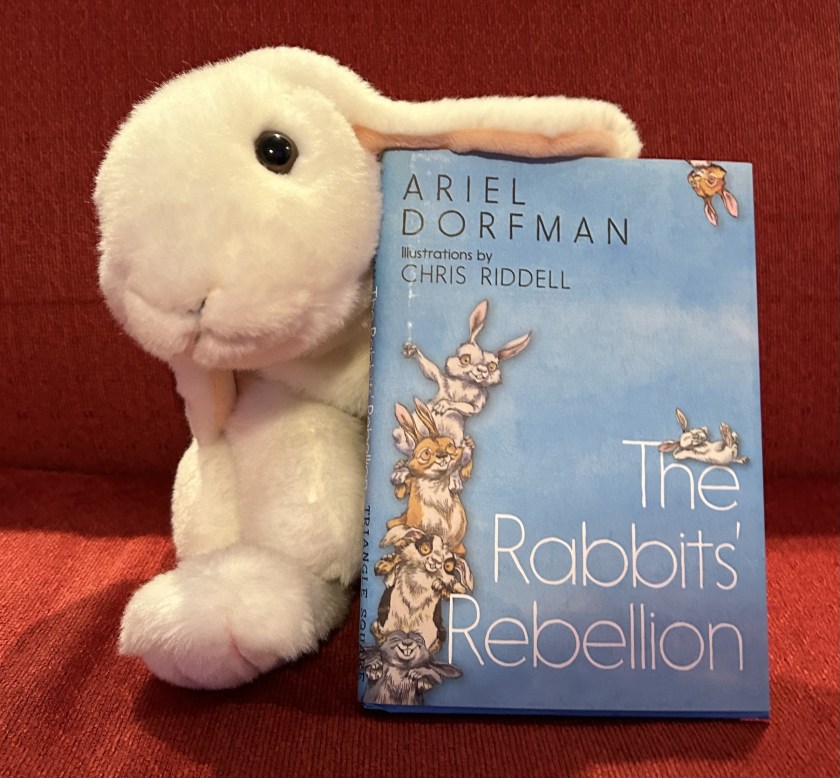
Marshmallow reviews The Rabbits' Rebellion, written by Ariel Dorfman and illustrated by Chris Riddell.
Marshmallow reviews The Rabbits’ Rebellion, written by Ariel Dorfman and illustrated by Chris Riddell.

Marshmallow’s Quick Take: If you like children’s books about animals and clever political commentary, then this is the book for you!

Marshmallow’s Summary (with Spoilers): When the wolves invade the land of the rabbits, the Wolf of all Wolves crowns himself king and begins to make some wild claims. First of all, he—feeling quite omnipotent that day—declares that rabbits don’t exist. He bans any reference to them in books (by personally crossing them all out) or in conversation. Unfortunately, birds can fly and report seeing some, which spread rumors that perhaps rabbits do exist.

The king then decides then, if (as his fox advisor says) “seeing is believing,” he’ll make his subjects see exactly what type of a ruler he is. So he commands an old monkey to take regal photos of him to be put up in every town square, every neighborhood, and in every house. He forces the birds to carry these posters, tying their feet to an “endless” cord to make sure they can’t escape. Naturally, the old monkey is terrified of the king and bends to his every whim and want. In other words, he says, too, that rabbits don’t exist. On the other hand (or paw!), the monkey’s daughter—with the fearlessness of innocence—knows that rabbits do exist even though her parents make sure to censor her whenever it becomes necessary.

But that’s just the beginning of the old monkey’s struggles. Every time he takes a photo of the wolf king, there is some hint of a rabbit in the background. When the king shatters the beavers’ dam (which took them three years to build), there are two rabbits sitting on the grass in front of the camera. When the king snarls in the most ‘majestic’ manner, a long, fuzzy ear shows up in the corner. This is most problematic because the monkey can’t show the king photos that go against his rule that rabbits don’t exist. So he doctors his photos after they develop, erasing any and every trace of rabbit hair, ears, or tails.

As the king becomes increasingly more controlling, more egotistical, and more tyrannical, the monkey must keep taking photos and editing them. Despite the king’s advisor tightening security around the photo shoots (he doesn’t want the king to know about the rabbits either—it would look bad on him), the rabbits persistently keep up their rebellious photo-bombing. But how could they, when they don’t exist?

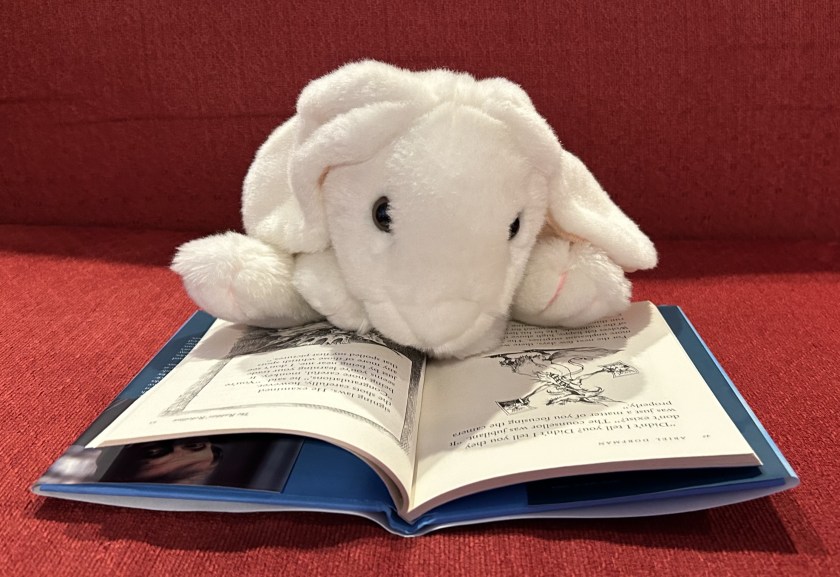
Marshmallow is reading The Rabbits' Rebellion, written by Ariel Dorfman and illustrated by Chris Riddell.
Marshmallow is reading The Rabbits’ Rebellion, written by Ariel Dorfman and illustrated by Chris Riddell.

Marshmallow’s Review: The Rabbits’ Rebellion is a really good book! It is written as a book for little children, and it reminds me of some Roald Dahl books I read earlier. Roald Dahl was unique in a way because his books could be read as childish tales, but they also touched on deeper topics. Likewise, the meaning of Dorfman’s book might not be understood by very young readers even though they would still enjoy reading about these mischievous rabbits who insist on existing! (Go, bunnies! Of course I cannot be too impartial here.)

At its core, The Rabbits’ Rebellion is about authoritarianism and dictatorship. The king’s suppression of truth, especially a truth that is so obvious, is in a way an almost comically extreme example of an Orwellian dystopia. In a way, this book is like Animal Farm or Nineteen Eighty-Four for young children. Except—spoiler alert—this one ends better than both of those books.

The Rabbits’ Rebellion is entertaining even if you don’t catch this theme. It is kind of like how one might enjoy reading parts of Animal Farm even without digging into the allegory. But Animal Farm ends at a quite depressing place for young bunnies to really enjoy it all the way to the end. Similarly, I learned that some parents have complained that the ending of The Rabbits’ Rebellion is too graphic to make it appropriate for a calm bedtime. So readers beware!

I found it interesting that the world of this book is so different yet also very similar to ours. There is no magic, but they do have cameras and books. Remember how in Maus the whole story only involved mice and a few other types of animals, but we could see our own world in it? Just in the same way, the differences and the similarities despite those differences help convey Dorfman’s message very clearly.

All in all, The Rabbits’ Rebellion has a really poignant yet simple plot and is a very thought-provoking book even though it is extremely short (only 63 pages). Written in large font and with really beautiful illustrations that evoke a serious, fairy-tale feel, it is quite easy to read, too. I think it could be a great way to introduce children to political thought and discussion. (I might reread Nineteen Eighty-Four as a result of reading The Rabbits’ Rebellion, because this book really reminded me of it.) Overall, I would definitely recommend this book to bunnies young and old, who both will find it entertaining (perhaps intellectually) and thought provoking. 

Marshmallow’s Rating: 100%.

Marshmallow rates The Rabbits' Rebellion, written by Ariel Dorfman and illustrated by Chris Riddell 100%.
Marshmallow rates The Rabbits’ Rebellion, written by Ariel Dorfman and illustrated by Chris Riddell 100%.

Sprinkles reviews Sleeping With Dogs: A Poetic Memoir by Barbara Barth

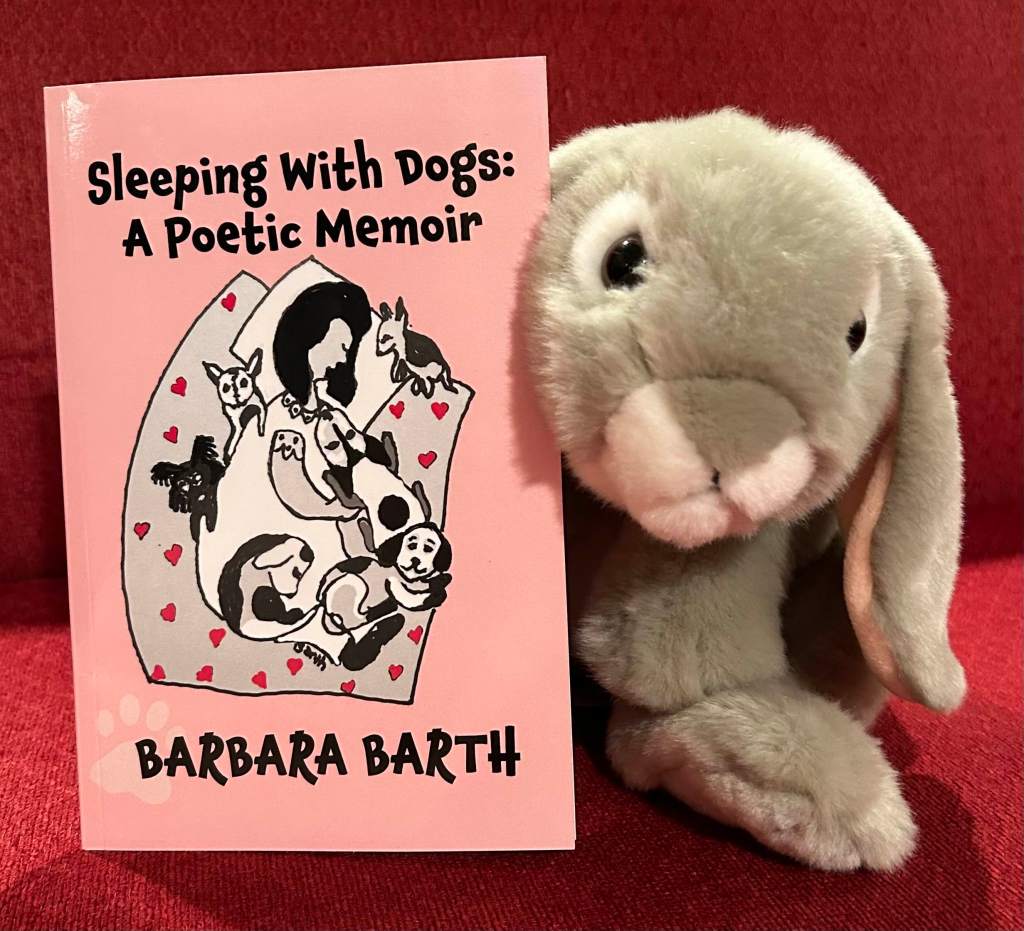
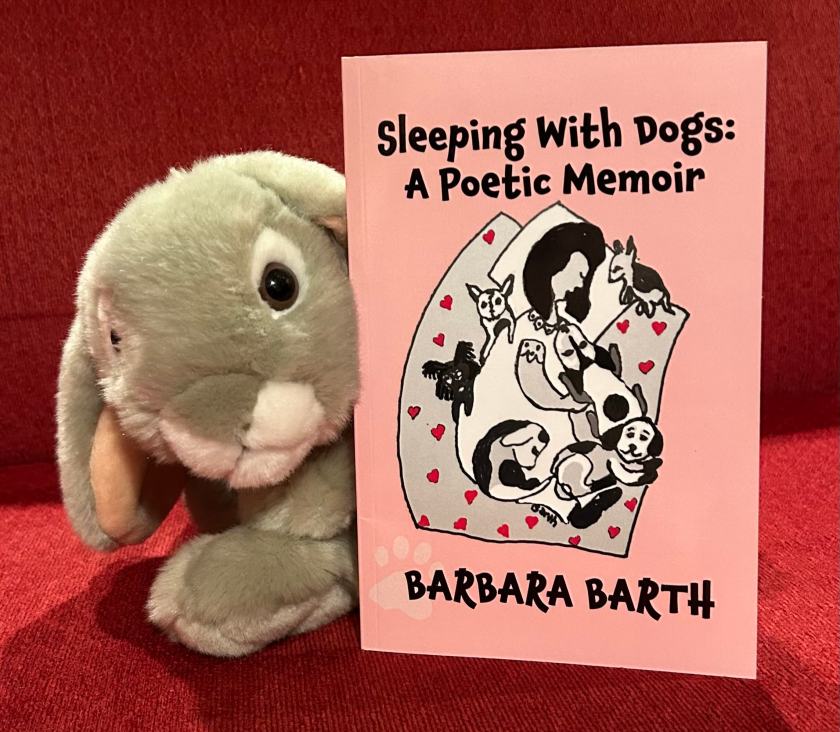
Today Sprinkles reviews a brand new chapbook, Sleeping With Dogs: A Poetic Memoir by Barbara Barth, published on January 24, 2025.

The book bunnies are delighted to be reviewing this book as part of a Blog Tour for Sleeping With Dogs: A Poetic Memoir organized by WOW! Women On Writing.

A chapbook is a small book, typically a collection of poems, typically within twenty to forty pages, sometimes organized around a theme, sometimes not. Even though chapbooks have a long and storied past, here at the book bunnies blog, we have not had the occasion to review any till now. And Sleeping With Dogs: A Poetic Memoir is just right for a blog hosted by bunnies!

This is indeed a little book of forty pages, with a cute pink cover; on the cover is a stylized image of a woman in a patch of a bed, sleeping surrounded by six little dogs, some curled up, some fully awake and curiously staring at the observer / reader. The patch of bed is covered with little pink hearts. So already you might imagine, this book is not only about dogs (as you probably had already figured out from the title) but it is also very much about love. And indeed love is the overwhelming theme of the book.

Barbara Barth’s writing journey began when she lost her husband in 2008. She began writing but also she began adopting dogs. Words and dogs became her lifelines. This chapbook collects her free verse poetry about her dogs and herself growing into the woman she is today with her dogs. Barth tells us the stories of Foxy-Lady, who knew her husband before he passed away, Bray, the first adoptee after, and many many others, via simple but evocative sentence fragments, which somehow come together into fluid free verse.

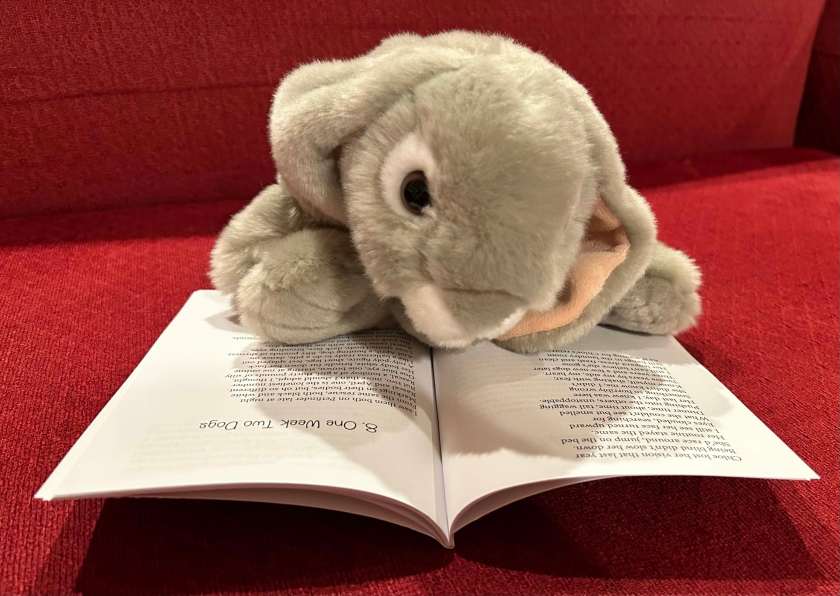
Sprinkles is reading Sleeping With Dogs: A Poetic Memoir by Barbara Barth, as part of a blog tour hosted by Women on Writing.

Out of the twenty-three poems in the chapbook, ten are written as odes to specific dogs: “Foxy-Lady” (2), “Bray” (5), “Annabelle” (6), “Queen Chloe” (7), “Odette” (10), “A Dog Named Studly” (11), “The Last of the Big Dogs” (12), “The Christmas Gift” (13), “Carmella” (17), “PS. Lucy In The Sky With Diamonds” (23). Each of these ten poems introduces its subject, a dog with their own personal back story, and tells the story of how they came to join Barth and her life. Most of the dogs are rescues, so often the back stories are sad or uncertain at times, but most of these poems end with joy, joy of a once-sad dog having found a new home that welcomes them. (Carmella shows up again in “Morning” (19) as the mischievous main character, crafty and still lovable.)

Then there are two poems, about two dogs each, that tell stories of new members joining a big happy family and making it happier. “One Week Two Dogs” (8) tells the story of how Barth first met Rascal and April on the same day, but took them home on two separate days. April immediately becomes Miss April in Paris, and they both find themselves full members of the growing new family Barth has been building around her. “Dumb and Dumber” (14) tells the story of how father-and-son duo Moe and Happy Dog, join the family. The Dumb and Dumber become loving nicknames to them and celebrate their natural silliness as they like to fool around.

The rest of the poems are not focused on individual dogs. Rather they tell the story of Barth’s life today, full with dogs and dog love. The very first poem in the chapbook, “”Why I Write” (1) introduces Barth to us a bit more. After having read the brief prose introduction to the collection, this poem eases us into the poetic form. “Sleeping With Dogs” (3) and “Six-Pack” (4) set the tone early towards the beginning of the chapbook, telling us how the dogs came to Barth’s life and made it whole. “Chihuahua Love” (9) tells us of her transformation from a “dog lady with big dogs” to a “dog lady with chihuahuas”. “Storm” (15) and “After the Rain” (16) tell us what happens in her household during and after a rainstorm. “Night Moves” (18), “Morning” (19), “Patio View” (20), and “Four Seasons” (21) offer more snapshots of her life with her dogs: a full life filled with love and joy and many other intense emotions lived in the moment. Finally “Paint Party” (22) tells us what Barth might just be doing today in her home: painting, with her four-legged friends surrounding her, content.

Being a household of four bunnies we do not have any dogs living with us. We are typically very timid near four-legged creatures who are bigger than ourselves. But Barth makes the best case for inviting dogs into your life. She does not preach or explain. She just tells her own story, in which she happens to find love over and over and over again. (Of course one imagines she is giving a lot of love back. It is impossible for this much love to flow only in one direction.)

All in all, I have very much appreciated the opportunity to read and review Sleeping With Dogs: A Poetic Memoir. And I’d recommend it highly to all sorts of folks, young bunnies and old bunnies, and everyone in between. I know that the little bunnies in my own household will love the book just as much as I did. If you like reading poetry, or if you love dogs, it is probably a no-brainer: you should read this book. Otherwise, if you just happen to have only a little space in your day to read a couple short pages at a time, then this little pink book might just be what you need to fill your heart with some joy.

Sprinkles has read Sleeping With Dogs: A Poetic Memoir by Barbara Barth, as part of a blog tour hosted by Women on Writing, and recommends it highly to all bunnies great and small.