Marshmallow reviews Amari and the Despicable Wonders by B.B. Alston

Marshmallow had already reviewed Amari and the Night Brothers and Amari and the Great Game, the first two books of the Supernatural Investigations series by B.B. Alston. Today she reviews the third book, Amari and the Despicable Wonders, which was published in 2024.
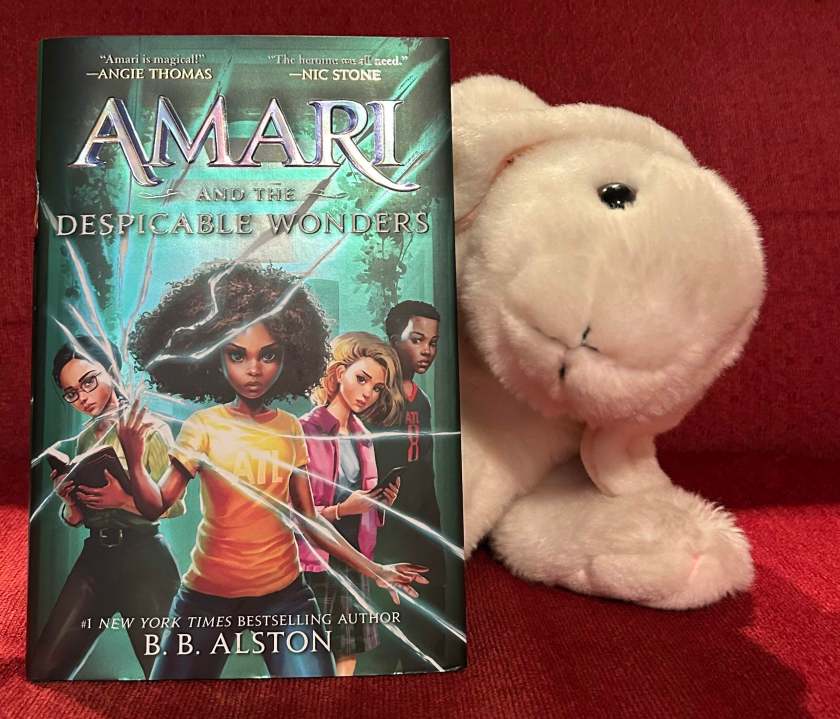
Marshmallow reviews Amari and the Despicable Wonders by B.B. Alston.

Marshmallow’s Quick Take: If you like books about family, friends, and magic with a strong, smart female protagonist, then this is the book for you!

Marshmallow’s Summary (with Spoilers): The supernatural world is on the brink of war with their risk of being revealed to the human world increasing by the minute. The Bureau of Supernatural Affairs, which functions as this world’s government and has been responsible for keeping the supernatural unseen by humans, has recently been taken over by Elaine Harlowe. Harlowe is a faun who has the ability to control others with her voice and now is the Director of the Bureau. The previous head of the Bureau was the one and only Merlin; unfortunately, he had to freeze himself along with all of the other leaders of the magical world in order to protect them from an unseen attack. Amari Peters, a Junior Agent training to work in the Bureau who is our protagonist, discovered this in the last book. However, the world’s leaders are still stuck in this time freeze, leaving Harlowe in charge. Unfortunately, Harlowe is very biased against magicians, which is not a great perspective to have during a time of great tension between the Bureau and the League of Magicians. The Bureau is the government of the supernatural world, but in this world, magicians and all their creations are viewed as UnWanteds. Unlike in the world of Harry Potter, being told “You’re a wizard, Harry” is something that would cause different reactions: first, self-loathing and fear of being discovered, and second, confusion at being called Harry.

Amari is a magician, but so far, she’s been sort of viewed as a good one, in comparison to the evil Night Brothers or Dylan Van Helsing. Unfortunately, the League of Magicians has been corrupted by Dylan, who wants to use foul magic to make magicians respected through fear and intimidation. Amari and her friends (Elsie, Jayden, and Lara) have been fighting against Dylan’s magician movement, but they also need to worry about what the Bureau is doing too. Magician-hating Harlowe fears that Amari will reveal to the public how she rose to power so quickly (with her mind-controlling powers), so Harlowe declares Amari an enemy of the Bureau which many believe because she is a magician.

In this book, Amari, Elsie (who is extraordinarily smart and can transform partly into a dragon), Jayden (a boy who can talk to animals, though I predict he will be talking to Amari a lot more soon 😉), Lara (Dylan’s non-magician sister who has recently allied herself with Amari), and Quinton (Amari’s famous Bureau Agent brother) are now working against the clock to prevent the Bureau and the League from going to full-on war—especially since the stakes have never been higher.

Amari learns that Dylan plans to use anti-magick to fight the Bureau and all those who oppose magicians. Just like anti-matter, anti-magick destroys all things with magic, which includes just about everything and everyone in the supernatural world. In order to utilize and then control this power, Dylan must find the Despicable Wonders: eight ancient items made long ago by the first magician. The only thing that can save the supernatural world from complete ruin is if Amari, her family, and friends can find the Wonders first and stop Dylan. The clock is ticking though, and he has a head start.

Can Amari catch up and should she? Perhaps this is all according to his plan… dun dun dun!!!
Marshmallow is reading Amari and the Despicable Wonders by B.B. Alston.

Marshmallow’s Review: This was a very good book. I will say there are a lot of parallels to be drawn between Amari’s world and that of J.K. Rowling’s Harry Potter series. Throughout this series, I definitely felt a lot of nostalgia because of the similarities to previous fantasy books for young adults and children. However, I would like to focus on what makes this series unique.

The world is definitely Alston’s own and it is not in any means identical. The premise starts off similarly, with a young child being told they are part of a magical world, and that they are exceptional even there. But this story evolves in a different direction. It focuses a lot more on equality, and fighting bias and hate. Amari is a magician, a group of supernaturals who are looked down upon. There is a lot of mistrust towards all magicians, and most live in hiding their whole lives. Amari’s perspective sheds light on the inequities in both the supernatural and natural world. This is clearly a statement, shown by the not-so-stark contrast between our world and theirs. This makes the story of Amari a lot more compelling and connects the reader more to her magical world.

That said, the characters are also very compelling. They develop in very human ways, even though not all of them are human. Even the enemy is clearly a thinking, breathing, feeling person and doesn’t start off as the embodiment of evil. The progression of the plot is both calculated and unexpected. It never feels slow though it is always very thoughtful. B.B. Alston is definitely, undoubtedly a very good author.

I really enjoyed reading Amari and the Despicable Wonders, and I am waiting excitedly for the fourth book to come out. The ending was bittersweet (because all the characters were so well-developed!), and while there was not really a defined cliffhanger, there are still unanswered questions. 

Marshmallow’s Rating: 100%.
Marshmallow rates Amari and the Despicable Wonders by B.B. Alston 100%.

Caramel reviews What’s Your Angle, Pythagoras? by Julie Ellis

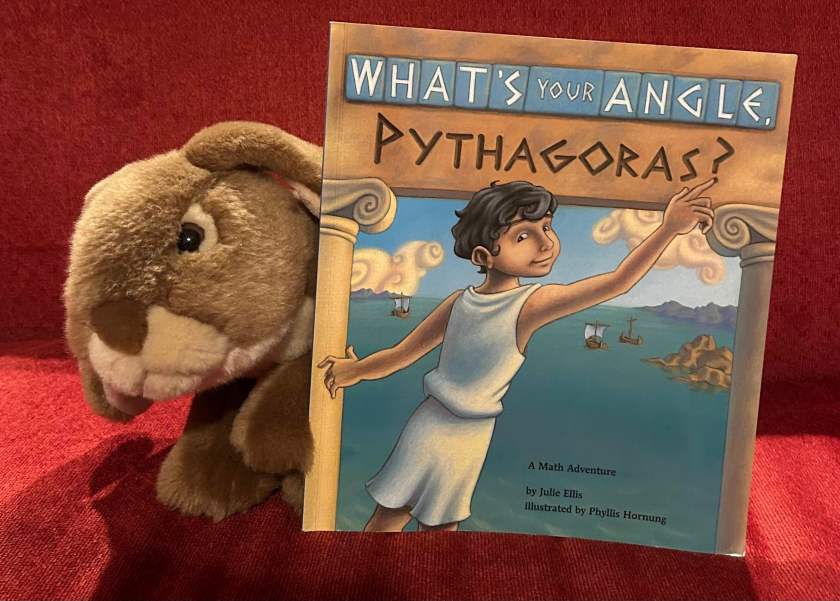
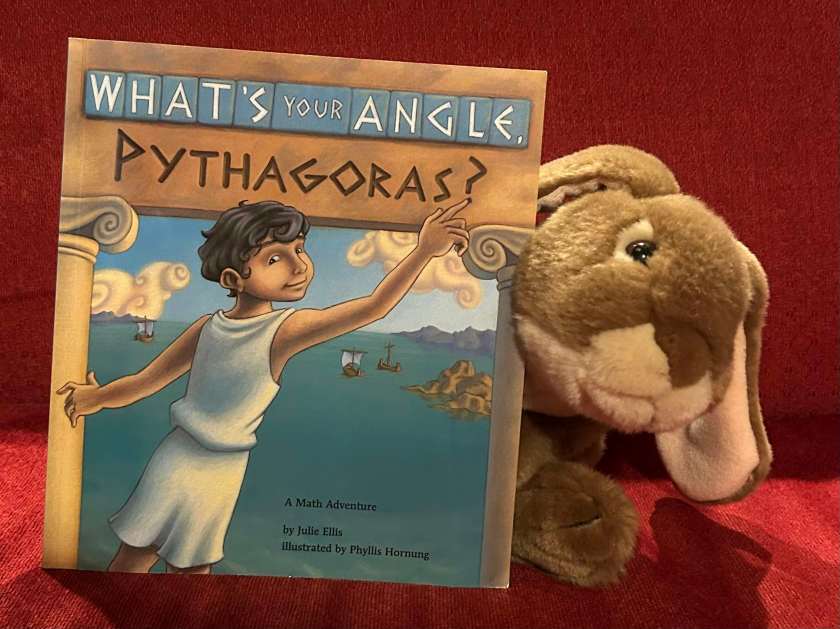
This past week Caramel’s class was learning about the Pythagorean Theorem so he thought that this was just the perfect week to talk about What’s Your Angle, Pythagoras? A Math Adventure, written by Julie Ellis, illustrated by Phyllis Hornung, and first published in 2004. As usual Sprinkles is taking notes and asking questions.

Caramel reviews What's Your Angle, Pythagoras? A Math Adventure, written by Julie Ellis and illustrated by Phyllis Hornung.
Caramel reviews What’s Your Angle, Pythagoras? A Math Adventure, written by Julie Ellis and illustrated by Phyllis Hornung.

Sprinkles: So Caramel, today we are talking about a math book. 

Caramel: When you say it like that, it sounds like we are talking about a school book. 

S: True, this is not quite a school book, though, in some sense, we are talking about it because of school. 

C: Yep. We were learning about the Pythagorean Theorem at school, so you gave this book to me. 

S: That I did. So what did you think? 

C: It was not that bad.

S: Hmm, that is faint praise. 

C: Yep.

S: So did you not like the book then? We do not review much that we do not like. 

C: No, I was kind of joking. The book is actually pretty good as a story, and the pictures are nice, too. There are some real mathematical diagrams, but they fit right into the story and it seems like they just show up naturally. But I do not think this is how Pythagoras came up with his theorem. 

S: I see. So it is the fiction part that you did not find most appealing. I do know you like your books with facts in them, so this had some facts, like the theorem itself, but a kind of a made-up story about how it came about, right?

C: Yes. Pythagoras is a boy living in ancient Greece, and he is trying to figure things out about distances, and he discovers the theorem all by himself. I mean it could have happened that way, but …

S: But you are not convinced?

C: Yeah, not really.

S: But it could have happened that way; we do not exactly know how Pythagoras came to his result. And don’t you think it might be fun for young bunnies to imagine themselves coming up with such an important result on their own? 

C: Yeah, I guess you’re right, but still…

S: Are you a little envious perhaps? A bunny might have more difficulty playing with ropes and such like the boy in the story and so might have more difficulty coming up with such a result maybe. 

C: No, I am not envious! And I like my paws and I can still do quite a lot of fun things with them!

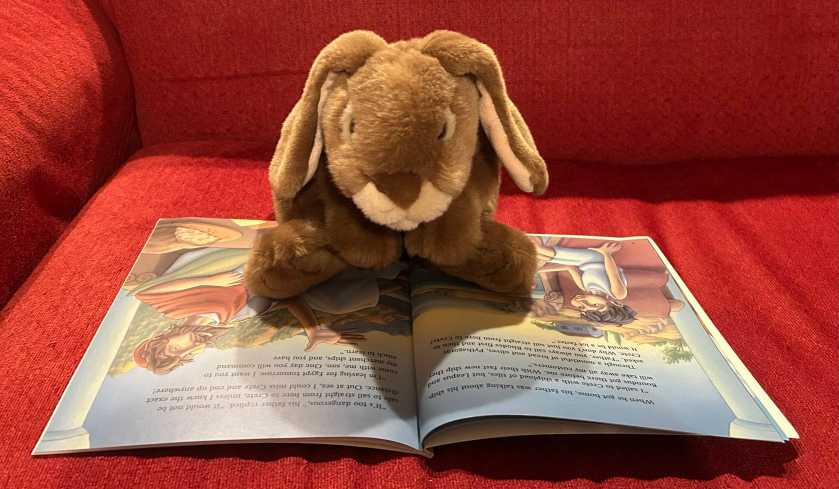
Caramel is reading What's Your Angle, Pythagoras? A Math Adventure, written by Julie Ellis and illustrated by Phyllis Hornung.
Caramel is reading What’s Your Angle, Pythagoras? A Math Adventure, written by Julie Ellis and illustrated by Phyllis Hornung.

S: Okay okay, so you did not like the fictional part of the story. I get it. Did you think the math was explained well at least?

C: Yeah, it made sense. I think I will not forget the theorem ever after that. So in that sense the book did its job well. 

S: Oh, that’s good! 

C: Yeah, and I think my math teacher would like this book, too. She likes the Pythagorean Theorem a lot. 

S: I am sure she will be at least happy that you now know the Pythagorean Theorem really well. Can you tell our readers what it is?

C: a2+b2=c2. You say it like “a squared plus b squared equals c squared.”

S: Okay, that is an equation. It does not mean much before you tell me what a, b, and c are.  

C: So you have a right triangle and these are the side lengths. c is the hypotenuse, that is the side across from the right angle. b and a are the legs, or the sides that are the part that from a right angle. And the cool thing is that this equation I said is always true, for any right triangle you can find. 

S: Yes, it is pretty neat actually! In the book the boy Pythagoras is trying to solve another problem and somehow figures out that this theorem works for all right triangles. So what is his angle then? The angle in the title, I mean?

C: They have a wordplay there. So the right angle is the one you need to look in the right way to find your answer… But also the right angle is the angle between two lines that splits the space between them into equal halves, and Pythagoras’s theorem is about right angles. So there are two meanings. 

S: Kind of clever!

C: Yep, I thought so, too. I do like wordplay.

S: So maybe this is a good place to wrap up our review Caramel. What would you like to tell our readers?

C: Stay tuned for more book bunny reviews!

Caramel enjoyed reading What's Your Angle, Pythagoras? A Math Adventure, written by Julie Ellis and illustrated by Phyllis Hornung, and expects that he will never ever forget the Pythagorean Theorem!
Caramel enjoyed reading What’s Your Angle, Pythagoras? A Math Adventure, written by Julie Ellis and illustrated by Phyllis Hornung, and expects that he will never ever forget the Pythagorean Theorem!

Marshmallow reviews Zenobia by Morten Dürr and Lars Horneman

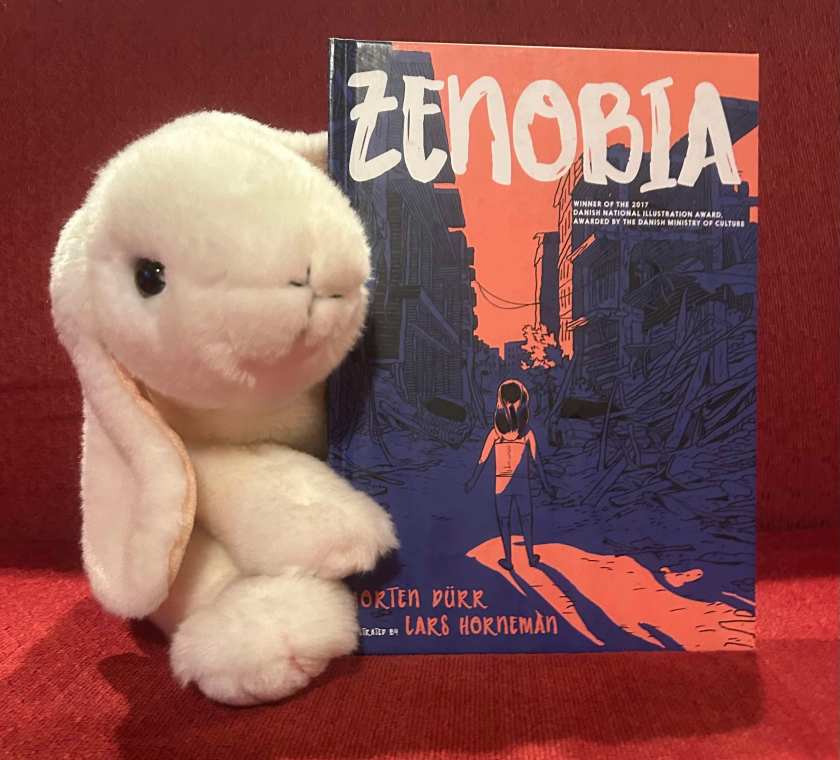
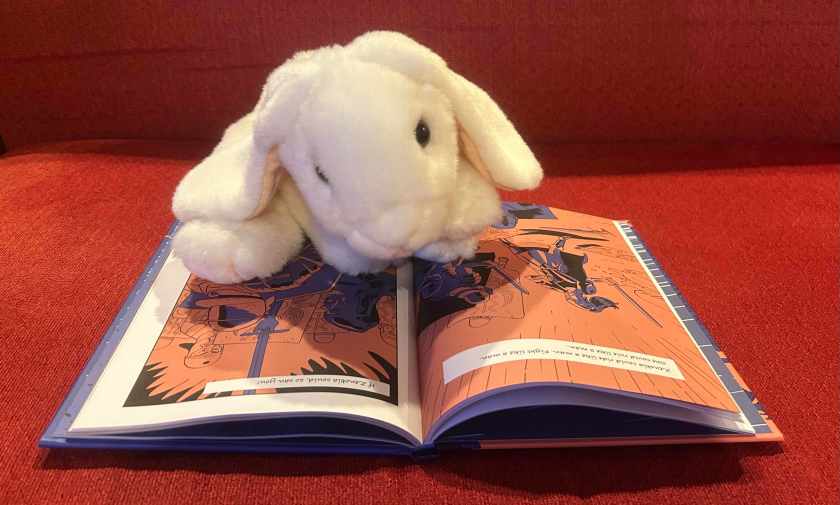
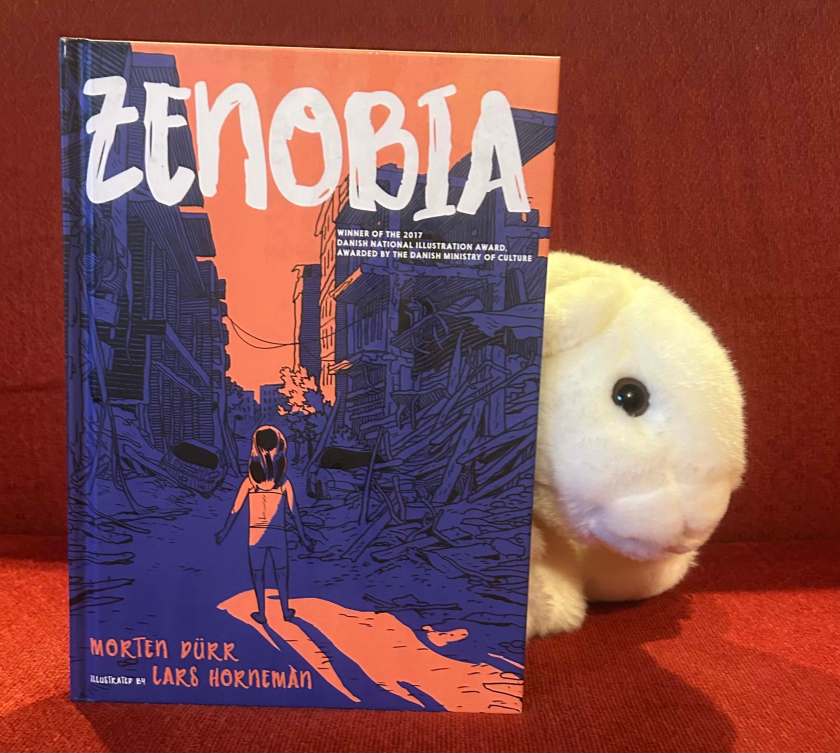
Today Marshmallow reviews a graphic novel with very few words, Zenobia, written by Morten Dürr, illustrated by Lars Horneman, and published in English for the first time in 2018.

Marshmallow reviews Zenobia, written by Morten Dürr and illustrated by Lars Horneman.

Marshmallow’s Quick Take: If you like reading books that have a deep meaning and require thoughtful discussion, then this is the book for you. 

Marshmallow’s Summary (with Spoilers): Zenobia was the queen of Syria long ago. She was regarded as the world’s most beautiful woman and led like a man. She was powerful. Now, Amina—a young Syrian girl fleeing her country—uses that image to stay strong.

The story starts on a boat full of refugees all escaping Syria. The boat is small and stuffy and dangerous. When the boat is hit by waves, Amina is thrown overboard, off the boat and into the cold sea. As she sinks slowly, she thinks of her family and the last few days before the present day.

Amina and her mother used to play hide and seek. But on the day the mother had to leave her home, the two had been making dolmas. They had only salt and rice to use though. Her parents left to go to town to get more ingredients but never returned. Amina’s uncle came to the door, where she was sitting waiting, and told her they had to leave. They crossed a Syria devastated by war. The buildings and homes were demolished, while tanks proudly paraded around the ruined streets. Amina and her uncle found a man who would take them to a place “without soldiers,” but could only pay for one passenger. Her uncle selflessly gave Amina the seat, the only way out of Syria. She boarded the boat, and we come to understand that this is the one she is thrown off of by the merciless waves.

As Amina sinks to the bottom of the sea, she sees a sunken boat, overtaken by the ocean and covered in sea life: its name is Zenobia. 

Marshmallow is reading Zenobia, written by Morten Dürr and illustrated by Lars Horneman.

Marshmallow’s Review: This was a heartbreaking story. I am not sure if it was inspired by a specific person’s story, but it is heartbreaking that many people have undoubtedly suffered similar fates. Zenobia is a book every person should read. There is no reason not to; it is easy to understand, quick to skim, and has a message that should not be missed. I read it and was not expecting a graphic novel or—is it even a graphic novel?—to be so moving. The ending seemed to be surreal since I didn’t think such a short book would be so heartbreaking.

Exposure to these kinds of stories makes it hard to hold onto hope. The world can be a terrifying, terrible place. Books like Zenobia and Refugee (another book that needs to be read by all) show what so many people are going through, all to reach a foreign country that is their only hope. Seeing what refugees are forced through just to try to get the normal, safe life they deserve is an experience we all need in the un-empathetic world we have made.

But there is undeniably hope. This book is a lesson that we all need. But we all need to also hold onto hope and do something to make our world better. In trying times, as cliche as this sounds, empathy and sympathy, love and compassion, understanding and action are what we need. It’s clear we are divided today, but we can come together and make beautiful things; we can make this world beautiful. At least, that’s what this bunny thinks. 

Marshmallow’s Rating: 100%.
Marshmallow rates Zenobia, written by Morten Dürr and illustrated by Lars Horneman 100%.

Caramel reviews The Extraordinary Book That Eats Itself by Susan Hayes, Penny Arlon, and Pintachan

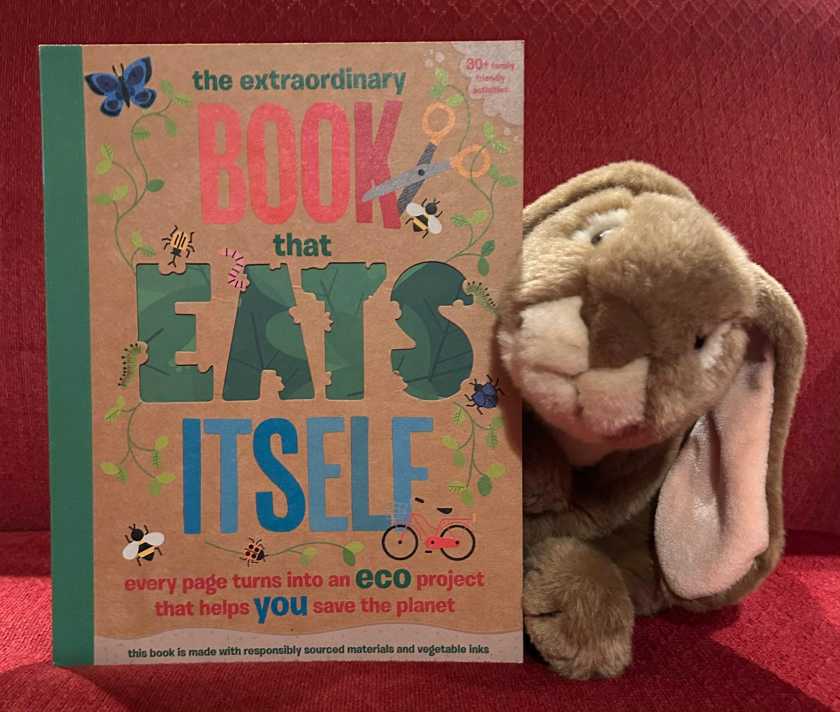
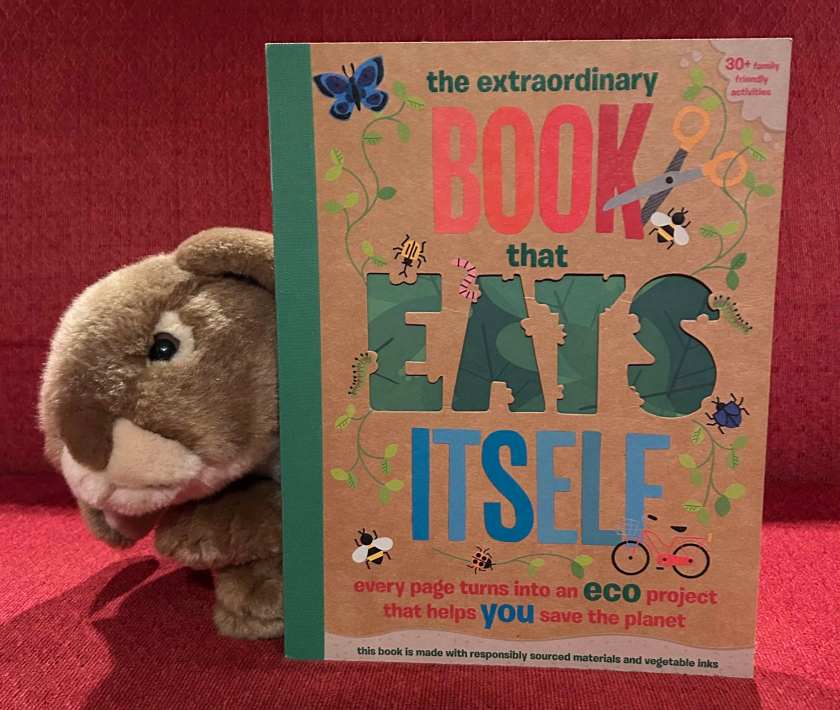
Caramel reviews The Extraordinary Book That Eats Itself, a book of eco-friendly activities that encourage environmental conservation through creative projects.

Today Caramel is talking to Sprinkles about a fun activity book first published in 2021: The Extraordinary Book That Eats Itself: Every Page Turns Into An Eco Project That Helps You Save The Planet, written by Susan Hayes and Penny Arlon and illustrated by Pintachan.

Caramel reviews The Extraordinary Book That Eats Itself, written by Susan Hayes and Penny Arlon, and illustrated by Pintachan.

Sprinkles: So Caramel, today you have another activity book for us. 

Caramel: Yep, I really like the activities in this book.

S: That is great! I hope we can talk about some of them in a bit. But let us start with the title. Why is this book called The Extraordinary Book That Eats Itself?

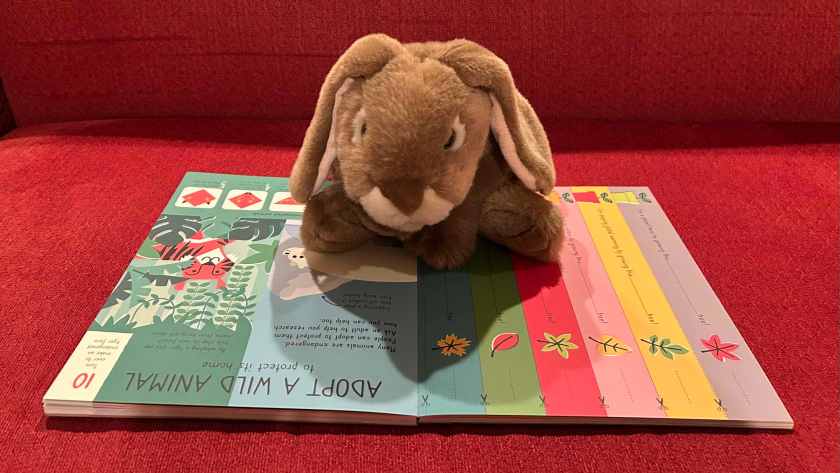
C: It is because the book has an activity on each page that allows you to use that page to create something that benefits the environment. You are supposed to use each of the pages, and even the cover pages, so in the end, when you are done with the book, the book has eaten itself up!

S: I see! That’s clever! 

C: Yes it is. And I want us to finish this review so I can get started with the activities!

S: Alright, we will hurry then. When I hold the book I can feel that the cover is hard card stock, and the pages are also relatively thick and very colorful. So they could make good material for crafts and such. 

C: Yeah, they suggest that you use all of them for a project. As I said, each page introduces a project and you are supposed to use that page, and sometimes some of the cover pages, for the activity.

S: I understand. So tell me about the activities then. 

C: Well, there are sixty pages and an activity on every two pages, so there are a total of thirty activities. There is a handy table of contents at the beginning and they list all the things. 

S: Okay, have you tried any of them yet?

C: No!! I am trying to finish this review so I can start pulling apart the pages and actually do the activities!

S: Okay, sorry, yes, let us get on with the review then, so you can get to help the book eat itself soon.

Caramel is reading The Extraordinary Book That Eats Itself, written by Susan Hayes and Penny Arlon, and illustrated by Pintachan.

S: Once we are done, which activity are you going to start with? Are you going to go page by page from the beginning to the end? Is there some kind of an order to the activities?

C: I think they mean it that way, but I am not sure if I want to go in the order they put the book together. 

S: Which activity will you start with then? 

C: I don’t know.

S: Well, then why don’t you begin at the beginning? That is the advice the King gave to Alice in Alice in Wonderland

C: Yeah, that might be the right train of thought there.

S: So what does that mean? What is the very first activity? 

C: To build a worm bin and to throw food into it like a composting bin.

S: Hmm, I like the idea in theory, but when we tried composting, we just got a lot of little flies in the house. But maybe we can try again. We probably did not do it right the first time. 

C: I remember the flies! But yes, maybe we should try again.

S: Okay, that is an interesting idea and we will talk about it. What is the next project?

C: To just share things. 

S: Instead of buying things new and so on?

C: Yep.

S: Hmm, so I can see why the book has the subtitle “Every Page Turns Into An Eco Project That Helps You Save The Planet”. They are trying to have you do things that will help you with environmental conservation, by encouraging you to try recycling, composting, and so on. 

C: Yep, remember you are supposed to recycle every scrap left over from the projects, so the book won’t create any trash. So it is truly a book that eats itself. Everything will be used up!

S: Like they say: ““Reduce, reuse, and recycle”.

C: Yes, that’s the spirit! 

S: Okay, what other projects seem especially enticing to you? 

C: I guess the first, the worm bin, is my favorite. But I also liked the twelfth one, which is about planting a tree. I also want to make my own pizza, which is the twenty-sixth activity. 

S: Hmm, pizza sounds yummy! And I love trees, and that sounds wonderful, too, Caramel. So maybe we should wrap this review up so you can get started!

C: Yep!

S: What do you want to tell our readers?

C: Stay tuned for more book bunnies reviews!

Caramel is excited to have finished reading and reviewing The Extraordinary Book That Eats Itself, written by Susan Hayes and Penny Arlon, and illustrated by Pintachan, so now he can get started with the activities!