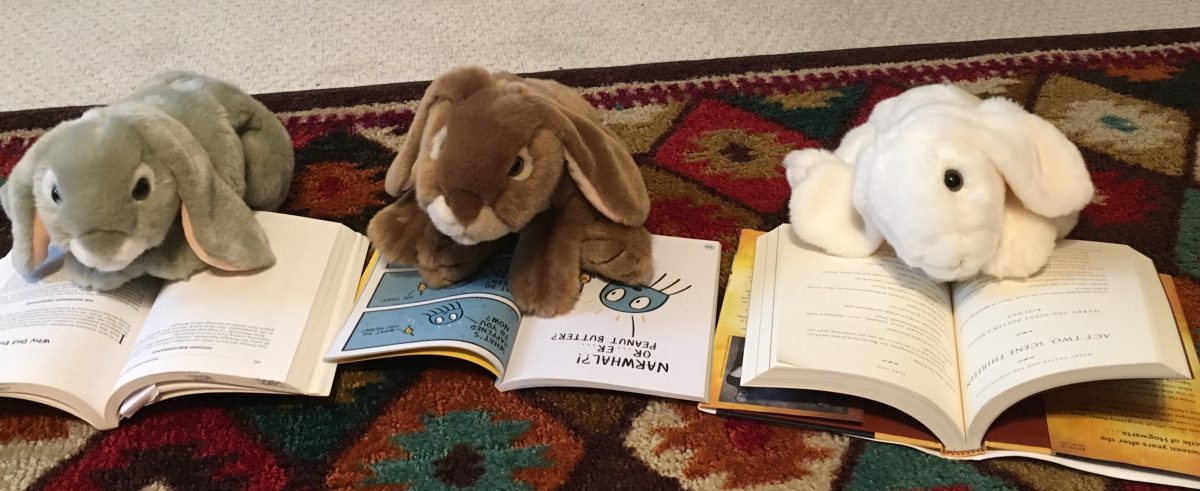
Marshmallow reviews They Called Us Enemy by George Takei

Marshmallow enjoys graphic novels just like many other bunnies, but she has been especially taken by a 2019 book, the memoir They Called Us Enemy, written by the Star Trek veteran George Takei together with Justin Eisinger and Steven Scott, and illustrated by Harmony Becker. Below she shares her thoughts on this striking book.

Marshmallow reviews They Called Us Enemy, written by the Star Trek veteran George Takei together with Justin Eisinger and Steven Scott, and illustrated by Harmony Becker.

Marshmallow’s Overview: In the book They Called Us Enemy, George Takei writes about what it was like to live in a Japanese internment camp. The internment camps were places where the USA put Japanese Americans and people who had come from Japan to find better opportunities in the USA during the second world war.

This was a dark time in American history that is not always emphasized. According to Wikipedia:

In 1988, President Ronald Reagan signed into law the Civil Liberties Act of 1988 which apologized for the internment on behalf of the U.S. government … The legislation admitted that government actions were based on “race prejudice, war hysteria, and a failure of political leadership.”

https://en.wikipedia.org/wiki/Internment_of_Japanese_Americans

George Takei was put in an internment camp when he was a little boy. He stayed there for four years. The time that he spent in the camps was very important and affected his whole life. This book tells his story.

Marshmallow’s Summary: One day, George wakes up and he and his family are ordered to leave their home. As a reaction to the bombing of Pearl Harbor, the US government gathered most Japanese immigrants and Japanese Americans and put them in the camps because many Americans thought that they might betray the United States of America. George does not realize any of this because he is a little boy at the time that he is put in the camp.

George’s family has to board a train to get to the camp and they can only bring what they can carry and that is not much. To add on to that, the government makes them sell everything else that they own. 

When they get to the camp, they see that it is in the middle of nowhere and that they are surrounded by barbed wire and watch towers that have men with guns watching then. George and his family, which includes his brother, Henry, his sister, Nancy Reiko, his father, Takekuma Norman Takei, and his mother, Fumiko Emily Nakamura, have to sleep in a tiny house split by walls that are not sound-proof and their neighbors are able to hear everything that they say. So, in the end the parents decide that they will speak Japanese to each other when talking about private stuff.

They Called Us Enemy is a graphic novel with very realistic drawings. Marshmallow is pointing to the page where George’s parents are frustrated and outraged by the way they are treated.

When they come to the house it is very hot. The book compares it to a furnace. When they were in the camp, many people lose loved ones. For example, Mrs. Takahashi loses her husband because he is a Buddhist minister. She has four children. Those four children lose their father. Mr. Yasuda is taken by federal agents because he is teaching children how to speak Japanese.

“Their husbands’ only crimes were that they occupied highly visible positions…”

Not only are they being taken from their homes, but they are also losing family and friends.

Marshmallow’s Review: This was a very bad time for many people and this book shows how devastating it was. It is a very good book that captures the essence of how important this event is in American history. The internment of Japanese Americans was a big event especially for people who suffered though it and lost members of their family and friends. It is also important for us today. We need to know our past so we don’t make similar mistakes in the future.

Marshmallow’s Rating: 100%.

Marshmallow rates They Called Us Enemy, by George Takei, written together with Justin Eisinger and Steven Scott, and illustrated by Harmony Becker, 100%.

Caramel reviews Just Ask! Be Different, Be Brave, Be You by Sonia Sotomayor

Caramel reviews Just Ask! Be Different, Be Brave, Be You, by Sonia Sotomayor, illustrated by Rafael Lopez.

Caramel enjoys picture books even though he is now able to read some chapter books on his own too. Today he is reviewing another neat picture book, Just Ask! Be Different, Be Brave, Be You, by Sonia Sotomayor, illustrated by Rafael Lopez. As usual Sprinkles is taking notes and asking questions.

Caramel reviews Just Ask! Be Different, Be Brave, Be You, by Sonia Sotomayor, illustrated by Rafael Lopez.

Sprinkles: So Caramel, what is this book about?

Caramel: It’s about being different.

S: In what way?

C: In many ways. Some children can have diabetes, some can have dyslexia, some have Down Syndrome, and some of them can be deaf or blind. And some kids might have autism.

S: So there are many different ways to be different. Right?

C: Yeah. You can like plants or dinosaurs, or you can like technology. (I like technology a lot!)

S: So what happens in the book?

C: The first person who is talking is called Sonia and she has diabetes.

S: So is thar the author, do you think?

C: Maybe.

S: Yeah, I actually think it is her. Sonia Sotomayor was diagnosed with diabetes when she was a child. Do you know who Sonia Sotomayor is?

C: Not quite.

S: Well the book jacket explains who she is, but I can also tell you. Sonia Sotomayor is the first Latina Justice in the United States Supreme Court. Marshmallow and I read another book by her at some point. She also has a real neat video with Abby from Sesame Street, where they are talkng about the word “career”:

S: Have you seen it?

C: Oh yes, I remember that one! Marshmallow loves that video, she also loves Abby!

S: That is true! But why do you think a supreme court justice would write this kind of a book for kids?

C: Is she retired?

S: No. She is still very much on the court. Any other thoughts?

C: Hmm. I can’t think of anything.

S: Well, from the book I read with Marshmallow, I learned that Sotomayor felt very different from other kids because of her diabetes. Can you imagine why that could lead her to write this book?

C: I think she wants all kids to feel unique and not bad because they are different.

S: Yes.

C: I will read you the very end, when Sonia is back talking to us:

Imagine of all the plants in this garden were exactly the same–like what if we only could grow peas? That would mean no strawberries or cucumbers or carrots. It might also mean no trees or roses or sunflowers.

S: Why would that be bad?

C: I’m reading, hold on, don’t interrupt. Here is Sonia again:

Just like in our garden, all the ways we are different make our neighborhood–our whole world really–more interesting and fun. And just like all of these plants, each of us has unique powers to share with the world and make it more interesting and richer.

S: That is a neat message, don’t you think?

C: Yes. I’m glad you didn’t interrupt me again.

S: I’m sorry! Alright, so tell us a bit more about the book then.

C: The book is a very colorful book. Very very colorful. And the children are of many different colors too. They have different skin colors, but they all have black eyes.

S: That’s interesting how you noticed that Caramel. Yes, the book is really colorful, and the pictures are really fun and joyful, right?

C: Yes, the illustrator Rafael Lopez must be a real good illustrator.

S: Yes! And there is also a Spanish version of the same book, for bunnies who read Spanish. All in all, we both enjoyed this book, right?

C: Yes! So it is now time to say: Stay tuned for more book bunnies adventures!

Caramel really enjoyed reading Just Ask! Be Different, Be Brave, Be You, by Sonia Sotomayor, illustrated by Rafael Lopez.

Marshmallow reviews Little Women by Louisa May Alcott

Marshmallow reviews Little Women by Louisa May Alcott, first published in 1868.

Marshmallow occasionally picks up classic children’s books. This time she wanted to talk about Little Women by Louisa May Alcott, first published in 1868. Sprinkles is asking questions and taking notes. There are some spoilers in the discussion so reader beware!

Marshmallow reviews Little Women by Louisa May Alcott.

Sprinkles: A lot of people have read Little Women before you. It is a classic from 1868, and now it will be the oldest book you have reviewed. We had not gone into the nineteenth century before this. The oldest book you reviewed before this was from 1902.

Marshmallow: Pippi Longstocking was also kind of old. But you are right, this book is old.

S: Does its age show?

M: Yeah. All sisters get married and even the tomboy of the family, Jo, ends up wanting to get married. It seems like they cannot just have a girl who doesn’t want to marry.

S: It does seem a little constraining, that is true. But of course at the time this book was written, women did not really have too many options.

M: I understand but I still wish the author could have offered other alternatives, at least to one of them (Jo).

S: That is true. The author seems to have modeled Jo after herself to an extent, and she, the author that is, was never married.

M: Yes, I did wish Jo had not gotten married. And it seemed that they all got married so early!

Marshmallow is reading  Little Women by Louisa May Alcott.
Marshmallow is reading Little Women by Louisa May Alcott.

S: Ok, maybe it will make sense for us to try and piece together a timeline of sorts for what happens when. So at the beginning …

M: There are four sisters, Meg March, Jo March, Beth March, and Amy March.

S: At the start of the book their ages are 16, 15, 13, and 12. And they all have very distinct personalities, right? Can you tell us a bit about them?

M: Let me read to you the synopsis from the book jacket:

There’s Meg, at 16 the oldest, who longs for a rich life full of beautiful things and free from material want. Next comes Jo, the willful and headstrong tomboy, who plans to become a writer and who retires to the attic when “genius burns.” Gentle, music-loving Beth, “the pet of the family,” is delicate and sweet. And fashionable Amy, the youngest of the four, is artistic, beautiful, spoiled, and in a hurry to grow up.

S: And the first part of the book (the first twenty-three chapters), which was published as a stand-alone book on itself in 1868, ends a year later, when the girls are 17, 16, 14, and 13. So they are still pretty young, but they are looking towards great things.

M: And the next part of the book is actually three years later. In Chapter 24 the author writes: “The three years that have passed have brought but few changes to the quiet family.”

S: According to Wikipedia, this second part was initially published separately under the title “Good Wives”, a title picked by the publisher. Then starting in 1880, the two books were published as one, under the title Little Women. But in any case, now how old are the sisters at the beginning of this part?

M: Meg is 20, Jo is 19, Beth is 17, and Amy is 16. It is sad though. Beth dies in this book! And she is so young!

S: Yes, a lot of the main events in this story are related to the author’s own life. Louisa May Alcott apparently had a sister Elizabeth, who died around the age that Beth in the book dies. And Jo seems to be modeled after the author herself.

M: Yes, Jo is the writer of the family after all! But it is still so sad that Beth dies. And it is even sadder that there was a real Beth who died so young too.

S: That is true. Life can be cruel sometimes. But there are happy parts of the book, too, no?

M: Yes. The book is not all about sad things. Meg has twins and she loves them and enjoys her time with them. And they are really funny kids.

S: So maybe this is a good place to stop the review, on a note of joy and hope. Do you have some last words for our readers?

M: This book is interesting and its plot is detailed and complex. Even though it is an old book, I can see why it is still a classic. I would definitely recommend other bunnies to check it out!

Marshmallow rates  Little Women by Louisa May Alcott 95%.
Marshmallow rates Little Women by Louisa May Alcott 95%.

Caramel reviews Drawn Together by Minh Le and Dan Santat

Caramel reviews Drawn Together, written by Minh Le and illustrated by Dan Santat.

Caramel has reviewed The Cookie Fiasco and Harold and Hog Pretend for Real! by Dan Santat before and enjoyed his quirky style. Today he reviews another book illustrated by Dan Santat: Drawn Together, written by Minh Le. As usual, Sprinkles is taking notes and asking followup questions.

Caramel reviews Drawn Together, written by Minh Le and illustrated by Dan Santat.

Sprinkles: So Caramel, tell me about this book.

Caramel: It is a very interesting book about this boy. He doesn’t really like his grandfather.

S: Or at least we know he doesn’t seem to enjoy spending time with him. Right?

C: Yes.

S: Why is that?

C: He thinks that time with him is boring.

S: How so?

C: They eat different things. The boy is eating hot dog with mustard. and the grandfather is eating noodles and eggs.

S: So they are eating different things. But there is a bigger problem, right? Can they communicate?

C: No. They speak different languages.

S: Yes, the boy speaks English and the grandfather seems to only speak Thai. That might make things difficult, right?

C: Yes.

S: You are lucky that you can communicate with your grandfather, but this boy’s grandfather seems to have difficulty speaking English. So they watch TV. How does that turn out?

C: The boy asks “Can we watch something else?” So he is bored.

S: Yes, so they don’t enjoy the same food and they don’t enjoy the same TV programs. That is sad a bit, right? You do like watching TV with your grandpa.

C: Yep, I sure do!

Caramel is looking at the front cover of Drawn Together, written by Minh Le and illustrated by Dan Santat.

S: So the boy is staying with his grandfather and is bored because he cannot communicate with him and he doesn’t think they have anything in common. Then what happens?

C: The boy takes some crayons out of his backpack and starts drawing. Then the grandfather takes out a sketch pad and a brush. It looks old fashioned but he can draw amazing things with it.

S: Yes, the things he can draw are very intricate, very detailed, right?

C: Yes. And I am surprised that this book is illustrated by Dan Santat, because the drawings don’t look like the ones in his other books I reviewed: The Cookie Fiasco and Harold and Hog Pretend for Real!

S: Well, that shows that he is a versatile illustrator, right? He can draw things in many different styles.

C: Yes, he can draw amazing things! He draws awesome dragons!

S: Yes apparently Thai dragons, like Chinese and Japanese dragons, are magical and have super powers. We saw some impressive images on Google. And the dragons in this book are just as amazing!

C: Yes. And then the boy and his grandfather start making art together. And the boy has color but his grandfather’s brush is one color only. But when they paint together, they both have colors.

Caramel is pointing to some of the artwork that the boy and his grandpa create together in  Drawn Together, written by Minh Le and illustrated by Dan Santat.
Caramel is pointing to some of the artwork that the boy and his grandpa create together in Drawn Together, written by Minh Le and illustrated by Dan Santat.

S: So what happens in the end?

C: They hug.

S: So even though they cannot communicate by talking …

C: They can communicate by hugging…

S: And by drawing! And when the boy’s mom comes to pick him up, it seems like the boy won’t be bored next time, right?

C: Right.

S: So did you like the book?

C: Yeah. It has bright colors and amazing drawings.

S: And a sweet story! So it is time to wrap up this review. What do you want to say Caramel?

C: Stay tuned for more book bunnies adventures!

Caramel enjoyed reading Drawn Together, written by Minh Le and illustrated by Dan Santat.