Caramel reviews A Kids Book About Racism by Jelani Memory

Caramel has already reviewed two books from the A Kids Book About ... series: A Kids Book About Change by David Kim and A Kids Book About Empathy by Daron K Roberts. (You can read more about the series here.) Today he is reviewing the first book in the series: A Kids Book About Racism, written by Jelani Memory. Sprinkles is asking questions and taking notes, as usual.
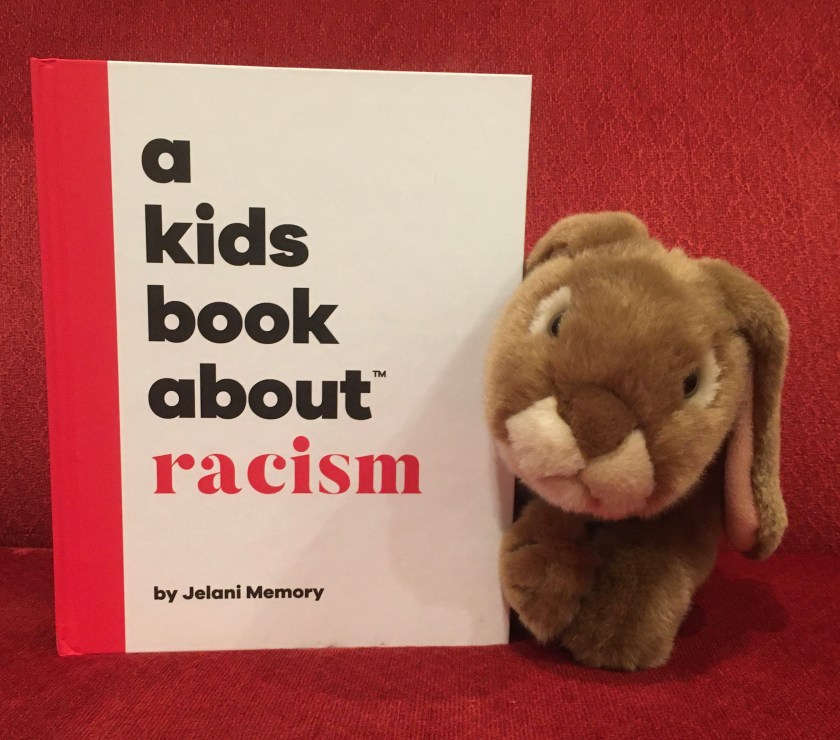
Caramel reviews A Kids Book About Racism by Jelani Memory.

Sprinkles: So Caramel, we just read the book together. Can you tell our readers what this book is about?

Caramel: It’s about racism. That’s what it says on the cover too.

S: That’s true. So what does it tell you about racism?

C: It tells you what racism is.

S: So what is racism?

C: Someone may be mean to someone else because of the color of their skin. Here is the definition the book gives:

“Racism means to hate someone, exclude them or treat them badly because of their race or because of the color of their skin.”
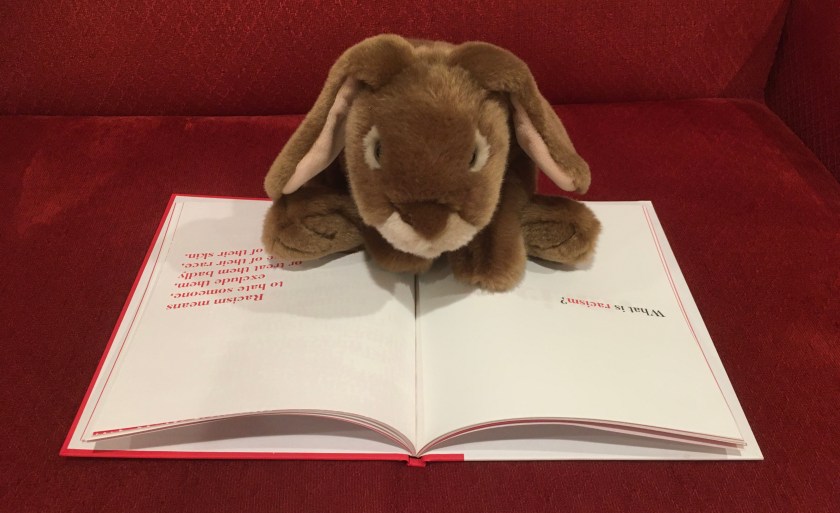
Caramel is rereading the definition of racism in A Kids Book About Racism by Jelani Memory.

S: The book makes it clear that racism is about treating people badly because they are different. But it also says that being different is actually good. Right?

C: Yes. Because if we are different we can offer other people more. Like.. let me read from the book: “help, ideas, strengths, skills, creativity..”

S: So what does that mean? Is being different better, like if you are different from others, then are you better than others?

C: No, that’s not what this means. This means if people are different from one another, then they have more ideas, they can help one another, and they can share.

S: Yes! I agree. I too interpreted that part the same way. Being different allows you to see things differently. And then you can bring a new perspective to a problem, you can share experiences that others may not have had, so they will be able to learn from you. And similarly you can learn from them. But the book also tells us how it makes someone feel to face racism, how people are sometimes made to feel so small just because they are different. How can you try and help people who are being treated badly because of racism?

C: You can try to include friends who look different when you are playing. Or when someone is mean to them, or exclude them from their game. You can invite them to join yours.

S: I like those ideas Caramel. A while back, we read a book by Sonya Sotomayor called Just Ask! Be Different, Be Brave, Be You which was also about how being different can be a valuable thing, right?

C: And Marshmallow reviewed a book called Wonder about a kid who looked very different and so his friends did not treat him too nicely. A lot of people are different in different ways. And it is not nice to treat them differently just because they are different. Why can’t you just treat everyone nicely?

S: Good question Caramel. It seems like people are a bit scared of others who are different.

C: I guess so. But it is not a good thing to do that!

S: Agreed. So let us wrap up our review with your three words for this book.

C: Helpful. Because it makes me think about different people. And let me see. Other words… Hmm. Black and white and red and orange and brown.

S: Hmm, that makes more than three words, but those are the main colors that show up in the book. You are right. I’d also say it could be a good starting point for little bunnies and their adults to talk about some difficult topics. Because racism is still around us —

C: Yes, there is that one page where there are a lot of “racism”s copied and pasted all over the place.

S: That’s true. That is a good way to show visually that racism is everywhere, pretty visible to many people who have to face it every day. But then there is also a page with 242 “really”s, and that page was fun, right?

C: Yes. It was fun to count! We counted them together!

S: Well, we did some basic arithmetic, so hopefully we got it right. But anyways, I do think this book could be a good conversation starter. So what do you say to end this review?

C: Stay tuned for more book bunny reviews!
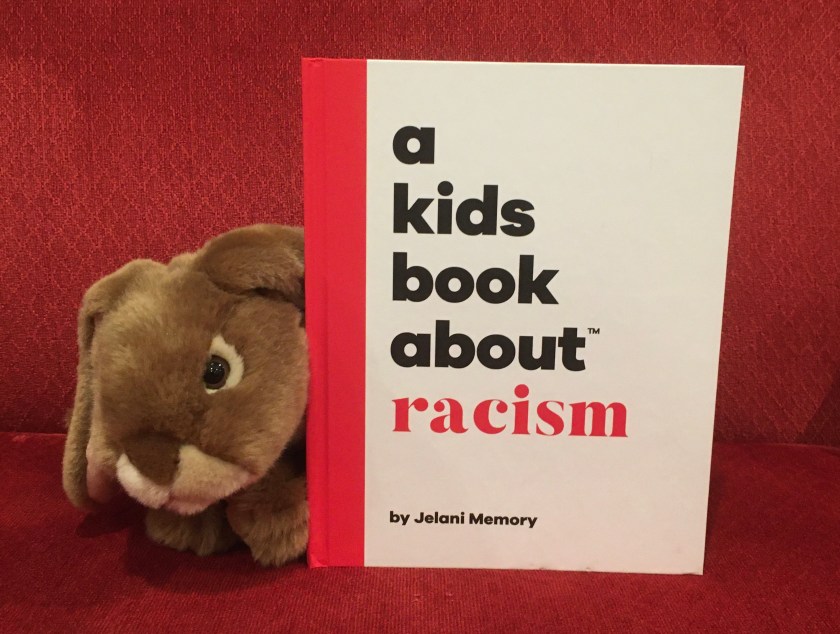
Caramel appreciated reading A Kids Book About Racism by Jelani Memory and thinks he has a better sense of what racism means now.

Marshmallow reviews Over Sea, Under Stone by Susan Cooper

Marshmallow recently read Over Sea, Under Stone written by Susan Cooper and first published in 1965. Today she is discussing it with Sprinkles.

Marshmallow reviews Over Sea, Under Stone by Susan Cooper.

Sprinkles: So Marshmallow, why don’t you start with a brief summary of what this book is about?

Marshmallow: Sure. Over Sea, Under Stone is about three kids, Barney, Simon and Jane. They are on vacation with their parents in Cornwall and are staying in an old house they rented together with an old family friend Great-Uncle Merry. Then they discover a mysterious map in a small room behind a wardrobe.

S: Oh, so like the kids in The Lion, The Witch and The Wardrobe, the first book written in the Chronicles of Narnia series, who find a new world within a wardrobe?

M: It is similar, but not quite the same. They do not go and find a new world inside the wardrobe. They find a map which allows them to see their own world through a new perspective.

S: How so?

M: When they show Great-Uncle Merry the map, he tells them of an ongoing war between good and evil, and that the warriors on both sides still are fighting it to this day.

S: Yes, this is a good summary I think. But this good versus evil fight is not as tied in with Christianity as it was in Narnia. Here, the good side is tied back to the King Arthur legends instead. It seems more directly connected to English lore. But the way you talked about the main characters, I also thought of a few other books you have reviewed for this blog. For example you reviewed Five Children and It by E. Nesbit and there too there were a few siblings that find something interesting during a family vacation. You also reviewed  Half Magic by Edward Eager which is similar.

M: Yes! And Half Magic by Edward Eager also involved the King Arthur legends in some ways.

S: So it seems like there is this genre of siblings, a handful of ordinary kids finding something extraordinary and then their lives change. Would you like that to happen to you and Caramel?

M: No!

S: Why not?

M: Possibly because they almost always get into real big trouble. Almost always there is a real big danger. And that’s not very appealing to me.

S: I see. But you seem to like reading about these kinds of things happening to other little bunnies. I guess you enjoy living vicariously through these characters’ adventures!

M: Yes! I will agree to that.

Marshmallow is reading Over Sea, Under Stone by Susan Cooper.

S: Apparently Susan Cooper, the author, wrote four more books about the same conflict between good and evil after this one, starting about ten years after having published this book. Together the five books make up the Dark is Rising sequence. Are you curious about those books?

M: Well, I am curious about what Cooper does with the world, but honestly I am not always too keen to read about female characters written in the time these books were written. They are almost always too stereotypical. I was disappointed with the female characters in Narnia, and here, too, I was disappointed that Jane always worried about cleanliness and her brothers always picked on her for being a girl.

S: I know what you mean. But I thought Jane was not too terrible. She did sense something was wrong with the Withers from the start. And the boys did eventually treat her a bit better. So maybe the other books will be a bit better?

M: I did read an excerpt of the second book at the end of this book and it seemed like there are a whole lot of new characters in there.

S: Yes, I think that is the case. I also heard that many people like that second book a lot. So we might just have to read it to see for ourselves, don’t you think?

M: Yes.

S: So let us wrap this up then. How would you rate this book?

M: Let me see. There was not much humor and the kids were a little too serious for me, I could not relate to any of them, but the story was quite intriguing and kept me wondering till the end.

S: Yes, it was quite stressful for me at times. I did think the author kept up the suspense well till the end.

M: I was not stressed myself but the story did work well. So I rate the book 95% and recommend it to other bunnies. Stay tuned for more book bunnies reviews!

Marshmallow rates Over Sea, Under Stone by Susan Cooper 95%.

Caramel reviews physics books for babies by Chris Ferrie

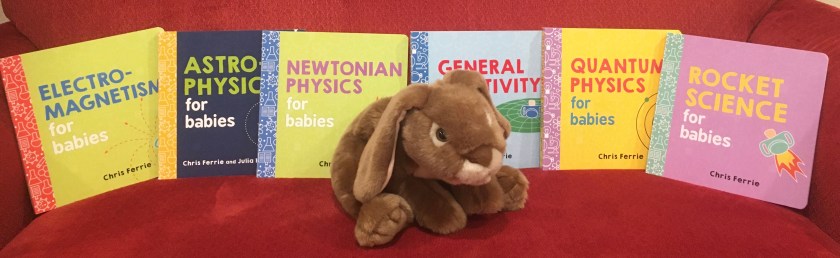
This past week Caramel got his paws on a handful of board books from the Baby University series, written mainly by Chris Ferrie. He is a voracious reader, and these little books, written for tinier bunnies and their adults, were all read within the course of one evening. Then he reread them and reread them again. And for today’s review, he insisted that we should talk about them. So that is what is happening today: Caramel is reviewing six books on physics from the Baby University series, and Sprinkles is taking notes and asking followup questions.

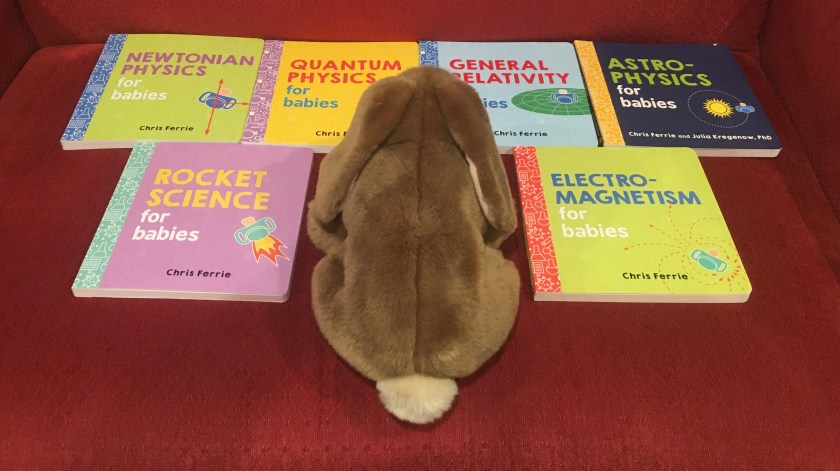
Caramel reviews Electromagnetism for Babies, Astrophysics for Babies, Newtonian Physics for Babies, General Relativity for Babies, Quantum Physics for Babies, and Rocket Science for Babies, almost all written by Chris Ferrie, except the astrophysics one which is coauthored by him and Julia Kregenow.
Caramel reviews Electromagnetism for Babies, Astrophysics for Babies, Newtonian Physics for Babies, General Relativity for Babies, Quantum Physics for Babies, and Rocket Science for Babies, almost all written by Chris Ferrie, except the astrophysics one which is coauthored by Ferrie and Julia Kregenow.

Sprinkles: So Caramel, why did you want to review these books?

Caramel: Well, I liked them. I review only the books I like.

S: But aren’t these books for babies?

C: Yes. So? I don’t care. I liked them!

S: I agree they are cute and fun. But did you find them amusing? Did you find them informative?

C: Both!

S: They do explain some basic physics in simple terms. And even for a little bunny like you, who can read big books, they could teach some basic principles, right?

C: Yes.

S: Okay, let us start from the beginning. The earliest physics these books talks about is Newtonian physics. Can you tell me a bit about what you learn in that book?

C: This book talks about gravity, and mass, and acceleration.

S: Hmm, those are big important words. Do you know what they mean?

C: Yeah. For example the book tells me what gravity is. It says: “We can’t see gravity. It is the force that keeps us on the ground.”

S: I see.

C: There are forces and they make a ball move faster. That is what accelerate means. And when an apple falls from a tree, it “feels the force of gravity, and Sir Isaac Newton feels the force of the apple.”

S: Yes, so in this book we go through Newton’s Three Laws of Motion.

C: I knew only one of them before reading this book, the one that says “for every action there is an equal and opposite reaction”. So I learned two more.

S: That is good! Then let us move to the book on electromagnetism. That is I believe the next one, in terms of the history of science.

C: Hmm, let me quickly read it again… Okay, this one, like all the others, starts with a ball. All of the books start with “This is a ball.”

S: It is a good starting point, especially if you want babies to be interested, right?

C: Yes. I like balls too.

S: I know! So okay, in this book you learn about electric charges and then magnets and then finally that the ideas of electricity and magnetism are related. Right?

C: Yes! I heard that they use big magnets in wind turbines to generate electricity! They are using this idea!

S: That is cool! Here is an article we found about “the critical role of magnets in wind turbines” and read together.

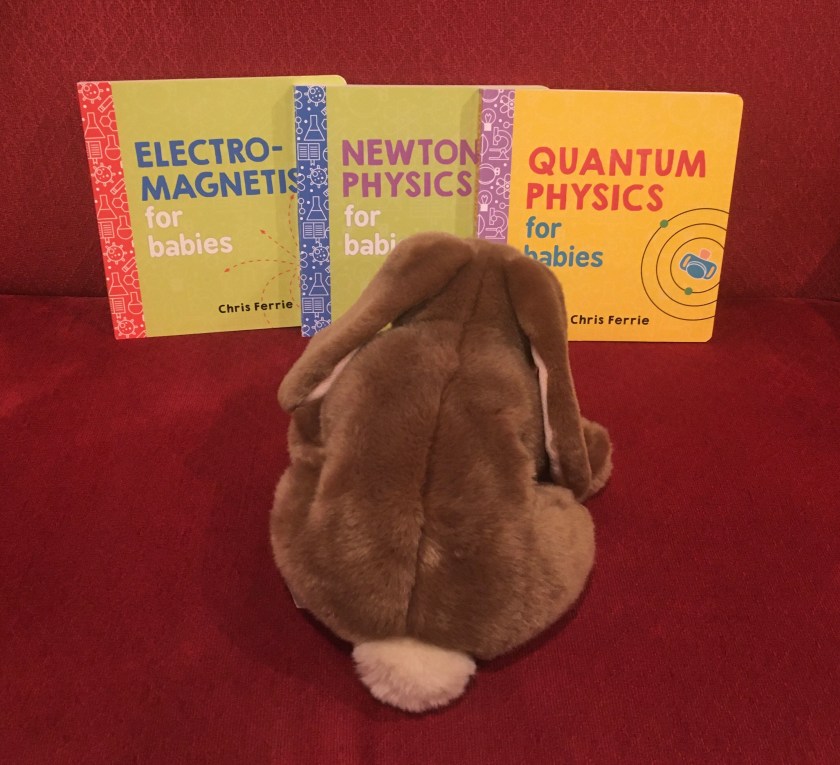
Caramel is looking at Electromagnetism for Babies, Newtonian Physics for Babies, and Quantum Physics for Babies, all written by Chris Ferrie.

S: Next let us talk about the book on quantum physics. Tell me about this one.

C: This also starts with a ball. Then it tells us about atoms and electrons. Electrons have energy. This energy is “quantized”.

S: That means that the energy electrons can have has to be among a few possible values. Not all values are allowed.

C: Yes. I learned that from this book.

S: That is some quite fancy knowledge Caramel. I’m glad you are learning all this already!

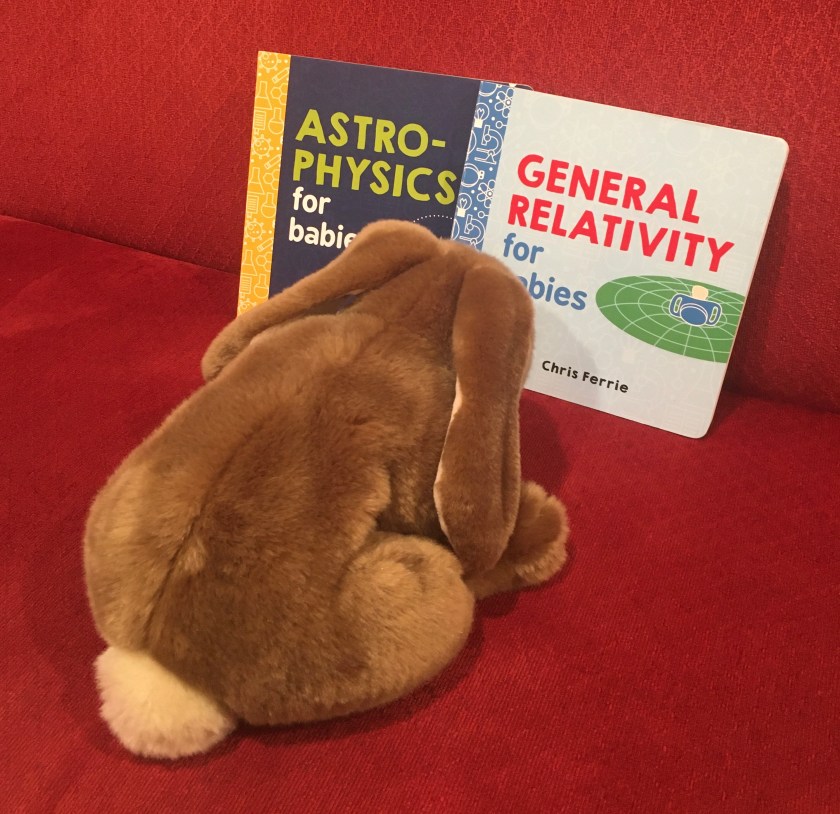
Caramel is looking at Astrophysics for Babies by Ferrie and Kregenow and General Relativity for Babies by Ferrie.

S: Tell me next about the astrophysics one. This is written by Chris Ferrie and Julie Kregenow.

C: This too starts with “This is a ball.” And then it says planets and stars are like balls. Then it talks about elements on the periodic table. They were all created in stars!

S: Yes, that part made me think about that Symphony of Science song we like to listen to. There is a part in that song where Carl Sagan says, “We’re made of star stuff”. He then says “We’re a way for the cosmos to know itself.” I love that!

C: Yeah, let us embed the video here!

S: Sure, why not?

“”We Are All Connected” was made from sampling Carl Sagan’s Cosmos, The History Channel’s Universe series, Richard Feynman’s 1983 interviews, Neil deGrasse Tyson’s cosmic sermon, and Bill Nye’s Eyes of Nye Series, plus added visuals from The Elegant Universe (NOVA), Stephen Hawking’s Universe, Cosmos, the Powers of 10, and more. It is a tribute to great minds of science, intended to spread scientific knowledge and philosophy through the medium of music.”

S: “And there is much to be learned.” I love this song. But let us get back to the books. Next if you want, we can talk about the book about general relativity.

C: This begins with the same sentence: “This is a ball.”

S: Then what happens? What do you learn?

C: I learn about mass and how it warps space, and then about black holes.

S: All pretty cool stuff really…

C: And now let us talk about my favorite one.

S: Yes, let us talk about Rocket Science for Babies.

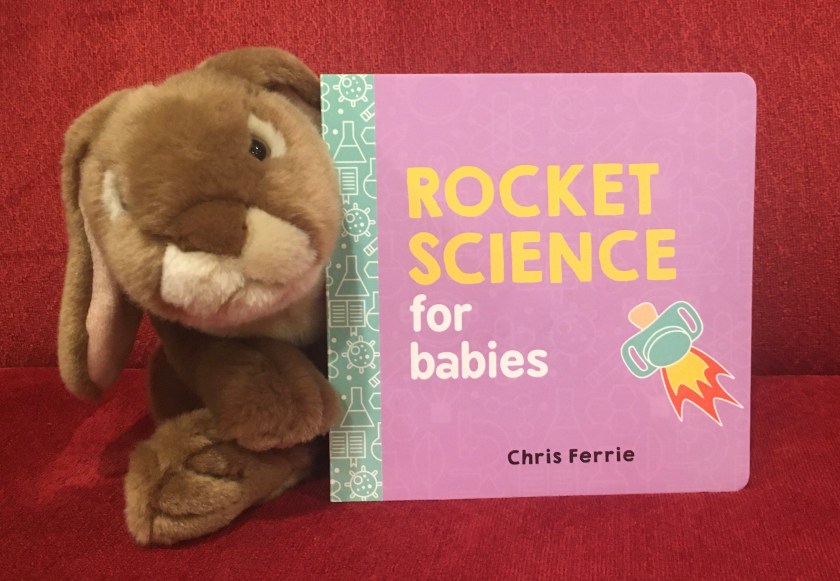
Caramel is posing with Rocket Science for Babies by Chris Ferrie, his favorite so far in this series.

C: This is my favorite! It again starts with “This is a ball.” Like all the other ones. Then it talks about lift and airplane wings and thrust. And rockets.

S: Why is it your favorite?

C: Because I love rocket ships and planes and balls. And the book is all about them.

S: Yes, that is a good reason to like the book. Did you learn something new from this book?

C: Well, not really. I already knew a bit about lift and thrust and such. But it is still a cool book.

Caramel is reading Rocket Science for Babies by Chris Ferrie, his favorite so far in this series.

S: So do you think it is time to give these books away to a baby bunny?

C: No! I like them and want to read them a lot more times before we do that!

S: Okay, you can read and reread them as many times as you like. I do think they are good ways to set up the fundamental ideas of some of these things. Do you think these books would work well for babies?

C: Yes, I would have loved to have read them with you when I was a baby.

S: So would I! I myself would recommend these books to parents, especially if they are willing to talk to their little ones about the science a bit, even if it has to be with the help of the internet. But we only found out about them this year. Oh well, better late than never, right? Let us wrap this up. What three words would you use to describe these books?

C: Helpful, colorful, fun.

S: I think those work! So what should our readers do?

C: Stay tuned for more book bunny reviews!

Caramel enjoyed reading and rereading Electromagnetism for Babies, Astrophysics for Babies, Newtonian Physics for Babies, General Relativity for Babies, Quantum Physics for Babies, and Rocket Science for Babies, almost all written by Chris Ferrie, except the astrophysics one which is coauthored by Ferrie and Julia Kregenow.

Marshmallow reviews Harry Potter and the Sorcerer’s Stone by J.K. Rowling

Marshmallow’s first contribution to this blog was a review of J.K. Rowling’s The Cursed Child. Recently she began rereading the original Harry Potter series in their illustrated versions, and today she offers us a review of the book that started the whole enterprise, Harry Potter and the Sorcerer’s Stone, illustrated luminously by Jim Kay.

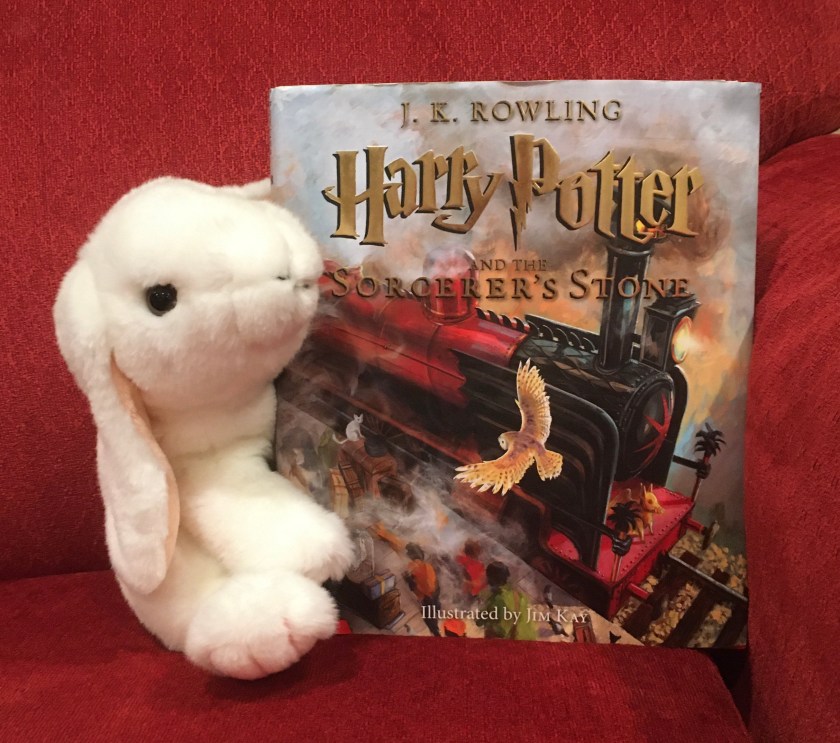
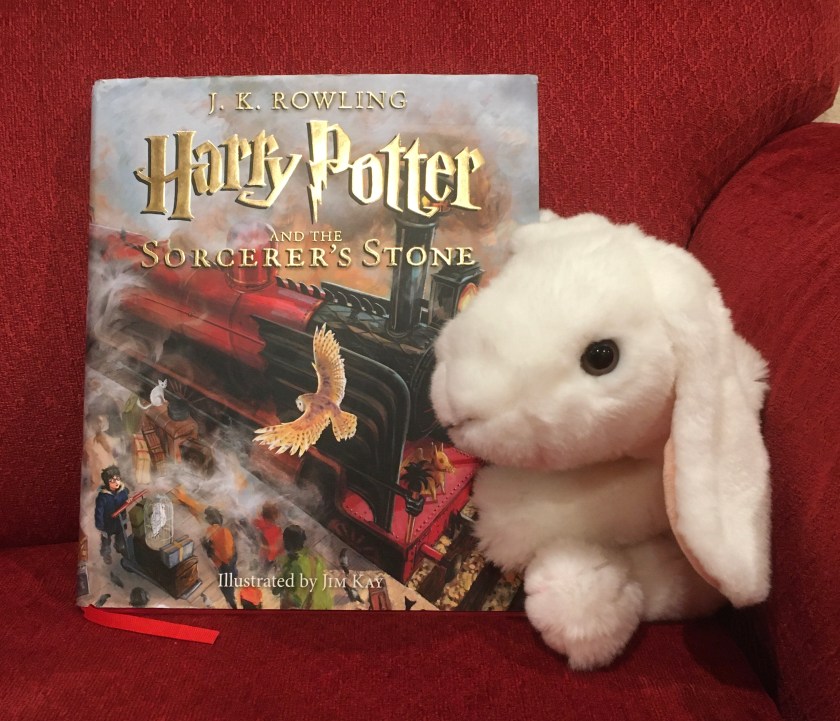
Marshmallow reviews Harry Potter and the Sorcerer’s Stone, written by J.K. Rowling and illustrated by Jim Kay.

Marshmallow’s Quick Take: If you like Harry Potter, or if you are new to his world and want to dive right in, then this illustrated version might be the book for you.

Marshmallow’s Summary (with Spoilers): When he was a baby and his parents were killed, Harry Potter was sent to live with his aunt and uncle Petunia and Vernon Dursley. The problem is that the Dursleys want to be ordinary and they don’t want anything to be out of the ordinary, which is bad because Harry Potter is anything but ordinary. Strange things happen when he gets scared or angry. For example, once when Dudley, his cousin who loves to punch him and hit him, was chasing him, he suddenly found himself on the roof of their school.

A little bit before his eleventh birthday, Harry receives a letter addressed directly to his “room”, a cupboard under the stairs, which his aunt and uncle, Petunia and Vernon, gave him out of the “goodness” of their hearts. Uncle Vernon and Aunt Petunia dispose of the letter, and then more of the same letters come, still addressed to Harry in the cupboard under the stairs, and when his aunt and uncle move him to Dudley’s second bedroom, the address for the letters switches to the second bedroom. When Aunt Petunia and Uncle Vernon see the letters, they freak out and go to any lengths to make sure that Harry and Dudley don’t see the contents of the letter. They even travel long distances to hide away at a house by the ocean in the hope that more letters don’t come. Meanwhile, Harry’s birthday has been forgotten, and like every other year, none of the Dursleys says or does anything for his birthday.

Then, in the house in the ocean, a giant man, Hagrid bangs open the door and tells Harry that he is a wizard and he has been invited to Hogwarts, a school for witchcraft and wizardry.

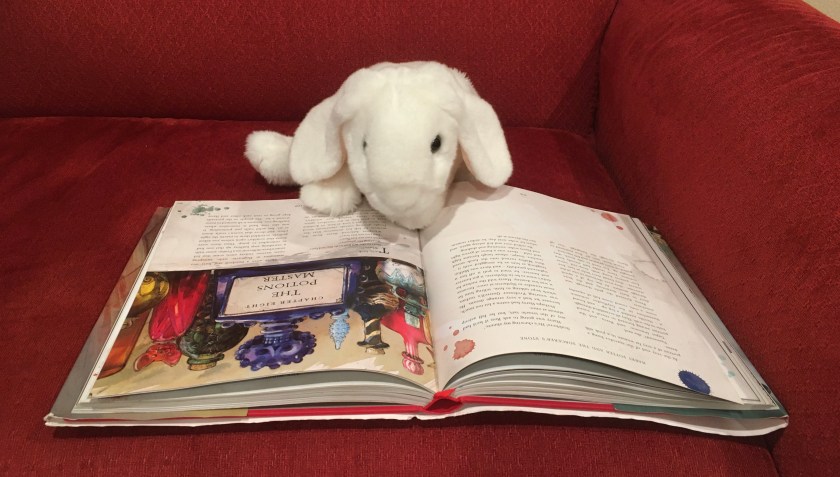
Marshmallow is reading Harry Potter and the Sorcerer’s Stone, written by J.K. Rowling and illustrated by Jim Kay.

But Harry also learns that his parents weren’t killed in a car crash, as Aunt Petunia and Uncle Vernon told him. They were killed by a wizard so feared that no one says his name, instead calling him You-Know-Who. You-Know-Who killed Harry’s parents but couldn’t kill Harry, and he himself got destroyed, but some people, like Hagrid believe that he is still out there, waiting to come back.

When Harry goes to Hogwarts, he makes friends and has a good time, except for one professor who seems to hate him and seems to be doing suspicious things. When Harry investigates, with his friends Ron and Hermione, they learn that the nameless horror is trying to return to power. (Dun dun dun!)

We would be amiss if we did not insert the Harry Potter and the Sorcerer’s Stone (2001) Official Trailer. Enjoy!

Marshmallow’s Review: Harry Potter and the Sorcerer’s Stone is a really good book. And the illustrations by Jim Kay really make it even better. The characters and the plot are amazing. The plot all fits together and the characters are all very realistic. The illustrations really add to the story. I especially liked the pictures of the different types of dragon eggs. The world of Harry Potter is magical and fascinating. The movies brought the magic into life with amazing visual effects. The illustrations do the same in this book format.

Marshmallow’s Rating: 100%. 

Marshmallow rates Harry Potter and the Sorcerer’s Stone, written by J.K. Rowling and illustrated by Jim Kay, 100%.