Marshmallow and Caramel have been complaining that Sprinkles has not written a post since last Halloween (when she had reviewed a handful of children’s books about zombies). So she decided to write another one before the anniversary of that post came around. This is the post that resulted.
This week Sprinkles reviews a few books about gender identity written for children, with a nod to the International Pronouns Day, which was just this past Wednesday.
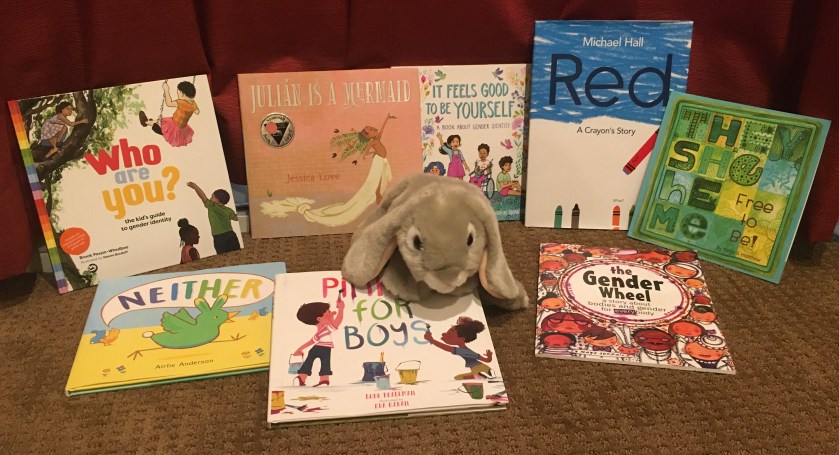
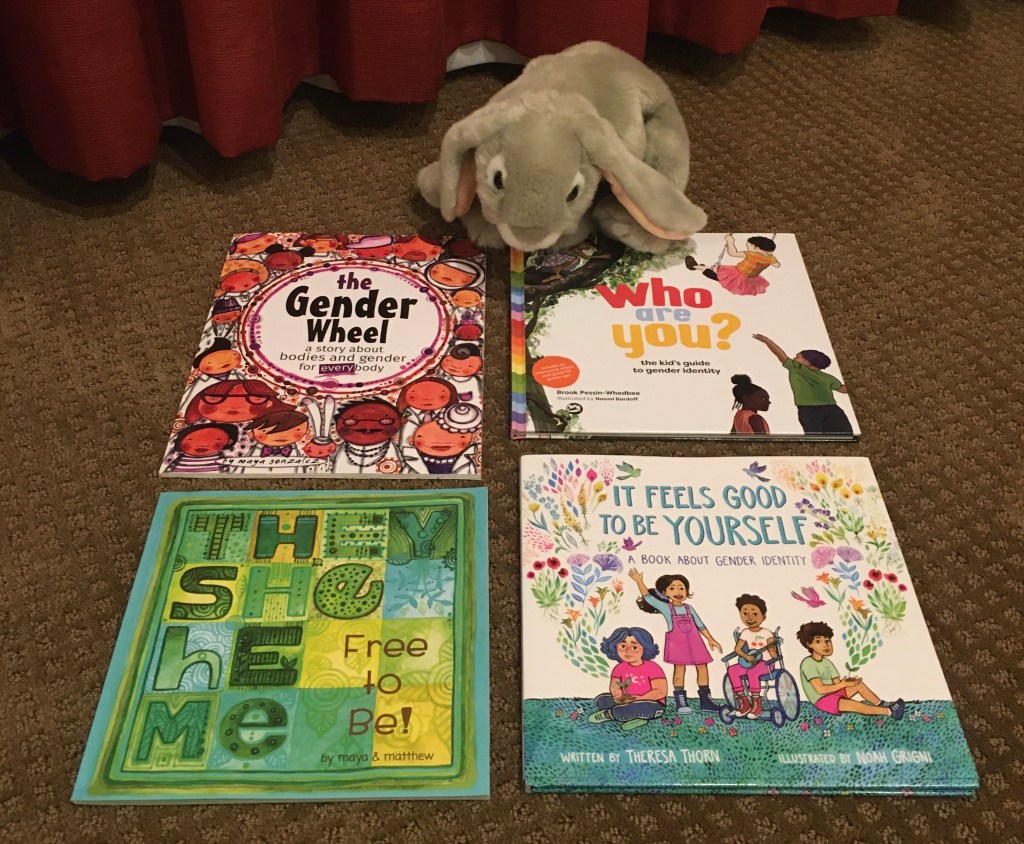
There have been a range of children’s books about gender identity written recently. In this post I would like to share some of my thoughts about eight of them: Julián Is A Mermaid by Jessica Love; Red: A Crayon’s Story by Michael Hall; Neither by Airlie Anderson; Pink Is For Boys written by Robb Pearlman and illustrated by Eda Kaban; The Gender Wheel by Maya Gonzalez; Who Are You? The Kid’s Guide to Gender Identity, written by Brook Pessin-Whedbee and illustrated by Naomi Bardoff; It Feels Good To Be Yourself, written by Theresa Thorn and illustrated by Noah Grigni; and They, She, He, Me: Free To Be! by Maya Gonzalez and Matthew Smith-Gonzalez.
I begin with a review of a handful of them that aim to emphasize the point that being different is alright, and there is a place for all of us in this world.
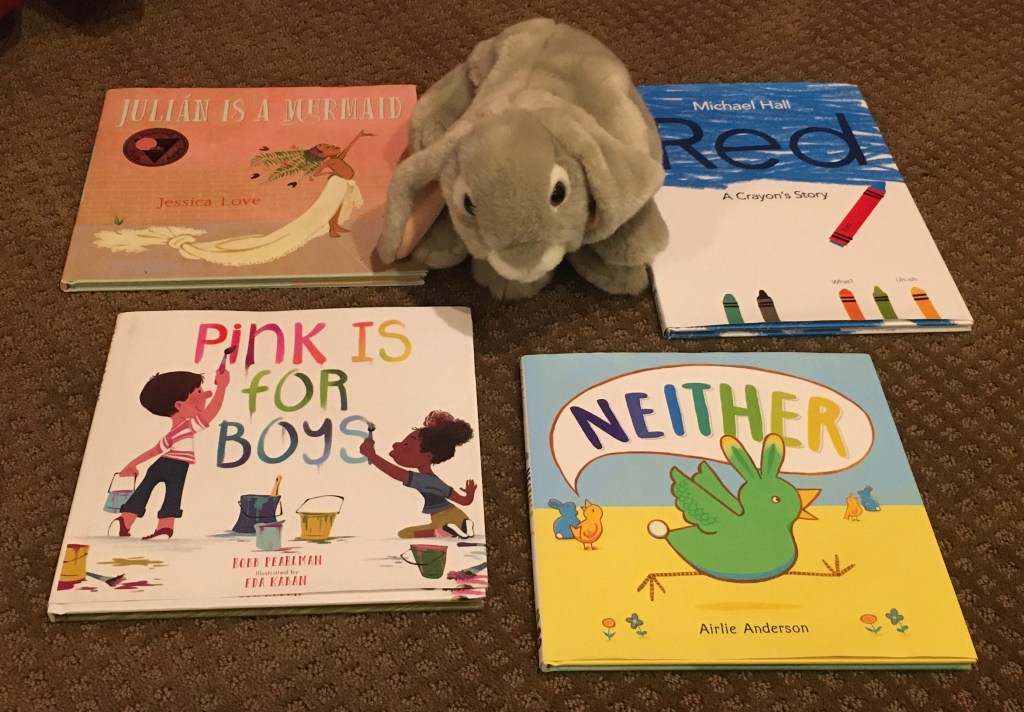
In Julián Is A Mermaid by Jessica Love we meet a little boy named Julián who wants to dress up as a mermaid. He finds acceptance in an unexpected place. The book ends as a celebration of differences. The colors of the book are pastel and lively at the same time, inviting us to Julián’s beautiful world.

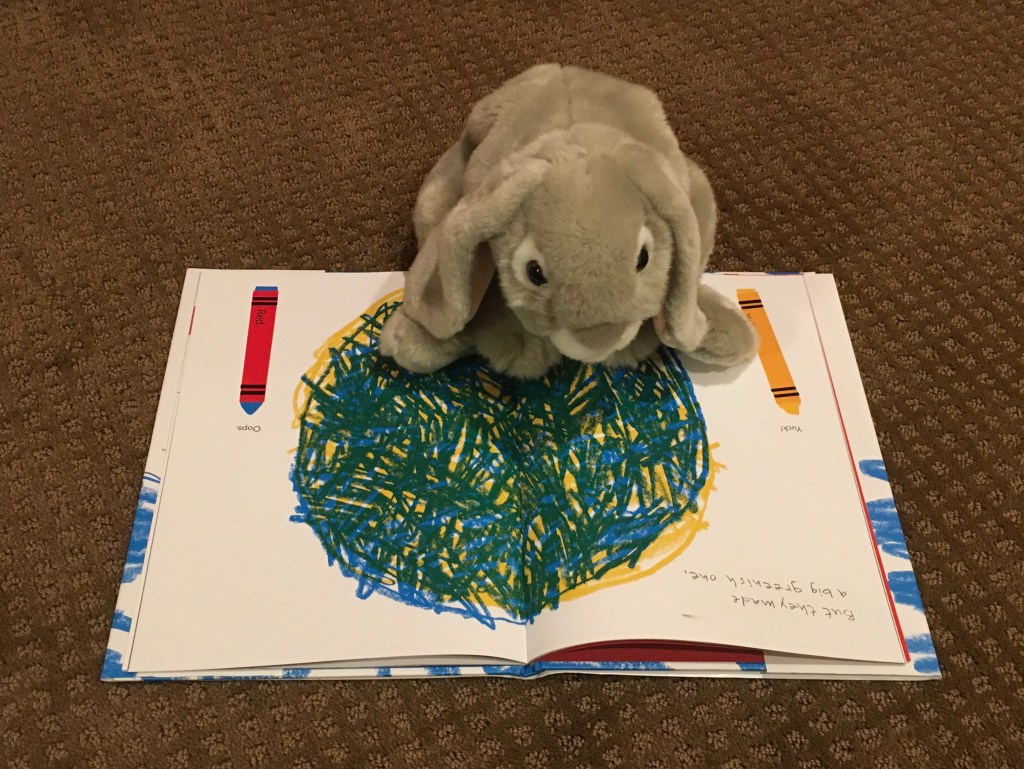
In Red: A Crayon’s Story by Michael Hall, we meet a little crayon who is blue but is in a red covering paper. He has a difficult time at the start trying to fit in. But in the end he finds that he can be who he is, and life is good again. The color scheme used is simple and reminded me a bit of the book series about crayons by Drew Daywalt. (Caramel reviewed The Crayons’ Christmas, the third book of that series, for our blog.) The illustrations are not intricate but they do exactly what they are meant to and give us a sense of this crayon’s inner world and the world around him as well.
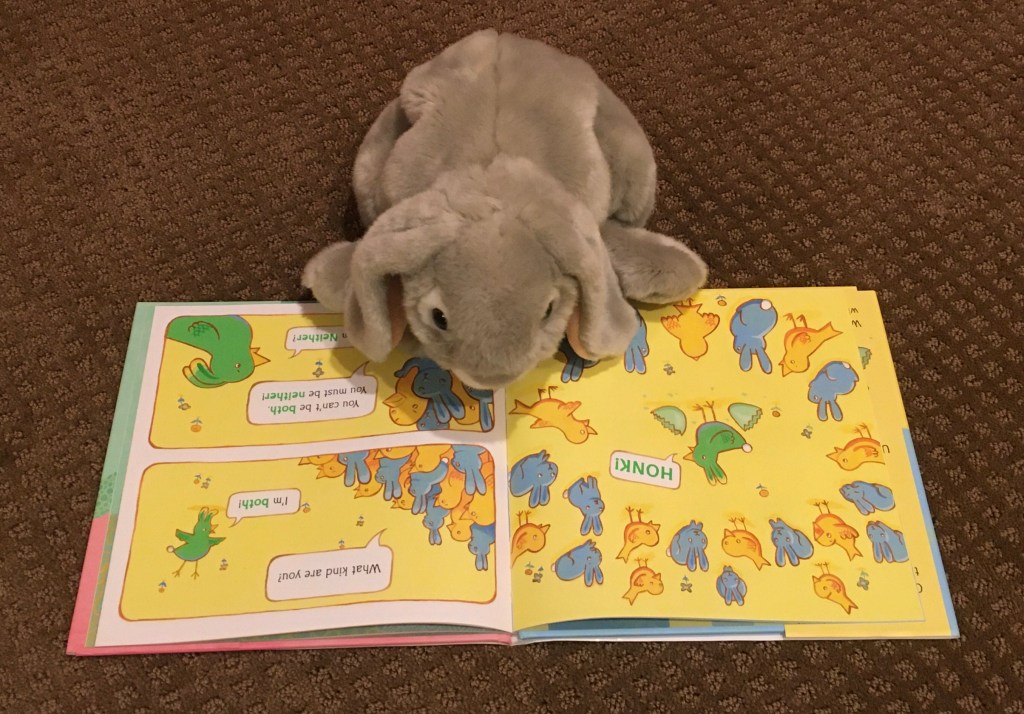
In Neither by Airlie Anderson, we learn of a land of This or That, where every creature has to be this or that, and when there is an individual who does not fit either, they are mocked and excluded from the two groups formed around being This and being That. Eventually we see our outcast, who sees themself as a Both but is called Neither by the two groups, finds themself in a land where they are accepted, along with everyone else. The colors are bright and cheery, and the little creatures are simply drawn but pretty cute.
All three books remind me a bit of a fascinating little book Caramel reviewed a while ago for this blog: From the Stars in the Sky to the Fish in the Sea by Kai Cheng Thom. That book had a dreamy atmosphere, and the main character was a child though magically different from others. Julián from Julián Is A Mermaid is also a little child, and I can see a little boy being comforted by reading about him and his dream of being a mermaid coming true. In some ways though, Neither and Red: A Crayon’s Story might be easier for parents who want to broach the subject of being different without explicitly bringing up gender identity. It is easy to identify the perceived and assumed boy-girl gender binary underlying the stratification of the land of This and That in Neither, though it is never explicitly stated. Similarly, the Blue Crayon in Red: A Crayon’s Story is also suffering from his peers’ expectations about how he should behave given what he looks like, but there is no explicit discussion of boyhood or girlhood.
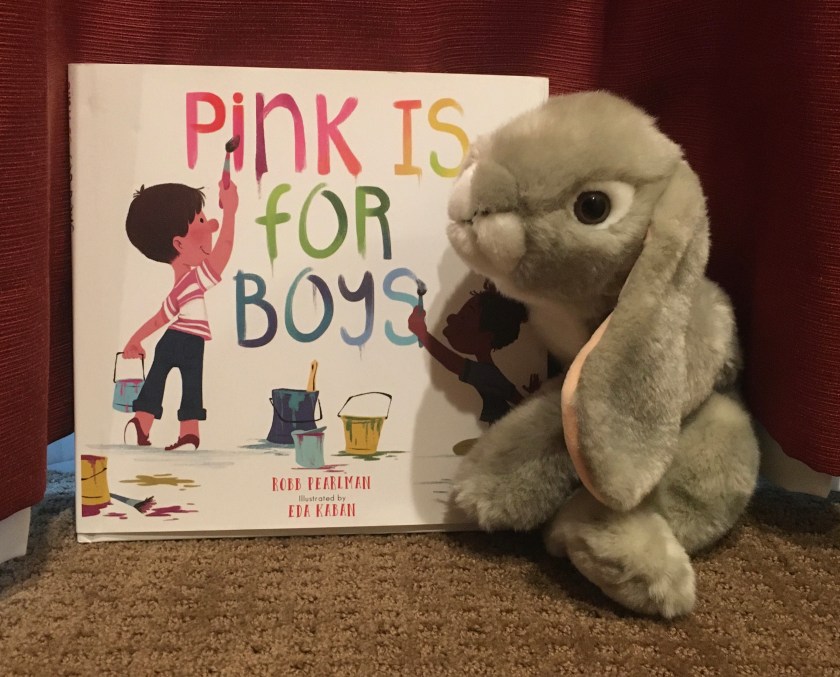
On the other hand, Pink Is For Boys, written by Robb Pearlman and illustrated by Eda Kaban, brings up the boy-girl binary right up front. The main point here is that boys can like pink just like girls can like blue. Similarly boys can enjoy bows on dresses and girls can like baseball. The binary is not really questioned here, but instead, children are told that the boundaries of the two categories are porous in many ways, that boys and girls can enjoy all sorts of things and still be themselves.
The first three books I described above were stories and could easily be viewed as fictional, though obviously the authors were writing with a particular goal and an intended moral. The fourth book was more an advice book, a nonfiction text that openly tells the child reading it (or being read to) what to think about the topic.
The next four books fit this mold as well. They are more like an adult talking to a child who is maybe a bit concerned about being different or simply curious about gender identity, even if they may not be asking explicitly to talk about the topic.
Let me start with They, She, He, Me: Free To Be! by Maya Gonzalez and Matthew Smith-Gonzalez. Among the four books explicitly about gender identity, this one is perhaps the simplest though definitely not oversimplified. The book starts with page after page of pronouns and pictures of people, and the pictures are pretty amazing.
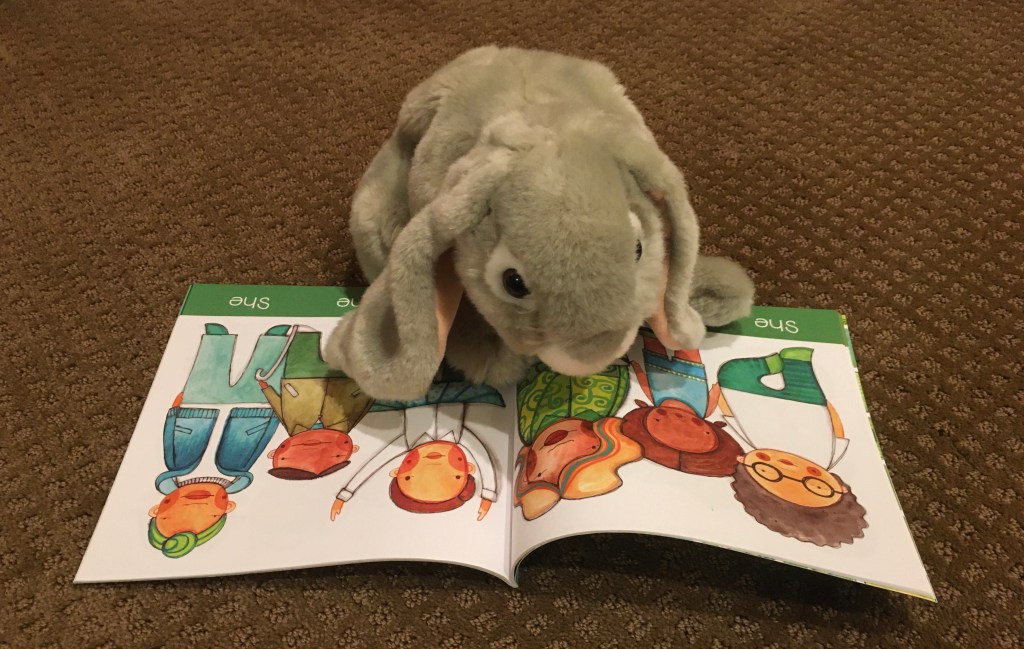
The emphasis of the book is on pronouns, but the main text that starts after the pronoun depictions is quite extensive. Though organized under headings of Pronouns, Freeing Pronouns, Claiming Pronouns, Creating Pronouns, Using Pronouns, and Playing With Pronouns, the text touches upon the uniqueness of each individual, the creative possibilities of pronouns, and the freedom to be who you want to be. Creators of this book share a bit about themselves too and then have a few words for the grownups. They summarize the main goal of this book really well in their personal introduction:
As parents we want our kids to feel fully free to blossom into their maximum magnificence.
They, She, He, Me: Free To Be! by Maya Gonzalez and Matthew Smith-Gonzalez
The Gender Wheel is written and illustrated by Maya Gonzalez, too. This book is a bit broader in its coverage of gender identity, and is beautifully illustrated, with lyrical language that explores the implications of thinking of the world and our identities as parts of a circle. I loved how the author kept coming back to the circle as a metaphor and a reflection of the world as well as our own inner lives.
However, the book is very U.S. centric, and explicitly asserts that the boy-girl gender binary was brought to North America by European settlers, who had “linear and rigid” beliefs and so they “boxed people in and kept nature out”. Though I sympathize with the author’s perspective, I see it as quite limited in the global context, as the gender binary is alive and well all around the world, without direct need for any seventeenth-century European influences. And though some native peoples of this continent may have had more fluid perceptions of gender than the ones we are living with these days (according to this Berkeley website for example, “more than 150 different pre-colonial Native American tribes acknowledged third genders in their communities”), this was definitely not always as freeing as some might imagine, and may not have meant what we might think it does. (The same website asserts that “By no means did all pre-colonial Native American communities accept or celebrate gender and sexual orientation diversity.”) So I saw this pass at colonialism as an unnecessary distraction.
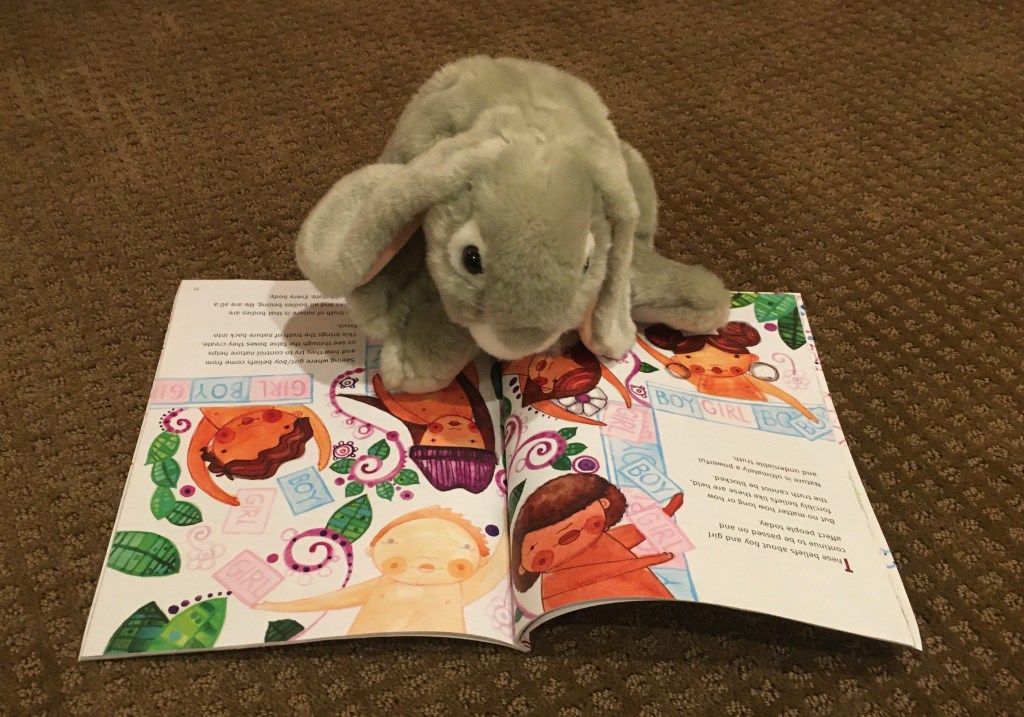
The gender wheel in the title of the book is extremely useful as a tool however. It is a beautiful way to visualize and understand the complexities of the construct of gender and it allows the reader to be able to distinguish between physical and biological bodies, how one feels inside their body, and how one chooses or needs to engage with the outside world. While scholars of gender studies dig deep into the nuances of their constructs and appreciate all their complexities, for the rest of us these very same intricacies might be barriers in understanding ourselves and our loved ones. Gonzalez and her wheel make the ideas quite transparent and very much easier to understand (and even discuss with young ones in our lives).
A similar idea is used and offered as a tool in Who Are You? The Kid’s Guide to Gender Identity, written by Brook Pessin-Whedbee and illustrated by Naomi Bardoff. This book, too, explicitly describes gender as made up of three layers; these are called Body, Identity, and Expression. (In The Gender Wheel, Gonzalez labels the layers as the body circle, the inside circle, and the pronoun circle.) Having read the two books together, I now find both sets of labels making a lot more sense to me. Unfortunately it seems that the latter book (Who Are You?) does not acknowledge the source of their own wheel construction, and as a result, it is highly likely that this is a case of plagiarism (see Maya Gonzalez’s blog post about the issue here.)
The illustrations in Who Are You? are in some ways a bit less whimsical than those in The Gender Wheel, which definitely reflects its creator’s particular style (as also seen in her book with Matthew Smith-Gonzalez, They, She, He, Me: Free To Be!). But they are definitely not boring or unattractive. Actually they occasionally reminded me very much of the style of the If You Give … series written by Laura Numeroff and illustrated by Felicia Bond, and could sufficiently capture a young reader’s attention.
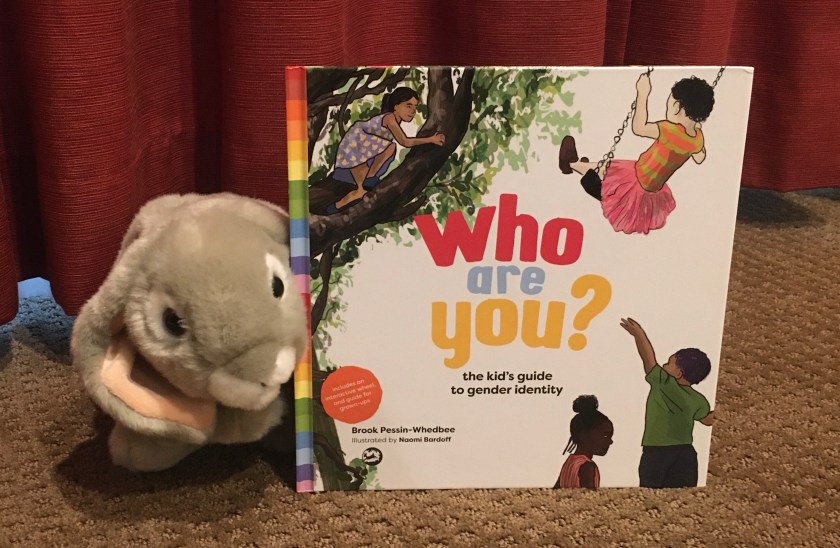
Who Are You? also comes with a few pages of advice for the adult reader. I think the author makes the (probably correct) assumption that an adult who shares this book with a young person will likely want to have as much support and ideas for resources as they can. So there are resources about how to use the wheel tool provided, how to engage with particular parts of the book with a young person, and where to find other resources (books and films) that can help support a conversation with a young person exploring these issues.
Finally let me say a few words about It Feels Good To Be Yourself: A Book About Gender Identity, written by Theresa Thorn and illustrated by Noah Grigni.

It Feels Good To Be Yourself introduces the reader to a few different children who have different gender identities and sexual expressions. Terms like “transgender” and “non-binary” are explicitly defined in child-friendly language, and the book depicts all gender identity-related difference positively and ends with the main moral:
No matter what your gender identity is, you are okay exactly the way you are. And you are loved.
It Feels Good To Be Yourself: A Book About Gender Identity, written by Theresa Thorn and illustrated by Noah Grigni.
This book too ends with some followup resource suggestions. And the color scheme in the book reminded me a bit of the book I mentioned earlier that Caramel had reviewed: From the Stars in the Sky to the Fish in the Sea by Kai Cheng Thom. But the listing of different people one by one, and how we all are different but belong together reminded me a bit of Just Ask! Be Different, Be Brave, Be You by Sonia Sotomayor.
Having read these eight books, what can I tell the reader who probably already regrets diving into such a long blog post?
First I have to admit I am grateful. I am grateful that our children today have these types of books. I am also grateful that we the parents, too, have access to these types of resources to help support our kids in finding and growing into the people they want to be, despite prejudices and oppressive social models of being a boy / man or a girl / woman in the world. I have found each and every one of the books I mentioned in this post to be helpful, and I think there are little people out there that could very much benefit from reading any of them.
Secondly I think these books would be great conversation starters, with all young people. If your child is not comfortable with the gender binary and its impositions on their life, then pick up one or more of these books and let them read it and then discuss. Or why not curl onto a couch or into a bed together and read them together? Depending on how you usually choose to broach various issues with your little one, there is definitely a book out there that will open the right communication channels for you.
Even if your child is already comfortable in their gender identity, it makes sense to bring these books and topics up for conversation. Sometimes children can be rigid adopters of social assumptions without questioning, and their reactions and comments can be hurtful to other people. If you want to raise children who are open-minded and flexible, and who can respect and love people of all ways of being, then these topics do belong, if not at your dining table (and then again why not there?) then definitely somewhere.
Finally I will add that Caramel told me his two favorites among these were Red: A Crayon’s Story, by Michael Hall, and Neither, by Airlie Anderson. I can see how the less openly didactic texts might be easier to share with young ones. At some point, though, especially for the slightly older crowd, the books with more explicit discussion of gender identity might be more appropriate. These books can easily introduce these growing readers to the correct terms and constructs to think about, understand, and express their own gender identities as well as to learn about other people around them.