Caramel reviews Asterix Omnibus 1 by Rene Goscinny and Albert Uderzo

Today Caramel talks about Asterix Omnibus 1, written by Rene Goscinny and illustrated by Albert Uderzo, the 2011 edition that brings together the very first three adventures of Asterix the Gaul. As usual, Sprinkles is taking notes and asking questions.
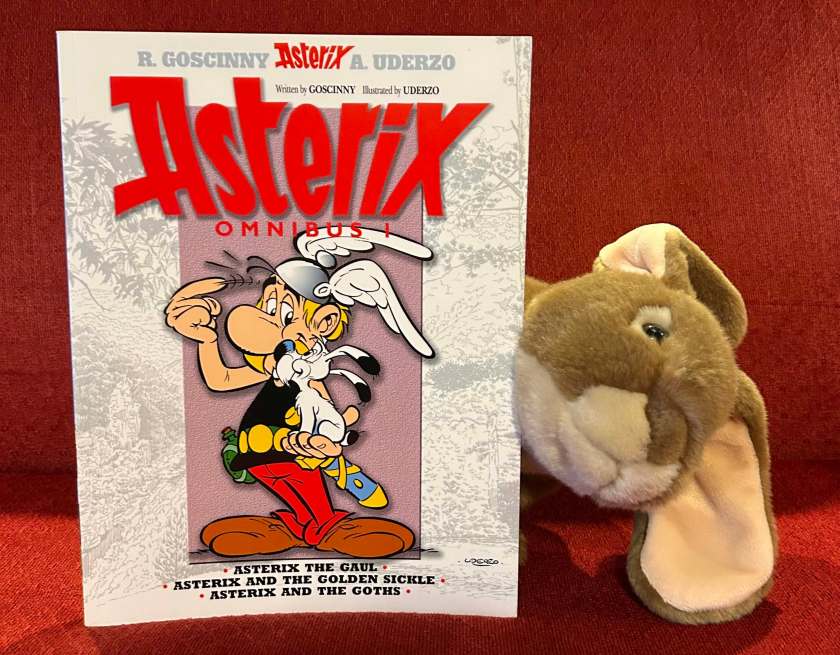
Caramel reviews Asterix Omnibus 1, written by Rene Goscinny and illustrated by Albert Uderzo.

Sprinkles: So Caramel, you finally discovered our Asterix collection.

Caramel: Yes.

S: And it seems like you have enjoyed reading them.

C: Yes. That’s why I wanted to talk about this one today.

S: Okay, so let us start. What is this book in your paws?

C: This is a collection of three stories about Asterix the Gaul and his friends.

S: Okay, so maybe you can tell us a bit about Asterix.

C: He is a Gaul, living in the Roman times. Apparently his village is the only village in Gaul that is not yet captured by the Romans. And they keep driving the Romans mad by being independent and so on. In these three stories we also get to meet the people from the village. There is Asterix’s best friend Obelix, and there is the village chief, Vitalstatistics, and the village potion maker druid, Getafix.

S: Those are some ridiculous names! I am guessing they are not in the original French. Anyways, continue please.

C: Okay. So Getafix makes a magic potion that makes the person who drinks it very very strong, and that is how the village has been able to defend itself against the Romans. And Obelix is very strong always, because apparently he fell into the potion cauldron when he was a baby. Anyways, the three stories are about them having some fun adventures.

S: So this is supposed to be in the ancient past, right?

C: Yep. So apparently Gaul is a part of Europe which is today split between France, Belgium, and a bunch of other countries. Wikipedia says that Romans conquered most of Gaul by 52 BCE. So according to the Asterix books, though, they did not manage to conquer this one little village.

S: So this is around 50 BCE?

C: Yes, the first sentence is “The year is 50 BC.” But you could also tell probably because Julius Caesar is alive and leading the Romans. And apparently he died in 44 BCE.

S: That makes sense.
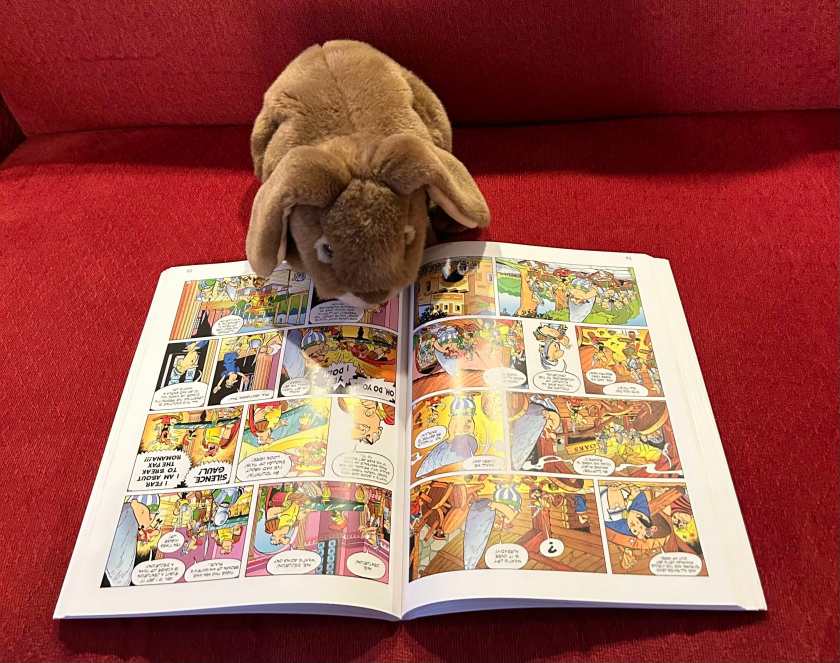
Caramel is reading Asterix Omnibus 1, written by Rene Goscinny and illustrated by Albert Uderzo.

S: So this is an omnibus, which, according to our trusted online dictionary, is “a volume containing several novels or other items previously published separately.” So which stories are in this one volume?

C: There are three. The first is called “Asterix the Gaul”. Then there is “Asterix and the Golden Sickle”. And finally “Asterix and the Goths”.

S: According to Wikipedia, these were first published in 1961, 1962, and 1963, respectively. That is a long time ago. Can you tell?

C: Not really. The stories all happen way back in time. And they are just as funny as they would be if they were written today. But I did read that some Asterix stories have issues with race. The way they represent people of African origin would be racist today, so those stories would probably not even be published.

S: That is a very sensitive issue Caramel. I am impressed that you took the time to learn about it and are sharing it with us.

C: At least those issues do not come up in these three stories. I mean, the Goths are pretty mean and sometimes stupid in the third story, and the Wikipedia article says that was because the authors had strong anti-German feelings because it was so soon after World War II. But that would not be racism even though it is still not a nice thing to do, stereotyping people like that.

S: You are right Caramel. Okay, let us move on to a lighter topic. I know my sister used to laugh out loud when reading these; did you find them funny too?

C: Yes. There is a funny thing on each page, and if you actually look carefully at the individual frames, there is a lot of other hilarious stuff happening, too. The characters are all funny themselves too.

S: They are all very caricaturish, actually. Some characters have huge noses, some are round like a ball, and so on. A lot of them have exaggerated features.

C: Yes, and that makes it funny. And the pictures are all very colorful.

S: I am getting the sense that you really enjoyed reading this book.

C: I did.

S: How would you describe it in three to five words?

C: Hilarious, cartoony, and Roman-ful.

S: Come on, those are not words!

C: Okay. Hilarious cartoons full of Romans. That’s five words!

S: Alright, that works. I think this is a good time to wrap up the review. What do you want to tell our readers?

C: Stay tuned for more book bunny reviews!
Caramel enjoyed reading Asterix Omnibus 1, written by Rene Goscinny and illustrated by Albert Uderzo, and recommends it to other bunnies who might enjoy reading about a stubborn village full of hilarious people standing up against the big Roman Empire.

Marshmallow reviews Philographics: Big Ideas in Simple Shapes by Genís Carreras

As she is getting older, Marshmallow has been getting more and more interested in philosophical ideas. Today she reviews Philographics: Big Ideas in Simple Shapes, written by Genís Carreras and published in 2013. Sprinkles, who is also interested in the book, is asking questions and taking notes.

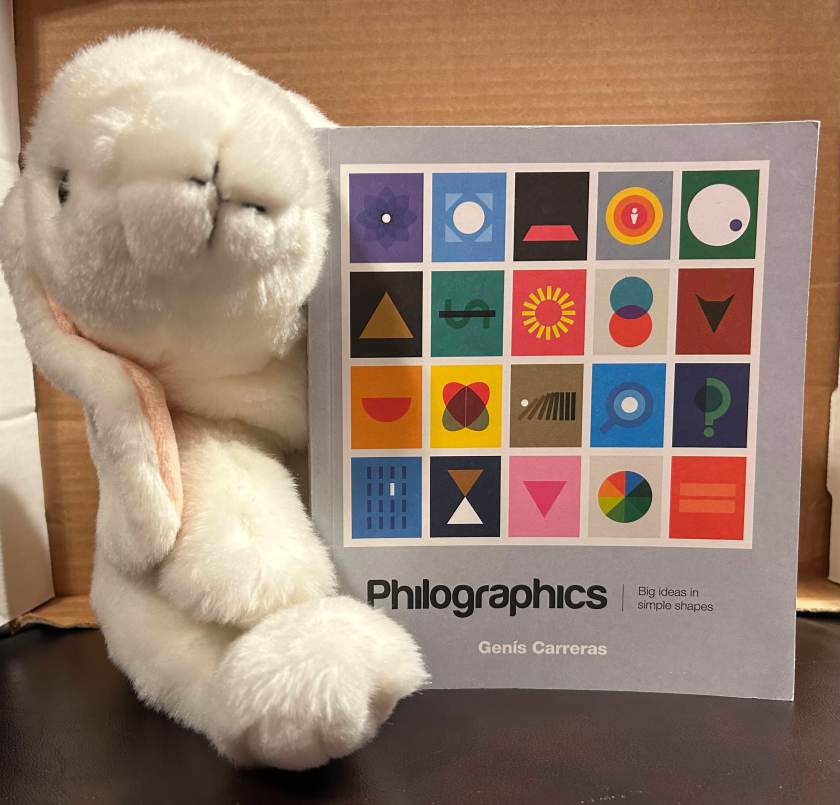
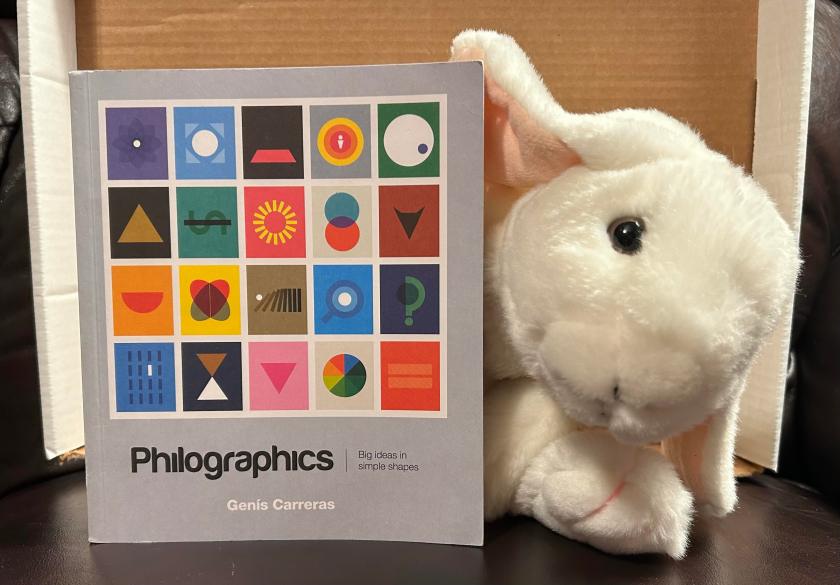
Marshmallow reviews Philographics: Big Ideas in Simple Shapes by Genís Carreras.

Sprinkles: So Marshmallow, I am so excited you wanted to review this book!

Marshmallow: Always happy to make you happy!

S: Thank you! Okay, so can you tell us a bit about what this book is about?

M: Well, the title is kind of self-explanatory. The book is about philosophy, more specifically about a hundred or so philosophical terms. The author of the book, or rather the artist Genís Carreras, uses two pages, side by side, for each term. Sort of reminded me of the book I recently reviewed about logical fallacies (An Illustrated Book of Bad Arguments by Ali Almossawi) in terms of the format.

S: I can definitely see that. So on each two-page spread, what do you see?

M: On the left page, there is a short, one-sentence definition of the term, apparently written by Chris Thomas, a friend of Carreras. And on the right side, there is a graphic depiction of the term, created by Carreras himself.

S: Oh, that kind of reminds me of a book Caramel reviewed way back: Opposites Abstract by Mo Willems.

M: Yes, you are right! But in that book there was no explanation, just a term on one side and a graphic on the other.

S: I guess that is why the Mo Willems book is more of a children’s book and this is not.

M: Yes, also this one has a lot of big ideas. The terms are all ordered in alphabetical order, and most of them are -isms. I mean, they are terms like feminism, optimism, realism, capitalism, nihilism, aestheticism, spiritualism, atomism, historicism, and so on.

S: Yes, this could be a really good dictionary of -isms.

M: Yes. But there are also some terms that don’t end with -ism that belong to philosophy. Like free will, extropy, dogma, and utopia.

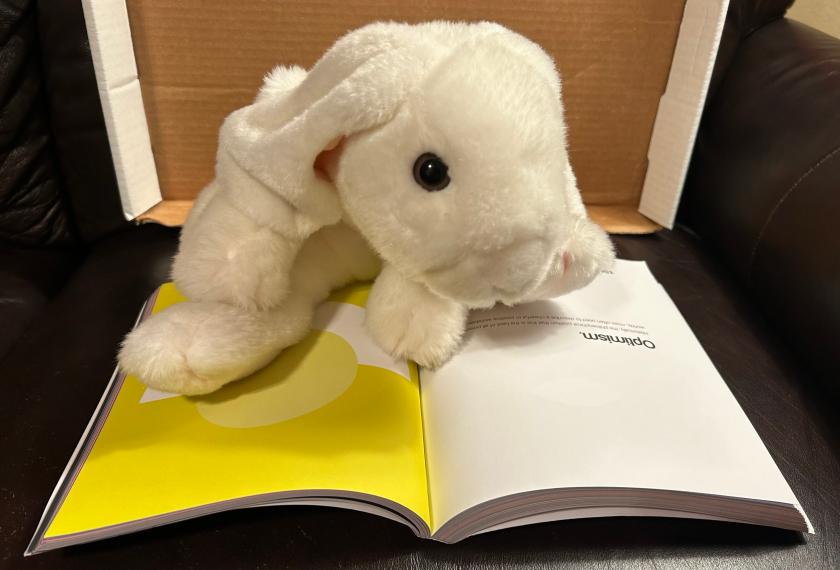
Marshmallow is reading Philographics: Big Ideas in Simple Shapes by Genís Carreras.

S: I think maybe the definition of realism (“the philosophical view that asserts that reality is fundamentally based on, and is shaped by, ideas and mental experience, rather than material forces”) is not quite accurate, but one mistake in such a neat book is not a big deal.

M: Yes, I can see how the book’s definition of realism is not quite in line with what Wikipedia or the Stanford Encyclopedia of Philosophy say. But other than that, I think we did not find anything else that sounded off.

S: Yes, the project is an awesome idea. And I think it is carried out quite superbly.

M: Yes, I totally think so. The graphics are so simple, and yet, they are most evocative. And I really like the use of bright colors in most of them.

S: Did you know that Carreras has a website where one can see many of the graphics from the book?

M: No! But we should definitely put a link to it!

S: Of course. Here it is: https://studiocarreras.com/philographics

M: All in all, I think this is a really neat book and it would be a great starting point if you are interested in big ideas. Carreras offers us a great way to get introduced to these big -isms and the connections between them.

S: How so?

M: At the bottom of most pages, there are some symbols that tell you what philosophical field the term belongs to. Like politics, religion, metaphysics, and ethics. And sometimes there are page numbers to send you to ideas that are directly related to the term on the page.

S: I see. That is really neat! And I agree that this book can be a neat guide to getting into philosophy.

M: Yep!

S: So how would you rate this book?

M: I’d rate it 100%.

S: Sounds good! So let us wrap this review up. What would you like to tell our readers?

M: Stay tuned for more amazing reviews from the book bunnies!

Marshmallow rates Philographics: Big Ideas in Simple Shapes by Genís Carreras 100%.

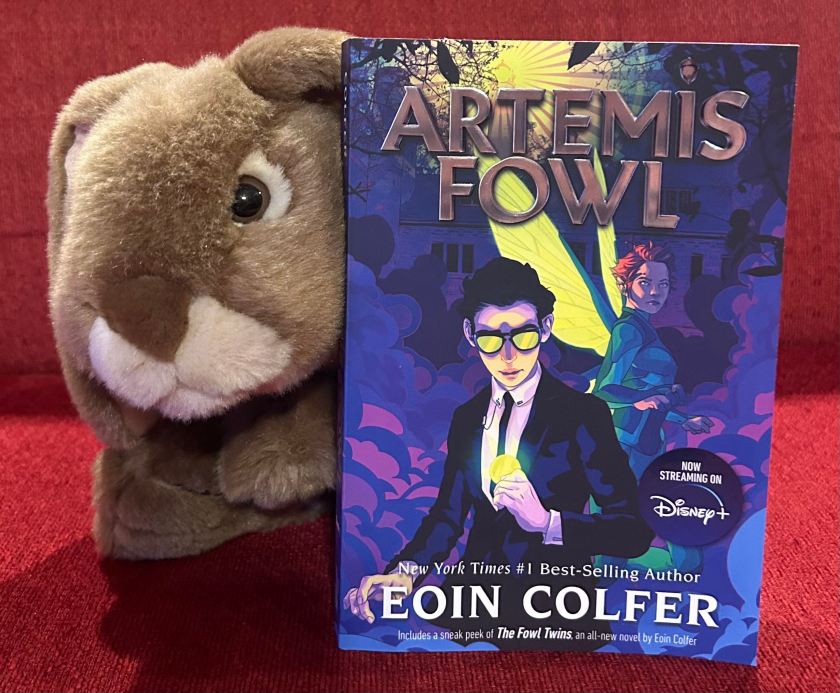
Caramel reviews Artemis Fowl by Eoin Colfer

Today Caramel reviews Artemis Fowl by Eoin Colfer, the first book of the famed Artemis Fowl series, originally published in 2001. As usual, Sprinkles is taking notes and asking questions.

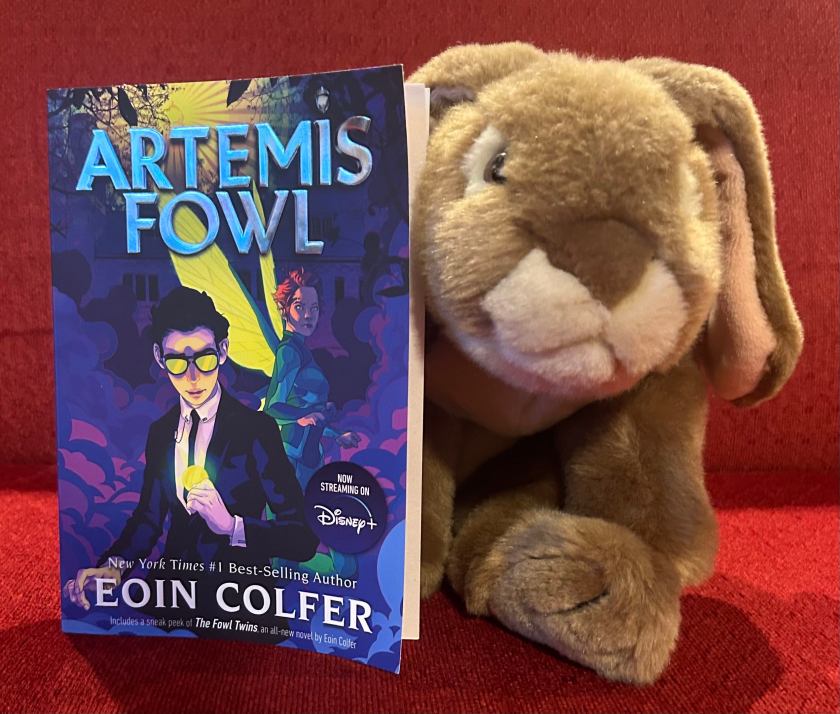
Caramel reviews Artemis Fowl by Eoin Colfer.

Sprinkles: So Caramel, you just finished reading the first book of yet another long series.

Caramel: Yep.

S: So what is this book about?

C: It is about a kid named Artemis Fowl, who is a genius and who uses his intellect for criminal purposes.

S: So kind of like the opposite of Ben Ripley from the Spy School books, no?

C: Yes, exactly. It is kind of the opposite of Spy School, Spy School is on the good guys’ side and Artemis Fowl is on the criminal side of the world.

S: Okay so what kinds of bad things does Artemis Fowl do?

C: He kidnaps Holly Short. Short is an officer in LEPrecon, a fairy organization, like a fairy police.

S: Wait, there are fairies?

C: Yep. And trolls. And dwarves. And gnomes.

S: Wow! I understand the author is Irish, so maybe some of these creatures are inspired by Irish mythology.

C: Well, the book takes place in Ireland. And we hear about Tuatha Dé Danann, that is a part of Irish mythology.

S: Yes, apparently they are an ancient supernatural race of beings, who eventually evolved into fairies. Or something. I had not heard of them before. But maybe Marshmallow has. You know she recently reviewed a book about fairies too.

C: Oh yes, I remember.

S: Okay, so other than Artemis and Holly, are there any other interesting characters in the book?

C: I like Butler. Butler is a butler but also a bodyguard to Artemis Fowl.

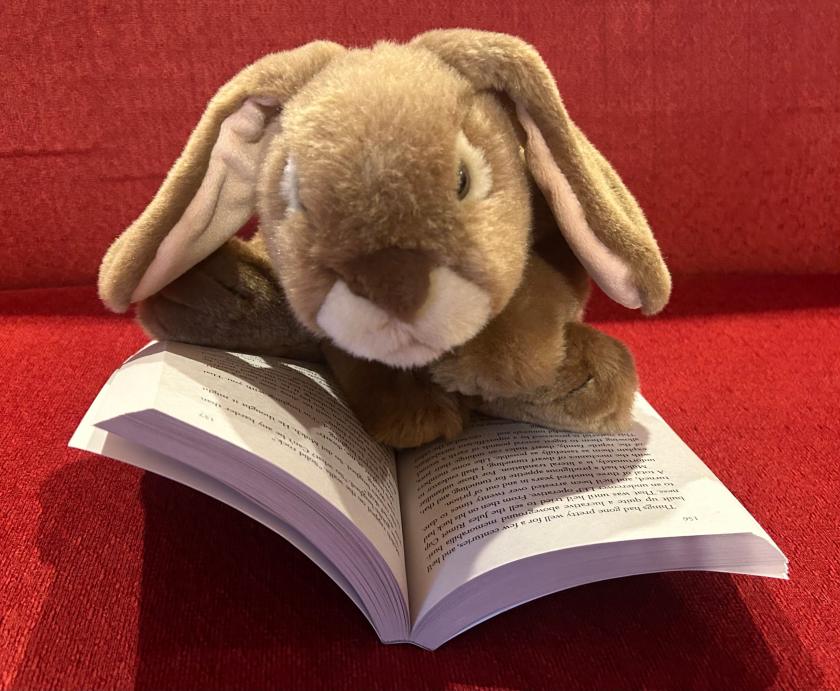
Caramel is reading Artemis Fowl by Eoin Colfer.

S: What surprises me most about this book is that the main character is a boy who is named Artemis. But Artemis is the name of a Greek goddess.

C: Yes, somebody mentions that in the book too. It is because Artemis is the hunter goddess, and the boy Artemis here is also a hunter. I think.

S: Okay. So did you enjoy reading this book?

C: Yep!

S: What did you like most about it?

C: The action sequences are amazingly detailed and give an image for your mind to visualize. I like it for the fact that it gives you something to think about.

S: I see. If I were to ask you, could you describe the book in three to five words?

C: Yes, I could, but the question is will I?

S: What if I say please?

C: Okay, then. I’d say “fast-paced and action-packed page-turner.”

S: So you really enjoyed this book. But you say the main character is not a good person? How does that work?

C: Well, actually, the book is narrated by some people who are observing Artemis Fowl. They keep telling us that he is a terrible person.

S: But do you ever sympathize with him? Or do you always want him to fail?

C: I think I kind of sympathize with him.

S: Hmm. Apparently in the later books he will change a bit and not be always motivated by criminal intentions.

C: Well, in this book, too, he does do some good in the end.

S: I am intrigued. Apparently there is a movie made in 2020 about this book, but it seems hard to find anywhere. Apparently it did not do too well, but the trailer looked interesting.

C: Maybe we can look for it after we finish this review? I do want to watch it, even if “they” did not like it. I thought the trailer looked interesting.

S: Okay, we might give it a try. So let us wrap up this review then. Are you interested in reading more from this series?

C: Yes, definitely.

S: Okay, I will see what we can do about that. In the meantime, what do you want to tell our readers as we end this review?

C: Stay tuned for more book bunny reviews!
Caramel enjoyed reading Artemis Fowl by Eoin Colfer and is keen to read more about this curious character and his later adventures.

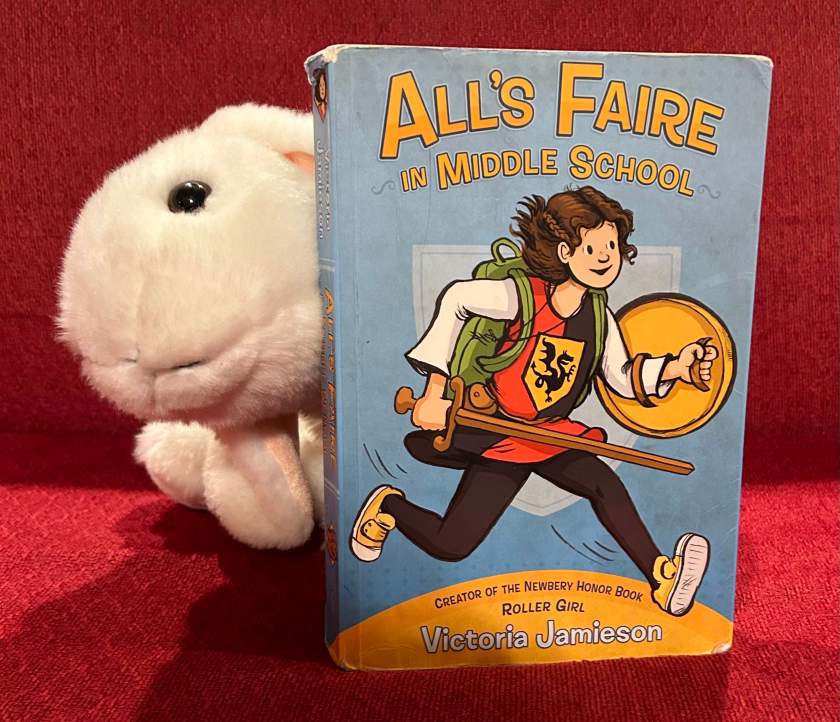
Marshmallow reviews All’s Faire in Middle School by Victoria Jamieson

The book bunnies are quite fond of Renaissance fairs and have been to a few in the last few years. So when Caramel brought home a library book about a young person growing up around these festivals, Marshmallow had to devour it, too. And today she is talking to Sprinkles about All’s Faire in Middle School by Victoria Jamieson, first published in 2017.

Marshmallow reviews All's Faire in Middle School by Victoria Jamieson.
Marshmallow reviews All’s Faire in Middle School by Victoria Jamieson.

Sprinkles: So Marshmallow, you just had to read this book!

Marshmallow: Yes! But I did wait until Caramel finished it first. You know, he was the one who brought it home, so it is only fair.

S: Agreed. So tell me a bit about the book.

M: It’s about a girl named Imogene whose parents work at a Renaissance Fair. She occasionally works there, too. The book starts with her being nervous about starting middle school. She has always been home-schooled before, so she is not sure what to expect.

S: I see. So why is she going to middle school then? Why is she not continuing with home-schooling?

M: I am not sure. I think she wants to go because she thinks it is a brave thing to do.

S: I see. So how does it go?

M: She is not sure how school works, so she has difficulty understanding what the rules are.

S: Can you be more specific? What kinds of rules?

M: There are some unsaid social rules about who hangs out with whom, and she does not know how to read any of the social cues.

S: Okay.

M: Then she makes friends with a group of girls who seem nice at first, but then they are actually kind of toxic.

S: This is reminding me of the movie Mean Girls. There is a new version of the movie too, but we only saw the original one from 2004.

M: Yes, actually it is kind of similar. The main character there was also home-schooled and had some trouble fitting in with the kids in her high school. And just like the main character there, Imogene also makes a huge mistake.

S: She is unkind to some people so she can fit in with the “cool” kids?

M: Kind of. But of course this is middle school, so it is a bit different than the movie.

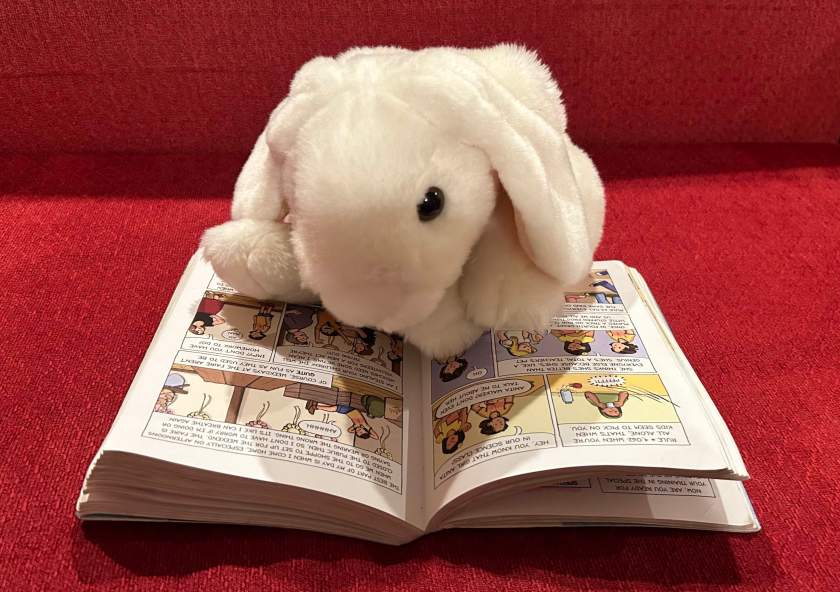
Marshmallow is reading All's Faire in Middle School by Victoria Jamieson.
Marshmallow is reading All’s Faire in Middle School by Victoria Jamieson.

S: Okay, so tell me a bit about the graphics. Did you like the drawing of the main character?

M: Yes.

S: The color scheme kind of reminded me of some of the books you reviewed from Raina Telgemeier.

M: There are some similarities I think. But I do not think one artist was necessarily influenced by the other. I think they are both neat illustrators. They both manage to draw very expressive faces and bodies with only a few strokes of their pen.

S: Sounds like you liked the book!

M: Yes. I’d rate it 100%.

S: Wow! That is great! I am glad Caramel found this in his school library.

M: Me too.

S: Okay, let us wrap this up then. It is getting late. What would you like to tell our readers as we finish this up?

M: Stay tuned for more amazing reviews from the book bunnies!

Marshmallow rates All's Faire in Middle School by Victoria Jamieson 100%.
Marshmallow rates All’s Faire in Middle School by Victoria Jamieson 100%.