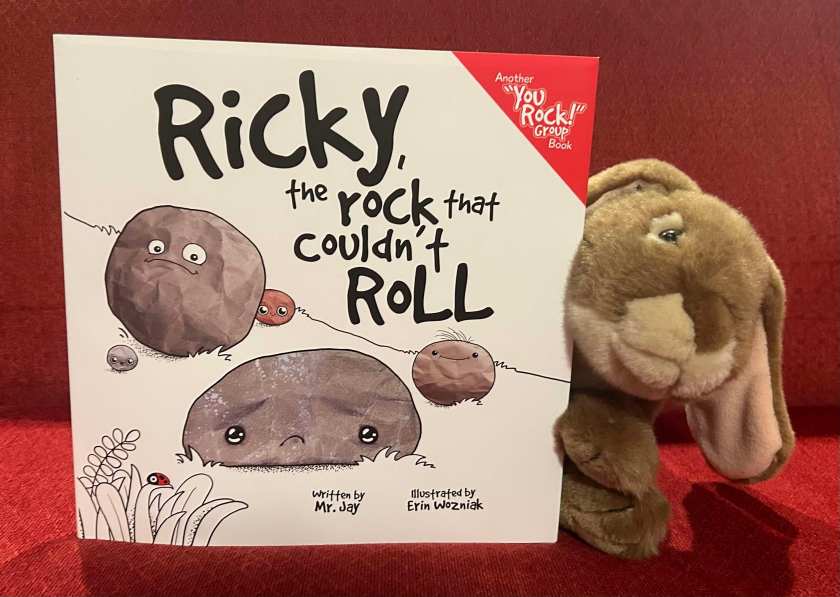
Today Caramel reviews a cute picture book from 2017, Ricky, The Rock That Couldn’t Roll, written by Mr. Jay (Jay Miletsky) and illustrated by Erin Wozniak. As usual, Sprinkles is taking notes and asking questions.
Caramel reviews Ricky, The Rock That Couldn’t Roll, written by Mr. Jay and illustrated by Erin Wozniak.
Sprinkles: So Caramel, tell me a bit about this book.
Caramel: This book is about a rock named Ricky and about friendship.
S: Wait, now we are naming rocks?
C: No. This book is naming them. The book has a lot of talking rocks.
S: I see. So there are these talking rocks and one is called Ricky.
C: Yes. Unfortunately for Ricky, Ricky is different from his friends.
S: In what way?
C: Well, as the book title says, he can’t roll! He is flat on one side. All his friends are round. So they can all roll, but Ricky can’t.
S: I see. How does this make Ricky feel?
C: Sad because he feels left out.
S: I can understand that. If all your friends were ice skating, and you could not skate, it would not be too fun.
C: Exactly. But Ricky has really good friends. And they try to help him. They come up with many many ideas. Most of them fail, of course. They try to wrap him up with balloons and such, and that fails miserably.
S: But at least they are trying to help. I see now why you said the book is about friendship. Good friends help one another.
C: Yep. And in the end they succeed!
S: Okay, so let us not totally spoil the fun of reading the book, but that means that in the end Ricky will be happy, right?
C: Yup.
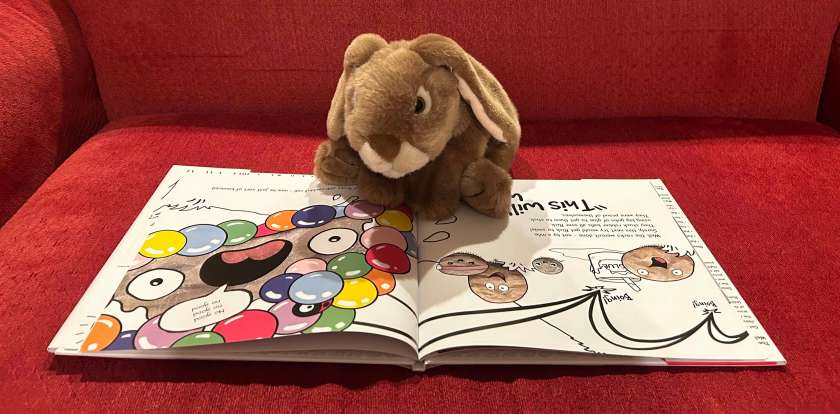
Caramel is reading Ricky, The Rock That Couldn’t Roll, written by Mr. Jay and illustrated by Erin Wozniak.
S: So then I am assuming you liked this book?
C: Yes. It made me happy.
S: I can understand why. You like books with happy endings.
C: Yes. And you are right, there are some similarities. There too there is a thing, called the Missing Piece, that wants to roll on its own but cannot. But there, the Missing Piece eventually figures out that by trying, it can smooth out its rough pointy corner and become rounder so it can roll. It does this more or less on its own. That book is not really about friendship. It is more about perseverance.
S: You are very wise Caramel. And that is a big word for a little bunny your age! But there is perseverance in this book, too. Ricky and his friends do not give up. They try and fail over and over again, but they do not give up, until they eventually solve the problem.
C: That is true.
S: But I can see how this book is more about friendship. So if you were to describe the book using three to five words, how would you do it?
C: Cute story about friends helping friends.
S: That works! So let us wrap this review up then. What do you want to tell our readers?
C: Stay tuned for more book bunny reviews!
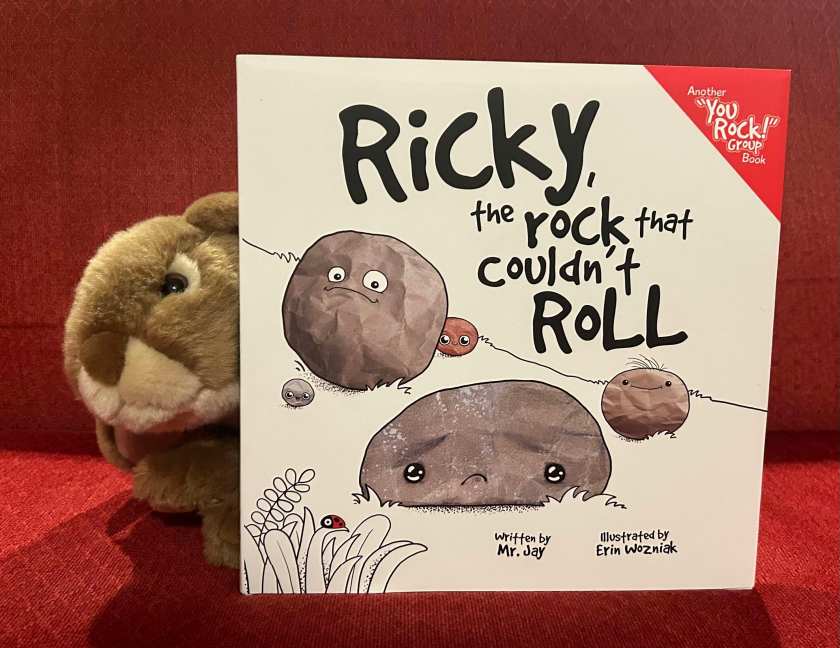
Caramel appreciated reading Ricky, The Rock That Couldn’t Roll, written by Mr. Jay and illustrated by Erin Wozniak, and recommends it to other young bunnies who can’t always do everything their friends can do.
Today Marshmallow reviews All-American Boys by Jason Reynolds and Brendan Kiely, first published in 2015.
Marshmallow reviews All-American Boys by Jason Reynolds and Brendan Kiely.
Marshmallow’s Quick Take: If you would like to read a book about social justice, friendship, bravery, and family, then this might be the book for you.
Marshmallow’s Summary (with Spoilers): Rashad Butler has worked hard to be an All-American boy. His father believes that the military is the best option for a young Black man in America, so Rashad is in the ROTC drill team at Springfield Central High School. One Friday, Rashad is preparing to go to a party. While he is buying chips in a store, he leans down and reaches into his bag on the floor to get his phone to text his brother. A woman trips over him, and a police officer comes over to see what’s happening. He presumes that Rashad is trying to steal the chips. He drags him outside, handcuffs him, pushes him to the ground, and starts beating him. Rashad is arrested and sent to the hospital with a broken nose, several broken ribs, and internal bleeding.
Quinn also goes to Rashad’s school. Quinn’s father died in Afghanistan and is viewed as a hero. Quinn feels constantly pressured to be a perfect All-American boy, living under his father’s shadow, even after his death. He’s doing a pretty good job, however, playing on the school’s basketball team competitively. Within a couple weeks, scouts from colleges and universities will be watching their games, and Quinn is determined to be seen.
That very Friday, Quinn and his friends are at the same store, waiting outside to find an adult who could buy them alcohol. Quinn is still there when the police officer beats Rashad viciously and remains there long enough to recognize the officer, Paul, who is like a father figure to him. After his father died, Quinn was taken care of, taught, and protected by Paul who filled the part of a family for Quinn that his mother and brother didn’t. Quinn and his friends flee the scene, and Quinn tells his friend Guzzo (Paul’s brother) what he saw.
Soon, Rashad’s beating is covered by the news, so much so that Rashad sees this all over the TV while in the hospital. He is confused as to what to do next. His brother Spooney is enraged and helps organize a protest about police brutality. His mother is devastated and tries to stay strong. His father, on the other hand, is conflicted. His father, who was in the military and in the police force, believes that Black men should be disciplined and look like it, because that will prevent anything bad from happening to them. He doesn’t even believe Rashad in the beginning when he says he wasn’t stealing the chips.
Quinn is also conflicted. He has known Paul for such a long time, and his mind cannot connect the violent officer he saw to the caring, protective figure he’s known for so long. As a family friend to Paul and Guzzo’s family, his “allegiance” to Paul is presumed, but inside he is unsure. He knows that Rashad didn’t deserve to be beaten.
After that Friday, the city of Springfield is torn into chaos. Sides are taken and lines are drawn. “Loyalties” are put into question while citizens work to fight against social injustice and stereotypes. Meanwhile, Rashad and Quinn live in two different worlds, in two different situations, struggling to make sense of what just happened.
Marshmallow is reading All-American Boys by Jason Reynolds and Brendan Kiely.
Marshmallow’s Review: I think All-American Boys is a very meaningful book. I have read and reviewed a book about police brutality from the perspective of a witness before (The Hate U Give). However, All-American Boys is unique because it is written in two different perspectives: the victim’s and the witness’s. So we see the narrative through the eyes of people with fundamentally different experiences. Rashad is Black and gets beaten by Paul, while Quinn is White and had been raised loving and respecting Paul. As expected, the two boys have a fundamentally different experience with racism. Each chapter is written from either Rashad’s or Quinn’s perspective, and they mostly alternate between the two narratives. Rashad’s chapters are written by Reynolds and Quinn’s are by Kiely, which adds depth and more detail to the storyline. The characters have a very realistic, down-to-earth feel (for example we get to connect with Rashad beyond his victimization as a young person who draws to express himself), as well as the school and small-town environment created by the authors. I find it impressive how the two authors wrote such a cohesive book together.
I have read another book by one of the authors (Jason Reynolds) before: Long Way Down. I have deeply enjoyed reading both, and I think this book, as well as that one, should be read by all. It is important for everyone to read and understand the perspectives of others, especially given how some situations are experienced in extremely different ways by different people based on their race.
All-American Boys might be more appropriate for bunnies older than ten because it has a lot of cursing, and the topic might be a bit heavy for younger ones. Otherwise, I would definitely recommend this book to all because of its well-written storyline, characters, and important message.
Marshmallow’s Rating: 100%.
Marshmallow rates All-American Boys by Jason Reynolds and Brendan Kiely 100%.
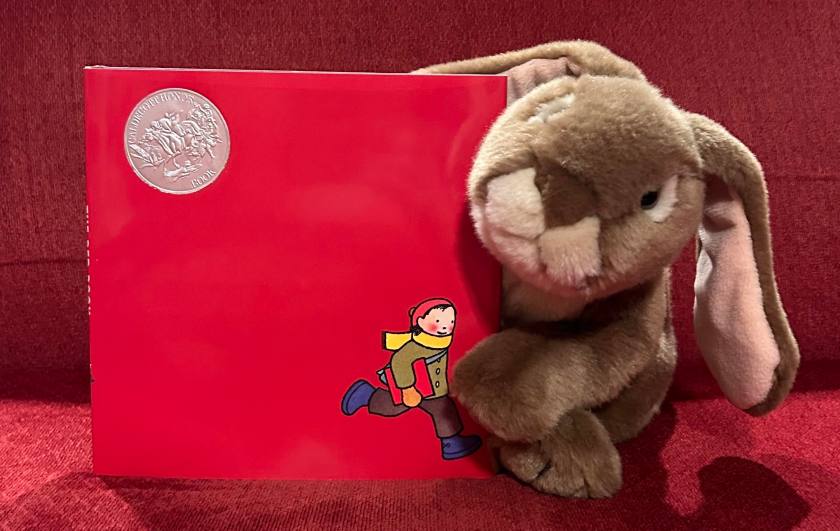
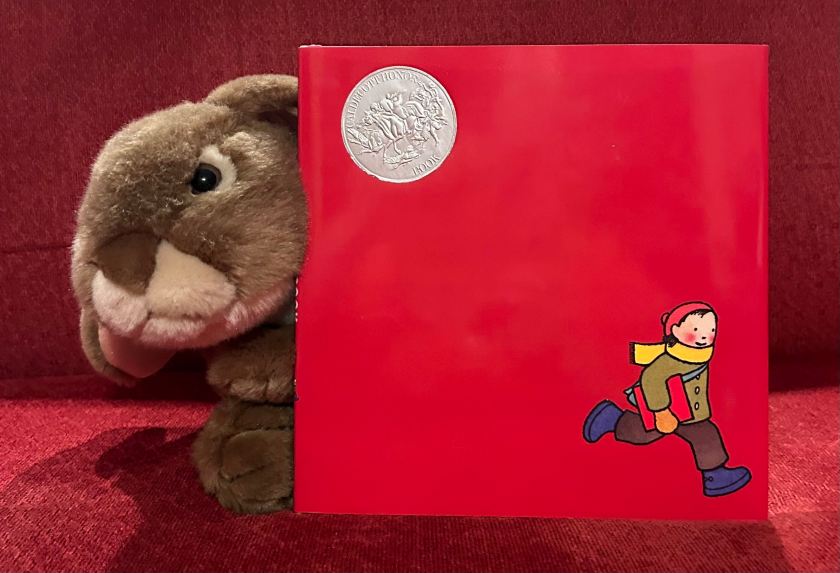
Today Caramel reviews The Red Book by Barbara Lehman, first published in 2004. As usual, Sprinkles is taking notes and asking questions.
Caramel reviews The Red Book by Barbara Lehman.
Sprinkles: So Caramel, you chose a beautiful picture book for today’s review. Can you tell us a bit about it?
Caramel: Yes. This book has no words. So any bunny can read it!
S: That sounds interesting!
C: It is! Remember that book I reviewed way back, The Book With No Pictures? This is kind of the opposite. There are pictures but no words.
S: But there is a story?
C: Yes. It is kind of complicated though.
S: How so?
C: So there is a girl walking in the snow in a big city, and she finds a red book in the snow.
S: Is it not destroyed in the snow?
C: No. And she opens the red book and begins to look through its pages and finds the picture of an island in the middle of an ocean. And then she looks more closely and on the island is a boy who is reading a red book of his own. And here is the shocking part: In the red book the boy is holding you can see the girl from the big city!
S: Wait! So the girl’s book shows the boy whose book shows the girl?
C: Yes. Like when you have two mirrors and you see the reflection of your reflection.
S: Okay. I can see how you could make such a comparison.
C: But wait! The weirdness is not over yet. The girl in the city finds a lot of balloons and then flies into the air and gets herself to the boy’s island. And then we see both of them sitting on the beach. And then the red book closes! And there is another person who finds the book and takes it with him.
S: That is interesting Caramel! Very self-referential! Do you know what that means?
C: Yes I think so. I think it means when you talk about yourself. And the red book is talking about itself. Because we are reading the red book which is telling a story about a red book, in which there is another red book…
S: Yes! It really is like the infinitely many reflections you can see in two mirrors facing one another!
C: But that can be confusing! This is not. This is just nice.
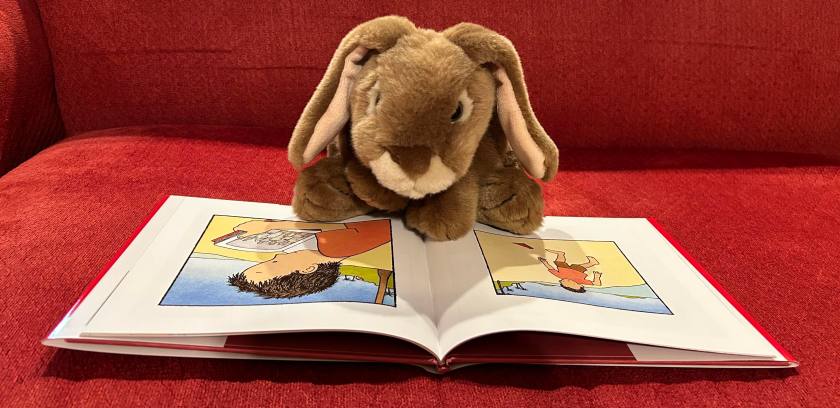
Caramel is reading The Red Book by Barbara Lehman.
S: I agree Caramel. This is really a very sweet book. What did you think about the drawings?
C: I thought they were pretty good. They are simple, but they do not need to be more complicated anyways. I like how the red book is always sticking out on the pages you can see it.
S: True! I like that too! So how did it feel to read a book that did not have any words?
Today Marshmallow reviews Powerless by Lauren Roberts, first published in 2023.
Marshmallow reviews Powerless by Lauren Roberts.
Marshmallow’s Quick Take: If you like fantasy books about romance or fighting against injustice, or if you just want to read an interesting book about adventure, then this is the book for you.
Marshmallow’s Summary (with Spoilers): Paedyn Gray is an Ordinary, even though she is definitely not ordinary. However, in Ilya, where there are only Elites, being an Ordinary is a crime. Many years ago, a deadly Plague swept the land. Many who survived were gifted powers; these made up the Elites. Elites pass on the status to their descendants, with Elite parents birthing Elite children with powers of their own. However, some who survived the Plague were not given powers. They and their children who are born without powers are Ordinaries. After another outbreak of a common illness, King Edric of Ilya decreed that Ordinaries were responsible and carrying some sort of disease, which is why they hadn’t been given powers. He claimed that Ordinaries suck away the power of Elites, stealing their gifts away. So all Ordinaries in Ilya were banished, killed, exiled to make Ilya stronger and the only, all-Elite kingdom. This was called the Purging, which is why Paedyn must be careful. Even now, Ordinaries and anyone caught helping them are killed or exiled to the desert (under the promise of mercy, of reaching an unreachable kingdom across it).
Paedyn’s mother died when she was young, so when Paedyn’s father, a Healer with magical healing powers, was killed, she fled her house and started living on the streets. Her father was stabbed through the chest, by the king himself, though she doesn’t know why. But before he died, he taught her how to survive by posing as a Psychic, a mundane magical ability that would keep her from being recognized as an Ordinary. On the streets, she is less traceable and lives with Adena, an Elite girl who loves sewing. Adena is a Phaser, meaning she can pass through objects and people (which is how she met Paedyn) if she wants. Adena sews clothes to sell using cloth and materials stolen by Paedyn.
One day, while looking for her next victim, Paedyn decides to rob a wealthy-looking Elite. She finds him intriguing and attractive but carries out the job anyways. Later, this man is attacked by a Silencer, a type of Elite whose power is to suppress the magic of other Elites and is persecuted in Ilya. Paedyn feels sorry for the stranger and saves him, which is quite easy for her since she is well trained in fighting and is not affected by the Silencer’s powers. Soon after, she learns that the stranger was Prince Kai Azer, future Enforcer for the king whose job is to eliminate all and any Ordinaries.
Paedyn is now dubbed the Silver Savior and is entered into the Sixth Purging Trials, a set of competitions designed in honor of the Purging to celebrate and show off the powers of the Elites. And while that’s certainly an issue given the fact that she has no powers, she is also starting to struggle with her growing attraction to Prince Kai (who is also competing). He also appears to reciprocate. But as it says on the book cover, she is hunted by him, the hunter. Now, Paedyn must fight battles on both fronts, the ones in the Trials and the one in her heart. Duh duh duh dun!!!
Marshmallow is reading Powerless by Lauren Roberts.
Marshmallow’s Review: I found Powerless to be a very interesting and intriguing book. I really enjoyed reading it, and I found the plot and the characters to be very well written and well developed. The reader definitely develops a sense of connection to the characters as the book goes on. I really liked how the author shows the perspectives of both of the main characters, Paedyn and Kai. Each chapter is narrated either by one of the two main characters which serves its purpose of showing the story from multiple views.
I think the author also did a very good job of creating a world that was foreign yet familiar at the same time. It is realistic and fantastic at the same time; the author gives the characters a sense of ability despite their challenges being unlike the ones that most people face today. The world discussed in this book is kind of dark, and genocide is a theme throughout: the Ordinaries are killed just because of the way they were born. But for readers who can handle more mature books, this is I think a very good book.
When I started to read Powerless, I had the sense that it would be similar to some other books that turned into intensely romance-oriented novels. And while the budding romantic relationship between Paedyn and Kai is a major part of the plot and the story, I was glad that it was not the only thing that was focused on throughout the book. The plot kept moving, and the romantic aspect stayed relevant all while keeping the focus on the trials the characters faced. There are a lot of scenes in which the two characters are in close contact and touch each other frequently; however, they do not ever actually start to have an official, romantic relationship. While this might seem confusing, let me explain. The two characters are attracted to each other, but they are both trying to stop themselves from falling in love with the other. They tantalize each other with touches, but there is no sexual activity. So in that aspect, it is not necessarily inappropriate for children.
Powerless is dramatic at times and comical at others. So in that sense, too, it is an entertaining read. However, I did find that there was a little bit too much violence for my taste, especially since the author includes very vivid descriptions of fighting, stabbing, gore, and blood. Moreover, I found the relationship between the two main characters to be a bit bizarre because of their desensitization to violence, though perhaps it makes sense; all the characters in the book seem to be somewhat desensitized to violence. and it is probably due to the harsh world they are living in, and in the case of many of the characters, due to the rough nature of their own upbringing. In any case, I feel personally that some descriptions of violent acts were a little too vivid, and that younger bunnies might be horrified or traumatized by the detailed descriptions. So I would recommend this book for bunnies over the age of fourteen.
I know that many readers are waiting for the sequel to this book to come out this summer. I myself am also excited because this book does end in a cliffhanger which made the ending quite unsatisfactory in my opinion. Overall, I think Powerless is a good book even though some parts are a little too graphic for me personally, and I am looking forward to reading the sequel and seeing the characters’ story continue to grow.
Marshmallow’s Rating: 95%.
Marshmallow rates Powerless by Lauren Roberts 95%.




 BookBunnies