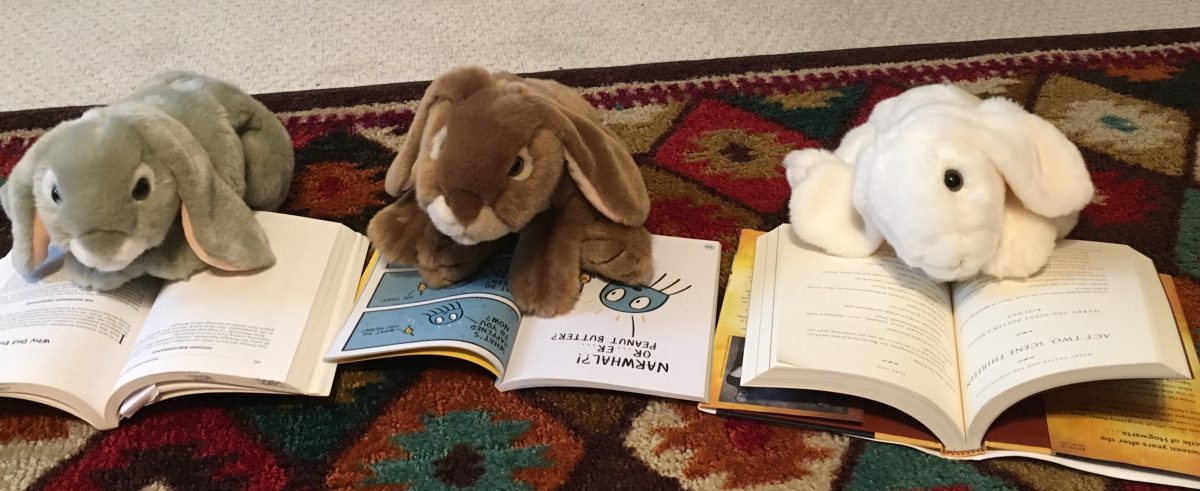
Marshmallow reviews Enola Holmes: The Case of the Missing Marquess by Nancy Springer

Today Marshmallow reviews the first book in Nancy Springer’s Enola Holmes series: The Case of the Missing Marquess, first published in 2006. Sprinkles, who loves detective stories, is asking questions and taking notes.
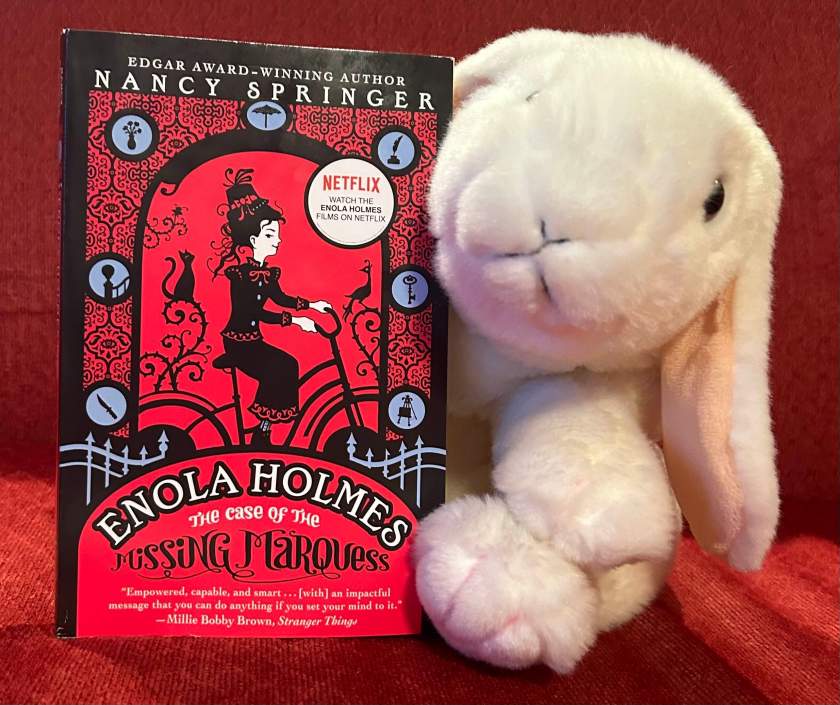
Marshmallow reviews Enola Holmes: The Case of the Missing Marquess by Nancy Springer.

Sprinkles: So Marshmallow, I am really eager to hear your thoughts about this book. I know that there is a TV movie made about Enola Holmes, the main character of this book series, who is supposed to be the teenage sister of the famed fictional detective Sherlock Holmes created by Arthur Conan Doyle. I have always enjoyed Sherlock Holmes and his many incarnations, especially a recent version depicted by Benedict Cumberbatch. So I really want to know what you thought of this book.

Marshmallow: I thought it was quite good!

S: Well, that’s a good start. Tell us what the book is about.

M: I saw the movie version first but reading the book, they are really very different.

S: Okay, I saw the trailer but did not see the movie myself. So let us start with the book then. What is it like? What is the story basically?

M: The story is about Enola, who is the younger sister of the famed detective Sherlock Holmes and Mycroft Holmes. Enola has been raised by her mother, who often leaves her alone, in a giant estate called Ferndell Hall. But one day, on her birthday actually, Enola wakes up to find that her mother is gone. She tries to get the older brothers to help her find their mother, but they instead dismiss her and say that she has “a limited cranial capacity”.

S: Ouch, so they are really saying she is stupid.

M: Yes, they are quite sexist. I mean, I guess it was the Victorian era and such, and women were not really thought to have been very smart back then, but these two brothers should have known better. But the book is pretty cool. She basically outsmarts them all!

S: I like that! Okay, so is the book basically about Enola’s search for her mom?

M: Well, it starts there, but along the way Enola gets involved with the kidnapping of the Marquess of Basilwether, who is a twelve-year-old boy. (In the movie, the marquess is a lot older and seems to even become a love interest, almost.) And of course she will solve the mystery, but she also has to keep evading her brothers who want to put her up in a boarding school for young ladies, which sounds like torture to her. Like they have to wear corsets which they progressively tighten so the ladies will have really tiny waists. And it is quite like physical torture. Enola hears that one girl even died from these!
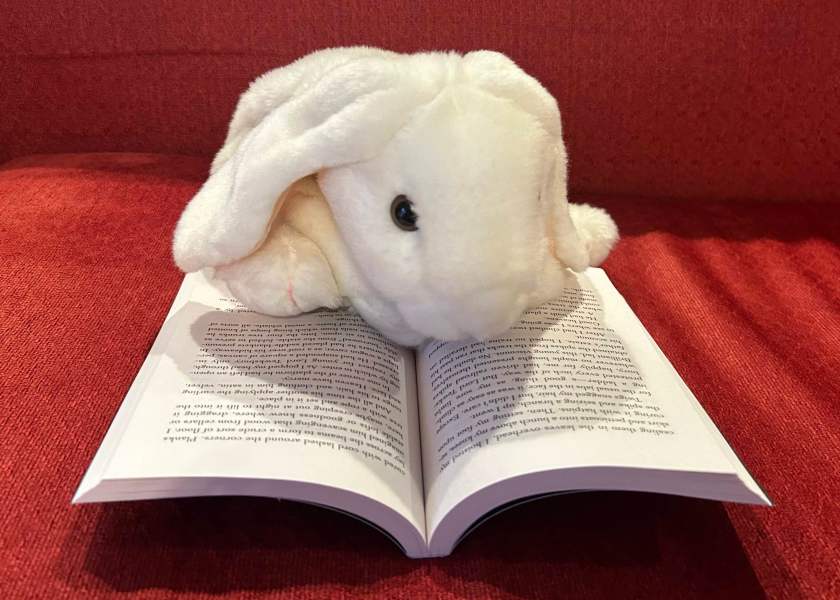
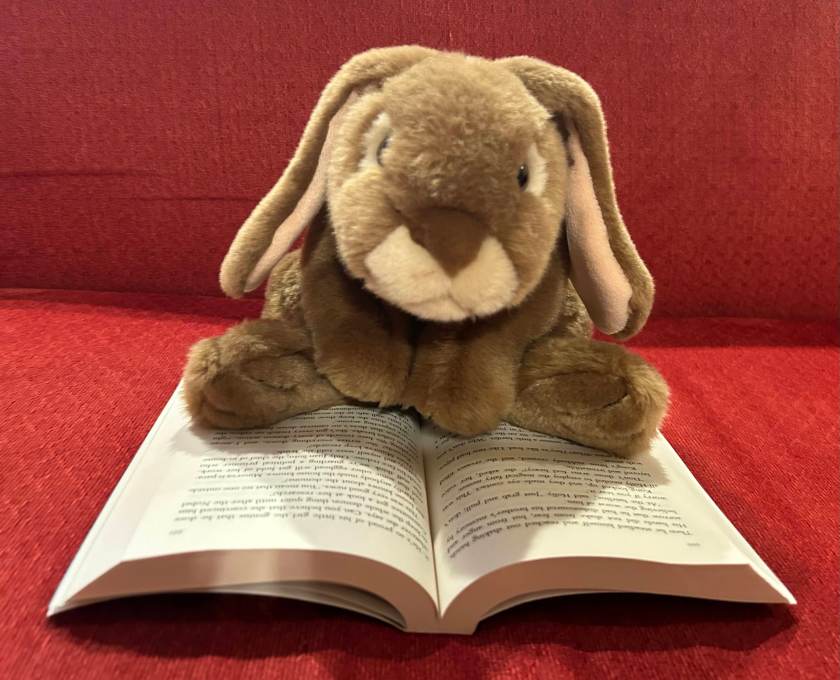
Marshmallow is reading Enola Holmes: The Case of the Missing Marquess by Nancy Springer.

S: Okay, so the plot sounds quite captivating even though the story is supposed to be historical fiction. How is the language used?

M: I think the author wants Enola to sound like a real teenager from that era, and as she is the narrator, the language of the book is not really modern. But it works well and it is still perfectly understandable.

S: I understand that Enola is pretty smart. Is she also funny?

M: Not specifically. The book is really entertaining but the narrator does not try to be funny exactly.

S: Is it a good detective story? You are a fan of Nancy Drew and have read a lot of Agatha Christie.

M: Yes. I think it really is a neat detective novel too. I am quite intrigued and I want to read more from this series.

S: That sounds great! Maybe you can move on to the second book and I can read this one.

M: Sounds like a good plan to me!

S: Okay, so let us wrap up this review then. How would you rate the book overall?

M: I’d rate it 100%. It is fun and empowering and clever, too.

S: Great! I really want to read it now. So what would you like to tell our readers as we end this post?

M: Stay tuned for more amazing reviews from the book bunnies!
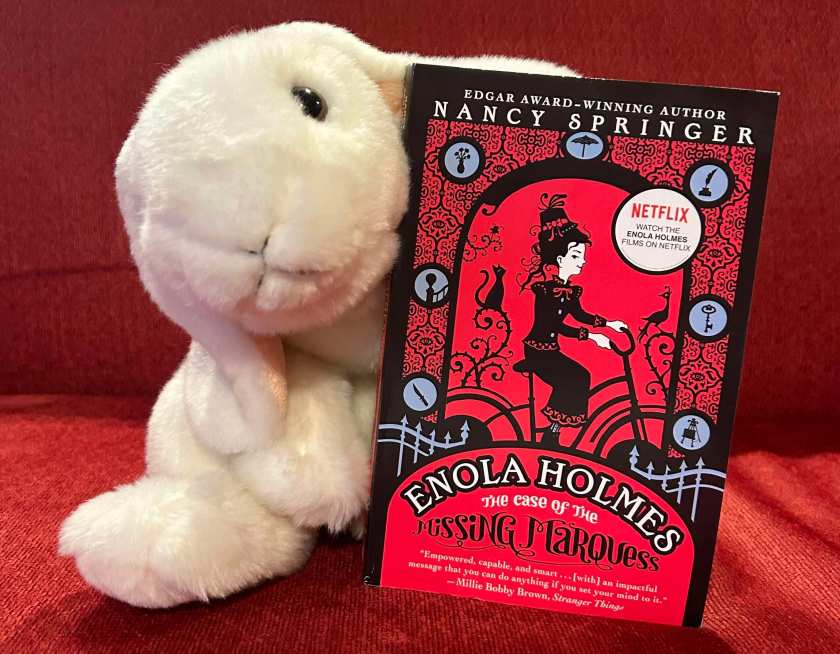
Marshmallow rates Enola Holmes: The Case of the Missing Marquess by Nancy Springer 100%.

Caramel reviews Artemis Fowl and the Lost Colony by Eoin Colfer

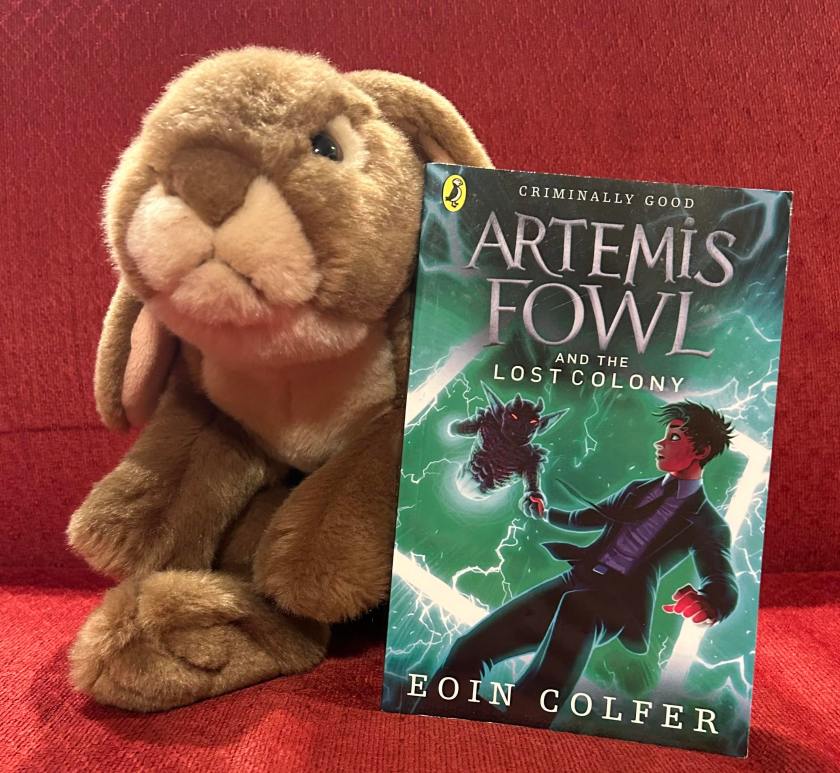
Caramel has already reviewed the first four Artemis Fowl books by Eoin Colfer. Today he is talking to Sprinkles about the fifth book, Artemis Fowl and the Lost Colony, first published in 2006.

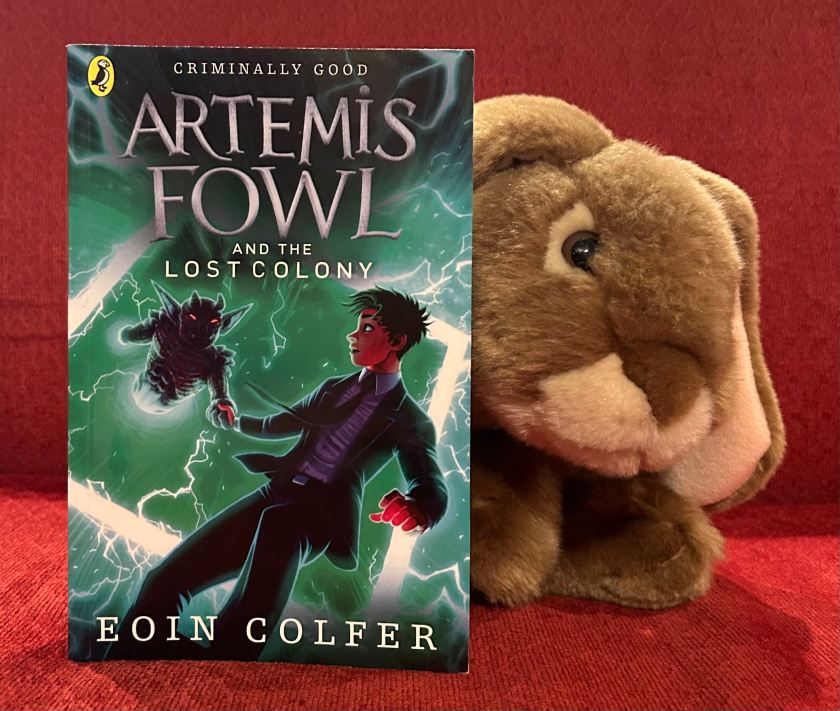
Caramel reviews Artemis Fowl and the Lost Colony by Eoin Colfer.

Sprinkles: So Caramel, this is book five. What happens to the world’s most famous evil boy genius in this one?

Caramel: He is not evil, remember? He has his memory back.

S: Oh, yes, you told us that last week, when we were talking about Artemis Fowl and the Opal Deception. Okay, so he is no longer evil. But he is still a boy genius and he is still friends with fairies, right?

C: Yep. But in this book there are also demons.

S: Oooh, interesting! Demons like in “an evil spirit” according to my computer dictionary, or “a malevolent supernatural entity” according to Wikipedia?

C: Kind of. They are kind of a fairy again, I think. They are not really evil. They just really hate humans.

S: Oh I see. You know I tried to read the summary of the book in the Wikipedia article for it. And I was quite confused. The plot sounds quite complicated.

C: The plot is kind of complicated, yes, but when you read the book, you can follow it.

S: Okay. So tell me a bit about what is going on.

C: So there is a lost colony of demons, lost in time. Their island has been moved out of time and regular space by magic, but the spell that they used is failing, so eventually all the demons will have to pop up in our universe right now, in the twenty-first century. Unless Artemis Fowl and his friends can save the day and repair the spell.

S: That sounds a lot clearer than the Wikipedia summary I think. Maybe the summary there was a lot more detailed and I kind of got lost in all the names and all the events. But this was helpful. Thank you.

C: You’re welcome.

Caramel is reading Artemis Fowl and the Lost Colony by Eoin Colfer.

S: But wait! So the lost colony in the title is an island colony of demons, right?

C: Yes. And in their island, because of the spell, there is no time.

S: That is really weird to try and think about. How can there be no time?

C: Well, they are sort of independent of the time going on in the rest of the universe. You know, other time travel stories also do this kind of thing sometimes. There is that one Doctor Who story, for example, where he travels to this Cathedral of Contemplation which is also out of time. It is an audio story called “Out Of Time“.

S: That does sound interesting. Maybe we can listen to it after this post. And you have a point; time travel is almost always very confusing but also very exciting to think about.

C: Yes.

S: So if you were to describe this book in three to five words, what would you say?

C: So you want me to give you a book blurb?

S: Yes, but please let us not do the “blurb blurb” thing again.

C: Blurb blurb. It is fun though, but okay.

S: Thank you.

C: Here goes: terrifyingly fun adventure within and out of time.

S: I like that!

C: That would make a great blurb, you mean?

S: Yes, I suppose so. Let us wrap up this post before things get too out of hand. So what would you tell our readers as we do so?

C: Stay tuned for more book bunny reviews! And blurb!

Caramel loved reading Artemis Fowl and the Lost Colony by Eoin Colfer and is ready for book six.

Marshmallow reviews Maus: A Survivor’s Tale by Art Spiegelman

Today Marshmallow reviews the first volume of Maus: A Survival Tale, Art Spiegelman’s graphic novel first published in 1986. Sprinkles is taking notes and asking questions.

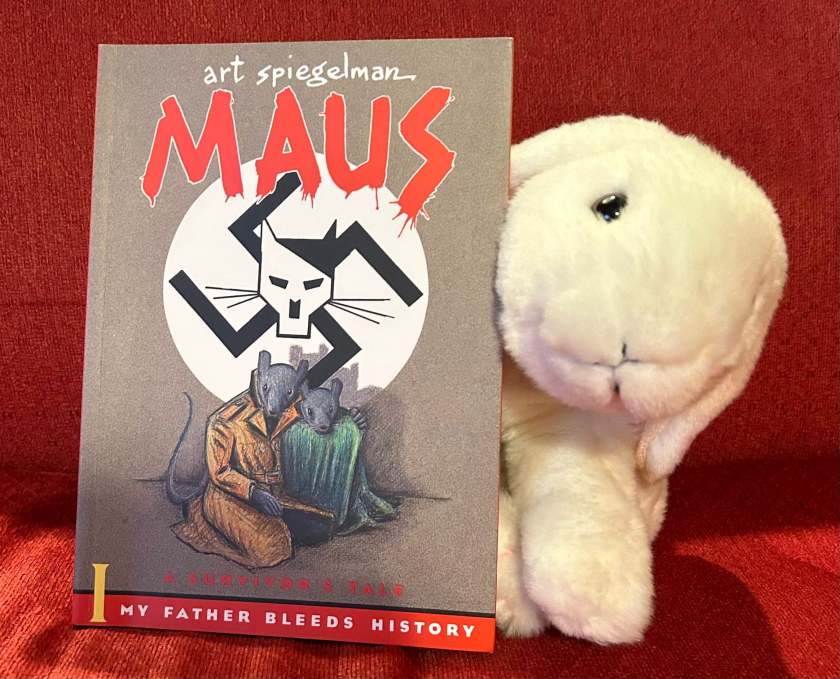
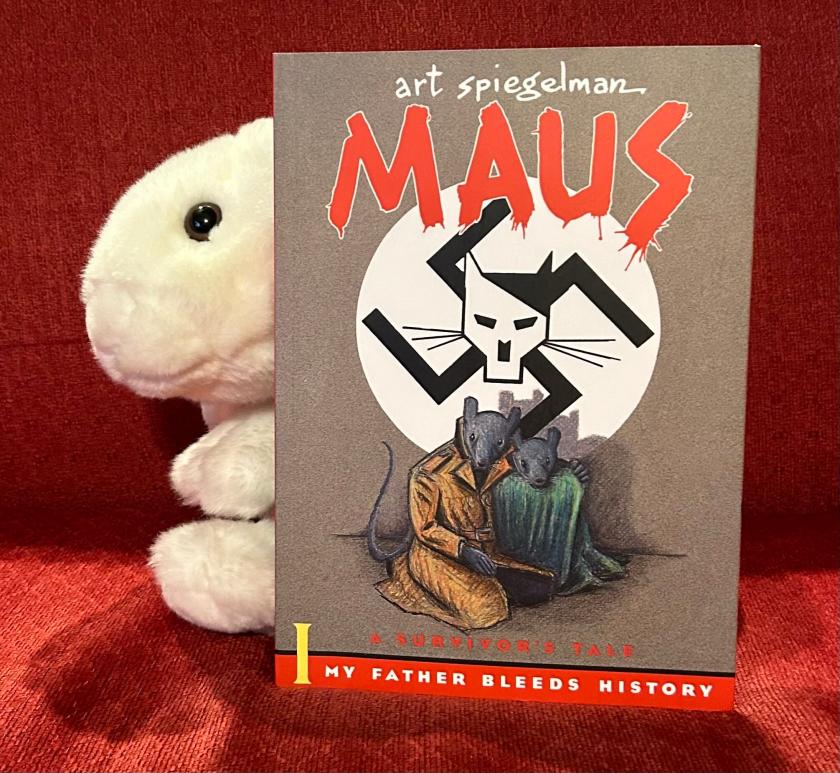
Marshmallow reviews Maus: A Survivor's Tale - I: My Father Bleeds History by Art Spiegelman.
Marshmallow reviews Maus: A Survivor’s Tale – I: My Father Bleeds History by Art Spiegelman.

Sprinkles: So Marshmallow, you chose to talk about a classic graphic novel today.

Marshmallow: Yes, we are talking about Maus: A Survivor’s Tale. This is in fact the first of two volumes, and Art Spiegelman published the second volume in 1991.

S: Okay, thanks for that important note. Wikipedia tells us that this is the first graphic novel that won a Pulitzer Prize. So I am glad you have read it and will talk with me about it.

M: I can see why it would get such an important prize. It is a very important book and it has a very important message.

S: Okay, so maybe it is about time to tell our readers what this book is about. They have already seen your photos with it, and they must be wondering.

M: Yes, sure. The book is about the Holocaust, and the imagery in the front cover is basically describing the main metaphorical device used in the story.

S: How so?

M: This is a graphic novel, as we said before, and all characters are animals. There are mice, and those are supposed to be the Jews, and then there are cats. Those are the Nazi Germans. Then there are pigs, who are supposed to be the non-Jewish Poles. And as I said before, the story takes place around the time of the Second World War.

S: I see. When you tell me all this, I am thinking of how sometimes a cat could be playing with a mouse just to have fun and even kill it with no remorse even when it does not need to eat it. I can see how the cat-mouse-pig metaphor could work.

M: Yes. The story is basically about Vladek who is the author’s father, and his experiences before and during the war. Vladek lived in Poland before the war, and when Germany invaded Poland, he and his family continued to live there. For a while they try to survive but eventually they are sent to the Auschwitz concentration camp.

S: That sounds intense!

M: It is. There is also a second story line, which is more or less the present day, or rather around the time this book was first published. The main story is basically the author’s father’s story, and the second story line is about the author as a grownup trying to connect with his father.

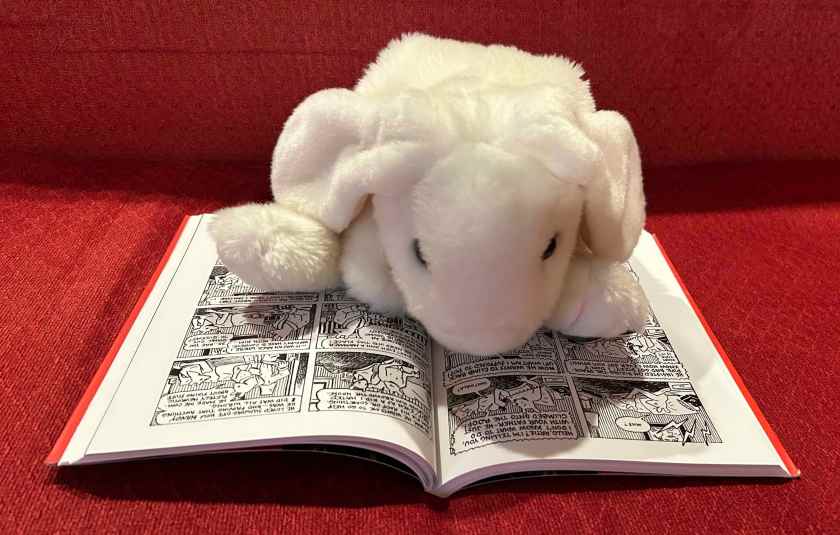
Marshmallow is reading Maus: A Survivor's Tale - I: My Father Bleeds History by Art Spiegelman.
Marshmallow is reading Maus: A Survivor’s Tale – I: My Father Bleeds History by Art Spiegelman.

S: Okay, so now we know the main plot lines and so on, but tell me Marshmallow, how was it like reading such a tough story in graphic novel form?

M: I thought it worked really well. It was very easy to visualize things, even though the characters are mice and cats and so on, because they had already been visualized for you. The book and its visual nature show the undeniably horrific nature of the Holocaust. You fully feel the pain of the mice, and knowing that these events actually happened to people, it makes the whole book even more impactful.

S: I wonder if the harshness of the realities the book is depicting can be related to why some people want to ban this book from school libraries. Some people want us to forget and never talk about these historical events, I am not talking about those people. But even those who believe we should teach this history might think that these stories are too hard to share with young people.

M: I understand why you want us to emphasize that the themes and imagery of the book might be disturbing to very young readers. There is violence in the book. But I also think it is very important for young bunnies to know what happened. And this book does a very good job in telling exactly what happened. And maybe ironically, the use of animal characters allows you to end up seeing the humanity of the victims of the Holocaust very clearly.

S: You make a very good point Marshmallow.

M: Thank you. I also wanted to say the book reminded me of Animal Farm a bit because it shows the worst aspects of humanity under the guise of animals. The animal characters allow us to look at ourselves and see how terrible we truly are or can be. Since we are not seeing humans, we can see things more objectively.

S: That makes sense to me, too, Marshmallow. Okay, this is already a pretty long post. Before we wrap things up, can you tell me how you would rate this book?

M: I’d rate it 100%. It is a striking and impactful book. And I recommend it strongly. It is important for bunnies to understand the magnitude and the impact of these events.

S: Okay, thank you Marshmallow. So last words?

M: Stay tuned for more amazing reviews from the book bunnies!
Marshmallow rates Maus: A Survivor's Tale - I: My Father Bleeds History by Art Spiegelman 100%.
Marshmallow rates Maus: A Survivor’s Tale – I: My Father Bleeds History by Art Spiegelman 100%.

Caramel reviews Artemis Fowl and the Opal Deception by Eoin Colfer

Caramel has already read the first three Artemis Fowl books by Eoin Colfer. (You can read Caramel’s reviews of Artemis Fowl, Artemis Fowl: The Arctic Incident, and Artemis Fowl: The Eternity Code before moving on.) Today he is talking about the fourth book in the series: Artemis Fowl and the Opal Deception, first published in 2005. As usual, Sprinkles is taking notes and asking questions.

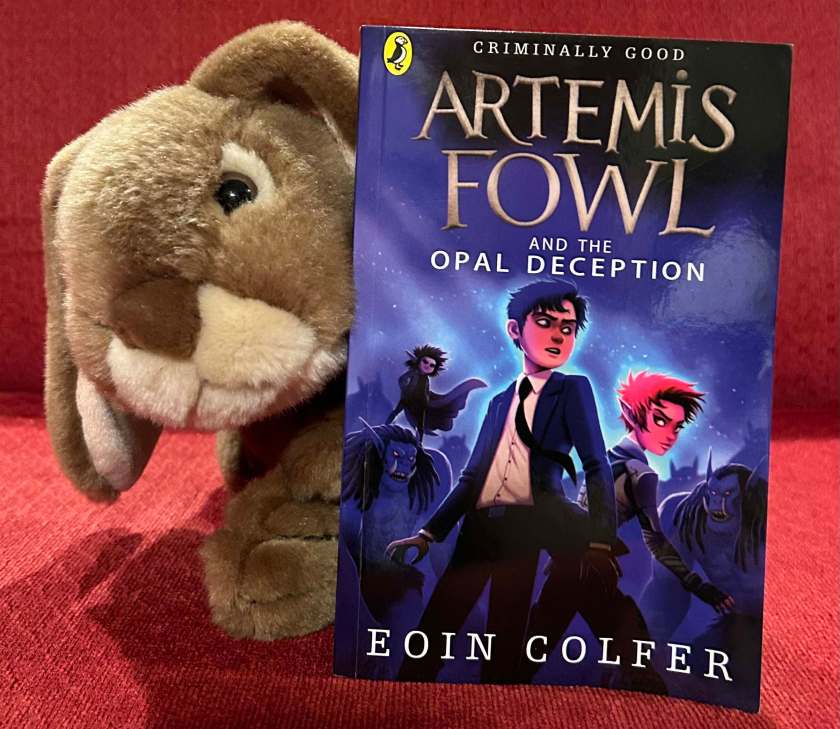
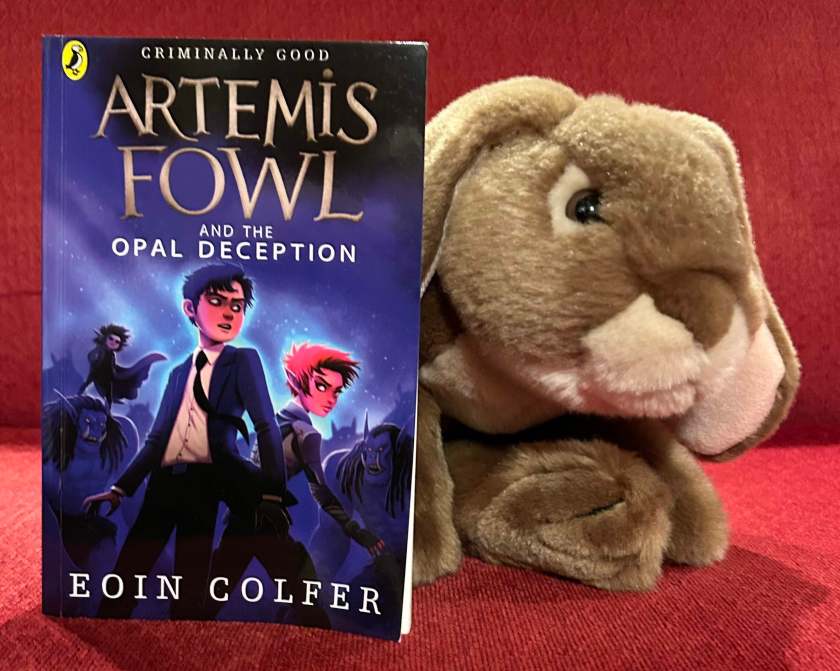
Caramel reviews Artemis Fowl and the Opal Deception by Eoin Colfer.

Sprinkles: So Caramel, we are back again with Artemis Fowl, the evil boy genius. What is he up to in this book?

Caramel: He was not evil really anymore in the second and the third book.

S: Okay. How come?

C: Because he decided to be a better person. But in this book, he is back to his evil ways, because his mind has been erased so he does not remember becoming a good person.

S: That is weird. Kind of convoluted, isn’t it?

C: Yes.

S: So does he recover his memory in the end?

C: Yes.

S: Tell me more.

C: The Opal Koboi from the previous book is back and she is still evil.

S: So is she a fairy?

C: She is a pixie, so yes, more or less.

S: And is the opal deception in the book title about her?

C: Yes. She is not really deceiving anyone, but much worse than that, she is trying to make the humans find the fairies so that they will start a war. She wants the humans to win.

S: Wait, she wants her own people to get destroyed?

C: Yup. She is evil, I said so already.

Caramel is reading Artemis Fowl and the Opal Deception by Eoin Colfer.

S: Okay, so this is once again a relatively long book but you seemed to have no trouble reading it fast.

C: Yes, it is over 343 pages, and yes, I did read it fast. Because it is amazing.

S: You mean it is exciting?

C: Yup. And it is extremely funny! Artemis Fowl can be really goofy.

S: So when he recovers his memories, does he decide to try to be a good person again?

C: Yes. I mean, he is trying to help the fairies and stop a war between them and the humans so yes, he is on the good side.

S: So if you were to describe this book in three to five words, how would you describe it?

C: Let me think. Fun adventures of not-so-evil boy genius. Does that work?

S: I think it is a bit longer than three to five words but still works. So are you ready to read the fifth book in the series?

C: Yes, so can we wrap up this review?

S: Sure, let us do that. What would you like to tell our readers?

C: Stay tuned for more book bunny reviews!

Caramel loved reading Artemis Fowl and the Opal Deception by Eoin Colfer and is ready to dive right into book five. Stay tuned!