Caramel reviews Albert’s Quiet Quest by Isabelle Arsenault

Caramel has recently gotten his paws on a few books by Isabelle Arsenault. Below he reviews Albert’s Quiet Quest. As usual Sprinkles is taking notes and asking followup questions.

Caramel reviews Albert's Quiet Quest by Isabelle Arsenault.
Caramel reviews Albert’s Quiet Quest by Isabelle Arsenault.

Sprinkles: So Caramel, what is this book about?

Caramel: It’s about a boy named Albert who wants to read a book. And inside of his house is too noisy so he goes out to find a quiet place to read.

S: That sounds like our home sometimes, right? We do make a lot of noise.

C: Yeah. We are noisy bunnies.

S: So this Albert wants to find a quiet place to read. Have you ever felt like that yourself?

C: Yep. Sometimes when I am trying to calm myself down, I want it to be quiet.

S: But it is not always quiet, right? So you could totally appreciate how Albert must have felt.

C: Yep. So he goes out and looks for a place to read.

S: Does he find it?

C: Yes. He goes to an alley way and finds a painting of a beach.

S: Then he pulls a chair to sit across from the painting and dreams that he is on that beach, right?

C: Yep.

S: What happens then? Can he read in peace and quiet?

C: No not really. Many friends come by and ask him to help them. They ask him to play with them and so on.

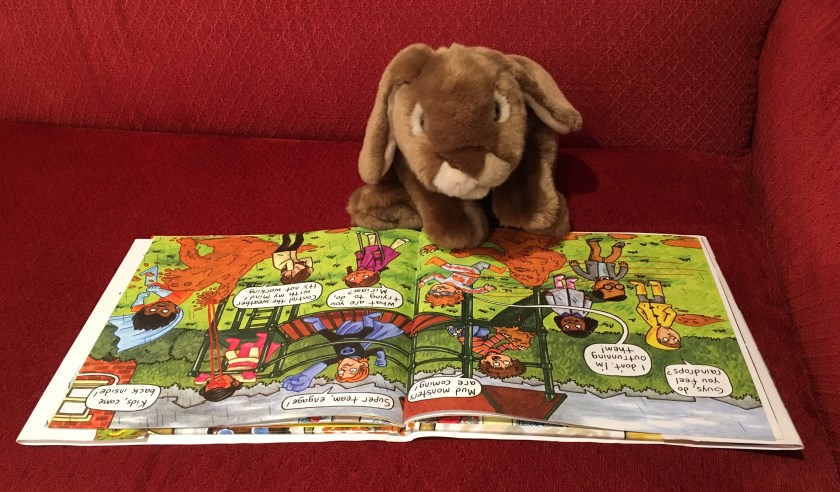
Caramel is looking at the page when things get a little too noisy on Albert's "beach".
Caramel is looking at the page when things get a little too noisy on Albert’s “beach”.

S: So he gets kind of mad at them, right?

C: Yes. He screams: “That’s it! Quiet! For Pete’s sake, can’t someone read a book around here or what?!”

Caramel is looking at the page when Albert loses his cool.

S: Hmm, that is not terribly nice, is it? He is understandably upset but he doesn’t need to scream at people.

C: Ah, Sprinkles. This sounds like somebody familiar. You too sometimes get pretty annoyed and scream!

S: Hmm. So I do. It is hard to keep one’s cool sometimes, right?

C: Yep. I get mad too sometimes.

S: Well, that’s kind of why we read all those books about training your angry dragon, right?

C: Yes.

S: What happens to Albert afterwards?

C: His friends get mad at him too. And then they all laugh together.

S: So this is a happy end, right?

C: Yes.

S: So did you like the book?

C: Yep. It’s a good book. It is kind of like a comic book, but the pictures are more like drawing than comics.

S: The color scheme is also very distinctive. All blues and oranges and grays and whites.

C: It’s mostly white. And orange is my favorite color. It’s awesome!

S: So you liked the pictures too, right?

C: Yes. I really liked the part where he is thinking of the beach.

S: Yes, he looks so calm and peaceful there.

C: Yes, he puts his hands behind his head and he is smiling. It’s like he is saying: “This is the life!”

S: Yes! You’re right.

C: And this is our life. And it is time to say: “Stay tuned for more book bunny adventures!”

Caramel really enjoyed reading Albert's Quiet Quest by Isabelle Arsenault.
Caramel really enjoyed reading Albert’s Quiet Quest by Isabelle Arsenault.

Marshmallow reviews In the Fifth at Malory Towers by Enid Blyton

Marshmallow has finally gotten into the Malory Towers series by Enid Blyton, which used to be a favorite of Sprinkles when she was a young bunny. In the review below Marshmallow reviews the fifth book of the series: In the Fifth at Malory Towers. As a change, this time Sprinkles is involved, too. Let us see how this one goes.

Marshmallow reviews In the Fifth at Malory Towers by Enid Blyton.

Sprinkles: So Marshmallow I have been seeing you reading the Malory Towers books over and over in these last few days.

Marshmallow: Yeah, I have been reading them, that’s true.

S: Can you tell our readers what these books are all about?

M: They are about some British girls going to a school called Malory Towers. Malory Towers is a boarding school for girls only.

S: The school is for six year and there is one book for each year, right?

M: Yes. Each year, there are multiple problems that come up and we see the girls grow up as they go through all that. Though some of them don’t seem to get more mature. They don’t seem to get nicer.

S: Yes, there is a specific mean character, you mean?

M: Yes. She’s spiteful, cunning, and sly. She’s also conceited; she thinks she’s great.

S: You’re talking about Gwendoline, right?

M: Yes, Gwendoline Mary Lacey. And she lies to her parents, too, telling them that she is good at everything.

S: Ok, let us talk about the more pleasant characters. Tell us about some of them.

M: Darrell Rivers is the main character. And her best friend is Sally Hope.

S: They are both good kids, right?

M: Well. Darrell has some anger issues. At least in the earlier books.

S: Then she should read Caramel’s review of Train Your Angry Dragon, right?

M: That might not be good enough. She needs to read the book! Anyways, Sally also is not perfect. She gets jealous sometimes. But overall they are, as you say, good kids. Actually most of the characters have some serious flaws.

S: But isn’t that quite natural? No bunny is perfect.

M: Yes I suppose that’s true. And maybe that makes the book more realistic.

S: Ok, now it is probably time that we start talking about the fifth book. Why did you want to talk about this one more specifically?

M: This one is my favorite. It’s interesting to see how all the talents and strengths of the girls come together to create something, the Christmas show.

S: You and your classmates often do school plays, right?

M: Yes we do at least one play every other year.

S: That does take a lot of group effort and practice.

M. Right. But in this book there are also other problems that the girls have to face. Moira and Alicia get really mad at each other for instance and Alicia quits. Then Alicia’s cousin June gets mad at Moira and starts writing poison pen letters.

S: That’s an interesting phrase Marshmallow. What does poison pen letter mean?

M: I had not heard of it before reading this book but Wikipedia has a brief description.

S: That’s really mean, right? To send spiteful and anonymous letters to people to hurt them?

M: Yes, that’s really mean. In the end June is punished for it. But let us not spoil the book for the readers. Maybe this is a good place to stop?

S: Yes, I think we gave them some good teasers so they can follow up with the threads themselves. Thanks for the chat Marshmallow.

M: Yay! I get to say it this time: Stay tuned for more reviews from the Book Bunnies!

Marshmallow enjoyed reading In the Fifth at Malory Towers by Enid Blyton.

Caramel reviews The Pigeon HAS to Go to School! by Mo Willems

Caramel loved everything he read about Mo Willems’ Pigeon and so he was excited to get his paws on a copy of his new adventure: The Pigeon HAS to Go to School! Below he reviews this book, published this summer. As usual Sprinkles is taking notes and asking followup questions as needed.

Caramel reviews The Pigeon HAS to Go to School! by Mo Willems.

Sprinkles: So another pigeon story, right?

Caramel: Yes! The pigeon is so funny! Here’s a quote:

“I wish I was a little chick again. A little-itty-bitty-not-going-to-school-baby-waybie pigeon!”

S: So that basically summarizes the book, right? The Pigeon does not want to go to school.

C: Yep.

Caramel is looking at the page where the Pigeon is worried about learning too much.

S: Were you also worried about starting school, Caramel?

C: Yes. A little bit.

S: Why?

C: I was nervous because I thought, what if I won’t have any friends?

S: That’s totally natural Caramel. When we go into new places, we might be worried about not knowing anyone. But you did make friends pretty soon, right?

C: Yes! I found a good friend almost immediately. We still play fun stuff together.

S: So the Pigeon does not have to worry, right?

C: No. He doesn’t. School is fun!

S: Would that be what you would tell the Pigeon, that school is fun, so he does not have to worry?

C: Yep. I’d say don’t worry. It’s going to be alright. It’s going to be fun. It’s going to be super duper awesome mega fun!

S: You like school a lot, don’t you Caramel?

C: Yep. I like my friends. I like my teacher. School is a lot of fun. But this year, I’ll probably have a new teacher. So I’m kind of worried. I already miss my old teacher.

S: Yes, your teacher was pretty cool, wasn’t she?

C: She was awesome!

S: I’m sure your new teacher will be awesome, too, Caramel.

C: Yes, I think so, too. I mean, I hope so.

S: Well, so in short we think school is fun. And the Pigeon doesn’t need to worry. What else do you want to say about this book Caramel?

C: This book would be a good book for kids who are starting school and who are a little scared.

S: Yes, Caramel! The Pigeon says all kinds of things that might worry a young child starting school. Like …

“What if the teacher doesn’t like pigeons?”

C: I really like the part where he is talking about heavy backpacks, but my favorite part is when he says:

“The unknown stresses me out, dude.”

S: The unknown can stress us out of course. We can totally see what the Pigeon is talking about, right?

C: Yes. There is a lot of stuff he doesn’t know about school and he is worried. He doesn’t even know if the finger paint will stick to his feathers!

S: Did you ever worry about finger paint Caramel?

C: No! I was worried about making friends and having a nice teacher. Finger paint sounds like fun! But we don’t do it too much in school actually.

S: You did some in preschool, but you might have forgotten. But you still do a lot of fun things at your school, right?

C: Yes, I love my school! It’s the best bunny school in the whole wide world!

S: And hopefully the school the Pigeon is going to is going to be the best school ever for pigeons.

C: Yes. I bet it will. Let us stop here. Readers: stay tuned for more reviews from the book bunnies!

Caramel wants to tell all pigeons that there is nothing to worry about and that school is really a lot of fun.

Marshmallow reviews Animal Farm by George Orwell

Marshmallow reviews Animal Farm by George Orwell (1945).

Marshmallow found a copy of George Orwell’s classic Animal Farm during her summer break and chose it for her first review of August 2019.

Marshmallow reviews Animal Farm by George Orwell.

Marshmallow’s quick take: If you like books that are about animals that act and talk like humans, then this might be the book for you.

Marshmallow’s Summary (with spoilers): The animals on Manor Farm gather to listen to the last speech made by Major, an old boar who is about to die. Major says in his speech that man is the real enemy and that if they overthrow the farmer then they can be free. He says that man does not produce anything like milk and eggs, but humans are still the top of the food chain. Three nights later Major passes away.

Soon after, three pigs named Napoleon, Snowball, and Squealer start a rebellion against humans, like Major said. They succeed and eventually overthrow the farmer Jones and his wife. The farmer runs away and leaves the farm to the animals. The animals rename the farm Animal Farm. But Jones does not want to give away the farm. He goes back to the farm to regain the farm. The humans lose and the animals remain the owners of the farm for the time being. 

Before the fight, the animals establish a kind of law called The Seven Commandments.

The Seven Commandments

1Whatever goes upon two legs is an enemy.
2Whatever goes upon four legs, or has wings, is a friend. 
3No animal shall wear clothes.
4No animal shall sleep in a bed.   
5No animal shall drink alcohol.
6No animal shall kill any other animal.
7All animals are equal.

These rules will eventually change and change for the worst.

Marshmallow is pointing to the original seven commandments in George Orwell's Animal Farm.
Marshmallow is pointing to the original seven commandments in George Orwell’s Animal Farm.

Animal Farm is a happy place until the leaders start getting corrupted by greed for power and eventually turn against each other. Snowball proposes that they build a windmill to get electricity. Napoleon is against the idea. The two comrades turn against each other. Napoleon trains a few dogs to use as bodyguards and he frightens Snowball away with them. Then he eventually says that he had agreed with the windmill plan the whole time and that he was really just pretending to disagree. Napoleon also says that it turns out the Snowball was allies with the evil farmer Jones. They start to build the windmill. Once they finish the windmill, after a lot of tiresome work, the windmill breaks and Snowball is blamed for the destruction of the windmill.

This is only page 47; the book has 95 pages total. A lot more happens but I think this is enough to give you a taste of what is to come.

Marshmallow’s review: This book is an allegory about how people treat each other when they have too much power. It reminded me of Aesop’s fables where the main characters are animals acting like humans. But this is a much more political story than The Boy Who Cried Wolf.

“It is the history of a revolution that went wrong—and of the excellent excuses that were forthcoming at every step for the perversion of the original doctrine.”

wrote Orwell in the original blurb for the first edition of Animal Farm in 1945.

from the back cover.

As in fables you learn lessons from the story. It seems that pretty much anybody can be corrupted by power. Of course, the silence and cooperation of the farm animals who are all scared of being the next victim of Napoleon’s dogs allow his corruption to grow.

This book is quite pessimistic and does not have a happy end. But maybe we can learn from it some things. All in all I appreciated reading it and will likely read it again.

Marshmallow’s rating: 95%

Marshmallow rates George Orwell's Animal Farm 95%.
Marshmallow rates George Orwell’s Animal Farm 95%.