Marshmallow reviews Flowers for Algernon by Daniel Keyes

In the last few weeks, Marshmallow and her English class have been reading a version of the classic novel Flowers for Algernon by Daniel Keyes, first published as a short story in 1959 and then expanded by its author to be published as a full novel in 1966. Sprinkles was excited to see Marshmallow getting into the story because she remembers it fondly from her own time reading the same book in school decades ago. In the blog post below, the two bunnies discuss the full book.
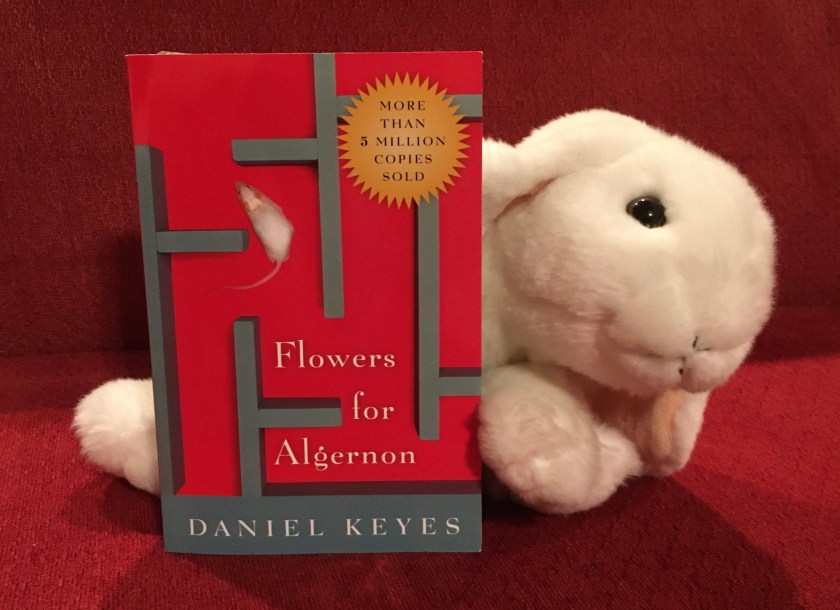
Marshmallow reviews Flowers for Algernon by Daniel Keyes.

Sprinkles: So Marshmallow, why don’t we start with your usual short overview of the book?

Marshmallow: Why not? If you like books about growing up or living through a big change, this might be the book for you.

S: I think that is a good way to describe the book. The main character is originally a mentally challenged adult, so he is not really growing up, but he undergoes an experimental treatment which enhances his mental capabilities immensely, and so he is going through a big change.

M: Yes. The main character is Charlie Gordon, and he is the one narrating the story. The book is written as a series of progress reports, all through his perspective.

S: Yes, the entries are like diary entries, right?

M: Yes, most of them. And at the beginning he is using very simple sentences and basic words and sometimes has very poor spelling. As the treatment takes effect, he begins to write more complex sentences and use bigger words. He also starts to write about more personal and complicated things and has to confront some past emotional trauma. So, for example, I should warn all bunnies that the book does have some explicit descriptions of certain sexual feelings and acts. As Charlie gets more and more mentally capable, he begins to notice his attraction to women.

S: Even before the operation, he might have felt some such feelings, but would perhaps not write about them?

M: I’m not sure. It seems to me that Charlie had the mind of a three year old before the operation, and so he did not have any sexual impulses.

S: Hmm, that sounds somewhat unrealistic to me, given that he has the body of a full-grown man; his hormones and related needs and desires would probably be quite typical.

M: Well, I don’t know, but he seems to become more interested in things like that, and that was quite a bit different from the version we have been reading at school. In that version, we do not see any of this stuff. Which is in some ways easier to read.

S: I can understand that. Perhaps that is why a lot of school districts have had discussions about this book, and apparently some have even removed it from their libraries. The sexual content might be a lot for some younger bunnies to handle, even though I was not bothered by them when I was a young bunny reading the book. Then again, I might have been a little older than you… Or who knows? Maybe I read an abridged version, too, and I do not recall very well.

M: Maybe. I don’t know. But the full book is a bit more adult than my usual reading fare. The only other book I have read that is kind of like this one is 1984 by George Orwell, which also had some explicit scenes.

S: I understand. I’d say that both books have very serious messages, and the sexually explicit scenes in both books play significant roles in clarifying those messages. So for example in 1984, the sexual scenes show us the main character’s difficulties with intimacy and the oppressiveness of the general climate. In this book, I think the sexual scenes are a part of Charlie becoming more aware of his body, his personality, his needs and desires, as well as how the outside world views him.

M: I can see that.
Marshmallow is reading Flowers for Algernon by Daniel Keyes.

S: So who or what is Algernon? Why is the book titled Flowers for Algernon?

M: Algernon is a mouse. He has gone through the same operation that Charlie has, and in some ways, the changes he goes through are similar to what happens to Charlie. So Charlie begins to really like and care for Algernon, because Algernon is more or less the only other creature in the world who is going through the same thing that Charlie is. And then —

S: Wait, don’t give everything away!

M: Okay, no more spoilers. But things do get pretty sad, and the title of the book is in the very last sentence of the book.

S: Yes, that is true. What did you think of Charlie? Did you like him or sympathize with him?

M: I liked him, more at some times and less at others. He is a childlike and kind person at the beginning, and that I really liked. But then as the operation takes effect and he begins to get more and more intelligent, he becomes more arrogant and he does not even realize that. I did not like him that much then. But eventually he does begin to understand other people better, and he remembers and tries to process some of the emotional trauma from his childhood. He justifiably gets angry at some people who mistreated him when he did not know they were being mean. And there I could of course sympathize with him. And he wants to be accepted most of all.

S: I guess that is a very understandable need. We are social creatures and we want to belong.

M: Yes. I think so. So when he becomes too intelligent, that is also isolating. Certain people used to feel better about themselves by putting him down, but now they feel inferior to him and begin to fear and avoid him. In some ways, those people were not good people to have as friends anyways, but Charlie did not know. In any case, in the end —

S: Wait, remember, we don’t want to be giving away too much…

M: Hmm, okay, I guess I should stop here.

S: Alright. Let us do that. Would you recommend this book to other young bunnies? Or perhaps, you’d recommend the abridged version?

M: I think young bunnies might really like the abridged version. Charlie’s story is a lot simpler in it and it is a lot easier to read. And you get to really like him and feel for him, and and the story is still sad but beautiful.

S: Okay. That makes sense to me. Full-blown people are all pretty complex, and I think the original book captures that really well. Charlie is a complex person with a complex story, and the book does give us a lot more to chew on. But the main message can come through quite clearly in the abridged version, too, without the distractions of the sex dimension and the emotional trauma. So how do you want to end this review?

M: I can say my usual: Stay tuned for more amazing reviews from the book bunnies!
Marshmallow appreciated reading Flowers for Algernon by Daniel Keyes and recommends it to her peers but emphasizes that perhaps some might prefer an abridged version.

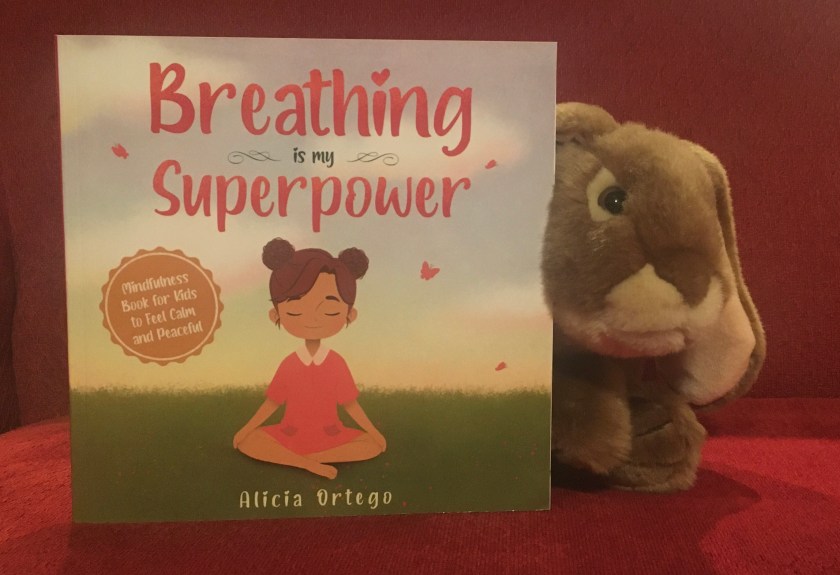
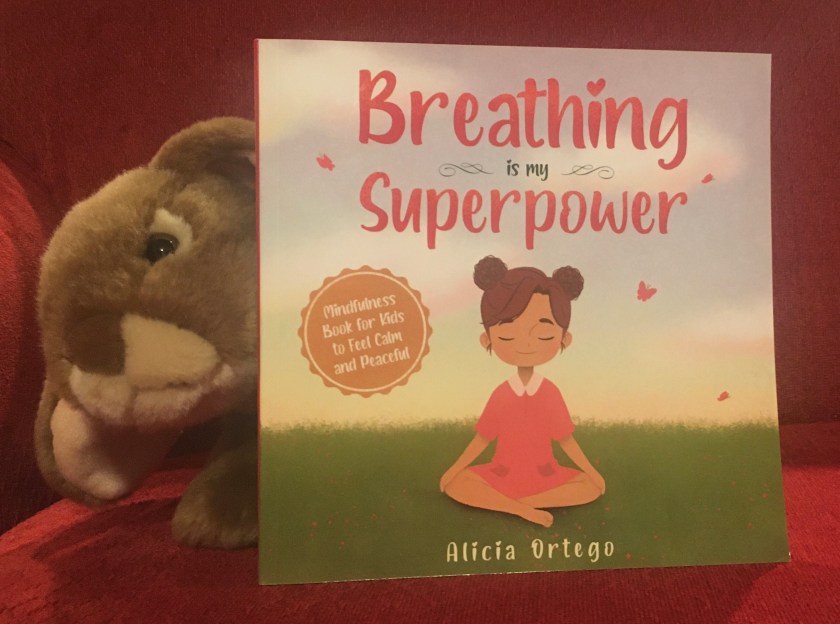
Caramel reviews Breathing is My Superpower by Alicia Ortego

Caramel is a young bunny who likes to read books, big and small. In this blog he has been reviewing picture books, graphic novels, chapter books, and even a couple middle grade books, blogging about whatever comes his way and strikes his fancy. This week he reviews a cute little book by Alicia Ortego published in 2020 titled Breathing is My Superpower. As usual, Sprinkles is taking notes and asking questions.

The book bunnies received this book as a review copy.

Caramel reviews Breathing is My Superpower by Alicia Ortego.

Sprinkles: Caramel, tell us a bit about this book, please.

Caramel: This is about a girl named Sophia. She gets angry and anxious a lot. And so her mom teaches her a technique to calm herself down.

S: What is this technique?

C: Breathing. Like in the title of the book.

S: I see. So Sophia can use breathing as a superpower, because it helps her calm down and not get too angry or anxious.

C: Yes.

S: This kind of reminds me of a book you reviewed a while back, Train Your Angry Dragon by Steve Herman.

C: Yep. I remember that book. It was about a dragon named Diggory Doo who was the pet dragon of a boy named Drew. And Drew was telling us how to help Diggory Doo calm down when he would be about to have a temper tantrum. So, yes, this book is kind of like that one.

S: Yes, you are right. But Breathing is My Superpower focuses exclusively on one technique.

C: Yes! And that is breathing.

S: You know, I tried it the other day, to do exactly as Sophia tells us, to use your hand and breathe five times, once per finger, and it worked really well to slow down my mind and take a break.

C: I tried it too, but I did not have the patience. I stopped at two.

S: Well, you were probably just breathing and counting, and you were not stressed, anxious, or angry, were you?

C: Yes that is true.

S: I think the breathing is a tool for times when you are feeling some of those strong feelings. It does work at those times. At least it did for me.

C: I guess I should try and remember that the next time I get annoyed at things.

S: Yes, I think it takes some practice to remember this kind of thing when you have strong emotions, but it is worth trying.

C: Okay, I will give it a try if you say so.

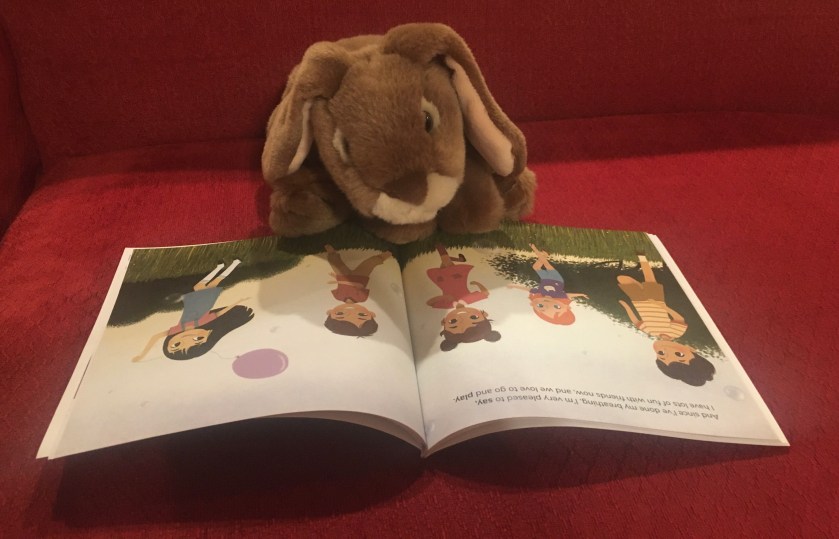
Caramel is reading Breathing is My Superpower by Alicia Ortego.

S: This book also reminded me a bit of Somewhere, Right Now by Kerry Docherty, which is a newer book that you reviewed this year. That, too, was about being calm in the midst of all the things going on around us.

C: True. Both books are also rhyming. Or at least this one is. I am not sure anymore if that other book rhymed.

S: Yes, the book has a simple rhyme which can make it more fun to read out loud.

C: Maybe we can read it together after the review? And apparently there are three more books in the series. They all have some new superpower in the title. There is Kindness, Acceptance, and Gratitude.

S: Hmm, I am guessing they too are about how kids can learn to manage big emotions. And the gratitude one sounds like it could help people play Pollyanna’s glad game

C: I did not read Pollyanna, but you mentioned her before.

S: Yes, Pollyanna is a fictional character, a little girl who makes up this game where she tries to find something to be happy about even when bad things happen.

C: That sounds hard.

S: I agree. So maybe breathing is not that hard in comparison.

C: Yes, I agree with that. But apparently I might need some practice with the breathing to remember to do it when I need it.

S: Agreed. So let us wrap this up with your three words for the book.

C: Colorful, rhyming, and smiling, because all the people in all the pictures are smiling.

S: Yes, I like those words. The book has a simple idea but it is an important one. So I am glad we read it. And maybe we can just read it together one more time after the review, like you said. What do you want to tell our readers at this moment?

C: Stay tuned for more book bunny reviews!

Caramel enjoyed reading Breathing is My Superpower by Alicia Ortego, and he recommends it to young bunnies and their adults to read together and discuss relaxation methods, practicing them along the way.

Marshmallow reviews The Final Gambit by Jennifer Lynn Barnes

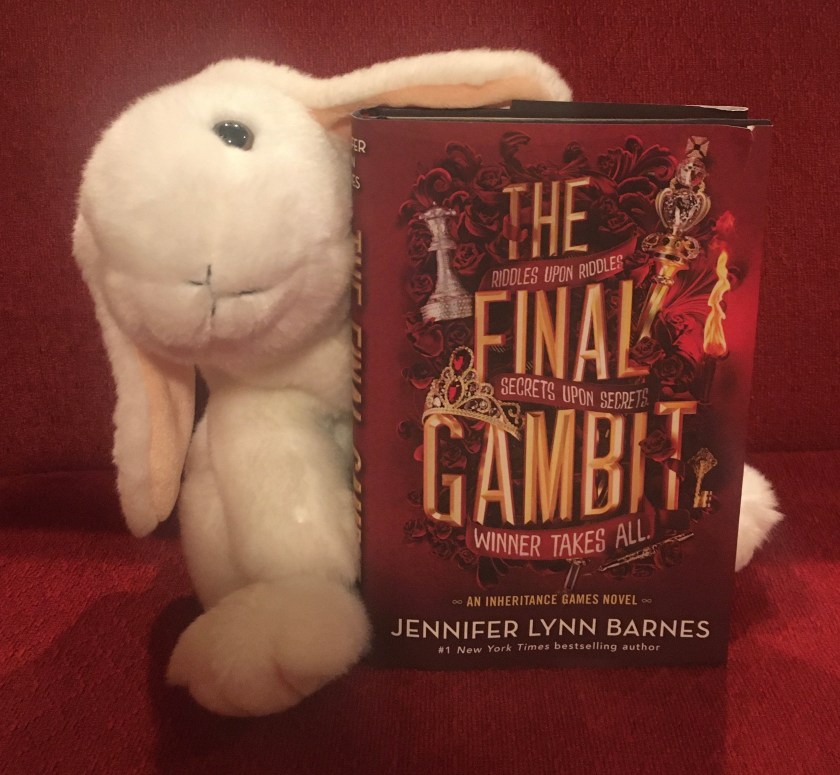
Marshmallow has already reviewed the first two books of the Inheritance Games trilogy of Jennifer Lynn Barnes. Today she reviews The Final Gambit, the third and final book of the series that was just published at the end of this August.

You might like to check out Marshmallow’s reviews of The Inheritance Games (2020), the first book, and The Hawthorne Legacy (2021), the second book, before you move on with this review.

Marshmallow reviews The Final Gambit by Jennifer Lynn Barnes.

Marshmallow’s Quick Take: If you like books about mystery, family secrets and / or romance, then this might be the book for you. 

Marshmallow’s Summary (with Spoilers): Around a year ago, Avery Kylie Grambs was left billions of dollars in the will of a very wealthy man named Tobias Hawthorne. Tobias Hawthorne was very fond of riddles, puzzles, games, and pretty much everything that requires investigation and deep thought. Even after he died, this did not change. Post-mortem, Tobias has been vexing Avery and her friends in a series of mysteries and puzzles he left Avery and his family.

Mr. Hawthorne had two daughters and four grandsons (all from his youngest daughter who planned to have the inheritance go to her children). In previous books, it was discovered that Tobias wished Avery and his grandsons to find and bring his supposedly dead son (Toby) back to the Hawthorne family. However, this was complicated significantly by the fact that Avery still did not know why she was chosen to inherit this fortune. Additionally, an invisible enemy seemed to be attacking her from everywhere and also has captured Toby.

In The Hawthorne Legacy, the second book of this trilogy, Avery believed that Toby was her father. However, in the end of that book, we learned that she is not. We also learned that he nonetheless did have a daughter named Eve. In The Final Gambit, we meet Eve. And Avery meeting Eve causes the start of a brand new puzzle set up by Tobias Hawthorne. This time, the stakes are higher. This will be the final countdown and we will finally see whether or not Avery can finalize the transaction of inheritance.

Marshmallow is reading The Final Gambit by Jennifer Lynn Barnes.

Marshmallow’s Review: The Final Gambit is a fascinating read! And I was very glad that I finally learned why Avery was chosen. (No spoilers!) The book is well written and the mystery is resolved satisfactorily, but you do have to wait till the end.

Overall, the three books make a great trilogy. I do think you would need the first two books to make any sense of this third one. But the books are quite easy to read quickly, because all chapters are very short and the twists and turns the mystery takes make you want to keep reading on.

On a different note, this is definitely written for young adults. There is a lot of romance, and this third book gets a lot more mature in terms of a lot of kissing / making out, and the occurrence of some sexual acts may or may not have been hinted at. I would recommend this book for bunnies 14 and up, and if a bunny is younger than that, then that said bunny’s parents might want to read the book first and decide if it is for them.

Marshmallow’s Rating: 95%.

Marshmallow rates The Final Gambit by Jennifer Lynn Barnes 95%.

Caramel reviews Dragonslayer by Tui Sutherland

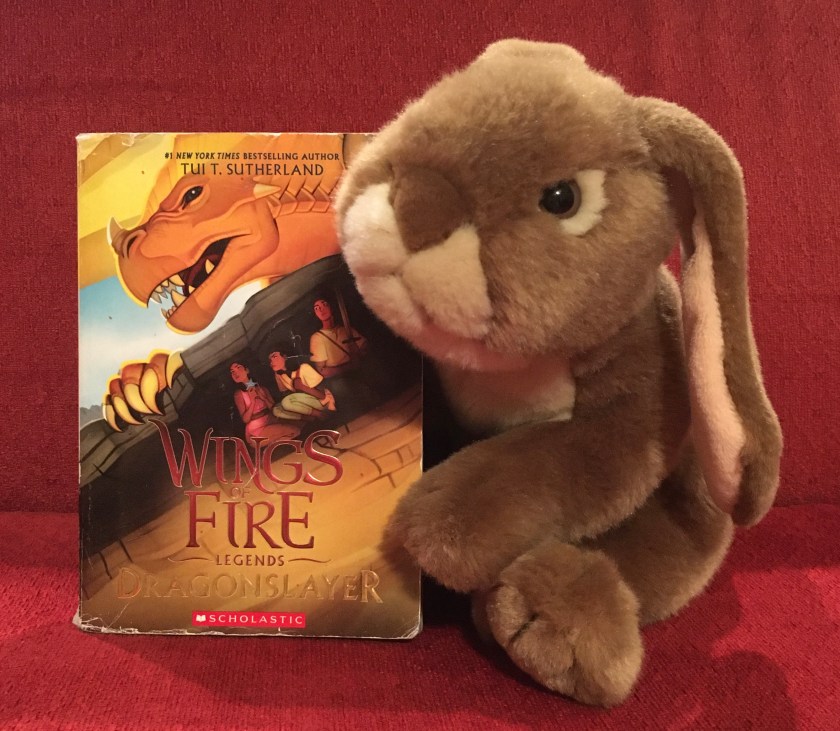
Caramel loves all things dragon, and has read and reviewed all fifteen books in Tui Sutherland’s Wings of Fire series. (His review of the fifteenth book, The Flames of Hope, contains links to all his reviews of the previous books.) Last week, he reviewed Darkstalker, the first of Sutherland’s “Wings of Fire: Legends” series that recounts some of the backstories and the legends of the world of dragons, in a way explaining and interpreting the events of the original series. Today he talks with Sprinkles about Dragonslayer, the second book in the Legends series, which was published, in 2020, in between books thirteen, The Poison Jungle (2019), and fourteen, The Dangerous Gift (2021).

Caramel reviews Dragonslayer by Tui Sutherland.

Sprinkles: Caramel, last week you reviewed Darkstalker by Tui Sutherland, tbe first book of the “Wings of Fire: Legends” series, and here we are today, with the second book. What do you want to tell us about it?

Caramel: It is as good as Darkstalker, but it is very different from all the other Wings of Fire books because its main characters are humans this time, and not dragons.

S: That is interesting! The dragons call humans “scavengers”, right?

C: Yup.

S: Why is that?

C: I don’t know. They never really explain.

S: Maybe it is a way to show us how the dragons see humans, as weak creatures skulking about, and trying to steal treasure or food when they can.

C: Maybe.

S: Okay, sorry for the distraction. Tell me more about Dragonslayer.

C: Okay. There are three main characters in this book, just like in Darkstalker. They are called Ivy, Leaf, and Wren. My favorite is Wren, because she is a strong female character, and she can talk to dragons, which I think is awesome.

S: I think she is abandoned by the other humans so makes friends with a dragon, right?

C: Yes, that’s more or less accurate. And Leaf is Wren’s brother but thinks she is dead. Everyone thinks Wren is dead. They tried to feed her to the dragons, but they messed up.

S: So they wanted to sacrifice her somehow?

C: Yes, exactly. So the humans live in villages, and they end up causing the war that was the main topic of the first five books in Wings of Fire. They kill the SandWing queen Oasis, and so a war begins among the SandWings to choose a new queen between her three daughters, Blister, Blaze, and Burn.

S: I remember that was the main problem in the Dragonet Prophecy story arc.

C: We even see the dragonets in their cave in this book! In fact we even see Kestrel, the female SkyWing who was one of their guardians. And we see Kestrel’s other child, Peril’s brother. It’s pretty cool.

S: So you would benefit from having read the first five books before reading this one, right?

C: I guess. But I think you could even start with this book if you wanted to. It does not say anything about the prophecy.

S: But I guess if you started the Wings of Fire series with this book, you would probably get the wrong idea. Because this one is all about humans and told from their perspective. And all the other books are about and from the perspective of the dragons. So Dragonslayer is in some ways quite peculiar among all the other books, right?

C: Yes. And I am not sure I love that it is about humans. I do like the series because I really like the dragons and I want to learn about their world.

S: Still, maybe one book out of seventeen so far being centered around some human characters might be acceptable?

C: Yes. I am not really complaining. I like the book. But maybe I like the ones told from the dragons’ points of view a bit more.

Caramel is reading Dragonslayer by Tui Sutherland.

S: So you told us a bit about the main characters, and you told us that one could read it any time in parallel with the other books in the series —

C: Well, they should probably read it before the fourteenth book, The Dangerous Gift.

S: Why is that?

C: Some of the characters show up as important characters in the last two books, and so it would be helpful to know their backstory. And actually, some of them apparently show up even earlier, in The Brightest Night, the fifth book. But I read the whole series before the Legends, and that worked well, too.

S: I see. So can you tell me in one sentence or two what the story is about? What are Ivy and Leaf and Wren doing?

C: The story tells us the human version of the events in Pyrrhia. But also Leaf and Ivy are looking for Wren, because at some point Leaf realizes Wren is not dead.

S: Who is the Dragonslayer in the title?

C: It is Ivy’s father. He is known as the dragon slayer because he apparently has slayed dragons in his youth, but Ivy eventually learns a lot more about him. We also read about how Wren learns to communicate with a dragon so that there might be some hope for humans and dragons to live in harmony.

S: Hmm, so this could eventually merge with your other favorite dragon story, the How to Train Your Dragon series, where humans and dragons are living in some sort of cooperative relationship, at least the TV series version?

C: Well, I think that could be neat. But then again, I also like that the dragons in Pyrrhia and Pantala can tell their stories independent of the humans. So I don’t need that to happen; I don’t need dragons and humans to become friends. The dragons are cool the way they are. But maybe they could be less cruel to humans.

S: I agree. So let us wrap things up with your three words for this book.

C: Human, amazing, funny. Human because there are humans as main characters now. And all the books in the series are amazing! And they are funny!

S: Those will work. What do you want to tell our readers now?

C: Stay tuned for more book bunny reviews!

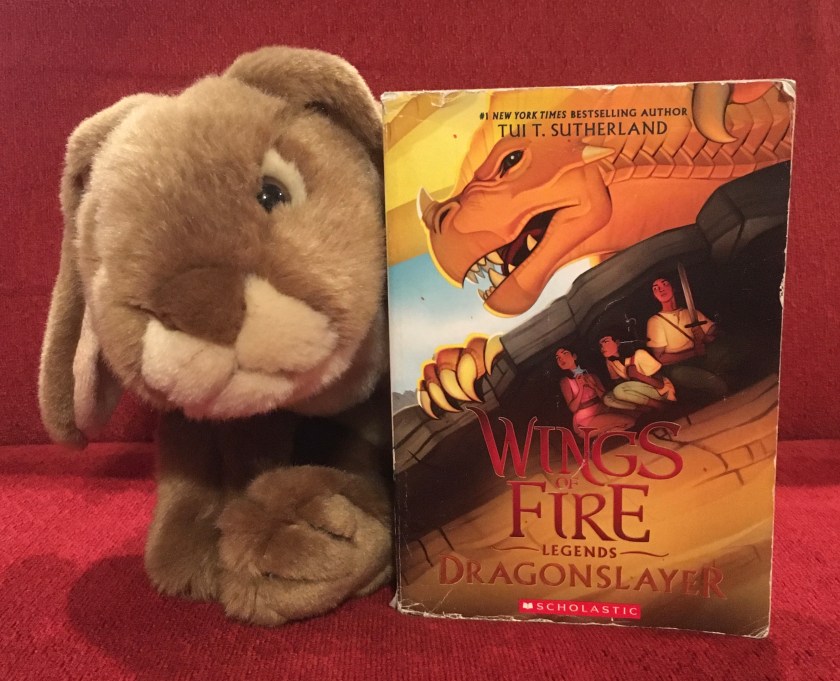
Caramel enjoyed reading and rereading Dragonslayer by Tui Sutherland so many times, the book is already showing some wear-and-tear, but it is clear that even this will not stop him from continuing to read and reread his favorite series over and over again.
Caramel enjoyed reading and rereading Dragonslayer by Tui Sutherland so many times that the book is already showing some wear-and-tear, but it is clear that even this will not stop him from continuing to read and reread his favorite series over and over again.