Marshmallow reviews Doctor Who: The Encyclopedia by Gary Russell

The book bunnies are all Whovians, that is, they are all fans of the British science fiction TV show Doctor Who. Having watched and enjoyed many episodes of the show from both its original run 1963-1989 and the reboot series 2005-present, they also have several books about the series on their bookshelves. Today Marshmallow talks about one of these books, Doctor Who: The Encyclopedia, written by Gary Russell in 2011. Sprinkles is taking notes and asking questions.
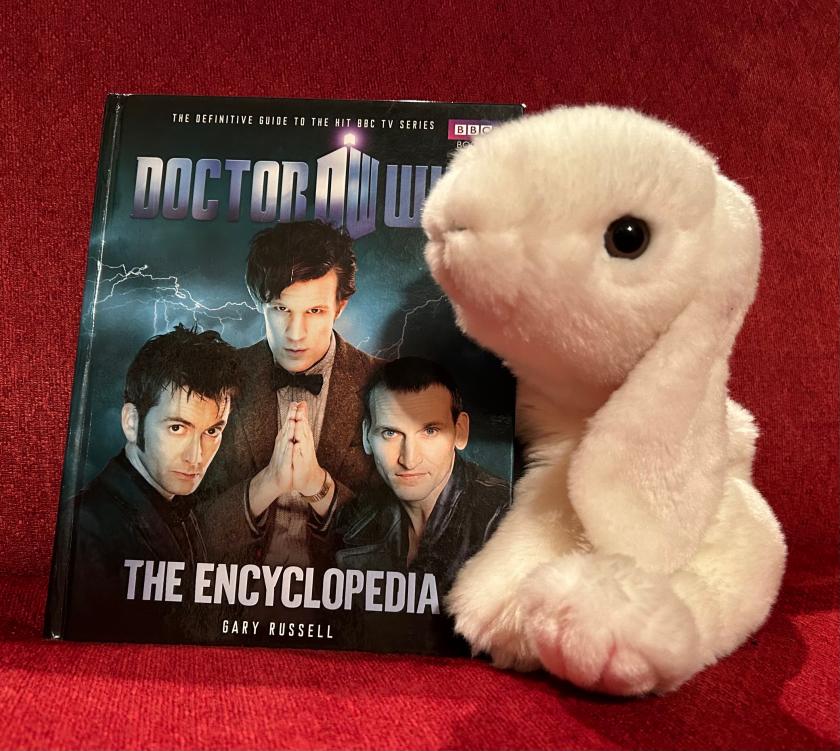
Marshmallow reviews Doctor Who: The Encyclopedia by Gary Russell.

Sprinkles: So Marshmallow, tell me a bit about why you wanted to talk about this book today.

Marshmallow: We went to a Doctor Who convention recently, and I thought it would be fun to revisit this book.

S: Yes, makes sense to me. So tell me a bit about Doctor Who for readers who may not know who he is.

M: Well, that’s a tall order. But let me try. Doctor Who is an alien, from a planet named Gallifrey, and he travels through time and space. Realistically, I think he finds himself on Earth way too often, but through his travels, he makes friends and defends humanity and anything good in this universe against all sorts of evil villains.

S: I think that is a good summary. And I like how you said he finds himself on Earth too often. In fact he finds himself in the UK, almost all the time, right?

M: Of course. It is after all a BBC show!

S: Of course.

M: And he has a companion or two almost in every episode. He is usually the only Time Lord — that is what people from his planet are called — but he often travels with a human or two, finding them in one of his many trips on Earth and bringing them along with him through many adventures.

S: I’m guessing Time Lords call themselves Time Lords. Kind of pretentious, don’t you think?

M: Yes, but they kind of are lords of time. They have the technology to travel through time and space, and they kind of have the ability to even get out of time sometimes. Which is of course weird, and even incomprehensible, for bunnies like us, who are bound by time.

S: I see. Okay, maybe they can call themselves Time Lords then. So tell me about the book. What is it about?

M: Well, it is written like an encyclopedia, and hence the title. So there are many entries, all ordered alphabetically, about all sorts of things about the show and its main characters.

S: I see on the book cover the faces of three of the Doctors.

M: Oh, yes, I forgot to tell you that one of the features of being a Time Lord involves regenerating as a new face and body when your original body is worn out or poisoned or otherwise damaged extensively. So of course this makes it awfully convenient for the BBC to change the actor who is playing the Doctor more or less regularly. And yes, the cover of the book has the ninth Doctor, Christopher Eccleston, the tenth Doctor, David Tennant, and the eleventh, Matt Smith. These are the first three doctors from the reboot era.

S: I see. So the book was published in 2011 —

M: And the Doctor was still Matt Smith back then.

S: But he is no longer?

M: Yep. At some point Matt Smith regenerated, and became Peter Capaldi, who was the twelfth Doctor. Then Capaldi regenerated to become Jodie Whitaker, who is the thirteenth. Apparently she will regenerate, and they will bring back David Tennant for a couple more episodes before he regenerates into Ncuti Gatwa, who will be the fifteenth Doctor.

S: Do you think it could be a bit hard to keep track of all these doctors?

M: Not really. They all have their own personalities. Even though it is supposed to be the same person, and the show is really about the life story of one particular individual, each actor has their own interpretation, and each Doctor is totally different.

S: That is amazing, and it is one of the things that keep the show fresh, no?

M: Yes. I think so too.
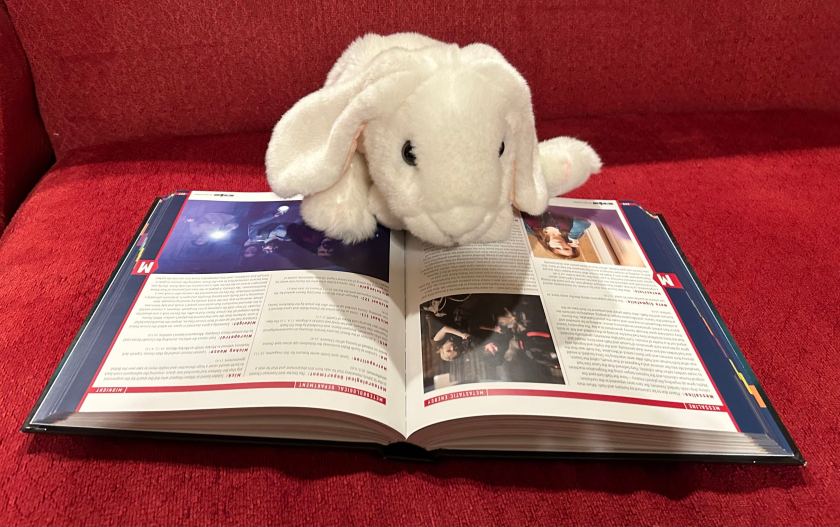
Marshmallow is reading Doctor Who: The Encyclopedia by Gary Russell.

S: Okay, back to The Encyclopedia. So this was published before the twelfth doctor, so it would not have anything about his adventures or companions or those of the thirteenth Doctor. Does it have information about the companions and adventures of the earlier doctors, or is it only about the three new doctors, nine to eleven?

M: I think it is mostly nine to eleven. But they have had a lot of adventures and so there is a lot to say. At the end of the book they list the episodes that the book covers, and they go from Episode 1 of the ninth Doctor to the end of the second year of the eleventh Doctor. And they also have some stuff about The Infinite Quest, which apparently was an animated series with the tenth Doctor and Martha, one of his companions. Somehow we must have missed that one.

S: I see. So there are a lot of details for about six years of the new show.

M: Yes, so you could learn so much! And the book has a lot of colorful pictures. It is really neat to read and look at. Though I must say, there are some scary pictures. And if you just see a picture like that when you turn a page, it could freak you out… It did to me.

S: What do you mean?

M: You know some of the episodes of Doctor Who are pretty scary, and so the pictures about those episodes remind me of the episodes and how scary they were. And even if I had not seen the full episodes, the pictures would still be very scary.

S: Hmm. So maybe this is not a great book for young bunnies.

M: No. But if a bunny likes Doctor Who and is not too scared of the scary episodes, I’m sure they would love this book. There are so many details on each of the episodes. It will be fun to re-watch the show after looking over this book. I think I will notice so much more.

S: So then you like the book, right?

M: Yes. If you are a Whovian, and especially if you like the new series, you have to read this book.

S: I see. Then how would you rate it?

M: I’d rate it 95%, only because of the scary pictures. But otherwise it is a pretty awesome book and would be appreciated by anyone who likes the show.

S: Thank you Marshmallow. I think that is fair. So what would you like to tell our readers as we wrap this up?

M: Stay tuned for more amazing book reviews from the book bunnies!
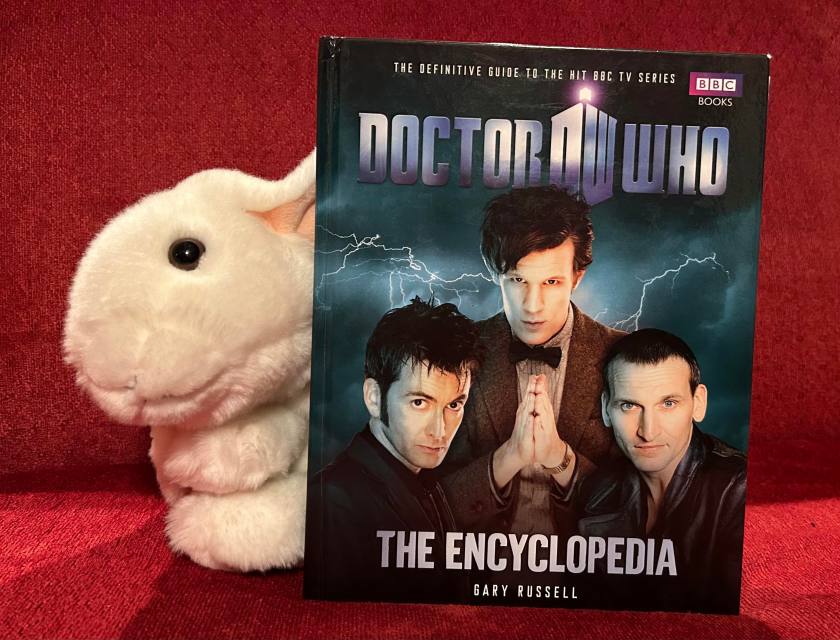
Marshmallow rates Doctor Who: The Encyclopedia by Gary Russell 95%.

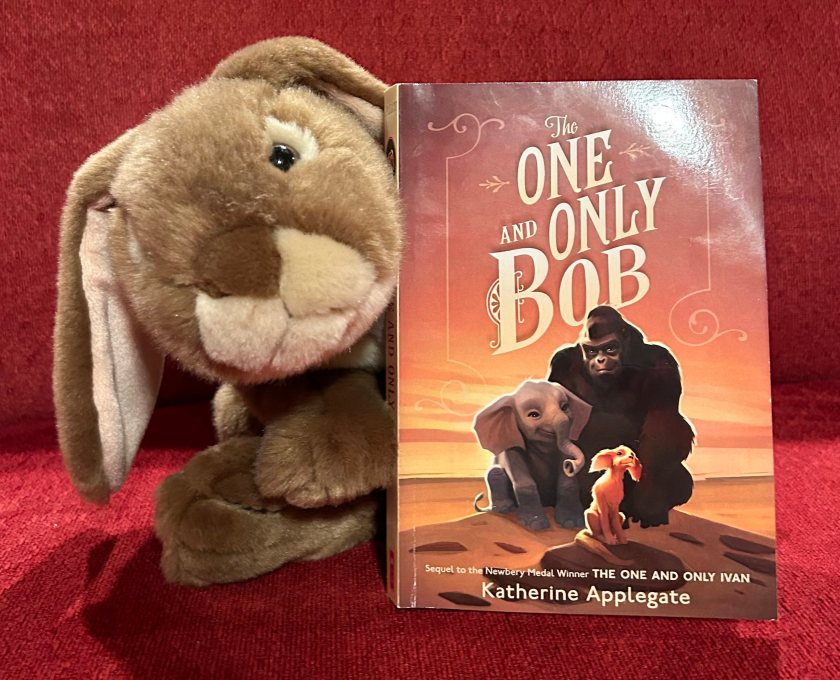
Caramel reviews The One and Only Bob by Katherine Applegate

A few years ago, Marshmallow reviewed The One and Only Ivan, a beautiful book by Katherine Applegate. At that time the whole book bunny family watched the accompanying movie. A year or so later, Caramel was able to read the same book himself and enjoyed it a lot. This week, he was able to get his paws on the sequel, The One and Only Bob, published in 2020. As usual, Sprinkles is taking notes and asking questions.

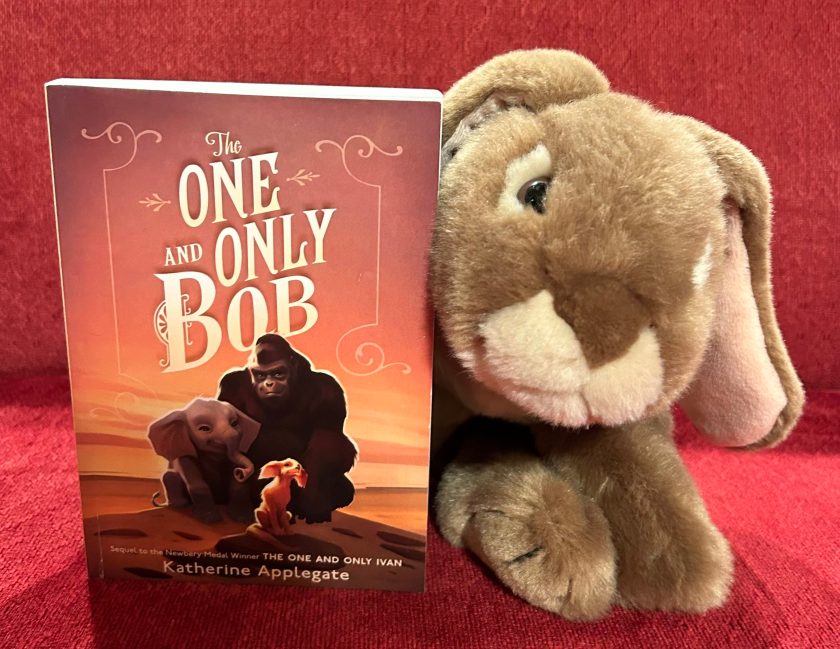
Caramel reviews The One and Only Bob by Katherine Applegate.

Sprinkles: So Caramel, I know you liked The One and Only Ivan. If I recall correctly, that one ended with gorilla Ivan’s dog friend Bob all alone, because most of the other animal friends went to a new zoo. So does this book start there?

Caramel: More or less. We see Ivan and Ruby in this book too, because Bob keeps visiting the zoo they are living in, even though probably he is not supposed to. But apparently the zoo keepers don’t care, so he manages to sneak in whenever he wants, with Julia.

S: So he is still hanging out with Julia then? This was the girl who gave Ivan the crayons, right?

C: Yes and yes.

S: Oh then Bob is not that alone after all if he sees Julia all the time.

C: No he is not really alone. He is actually living with Julia and her dad.

S: I see. That is cool too. So what is the main problem in this book? Bob is not completely alone then. And Ivan and Ruby are safe and happy, right? And Ruby was the baby elephant, right?

C: Yup. They are happy, but Bob is not completely happy. Because he is not used to living with humans because he had gotten very used to being a stray. And because he wants to find his sister Boss.

S: We did not hear about Boss in the first book, did we?

C: I don’t think so, but she is Bob’s main goal in this book. And as he looks for her, he has a lot of adventures. A hurricane hits the town and the zoo that Ivan and Ruby were at is destroyed and Bob is separated from his humans. And a lot of other things happen too. It is a very adventure-full book.

S: I can see that.

Caramel is reading The One and Only Bob by Katherine Applegate.

S: So One and Only Ivan was written in first person, through the eyes of the gorilla Ivan. Is this written in Bob’s voice?

C: Yes. And Bob’s voice is very different from Ivan’s. I mean, he is a dog, but also he is not very trusting. He is different.

S: I see. It is neat that the author was able to create another fully alive animal voice. So overall, did you like the book?

C: Yes. I don’t think I could say it is better than the story of Ivan, but it is just as good, I think.

S: So maybe they should make a movie out of this one, too?

C: Yes! I loved the Ivan movie! That was cool. It would be good to have a Bob movie too!

S: Well, maybe there will be one. Did you know that the author has written a third book, about the elephant Ruby this time?

C: I didn’t know that! I have to read it too! And soon! Please!

S: Well, it won’t come out till May, it seems like, but sure, we can read it when it comes out.

C: Yes, that will be great! I really like Ruby too!

S: Okay, so let us start wrapping things up then. How would you describe this book in three words?

C: Adventurous Animal Fun, but it is not always fun, because sometimes sad things happen too.

S: Still, I think your description works well Caramel. Okay, what do you want to tell our readers as we wrap this up?

C: Stay tuned for more book bunny reviews!

Caramel enjoyed reading The One and Only Bob by Katherine Applegate and thinks it would make a good movie!

Marshmallow reviews Brave New World by Aldous Huxley

As many young bunnies her age do, Marshmallow has been reading some dystopian novels. In these past few months, she has read and reviewed the recent Shatter Me and Unravel Me by Tahereh Mafi, as well as the classic Nineteen Eighty-Four by George Orwell. Today she reviews another classic dystopian novel: Aldous Huxley’s Brave New World, first published in 1932. Sprinkles is asking questions and taking notes.

Marshmallow reviews Brave New World by Aldous Huxley.

Sprinkles: So Marshmallow, I’m so glad you have read this book. It was one of my favorites when I read it, and I was only a bit older than you I think.

Marshmallow: I enjoyed reading it too! I found it fascinating.

S: That’s big endorsement from you! Okay, tell us a bit about the book.

M: Okay, let me set the stage: The year is AF (After Ford) 632. Technology is so advanced that humans who are citizens of the World State reproduce solely in artificial wombs, and everyone is conditioned to perfection. That is, if you’re in the right caste. Even before you are born, you are assigned a caste. If you are an Alpha or Alpha Plus, you will receive the most attention and care while in the incubator machines. If you are of a lower caste, say a Delta or an Epsilon, you will get less space, and your growth will be intentionally stunted by alcohol infusions. No matter how hard you work, you will always be working the job you were assigned at birth. Despite this inequality, no one ever complains because complacency and contentment with the system are essentially brainwashed into citizens while they are children. In this sea of conformity, individuality is diluted. On the one hand, everyone is happy, but on the other, this happiness is attained only at the cost of their humanity. 

S: Okay, that is pretty dismal as a setting. Go on.

M: So in short, when the story begins, the society is in harmony, but a couple people start to realize that the things that make us human are being lost. Two citizens, Bernard Marx, an Alpha Plus, and Lenina Crowne, a Beta, are vacationing in a reservation where humans still reproduce the natural way. Such societies are rare, and their residents are regarded by basically everyone else as savages. Here they meet John, a man whose mother Linda came from the “brave new world”. When they bring him back to their world, he is horrified by what he sees.

S: That is a good summary of the plot, Marshmallow. I know you thought a lot about this book and even prepared a report of sorts for your English class. So maybe you can tell us a bit more about the three main characters.

M: Sure. Bernard is an Alpha Plus who is at the top of the society. But he is different from others because he isn’t very cheery whereas everyone else is always happy. This is probably because he doesn’t take soma, the drug that everyone else does. Soma gives people a sense of euphoria and makes them unconcerned and joyful. Bernard’s refusal to take it is one example of his peculiarity. Bernard is a bit shorter than other Alpha Plus males, and he feels a bit bad about this.

Then there is Lenina, a very typical member of the World State. An average Beta, she is content with her status and is very disturbed by the comments made by Bernard and John that vilify the World State. 

Finally there is John. John’s mother Linda came from the World State, or the “developed” world. Linda actually got pregnant at some point and gave birth to John. This is highly unusual in the World State, as biological reproduction is regarded as a taboo in the brave new world. However, in the reservation, natural birth is just natural. Still, the tribe does not completely accept Linda and John, and so they feel like outcasts. When Bernard gets the permission to bring John to “the civilized world”, he is called the Savage, and people treat him almost like a celebrity. However, as an outsider with beliefs completely orthogonal to those of others, he finds this brave new world repulsive. 

Marshmallow is reading Brave New World by Aldous Huxley.

S: Thank you Marshmallow. I think you summarized the main features of these characters well. So I can see that Bernard might not be too happy because he does not feel confident about his stature, and I can see John finding it difficult to adjust. But tell me more about what is wrong with this world. Why do you think this book is so important? What is its main message?

M: I think that the main problem is that everything is supposedly perfect, and the fundamental struggles that make people human are long gone. John the Savage argues that people need to have problems to live properly like humans. Without them, they are not fully human. They become passive, complacent, and no longer crave for progress, creativity, new ideas.

S: When I was in school, we read this book in tandem with Orwell’s Nineteen Eighty-Four. You read and reviewed that book, too. Did you see any parallels or significant differences between the two books?

M: Well, I did like both books a lot. But both books had a little bit of adult content, a bit more than I like to engage with in the books I read. Other than that, they are both dystopian, telling us about a possible future where life as we know it is replaced by some very unpleasant and almost hopeless system. But when I was reading about Huxley and Brave New World for my class report, I found a very insightful quote by Neil Postman, who wrote in a 1985 book titled Amusing Ourselves to Death the following:

Orwell feared that the truth would be concealed from us. Huxley feared the truth would be drowned in a sea of irrelevance. Orwell feared we would become a captive culture. Huxley feared we would become a trivial culture […] In 1984, Huxley added, people are controlled by inflicting pain. In Brave New World, they are controlled by inflicting pleasure. In short, Orwell feared that what we hate will ruin us. Huxley feared that what we love will ruin us.

Neil Postman

The Wikipedia article on Brave New World has this quote, in its context, and the full quote is also very good. But this part is enough for me here. I especially like the last two sentences. Aldous Huxley delves into the psyche of humans to look at how easily they can be reduced to passivity and complacency.

S: Are there other themes that show up in the book?

M: According to Britannica, Huxley was always preoccupied “with the negative and positive impacts of science and technology on 20th-century life”. So there is that of course.

S: I see. The technology that allows the World State to govern one of the most fundamental processes of human life is awesome and scary, and the government, or any other entity, having such a power is bound to be dangerous.

M: Yes.

S: Any other themes that you would like to bring up?

M: Yes, the book is really rich. In Brave New World, humans have become passive and complacent under the eye of the World State. Brave New World presents a different type among the many terrifying futures that could occur. Most dystopian books have governments that are feared, but in this book the government rules by giving citizens everything that they could ever want. 

S: What could be wrong with that?

M: As I said before, I think one of the central messages of the book is that people are not fully human if they are not striving to be better; they are not fully human if they are completely satisfied and complacent.

S: How about bunnies? Would you not be a happy bunny if you got all the nice food and all the books and friends you wanted and so on and never needed anything?

M: Given all the terrible things happening in our world today, this kind of a possible world actually sounds nice initially, but I think I’d eventually get bored. I’d probably want to do something different, something new. I’d want a purpose in my life.

S: I can see that.

M: I do wonder if a lot of people would be better off or happier in that world. But they would all be pawns of the establishment. They would not have a purpose or even a choice in this way of living. I don’t think either of those is good.

S: I agree. So what would your rating be for this book?

M: I think I’d rate it 97%. I think this is a very provocative book, made me think a lot, but again, I don’t like too much adult stuff in a book.

S: I agree that there is some of that stuff in the book and some of it is truly disturbing. There is even a scene where they expect children as young as seven to engage in what they call “erotic play”.

M: Those kinds of things make me think that younger bunnies should probably not read this book.

S: Agreed. So a very good book, very thought-provoking, but definitely for older bunnies.

M: Yep.

S: Then we are done. Let us wrap this up. What would you like to tell our readers Marshmallow?

M: Stay tuned for more amazing book reviews from the book bunnies!
Marshmallow rates Brave New World by Aldous Huxley 97%.

Caramel reviews The Winglets Quartet: The First Four Stories by Tui T. Sutherland

Caramel has gone through almost all the books written by Tui T. Sutherland, including all fifteen books of her Wings of Fire series. Today he is talking about The Winglets Quartet: The First Four Stories (2020). As usual, Sprinkles is taking notes and asking questions.

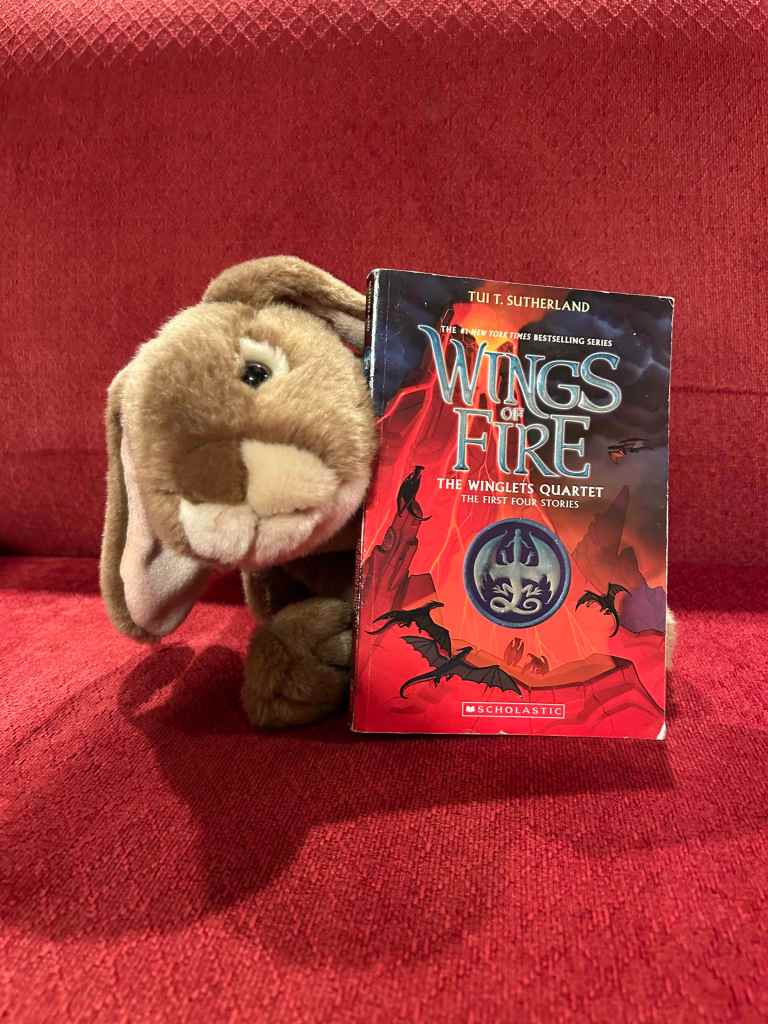
Caramel reviews The Winglets Quartet: The First Four Stories by Tui T. Sutherland.

Sprinkles: So Caramel, you managed to find yet another Wings of Fire book to review.

Caramel: Yup! Heh heh heh!

S: So this looks like a collection of four stories. Right?

C: Yes. There is one about a NightWing named Fierceteeth (“Prisoners”), another about the NightWing assassin named Deathbringer (“Assassin”), another about a SandWing named Six-Claws (“Deserter”) and another about an IceWing named Arctic (“Runaway”).

S: I remember Deathbringer! We met him in the third book, The Hidden Kingdom, right?

C: Yep. But in the story about him, we learn more about Deathbringer’s life, how he became an assassin and so on. It is called “Assassin” after all.

S: I see. So are all four stories about characters that show up somewhere in the fifteen main books of the series then?

C: Yep. Fierceteeth shows up in the fourth book already. That is The Dark Secret. Six-Claws shows up in the fifth book, The Brightest Night. And we first hear about Arctic in the sixth book, Moon Rising. Though Arctic’s story is more like the story of Darkstalker, because he lived many many years ago. In fact he is Darkstalker’s father. But Moonwatcher starts to learn about Arctic from Darkstalker when he communicates with her through her mind. So that happens in the sixth book.

S: So let me get this straight. Three of the main characters of these stories are contemporary characters that we meet in the main series, but we learn a lot more about their backstories. And the fourth, Arctic, is a significant character mentioned in the books, but one who lived many many years before the events of those books took place. Right?

C: Yup, I think you got it.

Caramel is reading The Winglets Quartet: The First Four Stories by Tui T. Sutherland.

S: So tell me more. I do not remember you reading too many short stories. How did it feel to read these ones?

C: They are fun! I loved to learn more about these characters and their stories. And you know, anything more Tui T. Sutherland can tell me about the world of these dragons, I’m eager to read.

S: I know. So since we are listening to The Hidden Kingdom at the moment, and we have met Deathbringer already, I am curious about that story myself. Would you say that reading that story (“Assassin”) would help me understand The Hidden Kingdom better? Or maybe at least understand Deathbringer’s motivations?

C: Yes I guess. But the stories are just fun no matter what.

S: From what I can gather looking at the dates when these stories were written, or at least published, the author seems to have already gotten all of the first arc done and was more or less in the middle of the second arc. So it is kind of neat to think about how she was knitting this world up all together, but along the way, she went back and told us a nit more about some of the incidental characters, and made the world a lot richer.

C: Yes. I guess. So for example you can understand Deathbringer’s psyche much better after reading “Assassin”.

S: Wow, Caramel, psyche is a big word!

C: But it is the right word here. So you understand him a lot better because you learn that his mom died when he was very young and that is one of the reasons why he does not like Blister —

S: Wait, don’t give away too much! I think I want to read that story myself!

C: You should. I think it might be one of my favorites among the four. Then again they are all pretty awesome!

S: So are they as funny and violent as the main books?

C: They are funny but maybe not as violent. They are a little less bloody.

S: Okay, I think I might borrow the book for a bit then.

C: Sure. But we should probably wrap up this review before then.

S: I agree. So describe the book to me in three words then.

C: Descriptive, funny, and biographical. Because the stories are kind of like little biographies of the four dragons.

S: Makes sense to me. So what would you like to tell our readers next?

C: Stay tuned for more book bunny reviews!

Caramel enjoyed reading The Winglets Quartet: The First Four Stories by Tui T. Sutherland, and hopes that there will eventually be more stories about this world.