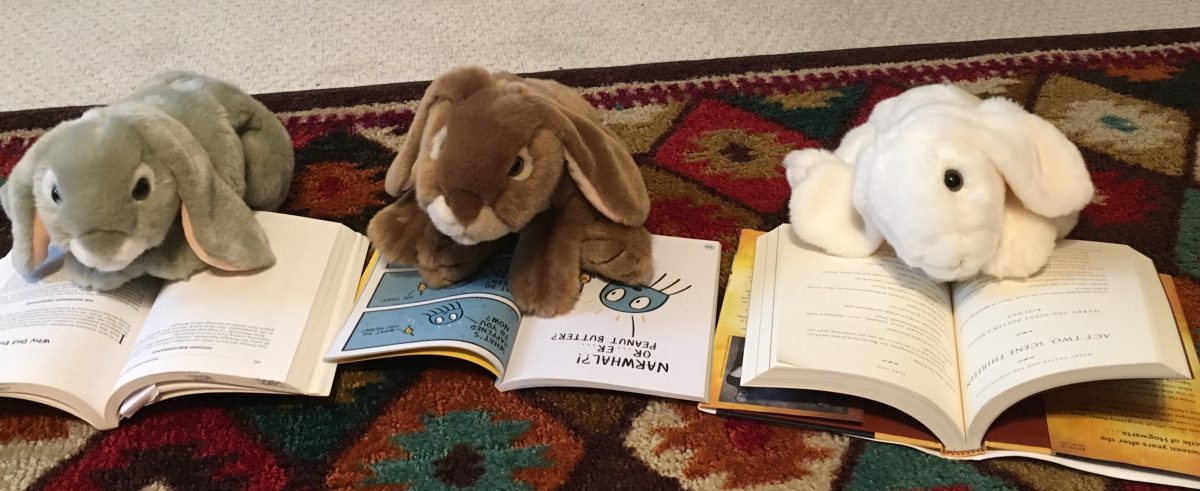
Sprinkles reviews Stopping by Woods on a Snowy Evening by Robert Frost and Susan Jeffers

Readers have already seen several books reviewed on this blog which had poetry as a significant theme. See, for example, Marshmallow’s reviews of How to Find What You’re Not Looking For by Veera Hiranandani and Starfish by Lisa Fipps. However, we have only reviewed one full book of poetry so far (A Light in the Attic by Shel Silverstein); that is, if we do not count the humorous BrainJuice American History: Fresh Squeezed! by Carol Diggory Shields. Today, we finally begin to remedy this situation. Below, Sprinkles writes about a book that the book bunnies household read together many times with much joy: Stopping by Woods on a Snowy Evening, an illustrated children’s book presenting the famed poem of Robert Frost with the same name, published first exactly a hundred years ago, in 1923.

[If you have any recommendations of poetry books and such for young ones, please let us know. Sprinkles is planning to put together a more extensive post on poetry in the near future, and your input would be much appreciated.]

Sprinkles reviews Stopping by Woods on a Snowy Evening, written by Robert Frost and illustrated by Susan Jeffers.

A lot of people read or hear about the American poet Robert Frost some time in their school years. And, originally published in 1923, “Stopping by Woods on a Snowy Evening” might be his most famous poem; it is so famous that it has its own Wikipedia entry! Especially the last stanza:

The woods are lovely, dark and deep,
But I have promises to keep,
And miles to go before I sleep,
And miles to go before I sleep.

has inspired and held the imagination of many people since then.

The simple words and sentences used through the poem make it quite accessible, and the iambic tetrameter (where each line of the poem is made up of four syllable-pairs with one emphasized and the other not) as well as the simple rhyme scheme used (AABA BBCB CCDC DDDD) make it melodic and easy to recite. So it is a natural choice for the text of a children’s book. The book I am writing about today is just that: Frost’s poem makes up the whole text, and the illustrations by Susan Jeffers complete the rest.

First published in 1978, the book uses a two-page spread for more or less every pair of lines from the poem. So you often get a full picture for each complete sentence of the poem.

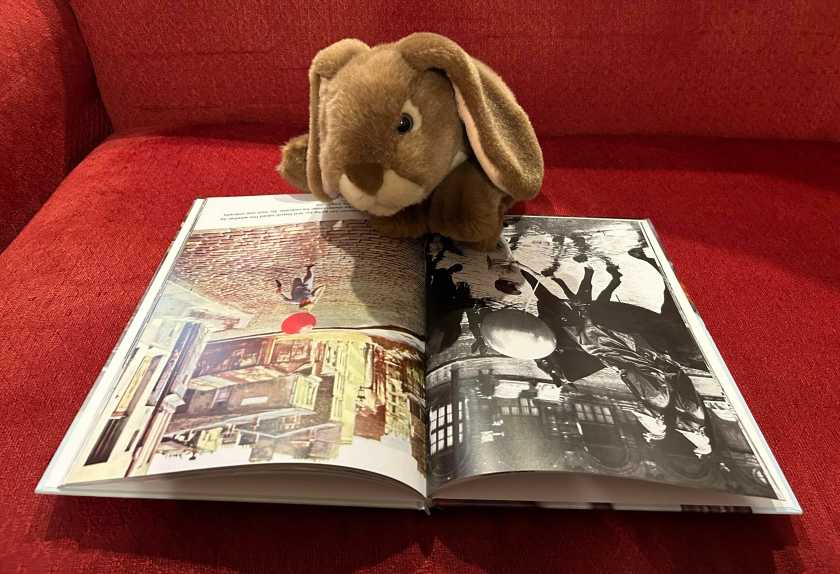
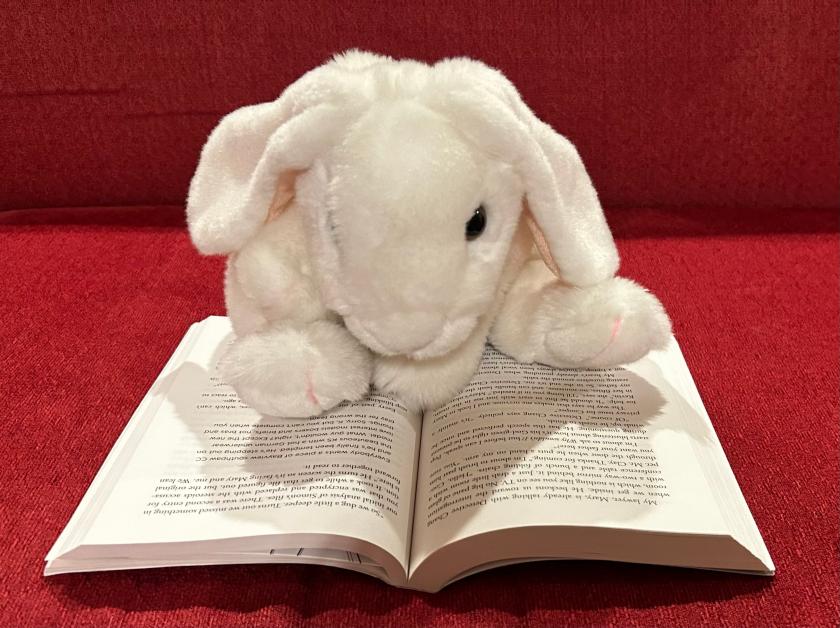
Sprinkles is reading Stopping by Woods on a Snowy Evening, written by Robert Frost and illustrated by Susan Jeffers. Here she is looking at the two-page spread where the narrator of the poem is saying, "But I have promises to keep."
Sprinkles is reading Stopping by Woods on a Snowy Evening, written by Robert Frost and illustrated by Susan Jeffers. Here she is looking at the two-page spread where the narrator of the poem is saying, “But I have promises to keep.”

The pictures, illustrated by the established illustrator Susan Jeffers, are mostly black and white, with only a few color touches on each. The sparse coloring directs our attention to the quiet and serene whiteness of the snowy woods. The way the poem is spread out through the pages allows us to read it more slowly and savor it.

The poem is lovely, and it is a joy to share it with young bunnies. In today’s busy world, we often miss out on finding those moments of joy in little things, like reading a well-worn poem with a young one.

Some might like to hear the poet read it himself:

Robert Frost reads “Stopping by Woods on a Snowy Evening” – from YouTube.

I also like this version, read by Susan Sarandon: https://vimeo.com/172768932. Someone uploaded a version to Youtube, too:

Susan Sarandon reads “Stopping by Woods on a Snowy Evening” – from YouTube.

Sarandon reads the poem most exquisitely. And at the end of this video there are a few children describing what they think poetry is. So it is definitely worth a watch.

Incidentally, this second video was created as part of a larger project focusing on introducing young ones to classical poetry. You can find some more information about it here: http://www.amyschatzproductions.com/classical-baby-im-grown-up-now-the-poetry-show. Another one of my favorites from this series is “How Do I Love Thee?” by Elizabeth Barrett Browning, read, I think, by Gwyneth Paltrow:

“How Do I Love Thee?” by Elizabeth Barrett Browning, read, I think, by Gwyneth Paltrow – from YouTube.

No matter how much I like these videos however, I still prefer reading poetry together with little ones myself. Stopping by Woods on a Snowy Evening, written by Robert Frost and illustrated by Susan Jeffers, gave me many opportunities to snuggle with one of my little bunnies and read it together. My copy was secondhand at least, and it was already somewhat worn out when I held it in my paws for the first time. The book has led to many joyful times nonetheless. I encourage all other adult bunnies who love poetry to find ways of sharing it with your little ones.

Sprinkles encourages all adult bunnies who love poetry to check out books like Stopping by Woods on a Snowy Evening, written by Robert Frost and illustrated by Susan Jeffers, which can help some of our favorite poems come to life for our little ones. And she would love to hear any recommendations of poetry books and such for young ones if you have any. She is hoping to put together a more extensive post on poetry in the near future, and your input would be much appreciated.

Caramel reviews Evil Spy School by Stuart Gibbs

Caramel is going through the Spy School novels by Stuart Gibbs one by one and reviewing them for the book bunnies blog. Today he is talking to Sprinkles about the third book: Evil Spy School, first published in 2015.

Caramel reviews Evil Spy School by Stuart Gibbs.

Sprinkles: So Caramel, here we are, talking about yet another Spy School book.

Caramel: Yep, this is the third book. I think there are a few more.

S: I think there are eleven in all so far.

C: So I have eight more to go.

S: Yes, that sounds about right. I don’t think these later books have the graphic novel versions just yet.

C: I don’t think so. But as soon as those show up, I will need to review those too.

S: I can see that. Okay, so this third book is called Evil Spy School. Why? Can you tell us a bit about what this book is about?

C: Ben is thrown out of his original spy school and so he enters SPYDER’s school.

S: Wait, isn’t SPYDER the evil organization that Ben was fighting against earlier?

C: Yes.

S: So why is Ben changing sides?

C: Well, they kicked him out of the other school.

S: Wait. The CIA was behind the original Spy School. So who is behind SPYDER?

C: It’s a secret.

S: I see. Are there any new characters?

C: Yes. There are at least two people that are new: Ashley Sparks and Nefarious Jones are the ones I remember.

S: Okay. So who are those?

C: They are both students at the evil spy school. Nefarious Jones sits on the couch all day playing video games, and he is not a very nice person really. Ashley Sparks was kicked out of the Olympics so decided to turn evil. I am not sure I totally got her reasoning, but she seems a bit weird. She actually seems to enjoy being evil.

S: I see. So does Ben become friends with these people?

C: Yes and no. But I am not going to say much more because otherwise I will give away some of the plot.

Caramel is reading Evil Spy School by Stuart Gibbs.

S: What did you like about Evil Spy School most?

C: The fact that Ben figures out the plot again.

S: Why?

C: Because I think that this was a good ending to the mystery.

S: Hmm, I see. I guess you cannot say much more without giving more away. So how about describing the book? How would you do that it using three to five words?

C: Action packed, funny, and spy-full.

S: That sounds like the book just hit the spot for you. Did it also make you want to continue to read the rest of the series?

C: Yes yes yes! I am ready for book four!

S: Okay, then, let us wrap this up so you can dive right into that one. So what do you want to tell our readers?

C: Stay tuned for more book bunny reviews!

Caramel enjoyed reading Evil Spy School by Stuart Gibbs and is ready for book four!

Marshmallow reviews Ashes by Laurie Halse Anderson

Marshmallow has already reviewed Chains and Forge, the first two books of Laurie Halse Anderson’s Seeds of America trilogy. Today she completes the trilogy by reviewing Ashes, the third and last book, first published in 2016.

Marshmallow reviews Ashes by Laurie Halse Anderson.

Marshmallow’s Quick Take: If you like historical fiction or emotional roller coasters, or if you have enjoyed reading the first two books of Laurie Halse Anderson’s Seeds of America trilogy, then this might be the book for you.

Marshmallow’s Summary (with Spoilers): This book starts a few years after the events of Forge. You might recall that it is the late 1700s (the time of the American Revolution), and Isabel is a runaway slave, who has been searching for her younger sister, Ruth. At age seven, Ruth was sold away and separated from her. Eventually, with her friend Curzon, Isabel escaped from her “owners” and set out to find her sister.

After many trials, hardships, and travels, Isabel and Curzon finally reach the area where Ruth might be living, in South Carolina. Isabel and Curzon’s friendship is in peril; they are both unsure of its future. The two have learned through several ordeals that, as former slaves, nowhere is safe for them. But after all of this, Isabel finds her sister living on a farm. Overjoyed, Isabel runs to her, only to find that her sister doesn’t recognize her.

We learn with Isabel that Ruth has been living with Mister Walter and Missus Serafina, an older couple who have raised her as their own. Isabel is grateful for their generosity but is heartbroken. When questioned further, Ruth admits to remembering Isabel but says that she is not her sister anymore, and that Isabel should go home.

Luckily, Mister Walter and Missus Serafina invite Isabel and Curzon to stay a while. There, they learn that the plantation that Ruth and the couple worked on was raided by Patriots and the owner left to go after them. After a second Patriot raid, many of the slaves on the plantation fled, but Mister Walter and Missus Serafina physically couldn’t run away. This is why Ruth stayed on the plantation. Another boy named Aberdeen tried to run away but was caught and brought back.

Isabel is still in shock from Ruth’s rejection of her when the plantation owner Prentiss returns. Mister Walter and Missus Serafina send Isabel, Curzon, Ruth, and Aberdeen away and tell them to run. Once again, Isabel is forced to confront a cruel world and must protect her sister from danger. 

Marshmallow is reading Ashes by Laurie Halse Anderson.

Marshmallow’s Review: Ashes makes a good ending to the Seeds of America trilogy. Like Chains, the first book of the series, it is narrated by Isabel. Ashes is a true emotional roller coaster, with ups and downs that keep you reading until the end.

The character development in this story is remarkable and adds to the depth of the plot of the book. Laurie Halse Anderson is very skilled at showing the external struggles faced by the characters and is very adept at weaving in the characters’ internal conflicts. We can see the development of Isabel’s feelings for Curzon change from pure friendship to romance, and the transition seems convincing.

The writing reflects the style of that period and accurately (I think) portrays life in that time. Also, just like she had done in the first two books, the author regularly includes quotes from real documents from the time of the Revolutionary War to provide some historical context. However, everything is still understandable and the book itself is very readable.

All in all, I appreciated the chance to read these three books and would recommend them wholeheartedly to other young bunnies interested in understanding the people and the events at the beginning of the United States as a nation.

Marshmallow’s Rating: 100%

Marshmallow rates Ashes by Laurie Halse Anderson 100%.

Caramel reviews Spy Camp: The Graphic Novel by Stuart Gibbs and Anjan Sarkar

Caramel is systematically going through Stuart Gibbs’s Spy School series. So far he has read and reviewed the first two books: Spy School and Spy Camp. He has also read and reviewed the graphic novel version of the first book: Spy School: The Graphic Novel. Today he talks to Sprinkles about the graphic novel version of the second book, Spy Camp: The Graphic Novel, published first in 2023.

Caramel reviews Spy Camp: The Graphic Novel by Stuart Gibbs and Anjan Sarkar.

Sprinkles: So Caramel you reviewed Spy Camp last week. And now you will tell us a bit about the graphic novel version of that book, right?

Caramel: Yes.

S: So let’s get started.

C: Sure. This book is essentially the same as the original book.

S: But usually in graphic novel versions, there are some parts that are shortened or completely taken out. How about this one?

C: Yes of course. There are some parts that we do not see in the graphic novel version, but the main story is essentially the same. Ben Ripley goes to a summer camp for spies. And dangerous things happen. So it is very much the same book. And it is still very good.

S: That is great! So I saw that the person who illustrated this one is the same person who illustrated the graphic novel version of the first book. So do the characters look like they did in that first graphic novel?

C: Yes.

S: So someone could just pick this up right after finishing the other book and they would be just fine.

C: Essentially, yes.

Caramel is reading Spy Camp: The Graphic Novel by Stuart Gibbs and Anjan Sarkar.

S: Okay, so I think the characters did not look like what you had thought they would look like in that first book. But by now, maybe you got used to them?

C: Yes.

S: So tell me a bit more about the illustrations.

C: They are very colorful and they show action really well. Like when they are pointing at something. And the facial expressions are very expressive.

S: That is cool. I know you have read a lot of graphic novels in your short life, so if you had not read the actual books, do you think you would still think these graphic novels are good books?

C: I think so. They can definitely stand on their own.

S: So would you recommend someone to start with the graphic novels? Or do you think the original books are worth reading too?

C: If you can I think you should probably start with the original books. But if you have only the graphic novels you can still have a lot of fun reading. Only the graphic novels are much newer, and the original series has a lot more books.

S: True. There are about eleven books I think. And there are graphic novel versions of only the first two.

C: Yes. And it seems like they are coming out one book a year. At best. But the series has a lot more books to read.

S: Kind of like the Wings of Fire books, then, where there is a whole series of fifteen books, but the graphic novels are not all out yet.

C: Yup. And you know I have been waiting for the next graphic novel. It will be Winter Turning, the graphic novel version of the seventh novel.

S: I think it is coming out at the end of this year, Caramel. I am guessing that you will read it as soon as it does.

C: I’d like to.

S: Okay, so let us come back to Spy Camp. So if you were to describe it in three words, what would you say?

C: Colorful, hilarious adventures.

S: That works! So are you ready for the next book?

C: Yes! Book Three, here I come!!

S: So let us wrap this up then. What would you like to tell our readers?

C: Stay tuned for more book bunny reviews!

Caramel loved reading Spy Camp: The Graphic Novel by Stuart Gibbs and Anjan Sarkar, and he is ready to dive into the third book of the Spy School novels!