Caramel reviews Great Minds and Finds in Antarctica by Robin Koontz

Today Caramel is talking to Sprinkles about Great Minds and Finds in Antarctica by Robin Koontz, first published in 2021.
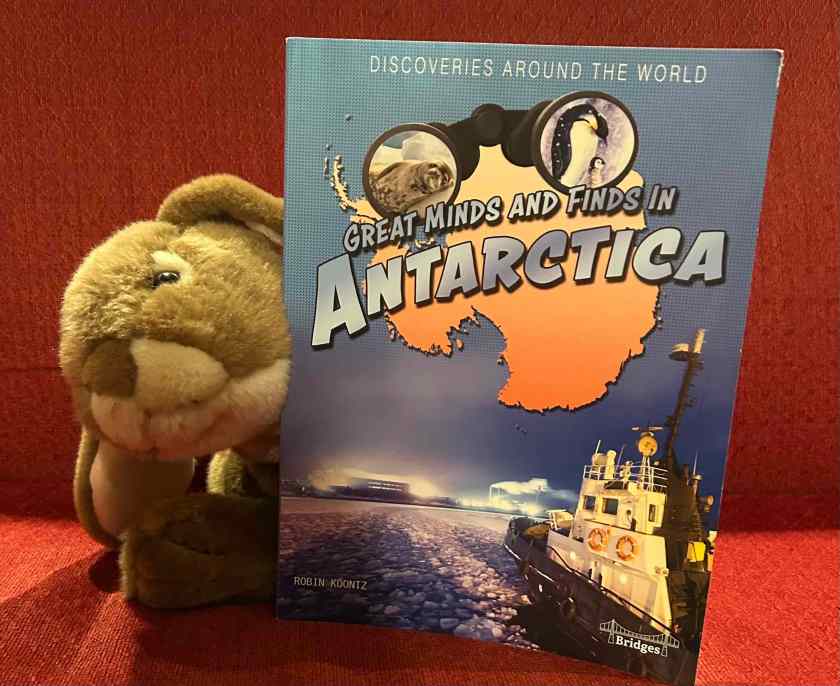
Caramel reviews Great Minds and Finds in Antarctica by Robin Koontz.

Sprinkles: So Caramel, what do you have for us today?

Caramel: We have a book about the coolest place in the world.

S: And where would that be?

C: Antarctica!

S: Oh I think you were being a bit punny, weren’t you? 

C: Yep, I was. Antarctica is cool because it is interesting, but also it is very very very cold, so doubly cool! 

S: I like that! So okay, the book is about Antarctica. So it is a book of facts, right?

C: Yep, it’s mostly facts, my favorite.

S: Yay! So what was a fun fact you learned in this book?

C: I learned that in Antarctica, they have this thing called the Antarctic hair grass. 

S: What’s that?

C: It’s a type of grass, and I find it cool because they look like a person’s hair if it was green..  

S: I guess that is why they are called hair grass. Wikipedia says they are one of only two species of flowering plants native to Antarctica. 

C: That is cool too! 

S: What else did you learn from the book?

C: Many many things. For example, some really cool animals live in Antarctica, like the yeti crab, which has hairy arms. 

S: I knew that some penguins lived there, but I did not know about the yeti crabs. They do look weird! 

C: A lot of other weird things live there, too. Another one is the skua. It is a bird, looks kind of like a pigeon. 

S: I did not know about the skua either! Apparently, it is kind of a vicious bird. It kills penguin babies. 

C: Oh, yeah, that’s not cool. They are predators and so are very aggressive. But they too have their own predators. It is a wild world out there. 
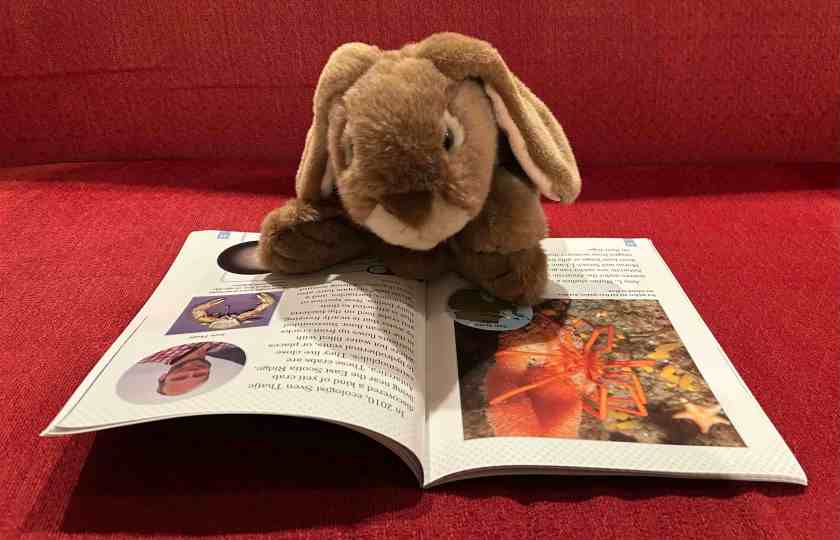
Caramel is reading Great Minds and Finds in Antarctica by Robin Koontz.

S: Agreed. So let us get back to the book itself. Is the book a random collection of facts about Antarctica or is there some sort of an organization?

C: Well, there are chapters, and many of them are really cool. For example, the first one is: “Where in the World is Antarctica?”

S: That makes sense, to start with the geographic location. 

C: Yes. Then there is the second chapter, called “Giant Ice and Extreme Life”. There is a chapter on “Ancient Remains”, a chapter called “A Mysterious Continent”, another called “Protecting Icy Life”. The others are called “Life Underwater”, “Changing Climate”, and “Amazing Antarctica”.  

S: That sounds like a good spread of topics. But I am curious. What is “A Mysterious Continent” about?

C: It is about how the first European people to explore Antarctica thought it was haunted, because of the cold.

S: That is interesting. So kind of like a brief history of its discovery. Is the chapter “Ancient Remains” also about history then?

C: Yes, but it is even more ancient history, like the animals frozen in the ice from many centuries ago. 

S: That is cool! Okay so it seems like this was a good book for you, with so many facts. Did you know that the same author has several other books in this same series called “Discoveries Around the World”, and the whole series has one book for each continent?

C: Oh, I didn’t know that! Maybe we can read some of those other books, too. 

S: Yeah, I will see if we can get a hold of any of the others. It is kind of nice to think about the world in terms of its continents. Not countries and national borders and such but purely geographical and physical borders. 

C: Yep, isn’t it cool? That is how we bunnies see the world. Maybe humans could too, one day. 

S: Oh Caramel! How I wish! Okay, so last question about the book. It looks like a very colorful one with lots of pictures. Can you tell us a bit about the pictures? Are they hand-drawn illustrations or photographs or maps?

C: They are mostly pictures, but they have some drawings, too. They are, as you said, all very colorful. And I thought they were informative. I learned a lot. 

S: What more could one ask of a book? Thanks Caramel. I think we have enough for a post. Let us wrap this up.

C: Okay. I can always go and read another book.

S: Sure. So what do you want to tell our readers as we wrap it up?

C: Stay tuned for more book bunny reviews!
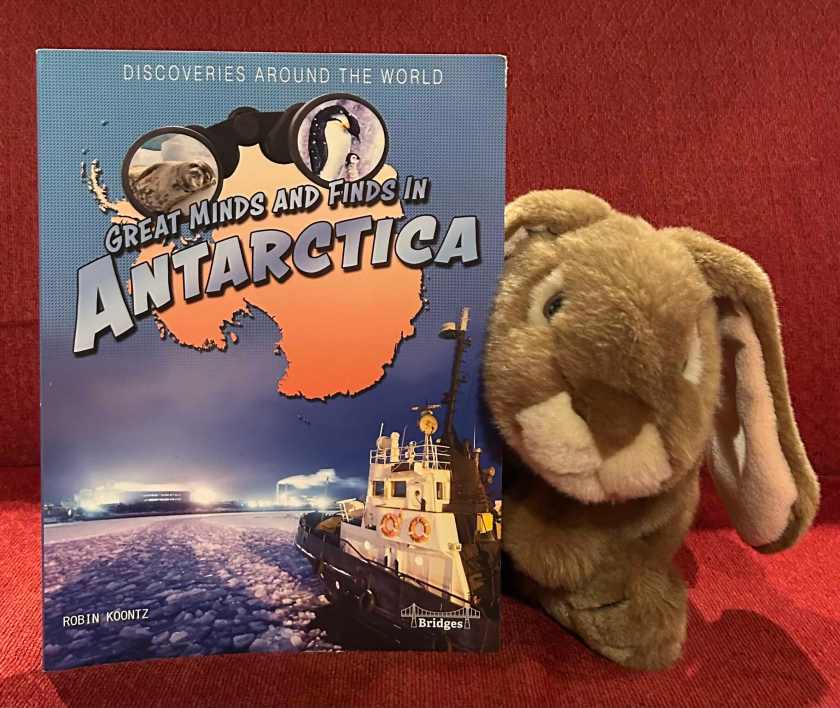
Caramel enjoyed reading Great Minds and Finds in Antarctica by Robin Koontz and recommends it to all little bunnies who are curious about the world.

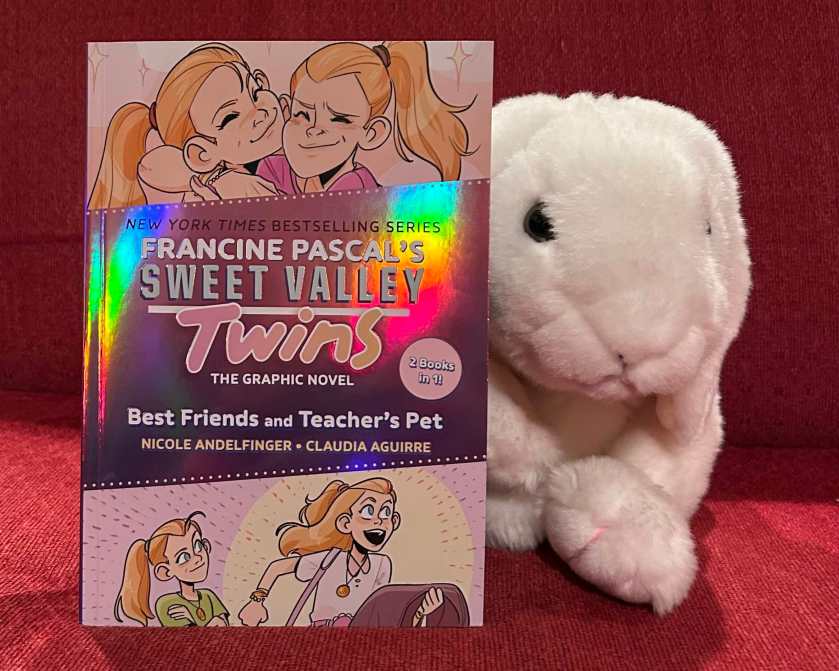
Marshmallow reviews Sweet Valley Twins: The Graphic Novel (Best Friends and Teacher’s Pet) by Nicole Andelfinger and Claudia Aguirre

A few years ago, Marshmallow read and reviewed Kristy’s Great Idea (The Baby-Sitters Club Graphic Novels #1) written by Ann M. Martin in the 1980s and 1990s and adapted into a graphic novel by Raina Telgemeier in 2006. Today she is reviewing Sweet Valley Twins: The Graphic Novel by Nicole Andelfinger and Claudia Aguirre, another book whose origins lie in a beloved book series from the 1980s written by Francine Pascal. The edition she is writing about combines the first two books, Best Friends and Teacher’s Pet, in one volume and was published just this year, in 2025. Other artists who contributed to the book include Sara Hagstrom, Andrea Bell, and Warren Montgomery.

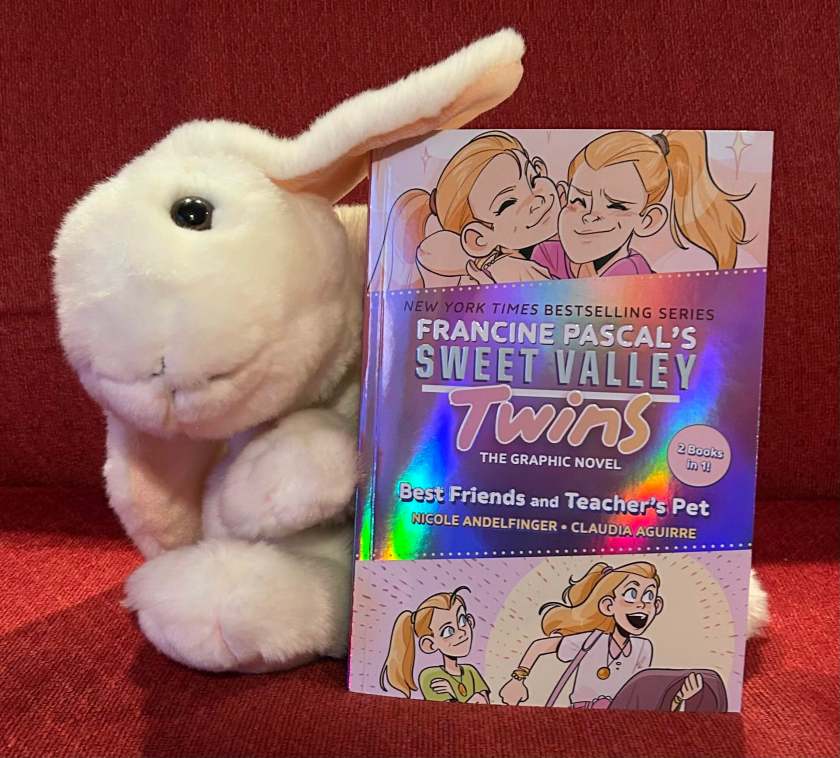
Marshmallow reviews Sweet Valley Twins: The Graphic Novel (Best Friends and Teacher’s Pet) by Nicole Andelfinger and Claudia Aguirre.

Marshmallow’s Quick Take: If you like books about friendship, sisters, family, and drama, then this is the book for you!

Marshmallow’s Summary (with Spoilers): Elizabeth and Jessica Wakefield are identical twins. In Best Friends, they start off as each other’s best friend. But like all middle-school aged girls and all book characters of that age, the two have started changing. In my opinion though, the one who is changing more is Jessica. Jessica has become increasingly more interested in boys and popularity, which is natural to an extent. Unfortunately, she has been recruited to join the Unicorns (which is a lot like the Plastics from Mean Girls). In order to get in, Jessica has to prove herself by completing three dares. Elizabeth is more interested in the Sweet Valley Sixers, the school newspaper she founded with her other friends Amy Sutton and Julie Porter. Both Elizabeth and Jessica thought they would be closer than ever in middle school, but they are growing apart instead.

In Teacher’s Pet, the focus is on their shared ballet classes. Jessica dresses to impress the first day, only to discover that their strict teacher Madame André is not a fan of her style. It is on that day that Jessica decides the teacher hates her. On the other hand, Elizabeth has no problem with the teacher, who actually really likes her. Jessica—who believes she is the best ballet dancer in the class—decides that Madame André picks favorites and that Elizabeth is a teacher’s pet. So when Elizabeth gets the solo for the rehearsal, Jessica is pretty jealous. Can the sisters overcome their differences? (Spoiler: The answer is predictably yes, but in a way that I was not too pleased with.)

Marshmallow is reading Sweet Valley Twins: The Graphic Novel (Best Friends and Teacher’s Pet) by Nicole Andelfinger and Claudia Aguirre.

Marshmallow’s Review: I think these books are really good, especially for young girls in middle school who are noticing behavioral changes in themselves or others. This book is a graphic novel and has two of the Sweet Valley Twins books in one. The Sweet Valley Twins books were originally written in 1986. I think it’s worth noting that there are no discussions about changing bodies in these books so the focus is more on how people’s personalities and interests change. That said, I was a little unhappy with the dynamic between Elizabeth and Jessica. I’ll preface this by saying I liked Elizabeth more due to her sweet, smart personality. I think the way Jessica changes is definitely normal and understandable too. But Jessica also changes in ways that are less excusable: she bullies other girls, pulls pranks on others, and is extremely self-centered. Jessica literally says she is the best dancer to her sister’s face—several times. I think this shows that she is a worse person, or at least doesn’t care so much about others. Yet, at the end of the second book (SPOILER), Jessica is the one given the solo lead role because Elizabeth fakes being injured. Why does Elizabeth give Jessica the role? Because Jessica complains about how she deserves it more and how she is better at ballet than everyone else until Elizabeth gives in and starts thinking she doesn’t deserve it either. I think it’s really good to have an accurate representation of sibling relationships in books, but I don’t like how the authors had the book end in a way that shows one of the sisters giving something they really wanted to the other just because the other one is jealous. I think that was a pretty messed-up ending and I don’t find that fair. I think Jessica definitely needs support, especially since she is so desperate to be viewed as popular and get validation. But the fact that she consistently bullies others and tears her sister down to get that is not okay. I think Jessica is portrayed too well in the book. So I definitely think this book is good to read for young girls. But I think parents and the readers should have a discussion about what a healthy relationship should be like, because Jessica’s behavior is not what should be normalized or idealized.

After I wrote the paragraphs above, I read this review of the second book in its original, which seems to imply that Jessica is clearly the better dancer and the teacher is really playing favorites and has poor judgment. That is not quite the impression one gets in the graphic novel version. Even if Jessica is more naturally inclined, Elizabeth is just as good though possibly with more instruction and practice. So to me, the teacher choosing one over the other does not seem like a big unfair thing. Jessica on the other hand does not handle things well and really comes across as a spoiled brat.

The graphic novel is otherwise a lot of fun to read. The colors and the characters’ depictions work really well. I did keep thinking back to all my favorite books by Raina Telgemeier, especially Drama. If you are up for a solid couple hours of fun reading about middle school blues, this book can be a good choice.

Marshmallow’s Rating: 92%.

Marshmallow rates Sweet Valley Twins: The Graphic Novel (Best Friends and Teacher’s Pet) by Nicole Andelfinger and Claudia Aguirre 92%.

Caramel reviews The Silence of Water by José Saramago

José Saramago was a Portuguese writer who received the 1998 Nobel Prize in Literature for his “parables sustained by imagination, compassion and irony [with which he] continually enables us once again to apprehend an elusory reality.” Today Caramel is talking to Sprinkles about The Silence of Water by Saramago, a picture book published in English in 2023. (The original Portuguese version was published in 2011). The book was translated into English by Margaret Jull Costa and was illustrated by Yolanda Mosquera.

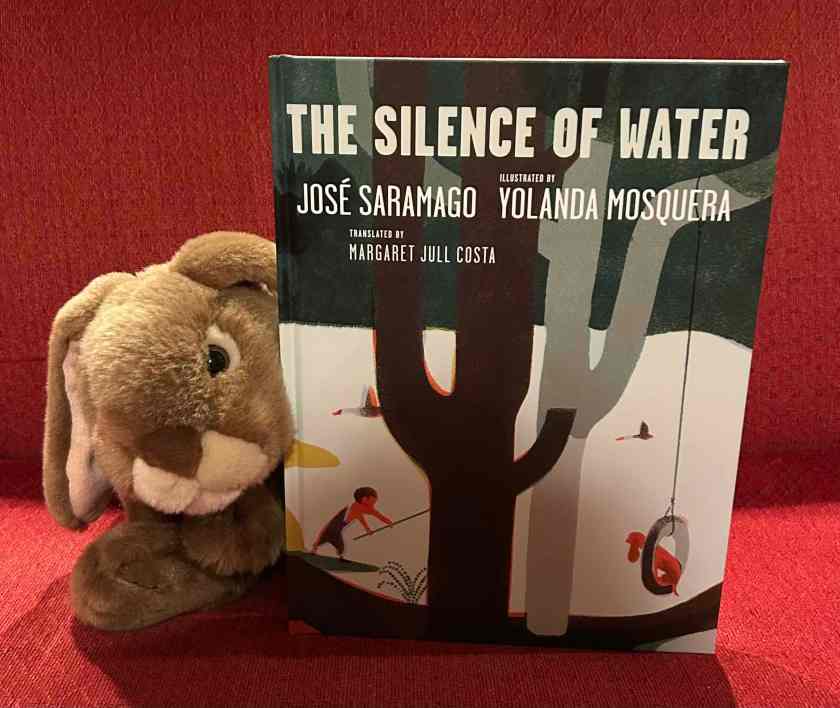
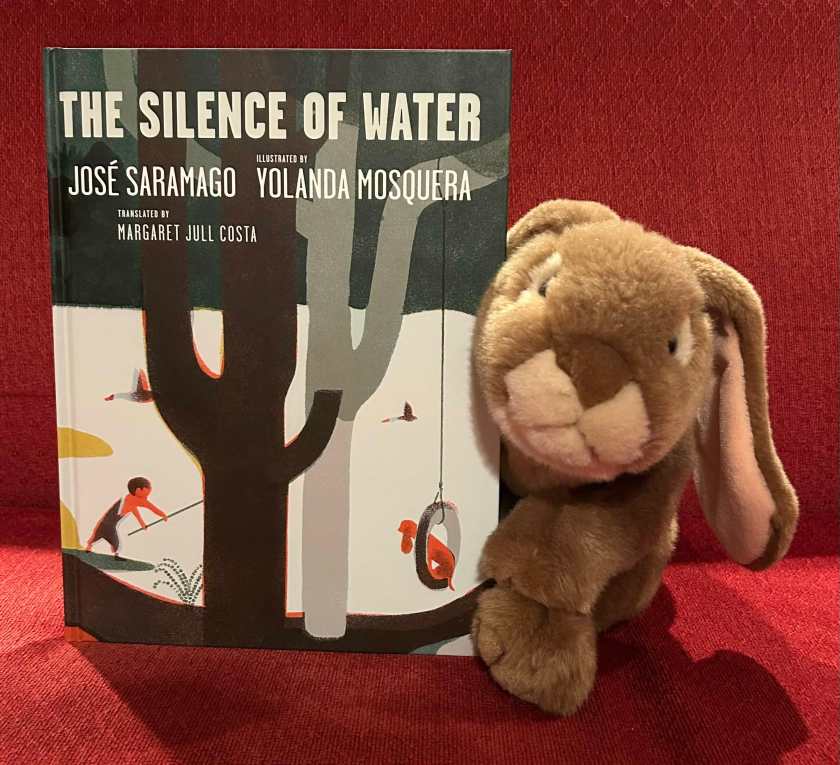
Caramel reviews The Silence of Water by José Saramago.

Sprinkles: So Caramel, today we are talking about a picture book. 

Caramel: Yes, it is called The Silence of Water. 

S: Can you tell us what it is about?

C: Sure. It is about this kid, the author, who goes fishing, and catches this big fish, a barbel, and he tries to pull it out, but the fish is too strong and escapes. It just pulls his fishing rod and everything with it too. 

S: Ouch! 

C: Yes, so the boy is annoyed, and he runs back to his home and gets another fishing rod and stuff and gets back to the pond and tries to catch the barbel again. He waits and waits, until the night falls. But he fails to catch it ever again.

S: Hmm, that is the whole story, right?

C: Yes, it is short. 

S: So what do you think about it?

C: I think it is good, but I kind of wished it was a little bit longer. There are many pages with just pictures in them. So there is a lot more room for more words. But they chose not to put more words. 

S: Do you think that could be intentional? Maybe they wanted to make you feel the “silence”, without too many words.

C: I guess that makes sense, yeah, I can see the thinking that the writer may have had. The many wordless pages are really quiet, and you do sort of feel, or even hear, the silence. 

S: I’d say many of the scenes have a serenity to them. Except the times the boy is running of course! 

C: I guess so. It’s kind of cool. 

S: The illustrations made me remember a couple books you reviewed before. Albert’s Quiet Quest and Colette’s Lost Pet, both by Isabelle Arsenault, and Captain Rosalie by Timothee De Fombelle. All three of those books had somewhat sparse illustrations, and quite limited color palettes, kind of like this book. 

C: Yeah, I can see that. There is definitely a fixed and limited color scheme, and it looks kind of like a jungle, which may have been the idea.

S: Overgrown nature all around the boy, right? But it is not the wet green of the jungle; it is a lot more subdued. Though there are some reds and blacks too. 

C: Yep, the contrast was pretty good.

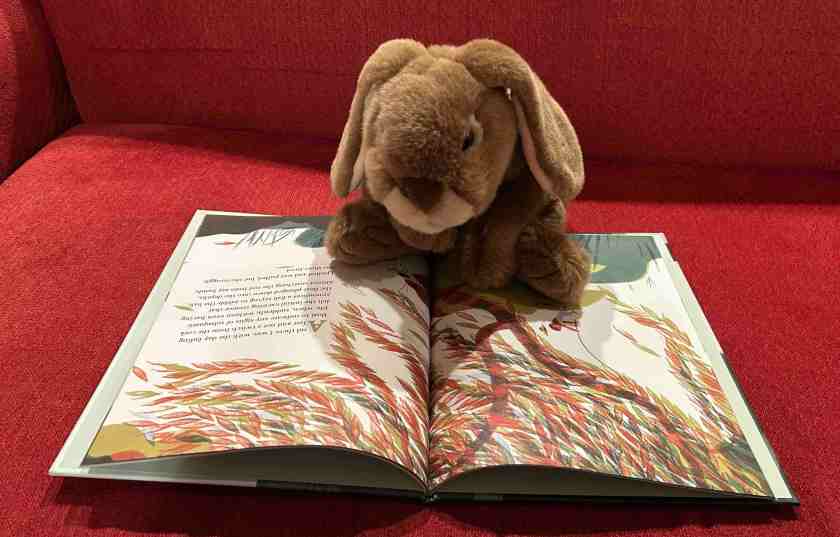
Caramel is reading The Silence of Water by José Saramago.

S: Okay, so why do you think the book is titled The Silence of Water? Which water is it?

C: The pond, I think. 

S: And in the pond, the barbel. The barbel is silent, too, right? The boy never gets to see or hear from it again?

C: Maybe, that could explain it.

S: Why do you think the author wrote this book, Caramel? What do we get out of it as readers?

C: it was the fact that he never stopped trying to catch the fish, so the theme is to never give up.

S: I can see that Caramel. A great analysis! Did you know that the text is actually an excerpt from the author’s memoir Small Memories, originally published in Portuguese in 2006? At the back cover it says that it is taken from a story of his childhood, “a tale of quiet conviction”.

C: Huh, I think “conviction” is a big word for a lot of young bunnies. 

S: You are right it is a big word. But you know what it means, right? It means more or less what you said. It means determination. It means having a belief or opinion but very firmly held. So the boy was determined to catch the fish. And it was impossible, and he more or less knew it was impossible, but he still gave it his all. And in the end, in most such stories, we often see the main character succeeding. So the moral becomes if you persist, you will eventually win. But this boy does not win. He does not get the fish. What do you say to that?

C: Well, that makes sense. The boy does not get the fish, but he knows he tried. And he also says in the end that he still left his mark on the fish. The fish is still his in some way. Though it is a bit morbid to say that. Because the mark he left on the fish is probably a big wound. The fish is probably wounded by the fishing hook and stuff. So he did leave a mark. But I am not sure I like the mark. Poor fish. 

S: You have a good point Caramel. The fish is hurt most likely. But then again maybe, since it is such a big and powerful fish, maybe it will be alright. And there will only be a little scar left. 

C: Huh, that’s a good way to see that. I hope so. And then it would be kind of like a memory. And the boy could feel that he made an impression. And it would not be so morbid. Okay, I will take it like that. 

S: Yes, let us do that. Then the boy’s story of determination, or of “conviction” like the book tells us, is still inspiring. The boy did not give up. And it was impossible, and he did fail, in the most straightforward meaning of the word, but he did leave his mark. And he did not give up. So he does end the book in an upbeat tone. 

C: Yes, he does, I guess. I was trying to understand why. This helped. 

S: Talking things out with you always helps me, too, Caramel. So overall, did you find this book worthwhile?

C: Yeah, it is a quick read, and the pictures are lovely, and when you dig into the determination thingy, it has a deeper message, too. Yes, overall, I like it! And I think other little bunnies could enjoy it, too!

S: That is great, thank you Caramel. So let us wrap this up, because it is getting really late. 

C: Yes. I should sleep soon.

S: What would you like to tell our readers?

C: Stay tuned for more book bunny reviews!
Caramel enjoyed reading The Silence of Water by José Saramago and recommends it to other young bunnies looking for a quiet book.

Marshmallow reviews The Handmaid’s Tale by Margaret Atwood

This week, Marshmallow decided to take on Margaret Atwood’s The Handmaid’s Tale. Originally published in 1985, this book is about a dystopian near-future where women’s lives are extremely constrained and their rights are almost nonexistent, and it might be a bit more challenging for some of our young readers than our usual fare.

Marshmallow reviews The Handmaid's Tale by Margaret Atwood.
Marshmallow reviews The Handmaid’s Tale by Margaret Atwood.

Marshmallow’s Quick Take: If you like books about terrifying dystopian futures, then this is the book for you!

Marshmallow’s Summary (with Spoilers): Offred is a handmaiden in Gilead who has been given to a Commander to conceive his child. Gilead is set in the north east of what used to be the United States and was established after the President, Congress, and the U.S. government were violently overthrown by the Sons of Jacob, a radical political group. The rebels set up a system that puts women as second-class citizens with no rights. This happens gradually. Early on, the Sons and the army say some of the measures are for security purposes, such as closing down roads and increasing surveillance. But eventually, women’s bank accounts are shut off and they are let go from their jobs.

Reading the signs, Offred (who had an unknown name before), her husband Luke, and her daughter attempt to flee to Canada. But Luke’s divorce with a previous wife is not valid according to Gilead’s new laws, making Offred an adulteress. They try to run away, but Offred is caught and taken away from her family. Her husband’s fate remains unknown, but her daughter is confirmed to be given to parents that firmly believe in Gilead’s ideals. Offred is taken to the Rachel and Leah Re-education Center or Red Center, in which she is taught to be a handmaiden. Amidst declining birth rates, increased infertility, and climate disasters, Gilead’s new system of birth is forcing fertile women to conceive. Handmaidens are forcibly impregnated by the leading elite—Commanders—in Ceremonies.

More generally, all people in Gilead are sorted into a structure, and power is concentrated solely at the top in the hands of certain white men. (The fate of non-white people is not described in the book.) Women are sorted into several categories: Wives who wear blue (who are married to the Commanders but have no physical or emotional bond with them), Aunts who wear brown (who re-educate Handmaids), Handmaids who wear red (who are forced to procreate with their assigned Commander, but have no relationship with anyone), Marthas who wear green (cooks, servants, etc.), Econowives who wear striped clothing (wives of lower ranking men), and so on.

The government watches its people with Eyes, who are like a secret police so that no one knows who to trust. Everyone lives in fear, but some truly believe that this is an improvement.

Offred is assigned to a Commander to bear him a child, and she is renamed Offred presumably because his name is Fred (Of Fred; all the Handmaids are named like that, like Ofwarren, Ofglen, etc.) The Commander’s Wife is Serena Joy, a former televangelist who pushed for Gilead’s extreme take of the Bible—which is used to justify the new way of life. Now, confined to home with a husband who does not love her, she realizes that the whole thing might have been a bad idea.

This Commander feels that Serena Joy does not understand him, so he invites Offred to play Scrabble with him. In this manner, they develop a peculiar bond, a sort of mutated friendship. However, Offred knows that she can never truly be friends with the man who literally has the power of life or death over her.

The Commander argues that life is much better now, and tries to convince Offred of this. At the same time, Offred’s assigned partner (for getting groceries in a very formal, terse manner) Ofglen reveals herself to be a member of a resistance group. Offred yearns for a way out, but at the same time finds herself becoming attached to the Commander’s personal servant.

What will happen to Offred? And what about Gilead?

Marshmallow is reading The Handmaid's Tale by Margaret Atwood.
Marshmallow is reading The Handmaid’s Tale by Margaret Atwood.

Marshmallow’s Review: The Handmaid’s Tale is a hard book to read, especially for a female bunny. It is definitely not appropriate for young bunnies. The book progresses in a very disturbing way. The ending is not definite, but it leaves a mark.

I read this book initially because I’d started hearing a lot more about it recently. Many people have begun to compare Gilead to the present United States of America, especially after the recent TV series adaptation of it. Some parallels do exist and are becoming more apparent, which is very saddening and truly terrifying. This book shows a distorted version of the United States, one which will hopefully never come to pass. But the geography certainly makes the book feel more urgent and too close for comfort. (Other books that depict possible dystopian futures for the United States, like Our Missing Hearts by Celeste Ng and The Hunger Games series, come to mind.)

I must say that The Handmaid’s Tale is definitely not a children’s book. Sex and sexual activity are frequently discussed—especially since Offred’s very existence is due to her fertility and ability to conceive. The world of Gilead is also in itself extremely harrowing. Political prisoners are killed by mobs at Prayvaganzas, hangings are regularly showcased at the Wall, women are ceremoniously raped, and there’s a lot of discourse about suicide. It’s a very dark book.

However, reading The Handmaid’s Tale makes one more motivated to fight for equal rights. While books like We Should All Be Feminists by Chimamanda Ngozi Adichie make clear-eyed arguments, this book depicts the chilling effects of what a world with no rights for women could be like. Offred’s mother was an activist who fought for those rights, which Offred remembers during several flashbacks. Those flashbacks are instrumental to the nuance of this book. They show the subtle ways in which the world changed, until it had transformed into a monstrous beast that couldn’t be cured.

The Handmaid’s Tale should also serve as a warning and as a reminder that democracy must be protected. Once again, as I mentioned in my review of On Tyranny: Graphic Edition by Timothy Snyder and Nora Krug, freedom is not free. This is a resounding message that has been echoed by so many people, in so many books, throughout so many different times.

It is interesting that the author does say that other countries have not changed like Gilead. In fact, it is implied that some of the states did not submit to the Sons of Jacob. There are references to war every now and then. But the way in which the narrative flows is really a testament to the author’s prowess. It leaves the reader with an understanding of how Offred feels because of how confused and disturbed and angry and anxious and traumatized the plot leaves one.

I would definitely recommend The Handmaid’s Tale to everyone, but once they can handle it and they can understand the reason for reading such a book: to understand why equal rights for all are so important. 

Marshmallow’s Rating: 100%

Marshmallow rates The Handmaid's Tale by Margaret Atwood 100%.
Marshmallow rates The Handmaid’s Tale by Margaret Atwood 100%.