Marshmallow reviews Enola Holmes: The Case of the Bizarre Bouquets by Nancy Springer

Today Marshmallow reviews the third book in Nancy Springer’s Enola Holmes series: The Case of the Bizarre Bouquets, first published in 2008. (You might also like to see Marshmallow’s reviews of the first two books: The Case of the Missing Marquess and The Case of the Left-Handed Lady.)
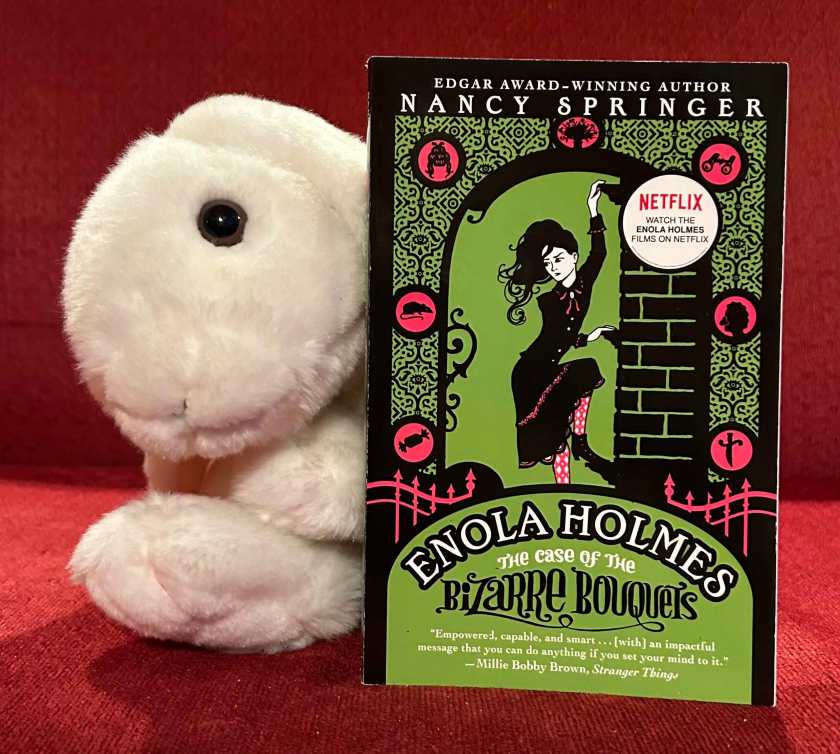
Marshmallow reviews Enola Holmes: The Case of the Bizarre Bouquets by Nancy Springer.

Marshmallow’s Quick Take: If you’re a Sherlock Holmes fan or if you like mysteries with female protagonist detectives, then this is the book for you!

Marshmallow’s Summary (with Spoilers): Enola Holmes has been living on her own in nineteenth century London for a couple months now. Given the fact that she is fourteen years old, one might ask why. The reason for her self-inflicted solitude is the fact that, during this period, women have no autonomy in the social status quo. Enola’s mother ran away from this set-up in a previous book and left Enola the means to do the same. Enola (whose name spells “alone” backwards) examined her surroundings and the expectations she was going to be forced to fulfill (finishing school, marriage, childbirth, etc.) and followed her mother’s suit. In doing so, Enola escaped the control of her older brothers: Mycroft and Sherlock Holmes (the famous detective). But even the famous detective Sherlock Holmes cannot locate her and she (while lying low) becomes adept at disguising herself by altering her appearance through various methods. Drawn to mysteries and puzzles, she solves several cases on her own (see for example The Case of the Missing Marquess and The Case of the Left-Handed Lady) and decides to found her own business as the world’s first and only professional “perditorian” (see The Case of the Missing Marquess: “From the Latin perditus, meaning “lost.” Perditorian: one who divines that which is lost”.)

Unfortunately, because women have no autonomy, she creates the business under the name of a male doctor while she disguises herself as his “assistant” Ivy Meshle. However, if her brothers find her, she will be forced to return to them and begin training to be a perfect “ornament to genteel society.” After several close brushes of being discovered by Sherlock and / or Mycroft, Enola once again finds herself drawn to the case of a certain Dr. John Watson. The reticent Arthur Conan Doyle reader may notice that this is the same Dr. Watson who is Sherlock’s loyal companion on his cases. For the few times she met him, Enola felt a fatherly affection towards Dr. Watson, so she (after some introspection and inspection of the situation) decides to search for Dr. Watson, too.

Normal mysteries are dangerous on their own. But her brother’s close proximity to this case makes it also a gamble with the freedom and autonomy she has had so far. Will Enola be able to find the doctor before her brother finds her?
Marshmallow is reading Enola Holmes: The Case of the Bizarre Bouquets by Nancy Springer.

Marshmallow’s Review: I would really recommend reading the first couple books in this series before this one to get context. But on its own, the world-building is enough to immerse the reader entirely in this Victorian-era mystery. The author consistently writes fascinating mysteries that never fail to disappoint in intrigue and complexity; yet the reader is never left confused at the end.

These Enola Holmes books stand out among all other mysteries I’ve read so far because the setting is so wonderfully set up. People often say reading is like a passport to other worlds and times. I was pretty sure they were lying, until now. Once I started reading this book, I couldn’t put it down because I didn’t want to stop learning about the mystery and the fascinating world it is in. The descriptions of London (I am pretty sure) are all factually correct for that time and all the details create an immersive experience that I would fully recommend.

This book series is also unique because it depicts a girl who is fully independent. Enola is perhaps the only female protagonist I have ever read about who isn’t in love, interested in, dating, or married to a guy. She is truly alone (in that sense) and is perfectly fine with it. It is good for girls to see that they have the choice to be so and that it is fine to be fine with that. This book also has strong themes of feminism; Enola’s strength, competence, and wit are rebelliously scandalous for the time. She stands up to the patriarchical system and doesn’t care what it thinks of her. She games the system to use it to her advantage when she disguises herself. But she never forgets to help the less fortunate with her fortunes.

But Enola is also more distinctive among other female protagonists because, as the author explicitly makes sure to state, Enola is not traditionally beautiful. She has a large nose, no delicate, feminine features of particular value, and a body like a “beanpole.” It is Enola’s virtue, brains, and bravery that makes her such a compelling character and I, for one, am expectantly looking forward to reading the next book!

Marshmallow’s Rating: 100%.
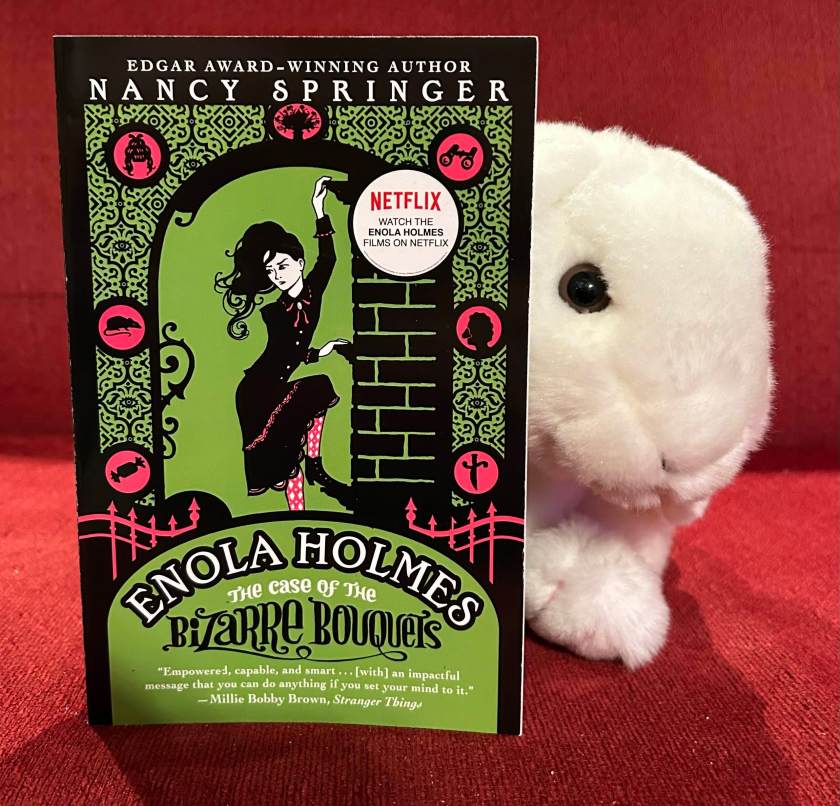
Marshmallow rates Enola Holmes: The Case of the Bizarre Bouquets by Nancy Springer 100%.

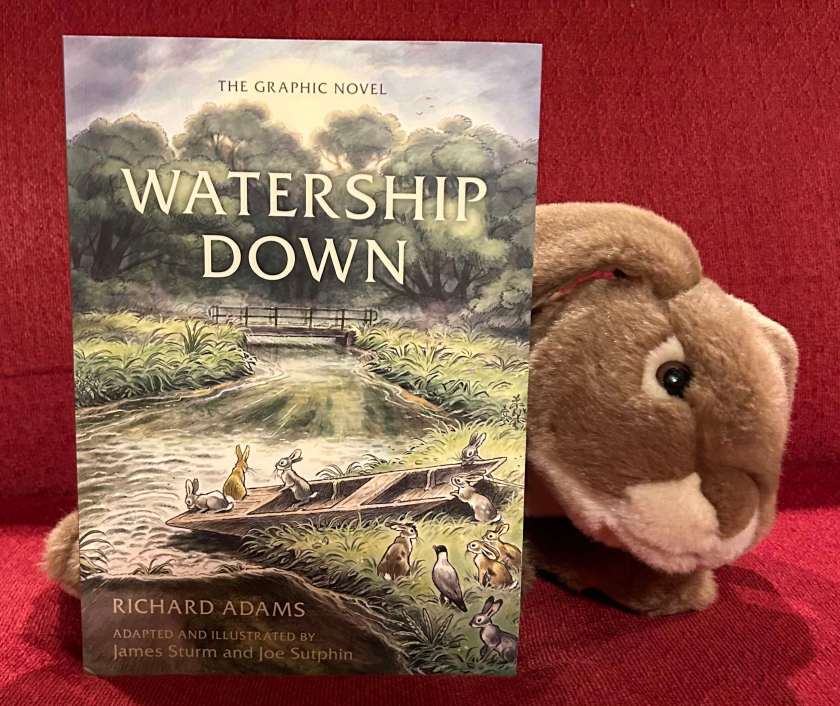
Caramel reviews Watership Down: The Graphic Novel by Richard Adams, James Sturm, and Joe Sutphin

Many years ago, over the course of a few days, the book bunnies listened all together as a family to an unabridged version of Watership Down, the 1972 classic by Richard Adams. Recently Caramel got his paws on a new (2023) graphic novel adaptation of the book by James Sturm and Joe Sutphin and read it over the course of a few hours. Today he is talking to Sprinkles about the book.

Caramel reviews Watership Down: The Graphic Novel, written by Richard Adams, adapted by James Sturm, and illustrated by Joe Sutphin.

Sprinkles: I remember how we listened to this whole story when you all were so much younger. So when I saw that there was a graphic novel adaptation, I knew you would want to read it. 

Caramel: Yes, I guess you were right! You know me well.

S: I think I do! Okay can you tell us a bit about the story?

C: Sure. In this book there are bunnies like us, but they are wild and are trying to escape from a great evil that was foretold by one of them named Fiver.

S: Oh, I think I remember Fiver. Isn’t he the dreamer one? Kind of like an oracle?

C: Yeah, kind of. He can see the future and warns the others of the dangers so they can survive.

S: Okay, so here is a group of rabbits living in a warren. That is, my dictionary tells me, a network of interconnecting rabbit burrows. And they are living a normal wild rabbit life. But then some great evil thing happens, is that it?

C: Yes, it is kind of like that. However not everyone believes Fiver, and so not all of them make it.

S: Well, I can see how not everyone would immediately believe some little bunny saying something terrible will happen, without evidence. But his brother believes him, right?

C: Yep, so Hazel, that is Fiver’s brother, gathers everyone who believes Fiver and they run. 

S: So they leave their warren and wander away, and try to find a new place to settle down at?

C: Yep. Along the way they find a different warren in which there are some not-so-nice bunnies who try to kill the main character bunnies, but thankfully the good bunnies make it out, and they get two new bunnies from that warren.

S: Cool! Okay, so Fiver is the dreamer, oracle bunny. Hazel is the main leader bunny. Are there other characters that you especially liked or remembered from when we listened to the book those many years ago?

C: Fiver is my favorite, I don’t know why but he is my favorite bunny in the book.

S: He is a gentle soul, as far as I remember. He is sensitive and kind. 

C: Yeah, but he can also see the future, and that is cool.

S: Yes, that is really cool, I agree. I do remember another character, Bigwig, I think. He is a fighter, and a good one too. 

C: Yeah, he is also really cool, but Fiver is still my favorite character. There is also a big bird who helps the bunnies occasionally, His name is Kehaar. 

S: That is cool! I liked that character, too. 

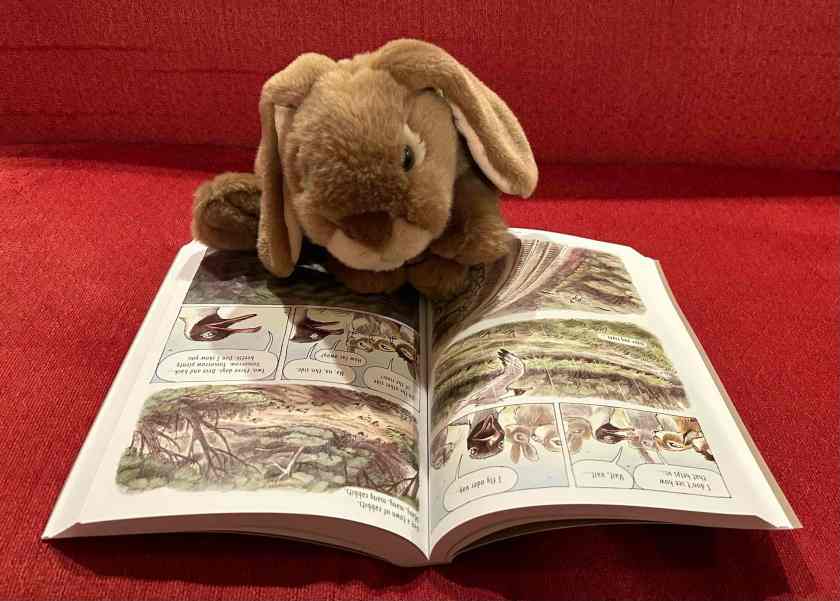
Caramel is reading Watership Down: The Graphic Novel, written by Richard Adams, adapted by James Sturm, and illustrated by Joe Sutphin.

S: Okay, so when we listened to this book many years ago, we had no images to attach to the main characters. But a graphic novel of course will have faces attached to each character. Did these work for you? Did you like the illustrations? Is the world of Fiver and Hazel how you had imagined it to be?

C: Yeah, it is a lot like what I thought. The bunnies are all very realistic looking, too, and exactly how I imagined them to be. 

S: That sounds great! I was just going to ask you if they were more cartoonish or more realistic. So this was perhaps the longest graphic novel you have ever read, right? 

C: Yep, it was 382 pages!

S: That is long for a graphic novel. But the original book is a very long one, too, so that makes sense. Anyways, did you know that the original book was banned in some places because it was too violent and there was a lot of brutality depicted explicitly? 

C: Oh no. I did not think it was too violent. 

S: Well, then again, you do like the Wings of Fire series and those are also kind of violent. So maybe your generation of bunnies is a bit more used to violence… 

C: No, I would hope not.

S: I see what you mean Caramel. Yes you are right, it is not a good thing to get used to violence. Maybe I should have said that you can handle some more violence. I think that especially when they made the animated movie in 1978, the movie started out looking like a typical Disney movie, with cute bunnies who speak and are living in this idyllic natural place, but then things get dark very fast, and terrible things happen, bunnies killing each other, getting killed by humans, and so on. So maybe it shocked people a lot more back then. 

C: Maybe. 

S: I also read that it was banned in China for a while because it depicted animals and humans as equals or at least somewhat on a similar level, and this was unacceptable. 

C: Hmm, they probably would not like Animal Farm either, then. Or us.

S: Yes, you have a point there Caramel. Bunnies talking about books would probably not be okay. Anyways, we are bunnies who love to read and talk about books. So let us get back to the book. So overall, did you enjoy this graphic novel?

C: Yes, greatly. And I recommend it to all young bunnies who like to read about other bunnies being heroic. 

S: Cool! Okay let us wrap this up then. What would you like to tell our readers?

C: Stay tuned for more book bunny reviews!

Caramel enjoyed reading Watership Down: The Graphic Novel, written by Richard Adams, adapted by James Sturm, and illustrated by Joe Sutphin, and recommends the book to all young bunnies who like to read about other bunnies being heroic.

Marshmallow reviews Thornhedge by T. Kingfisher

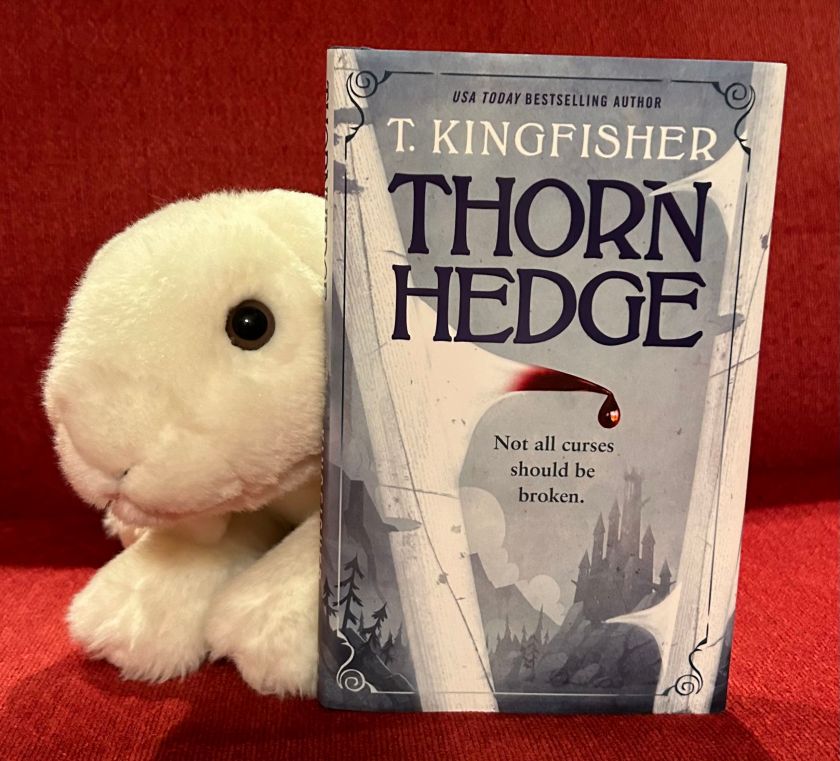
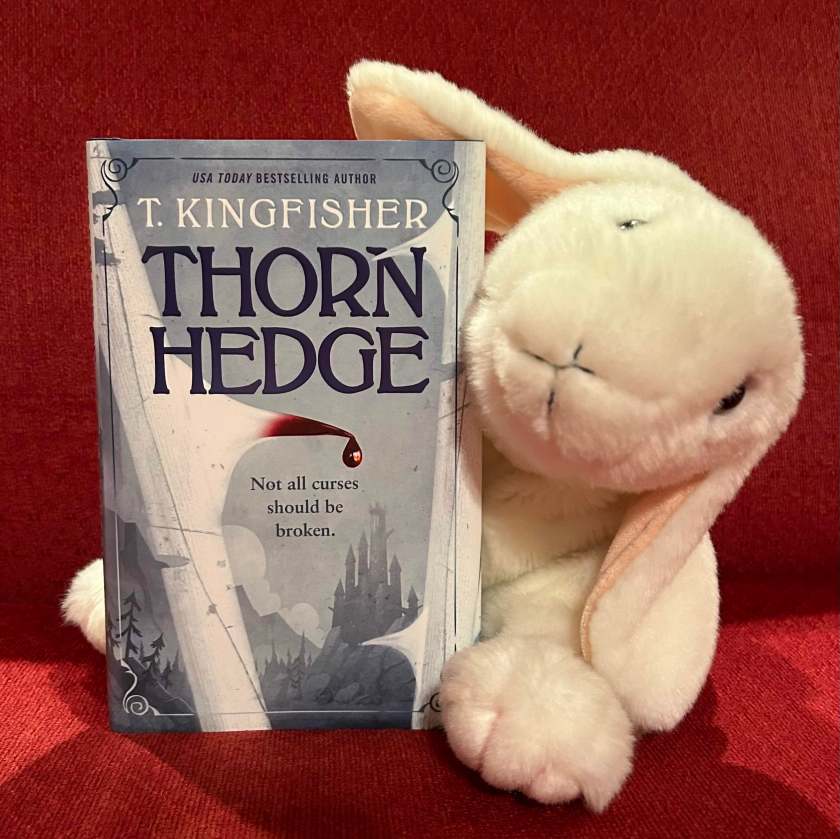
Today Marshmallow is talking to Sprinkles about Thornhedge, a 2023 book by T. Kingfisher that won the Hugo Award for Best Novella in 2024.

Marshmallow reviews Thornhedge by T. Kingfisher.

Sprinkles: So Marshmallow, I know you love retellings of fairy tales, so I thought you would appreciate this book. Was I right?

Marshmallow: Yes.

S: Yay! I liked it too. So tell us a bit about the book.

M: This is a retelling of the Sleeping Beauty story. I had already read and reviewed Thornwood, another retelling of Sleeping Beauty, and that was pretty good too, but this one turns things even more upside down.

S: What do you mean?

M: Well, first of all, the narrator is a timid creature who calls herself Toadling, and we eventually learn that she is the fairy godmother who was the one to put the princess to sleep. But nothing is as we think we knew it to be.

S: You are being quite cryptic Marshmallow.

M: Yes, I am a very cryptic bunny.

S: That might not be optimal for one who is reviewing a book!

M: Well, I do not want to spill all the beans!

S: Okay, yes, you do have a point, but maybe then let us give the readers just a bit more.

M: So as I said, the book tells the story of the fairy godmother of Sleeping Beauty. It turns out that she was a human child, and she was kidnapped from the castle of her parents, a king and a queen, by evil fairies who replaced her with a changeling. Changelings are powerful creatures that seek to cause mischief or even worse. There is a deeper reason for why they cause mischief, but maybe this is enough for the time being.

S: Okay, so changelings in the sense of European folk stories.

M: Yes, not like the changelings of Star Trek Deep Space Nine.

S: Okay, I see.

M: When Toadling was replaced by a changeling, she was taken to the fairy world and was raised there by some frog-like fairy creatures called greenteeth. Then she is then somewhere else by a hare goddess and trained to be a fairy godmother.

S: Ooh, I like it when there are bunnies in the story!

M: Well, I am not sure this hare goddess is a very nice bunny. Anyways, time passes differently in the fairy world and the regular world. So by the time Toadling has spent nine years with the greenteeth and one year in training, the changeling named Fayette has just been “born”. So Toadling goes and becomes her doppelganger’s godmother.

S: That is interesting. Do her parents recognize her?

M: No. The nine years she spent with the greenteeth underwater have changed her and morphed her into a toadlike creature. She can look humanlike, but also can transform into a toad when she wants.

S: I see. So why is Fayette sleeping though?

M: Well, she is not, when Toadling comes by, but Toadling is supposed to do some magic and make her not harm anyone but she is sidetracked somehow and misses the opportunity to do her magic fully. So she ends up trying to stay around the child to make sure she will not harm anyone. But as the child grows up, she becomes more and more unruly, and at some point even starts torturing animals and shows no remorse or pity. So Toadling decides to put her to sleep.

S: That is awful! So these changelings are pure evil?

M: Well, in some sense yes, they are evil. But there is actually a reason for this. The changelings who are placed in human families are also babies when the switch occurs. However, these changelings belong to another plane of existence (the fairy world, I think), so nothing feels real to them. They grow up never really feeling anything, never being able to taste any food, and having metallic things burn them upon touch. The changelings grow up in a world without their kind, knowing in the back of their mind that this was not where they were supposed to be. Ultimately, they grow up confused and alone, and to them, human life is insignificant in this fake, foreign world.

S: Yes, but so was Toadling taken and placed in a totally different world. And she did not become wantonly cruel. She wants to help she wants to diminish people’s pains.

M: You have a point, so maybe the changelings have some tinge of evil in them from the start. But then again, Toadling was in some sense lucky. The greenteeth were kind to her and loved her.

S: But a family whose baby has been replaced by a changeling would also love that changeling, not knowing that it is not their original baby.

M: Yeah, I guess. But I kind of want to believe that nothing is born evil.

S: I can totally understand that and sympathize.

Marshmallow is reading Thornhedge by T. Kingfisher.

S: Okay back to the story though. So Toadling put the changeling to sleep and then what happens?

M: Well, lots of time passes. Centuries. And Toadling stays around the castle and grows a thorn hedge around it to keep people out. She hopes that people will eventually forget the castle, the story of the princess who fell asleep and so on. Unfortunately people do spread the story, and even though she hides things so well that most do forget, there comes a knight one day who wants to save the princess. But maybe it is not the princess who needs saving but Toadling herself!

S: Ooh, that is a great way to wrap up your summary and keep things still open!

M: Thank you.

S: Okay, so now tell me a bit about the book in terms of style.

M: I liked how the author used a very simple voice but still managed to capture a fairy-tale atmosphere for the story. And she created this character, a timid human-fairy child, that is very likeable. She was only ten when she became this fairy godmother, but then she lived outside the castle for centuries, determined to keep the world safe from the changeling-princess. So she grows up and maybe more mature but she still has this childlike innocence.

S: I agree.

M: I also like how the author develops two themes throughout the book; these were the two I caught: first magic being intertwined and represented and talked about as water. And second how beauty is not surface-level, that beauty is not what you see on the outside, but something else entirely. The changeling looks like a beautiful child, but she is evil and to Toadling she looks terrifying. The greenteeth would look ugly to us probably but to Toadling they are strong, and they define beauty for her. It is somehow related to their strength and skills.

S: But she likes them, they are kind to her, and they are her family.

M: Yes, but it goes beyond that I think. Toadling is raised in this other world based on scavenging and surviving, so she learns to appreciate totally different things, not superficial beauty but something beyond. She values traits like skilled hunting over things like soft smooth skin.

S: That makes sense to me Marshmallow. So this short little book was worth reading then?

M: Yes, 100%. Which is also, coincidentally, how I’d rate it.

S: I was just going to ask that!

M: Well, now you don’t have to!

S: Yes, thank you. Okay, let us wrap this review then. What would you like to tell our readers?

M: Stay tuned for more amazing reviews from the book bunnies!

Marshmallow rates Thornhedge by T. Kingfisher 100%.

Caramel reviews The Hitchhiker’s Guide to the Galaxy by Douglas Adams

Today Caramel is talking to Sprinkles about The Hitchhiker’s Guide to the Galaxy, the 1979 book by Douglas Adams that originated from a 1978 radio show and then went on to evolve into a whole “comedy science fiction franchise”, according to Wikipedia.

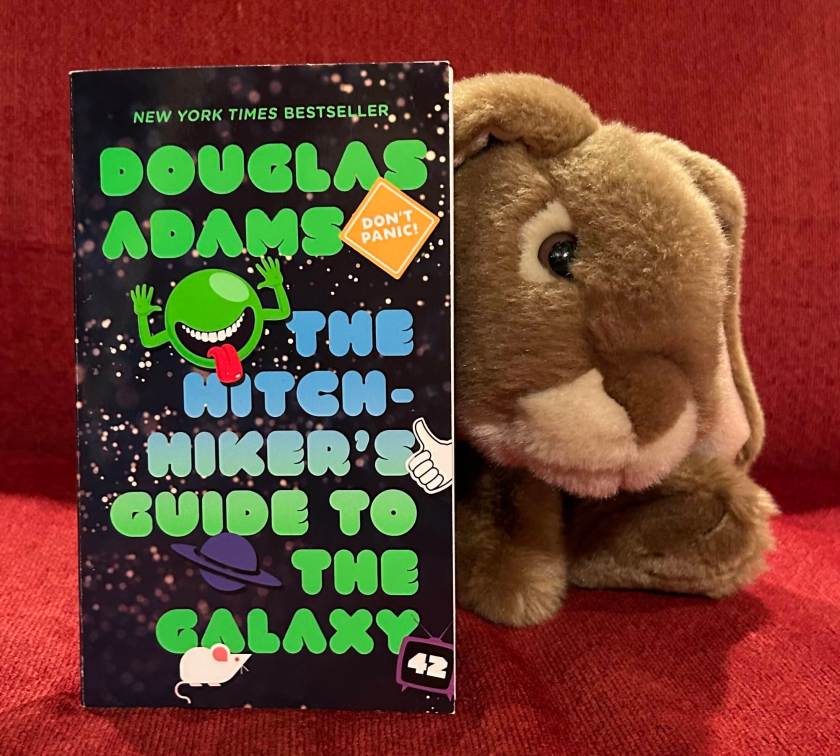
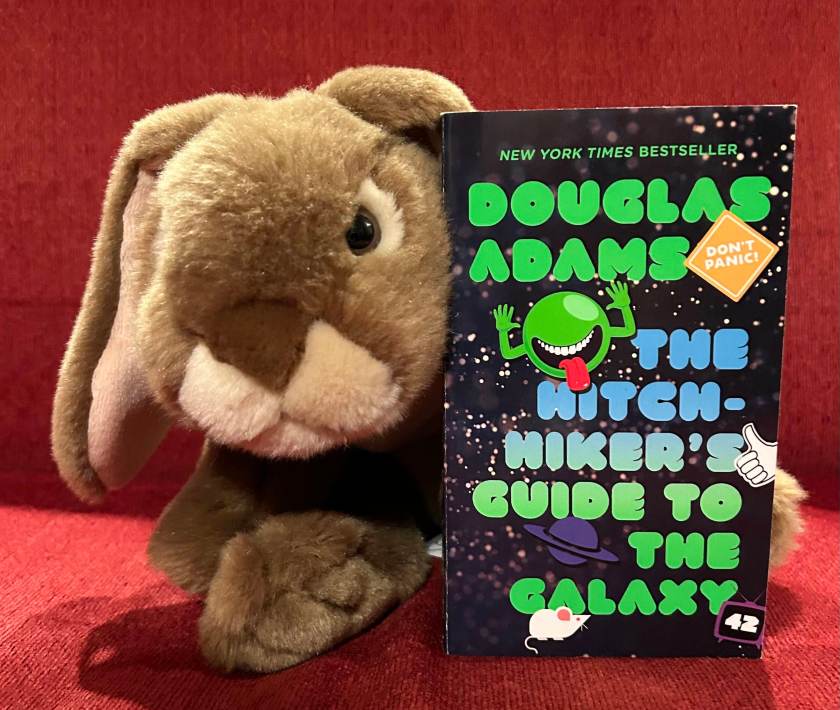
Caramel reviews The Hitchhiker's Guide to the Galaxy by Douglas Adams.
Caramel reviews The Hitchhiker’s Guide to the Galaxy by Douglas Adams.

Sprinkles: So we are talking about The Hitchhiker’s Guide to the Galaxy today. I am excited! I had really enjoyed reading this book myself.

Caramel: Yup, this book was surely a really good read. I had a lot of fun reading it.

S: Yay! So maybe we can start with a brief introduction to the story for anyone reading our blog who might not know about it. 

C: Sure. It is a scifi book that is infused with a lot of comedy.

S: It is funny, I agree. Tell us more.

C: This book tells the story of a guy named Arthur Dent and another one named Ford Perfect.

S: It is actually Prefect, as in Ford Prefect, the car

C: Yes, I knew that but somehow forgot. Yes, he is actually named that because he came to Earth fifteen years before the start of this story, maybe around when the car came out, you see Ford Prefect is an alien from Betelgeuse Seven. 

S: Yes, apparently the author at some point said that Ford “had simply mistaken the dominant life form on Earth” (again according to Wikipedia). 

C: Yes, when you look at it from outer space, apparently, humans don’t look like the dominant species on Earth. So Ford Prefect thought he should blend in and  gave himself the name of a common car. But actually humans are really not the dominant species on Earth, according to The Hitchhiker’s Guide. It is the mice who are the smartest species on our planet. 

S: That is funny! I mean, we have read many books about clever mice, remember Poppy and Ragweed

C: Yes, then there is Ralph and Babymouse. So to me it sounds reasonable!  

S: But this book is not really about mice, is it? 

C: No, it is about the adventures of Arthur and Ford. So Ford comes to Earth to work on a guide book, and then is stuck. At the time when the book starts, Ford knows that the planet is going to be destroyed soon and wants to save Arthur and he tries to teach him about life in the universe. He tells him about this amazing guide book, The Hitchhiker’s Guide, that anyone who is going out traveling in space should have. 

S: So the book The Hitchhiker’s Guide to the Galaxy is about a book called The Hitchhiker’s Guide to the Galaxy

C: Kind of, but it is more about Ford and Arthur. 

S: So what happens? Do they leave the Earth together? And why on earth is the Earth going to be destroyed?

C: Because the planet is in the way of an intergalactic highway that some people want to build.

S: Ouch! That’s rough! Okay, so Earth cannot appeal and they have to leave, right? What do they do? Does the Earth really get destroyed in the book?

C: Yes, the entire planet is destroyed and turned to ash. 

S: You said this was a funny book. That sounds pretty terrible. 

C: Yes, but you know it is fiction when you are reading it. And the book is funny! Really funny. And they do not go into the details of the destruction at all really; that is almost an excuse to get Ford and Arthur traveling together.

S: And also telling us that our planet is one of many and maybe we should not be so full of ourselves if they can just demolish it to make a highway, like we do not really matter in the grand scheme of things. 

C: When you say it like that, it maybe does not sound so funny, but it is really funny Sprinkles. 

S: I know Caramel, and actually I like being reminded that we should not be too full of ourselves. Our lives matter, what we do matters, but we are not at the center of the universe. It is a small world after all but it is inside a very big universe.

Caramel is reading The Hitchhiker's Guide to the Galaxy by Douglas Adams.
Caramel is reading The Hitchhiker’s Guide to the Galaxy by Douglas Adams.

S: Anyways back to the book. So what happens in the end? You know there are many more books in the series?

C: They get picked up on accident by an alien ship, and are then thrown out of the ship, and then are picked up by another ship. Apparently Arthur is the only human remaining from Earth, and it is kind of funny because he is just a normal guy. Anyways, along the way a lot of hilarious things happen and we learn from Ford about the Guide and all sorts of weird facts from it. 

S: Oooh, you like facts! But of course these are probably fictional facts, right? Can you tell me a couple?

C: Yep, they are fictional but also really fun. One is about the Babel fish which feeds off of brain waves and can translate any language.

S: Ooh, cool, like the universal translator in Star Trek or in Doctor Who, but it is a fish! Awesome! One more?

C: There is a thing called the Pan Galactic Gargle Blaster, which is a cocktail that contains Ol’ Janx Spirit, a particularly vicious alcoholic drink, and is so strong that you will need to recuperate in a hospital. 

S: That sounds bad. Okay, so maybe it is time to wrap up this review. Overall it seems like this book kept you entertained, right? Do you want to read the next book in the series? It is called The Restaurant at the End of the Universe. I think there are five more books in total. 

C: Sure, why not?

S: Alright, we will see if we can get you a copy. Okay, Caramel, what would you like to tell our readers as we wrap up this review?

C: Stay tuned for more book bunny reviews!

Caramel enjoyed reading The Hitchhiker's Guide to the Galaxy by Douglas Adams and is keen to read more from this series.
Caramel enjoyed reading The Hitchhiker’s Guide to the Galaxy by Douglas Adams and is keen to read more from this series.