Caramel reviews The Science of Acne and Warts: The Itchy Truth About Skin by Alex Woolf

Caramel has recently been reviewing a series of books about the human body for the book bunnies blog. So far he has reviewed  The Science of Snot and Phlegm: The Slimy Truth about Breathing by Fiona MacDonaldThe Science of Scabs and Pus: The Sticky Truth About Blood by Ian Graham, and The Science of Poop and Farts: The Smelly Truth About Digestion by Alex Woolf. Today he is talking about the fourth and last book in the series: The Science of Acne and Warts: The Itchy Truth About Skin, written by Alex Woolf. As usual, Sprinkles is asking questions and taking notes.
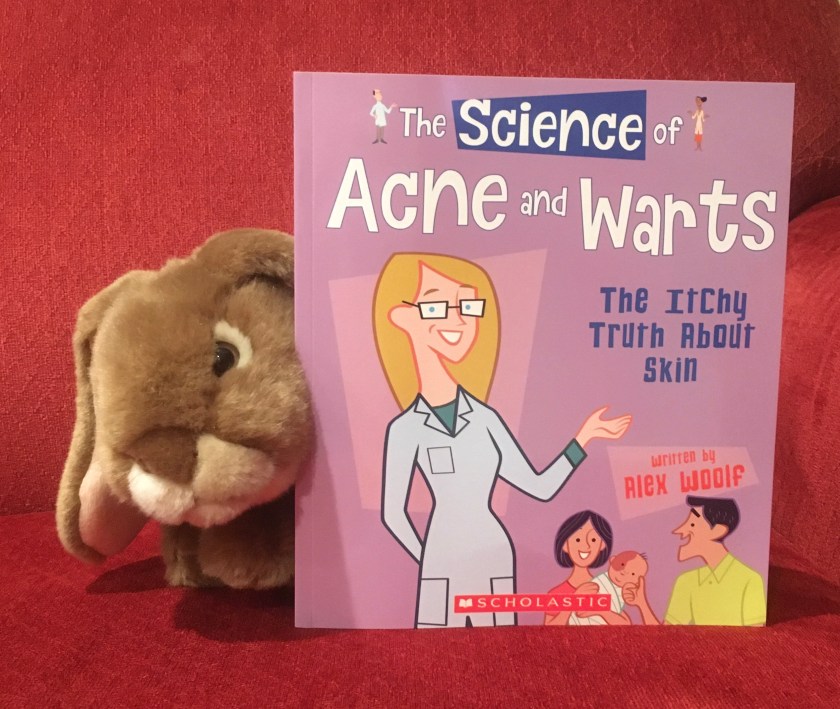
Caramel reviews The Science of Acne and Warts: The Itchy Truth About Skin by Alex Woolf.

Sprinkles: So Caramel, tell us about this book.

Caramel: This is a book about human skin. You can learn everything about skin by reading it.

S: So tell me something you learned then.

C: I learned that the layers of skin are the epidermis, the dermis, and the very bottom one is subcutis. I also learned how the body creates blood clots.

S: Wait, blood clots were in The Science of Scabs and Pus: The Sticky Truth About Blood by Ian Graham, too, right?

C: Yes.

S: So why do they show up here too?

C: Because when your skin is wounded, and it is trying to repair itself, you make a blood clot.

S: Hmm, so it is about blood but also about the skin, I see. So what else is there in this book?

C: There are pages about fungal infections, warts, acne, skin rashes, …

S: Hmm, those all sound quite irritating at the very least. Nobody likes them.

C: True, but they are also very interesting.

S: I guess that means the author is doing a good job keeping things engaging.

C: Yeah.
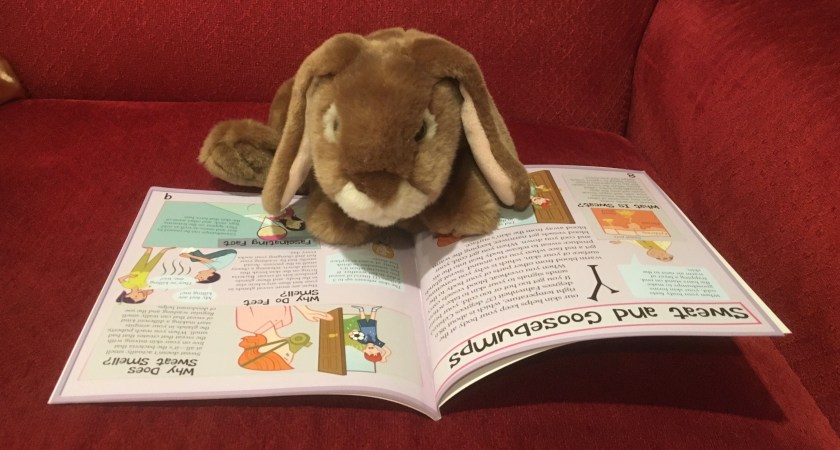
Caramel is reading The Science of Acne and Warts: The Itchy Truth About Skin by Alex Woolf.

S: What is the most interesting thing you learned from the book?

C: Let me see. There are a lot of interesting things in here. Here is one: Did you know that some of the dust at home is dead skin cells? People lose up to 30,000-40,000 dead skin cells every day. That adds up to 9 pounds of skin every year.

S: Wow! That is amazing!

C: Here is another interesting fact: There is a skin condition, a hive called dermographism, where you write on your own skin with your finger. It stays there as a rash for fifteen minutes.

S: That is so interesting. I had never heard of it before. Here is the Wikipedia article about it if our readers want to learn more.

C: Here is another strange fact. There is a mouse in Africa, the African spiny mouse, and it loses its skin when a predator catches it. Its skin just peels off and the mouse can run away. And it can regenerate new skin and is safe from the predator.

S: That is a very interesting defense mechanism Caramel. Okay, let us wrap this up so you can go on ahead and reread the book if you want to. But before we do that, tell me your three words to describe this book.

C: Interesting, helpful, and colorful.

S: Those work! Okay and as your last words to wrap things up?

C: Stay tuned for more book bunny reviews!
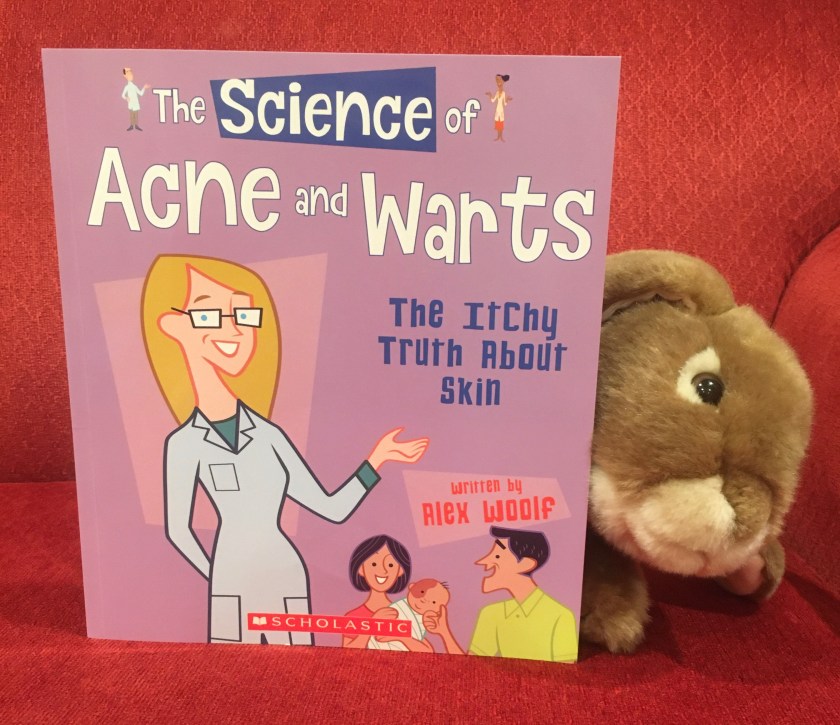
Caramel enjoyed reading The Science of Acne and Warts: The Itchy Truth About Skin by Alex Woolf, and learned a lot.

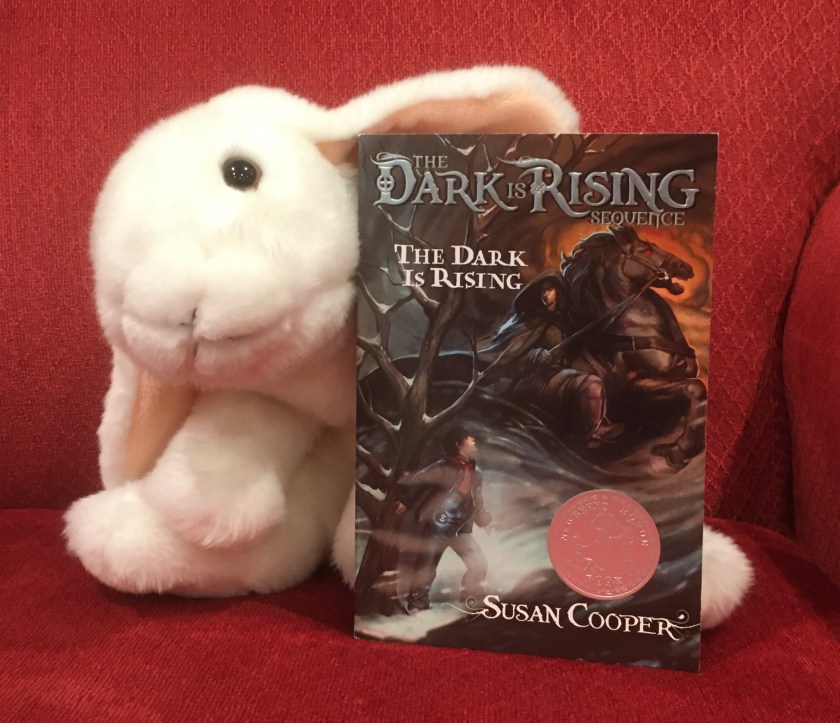
Marshmallow reviews The Dark Is Rising by Susan Cooper

A few weeks ago Marshmallow reviewed Over Sea, Under Stone by Susan Cooper. Today she is talking with Sprinkles about The Dark Is Rising, Susan Cooper’s next book in The Dark Is Rising series, the book that gave the series its name and received a Newberry honor in 1974.

Marshmallow reviews The Dark Is Rising by Susan Cooper.

Sprinkles: Marshmallow let us start with you telling us what this book is about.

Marshmallow: This book is about a boy named Will. On his eleventh birthday, he discovers that he is one of the Old Ones. That means he has some special kind of magic powers.

S: Hmm, that reminds me of another eleven-year old boy who discovers he has magic powers…

M: Yes, Harry Potter also learns about his magic powers when he turns eleven.

S: Why do you think these two authors took this age to be the time for these boys to discover their hidden powers?

M: Probably because that is the average age of the readers they are targeting.

S: That is a very good reason Marshmallow. Can you think of any others?

M: I guess that is when children go to a new school, like finishing primary school?

S: I think that might be related. Eleven is also the age when many children start going through puberty. So it is naturally a time of change and discovery.

M: I guess that makes sense.

S: So now tell me what these Old Ones are about.

M: They are godlike, powerful beings, with magical powers. I think they might be immortal. They are on the side of the Light, which is always fighting the Dark.

S: Hmm, tell me more. What is the Light? Is the Dark the dark that is rising in the title of the book?

M: The Light stands for good and the Dark is evil.

S: So if the Light is represented or protected by immortal beings, are the protectors and defenders of the Dark also immortal?

M: Not sure. I think so. The Dark seems to find helpers at any era though, and the story of the book is about the twentieth century when a new battle is being fought.

S: Is this related to any of the wars of the twentieth century?

M: I think they might be related, but the fight between the Light and the Dark Will is pulled into involves him finding the Six Signs.

S: Hmm, what are the Six Signs?

M: They are six symbols made of wood, bronze, iron, water, fire, and stone. The fire and water ones are not really made of fire or water of course. But they represent them.

S: So Will is supposed to find these objects to help the Light, right?

M: Yes.

Marshmallow is reading The Dark Is Rising by Susan Cooper.

S: So this book is supposed to be in a five-book series that started with Over Sea, Under Stone. How are the two books related? Will was not in that first book, nor have we heard about the signs in that one.

M: True. Will was not in that book. And this book seems pretty unrelated to that book. But there is a character in this one that we know from the first book: Merriman Lyon in this book is Uncle Merry from the first book. And the events of the first book are mentioned in passing in this one.

S: That is interesting. And it seems from the description of the third book in the series that Barney, Simon and Jane, the three children from that first book, will meet Will eventually.

M: Oh, that’s intriguing!

S: We are going to have to read that third book soon then, I suppose.

M: Yes, I guess so.

S: Then did you enjoy reading this one?

M: Yes, I liked it! I rate it 1o0%.

S: Cool! Let us wrap up this review then. You always want to end our chats the way Caramel ends his reviews. Right? So go ahead!

M: Stay tuned for more book bunny reviews!

Marshmallow rates The Dark Is Rising by Susan Cooper 100%.

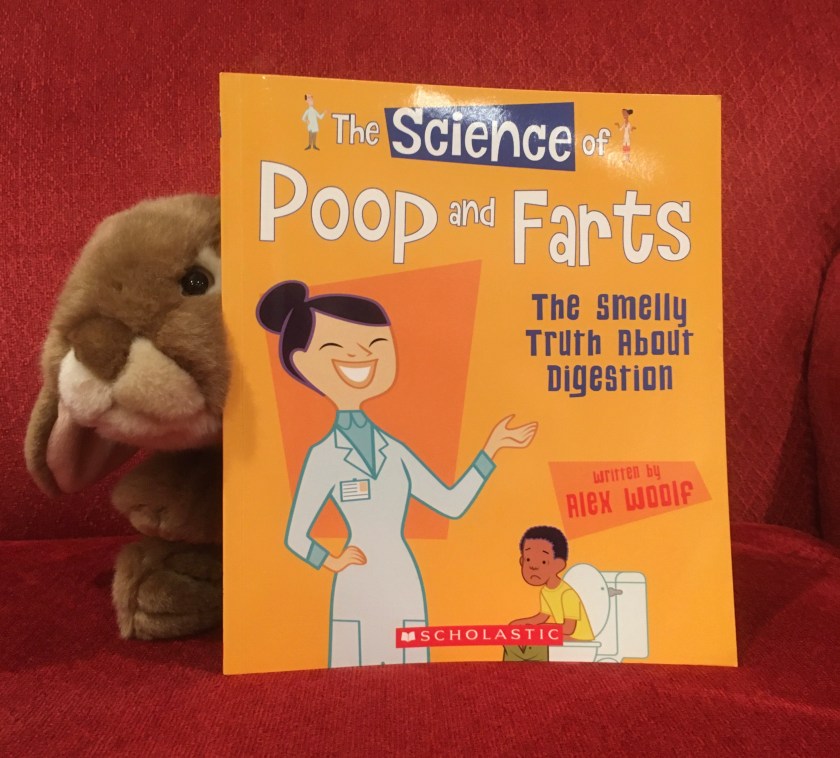
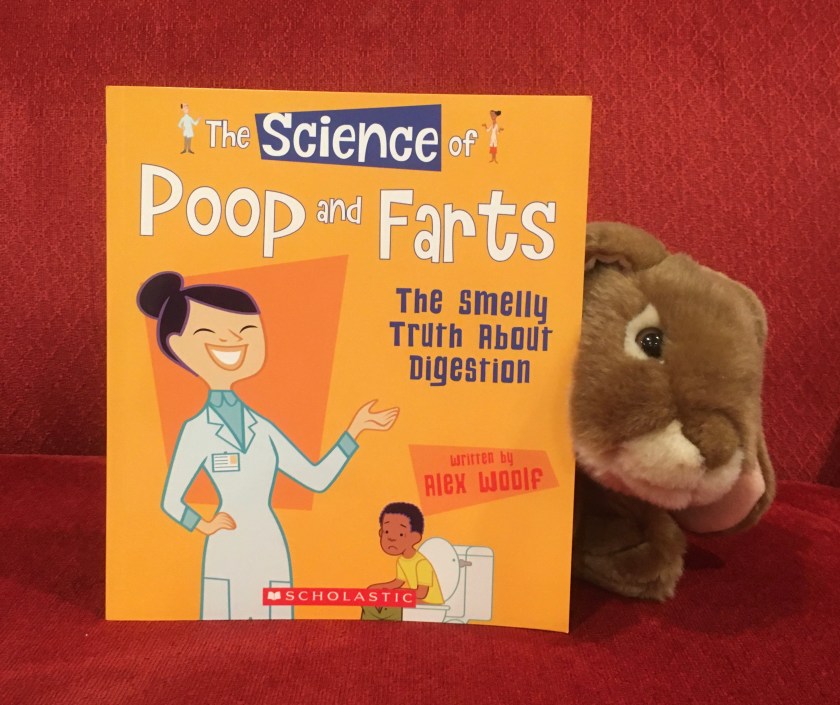
Caramel reviews The Science of Poop and Farts: The Smelly Truth About Digestion by Alex Woolf

Caramel loves reading books about facts. A short while ago he got his paws on a series of four books about the human body, and he has already reviewed The Science of Snot and Phlegm: The Slimy Truth about Breathing by Fiona MacDonald and The Science of Scabs and Pus: The Sticky Truth About Blood by Ian Graham for the book bunnies blog. Today he reviews the third book he read from this series: The Science of Poop and Fart: The Smelly Truth About Digestion, written by Alex Woolf. As usual, Sprinkles is asking questions and taking notes.

Caramel reviews The Science of Poop and Farts: The Smelly Truth About Digestion by Alex Woolf.

Sprinkles: So Caramel, tell me about this book with the funny title. Is it really about pooping and farting?

Caramel: It is!

S: As soon as I saw the title, I knew you would be curious about it. You love jokes about poop and fart. So it worked, right? It made you want to read the book?

C: Yes. It did. And I learned a lot of new things about digestion. Did you know that some ancient Romans rinsed their mouths with pee? To get whiter teeth?

S: Ugh, that sounds pretty disgusting. Does it work?

C: I don’t know. But it is pretty disgusting. I also learned that hippos spin their tail to launch their poop under water.

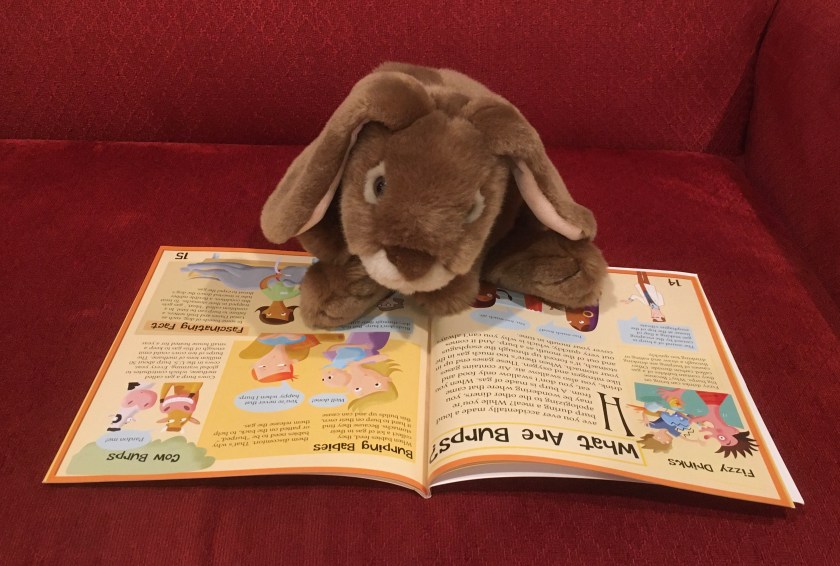
Caramel is reading The Science of Poop and Farts: The Smelly Truth About Digestion by Alex Woolf.

S: Hmm, so the book is full of weird facts about pee, poop, and, obvious from the title, farts. Does it also tell you about the digestive system more generally?

C: Not quite. It is full of stuff about poop though. Here are some chapter titles: “How do we produce poop?”, “What is pee?”, “What are farts?”, “What are burps?”, “What is saliva?”, “What are diarrhea and vomiting?”, “What is constipation?”, “Digestive problems”, “A healthy diet”, “Can poop be useful?”, “What happens to poop?”

S: Okay, these all sound quite fascinating. I think you learned a lot about the general stuff on the digestive system from Survive! Inside the Human Body: The Digestive System by Hyun-Dong Han already, and this book gives you a lot more weird but true facts about digestion in bite-size., digestible chunks.

C: Yes! Did you know that the tropical pitcher plant has tube-shaped leaves that are used as toilets by some animals? The poop provides the plant with lots of nutrition.

S: I seem to remember seeing that in a documentary. I guess the poop is full of food waste, so there are nutrients in it that the plant can use. What an interesting way to recycle!

C: Oh, and if you eat beans, your fart smells.

S: Yes, I knew that. Also red cabbage.

C: I also learned that some dogs, if they cannot burp, they can die. So to treat the condition, they insert a flexible rubber tube down their throat.

S: Oh that sounds kind of painful, but it is better than dying.

C: Yes.

S: Okay, I can see you want to read the book again and go over these very interesting facts all over again. So let us try and wrap up.

C: Yes, but did you know that if a llama feels threatened, it will spit, and it can spit about three meters away?

S: I knew llamas could spit, but that is a long way to spit! Do you remember the llama we met way back in Big Bear Lake?

C: Yes, he did not spit on us though, thankfully. And he really seemed to know when we were taking his picture.

S: Yes, I remember. He was almost posing for us. Okay, then. Give me your three words for this book.

C: Interesting, colorful, and informative.

S: Those work! I agree. I too learned a lot reading it. So what do you want to say to our readers?

C: Stay tuned for more book bunny reviews!
Caramel enjoyed reading The Science of Poop and Farts: The Smelly Truth About Digestion by Alex Woolf, and recommends it to other little bunnies who want to learn more about poop and fart and other funny (and yet very useful) things our digestive systems do.

Marshmallow reviews The Tyrant’s Tomb (Book 4 of the Trials of Apollo Series) by Rick Riordan

Marshmallow has already reviewed the first three books in Rick Riordan’s Trials of Apollo series for the book bunnies blog. This week she got her paws on the fourth book, The Tyrant’s Tomb, and read it in lightning speed. Below she shares her thoughts on this 400+-page book, published in paperback only this month.

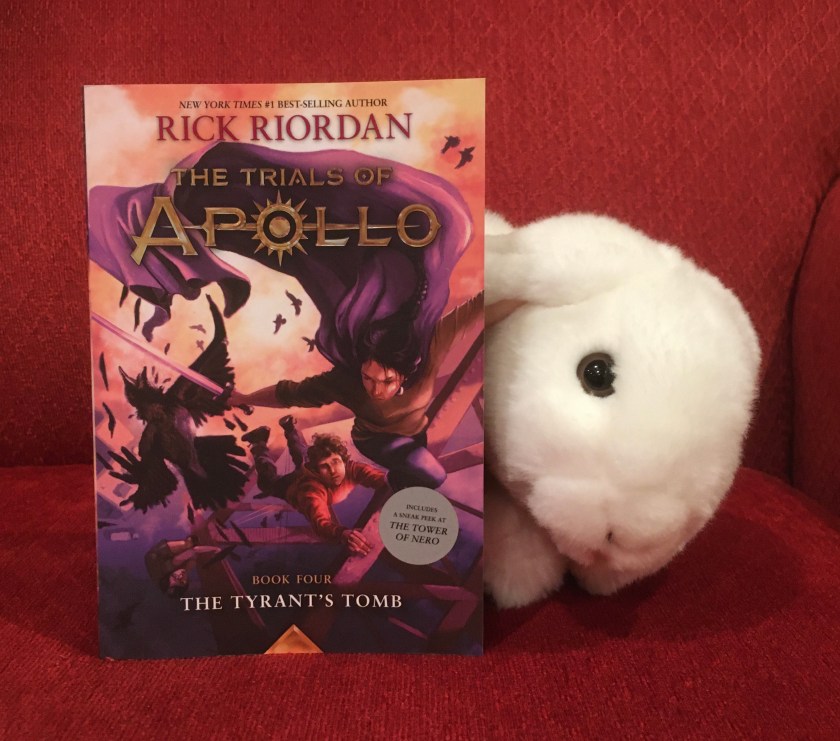
Marshmallow reviews The Tyrant's Tomb (Book 4 of the Trials of Apollo series) by Rick Riordan.
Marshmallow reviews The Tyrant’s Tomb (Book 4 of the Trials of Apollo series) by Rick Riordan.

Marshmallow’s Quick Take: If you have enjoyed reading Rick Riordan’s other books or if you like mythology, then this might be the book for you. 

Marshmallow’s Summary (with Spoilers): In the first book of the Trials of Apollo series, Apollo, the god of music, prophecy, and archery, was transformed into Lester, who is described as the “most worthless of teens,” by a mutual friend in one of the past books. Now he is carrying the body of a deceased friend who was killed in the last book. (I will not say who died. I am not spoiling that much!)

While on the road to Camp Jupiter, a training camp for Roman demigods, or half-bloods as they are also called, Lester and his master Meg McCaffrey are attacked by ghouls. They are rescued by a group of campers from Camp Jupiter, led by a pink-haired girl named Lavinia. They are taken to Camp Jupiter, where they are welcomed by the praetors Frank and Reyna. Lester sees in a dream that an evil Roman emperor is now working with the Triumvirate. (We learned about the Triumvirate earlier. It is made up of Caligula, Commodus, and Nero, three evil Roman emperors who are enemies of Apollo/Lester and his friends.) Now the Triumvirate is working with a new ally, and Apollo has a new deadline: in four days an evil army of undead will be unleashed upon the Camp. 

Marshmallow is reading  The Tyrant's Tomb (Book 4 of the Trials of Apollo series) by Rick Riordan.
Marshmallow is reading The Tyrant’s Tomb (Book 4 of the Trials of Apollo series) by Rick Riordan.

Marshmallow’s Review: The Tyrant’s Tomb is a good book. However, I think that if you want to read The Tyrant’s Tomb, you need to have read the first three books in the Trials of Apollo series. I would also highly recommend reading Riordan’s earlier books in the Heroes of Olympus series and the Percy Jackson and the Olympians series to give you the full context of the story and the backstories of the characters.

Rick Riordan does a good job of “interacting” with the reader and being funny. Lester is a hilarious narrator. His haikus are funny and it is always amusing to try to guess what they mean: they are sneak peeks of the chapter they start. Here is a favorite, from page 114:

I now have a plan
To make a plan concerning 
The plan for my plan 

I think that The Tyrant’s Tomb is a good book for almost everyone, though it might be too complicated or scary for younger readers. (It is not really horror. It is scary more around the level of the Harry Potter books, possibly less than the later books of Harry Potter which turn quite dark.) The plot is well thought-out and everything is all tied up at the end, though the next book, The Tower of Nero, is the true end of the series and I can’t wait to read it.

Marshmallow’s Rating: 95%.

Marshmallow rates The Tyrant's Tomb (Book 4 of the Trials of Apollo series) by Rick Riordan 95%.
Marshmallow rates The Tyrant’s Tomb (Book 4 of the Trials of Apollo series) by Rick Riordan 95%.