The book bunnies love various retellings of the classic fairy tales of the Western tradition, and through the years, they have reviewed many books that offered different takes on them. They also have explored, these past few months, several books that collect together fairy tales from geographies from around the world. Therefore they were delighted to learn that they made it to the list of 30 Best Fairy Tale Blogs and Websites in 2025, curated by Feedspot, a blog aggregation site.
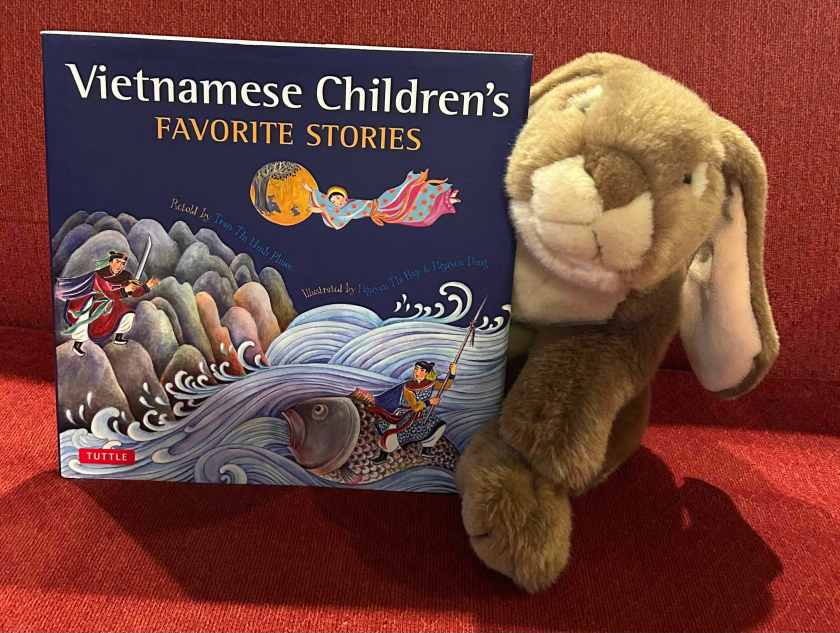
To celebrate, today Caramel is reviewing yet another book of fairy tales: Vietnamese Children’s Favorite Stories, retold by Tran Thi Minh Phuoc and illustrated by Nguyen Thi Hop and Nguyen Dong, published originally in 2015. As usual Sprinkles is taking notes and asking questions.
Sprinkles: So Caramel, what are we talking about today?
Caramel: Well, this is a book about the fairytales and stories that Vietnamese children would be told as they grew up.
S: So just like Japanese Myths, Legends, and Folktales, Tamamo the Fox Maiden and Other Asian Stories, and Chinese Myths and Legends: The Monkey King and Other Adventures, which you reviewed before for our blog, this is one of those books you read for that course you took on Asian myths and legends, right?
C: Yeah, and just like those other books, this is a good book, too. I liked it a lot.
S: That sounds great! Tell us about it then.
C: This book contains fifteen stories that the author remembers from their own childhood. They were told these stories as they were growing up. Each story is around nine pages or so. The stories all contain some sort of moral, like most children’s stories do.
S: Yes, that is true; most fairy tales have some morals. The author Tran Thi Minh Phuoc writes in the introduction that all of the stories “paint a picture of a world that values the five great virtues: Nhan (compassion), Le (Rituals), Nghia (Righteousness), Tri (Wisdom), and Tin (Trust)”. What kinds of morals come up in these stories?
C: Don’t be greedy, be kind to others, and don’t be selfish.
S: Those seem like very standard morals, good values to pass on to young bunnies. Did you come across any that felt different?
C: No, not really. But there is a story called “Why Ducks Sleep on One Leg”, which, as you might guess, is about why ducks sleep on one leg.
S: Wait, does that one have a moral? What would it be?
C: I think it’s more of an explanation of why they sleep that way.
S: That is interesting. So not all have morals then. But all across different cultures, there are many traditional stories about how things are and they give explanations, sometimes humorous but always creative, about why things are the way they are.
C: Yes. Some of the stories do not have obvious morals, but they still contain at least an explanation of something interesting, like a duck’s behavior. There is another story, “Why The Sea Is Salty”, about why the sea is salty. And there is a story about a tradition and why it exists: “Why One Shouldn’t Sweep the House on Tet Nguyen Dan“.
S: I seem to recall a story about how the tiger got its stripes. The internet tells me it is also a Vietnamese story. Apparently such stories are called “pourquoi” stories, stories that purport to explain why some natural thing is the way it is. Anyways, does the story of the tiger stripes come up in this book?
C: I don’t believe so. But there is the origin story of the jade rabbit. The jade rabbit lives in the forest with his friends and his companion, the goddess Chang’e, and he makes immortality elixirs.
S: Wait, the jade rabbit is not a natural being. It is a mythical creature, isn’t it? And didn’t we read about it in another story before? And the goddess Chang’e?
C; Yeah, the moon goddess Chang’e appeared in one of the stories we talked about before from Chinese Myths and Legends: The Monkey King and Other Adventures. And I remember the jade rabbit from the movie Over The Moon, which we talked about when we discussed that book. Anyways, according to the story “The Jade Rabbit” in this book, the jade rabbit used to be a normal rabbit, who sacrificed himself to help someone who happened to be the jade emperor in disguise. The rabbit did not know this though. Then the emperor carried him to the moon, and the goddess Chang’e turned him into the jade rabbit, an immortal being who makes immortality elixirs.
S: That is neat Caramel! According to Wikipedia, the character of the jade rabbit shows up in many East Asian traditions. And how wonderful that we now know one of its origin stories!
C: Yeah, it’s cool. I told you this is a good book!
S: So you did. Okay now, please tell me a bit about the illustrations. I see that this is really a beautiful book.
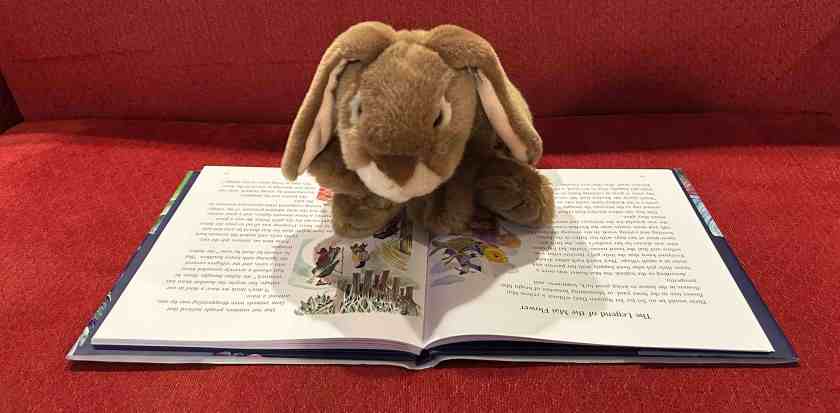
C: Yes! The pictures are very interesting! They are made in the sort of painting type. I mean, the individual pictures look like they were made with water color and acrylic paint. Very pretty. Sometimes people look like they are floating and there is a lot of color.
S: Cool! Alright, so it seems like you approve of this book and would recommend it to other young bunnies?
C: Yeah, the stories were kind of made for younger bunnies. At least the book is very much meant for us.
S: Then maybe young bunnies like you can read the book on their own, and even younger ones can maybe get an adult bunny to read it to them.
C: Yeah that would be a good idea! They should do that!
S: Okay, Caramel. Thank you for this review. Do you want to say something to our readers as we wrap up this post?
C: Stay tuned for more book bunny reviews!

 BookBunnies
RG’s Comments:
I think that, first of all, congratulations are in order. It is a great honor for the Book Bunnies to be ranked among the 15 best Fairy Tales Blogs. Wow indeed!
It is interesting to see how much in common are the virtues shared by these different societies. The stories may be different, but the “virtues” are pretty similar.
KG’s Comments:
Yes indeed, a well deserved congratulations to the Book Bunnies family!
Fairy tales are a great way to teach young bunnies about the principles that (should) guide us in daily life. They make great bedtime stories too.
LikeLiked by 1 person