Last summer Caramel read several books on Asian myths and legends. Today he is talking to Sprinkles about one of these: Japanese Myths, Legends and Folktales: Bilingual English and Japanese Edition, written by Yuri Yasuda, illustrated by Yoshinobu Sakakura and Eiichi Mitsui, and published in 2019.
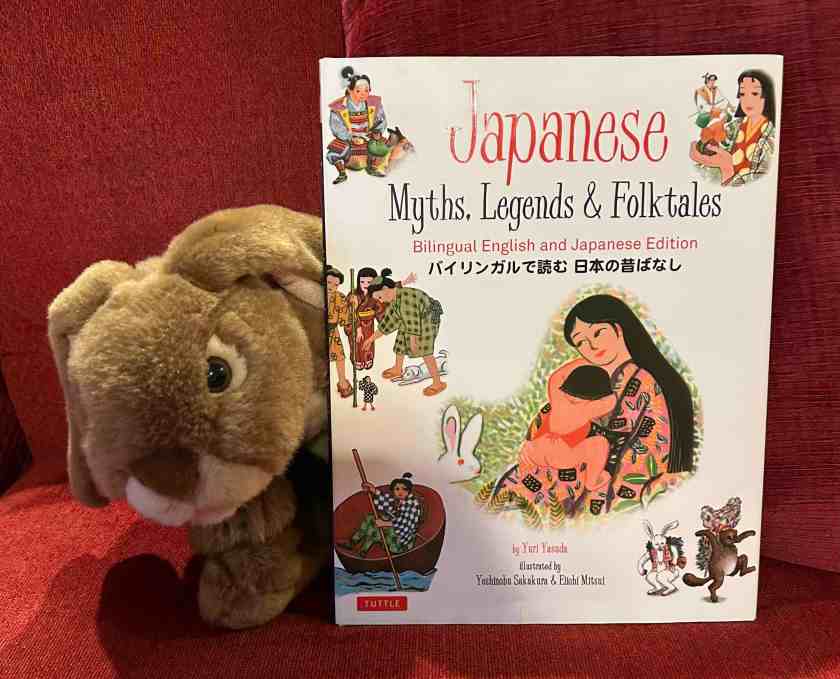
Sprinkles: So Caramel, this is one of your last reviews before we take off for the summer. What do you want to talk about today?
Caramel: It’s this book on Japanese myths and legends. I like all of the nice stories, and the pictures. The colors are nice.
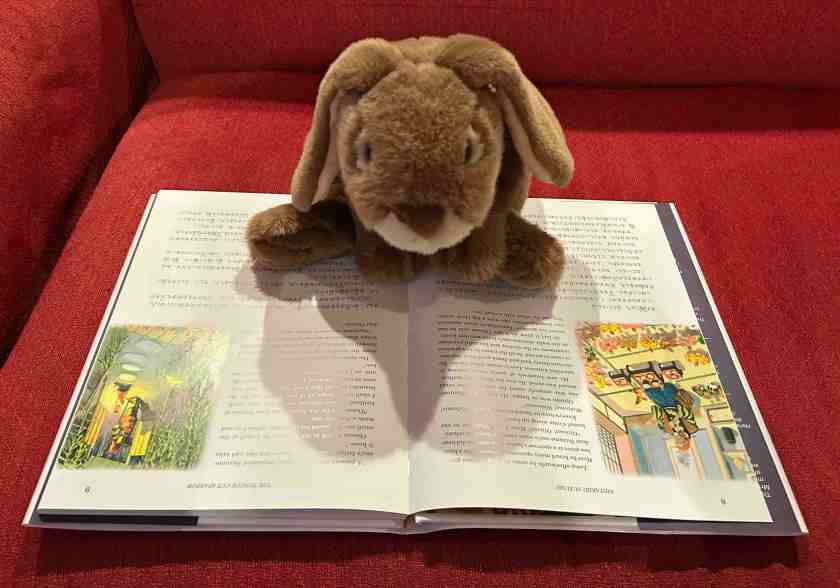
S: You are right, there are a lot of illustrations in this book. Each page has at least one. And they are very stylized. That is, they all kind of fit in one style, they resemble one another in some ways.
C: That makes sense though. It is all the same people who drew them. So it makes sense they would look like one another.
S: True.
C: And they are all very colorful and they use some really cool drawing techniques!
S: That is a good observation Caramel! I agree with you! Now tell me a bit more about the stories.
C: There are twelve stories. Each of them takes about three to five pages, usually below ten. On each page there is a picture or two, and then the top of the page is in English. And in the second half of the page the story is in Japanese.
S: Oh, part of the book is in Japanese then! I guess it makes sense: the book is subtitled “The Bilingual Edition” after all.
C: Well, actually, it’s called, “Bilingual English and Japanese Edition”.
S: Thank you for the correction Caramel. That makes total sense. But you don’t know how to read in Japanese. Was that okay?
C: Well, I don’t know how to read in Japanese YET. But yes, it was more than okay. It was cool to see the difference in the writing. Japanese people use a different alphabet than us. Or rather three different writing systems. I looked it up. There is a long Wikipedia article about it. And we tried to learn a bit of Japanese last summer. It is hard but it is also a lot of fun. I loved using the brush pens!
S: Yes, that was a lot of fun! And you are so right in saying that you don’t know it YET. You are still such a young bunny, maybe you will learn it at some point.
C: I hope so. I especially want to play more with the brush pens, mostly the pens.
S: Sounds like a plan to me!
S: Okay, so let us get back to the stories. You said there are twelve of them. So tell us a bit about a couple of them. Maybe your favorites?
C: I liked the first one, “The Tongue-Cut Sparrow”. It’s about a kind old man who finds an injured sparrow and saves it. One day as he is out doing something, the sparrow eats the house flour, so the old man’s wife cuts the sparrow’s tongue off as punishment, and the sparrow flies off. Then on another day, the old man goes walking, and he meets the sparrow again. The old man was always kind to the bird, so the sparrow offers him some gifts. The old man takes the smaller gift and walks home to find that it has money. But his wife is not a nice person and she is greedy too so she gets upset that her husband did not get the bigger gift. So the next day she takes off to find the sparrow and asks for the bigger gift. The sparrow gives her the bigger gift and tells her not to open it until she is home. But she does open it before she gets home, and the demons inside the box attack her. Finally the old kind man finds her and saves her and the wife apologizes for being mean and unkind and they all forgive each other and live happily ever after.
S: Hmm. What do you think the story means?
C: I think the moral of the story is that if you are given a gift, and told not to open it till home, then you should not open it till home.
S: I can see how that could be one of the messages you get. Anything else?
C: You should not be selfish or greedy? And ask for the bigger gift? Bigger is not always better.
S: That too could be a good lesson.
C: Yes, and maybe being kind is always a good thing? The old man was kind to the bird and he was rewarded for it even though he was not being kind to get a reward.
S: All true. Very good Caramel! I like these messages! And apparently this is a well-known story. There is even a Wikipedia article on it.
C: I am not surprised. The book is supposed to be about myths and legends, and those are probably all well known.
S: You do have a good point there Caramel. Can you tell us the names of some of the other stories?
C: Here is the full list: The Strong Boy, The Marriage of a Mouse, The Fisherman and the Tortoise, The Luminous Princess, The Peach Boy, The Kachi Kachi Mountain, The Old Man With Wens, The Old Man Who Made Trees Blossom, The One-Inch Boy, The Lucky Cauldron, and The Monkey-and-Crab Fight.
S: What is that last one about?
C: There is a crab who wants some peaches and asks for help from a monkey but the monkey cheats him and steals all the peaches.
S: So these stories are somewhat different from the fairy tales you grew up with, right?
C: Yes very much so. There are lessons to learn in these too, but sometimes the lessons are a bit harder to see.
S: Maybe because we did not grow up in Japan, the cultural context is not as transparent to us.
C: Maybe. But I really liked these stories. They are all somewhat different but also very interesting. Kind of surprising and definitely fun to read.
S: So I am guessing you would not mind it if other young bunnies read this book too?
C: Mind it? Of course not. In fact I would say they should read it. And maybe also look at the pictures and also the Japanese text below. I will learn how to read it one day, hopefully.
S: Sounds like a good goal, Caramel. Okay, this is a good time to wrap up this review. What do you want to tell our readers?
C: Stay tuned for more book bunny reviews!
 BookBunnies
RG’s Comments:
__________
Interesting book. The Japanese language is so nuanced, I wonder how close to each other the English and Japanese translations are.
Somewhere in this house we also have a book of Japanese stories, will need to dig it up and see if it has any of those stories.
KG’s Comments:
__________
Caramel got the moral of the story 100%.
LikeLiked by 1 person