This week, Marshmallow decided to take on Margaret Atwood’s The Handmaid’s Tale. Originally published in 1985, this book is about a dystopian near-future where women’s lives are extremely constrained and their rights are almost nonexistent, and it might be a bit more challenging for some of our young readers than our usual fare.
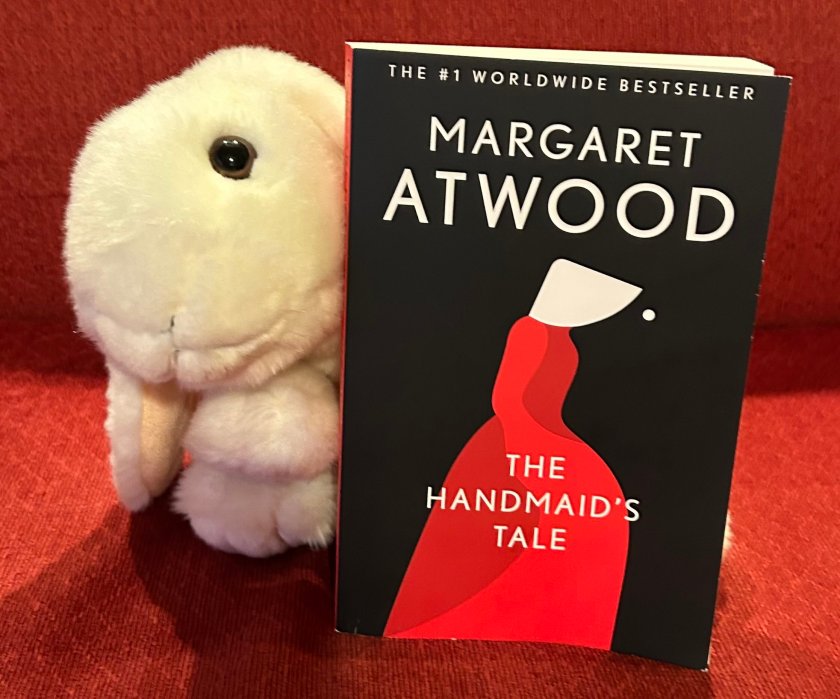
Marshmallow’s Quick Take: If you like books about terrifying dystopian futures, then this is the book for you!
Marshmallow’s Summary (with Spoilers): Offred is a handmaiden in Gilead who has been given to a Commander to conceive his child. Gilead is set in the north east of what used to be the United States and was established after the President, Congress, and the U.S. government were violently overthrown by the Sons of Jacob, a radical political group. The rebels set up a system that puts women as second-class citizens with no rights. This happens gradually. Early on, the Sons and the army say some of the measures are for security purposes, such as closing down roads and increasing surveillance. But eventually, women’s bank accounts are shut off and they are let go from their jobs.
Reading the signs, Offred (who had an unknown name before), her husband Luke, and her daughter attempt to flee to Canada. But Luke’s divorce with a previous wife is not valid according to Gilead’s new laws, making Offred an adulteress. They try to run away, but Offred is caught and taken away from her family. Her husband’s fate remains unknown, but her daughter is confirmed to be given to parents that firmly believe in Gilead’s ideals. Offred is taken to the Rachel and Leah Re-education Center or Red Center, in which she is taught to be a handmaiden. Amidst declining birth rates, increased infertility, and climate disasters, Gilead’s new system of birth is forcing fertile women to conceive. Handmaidens are forcibly impregnated by the leading elite—Commanders—in Ceremonies.
More generally, all people in Gilead are sorted into a structure, and power is concentrated solely at the top in the hands of certain white men. (The fate of non-white people is not described in the book.) Women are sorted into several categories: Wives who wear blue (who are married to the Commanders but have no physical or emotional bond with them), Aunts who wear brown (who re-educate Handmaids), Handmaids who wear red (who are forced to procreate with their assigned Commander, but have no relationship with anyone), Marthas who wear green (cooks, servants, etc.), Econowives who wear striped clothing (wives of lower ranking men), and so on.
The government watches its people with Eyes, who are like a secret police so that no one knows who to trust. Everyone lives in fear, but some truly believe that this is an improvement.
Offred is assigned to a Commander to bear him a child, and she is renamed Offred presumably because his name is Fred (Of Fred; all the Handmaids are named like that, like Ofwarren, Ofglen, etc.) The Commander’s Wife is Serena Joy, a former televangelist who pushed for Gilead’s extreme take of the Bible—which is used to justify the new way of life. Now, confined to home with a husband who does not love her, she realizes that the whole thing might have been a bad idea.
This Commander feels that Serena Joy does not understand him, so he invites Offred to play Scrabble with him. In this manner, they develop a peculiar bond, a sort of mutated friendship. However, Offred knows that she can never truly be friends with the man who literally has the power of life or death over her.
The Commander argues that life is much better now, and tries to convince Offred of this. At the same time, Offred’s assigned partner (for getting groceries in a very formal, terse manner) Ofglen reveals herself to be a member of a resistance group. Offred yearns for a way out, but at the same time finds herself becoming attached to the Commander’s personal servant.
What will happen to Offred? And what about Gilead?
Marshmallow’s Review: The Handmaid’s Tale is a hard book to read, especially for a female bunny. It is definitely not appropriate for young bunnies. The book progresses in a very disturbing way. The ending is not definite, but it leaves a mark.
I read this book initially because I’d started hearing a lot more about it recently. Many people have begun to compare Gilead to the present United States of America, especially after the recent TV series adaptation of it. Some parallels do exist and are becoming more apparent, which is very saddening and truly terrifying. This book shows a distorted version of the United States, one which will hopefully never come to pass. But the geography certainly makes the book feel more urgent and too close for comfort. (Other books that depict possible dystopian futures for the United States, like Our Missing Hearts by Celeste Ng and The Hunger Games series, come to mind.)
I must say that The Handmaid’s Tale is definitely not a children’s book. Sex and sexual activity are frequently discussed—especially since Offred’s very existence is due to her fertility and ability to conceive. The world of Gilead is also in itself extremely harrowing. Political prisoners are killed by mobs at Prayvaganzas, hangings are regularly showcased at the Wall, women are ceremoniously raped, and there’s a lot of discourse about suicide. It’s a very dark book.
However, reading The Handmaid’s Tale makes one more motivated to fight for equal rights. While books like We Should All Be Feminists by Chimamanda Ngozi Adichie make clear-eyed arguments, this book depicts the chilling effects of what a world with no rights for women could be like. Offred’s mother was an activist who fought for those rights, which Offred remembers during several flashbacks. Those flashbacks are instrumental to the nuance of this book. They show the subtle ways in which the world changed, until it had transformed into a monstrous beast that couldn’t be cured.
The Handmaid’s Tale should also serve as a warning and as a reminder that democracy must be protected. Once again, as I mentioned in my review of On Tyranny: Graphic Edition by Timothy Snyder and Nora Krug, freedom is not free. This is a resounding message that has been echoed by so many people, in so many books, throughout so many different times.
It is interesting that the author does say that other countries have not changed like Gilead. In fact, it is implied that some of the states did not submit to the Sons of Jacob. There are references to war every now and then. But the way in which the narrative flows is really a testament to the author’s prowess. It leaves the reader with an understanding of how Offred feels because of how confused and disturbed and angry and anxious and traumatized the plot leaves one.
I would definitely recommend The Handmaid’s Tale to everyone, but once they can handle it and they can understand the reason for reading such a book: to understand why equal rights for all are so important.
Marshmallow’s Rating: 100%
 BookBunnies
RG’s Comments:
__________
This book is a truly disturbing view of a future that could be. Actually, it almost is if one looks at women in Afghanistan, under Taliban rule.
KG’s Comments:
__________
This is a seriously disturbing book. It already seems to be happening to minorities in this country.
LikeLiked by 1 person